

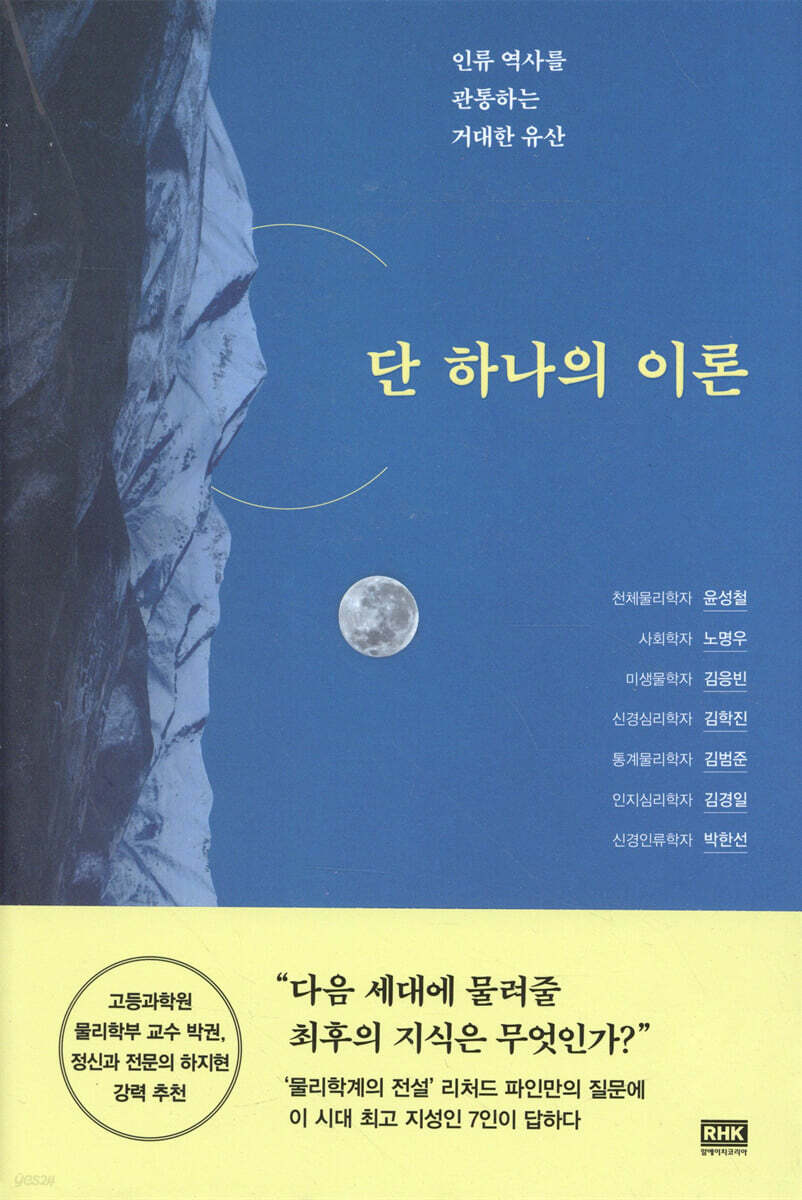
Just one theory
 |
Description
Book Introduction
How do you understand this world?
The question of Richard Feynman, the greatest physicist of the 20th century
Answers from Seven Leading Scholars of the 21st Century
Nobel Prize winner in physics Richard Feynman famously asked the following question:
“If a great revolution occurred that completely destroyed all existing scientific knowledge, and there was only one sentence left to pass on to the next generation, what would that sentence contain?” Now that a generation has passed away from Feynman, what is the one sentence that the leading intellectuals of the 21st century would like to leave to the next generation? This book, “The One Theory,” contains the answers to Richard Feynman’s question by seven intellectuals who have devoted themselves to their fields for long periods of time, including astrophysicists, sociologists, microbiologists, neuropsychologists, statistical physicists, cognitive psychologists, and neuroanthropologists.
Feynman's question may at first sound limited to physics, but if you think about it carefully, it encompasses all areas of the world.
Accordingly, the authors discuss propositions that cannot be overturned even in exceptional circumstances, from the most fundamental physical phenomena in the universe to the human instincts that make up the Earth.
Their intellectual legacy allows us to continually expand our worldview and discover new facets of reality that we could not otherwise see through conventional eyes.
For those seeking timeless truths and life's values in this rapidly changing era, this book will provide the key to unlocking the future.
- You can preview some of the book's contents.
Preview
index
Starting this book
Chapter 1: The Universe is a Verb, Not a Noun_Yoon Seong-cheol
Some of the atoms that move according to certain rules deviate slightly from their orbits and collide with other atoms, resulting in the creation of new objects or unprecedented events.
Chapter 2: You Are Not Alone_Noh Myung-woo
Unless we are viruses, viruses remind us of our human nature, which can be expressed in a single sentence.
The virus speaks.
You are not alone.
Chapter 3: Life is the Memory Semiconductor of the Universe_Kim Eung-bin
Genes can be seen as storing information about the natural environment of a specific time and space in the past.
So to speak, genes contain traces of past life.
Chapter 4: The Mind Originates from Communication Between the Body and the Environment_Kim Hak-jin
Excellent empathy comes from a life attitude that sensitively picks up on signals from the body at every moment by delicately categorizing one's emotions and finding an appropriate response.
Chapter 5: The Source of Human Knowledge: Entropy_Kim Beom-jun
This is because thermodynamics is considered a kind of meta-theory, that is, a theory of theories that must be satisfied by any theory, rather than an individual theory that changes when a specific subject changes.
Chapter 6: Human Desire is Contagious_Kim Kyung-il
Humans are not only unaware of the true nature of their own desires, but they are also creatures who transmit or transfer their current desires to completely different areas.
However, by exquisitely creating this malfunction mechanism, we increased the frequency of happiness and laid the foundation for longevity.
Chapter 7: The Human Mind is a Result of Evolution_Park Han-seon
True altruism, that is, traits that do not provide survival or reproductive advantage to oneself at any level, cannot evolve.
I don't want to see it and I don't want to believe it, but the truth is cold.
References
Recommendation
Chapter 1: The Universe is a Verb, Not a Noun_Yoon Seong-cheol
Some of the atoms that move according to certain rules deviate slightly from their orbits and collide with other atoms, resulting in the creation of new objects or unprecedented events.
Chapter 2: You Are Not Alone_Noh Myung-woo
Unless we are viruses, viruses remind us of our human nature, which can be expressed in a single sentence.
The virus speaks.
You are not alone.
Chapter 3: Life is the Memory Semiconductor of the Universe_Kim Eung-bin
Genes can be seen as storing information about the natural environment of a specific time and space in the past.
So to speak, genes contain traces of past life.
Chapter 4: The Mind Originates from Communication Between the Body and the Environment_Kim Hak-jin
Excellent empathy comes from a life attitude that sensitively picks up on signals from the body at every moment by delicately categorizing one's emotions and finding an appropriate response.
Chapter 5: The Source of Human Knowledge: Entropy_Kim Beom-jun
This is because thermodynamics is considered a kind of meta-theory, that is, a theory of theories that must be satisfied by any theory, rather than an individual theory that changes when a specific subject changes.
Chapter 6: Human Desire is Contagious_Kim Kyung-il
Humans are not only unaware of the true nature of their own desires, but they are also creatures who transmit or transfer their current desires to completely different areas.
However, by exquisitely creating this malfunction mechanism, we increased the frequency of happiness and laid the foundation for longevity.
Chapter 7: The Human Mind is a Result of Evolution_Park Han-seon
True altruism, that is, traits that do not provide survival or reproductive advantage to oneself at any level, cannot evolve.
I don't want to see it and I don't want to believe it, but the truth is cold.
References
Recommendation
Detailed image

Into the book
The universe also has a different appearance now that it contains life, compared to the past 13 billion years ago when there was no life.
Ultimately, to understand the universe, we have no choice but to look into the history of the entire universe.
Because everything in the universe is a historical product.
Modern astronomy teaches us that, far from being a corruption of existence, existence is, in fact, the fruit of change.
--- p.26
In the age of contagion, the age of COVID-19, we are reaffirming this.
Homo sapiens never exist alone.
The basic reproduction number, or the rate at which an infectious disease persists, is a concept that explains the power of COVID-19 and human interdependence.
Paradoxically, the reason COVID-19 was able to spread so quickly across the globe is because it constitutes an interconnected ecosystem.
The coronavirus has awakened us, modern people, to the profoundly clear truth of humanity: "You are not alone," a truth we had long forgotten due to the unequal distribution of human rights.
--- p.70
Living things live only in places where they are provided with the environment necessary for their survival and reproduction.
However, environmental conditions change frequently.
Therefore, all living creatures are products of natural selection, having survived the rough waves of nature.
At the level of molecular biology, existing genes are the product of natural selection.
If so, it can be seen that genes store information about the natural environment of a specific space-time in the past.
So to speak, genes contain traces of past life.
We expect that by integrating and analyzing the genetic information of living organisms in depth, we will be able to obtain more accurate and specific information about Luca.
--- p.97
Excellent empathy comes from a life attitude that sensitively picks up on signals from the body at every moment by delicately categorizing one's emotions and finding an appropriate response.
When you faithfully examine and listen to your own emotions in every moment, your empathy with others will naturally become more accurate and expanded, and your ability to communicate emotions with others will also improve.
This is why, rather than trying to understand the emotions of others in order to develop empathy, it is more important to make an effort to more accurately recognize and reflect on your own emotions.
--- p.132
This is why Einstein said that thermodynamics is the theory of physics that will never be judged to be wrong, no matter how much physics advances in the future.
If I were to meet an alien being, I would first ask, “Do you also know that there are quantities that do not change in any process, and that there are quantities that always increase in that process?”
If they know what two sheep are, it seems clear that they have a considerable level of scientific knowledge.
These extraterrestrial intelligences, in a form completely different from ours, may be able to create classical and quantum mechanics, but their thermodynamics must be the same as ours.
--- p.162~163
So, what can lead humans to think about the future most wisely? It's about properly understanding and addressing the desires that dominate our thoughts in this moment.
Because that's how humans are designed.
Humans are not only unaware of the true nature of their own desires, but they are also creatures who transmit or transfer their current desires to completely different areas.
However, by exquisitely creating this malfunction mechanism, we increased the frequency of happiness and laid the foundation for longevity.
--- p.192~193
The natural world (and of course the human world as well) is harsh and harsh.
The saying that they barely managed to survive and continue the family line is closer to the truth.
The strong bond between parents and children, warm affection, and cooperation based on loyalty are all the same when you look closely.
Ultimately, it is a trait that is advantageous to oneself or one's genes.
True altruism, that is, traits that do not confer survival or reproductive advantage on oneself at any level, cannot evolve.
I don't want to see it and I don't want to believe it, but the truth is cold.
Ultimately, to understand the universe, we have no choice but to look into the history of the entire universe.
Because everything in the universe is a historical product.
Modern astronomy teaches us that, far from being a corruption of existence, existence is, in fact, the fruit of change.
--- p.26
In the age of contagion, the age of COVID-19, we are reaffirming this.
Homo sapiens never exist alone.
The basic reproduction number, or the rate at which an infectious disease persists, is a concept that explains the power of COVID-19 and human interdependence.
Paradoxically, the reason COVID-19 was able to spread so quickly across the globe is because it constitutes an interconnected ecosystem.
The coronavirus has awakened us, modern people, to the profoundly clear truth of humanity: "You are not alone," a truth we had long forgotten due to the unequal distribution of human rights.
--- p.70
Living things live only in places where they are provided with the environment necessary for their survival and reproduction.
However, environmental conditions change frequently.
Therefore, all living creatures are products of natural selection, having survived the rough waves of nature.
At the level of molecular biology, existing genes are the product of natural selection.
If so, it can be seen that genes store information about the natural environment of a specific space-time in the past.
So to speak, genes contain traces of past life.
We expect that by integrating and analyzing the genetic information of living organisms in depth, we will be able to obtain more accurate and specific information about Luca.
--- p.97
Excellent empathy comes from a life attitude that sensitively picks up on signals from the body at every moment by delicately categorizing one's emotions and finding an appropriate response.
When you faithfully examine and listen to your own emotions in every moment, your empathy with others will naturally become more accurate and expanded, and your ability to communicate emotions with others will also improve.
This is why, rather than trying to understand the emotions of others in order to develop empathy, it is more important to make an effort to more accurately recognize and reflect on your own emotions.
--- p.132
This is why Einstein said that thermodynamics is the theory of physics that will never be judged to be wrong, no matter how much physics advances in the future.
If I were to meet an alien being, I would first ask, “Do you also know that there are quantities that do not change in any process, and that there are quantities that always increase in that process?”
If they know what two sheep are, it seems clear that they have a considerable level of scientific knowledge.
These extraterrestrial intelligences, in a form completely different from ours, may be able to create classical and quantum mechanics, but their thermodynamics must be the same as ours.
--- p.162~163
So, what can lead humans to think about the future most wisely? It's about properly understanding and addressing the desires that dominate our thoughts in this moment.
Because that's how humans are designed.
Humans are not only unaware of the true nature of their own desires, but they are also creatures who transmit or transfer their current desires to completely different areas.
However, by exquisitely creating this malfunction mechanism, we increased the frequency of happiness and laid the foundation for longevity.
--- p.192~193
The natural world (and of course the human world as well) is harsh and harsh.
The saying that they barely managed to survive and continue the family line is closer to the truth.
The strong bond between parents and children, warm affection, and cooperation based on loyalty are all the same when you look closely.
Ultimately, it is a trait that is advantageous to oneself or one's genes.
True altruism, that is, traits that do not confer survival or reproductive advantage on oneself at any level, cannot evolve.
I don't want to see it and I don't want to believe it, but the truth is cold.
--- p.202~203
Publisher's Review
“What is the ultimate knowledge that we will pass on to the next generation?”
A question from Richard Feynman, the 'legend of physics'
Seven of the greatest intellectuals of our time answer.
“If a revolution were to occur that would completely destroy all existing scientific knowledge, leaving only one sentence to be passed on to the next generation, what would that sentence contain?”
This is a famous question posed by Richard Feynman, winner of the 1965 Nobel Prize in Physics and considered the greatest physicist of the 20th century.
At first glance, it may sound like a story limited to physics, but if you think about it carefully, it is a question that converges with the universe, humanity, and life.
Especially considering the chaotic times we are experiencing as the coronavirus pandemic continues to prolong, this is a topic that must be addressed for the future and future generations.
So, what did Feynman single out as his single piece of knowledge? It was atomism, the idea that "all matter in the world is made of atoms."
Atoms are so small that they cannot be seen, but they make up everything in this world.
Even humans.
It is no exaggeration to say that science and technology, including chemistry, and human civilization have developed explosively based on this theory.
He then added a meaningful comment.
“If you add a little imagination and reasoning to a theory, you can derive an enormous amount of information about the world.”
Perhaps the implication is that accurately understanding the common thread that permeates the entire situation holds the key to resolving complex phenomena. Now, a generation later, if we were to ask the same question to 21st-century intellectuals who, like Feynman, have devoted themselves to their fields for such a long time, what would they say? To find the answer, the following experts gathered.
Astrophysicist Yoon Seong-cheol, sociologist Noh Myeong-woo, biologist Kim Eung-bin, neuropsychologist Kim Hak-jin, statistical physicist Kim Beom-jun, cognitive psychologist Kim Gyeong-il, and neuroanthropologist Park Han-seon—seven intellectuals who have garnered attention from academic circles and are striving to popularize their respective fields—will convey to us the vast intellectual legacy that permeates human history.
From Darwin's theory of evolution to human psychological analysis
Following the propositions proven by the intellectuals of the time
Reading humanity's past, present, and future
《The Only Theory》 contains propositions that cannot be changed even in exceptional circumstances, ranging from the most fundamental physical phenomena in the universe to human instincts and philosophical thoughts about existence and life.
In particular, the topics presented by seven scholars representing each field intuitively demonstrate how a single concept discovered in a specific field can be expanded into a useful tool for solving problems in our daily lives and explaining this complex world.
Furthermore, it guides us through humanity's past, present, and future, broadening our worldview and leading us to discover new aspects that we could not see through conventional eyes.
Feynman's grand questions and the great theories of intellectuals sharply point out issues such as science and technology, the environment, and social justice that have already confronted us and will continue to weigh on us in the near future. They urge deeper reflection and exploration on how humanity should cooperate and where good ideas and technologies emerge.
Just as Richard Feynman said half a century ago, "A theory, with a little imagination and reasoning, can yield an enormous amount of information about the world." With the intellectual heritage we inherited along with the evolution of knowledge, we too can read human history, predict the future, and find breakthroughs to solve various problems that arise in the real world.
Reflections and Reflections by Seven Leading Intellectuals of South Korea
Seven lectures that unravel the evolution of humanity and the exploration of the universe.
Consisting of seven chapters, “A Single Theory” crosses the boundaries between science and philosophy.
Chapter 1 is opened by Professor Seong-cheol Yoon, an astrophysicist who examines life from a cosmic perspective.
He says that modern astronomy makes us realize that the change of existence is not a fall but a fruit, and that the emergence of human consciousness is a singularity in the history of the universe.
In Chapter 2, Professor Noh Myung-woo, a sociologist who observes and interprets the ordinary, talks about the fact that we are not alone in human nature.
In Chapter 3, Professor Kim Eung-bin, a microbiologist steeped in philosophy, explains that genes contain all the information from a specific time and space in the past, and discusses how traces of past life could remain.
In Chapter 4, Professor Kim Hak-jin, a neuropsychologist who studies the brain, talks about the origins of the human mind.
In Chapter 5, Professor Kim Beom-jun, a statistical physicist who interprets the world's circuits, introduces thermodynamics as a theory that will never be judged to be wrong, no matter how much science advances in the future.
In Chapter 6, Professor Kim Kyung-il, a cognitive psychologist who analyzes the secret code of thought, explains that human desires are contagious and connects this mechanism to human happiness.
In the final chapter, Hanseon Park, a psychiatrist and neuroanthropologist who studies the origins of the mind, proves that the human mind is a result of evolution and discusses the relationship between traits that provide survival advantages and evolution.
In this way, this book is a rare opportunity to read at a glance the thoughts of leading intellectuals from various fields, and the process of examining everything from the birth of the universe to the formation of human culture through the single theory presented by each author is very interesting.
We humans derive our own answers based on information, knowledge, and experience.
And live accordingly.
This is why we must constantly acquire and experience reliable knowledge across various scientific theories and philosophical thoughts that explain humans, society, and the universe.
If you're looking for something that remains constant despite the daily changes in the fabric of our lives, this book will reveal an essence that becomes clearer with time.
Furthermore, based on the final knowledge passed down to us, we will be able to understand the world more deeply and more proactively address the various problems that will arise in the future.
A question from Richard Feynman, the 'legend of physics'
Seven of the greatest intellectuals of our time answer.
“If a revolution were to occur that would completely destroy all existing scientific knowledge, leaving only one sentence to be passed on to the next generation, what would that sentence contain?”
This is a famous question posed by Richard Feynman, winner of the 1965 Nobel Prize in Physics and considered the greatest physicist of the 20th century.
At first glance, it may sound like a story limited to physics, but if you think about it carefully, it is a question that converges with the universe, humanity, and life.
Especially considering the chaotic times we are experiencing as the coronavirus pandemic continues to prolong, this is a topic that must be addressed for the future and future generations.
So, what did Feynman single out as his single piece of knowledge? It was atomism, the idea that "all matter in the world is made of atoms."
Atoms are so small that they cannot be seen, but they make up everything in this world.
Even humans.
It is no exaggeration to say that science and technology, including chemistry, and human civilization have developed explosively based on this theory.
He then added a meaningful comment.
“If you add a little imagination and reasoning to a theory, you can derive an enormous amount of information about the world.”
Perhaps the implication is that accurately understanding the common thread that permeates the entire situation holds the key to resolving complex phenomena. Now, a generation later, if we were to ask the same question to 21st-century intellectuals who, like Feynman, have devoted themselves to their fields for such a long time, what would they say? To find the answer, the following experts gathered.
Astrophysicist Yoon Seong-cheol, sociologist Noh Myeong-woo, biologist Kim Eung-bin, neuropsychologist Kim Hak-jin, statistical physicist Kim Beom-jun, cognitive psychologist Kim Gyeong-il, and neuroanthropologist Park Han-seon—seven intellectuals who have garnered attention from academic circles and are striving to popularize their respective fields—will convey to us the vast intellectual legacy that permeates human history.
From Darwin's theory of evolution to human psychological analysis
Following the propositions proven by the intellectuals of the time
Reading humanity's past, present, and future
《The Only Theory》 contains propositions that cannot be changed even in exceptional circumstances, ranging from the most fundamental physical phenomena in the universe to human instincts and philosophical thoughts about existence and life.
In particular, the topics presented by seven scholars representing each field intuitively demonstrate how a single concept discovered in a specific field can be expanded into a useful tool for solving problems in our daily lives and explaining this complex world.
Furthermore, it guides us through humanity's past, present, and future, broadening our worldview and leading us to discover new aspects that we could not see through conventional eyes.
Feynman's grand questions and the great theories of intellectuals sharply point out issues such as science and technology, the environment, and social justice that have already confronted us and will continue to weigh on us in the near future. They urge deeper reflection and exploration on how humanity should cooperate and where good ideas and technologies emerge.
Just as Richard Feynman said half a century ago, "A theory, with a little imagination and reasoning, can yield an enormous amount of information about the world." With the intellectual heritage we inherited along with the evolution of knowledge, we too can read human history, predict the future, and find breakthroughs to solve various problems that arise in the real world.
Reflections and Reflections by Seven Leading Intellectuals of South Korea
Seven lectures that unravel the evolution of humanity and the exploration of the universe.
Consisting of seven chapters, “A Single Theory” crosses the boundaries between science and philosophy.
Chapter 1 is opened by Professor Seong-cheol Yoon, an astrophysicist who examines life from a cosmic perspective.
He says that modern astronomy makes us realize that the change of existence is not a fall but a fruit, and that the emergence of human consciousness is a singularity in the history of the universe.
In Chapter 2, Professor Noh Myung-woo, a sociologist who observes and interprets the ordinary, talks about the fact that we are not alone in human nature.
In Chapter 3, Professor Kim Eung-bin, a microbiologist steeped in philosophy, explains that genes contain all the information from a specific time and space in the past, and discusses how traces of past life could remain.
In Chapter 4, Professor Kim Hak-jin, a neuropsychologist who studies the brain, talks about the origins of the human mind.
In Chapter 5, Professor Kim Beom-jun, a statistical physicist who interprets the world's circuits, introduces thermodynamics as a theory that will never be judged to be wrong, no matter how much science advances in the future.
In Chapter 6, Professor Kim Kyung-il, a cognitive psychologist who analyzes the secret code of thought, explains that human desires are contagious and connects this mechanism to human happiness.
In the final chapter, Hanseon Park, a psychiatrist and neuroanthropologist who studies the origins of the mind, proves that the human mind is a result of evolution and discusses the relationship between traits that provide survival advantages and evolution.
In this way, this book is a rare opportunity to read at a glance the thoughts of leading intellectuals from various fields, and the process of examining everything from the birth of the universe to the formation of human culture through the single theory presented by each author is very interesting.
We humans derive our own answers based on information, knowledge, and experience.
And live accordingly.
This is why we must constantly acquire and experience reliable knowledge across various scientific theories and philosophical thoughts that explain humans, society, and the universe.
If you're looking for something that remains constant despite the daily changes in the fabric of our lives, this book will reveal an essence that becomes clearer with time.
Furthermore, based on the final knowledge passed down to us, we will be able to understand the world more deeply and more proactively address the various problems that will arise in the future.
GOODS SPECIFICS
- Publication date: September 18, 2021
- Page count, weight, size: 232 pages | 474g | 146*215*17mm
- ISBN13: 9788925579795
- ISBN10: 8925579790
You may also like
카테고리
korean


korean

![ELLE 엘르 스페셜 에디션 A형 : 12월 [2025]](http://librairie.coreenne.fr/cdn/shop/files/b8e27a3de6c9538896439686c6b0e8fb.jpg?v=1766436872&width=3840)


