

Foreign language learning story
 |
Description
Book Introduction
- A word from MD
-
Things you can only see when you learn a foreign languageIn this book, Robert Fouser, author of "The Story of Learning a Foreign Language," shares the joys of learning a foreign language.
The purpose of learning a foreign language does not have to be limited to advancement in higher education, employment, or promotion.
We discussed the enjoyment, intellectual stimulation, and effective methods of learning a foreign language.
August 31, 2021. Humanities PD Son Min-gyu
A book for adults who have graduated from school and are now entering the world of foreign languages.
It enables learning through reflection, where ‘yesterday’s me’ suddenly appears and helps ‘today’s me’.
A completely new approach to learning a foreign language
The intended audience for this book is clear.
This book is for adults who have long since graduated from school and are trying to learn a new foreign language.
The author recommends starting a new foreign language for a variety of reasons, not the least of which is learning for academic advancement, employment, or promotion.
Therefore, the purpose of this book is not to display any unique know-how in learning a foreign language, any special all-purpose learning method, or to impart any dazzling secrets.
Rather, it emphasizes that even more personal and trivial reasons can be sufficient motivation to start a foreign language, and that even if you have experienced some frustration in the past, you can start happily by setting goals that are right for you.
To this end, the author begins this book by describing the cultural shock experienced by a late-teen American youth who had to stay at a homestay in Tokyo, and his first foreign language experience with Spanish in high school, and then goes on to describe the entire process of his lifelong foreign language learning in its entirety.
It enables learning through reflection, where ‘yesterday’s me’ suddenly appears and helps ‘today’s me’.
A completely new approach to learning a foreign language
The intended audience for this book is clear.
This book is for adults who have long since graduated from school and are trying to learn a new foreign language.
The author recommends starting a new foreign language for a variety of reasons, not the least of which is learning for academic advancement, employment, or promotion.
Therefore, the purpose of this book is not to display any unique know-how in learning a foreign language, any special all-purpose learning method, or to impart any dazzling secrets.
Rather, it emphasizes that even more personal and trivial reasons can be sufficient motivation to start a foreign language, and that even if you have experienced some frustration in the past, you can start happily by setting goals that are right for you.
To this end, the author begins this book by describing the cultural shock experienced by a late-teen American youth who had to stay at a homestay in Tokyo, and his first foreign language experience with Spanish in high school, and then goes on to describe the entire process of his lifelong foreign language learning in its entirety.
- You can preview some of the book's contents.
Preview
index
■ Preface [Korean] ■ Preface [English] ■ Prefacio [Spanish]
01.
The story begins with the first memory of learning a foreign language by Robert Fouser, a 16-year-old American teenager.
A foreign language pilgrimage that began in my late teens | My first foreign languages were Spanish and Japanese | Majored in Japanese at an American university | Discovered Korea and learned Korean | My own method of learning foreign languages through extensive reading
02.
Where does human foreign language learning begin and where does it lead? How has foreign language learning evolved?
Foreign language learning, once the preserve of the upper class and elite | The goal of foreign language learning: From reading to speaking | The winds of change blowing through education | Foreign language learning evolving alongside technological advancements | Foreign language learning shifts from reading to speaking, but what about pronunciation?
03.
Do you remember the moment you first learned a foreign language? Was it your choice?
Why We Started Learning Foreign Languages | Why We Had to Learn That Foreign Language | China and France Respond to English Hegemony | India and Rwanda: The Inside Story of Language Policy | How a Language Arrived in My Heart
04. The AI Era, the Dilemma of Foreign Language Learning, and the New Goals Ahead
A long-held human dream: Overcoming language barriers with human technology | Is learning a foreign language necessary in the AI era? Yes! Why? | Is the oppa in Psy's song Gangnam Style "oppa" or "big brother"? | A new paradigm for foreign language learning | From hobby to tool, and then back to hobby! The evolution of the purpose of foreign language learning | The initiative in foreign language learning has already shifted to the individual.
05.
Are you starting to learn a foreign language again? Let's take a look back at the history of foreign language learning!
Where are the foreign languages you learned in school now? | Reflecting on foreign languages: A fresh starting point for learning them | The European Language Portfolio developed for adult learners | Want to excel in a foreign language? Want an easy way?
06.
'Yesterday's me' suddenly appears and helps 'Today's me'
Where was yesterday's me? How is today's me? | Lessons from yesterday's me to today's me | From a bad me to a good me, from defeat to accomplishment
07.
There are countless arguments surrounding effective methods of learning foreign languages.
Have foreign languages always been about reading, writing, listening, and speaking? | A new approach to learning foreign languages: focusing on task-based learning? | This time, focusing on productive and passive skills? | An amazing learning method for everyone?
08.
What is the correlation between the best learning method and individual learner characteristics?
We're all standing outside the school | No two people in the world are alike
09.
Robert Fouser, faced with the question of how to become fluent in a foreign language.
How did I end up studying a foreign language my whole life? | My secret to becoming good at a foreign language is extensive reading | Choosing the right extensive reading text for me | Real-life example: Robert Fouser, a 20-something who read a Japanese newspaper in four months | Only successful experiences become the foundation of confidence | Vocabulary, the most effective weapon for success in learning a foreign language | Can vocabulary alone help you read, write, and speak? | The benefits of extensive reading cannot be overemphasized | Is pronunciation really that important?
10.
Everyone has probably thought at least once: isn't it too late to learn a foreign language?
The Correlation Between Age and Foreign Language Proficiency? Some Are True, Some Are Not | The Unexpected Gifts of Aging and Globalization | Adulthood Isn't About Age, It's About Autonomy!
11.
Adults need a purpose for learning foreign languages that is specifically for adults.
What matters is not efficiency, but each individual's heart. | The ideal attitude toward a foreign language: like play, like a friend, like a hobby. | The lower the goal, the better. | Those who are good at foreign languages, because it's fun, they get better, and because they get better, they work harder. | The key to success in learning a foreign language: Enjoying the learning process itself. | Foreign languages are difficult, and we're not the only ones.
12.
The path of learning a foreign language is a path that disappears if you stop, a path that only leads forward.
The moment you stop, you take a step back | Learning period: Foreign language learning is never a straight line | Maintenance period: The unwelcome guest called "foreign language loss" | Foreign language loss is inversely proportional to skill level. If you want to slow the loss, improve your skills!
13.
Learn a foreign language once and use it for life. Read, write, listen, and watch a little every day!
Want to stay with a foreign language for a long time? Bringing a foreign language into your daily life | Is a foreign language a culture or a skill? | "I am a user of this language," a new self-imposed identity | Real-life examples: Robert Fouser, a 50-year-old who resumed studying Spanish after 40 years | The time needed before starting: reflection on foreign languages | A two-week Spanish recovery project | Spanish is my language; Robert Fouser has acquired a new identity | No more miserable pasts! Meet me, experiencing new joys.
14.
Is English the only foreign language? The world is vast, and there are many great foreign languages to learn!
The History of Priority Foreign Languages | Those who break free from English will discover boundless territories | Western languages only? Chinese and Japanese? Foreign languages become easier the closer you are to them | European languages? French, German, Spanish, and more. The benefits of leveraging a well-established foundation | The right attitude toward slumps: Don't give up on a foreign language after a single setback! | From Vietnamese to Esperanto, take on the challenge! Start learning a foreign language you've never encountered before | Once you've chosen a foreign language to learn, find a way to maintain enjoyment!
15.
Language pilgrim Robert Fouser's new challenge, this time in Italian!
If possible, learn a language you've never encountered before | Setting realistic goals | Starting with the alphabet, the first foreign language you've learned without a paper book | Traveling to Italy: The fun of studying locally | Upgrading to the next level, but things didn't go as planned | Learning as labor: Self-studying within daily life | One year since I started, not so great progress, but my Italian learning is ongoing
■ Conclusion ■ References
■ I read it before it was published
An invitation to a journey that weaves life and foreign languages_Kim Seong-woo, applied linguist, author of "Solid English Study"
01.
The story begins with the first memory of learning a foreign language by Robert Fouser, a 16-year-old American teenager.
A foreign language pilgrimage that began in my late teens | My first foreign languages were Spanish and Japanese | Majored in Japanese at an American university | Discovered Korea and learned Korean | My own method of learning foreign languages through extensive reading
02.
Where does human foreign language learning begin and where does it lead? How has foreign language learning evolved?
Foreign language learning, once the preserve of the upper class and elite | The goal of foreign language learning: From reading to speaking | The winds of change blowing through education | Foreign language learning evolving alongside technological advancements | Foreign language learning shifts from reading to speaking, but what about pronunciation?
03.
Do you remember the moment you first learned a foreign language? Was it your choice?
Why We Started Learning Foreign Languages | Why We Had to Learn That Foreign Language | China and France Respond to English Hegemony | India and Rwanda: The Inside Story of Language Policy | How a Language Arrived in My Heart
04. The AI Era, the Dilemma of Foreign Language Learning, and the New Goals Ahead
A long-held human dream: Overcoming language barriers with human technology | Is learning a foreign language necessary in the AI era? Yes! Why? | Is the oppa in Psy's song Gangnam Style "oppa" or "big brother"? | A new paradigm for foreign language learning | From hobby to tool, and then back to hobby! The evolution of the purpose of foreign language learning | The initiative in foreign language learning has already shifted to the individual.
05.
Are you starting to learn a foreign language again? Let's take a look back at the history of foreign language learning!
Where are the foreign languages you learned in school now? | Reflecting on foreign languages: A fresh starting point for learning them | The European Language Portfolio developed for adult learners | Want to excel in a foreign language? Want an easy way?
06.
'Yesterday's me' suddenly appears and helps 'Today's me'
Where was yesterday's me? How is today's me? | Lessons from yesterday's me to today's me | From a bad me to a good me, from defeat to accomplishment
07.
There are countless arguments surrounding effective methods of learning foreign languages.
Have foreign languages always been about reading, writing, listening, and speaking? | A new approach to learning foreign languages: focusing on task-based learning? | This time, focusing on productive and passive skills? | An amazing learning method for everyone?
08.
What is the correlation between the best learning method and individual learner characteristics?
We're all standing outside the school | No two people in the world are alike
09.
Robert Fouser, faced with the question of how to become fluent in a foreign language.
How did I end up studying a foreign language my whole life? | My secret to becoming good at a foreign language is extensive reading | Choosing the right extensive reading text for me | Real-life example: Robert Fouser, a 20-something who read a Japanese newspaper in four months | Only successful experiences become the foundation of confidence | Vocabulary, the most effective weapon for success in learning a foreign language | Can vocabulary alone help you read, write, and speak? | The benefits of extensive reading cannot be overemphasized | Is pronunciation really that important?
10.
Everyone has probably thought at least once: isn't it too late to learn a foreign language?
The Correlation Between Age and Foreign Language Proficiency? Some Are True, Some Are Not | The Unexpected Gifts of Aging and Globalization | Adulthood Isn't About Age, It's About Autonomy!
11.
Adults need a purpose for learning foreign languages that is specifically for adults.
What matters is not efficiency, but each individual's heart. | The ideal attitude toward a foreign language: like play, like a friend, like a hobby. | The lower the goal, the better. | Those who are good at foreign languages, because it's fun, they get better, and because they get better, they work harder. | The key to success in learning a foreign language: Enjoying the learning process itself. | Foreign languages are difficult, and we're not the only ones.
12.
The path of learning a foreign language is a path that disappears if you stop, a path that only leads forward.
The moment you stop, you take a step back | Learning period: Foreign language learning is never a straight line | Maintenance period: The unwelcome guest called "foreign language loss" | Foreign language loss is inversely proportional to skill level. If you want to slow the loss, improve your skills!
13.
Learn a foreign language once and use it for life. Read, write, listen, and watch a little every day!
Want to stay with a foreign language for a long time? Bringing a foreign language into your daily life | Is a foreign language a culture or a skill? | "I am a user of this language," a new self-imposed identity | Real-life examples: Robert Fouser, a 50-year-old who resumed studying Spanish after 40 years | The time needed before starting: reflection on foreign languages | A two-week Spanish recovery project | Spanish is my language; Robert Fouser has acquired a new identity | No more miserable pasts! Meet me, experiencing new joys.
14.
Is English the only foreign language? The world is vast, and there are many great foreign languages to learn!
The History of Priority Foreign Languages | Those who break free from English will discover boundless territories | Western languages only? Chinese and Japanese? Foreign languages become easier the closer you are to them | European languages? French, German, Spanish, and more. The benefits of leveraging a well-established foundation | The right attitude toward slumps: Don't give up on a foreign language after a single setback! | From Vietnamese to Esperanto, take on the challenge! Start learning a foreign language you've never encountered before | Once you've chosen a foreign language to learn, find a way to maintain enjoyment!
15.
Language pilgrim Robert Fouser's new challenge, this time in Italian!
If possible, learn a language you've never encountered before | Setting realistic goals | Starting with the alphabet, the first foreign language you've learned without a paper book | Traveling to Italy: The fun of studying locally | Upgrading to the next level, but things didn't go as planned | Learning as labor: Self-studying within daily life | One year since I started, not so great progress, but my Italian learning is ongoing
■ Conclusion ■ References
■ I read it before it was published
An invitation to a journey that weaves life and foreign languages_Kim Seong-woo, applied linguist, author of "Solid English Study"
Detailed image

.jpg)
Publisher's Review
“An American writes a book in Korean?
You're teaching in Korean?
How can you be so good at foreign languages?
“I want to be good at a foreign language. Is there a way to do it?”
The author of this book, Robert Fouser, a white American male, speaks and writes in Korean and Hangul in all of his lectures in Korea, as well as in all of his writing activities, including columns for media outlets.
Of course, this book was also written entirely in Korean from beginning to end.
After encountering Korea and the Korean language in the mid-1980s, he served as a professor in the Department of Korean Language Education at Seoul National University from 2008 to 2014.
Prior to that, I studied Japanese in Japan and taught English and Korean in Japanese at several universities in Japan, including Kyoto University.
Born in the United States but having lived more of his life outside the country, he has spent over a decade communicating in Korean and Japanese, rather than his native English. He is a true world language pilgrim, having studied Spanish, German, Chinese, Mongolian, French, Portuguese, Latin, North American Indigenous languages, Middle Korean, and even Esperanto and Italian.
Besides this, his history of learning foreign languages is diverse and varied.
Asking him the secret to being good at foreign languages is a common question.
This book was born from this very question.
While living in a non-English speaking country, he learned and used the language of that country and region.
For him, foreign languages were the foundation of life and the language of his home.
What kind of answers did he give to the countless questions he received through this book?
“Why do you want to be good at foreign languages?
“Did you really choose that foreign language that you want to learn and be good at?”
Instead of answering the questions he is familiar with, he poses different questions to the reader.
This question is a proposal to rethink the fundamental meaning of foreign language.
For many people around the world, the first foreign language they learn is usually English, and it's hard to deny that wanting to be good at a foreign language means getting good grades.
This first encounter with a foreign language and the direction of your desire to excel at it will have a powerful influence even after graduating from school and when you encounter a foreign language in a completely different situation.
People who got good grades in English in school tend to have unfounded confidence in all foreign languages, while people who didn't do well in English tend to feel intimidated by new foreign languages.
But is this confidence and timidity really right?
Faced with the universal prejudices and entrenched realities that everyone holds, author Robert Fouser asks the question, "Why?", making us rethink the very reasons why we encounter foreign languages and the meaning they hold.
A book for adults who have graduated from school and are now entering the world of foreign languages.
It enables learning through reflection, where ‘yesterday’s me’ suddenly appears and helps ‘today’s me’.
A completely new approach to learning a foreign language
The intended audience for this book is clear.
This book is for adults who have long since graduated from school and are trying to learn a new foreign language.
The author recommends starting a new foreign language for a variety of reasons, not the least of which is learning for academic advancement, employment, or promotion.
Therefore, the purpose of this book is not to display any unique know-how in learning a foreign language, any special all-purpose learning method, or to impart any dazzling secrets.
Rather, it emphasizes that even more personal and trivial reasons can be sufficient motivation to start a foreign language, and that even if you have experienced some frustration in the past, you can start happily by setting goals that are right for you.
To this end, the author begins this book by describing the cultural shock experienced by a late-teen American youth who had to stay at a homestay in Tokyo, and his first foreign language experience with Spanish in high school, and then goes on to describe the entire process of his lifelong foreign language learning in its entirety.
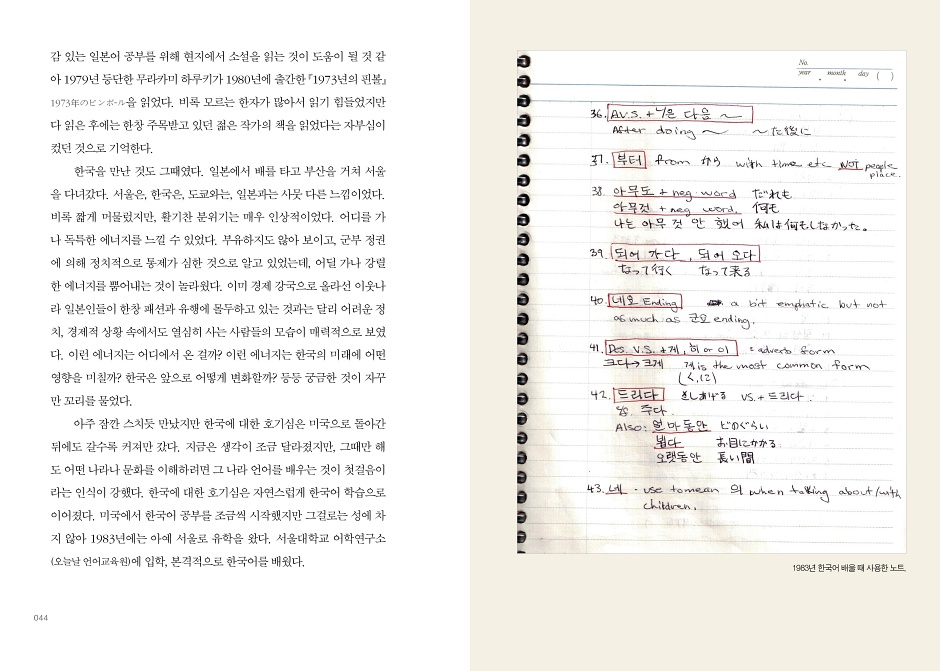
In other words, the experience of studying Japanese on one's own in one's early 20s, which felt like the "language of the universe," the usefulness of cross-language learning methods experienced while learning Korean, the memories of frustration while learning German and Chinese, and the story of self-studying Spanish as a way to recover from the pain of loss, all lead to the story of learning Italian, which one began learning in one's late 50s, showing the pilgrimage of a person who has lived their entire life with foreign languages, as it is.
Through this, readers are naturally drawn into a journey of learning a foreign language that is genuine and realistic, free from the temptations of any rhetoric or secrets. The message conveyed by this journey is clear.
That is, we must realize the reasons why so many individuals begin learning a foreign language and the mindset and attitude that must be possessed to study a foreign language.
This awakening is precisely why he invites us on his linguistic pilgrimage.
It is also clear what the reader gains from this.
To properly begin studying a foreign language, the first thing to look back on and focus on is none other than your yesterday's self and your relationship with the foreign language you've encountered so far.
The author emphasizes in this book that in order to begin learning a foreign language anew, one must first examine one's own history of learning a foreign language and what achievements and failures one experienced at that time.
The important point of this book is that if we go through such reflection, 'today's me' can enter the world of foreign languages in a different way through 'yesterday's me' who struggled with foreign languages.
Isn't it too late to learn a foreign language?
With the development of AI, won't we live in a world where learning foreign languages is no longer necessary?
What exactly does it mean to be good at a foreign language?
What are the answers to some very common, yet unanswerable, questions surrounding foreign languages?
Anyone who is determined to learn a foreign language will have to worry about their age at least once.
Or, for those struggling to learn a foreign language, perhaps the advancement of AI technology can be a source of hope.
In addition, various prejudices and fixed ideas surrounding foreign languages are surprisingly strong, and even the answers to them are not clear.
The author answers these questions in a clear tone, drawing on his own experience and the numerous theories that have emerged in the field of linguistics.
It also fully captures the shift in perception of how all of humanity should view foreign languages in the wake of COVID-19.
In other words, this book has a unique feature that clearly sets it apart from other books on foreign language learning that focus on personal experience.
If a foreign language is a window to another world, he has countless windows.
From English-speaking countries to continental Europe, Asia and Africa
The diverse world surrounding foreign language learning that is presented to us through that window,
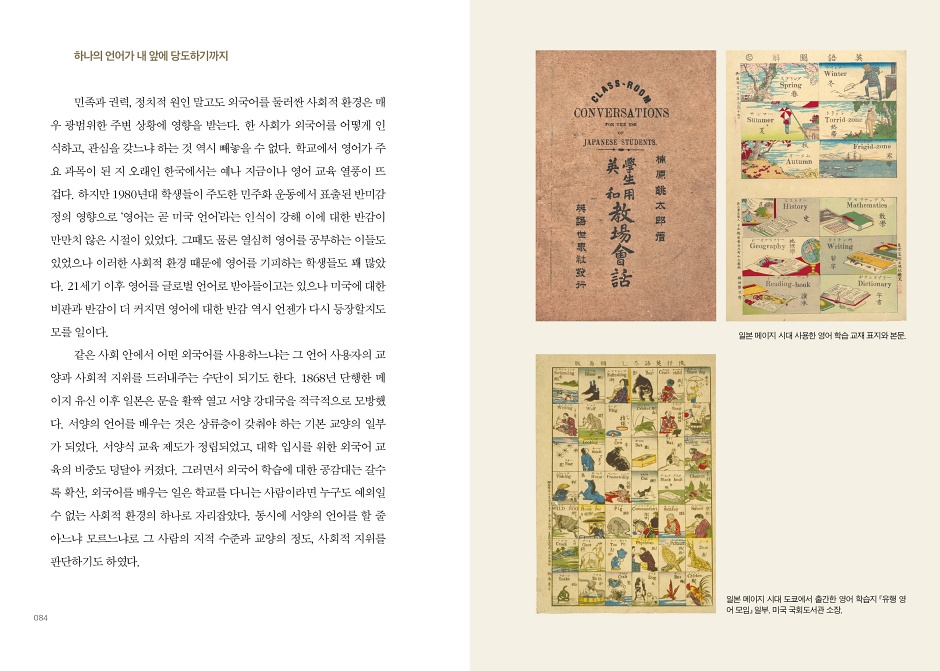
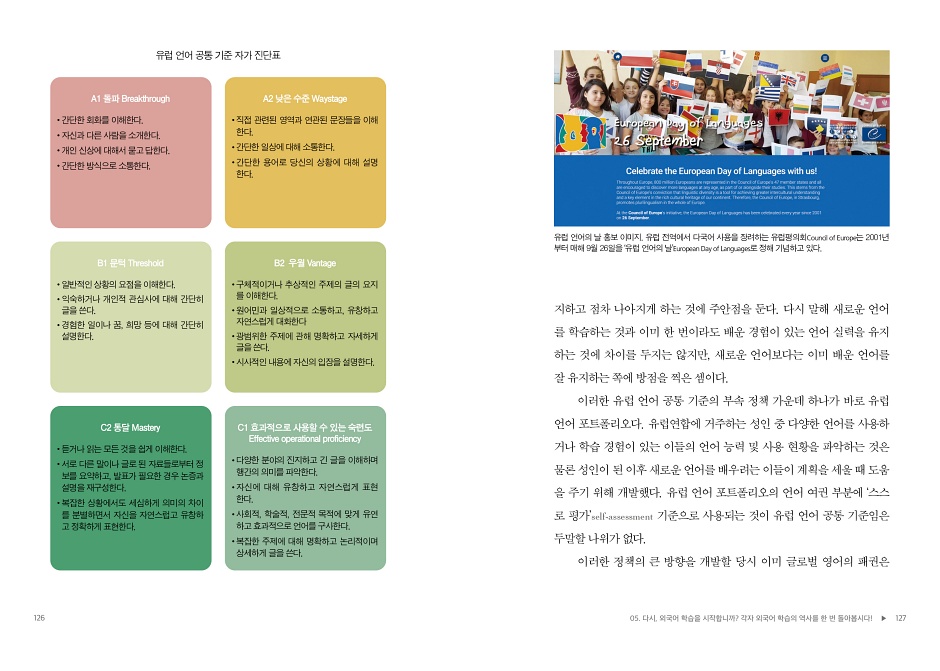
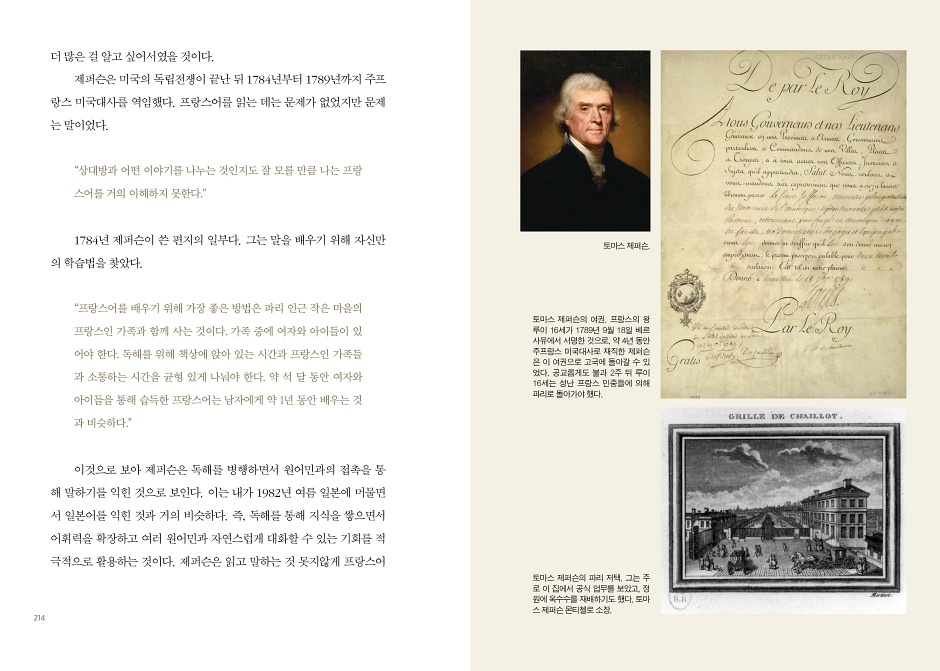
Enjoy the pleasure of viewing through special images that you can't see anywhere else!
He freely searches for and reads literature and materials from around the world, including English, various European languages, Japanese, Korean, and Chinese, and his search scope for cases and materials related to language expands infinitely.
Through this, readers also gain a new perspective on the cultural, political, and economic implications of learning a foreign language, which is undoubtedly a significant benefit of this book.
Moreover, because he is able to overcome language barriers more easily than anyone else, the special and diverse images he finds in the boundless realm of search double the viewing pleasure that cannot be felt in existing foreign language textbooks.
In addition, the significance of the fact that the foreign language most Korean readers first encounter is none other than English, and the origin of the fixed perception that "a foreign language is English", are also examined, and the expansion of awareness of the world of various languages besides English is also something that can be gained along the path he guides.
Furthermore, the book's examination of where humanity's concerns surrounding language are coming from and where they are headed in the face of COVID-19 is an achievement that only author Robert Fouser could capture.
Robert Fouser, who stands in the mainstream as American, white, and male,
His typical self-reflection on his own existence and position as a linguistic pilgrim,
After much deliberation, he found the answer to his question about the need to learn a foreign language!
Amidst the COVID-19 pandemic, a tragic incident occurred in the United States where a black citizen was murdered by a white male police officer.
Since then, massive protests against racism have taken place, which has become a global wake-up call against discrimination.
The author, who observed this scene in real time in the United States at the time, begins to reflect on his own position and the meaning of hospitality that a white man who speaks English as his native language easily obtains anywhere.
He reflects on whether his attitude of being happy that foreign languages are fun and that he can experience more of the world through them might not be so different from the circumstances of those who have no choice but to learn English, and whether his act of learning numerous languages might have contributed to further solidifying the position of the mainstream white male. He takes some time to reflect on the meaning of his own foreign language learning.
This book is built on the foundation of these reflections, posing the question to readers about where we should be headed when learning a foreign language.
“Mr. Robert Fouser, you are truly an amazing person!”
A Japanese publisher's note after seeing a pre-publication draft indicates a copyright deal has already been reached.
When the first draft of this book was completed, the editor, convinced that it would be meaningful not only to Korean readers but also to Japanese readers who were struggling with similar concerns about learning a foreign language, requested a review of the manuscript in Japan and explored the possibility of a copyright agreement.
The first sentence of the email I received from the Japanese publisher after reviewing the manuscript began with admiration.
This not only demonstrates that countless people living in the 21st century, regardless of national borders, share the same concerns about learning a foreign language, but also attests to the special yet universal meaning and value of this book.
“I would rate the introduction to this book as the best introduction of the year!”
The unanimous opinion of the SBI prospective editors of the Korean Publishers Association, who reviewed the draft together before publication,
What factors moved them?
This book was provided as a collaborative manuscript by the editorial team of the Seoul Publishing Institute (SBI) of the Korean Publishers Association.
This process, where aspiring editors read a single manuscript and each create their own book, also provides publishers with an opportunity to hear diverse and in-depth opinions on manuscripts scheduled for publication.
The prospective editors who read the first draft of this book commented that it presented a new approach to foreign languages that had not been seen before and gave them an opportunity to think about the various meanings of language learning.
The credibility of the manuscript and the author itself was doubled, especially with the introduction, which contained the unique reflections of a Western white male.
You're teaching in Korean?
How can you be so good at foreign languages?
“I want to be good at a foreign language. Is there a way to do it?”
The author of this book, Robert Fouser, a white American male, speaks and writes in Korean and Hangul in all of his lectures in Korea, as well as in all of his writing activities, including columns for media outlets.
Of course, this book was also written entirely in Korean from beginning to end.
After encountering Korea and the Korean language in the mid-1980s, he served as a professor in the Department of Korean Language Education at Seoul National University from 2008 to 2014.
Prior to that, I studied Japanese in Japan and taught English and Korean in Japanese at several universities in Japan, including Kyoto University.
Born in the United States but having lived more of his life outside the country, he has spent over a decade communicating in Korean and Japanese, rather than his native English. He is a true world language pilgrim, having studied Spanish, German, Chinese, Mongolian, French, Portuguese, Latin, North American Indigenous languages, Middle Korean, and even Esperanto and Italian.
Besides this, his history of learning foreign languages is diverse and varied.
Asking him the secret to being good at foreign languages is a common question.
This book was born from this very question.
While living in a non-English speaking country, he learned and used the language of that country and region.
For him, foreign languages were the foundation of life and the language of his home.
What kind of answers did he give to the countless questions he received through this book?
“Why do you want to be good at foreign languages?
“Did you really choose that foreign language that you want to learn and be good at?”
Instead of answering the questions he is familiar with, he poses different questions to the reader.
This question is a proposal to rethink the fundamental meaning of foreign language.
For many people around the world, the first foreign language they learn is usually English, and it's hard to deny that wanting to be good at a foreign language means getting good grades.
This first encounter with a foreign language and the direction of your desire to excel at it will have a powerful influence even after graduating from school and when you encounter a foreign language in a completely different situation.
People who got good grades in English in school tend to have unfounded confidence in all foreign languages, while people who didn't do well in English tend to feel intimidated by new foreign languages.
But is this confidence and timidity really right?
Faced with the universal prejudices and entrenched realities that everyone holds, author Robert Fouser asks the question, "Why?", making us rethink the very reasons why we encounter foreign languages and the meaning they hold.
A book for adults who have graduated from school and are now entering the world of foreign languages.
It enables learning through reflection, where ‘yesterday’s me’ suddenly appears and helps ‘today’s me’.
A completely new approach to learning a foreign language
The intended audience for this book is clear.
This book is for adults who have long since graduated from school and are trying to learn a new foreign language.
The author recommends starting a new foreign language for a variety of reasons, not the least of which is learning for academic advancement, employment, or promotion.
Therefore, the purpose of this book is not to display any unique know-how in learning a foreign language, any special all-purpose learning method, or to impart any dazzling secrets.
Rather, it emphasizes that even more personal and trivial reasons can be sufficient motivation to start a foreign language, and that even if you have experienced some frustration in the past, you can start happily by setting goals that are right for you.
To this end, the author begins this book by describing the cultural shock experienced by a late-teen American youth who had to stay at a homestay in Tokyo, and his first foreign language experience with Spanish in high school, and then goes on to describe the entire process of his lifelong foreign language learning in its entirety.
In other words, the experience of studying Japanese on one's own in one's early 20s, which felt like the "language of the universe," the usefulness of cross-language learning methods experienced while learning Korean, the memories of frustration while learning German and Chinese, and the story of self-studying Spanish as a way to recover from the pain of loss, all lead to the story of learning Italian, which one began learning in one's late 50s, showing the pilgrimage of a person who has lived their entire life with foreign languages, as it is.
Through this, readers are naturally drawn into a journey of learning a foreign language that is genuine and realistic, free from the temptations of any rhetoric or secrets. The message conveyed by this journey is clear.
That is, we must realize the reasons why so many individuals begin learning a foreign language and the mindset and attitude that must be possessed to study a foreign language.
This awakening is precisely why he invites us on his linguistic pilgrimage.
It is also clear what the reader gains from this.
To properly begin studying a foreign language, the first thing to look back on and focus on is none other than your yesterday's self and your relationship with the foreign language you've encountered so far.
The author emphasizes in this book that in order to begin learning a foreign language anew, one must first examine one's own history of learning a foreign language and what achievements and failures one experienced at that time.
The important point of this book is that if we go through such reflection, 'today's me' can enter the world of foreign languages in a different way through 'yesterday's me' who struggled with foreign languages.
Isn't it too late to learn a foreign language?
With the development of AI, won't we live in a world where learning foreign languages is no longer necessary?
What exactly does it mean to be good at a foreign language?
What are the answers to some very common, yet unanswerable, questions surrounding foreign languages?
Anyone who is determined to learn a foreign language will have to worry about their age at least once.
Or, for those struggling to learn a foreign language, perhaps the advancement of AI technology can be a source of hope.
In addition, various prejudices and fixed ideas surrounding foreign languages are surprisingly strong, and even the answers to them are not clear.
The author answers these questions in a clear tone, drawing on his own experience and the numerous theories that have emerged in the field of linguistics.
It also fully captures the shift in perception of how all of humanity should view foreign languages in the wake of COVID-19.
In other words, this book has a unique feature that clearly sets it apart from other books on foreign language learning that focus on personal experience.
If a foreign language is a window to another world, he has countless windows.
From English-speaking countries to continental Europe, Asia and Africa
The diverse world surrounding foreign language learning that is presented to us through that window,
Enjoy the pleasure of viewing through special images that you can't see anywhere else!
He freely searches for and reads literature and materials from around the world, including English, various European languages, Japanese, Korean, and Chinese, and his search scope for cases and materials related to language expands infinitely.
Through this, readers also gain a new perspective on the cultural, political, and economic implications of learning a foreign language, which is undoubtedly a significant benefit of this book.
Moreover, because he is able to overcome language barriers more easily than anyone else, the special and diverse images he finds in the boundless realm of search double the viewing pleasure that cannot be felt in existing foreign language textbooks.
In addition, the significance of the fact that the foreign language most Korean readers first encounter is none other than English, and the origin of the fixed perception that "a foreign language is English", are also examined, and the expansion of awareness of the world of various languages besides English is also something that can be gained along the path he guides.
Furthermore, the book's examination of where humanity's concerns surrounding language are coming from and where they are headed in the face of COVID-19 is an achievement that only author Robert Fouser could capture.
Robert Fouser, who stands in the mainstream as American, white, and male,
His typical self-reflection on his own existence and position as a linguistic pilgrim,
After much deliberation, he found the answer to his question about the need to learn a foreign language!
Amidst the COVID-19 pandemic, a tragic incident occurred in the United States where a black citizen was murdered by a white male police officer.
Since then, massive protests against racism have taken place, which has become a global wake-up call against discrimination.
The author, who observed this scene in real time in the United States at the time, begins to reflect on his own position and the meaning of hospitality that a white man who speaks English as his native language easily obtains anywhere.
He reflects on whether his attitude of being happy that foreign languages are fun and that he can experience more of the world through them might not be so different from the circumstances of those who have no choice but to learn English, and whether his act of learning numerous languages might have contributed to further solidifying the position of the mainstream white male. He takes some time to reflect on the meaning of his own foreign language learning.
This book is built on the foundation of these reflections, posing the question to readers about where we should be headed when learning a foreign language.
“Mr. Robert Fouser, you are truly an amazing person!”
A Japanese publisher's note after seeing a pre-publication draft indicates a copyright deal has already been reached.
When the first draft of this book was completed, the editor, convinced that it would be meaningful not only to Korean readers but also to Japanese readers who were struggling with similar concerns about learning a foreign language, requested a review of the manuscript in Japan and explored the possibility of a copyright agreement.
The first sentence of the email I received from the Japanese publisher after reviewing the manuscript began with admiration.
This not only demonstrates that countless people living in the 21st century, regardless of national borders, share the same concerns about learning a foreign language, but also attests to the special yet universal meaning and value of this book.
“I would rate the introduction to this book as the best introduction of the year!”
The unanimous opinion of the SBI prospective editors of the Korean Publishers Association, who reviewed the draft together before publication,
What factors moved them?
This book was provided as a collaborative manuscript by the editorial team of the Seoul Publishing Institute (SBI) of the Korean Publishers Association.
This process, where aspiring editors read a single manuscript and each create their own book, also provides publishers with an opportunity to hear diverse and in-depth opinions on manuscripts scheduled for publication.
The prospective editors who read the first draft of this book commented that it presented a new approach to foreign languages that had not been seen before and gave them an opportunity to think about the various meanings of language learning.
The credibility of the manuscript and the author itself was doubled, especially with the introduction, which contained the unique reflections of a Western white male.
GOODS SPECIFICS
- Date of issue: September 1, 2021
- Page count, weight, size: 336 pages | 516g | 140*200*30mm
- ISBN13: 9791191133035
- ISBN10: 1191133036
You may also like
카테고리
korean


korean

![ELLE 엘르 스페셜 에디션 A형 : 12월 [2025]](http://librairie.coreenne.fr/cdn/shop/files/b8e27a3de6c9538896439686c6b0e8fb.jpg?v=1766436872&width=3840)


