

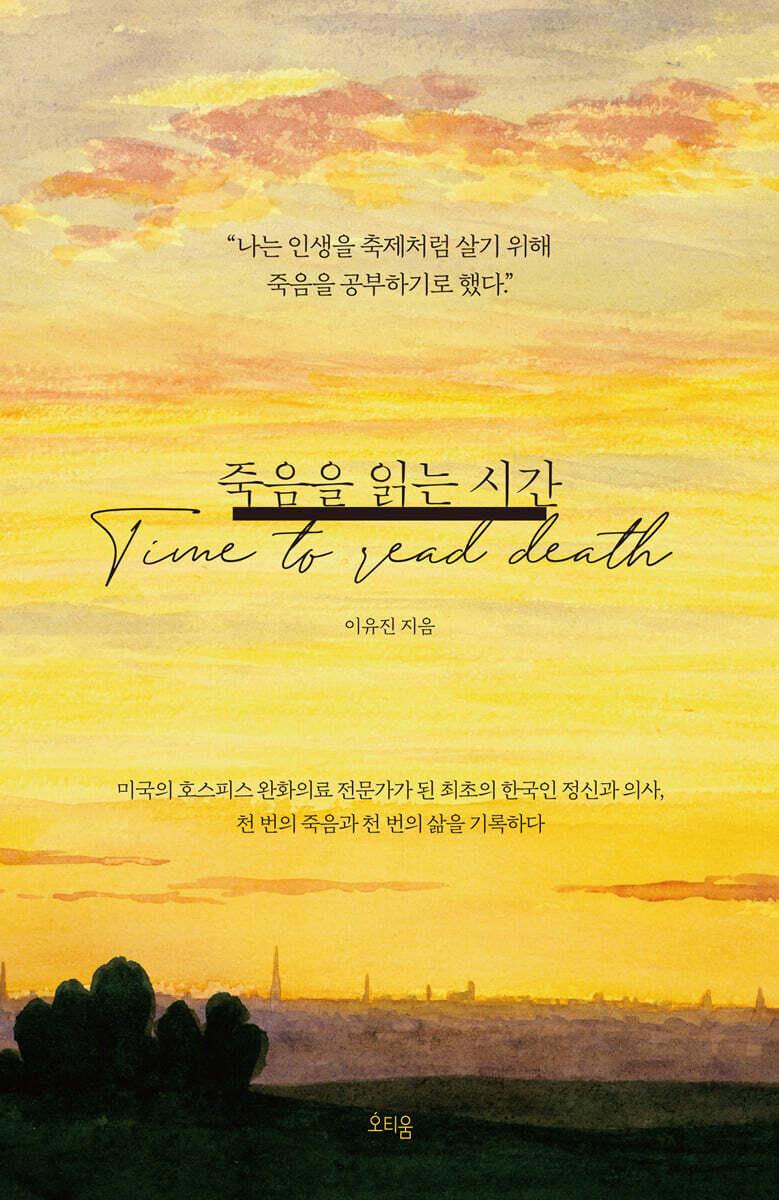
Time to read death
 |
Description
Book Introduction
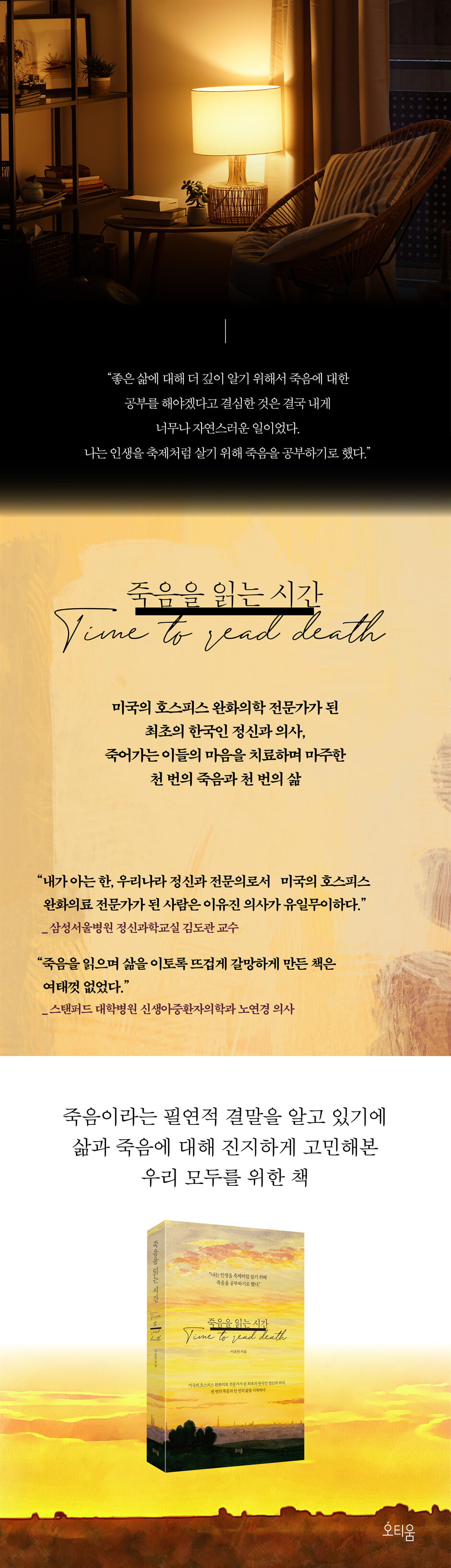
“I want to live my life like a festival
“I decided to study death.”
Became a hospice palliative care specialist in the United States
The first Korean psychiatrist,
Recording a Thousand Deaths and a Thousand Lives
“As far as I know, Dr. Lee Yu-jin is the only Korean psychiatrist who has become a hospice palliative care specialist in the United States.
His dream of becoming a physician specializing in the mental health of cancer patients has broadened into a passion to help more people living with chronic, incurable illnesses, and now, aspirations to help all of us who will one day face death.
This book contains stories from the field that only someone who has deeply contemplated life can tell.
“I hope that through ‘Time to Read Death,’ people who continue to live in pain can practice self-compassion and still love life.” _Professor Kim Do-kwan, Department of Psychiatry, Samsung Seoul Hospital
“I am a doctor who cares for the world’s most fragile lives in the neonatal intensive care unit, where life begins and ends.
Every time I see babies leaving after a fierce battle for life, I think about life and death.
How should I die, how should I live, how should I prepare for separation from my loved one?
In this book, which contains deep insights into life and death by Dr. Lee Yu-jin, a psychiatrist and hospice palliative care specialist, I found answers to long-standing questions.
Reading about death has never made me yearn for life so passionately.
I want to give this book to you who has lost the strength to live today and is exhausted.” _ Dr. Yeon-Kyung Noh, Department of Neonatal Critical Care Medicine, Stanford University Hospital
“I decided to study death.”
Became a hospice palliative care specialist in the United States
The first Korean psychiatrist,
Recording a Thousand Deaths and a Thousand Lives
“As far as I know, Dr. Lee Yu-jin is the only Korean psychiatrist who has become a hospice palliative care specialist in the United States.
His dream of becoming a physician specializing in the mental health of cancer patients has broadened into a passion to help more people living with chronic, incurable illnesses, and now, aspirations to help all of us who will one day face death.
This book contains stories from the field that only someone who has deeply contemplated life can tell.
“I hope that through ‘Time to Read Death,’ people who continue to live in pain can practice self-compassion and still love life.” _Professor Kim Do-kwan, Department of Psychiatry, Samsung Seoul Hospital
“I am a doctor who cares for the world’s most fragile lives in the neonatal intensive care unit, where life begins and ends.
Every time I see babies leaving after a fierce battle for life, I think about life and death.
How should I die, how should I live, how should I prepare for separation from my loved one?
In this book, which contains deep insights into life and death by Dr. Lee Yu-jin, a psychiatrist and hospice palliative care specialist, I found answers to long-standing questions.
Reading about death has never made me yearn for life so passionately.
I want to give this book to you who has lost the strength to live today and is exhausted.” _ Dr. Yeon-Kyung Noh, Department of Neonatal Critical Care Medicine, Stanford University Hospital
- You can preview some of the book's contents.
Preview
index
prolog.
A warm coat is needed in both life and death. 4
Chapter 1.
Doctor who studies death
The Man Who Lost His Tongue 14
Should I become a hospice doctor? 20
In Search of the Lost Self 28
Becoming a Doctor Again in America 38
46 doctors who prescribe psychiatric medication
It's okay if it's not okay 56
We Don't Dream 64
The Death of Doctor K 74
84 Reasons Why You Should Be 'Together'
The Strange Old Man Living in the Mirror 94
Is a Less Painful Breakup Possible? 104
Chapter 2.
To live the rest of my life without regrets even for a single day
I will stop receiving treatment now 114
Is this life worth living? 120
There is meaningless treatment, but no meaningless care 130
How Doctors Deliver Bad News 140
I will decide when and how I die 153
Conversations with Those Facing Death 172
How to Overcome the Fear of Death 180
The Courage to Witness Death 186
Parents' Parents 192
A Beginner's Guide to Death 201
Words Unspoken 206
The Size of Love, the Weight of Mourning 212
Chapter 3.
Even if it hurts and is difficult, still life
What is Pain? 224
236 For you who are about to visit a psychiatrist for the first time in your life
A Young Cancer Patient's Story 245
Life After Treatment 250
People Living with Incurable Diseases 260
The Inevitable Ending of Your Life 270
Fleischer's World-Changing Power 280
Is Elon Musk Happy? 288
If you are living in a nightmare present 296
Comforting Techniques to Help You and Me 304
I'm going to die soon, but I want to die now. 319
Epilogue.
We met each other through the pain of life and death. 330
A warm coat is needed in both life and death. 4
Chapter 1.
Doctor who studies death
The Man Who Lost His Tongue 14
Should I become a hospice doctor? 20
In Search of the Lost Self 28
Becoming a Doctor Again in America 38
46 doctors who prescribe psychiatric medication
It's okay if it's not okay 56
We Don't Dream 64
The Death of Doctor K 74
84 Reasons Why You Should Be 'Together'
The Strange Old Man Living in the Mirror 94
Is a Less Painful Breakup Possible? 104
Chapter 2.
To live the rest of my life without regrets even for a single day
I will stop receiving treatment now 114
Is this life worth living? 120
There is meaningless treatment, but no meaningless care 130
How Doctors Deliver Bad News 140
I will decide when and how I die 153
Conversations with Those Facing Death 172
How to Overcome the Fear of Death 180
The Courage to Witness Death 186
Parents' Parents 192
A Beginner's Guide to Death 201
Words Unspoken 206
The Size of Love, the Weight of Mourning 212
Chapter 3.
Even if it hurts and is difficult, still life
What is Pain? 224
236 For you who are about to visit a psychiatrist for the first time in your life
A Young Cancer Patient's Story 245
Life After Treatment 250
People Living with Incurable Diseases 260
The Inevitable Ending of Your Life 270
Fleischer's World-Changing Power 280
Is Elon Musk Happy? 288
If you are living in a nightmare present 296
Comforting Techniques to Help You and Me 304
I'm going to die soon, but I want to die now. 319
Epilogue.
We met each other through the pain of life and death. 330
Detailed image
Into the book
I am a psychiatrist in Korea and a hospice palliative care specialist in the United States.
… … In the sense that psychiatry alleviates the pain of living and hospice palliative care alleviates the pain of death, these two different disciplines are working toward the same goal.
The etymology of palliation is the Latin word 'palliare', which means 'coat'.
Therefore, my role, and the purpose of this book, is to provide warmth to those who need a coat to endure the pitch-black darkness and cold just before dawn.
I hope this book will be one you'll want to keep by your side for a long time, like a thick coat in your closet that you return to on a day when your heart is aching.
---From "A warm coat is needed for both life and death"
It was only natural for me to decide to study death in order to gain a deeper understanding of the good life.
Knowing that there is an end colors every moment of life with a little sadness.
Because even this happy moment will end someday.
So now our time must shine more brightly.
I decided to study death in order to live life like a festival.
---From "Should I Become a Hospice Doctor?"
“I’m going to write you a prescription, and you must follow it.
“You understand, right?”
I have prescribed him three days' leave of absence, using the authority given to me.
He added that the leave begins the moment he leaves the consulting room and he must not return to the hospital until the end of the leave.
He also prescribed three days of observing the clouds, feeling the wind, basking in the sun, smelling the flowers and trees planted along the road, returning home to eat with family, and chatting with old friends who loved him.
… … After returning to the hospital from his vacation, he looked much brighter and healthier.
What he needed was life, not antidepressants.
He didn't commit suicide.
---From "The Death of Doctor K"
The six questions below are ones you must ask yourself for the rest of your life.
These are the questions needed to return the power of life decisions, which doctors and hospitals held for the treatment of illness, back to the person concerned and help them live the rest of their lives as they wish.
“If you can’t recover like this, how do you want to spend the rest of your life?”
“What is one bodily function that you absolutely cannot give up until the very last moment?”
“If you can’t solve all the inconveniences you have now, what would you like to solve first?”
“Is there anything you absolutely must do before you die?”
“What kind of treatment would you like to receive and what are your goals for that treatment?”
"Where do you want to die? Should it be at home, or would a hospital be fine?"
---From "Is this a life worth living now?"
Those who have lived a life of subjective choice and responsibility for that choice often hope to choose death as well, actively and subjectively.
As we get closer to death, we gain the courage to reveal more of our true selves.
Just as there are no wrong lives, there are no wrong deaths.
Death is simply an inevitable process of life that is decided at birth.
Whether it's a good death, a dignified death, or euthanasia, we will all just live our lives and meet our own ending.
… … In the sense that psychiatry alleviates the pain of living and hospice palliative care alleviates the pain of death, these two different disciplines are working toward the same goal.
The etymology of palliation is the Latin word 'palliare', which means 'coat'.
Therefore, my role, and the purpose of this book, is to provide warmth to those who need a coat to endure the pitch-black darkness and cold just before dawn.
I hope this book will be one you'll want to keep by your side for a long time, like a thick coat in your closet that you return to on a day when your heart is aching.
---From "A warm coat is needed for both life and death"
It was only natural for me to decide to study death in order to gain a deeper understanding of the good life.
Knowing that there is an end colors every moment of life with a little sadness.
Because even this happy moment will end someday.
So now our time must shine more brightly.
I decided to study death in order to live life like a festival.
---From "Should I Become a Hospice Doctor?"
“I’m going to write you a prescription, and you must follow it.
“You understand, right?”
I have prescribed him three days' leave of absence, using the authority given to me.
He added that the leave begins the moment he leaves the consulting room and he must not return to the hospital until the end of the leave.
He also prescribed three days of observing the clouds, feeling the wind, basking in the sun, smelling the flowers and trees planted along the road, returning home to eat with family, and chatting with old friends who loved him.
… … After returning to the hospital from his vacation, he looked much brighter and healthier.
What he needed was life, not antidepressants.
He didn't commit suicide.
---From "The Death of Doctor K"
The six questions below are ones you must ask yourself for the rest of your life.
These are the questions needed to return the power of life decisions, which doctors and hospitals held for the treatment of illness, back to the person concerned and help them live the rest of their lives as they wish.
“If you can’t recover like this, how do you want to spend the rest of your life?”
“What is one bodily function that you absolutely cannot give up until the very last moment?”
“If you can’t solve all the inconveniences you have now, what would you like to solve first?”
“Is there anything you absolutely must do before you die?”
“What kind of treatment would you like to receive and what are your goals for that treatment?”
"Where do you want to die? Should it be at home, or would a hospital be fine?"
---From "Is this a life worth living now?"
Those who have lived a life of subjective choice and responsibility for that choice often hope to choose death as well, actively and subjectively.
As we get closer to death, we gain the courage to reveal more of our true selves.
Just as there are no wrong lives, there are no wrong deaths.
Death is simply an inevitable process of life that is decided at birth.
Whether it's a good death, a dignified death, or euthanasia, we will all just live our lives and meet our own ending.
---From "Is this a life worth living now?"
Publisher's Review
Dr. Lee Yu-jin, the first Korean hospice psychiatrist in the United States, has been working for 13 years and has been treating the hearts of people facing death. She has published her first book, "Time to Read Death," to help more people.
This is a humanistic essay about a thousand deaths and lives observed by the author, who studied psychiatry in Korea and received additional training in hospice and palliative care in the United States.
Dr. Yeon-Kyung Noh, a neonatal intensive care physician at Stanford University, recommended this book, saying, “I have never read a book that makes me yearn for life so passionately while reading about death.”
In Korea, additional training in hospice palliative care is not permitted for psychiatrists.
However, the author says that what people facing death need is help to relieve not only physical pain but also mental pain.
People who are sent home with an incurable illness and not long to live are likely to lose their will to live.
Even if it's not such a dramatic event, I wrote this book to help people who are contemplating taking their own life because of someone else's suicide, or whose quality of life has plummeted to the point where they wonder, "Is it really worth living like this?" because life is out of their control.
From the moment we are born, we are destined to face death at any moment.
Even if you are healthy and young right now, you should think about 'how you will die' at least once.
The question soon leads to 'how to live' and allows us to enjoy life in the present moment.
The patients seen through Dr. Lee Yu-jin's eyes are facing death.
Through them, we can ask ourselves what the hearts of those facing death are like, what they regret and what they think, how they should end their remaining lives, and what words they should leave behind for those who are left behind. We can live the present without regrets like a festival with the people we care about.
This book is for people who are near death due to an incurable illness or their families, people who are not imminent but still fear death due to a chronic illness, people who are suffering from cancer or have had cancer and live with the fear of recurrence, people who are considering suicide after experiencing the suicide of someone close to them, people who worry because they don't know how to help them, people who are suffering after saying goodbye to a loved one, and all of us who have seriously thought about life and death because we know that death is an inevitable ending that we will face someday.
Statistically, one or two out of ten people die suddenly and without warning.
This book will be a powerful resource for all of us who live uncertain, unpredictable, and loss-filled lives.
This is a humanistic essay about a thousand deaths and lives observed by the author, who studied psychiatry in Korea and received additional training in hospice and palliative care in the United States.
Dr. Yeon-Kyung Noh, a neonatal intensive care physician at Stanford University, recommended this book, saying, “I have never read a book that makes me yearn for life so passionately while reading about death.”
In Korea, additional training in hospice palliative care is not permitted for psychiatrists.
However, the author says that what people facing death need is help to relieve not only physical pain but also mental pain.
People who are sent home with an incurable illness and not long to live are likely to lose their will to live.
Even if it's not such a dramatic event, I wrote this book to help people who are contemplating taking their own life because of someone else's suicide, or whose quality of life has plummeted to the point where they wonder, "Is it really worth living like this?" because life is out of their control.
From the moment we are born, we are destined to face death at any moment.
Even if you are healthy and young right now, you should think about 'how you will die' at least once.
The question soon leads to 'how to live' and allows us to enjoy life in the present moment.
The patients seen through Dr. Lee Yu-jin's eyes are facing death.
Through them, we can ask ourselves what the hearts of those facing death are like, what they regret and what they think, how they should end their remaining lives, and what words they should leave behind for those who are left behind. We can live the present without regrets like a festival with the people we care about.
This book is for people who are near death due to an incurable illness or their families, people who are not imminent but still fear death due to a chronic illness, people who are suffering from cancer or have had cancer and live with the fear of recurrence, people who are considering suicide after experiencing the suicide of someone close to them, people who worry because they don't know how to help them, people who are suffering after saying goodbye to a loved one, and all of us who have seriously thought about life and death because we know that death is an inevitable ending that we will face someday.
Statistically, one or two out of ten people die suddenly and without warning.
This book will be a powerful resource for all of us who live uncertain, unpredictable, and loss-filled lives.
GOODS SPECIFICS
- Date of issue: August 25, 2021
- Page count, weight, size: 336 pages | 394g | 130*200*30mm
- ISBN13: 9791130640020
- ISBN10: 1130640027
You may also like
카테고리
korean


korean

![ELLE 엘르 스페셜 에디션 A형 : 12월 [2025]](http://librairie.coreenne.fr/cdn/shop/files/b8e27a3de6c9538896439686c6b0e8fb.jpg?v=1766436872&width=3840)


