

Testimony
 |
Description
Book Introduction
Reissue after 18 years,
The fuse that triggered the 'Shostakovich War'
That very book is being republished.
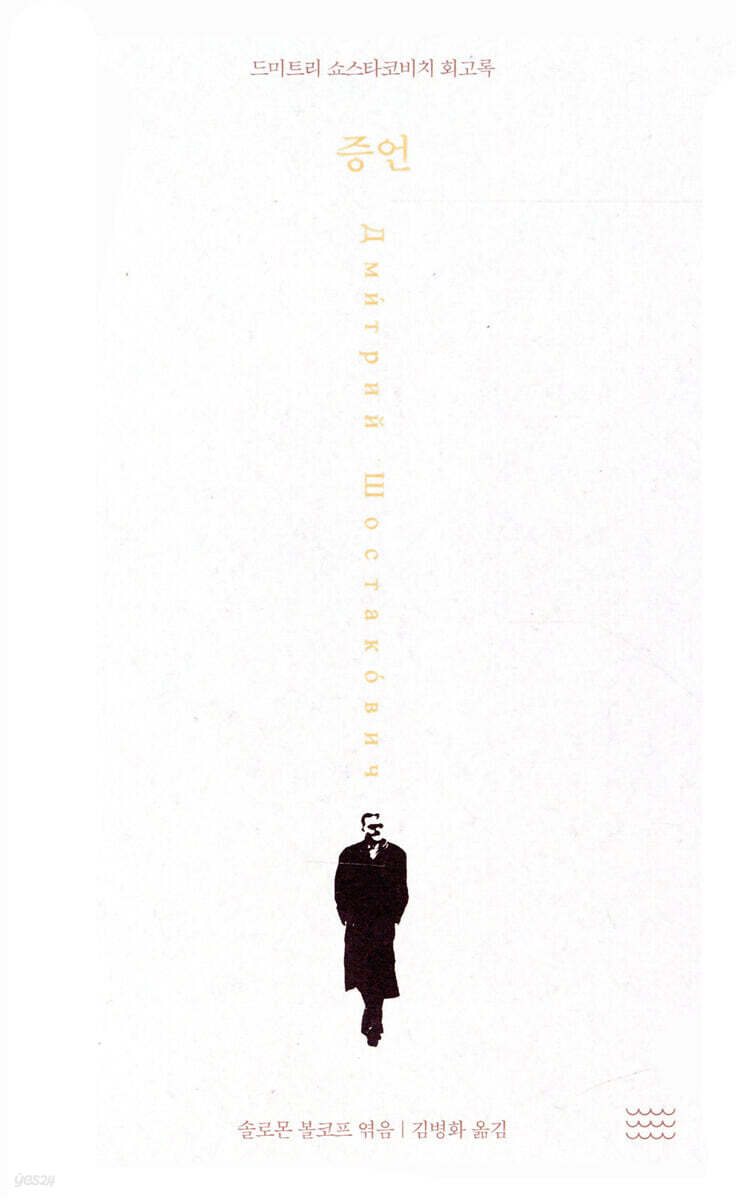
『Testimony: the Memoirs of Dmitri Shostakovich』 is a collection of oral records of the 20th century's representative composer, Shostakovich, compiled by his disciple and musicologist, Solomon Volkov.
It caused a huge sensation immediately after its publication in the United States in 1979, as it contained criticism of Stalin, the leader of the former Soviet Union, as well as sharp criticism of the hypocrisy of the greatest artists of the time, Stravinsky and Prokofiev, as well as anti-establishment intellectuals such as Solzhenitsyn, André Malraux, Bernard Shaw, and Romain Rolland.
Because the impact was so great, the claim that "this book is a forgery written by someone other than Shostakovich" continues to this day, even 40 years after the book was published.
This was a situation that could be called “the Shostakovich War,” as Elizabeth Wilson, one of the most trusted authorities on Shostakovich studies, put it.
Naturally, this memoir was always a key book that could not be left out during the war.
Shostakovich wanted to distinguish between 'despair and cynicism' in his music.
Cynicism is the loss of faith, so no matter how dark the times, we must not lose faith in humanity, and I hope that people will understand the despair inherent in music.
It is a challenge to the impossibility of truth, with infinite trust in music itself.
Thus, the music he created was finally named 'straight-line music' that pierced through pessimism, nihilism, and cynicism.
"Testimony", this is Shostakovich as no one has ever seen him, a sketch of a life that is both triumphant and tragic.
This is also the world we live in today.
- You can preview some of the book's contents.
Preview
index
Dedicated to the republication of "Testimony" · Jang Jeong-il
preface
introduction
1.
Childhood: Kustodiev
2.
St. Petersburg Musicians: Stravinsky and Glazunov
3.
Meyerhold and Tukhachevsky
4.
Lady Macbeth and Formalism
5.
New and powerful music
6.
Meditations on Chekhov: Truth and Death
7.
Mussorgsky's music
8.
Stalin and the Artists
Shostakovich chronology and works
About the editor
Translator's Note (First Edition)
Translator's Note (for the reprint)
Browse (music, literature, people)
Publisher's Review
“Even now I ask myself:
How did I survive?”
The story begins with a description of a portrait.
“I am an old man now.
I sit at my desk and keep looking at it.
It reminds me of Kustodiev and the suffering he endured.” (p. 97)
Shostakovich tells the story of Russian art in the early 20th century as if telling a fairy tale through the portrayal of key figures in modern and contemporary Russia.
Kustodiev, the greatest landscape painter of his time; Borodin, who was both a chemist and a composer; Glinka, who laid the foundation for modern Russian music; Mussorgsky, the composer of great operas; Rimsky-Korsakov, the wise music teacher; Glazunov, who refined Shostakovich's music and life; and finally, Anton Chekhov, who provided countless inspirations for modern and contemporary Russian art... This book introduces portraits of numerous artists painted by representative Russian painters, including Ilya Repin, along with Shostakovich's memoirs.
It is an opportunity to experience not only their music but also scenes from their lives more vividly.
In addition to the advantage of providing a glimpse into the history of modern and contemporary Russian art, it is also valuable as a record of someone who personally navigated the rise and fall of the Soviet Union, particularly its political turmoil.
Following his predecessors, Shostakovich delved into the core of the problems of music and society, even while experiencing conflict with the system.
He also looks back with sorrow on the unexpected deaths of leading figures of the Russian avant-garde, such as Meyerhold and Mayakovsky, and the death of Tukhachevsky, a leading modern Russian soldier and military theorist who was also his staunch supporter.
The suspicious deaths that occurred publicly under Stalin's reign of terror cast a shadow of despair over Shostakovich's later life.
Besides real-world politics, what plagued Shostakovich were factions and politics within music and art.
If we were to name the artists who plagued his musical life, the most representative examples would be Stravinsky and Prokofiev, both Russian musicians who lived abroad.
In addition, the sharp depictions of hypocrisy by representative Russian artists such as Tarkovsky, Stanislavsky, Eisenstein, and Mayakovsky are interesting.
“This is Shostakovich as no one has ever seen him, a sketch of a life that is both triumphant and tragic.”
“I am sick and tired of people thinking that the notes on a symphony are more important than the symphony itself.
What matters to them is the flood of bold language.
This is a situation where the cart is put before the horse.
What we need is not bold words, but bold music.
This is not bold in the sense of using diagrams instead of notes, but bold because it is true.
Music that allows the composer to truly express his or her thoughts, music that allows as many good citizens of one's own country and abroad as possible to understand and accept that music, and thus to understand one's own country and people.
“That is the meaning that can be found in composing music, as far as I can see.” (pp. 447-48)
Shostakovich was born in tsarist Russia, experienced the Russian Revolution at the age of eleven, lived under Stalin and Khrushchev, and died under Brezhnev.
Having lived through upheaval throughout his life, he was hailed as a symbol of socialist art and a musical giant, but at other times he was treated as an outsider, an outsider whose livelihood was threatened the very next day.
Shostakovich wanted to distinguish between 'despair and cynicism' in his music.
Cynicism is the loss of faith, so no matter how dark the times, we must not lose faith in humanity, and I hope that people will understand the despair inherent in music.
It is a challenge to the impossibility of truth, with infinite trust in music itself.
Thus, the music he created was finally named 'straight-line music' that pierced through pessimism, nihilism, and cynicism.
"Testimony", this is Shostakovich as no one has ever seen him, a sketch of a life that is both triumphant and tragic.
This is also the world we live in today.
GOODS SPECIFICS
- Date of publication: May 20, 2019
- Format: Hardcover book binding method guide
- Page count, weight, size: 654 pages | 696g | 128*210*37mm
- ISBN13: 9791196329150
- ISBN10: 119632915X
You may also like
카테고리
korean


korean


