

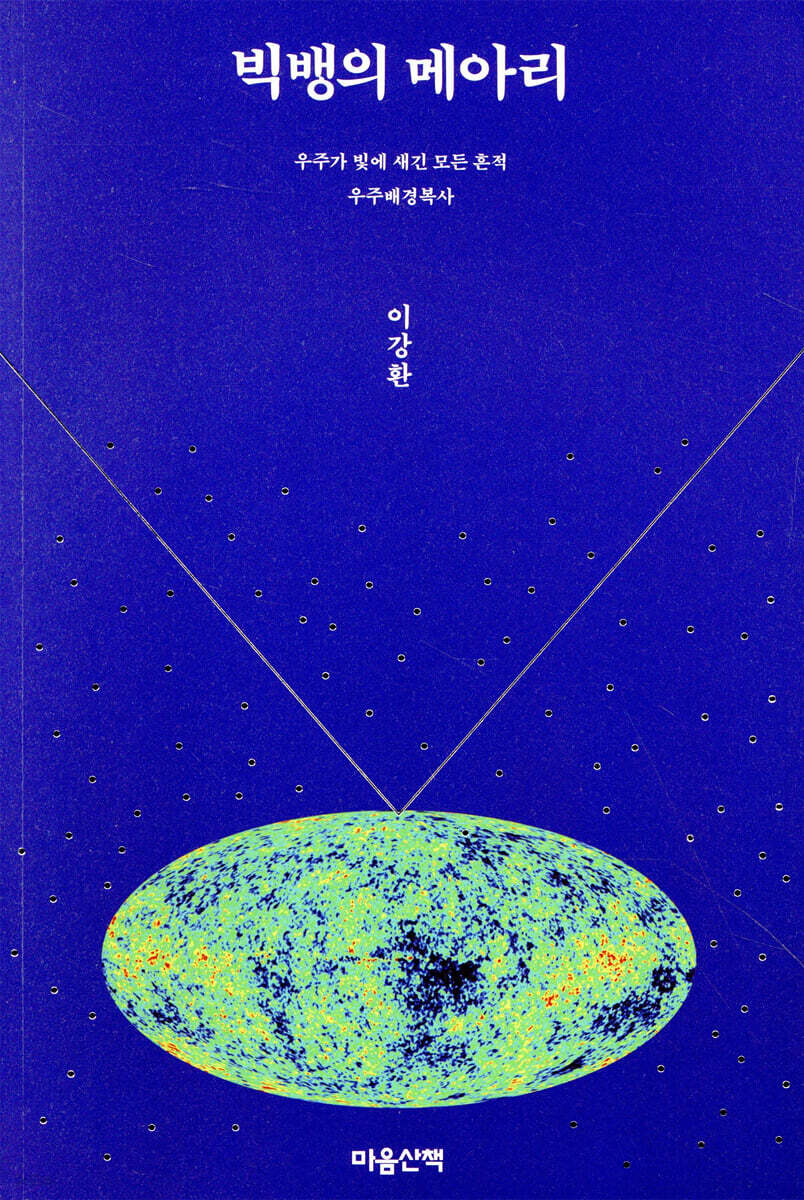
Echoes of the Big Bang
 |
Description
Book Introduction
The echo left behind by light that traveled through space for 13.8 billion years
Cosmic background radiation that will reveal the secrets of the birth of the universe
"Echoes of the Big Bang" is an introductory book on cosmology that examines the cosmic microwave background radiation, which preserves the early traces of the universe born from the Big Bang.
It unfolds in an exciting narrative, tracing the context from the Big Bang, which explains the birth and evolution of the universe, to the discovery of inflation, dark matter, and dark energy.
It also provides the easiest access to the latest astronomical information, from the detection of gravitational waves, the subject of the 2017 Nobel Prize in Physics, to string theory.
The universe, which was born from an infinitely small point and is expanding at an ever-increasing speed, is still expanding.
The Big Bang theory, the most scientific theory explaining the universe we live in, is the result of countless scientists' ceaseless efforts, and with the discovery of cosmic background radiation, it was elevated to the ranks of verifiable science.
The cosmic microwave background radiation, which has been spreading throughout the universe for 13.8 billion years, remains like an echo throughout our universe.
Many scientists are trying to solve the mystery of the birth of the universe by filtering out this light, developing theories, observing, and proving them.
In "Echoes of the Big Bang," we can examine not only the fierce debate between the Big Bang cosmology and the Steady State cosmology, but also the constant challenges faced by individual scientists.
It also provides concrete information on 'how to do science', which was previously thought of only abstractly.
It is full of rich data and episodes that contain information on how scientific theories are established and developed, and the process through which we obtain the knowledge about the universe that we know as a result.
The discovery and observation of cosmic background radiation, based on the sole efforts of scientists, opens readers to a new perspective on the universe.
Thanks to the accumulated efforts of countless scientists, we have learned a great deal about the universe in less than 100 years.
But as with all scientific fields, the more we learn about the universe, the more questions arise.
Perhaps science will never uncover all the secrets of the universe.
That is why science can be humble.
-From "Preface"
“The process of exploration, which may never end, is the greatest joy that can be gained from exploring the universe,” says author Dr. Kang-Hwan Lee, an astronomer and director of the Seodaemun Museum of Natural History.
He has become very popular through his anonymous appearances on the podcast "Sitting with Science," and he is working to make science accessible and fun for the general public.
What 『Echoes of the Big Bang』 is looking for
“If the universe is getting smaller, won’t there be a moment when its size becomes zero?”
One of the most remarkable things about studying the universe is that we can observe very precisely a specific point in time in the early universe.
This point is 380,000 years after the birth of the universe, and what we can precisely observe is the primordial light that appeared at this very moment.
This light is spread evenly throughout our universe and can be seen from any direction in space.
This light is called the cosmic microwave background because it appears as if it were the background of our universe.
-Page 74
Astronomy observes light, the only clue the universe provides, and interprets the results.
『Echoes of the Big Bang』 is a journey to find the first light to appear in the universe, the cosmic microwave background radiation.
The cosmic microwave background radiation is a faint glow that remains in the background of the universe, originating from a single hot point after the Big Bang and spreading evenly throughout the universe.
Because it preserves traces of the early universe, astronomers observe this light to look into the universe's past and, based on that, understand the present universe.
When the COBE results were announced, the astronomical community was engulfed in excitement.
Astronomers began studying the cosmic microwave background to see if there was anything more to learn.
It soon became clear that these tiny temperature variations in space were a goldmine for figuring out almost every kind of variable about the universe.
-Page 138
By launching cutting-edge satellites such as COBE, WMAP, and Planck into space and observing the remaining cosmic microwave background radiation, scientists are gradually drawing a picture of our universe.
We now know that the universe is flat, that dark matter must exist, and that inflation must have occurred. It is thanks to the cosmic microwave background that we now know with great precision that the universe's age, which was estimated to be between 10 and 20 billion years ago, is now estimated to be 13.7 or 13.8 billion years old.
To get a closer look at the cold 'primordial light', just above absolute zero, countless scientists have invested countless hours building sophisticated observation equipment and extracting the most from the data.
The answers they revealed about the birth of the universe have changed our perception of the night sky and have greatly expanded human knowledge.
How to Do Science: A Guide for Honest Scientists
“Science isn't about finding the right answer, it's about the process of finding the right answer.”
In 1924, Hubble discovered Cepheid variables in the Andromeda Galaxy, leading him to believe that the galaxy was much farther away than our own.
This discovery completely changed the way humanity had thought about the universe until then.
Our galaxy was no longer the entire universe, but just one of many galaxies.
-Page 22
The secret of the universe's birth revealed by the cosmic microwave background radiation is the beautiful result of countless scientists sharing, competing, and persistently observing their research results.
It is also an exciting story that has allowed us to understand the universe we see more accurately through the efforts of scientists.
"Echoes of the Big Bang" meticulously captures everything from little-known anecdotes about well-known scientists to the achievements and human aspects of hidden scientists who have not been highlighted until now.
This book examines in detail the achievements of each scientist who made the most important discoveries in history, including Henrietta Leavitt, the female astronomer who discovered Cepheid variables, the most important stars for measuring distances in the universe; Milton Humason, who helped Edwin Hubble with his extraordinary observation skills; Fritz Zwicky, who predicted dark matter too early; Alan Guth, who surprised the scientific community by proposing the theory of inflation; Nancy Boggess, who recognized the importance of the cosmic microwave background and successfully formed a team; George Smoot, who shows the other side of a brilliant scientist; David Wilkinson, who constantly pioneered his own path and led the discovery of the cosmic microwave background; and Rainer Weiss, who won the Nobel Prize in Physics in 2017 for the detection of gravitational waves.
"Echoes of the Big Bang" shows that science is a diligent process of adding another brick to the pile of bricks that many scientists have observed and verified.
The joy of studying science
“The research isn't over yet.”
Every time we discover a new fact, the universe creates more new questions.
This is probably true not only of space but of all fields that science explores.
Many of the new questions that arise now seem insoluble at first glance, but science has come this far by resolving many of those questions that once seemed so unanswerable.
-Page 236
Typically, scientific theories consist of hypotheses, predictions, and tests.
When a phenomenon occurring in nature is observed, a theory that can explain the phenomenon is first hypothesized, and then that theory is used to predict new phenomena that may be discovered.
And when the predicted phenomenon is actually observed, the initial hypothesis is verified and becomes a scientific theory.
In a radio interview with the BBC, Hoyle criticized Gamow's theory, saying, "So, you're saying that all the matter in the universe was created in a single moment in the past with a Big Bang." Gamow, who had a great sense of humor, found this amusing and called his theory the Big Bang cosmology.
-Pages 38-39
The Big Bang theory is the most scientific explanation of the universe as we currently understand it.
The process by which the Big Bang cosmology was completed through a decade-long, fierce debate with the Steady-State cosmology, observations of the cosmic background radiation, the emergence of inflation theory, and predictions of the existence of dark matter and dark energy clearly illustrates the development of scientific theories.
Inflation theory emerged to solve several problems with the Big Bang cosmology, which was a hypothesis, and showed that tiny quantum fluctuations that occurred in the early universe could grow along with rapid expansion and become the seeds of stars and galaxies that exist in the universe.
Then, finding traces of minute temperature changes that would remain in the cosmic background radiation became an important task.
It was later discovered that the temperature change of the cosmic microwave background was much lower than initially expected, and that invisible dark matter must play an important role in shaping the structure of the universe.
The inflation theory has been further developed through the research of many scientists and is now established as an important theory explaining the birth and evolution of the universe, along with the Big Bang cosmology.
It's truly amazing how such complex problems can be solved with such a simple idea.
-Page 87
To test their hypothesis, scientists searched for subtle temperature variations in the cosmic microwave background, and in 1992, they observed temperature differences with the COBE satellite. The WMAP satellite, launched after COBE, observed the cosmic microwave background at even higher resolution, enabling them to estimate various physical quantities in the universe with considerable accuracy.
And the Planck satellite, launched with the goal of 'ending the cosmic microwave background', enabled more precise determination of physical quantities in the universe.
With continuous observations, standard cosmology has become an exact science that can speak with precise numbers.
This is a remarkable achievement, made in less than 100 years since modern cosmology began with the observation in 1929 that the universe is expanding.
In science, the process is more important than the result.
The credibility of science comes not from the reliability of its results, but from the rigor of its process.
-From "Preface"
The exploration of the cosmic microwave background radiation, as described in Echoes of the Big Bang, includes a series of important discoveries in the history of the development of cosmology.
While many people cheer the research results, if you examine the observations and research processes of the scientists featured in this book, you will find that beyond the "surprise of the results," you will gain daily inspiration and experience the joy of limitless intellectual expansion.
Cosmic background radiation that will reveal the secrets of the birth of the universe
"Echoes of the Big Bang" is an introductory book on cosmology that examines the cosmic microwave background radiation, which preserves the early traces of the universe born from the Big Bang.
It unfolds in an exciting narrative, tracing the context from the Big Bang, which explains the birth and evolution of the universe, to the discovery of inflation, dark matter, and dark energy.
It also provides the easiest access to the latest astronomical information, from the detection of gravitational waves, the subject of the 2017 Nobel Prize in Physics, to string theory.
The universe, which was born from an infinitely small point and is expanding at an ever-increasing speed, is still expanding.
The Big Bang theory, the most scientific theory explaining the universe we live in, is the result of countless scientists' ceaseless efforts, and with the discovery of cosmic background radiation, it was elevated to the ranks of verifiable science.
The cosmic microwave background radiation, which has been spreading throughout the universe for 13.8 billion years, remains like an echo throughout our universe.
Many scientists are trying to solve the mystery of the birth of the universe by filtering out this light, developing theories, observing, and proving them.
In "Echoes of the Big Bang," we can examine not only the fierce debate between the Big Bang cosmology and the Steady State cosmology, but also the constant challenges faced by individual scientists.
It also provides concrete information on 'how to do science', which was previously thought of only abstractly.
It is full of rich data and episodes that contain information on how scientific theories are established and developed, and the process through which we obtain the knowledge about the universe that we know as a result.
The discovery and observation of cosmic background radiation, based on the sole efforts of scientists, opens readers to a new perspective on the universe.
Thanks to the accumulated efforts of countless scientists, we have learned a great deal about the universe in less than 100 years.
But as with all scientific fields, the more we learn about the universe, the more questions arise.
Perhaps science will never uncover all the secrets of the universe.
That is why science can be humble.
-From "Preface"
“The process of exploration, which may never end, is the greatest joy that can be gained from exploring the universe,” says author Dr. Kang-Hwan Lee, an astronomer and director of the Seodaemun Museum of Natural History.
He has become very popular through his anonymous appearances on the podcast "Sitting with Science," and he is working to make science accessible and fun for the general public.
What 『Echoes of the Big Bang』 is looking for
“If the universe is getting smaller, won’t there be a moment when its size becomes zero?”
One of the most remarkable things about studying the universe is that we can observe very precisely a specific point in time in the early universe.
This point is 380,000 years after the birth of the universe, and what we can precisely observe is the primordial light that appeared at this very moment.
This light is spread evenly throughout our universe and can be seen from any direction in space.
This light is called the cosmic microwave background because it appears as if it were the background of our universe.
-Page 74
Astronomy observes light, the only clue the universe provides, and interprets the results.
『Echoes of the Big Bang』 is a journey to find the first light to appear in the universe, the cosmic microwave background radiation.
The cosmic microwave background radiation is a faint glow that remains in the background of the universe, originating from a single hot point after the Big Bang and spreading evenly throughout the universe.
Because it preserves traces of the early universe, astronomers observe this light to look into the universe's past and, based on that, understand the present universe.
When the COBE results were announced, the astronomical community was engulfed in excitement.
Astronomers began studying the cosmic microwave background to see if there was anything more to learn.
It soon became clear that these tiny temperature variations in space were a goldmine for figuring out almost every kind of variable about the universe.
-Page 138
By launching cutting-edge satellites such as COBE, WMAP, and Planck into space and observing the remaining cosmic microwave background radiation, scientists are gradually drawing a picture of our universe.
We now know that the universe is flat, that dark matter must exist, and that inflation must have occurred. It is thanks to the cosmic microwave background that we now know with great precision that the universe's age, which was estimated to be between 10 and 20 billion years ago, is now estimated to be 13.7 or 13.8 billion years old.
To get a closer look at the cold 'primordial light', just above absolute zero, countless scientists have invested countless hours building sophisticated observation equipment and extracting the most from the data.
The answers they revealed about the birth of the universe have changed our perception of the night sky and have greatly expanded human knowledge.
How to Do Science: A Guide for Honest Scientists
“Science isn't about finding the right answer, it's about the process of finding the right answer.”
In 1924, Hubble discovered Cepheid variables in the Andromeda Galaxy, leading him to believe that the galaxy was much farther away than our own.
This discovery completely changed the way humanity had thought about the universe until then.
Our galaxy was no longer the entire universe, but just one of many galaxies.
-Page 22
The secret of the universe's birth revealed by the cosmic microwave background radiation is the beautiful result of countless scientists sharing, competing, and persistently observing their research results.
It is also an exciting story that has allowed us to understand the universe we see more accurately through the efforts of scientists.
"Echoes of the Big Bang" meticulously captures everything from little-known anecdotes about well-known scientists to the achievements and human aspects of hidden scientists who have not been highlighted until now.
This book examines in detail the achievements of each scientist who made the most important discoveries in history, including Henrietta Leavitt, the female astronomer who discovered Cepheid variables, the most important stars for measuring distances in the universe; Milton Humason, who helped Edwin Hubble with his extraordinary observation skills; Fritz Zwicky, who predicted dark matter too early; Alan Guth, who surprised the scientific community by proposing the theory of inflation; Nancy Boggess, who recognized the importance of the cosmic microwave background and successfully formed a team; George Smoot, who shows the other side of a brilliant scientist; David Wilkinson, who constantly pioneered his own path and led the discovery of the cosmic microwave background; and Rainer Weiss, who won the Nobel Prize in Physics in 2017 for the detection of gravitational waves.
"Echoes of the Big Bang" shows that science is a diligent process of adding another brick to the pile of bricks that many scientists have observed and verified.
The joy of studying science
“The research isn't over yet.”
Every time we discover a new fact, the universe creates more new questions.
This is probably true not only of space but of all fields that science explores.
Many of the new questions that arise now seem insoluble at first glance, but science has come this far by resolving many of those questions that once seemed so unanswerable.
-Page 236
Typically, scientific theories consist of hypotheses, predictions, and tests.
When a phenomenon occurring in nature is observed, a theory that can explain the phenomenon is first hypothesized, and then that theory is used to predict new phenomena that may be discovered.
And when the predicted phenomenon is actually observed, the initial hypothesis is verified and becomes a scientific theory.
In a radio interview with the BBC, Hoyle criticized Gamow's theory, saying, "So, you're saying that all the matter in the universe was created in a single moment in the past with a Big Bang." Gamow, who had a great sense of humor, found this amusing and called his theory the Big Bang cosmology.
-Pages 38-39
The Big Bang theory is the most scientific explanation of the universe as we currently understand it.
The process by which the Big Bang cosmology was completed through a decade-long, fierce debate with the Steady-State cosmology, observations of the cosmic background radiation, the emergence of inflation theory, and predictions of the existence of dark matter and dark energy clearly illustrates the development of scientific theories.
Inflation theory emerged to solve several problems with the Big Bang cosmology, which was a hypothesis, and showed that tiny quantum fluctuations that occurred in the early universe could grow along with rapid expansion and become the seeds of stars and galaxies that exist in the universe.
Then, finding traces of minute temperature changes that would remain in the cosmic background radiation became an important task.
It was later discovered that the temperature change of the cosmic microwave background was much lower than initially expected, and that invisible dark matter must play an important role in shaping the structure of the universe.
The inflation theory has been further developed through the research of many scientists and is now established as an important theory explaining the birth and evolution of the universe, along with the Big Bang cosmology.
It's truly amazing how such complex problems can be solved with such a simple idea.
-Page 87
To test their hypothesis, scientists searched for subtle temperature variations in the cosmic microwave background, and in 1992, they observed temperature differences with the COBE satellite. The WMAP satellite, launched after COBE, observed the cosmic microwave background at even higher resolution, enabling them to estimate various physical quantities in the universe with considerable accuracy.
And the Planck satellite, launched with the goal of 'ending the cosmic microwave background', enabled more precise determination of physical quantities in the universe.
With continuous observations, standard cosmology has become an exact science that can speak with precise numbers.
This is a remarkable achievement, made in less than 100 years since modern cosmology began with the observation in 1929 that the universe is expanding.
In science, the process is more important than the result.
The credibility of science comes not from the reliability of its results, but from the rigor of its process.
-From "Preface"
The exploration of the cosmic microwave background radiation, as described in Echoes of the Big Bang, includes a series of important discoveries in the history of the development of cosmology.
While many people cheer the research results, if you examine the observations and research processes of the scientists featured in this book, you will find that beyond the "surprise of the results," you will gain daily inspiration and experience the joy of limitless intellectual expansion.
- You can preview some of the book's contents.
Preview
index
6 at the beginning of the book
Cosmology as a Science
The Expanding Universe 17
The Emergence of the Big Bang Cosmology 29
Rivals to the Big Bang Cosmology 36
A New Look at the Universe 42
Critical Discovery 53
Light scattered across space
Age of Chaos 67
The Light of the Beginning 73
The Uneven Universe 77
The emergence of inflation theory 82
Seeds Sown in Space 88
Find the subtle temperature differences in space COBE
Needle in a haystack 99
The Beginning of a Long Journey 104
COBE into Space 111
First result 117
Seeing the Face of God 123
WMAP, a map of the universe drawn by light
Goldmine of the Universe 137
New Team 142
New Observation Satellite 150
Surprisingly surprising results 161
See the Sound of the Universe 168
Gold Digging in Space 178
Ending the Cosmic Microwave Background Planck
All the information contained in the cosmic microwave background 189
Harvesting Results 194
Planck's results 208
Cosmic Microwave Background and Inflation 215
The research is not over yet
History of Cosmology and the Standard Cosmological Model 223
The truth is still out there 229
Search 238
References 250
Cosmology as a Science
The Expanding Universe 17
The Emergence of the Big Bang Cosmology 29
Rivals to the Big Bang Cosmology 36
A New Look at the Universe 42
Critical Discovery 53
Light scattered across space
Age of Chaos 67
The Light of the Beginning 73
The Uneven Universe 77
The emergence of inflation theory 82
Seeds Sown in Space 88
Find the subtle temperature differences in space COBE
Needle in a haystack 99
The Beginning of a Long Journey 104
COBE into Space 111
First result 117
Seeing the Face of God 123
WMAP, a map of the universe drawn by light
Goldmine of the Universe 137
New Team 142
New Observation Satellite 150
Surprisingly surprising results 161
See the Sound of the Universe 168
Gold Digging in Space 178
Ending the Cosmic Microwave Background Planck
All the information contained in the cosmic microwave background 189
Harvesting Results 194
Planck's results 208
Cosmic Microwave Background and Inflation 215
The research is not over yet
History of Cosmology and the Standard Cosmological Model 223
The truth is still out there 229
Search 238
References 250
Detailed image

GOODS SPECIFICS
- Date of publication: October 15, 2017
- Page count, weight, size: 252 pages | 418g | 145*215*20mm
- ISBN13: 9788960903371
- ISBN10: 896090337X
You may also like
카테고리
korean


korean

![GQ KOREA Mark (Monthly): December [2025]](http://librairie.coreenne.fr/cdn/shop/files/8ef265dbbfbf186523ed75ba7319009d.jpg?v=1765340328&width=3840)


