

Thoughts that change your mind
 |
Description
Book Introduction
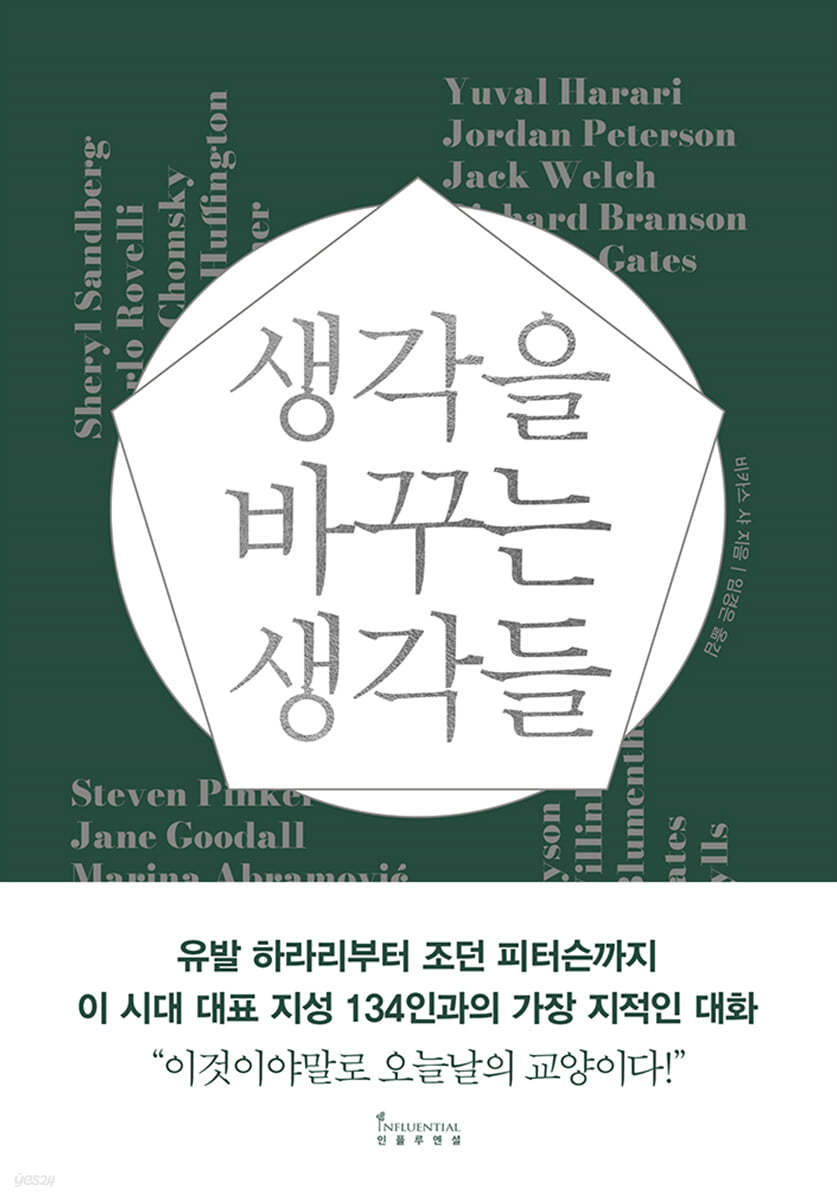
“Thoughts are the power that change your life and take you one step forward!” Yuval Harari, Jordan Peterson, Jane Goodall, Maya Angelou, Muhammad Yunus, Richard Branson, Sheryl Sandberg… A book that compiles the thoughts of 134 true leaders of this era! What if you could gather together the world's leading minds—Yuval Harari, Jordan Peterson, Jane Goodall, Carlo Rovelli, Maya Angelou, Yann Martel, Muhammad Yunus, Jack Welch, James Dyson, Sheryl Sandberg—to hear their thoughts on the most pressing issues of our time? This seemingly impossible feat has actually happened. Vikas Shah, author of "Thoughts That Change Thinking," has been conducting the "Thought Economics Project" since 2007, interviewing people who have had a significant impact on our time, and has compiled all of this into a book. In this book, he focuses on the fact that "the driving force that creates this world lies in our thoughts," and asks 134 world-renowned intellectuals, from historians and artists to Nobel laureates and entrepreneurs who have had a significant impact on this era, about the most important issues of our time and hear their thoughts. The unpredictable, curious exploration that arises when exceptional questions are asked to exceptional people unfolds in a fascinating way throughout the book. Their profound and insightful thoughts will not only help us see today's world clearly, but will also awaken our thoughts and inspiration, leading us to a deeper level of life. |
- You can preview some of the book's contents.
Preview
index
Praise poured in for this book
Recommended Reading│Excellent Insights Needed in This Era
Introduction│Conversations that will help you realize the power of thought
PART 1 Identity: Questions About Ourselves
How Identity Defines Us
What does it mean to be alive
What role do religion and science play in our lives?
Are humans superior to animals?
What is the relationship between art and identity?
Does education contribute to human development?
PART 2 Culture: What Makes Up Our Lives
Why do we create and tell stories?
What are the qualities of good writing?
Can the power of language change the world?
How Poetry Enlightens Our Lives
What experiences does music give us?
What is the role of film in culture?
What is the artistic value of photography?
How Food Became Culture
PART 3 LEADERSHIP: A VISION THAT UNITES OUR STRENGTH
What does it mean to be a leader?
What kind of leadership is needed in this era?
How Excellence Becomes a Culture
How Do Failure Experiences Affect Leadership?
Why Resilience Matters in Leadership
What does leadership look like in a crisis?
PART 4 Entrepreneurship: The Power to Change the World
What is the true meaning of entrepreneurship?
Does an entrepreneurial identity exist?
What drives entrepreneurs?
What Makes a Great Entrepreneur
What is the role of entrepreneurs in the economy and society?
What does philanthropy mean in entrepreneurship?
Advice for future entrepreneurs
PART 5 Discrimination: Seeing the World Through Others' Eyes
How is poverty addressed today?
Why Disability Became a Target of Discrimination
Why doesn't racism go away?
Can humanity solve the problem of gender discrimination?
Why haven't sexual minority rights been treated as human rights?
Can online violence be eradicated?
How civil rights movements are fighting discrimination
PART 6: CONFLICT: WAR, PEACE, AND JUSTICE
Why do wars and conflicts exist?
Can conflict and violence ever be justified?
What should we do for peace?
Why We Should Forgive Instead of Revenge
Is a world without conflict and strife really possible?
What are our moral obligations toward refugees?
PART 7 Democracy: 2,500 Years of Experiments in Power
What is democracy and why is it important?
How democratic is our society today?
Why is right-wing populism gaining ground?
Why is citizen political participation important in a democracy?
What does power mean in politics?
What role do law and institutions play in democracy?
Advice for the Future of Democracy
Acknowledgements
annotation
Recommended Reading│Excellent Insights Needed in This Era
Introduction│Conversations that will help you realize the power of thought
PART 1 Identity: Questions About Ourselves
How Identity Defines Us
What does it mean to be alive
What role do religion and science play in our lives?
Are humans superior to animals?
What is the relationship between art and identity?
Does education contribute to human development?
PART 2 Culture: What Makes Up Our Lives
Why do we create and tell stories?
What are the qualities of good writing?
Can the power of language change the world?
How Poetry Enlightens Our Lives
What experiences does music give us?
What is the role of film in culture?
What is the artistic value of photography?
How Food Became Culture
PART 3 LEADERSHIP: A VISION THAT UNITES OUR STRENGTH
What does it mean to be a leader?
What kind of leadership is needed in this era?
How Excellence Becomes a Culture
How Do Failure Experiences Affect Leadership?
Why Resilience Matters in Leadership
What does leadership look like in a crisis?
PART 4 Entrepreneurship: The Power to Change the World
What is the true meaning of entrepreneurship?
Does an entrepreneurial identity exist?
What drives entrepreneurs?
What Makes a Great Entrepreneur
What is the role of entrepreneurs in the economy and society?
What does philanthropy mean in entrepreneurship?
Advice for future entrepreneurs
PART 5 Discrimination: Seeing the World Through Others' Eyes
How is poverty addressed today?
Why Disability Became a Target of Discrimination
Why doesn't racism go away?
Can humanity solve the problem of gender discrimination?
Why haven't sexual minority rights been treated as human rights?
Can online violence be eradicated?
How civil rights movements are fighting discrimination
PART 6: CONFLICT: WAR, PEACE, AND JUSTICE
Why do wars and conflicts exist?
Can conflict and violence ever be justified?
What should we do for peace?
Why We Should Forgive Instead of Revenge
Is a world without conflict and strife really possible?
What are our moral obligations toward refugees?
PART 7 Democracy: 2,500 Years of Experiments in Power
What is democracy and why is it important?
How democratic is our society today?
Why is right-wing populism gaining ground?
Why is citizen political participation important in a democracy?
What does power mean in politics?
What role do law and institutions play in democracy?
Advice for the Future of Democracy
Acknowledgements
annotation
Detailed image

Into the book
In fact, everything we think of as the best or the worst is also the result of our 'thoughts'.
With increasing instability and opacity in all areas of culture, society, economy, and politics, what we need now is to embrace the widest possible range of knowledge and opinions through honest and open dialogue.
This is because only then can we more deeply understand and solve the problems we face.
The distrust, hatred, and personal attacks we see on social networks may be due to our inability to fully share our thoughts with one another.
--- pp.21-22
Are we truly living to be happy? Jordan Peterson, author of "12 Rules for Life," which could be considered the answer to the question, "What is the most important thing in life?" I asked him, "What kind of life does it take to be considered a good life?"
Jordan Peterson─ “If I had to sum it up in one word, I would say this.
“If you are willing to spend time solving the problems of this world, including those of yourself and your family, and of society, then you are living a good life.”
Anyone who feels something is wrong around them or sees someone in pain is likely to feel emotionally disturbed.
The only way to relieve this moral burden, which is so difficult for humans to avoid, is to do whatever we can to confront it.
We all know that when faced with difficult and serious problems, acting responsibly and not avoiding them is the most valuable thing in life.
It is when we do such things that we can feel our inner strength and self-esteem.
It is a vain wish to make happiness the goal of life.
Life is inherently complex, full of anxiety, pain, disappointment, and hurt.”
--- pp.42-43
Yuval Harari predicted a major shift in human identity.
The story was that humans would rise above their status as the most superior life form in the universe and ascend to the position of gods.
He shared his vision of the future of humanity, which will undergo great changes due to technological advancements.
Yuval Harari─ “In the future, humans will use technology to acquire abilities previously considered divine.
This is not a metaphor, it is a literal meaning.
Soon, humans will be able to design and create life forms to their own liking, travel through virtual realities directly connected to their minds, boldly extend their lifespans, and modify their bodies and minds to their own desires.
Throughout history, countless economic, social, and political revolutions have occurred, but one thing has remained constant.
It's a human being.
Our bodies and minds have changed so little that they are comparable to those of our ancestors in the Roman Empire or ancient Egypt.
But in the coming decades, for the first time in history, humanity itself will undergo a radical revolution.
The human body and mind will also be transformed by genetic engineering, nanotechnology, and brain-computer interfaces.
Body and mind may become the commodities that represent the 21st century economy.
When we think of the future, we often picture a world where people who look like us enjoy the benefits of more advanced technology than we do today, like laser guns, intelligent robots, and spaceships that travel at the speed of light.
But the transformative potential of future technologies will emerge from the transformation of Homo sapiens itself, including our bodies and minds.
“This means that the most amazing technology of the future will not be spaceships, but the life forms that ride on them.”
--- pp.59-60
Maya Angelou, the American poet and novelist, said that the purpose of storytelling is “to convey a message so widely that future generations will not repeat the mistakes we have made, whether voluntarily or involuntarily.”
So, do writers write for that very purpose? According to Maya Angelou, there's another, far more profound reason why we create stories and write.
Maya Angelou─ “There is a desire within us to tell our stories to others.
It's the same reason why we draw and have the courage to love someone.
Because there is a desire to let others know who you are.
It's a desire to go beyond simply how tall you are and what your body looks like, to speak to your inner self and soul.
There are things in the world that stimulate us to bring out something within ourselves.
The more courage we have, the better we can tell our stories.
“If a story can resonate with black and white people, older and younger generations, poor and rich, then that story has been a success in storytelling.”
--- pp.78-79
Resilience can be defined as the mental strength to use adversity, trials, and failures as springboards to move forward.
We asked Sheryl Sandberg, Facebook's COO and one of the most successful female leaders, how she learned from adversity and hardship.
Sheryl Sandberg─ “You have to acknowledge the adversity, dare to raise the issue, and accept that there is a problem.
If you never talk about your hardships and trials, you will never learn anything from them.
It's not uncommon for things to go wrong in business.
At this point, many people are trying to hush it up, making it easier to cover up advanced technological issues.
But to solve the problem, we must bring it out into the open, not hide it.”
--- pp.169-170
Lech Walesa, who served as President of Poland from 1990 to 1995, is a hero of Polish democracy and a Nobel Peace Prize winner.
I asked him, “What message do you want to pass on to the next generation for a peaceful world?”
He said that the next generation must be most wary of 'populism'.
Lech Walesa─ “When I think about the next generation, my biggest worry is that populists who seek to appeal to the masses will come to power in large numbers.
We must fight against agitators and so-called leaders who act without thinking about the consequences.
They might destroy society.
We must find new social structures and new ways of thinking as the answer to building a beautiful world.
We must also be clear that technology has advanced so much that our weapons have reached a point where they can destroy the entire world.
“The only way forward is to build peace and for nations to cooperate with one another.”
With increasing instability and opacity in all areas of culture, society, economy, and politics, what we need now is to embrace the widest possible range of knowledge and opinions through honest and open dialogue.
This is because only then can we more deeply understand and solve the problems we face.
The distrust, hatred, and personal attacks we see on social networks may be due to our inability to fully share our thoughts with one another.
--- pp.21-22
Are we truly living to be happy? Jordan Peterson, author of "12 Rules for Life," which could be considered the answer to the question, "What is the most important thing in life?" I asked him, "What kind of life does it take to be considered a good life?"
Jordan Peterson─ “If I had to sum it up in one word, I would say this.
“If you are willing to spend time solving the problems of this world, including those of yourself and your family, and of society, then you are living a good life.”
Anyone who feels something is wrong around them or sees someone in pain is likely to feel emotionally disturbed.
The only way to relieve this moral burden, which is so difficult for humans to avoid, is to do whatever we can to confront it.
We all know that when faced with difficult and serious problems, acting responsibly and not avoiding them is the most valuable thing in life.
It is when we do such things that we can feel our inner strength and self-esteem.
It is a vain wish to make happiness the goal of life.
Life is inherently complex, full of anxiety, pain, disappointment, and hurt.”
--- pp.42-43
Yuval Harari predicted a major shift in human identity.
The story was that humans would rise above their status as the most superior life form in the universe and ascend to the position of gods.
He shared his vision of the future of humanity, which will undergo great changes due to technological advancements.
Yuval Harari─ “In the future, humans will use technology to acquire abilities previously considered divine.
This is not a metaphor, it is a literal meaning.
Soon, humans will be able to design and create life forms to their own liking, travel through virtual realities directly connected to their minds, boldly extend their lifespans, and modify their bodies and minds to their own desires.
Throughout history, countless economic, social, and political revolutions have occurred, but one thing has remained constant.
It's a human being.
Our bodies and minds have changed so little that they are comparable to those of our ancestors in the Roman Empire or ancient Egypt.
But in the coming decades, for the first time in history, humanity itself will undergo a radical revolution.
The human body and mind will also be transformed by genetic engineering, nanotechnology, and brain-computer interfaces.
Body and mind may become the commodities that represent the 21st century economy.
When we think of the future, we often picture a world where people who look like us enjoy the benefits of more advanced technology than we do today, like laser guns, intelligent robots, and spaceships that travel at the speed of light.
But the transformative potential of future technologies will emerge from the transformation of Homo sapiens itself, including our bodies and minds.
“This means that the most amazing technology of the future will not be spaceships, but the life forms that ride on them.”
--- pp.59-60
Maya Angelou, the American poet and novelist, said that the purpose of storytelling is “to convey a message so widely that future generations will not repeat the mistakes we have made, whether voluntarily or involuntarily.”
So, do writers write for that very purpose? According to Maya Angelou, there's another, far more profound reason why we create stories and write.
Maya Angelou─ “There is a desire within us to tell our stories to others.
It's the same reason why we draw and have the courage to love someone.
Because there is a desire to let others know who you are.
It's a desire to go beyond simply how tall you are and what your body looks like, to speak to your inner self and soul.
There are things in the world that stimulate us to bring out something within ourselves.
The more courage we have, the better we can tell our stories.
“If a story can resonate with black and white people, older and younger generations, poor and rich, then that story has been a success in storytelling.”
--- pp.78-79
Resilience can be defined as the mental strength to use adversity, trials, and failures as springboards to move forward.
We asked Sheryl Sandberg, Facebook's COO and one of the most successful female leaders, how she learned from adversity and hardship.
Sheryl Sandberg─ “You have to acknowledge the adversity, dare to raise the issue, and accept that there is a problem.
If you never talk about your hardships and trials, you will never learn anything from them.
It's not uncommon for things to go wrong in business.
At this point, many people are trying to hush it up, making it easier to cover up advanced technological issues.
But to solve the problem, we must bring it out into the open, not hide it.”
--- pp.169-170
Lech Walesa, who served as President of Poland from 1990 to 1995, is a hero of Polish democracy and a Nobel Peace Prize winner.
I asked him, “What message do you want to pass on to the next generation for a peaceful world?”
He said that the next generation must be most wary of 'populism'.
Lech Walesa─ “When I think about the next generation, my biggest worry is that populists who seek to appeal to the masses will come to power in large numbers.
We must fight against agitators and so-called leaders who act without thinking about the consequences.
They might destroy society.
We must find new social structures and new ways of thinking as the answer to building a beautiful world.
We must also be clear that technology has advanced so much that our weapons have reached a point where they can destroy the entire world.
“The only way forward is to build peace and for nations to cooperate with one another.”
--- p.331
Publisher's Review
“Intriguing conversations with the world's most influential people.”
Yuval Harari, Jordan Peterson, Jane Goodall, Jack Welch, Sheryl Sandberg…
The "Thought Economics Project," a compilation of the thoughts of leading intellectuals of our time.
What created this era and society? We perceive the economy, culture, society, and politics as phenomena existing outside of ourselves, but in reality, they are the product of our "thoughts," that is, our cognitive activities.
“Our thoughts are what we are.
Everything happens with our thoughts.
As Buddha said, “Our thoughts shape this world,” our thoughts are woven together as warp and weft to create this era and society.
Vikas Shah's "Thoughts That Change Your Mind" is a book that compiles the "Thought Economics Project", which interviews the thoughts of world-renowned intellectuals, based on this fact.
The 'Thought Economics Project' began in 2007 when Vikas Shah posted interviews with people around him on his blog.
Unexpectedly, the reader response to the interview post was enthusiastic, and in just one year, readers from all over the world were flooding him with requests for topics they would like him to cover and people they would like him to interview.
To share the interview content with a wider audience, he launched an official website and began interviewing global intellectuals who had a significant impact on the era.
The curtain has risen on the 'Thought Economics Project', a compilation of the best ideas of this century.
The early 'Thought Economics Project' had difficulties as every interview request received a refusal.
However, Vikas Shah's genuine attitude, born from curiosity and passion, finally moved their hearts, and leading intellectuals of the era, including Wikipedia founder Jimmy Wales, Yuval Harari, Jordan Peterson, Jane Goodall, Carlo Rovelli, and Noam Chomsky, participated as interviewees.
Since then, the 'Thought Economics Project' has received praise from readers and media around the world, with Steven Pinker calling it "a surprising, intelligent, and entertaining conversation about the most important issues of our time." From 2012 to 2016, it won the 'Webby Awards', an international award given to excellent websites, along with the BBC, New York Times, Paris Review, and Financial Times.
What began as a project driven by one individual's curiosity and passion has evolved into a remarkable collection of once-in-a-lifetime conversations with luminaries.
“If the art of questioning can be categorized as a genre of ‘art,’ then Vikas Shah is a worthy counterpart to Pablo Picasso.” (Rem Cisse, British poet and bestselling author)
“How should we view today’s world?”
From questions about ourselves to advice on democracy
Outstanding insights from 134 world-renowned intellectuals needed for today's era.
"Thoughts that Change Your Mind" covers seven major topics, starting with identity, followed by culture, leadership, entrepreneurship, discrimination, conflict, and democracy.
These topics are important for determining the right direction for life in this era of increasing instability and uncertainty across all areas.
We will ask 134 leading intellectuals from around the world questions and hear their thoughts on the most important issues of our time, such as 'How does identity define us?', 'How do arts and culture influence our lives?', 'What kind of leadership is needed in this era?', 'Why do discrimination and conflict exist?', and 'What crisis is democracy facing today?'
Great ideas from leading figures in various fields, including Yuval Harari, Jordan Peterson, Jane Goodall, Maya Angelou, Muhammad Yunus, Richard Branson, and Sheryl Sandberg, guide readers into a place of deep thought.
For example, Jordan Peterson, a psychologist and author of Beyond Order, answers Vikas Shah's question, "What kind of life is a good life?" as follows:
“If I had to summarize it in one word, I would say this.
'If you are willing to spend time solving the problems of this world, including those of yourself and your family, then you are living a good life.'
Anyone who feels something is wrong around them or sees someone in pain is likely to feel emotionally disturbed.
“The only way to relieve this moral burden, which is so difficult for humans to avoid, is to do whatever we can to confront it.”
Page 41 (from "What Does It Mean to Be Alive?")
Before she passed away in 2014, American poet and civil rights activist Maya Angelou, when asked what constitutes a good story and great writing, gave the following answer, emphasizing "truthfulness."
"What is the key to great writing? It's 'authenticity.'
Any writing that doesn't tell the truth is of little use.
“A story that is true, that is, a story that tells the truth about people and life, will make everyone, from old white people to Asian women to ranchers, nod and say, ‘Yes, that’s right.’”
Pages 82-83 (from 'What are the conditions for good writing?')
Meanwhile, Yann Martel, author of Life of Pi, winner of the Man Booker Prize, answers the same question as Maya Angelou:
“Great writing contains a travel bag that moves people no matter what era it is opened.
For example, the Iliad, attributed to the ancient Greek writer Homer, still moves us with its poignant tragic elements nearly 3,000 years later.
Because the truth contained in life's tragedy and irony transcends time and touches everyone.
But the travel bag isn't just filled with lingering emotions.
Great writing also brings intellectual fulfillment.
So, you have to be able to change the reader's mind.
“A story that beautifully combines emotional lingering emotion with intellectual insight can be told over time without losing its freshness, even as times change.”
Pages 82-83 (from 'What are the conditions for good writing?')
Yuval Harari, who predicted a major change in human identity through Sapiens, expressed his thoughts on the question, “What changes will humanity experience in the future?” as follows.
“In the future, humans will use technology to acquire abilities once considered divine.
This is not a metaphor, it is a literal meaning.
Soon, humans will be able to design and create life forms to their own liking, travel through virtual realities directly connected to their minds, boldly extend their lifespans, and modify their bodies and minds to their own desires.
Throughout history, countless economic, social, and political revolutions have occurred, but one thing has remained constant.
It's a human being.
(Omitted) The revolutionary potential of future technologies will emerge from the transformation of Homo sapiens itself, including our bodies and minds.
“This means that the most amazing technology of the future will not be spaceships, but the life forms that ride on them.”
Pages 59-60 (from 'Are Humans Superior to Animals?')
Ai Weiwei, a Chinese installation artist and social activist, said this when asked, “Why should we fight against social discrimination?”
“This time will pass, and the next generation will face a completely different test.
But I can tell you one thing for sure.
“Without the struggle to protect what is precious and meaningful to us, the word ‘freedom’ becomes empty and our lives become worthless.”
Page 298 (from "How Civic Movements Fight Discrimination")
When asked for advice on the crisis of democracy, chess grandmaster and political activist Garry Kasparov responded by quoting former US President Ronald Reagan:
“Democracy is not something we can take for granted forever.
Former President Ronald Reagan said, "It takes less than a generation for freedom to disappear," but while we assumed it would just work itself out, democracy ended up being significantly corrupted.
(Omitted) To prevent this situation from recurring, citizens’ political participation must be expanded, and there must be more intellectual discussion about democracy.”
Pages 386-387 (from "Advice for the Future of Democracy")
“Is your mind awake?”
In a time of anxiety and confusion,
Today's liberal arts that will help you reflect on the purpose and meaning of life
In a society that changes so rapidly that we can't even keep our wits about us, most of us live unconsciously, preoccupied with the problem of survival, focusing on making a living.
However, when we face existential questions that shake the very foundations of life, such as, "How should we deal with the conflict and hatred that permeates the world?", our dormant consciousness awakens and our attitude toward life changes.
As performance artist Marina Abramović said, “Everyone should wake up in the morning and ask themselves what the purpose of life is,” “Thoughts That Change Your Mind” helps us question our true lives and re-establish our life’s direction in today’s world, when fundamental values are being shaken to their core.
This book offers a broad perspective on the world we live in, as it contains the diverse thoughts of those who have shaped today's world, from historians to artists, Nobel Prize winners, and entrepreneurs.
While reflecting on the problems we must address today, we also offer diverse insights on what attitudes we should take for a better tomorrow and where we should find value in life.
Although they sometimes present diametrically opposed views on the same topic or interpret issues from completely different perspectives, the excellent ideas they convey serve as an excellent medium that broadens and inspires readers' thinking.
Their diverse ideas, which have had a significant impact on our times, will broaden our thinking and serve as an opportunity to take a step toward a better life.
Yuval Harari, Jordan Peterson, Jane Goodall, Jack Welch, Sheryl Sandberg…
The "Thought Economics Project," a compilation of the thoughts of leading intellectuals of our time.
What created this era and society? We perceive the economy, culture, society, and politics as phenomena existing outside of ourselves, but in reality, they are the product of our "thoughts," that is, our cognitive activities.
“Our thoughts are what we are.
Everything happens with our thoughts.
As Buddha said, “Our thoughts shape this world,” our thoughts are woven together as warp and weft to create this era and society.
Vikas Shah's "Thoughts That Change Your Mind" is a book that compiles the "Thought Economics Project", which interviews the thoughts of world-renowned intellectuals, based on this fact.
The 'Thought Economics Project' began in 2007 when Vikas Shah posted interviews with people around him on his blog.
Unexpectedly, the reader response to the interview post was enthusiastic, and in just one year, readers from all over the world were flooding him with requests for topics they would like him to cover and people they would like him to interview.
To share the interview content with a wider audience, he launched an official website and began interviewing global intellectuals who had a significant impact on the era.
The curtain has risen on the 'Thought Economics Project', a compilation of the best ideas of this century.
The early 'Thought Economics Project' had difficulties as every interview request received a refusal.
However, Vikas Shah's genuine attitude, born from curiosity and passion, finally moved their hearts, and leading intellectuals of the era, including Wikipedia founder Jimmy Wales, Yuval Harari, Jordan Peterson, Jane Goodall, Carlo Rovelli, and Noam Chomsky, participated as interviewees.
Since then, the 'Thought Economics Project' has received praise from readers and media around the world, with Steven Pinker calling it "a surprising, intelligent, and entertaining conversation about the most important issues of our time." From 2012 to 2016, it won the 'Webby Awards', an international award given to excellent websites, along with the BBC, New York Times, Paris Review, and Financial Times.
What began as a project driven by one individual's curiosity and passion has evolved into a remarkable collection of once-in-a-lifetime conversations with luminaries.
“If the art of questioning can be categorized as a genre of ‘art,’ then Vikas Shah is a worthy counterpart to Pablo Picasso.” (Rem Cisse, British poet and bestselling author)
“How should we view today’s world?”
From questions about ourselves to advice on democracy
Outstanding insights from 134 world-renowned intellectuals needed for today's era.
"Thoughts that Change Your Mind" covers seven major topics, starting with identity, followed by culture, leadership, entrepreneurship, discrimination, conflict, and democracy.
These topics are important for determining the right direction for life in this era of increasing instability and uncertainty across all areas.
We will ask 134 leading intellectuals from around the world questions and hear their thoughts on the most important issues of our time, such as 'How does identity define us?', 'How do arts and culture influence our lives?', 'What kind of leadership is needed in this era?', 'Why do discrimination and conflict exist?', and 'What crisis is democracy facing today?'
Great ideas from leading figures in various fields, including Yuval Harari, Jordan Peterson, Jane Goodall, Maya Angelou, Muhammad Yunus, Richard Branson, and Sheryl Sandberg, guide readers into a place of deep thought.
For example, Jordan Peterson, a psychologist and author of Beyond Order, answers Vikas Shah's question, "What kind of life is a good life?" as follows:
“If I had to summarize it in one word, I would say this.
'If you are willing to spend time solving the problems of this world, including those of yourself and your family, then you are living a good life.'
Anyone who feels something is wrong around them or sees someone in pain is likely to feel emotionally disturbed.
“The only way to relieve this moral burden, which is so difficult for humans to avoid, is to do whatever we can to confront it.”
Page 41 (from "What Does It Mean to Be Alive?")
Before she passed away in 2014, American poet and civil rights activist Maya Angelou, when asked what constitutes a good story and great writing, gave the following answer, emphasizing "truthfulness."
"What is the key to great writing? It's 'authenticity.'
Any writing that doesn't tell the truth is of little use.
“A story that is true, that is, a story that tells the truth about people and life, will make everyone, from old white people to Asian women to ranchers, nod and say, ‘Yes, that’s right.’”
Pages 82-83 (from 'What are the conditions for good writing?')
Meanwhile, Yann Martel, author of Life of Pi, winner of the Man Booker Prize, answers the same question as Maya Angelou:
“Great writing contains a travel bag that moves people no matter what era it is opened.
For example, the Iliad, attributed to the ancient Greek writer Homer, still moves us with its poignant tragic elements nearly 3,000 years later.
Because the truth contained in life's tragedy and irony transcends time and touches everyone.
But the travel bag isn't just filled with lingering emotions.
Great writing also brings intellectual fulfillment.
So, you have to be able to change the reader's mind.
“A story that beautifully combines emotional lingering emotion with intellectual insight can be told over time without losing its freshness, even as times change.”
Pages 82-83 (from 'What are the conditions for good writing?')
Yuval Harari, who predicted a major change in human identity through Sapiens, expressed his thoughts on the question, “What changes will humanity experience in the future?” as follows.
“In the future, humans will use technology to acquire abilities once considered divine.
This is not a metaphor, it is a literal meaning.
Soon, humans will be able to design and create life forms to their own liking, travel through virtual realities directly connected to their minds, boldly extend their lifespans, and modify their bodies and minds to their own desires.
Throughout history, countless economic, social, and political revolutions have occurred, but one thing has remained constant.
It's a human being.
(Omitted) The revolutionary potential of future technologies will emerge from the transformation of Homo sapiens itself, including our bodies and minds.
“This means that the most amazing technology of the future will not be spaceships, but the life forms that ride on them.”
Pages 59-60 (from 'Are Humans Superior to Animals?')
Ai Weiwei, a Chinese installation artist and social activist, said this when asked, “Why should we fight against social discrimination?”
“This time will pass, and the next generation will face a completely different test.
But I can tell you one thing for sure.
“Without the struggle to protect what is precious and meaningful to us, the word ‘freedom’ becomes empty and our lives become worthless.”
Page 298 (from "How Civic Movements Fight Discrimination")
When asked for advice on the crisis of democracy, chess grandmaster and political activist Garry Kasparov responded by quoting former US President Ronald Reagan:
“Democracy is not something we can take for granted forever.
Former President Ronald Reagan said, "It takes less than a generation for freedom to disappear," but while we assumed it would just work itself out, democracy ended up being significantly corrupted.
(Omitted) To prevent this situation from recurring, citizens’ political participation must be expanded, and there must be more intellectual discussion about democracy.”
Pages 386-387 (from "Advice for the Future of Democracy")
“Is your mind awake?”
In a time of anxiety and confusion,
Today's liberal arts that will help you reflect on the purpose and meaning of life
In a society that changes so rapidly that we can't even keep our wits about us, most of us live unconsciously, preoccupied with the problem of survival, focusing on making a living.
However, when we face existential questions that shake the very foundations of life, such as, "How should we deal with the conflict and hatred that permeates the world?", our dormant consciousness awakens and our attitude toward life changes.
As performance artist Marina Abramović said, “Everyone should wake up in the morning and ask themselves what the purpose of life is,” “Thoughts That Change Your Mind” helps us question our true lives and re-establish our life’s direction in today’s world, when fundamental values are being shaken to their core.
This book offers a broad perspective on the world we live in, as it contains the diverse thoughts of those who have shaped today's world, from historians to artists, Nobel Prize winners, and entrepreneurs.
While reflecting on the problems we must address today, we also offer diverse insights on what attitudes we should take for a better tomorrow and where we should find value in life.
Although they sometimes present diametrically opposed views on the same topic or interpret issues from completely different perspectives, the excellent ideas they convey serve as an excellent medium that broadens and inspires readers' thinking.
Their diverse ideas, which have had a significant impact on our times, will broaden our thinking and serve as an opportunity to take a step toward a better life.
GOODS SPECIFICS
- Date of issue: August 11, 2021
- Page count, weight, size: 400 pages | 664g | 153*215*29mm
- ISBN13: 9791191056853
- ISBN10: 1191056856
You may also like
카테고리
korean


korean

![GQ KOREA Mark (Monthly): December [2025]](http://librairie.coreenne.fr/cdn/shop/files/8ef265dbbfbf186523ed75ba7319009d.jpg?v=1765340328&width=3840)


