

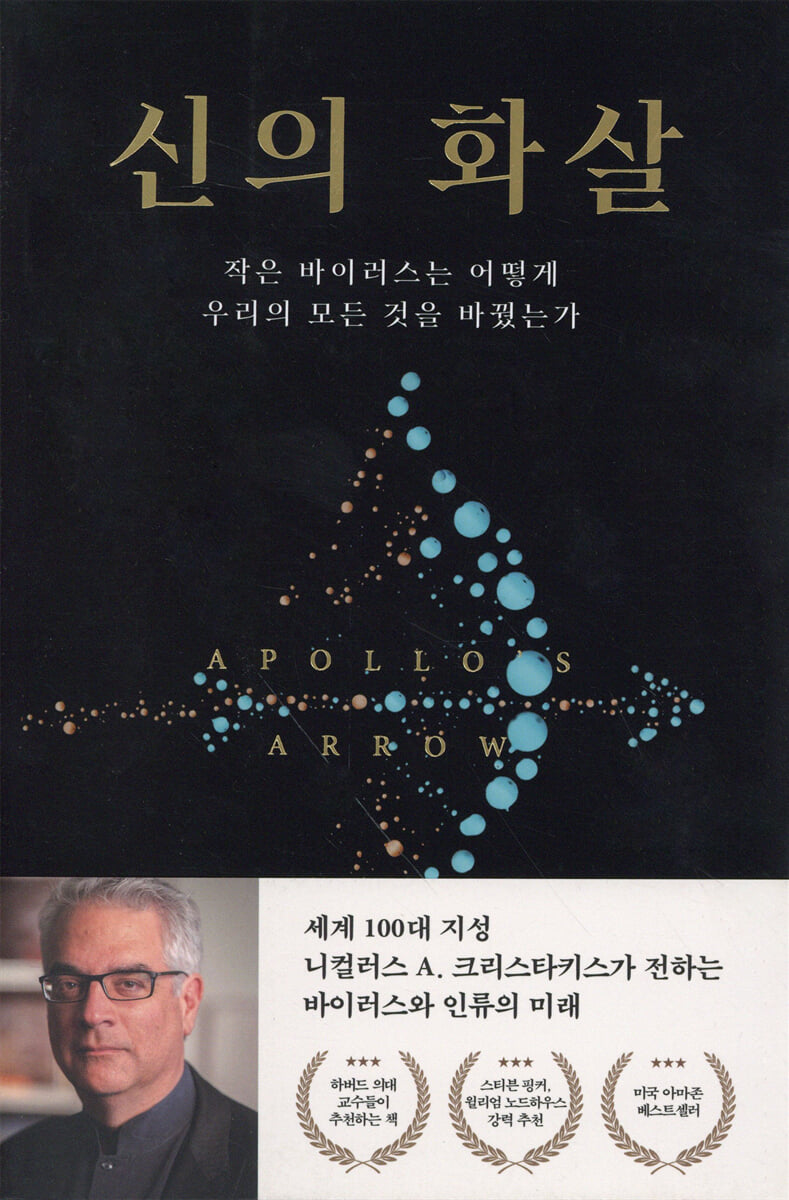
Arrow of God
 |
Description
Book Introduction
Selected as a "Best Masterpiece" by the Times Literary Supplement in 2020 Highly recommended by Steven Pinker, Paul Farmer, Jeffrey Flier, and William Nordhaus. "Next Corona: What Future Will We Await After the Vaccine?" Christakis's sobering predictions are presented in the 2021 Korean edition, now available exclusively worldwide. A preface has been added. During the Trojan War, Apollo aimed his silver bow and rained down arrows, bringing a plague upon the Greeks. It was punishment for the Greeks for kidnapping and not releasing Chryseis, the daughter of a priest who served him. Now, 3,000 years after the Trojan War described in the Iliad, I watched the unfolding events before my eyes, and involuntarily recalled Apollo's vengeance. (prolog) In 2020, why did God shoot us with the arrow of death, and what questions does it leave us with? Nicholas A., a physician, sociologist, public health scientist, and biologist, and author named one of Foreign Policy's "100 Most Influential Minds," addresses this question. Christakis. To answer this question, he draws on medicine, sociology, epidemiology, data science, and genetics to provide the wisdom we need as we navigate the post-COVID-19 era. Armed with both scientific knowledge and humanistic insight, he unfolds the truth and discourse surrounding the pandemic from a multi-layered context, sometimes coolly and sometimes profoundly. Through his unique perspective, we see clearly what COVID-19 has taken from us, what it has left behind, and what truths hidden beneath our society have been revealed by that tiny virus. Additionally, you will receive practical guidance on the changes that humanity will experience in the future. Meanwhile, the author's integrated and balanced perspective, having cared for patients as a doctor and protected the socially vulnerable as a sociologist, explores areas that have inevitably been left blank in the post-COVID discourse. In this book, he explores the reality of the current human race as revealed by the invisible virus COVID-19 and what happens when the powerful force of the virus meets the evolved social nature of humans in the most sophisticated, analytical, and objective way. Especially as of June 2021, when the world is facing the next post-vaccine Corona, Christakis adds a special preface and afterword to the Korean edition, and predicts the "era after" with a cool-headed eye. |
- You can preview some of the book's contents.
Preview
index
prolog
2021 Korean Edition Preface _ After the Vaccine, God Hasn't Shed His Bow Yet
Chapter 1.
Tiny Beings _ A Tiny Virus Covers the World
Chapter 2.
The Return of the Natural Enemy: Viruses and Pandemics That Threaten Humanity
Chapter 3.
Disconnection: How COVID-19 Led to Global Loss
Chapter 4.
Grief, Fear, and Lies: How Emotional Contagions Spread and Distort
Chapter 5.
Us and Others _ Line-drawing and witch-hunting driven by fear of spread
Chapter 6.
Solidarity _ Hope that grows from the good instincts of human beings
Chapter 7.
Change - What Changes and What Remains
Chapter 8.
The End of the Plague: In the Aftermath of Chaos, Asking the Path of Humanity
Epilogue _ The Next Pandemic, Before Facing a New Virus
2021 Korean Edition Preface _ After the Vaccine, God Hasn't Shed His Bow Yet
Chapter 1.
Tiny Beings _ A Tiny Virus Covers the World
Chapter 2.
The Return of the Natural Enemy: Viruses and Pandemics That Threaten Humanity
Chapter 3.
Disconnection: How COVID-19 Led to Global Loss
Chapter 4.
Grief, Fear, and Lies: How Emotional Contagions Spread and Distort
Chapter 5.
Us and Others _ Line-drawing and witch-hunting driven by fear of spread
Chapter 6.
Solidarity _ Hope that grows from the good instincts of human beings
Chapter 7.
Change - What Changes and What Remains
Chapter 8.
The End of the Plague: In the Aftermath of Chaos, Asking the Path of Humanity
Epilogue _ The Next Pandemic, Before Facing a New Virus
Detailed image

Into the book
The gods of Greek mythology were always with me as a child.
--- First sentence
The devastating COVID-19 pandemic in the United States now appears to be coming to an end, or at least entering the process of ending.
But the adversity wasn't over.
The United States, and indeed all of humanity, will inevitably suffer the enormous clinical, psychological, economic, and social repercussions of the virus.
--- p.21
Humanity must find a compromise with this virus.
But until then, many sacrifices are inevitable.
New pathogens have already established themselves in the human world and will be with us in one form or another forever.
--- p.66
Epidemics often delve into the most fundamental and evolved aspects of human nature.
Humans are animals that evolved to live in groups and get along with each other.
They are animals that share affection and intimacy through physical contact, and mourn by burying the dead.
If we had each lived in seclusion, we would not have fallen victim to the plague.
The pathogens that spread epidemics and take our lives often do so for the very reason that makes us human.
--- p.130
We have suffered countless moments of despair, both from the wounds caused by the virus itself and from the wounds caused by our response to the virus.
In addition to this double biological and social shock, we faced the uncertainty of what path lay ahead.
--- p.248
As strong and organized national action is essential to achieving quarantine, the government's role itself is expected to grow in the future.
Such trends could continue from the pandemic phase into the post-pandemic period.
As the pandemic worsens, people expect more from themselves, from others, and from their country.
--- pp.411-412
Many of the challenges facing pandemics—the need for international cooperation, the burden-sharing issue between neighboring countries, respect for science-based expert opinions, complex political factors—also involve climate change.
So, in a way, the COVID-19 pandemic presents a rehearsal opportunity to prepare not only for future pandemics but also for other massive global challenges.
--- First sentence
The devastating COVID-19 pandemic in the United States now appears to be coming to an end, or at least entering the process of ending.
But the adversity wasn't over.
The United States, and indeed all of humanity, will inevitably suffer the enormous clinical, psychological, economic, and social repercussions of the virus.
--- p.21
Humanity must find a compromise with this virus.
But until then, many sacrifices are inevitable.
New pathogens have already established themselves in the human world and will be with us in one form or another forever.
--- p.66
Epidemics often delve into the most fundamental and evolved aspects of human nature.
Humans are animals that evolved to live in groups and get along with each other.
They are animals that share affection and intimacy through physical contact, and mourn by burying the dead.
If we had each lived in seclusion, we would not have fallen victim to the plague.
The pathogens that spread epidemics and take our lives often do so for the very reason that makes us human.
--- p.130
We have suffered countless moments of despair, both from the wounds caused by the virus itself and from the wounds caused by our response to the virus.
In addition to this double biological and social shock, we faced the uncertainty of what path lay ahead.
--- p.248
As strong and organized national action is essential to achieving quarantine, the government's role itself is expected to grow in the future.
Such trends could continue from the pandemic phase into the post-pandemic period.
As the pandemic worsens, people expect more from themselves, from others, and from their country.
--- pp.411-412
Many of the challenges facing pandemics—the need for international cooperation, the burden-sharing issue between neighboring countries, respect for science-based expert opinions, complex political factors—also involve climate change.
So, in a way, the COVID-19 pandemic presents a rehearsal opportunity to prepare not only for future pandemics but also for other massive global challenges.
--- p.483
Publisher's Review
“The events of 2020 were not something new to humanity.
“It was just something we experienced for the first time.”
A unique perspective that crosses medicine, sociology, epidemiology, data science, and genetics!
In early 2020, we were all hit by the gods' arrows of death, just like in the Trojan War in the Iliad, and as of the summer of 2021, 4 million people have died.
Even after that, we continued to suffer from the physical pain caused by the virus, as well as the reality of relying on scattered, inaccurate information and false information, and we had to witness the darkness and true face of our society.
Nicholas Christakis offers clear fact-checking and predictions on the ever-present question of "life after the vaccine," while also delving into the biological and social landscape of our time from 2020 to the present, examining how humanity has navigated similar disasters in the past.
With a unique background as a physician, sociologist, biologist, and public health scientist, he diagnoses the pandemic with a uniquely comprehensive perspective.
We analyze the epidemiological characteristics of COVID-19, which, unlike previous novel viruses, led to a global catastrophe, and use genetic technology to understand the process of its spread.
We also explore the impact of non-pharmaceutical interventions implemented in each country on curbing the spread of the pandemic from a data science perspective.
This meticulous and detailed analysis of the causal relationships of infectious diseases goes beyond simply documenting the facts of COVID-19.
Professor Christakis presents the global shock situation in a coherent way and suggests a direction for our society and its members to move forward.
Beyond the scattered and fragmented knowledge we've encountered through the news, here lies the most essential knowledge, filtered through academic fields like medicine, sociology, genetics, and data science.
This is the only book that provides intellectual insight into the pandemic we have experienced. Harvard professor Steven Pinker said of this book, “If you want to understand the virus that has completely changed the world and our lives, you must read this book.
“This is a very important book for us today,” he commented.
"After the vaccine, God still hasn't put away his bow."
The profound and lasting impact of the coronavirus on how we live.
There is no end in sight.
In the summer of 2021, the fourth wave of the pandemic began in South Korea.
This is because the mutant virus, 'Delta Virus', is showing unprecedented contagiousness.
The world, which was filled with optimism that a vaccine could be developed, vaccinations began, and that we could finally return to the pre-COVID-19 era, has been subdued again by the emergence of a mutant virus.
What does it mean to imagine and prepare for the 'post-corona' era in this context?
Before facing this, Christakis, who served as a professor at Harvard Medical School for 13 years, answers the following questions that we must address now with the cool-headed perspective that only a medical professional can.
ㆍ Could the virus mutate into a form that completely evades the currently available vaccines?
Among the various quarantine measures adopted around the world, which have been most effective, and what measures should be implemented to prepare for a resurgence?
ㆍ What should we do to prevent the virus from continuing to mutate?
How can we overcome vaccine hesitancy?
Even if we successfully overcome this pandemic, there are still fundamental measures we need to address.
Will we be better prepared next time? How lethal will the pathogen causing the next pandemic be? How long will it take for a new pandemic to strike? As we navigate the pandemics of 2020 and 2021, we may be undergoing a kind of rehearsal for a larger global catastrophe.
This is why we should heed Christakis's suggestions, which address the need for international cooperation, the burden-sharing issue among neighboring countries, respect for science-based expert opinions, and complex political factors.
"Arrow of God" provides meaningful insight to "Corona Sapiens," who must thoroughly prepare for this new crisis and live a life different from before.
Above all, anyone who wants to seriously think about the experience of the pandemic needs to at least once go through the narrative of COVID-19 and humanity captured by Christakis.
How COVID-19 has led to global loss
Here, right now, we encounter the most significant side of the pandemic.
The author keenly diagnoses the problems faced by our social leaders and the social structural situation through a sociological perspective.
This includes the Chinese authorities' initial concealment of the virus outbreak for the sake of the Party Congress, and the US government's complacent attitude in responding a step too late when the outbreak began.
As I read through the flow of the pandemic he conveys, I begin to think that this pandemic may be, to some extent, a man-made disaster.
If we look closely at the discourse he presents, the dark side of society revealed by the virus is clearly revealed.
Early in the pandemic, we saw a frustrating number of attempts, both collectively and individually, to create divisions and arbitrary boundaries.
This has led to persistent discrimination by distinguishing between residential environments and occupations that are more likely to expose people to outbreaks, further exacerbating and exposing the inequalities that permeate our society.
He emphasizes solidarity and collective quarantine efforts to resolve this.
In the ongoing battle between humanity and this new virus, the only thing we can and must do is to confront it with good thoughts and altruistic actions like these.
The prevailing view is that humanity will never be able to return to the way things were before 2020.
Before seeking opportunities in these disruptive changes, the author urges us to consider the social and structural problems they will create.
Examples include privacy violations related to learning or work occurring in remote locations, and the cascading effects of non-face-to-face interactions becoming the norm, leading to massive job losses in related industries.
The author asks what citizens should do and what role politics should play to prevent the "normal" we seek to regain from becoming a tragedy for some.
“In a way, the COVID-19 pandemic presents a rehearsal opportunity to prepare not only for future pandemics but also for other massive global challenges.
We have now become somewhat accustomed to the age-old threat of plague.
And I know it very well.
The book's final sentence, "To navigate this pandemic, both leaders and we ourselves must demonstrate wisdom," is very significant.
“It was just something we experienced for the first time.”
A unique perspective that crosses medicine, sociology, epidemiology, data science, and genetics!
In early 2020, we were all hit by the gods' arrows of death, just like in the Trojan War in the Iliad, and as of the summer of 2021, 4 million people have died.
Even after that, we continued to suffer from the physical pain caused by the virus, as well as the reality of relying on scattered, inaccurate information and false information, and we had to witness the darkness and true face of our society.
Nicholas Christakis offers clear fact-checking and predictions on the ever-present question of "life after the vaccine," while also delving into the biological and social landscape of our time from 2020 to the present, examining how humanity has navigated similar disasters in the past.
With a unique background as a physician, sociologist, biologist, and public health scientist, he diagnoses the pandemic with a uniquely comprehensive perspective.
We analyze the epidemiological characteristics of COVID-19, which, unlike previous novel viruses, led to a global catastrophe, and use genetic technology to understand the process of its spread.
We also explore the impact of non-pharmaceutical interventions implemented in each country on curbing the spread of the pandemic from a data science perspective.
This meticulous and detailed analysis of the causal relationships of infectious diseases goes beyond simply documenting the facts of COVID-19.
Professor Christakis presents the global shock situation in a coherent way and suggests a direction for our society and its members to move forward.
Beyond the scattered and fragmented knowledge we've encountered through the news, here lies the most essential knowledge, filtered through academic fields like medicine, sociology, genetics, and data science.
This is the only book that provides intellectual insight into the pandemic we have experienced. Harvard professor Steven Pinker said of this book, “If you want to understand the virus that has completely changed the world and our lives, you must read this book.
“This is a very important book for us today,” he commented.
"After the vaccine, God still hasn't put away his bow."
The profound and lasting impact of the coronavirus on how we live.
There is no end in sight.
In the summer of 2021, the fourth wave of the pandemic began in South Korea.
This is because the mutant virus, 'Delta Virus', is showing unprecedented contagiousness.
The world, which was filled with optimism that a vaccine could be developed, vaccinations began, and that we could finally return to the pre-COVID-19 era, has been subdued again by the emergence of a mutant virus.
What does it mean to imagine and prepare for the 'post-corona' era in this context?
Before facing this, Christakis, who served as a professor at Harvard Medical School for 13 years, answers the following questions that we must address now with the cool-headed perspective that only a medical professional can.
ㆍ Could the virus mutate into a form that completely evades the currently available vaccines?
Among the various quarantine measures adopted around the world, which have been most effective, and what measures should be implemented to prepare for a resurgence?
ㆍ What should we do to prevent the virus from continuing to mutate?
How can we overcome vaccine hesitancy?
Even if we successfully overcome this pandemic, there are still fundamental measures we need to address.
Will we be better prepared next time? How lethal will the pathogen causing the next pandemic be? How long will it take for a new pandemic to strike? As we navigate the pandemics of 2020 and 2021, we may be undergoing a kind of rehearsal for a larger global catastrophe.
This is why we should heed Christakis's suggestions, which address the need for international cooperation, the burden-sharing issue among neighboring countries, respect for science-based expert opinions, and complex political factors.
"Arrow of God" provides meaningful insight to "Corona Sapiens," who must thoroughly prepare for this new crisis and live a life different from before.
Above all, anyone who wants to seriously think about the experience of the pandemic needs to at least once go through the narrative of COVID-19 and humanity captured by Christakis.
How COVID-19 has led to global loss
Here, right now, we encounter the most significant side of the pandemic.
The author keenly diagnoses the problems faced by our social leaders and the social structural situation through a sociological perspective.
This includes the Chinese authorities' initial concealment of the virus outbreak for the sake of the Party Congress, and the US government's complacent attitude in responding a step too late when the outbreak began.
As I read through the flow of the pandemic he conveys, I begin to think that this pandemic may be, to some extent, a man-made disaster.
If we look closely at the discourse he presents, the dark side of society revealed by the virus is clearly revealed.
Early in the pandemic, we saw a frustrating number of attempts, both collectively and individually, to create divisions and arbitrary boundaries.
This has led to persistent discrimination by distinguishing between residential environments and occupations that are more likely to expose people to outbreaks, further exacerbating and exposing the inequalities that permeate our society.
He emphasizes solidarity and collective quarantine efforts to resolve this.
In the ongoing battle between humanity and this new virus, the only thing we can and must do is to confront it with good thoughts and altruistic actions like these.
The prevailing view is that humanity will never be able to return to the way things were before 2020.
Before seeking opportunities in these disruptive changes, the author urges us to consider the social and structural problems they will create.
Examples include privacy violations related to learning or work occurring in remote locations, and the cascading effects of non-face-to-face interactions becoming the norm, leading to massive job losses in related industries.
The author asks what citizens should do and what role politics should play to prevent the "normal" we seek to regain from becoming a tragedy for some.
“In a way, the COVID-19 pandemic presents a rehearsal opportunity to prepare not only for future pandemics but also for other massive global challenges.
We have now become somewhat accustomed to the age-old threat of plague.
And I know it very well.
The book's final sentence, "To navigate this pandemic, both leaders and we ourselves must demonstrate wisdom," is very significant.
GOODS SPECIFICS
- Publication date: July 30, 2021
- Page count, weight, size: 548 pages | 746g | 145*220*26mm
- ISBN13: 9791155813720
- ISBN10: 1155813723
You may also like
카테고리
korean


korean

![ELLE 엘르 스페셜 에디션 A형 : 12월 [2025]](http://librairie.coreenne.fr/cdn/shop/files/b8e27a3de6c9538896439686c6b0e8fb.jpg?v=1766436872&width=3840)


