

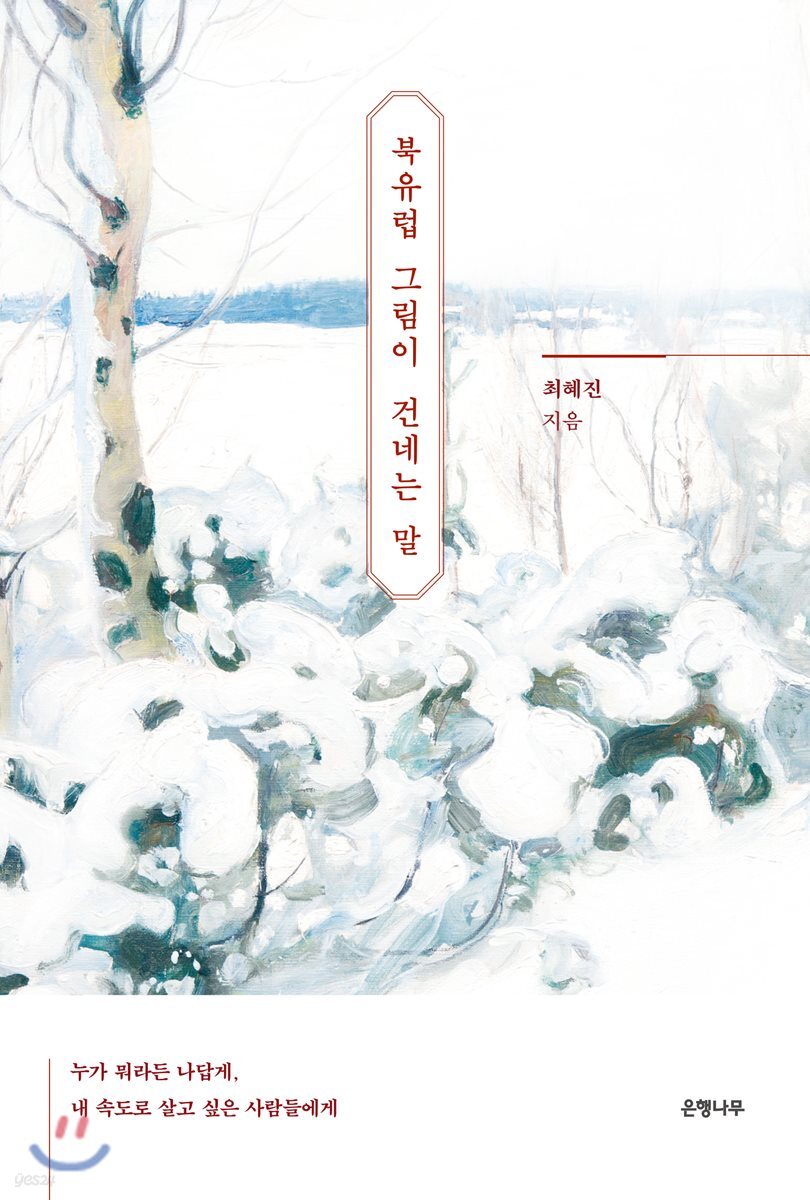
What Nordic paintings say
 |
Description
Book Introduction
A mind that doesn't get impatient Attitude of seeking small meanings An attitude of caring for body, mind, and relationships If this is not happiness, then what can be called happiness? On a trip to Northern European art museums, wherever my feet took me The sense of life slowly recovering Everyone has an encounter that shakes up their life. Author Choi Hye-jin, who became fascinated with paintings after visiting Vincent van Gogh's grave and became an 'art museum traveler' as her intuition led her. When she was so tired and worn out that nothing she saw inspired her, she went to an art gallery in a faraway country. The paintings he encountered with both feet and both eyes so earnestly became stepping stones that allowed him to silently cross the harsh reality as he passed through his thirties. The stepping stones became writings and published the books, “Ask Me a Question from a Masterpiece,” “Asking My Heart to Picture Books,” and “Asking European Picture Book Writers.” This new book, "What Nordic Paintings Say," is a record of the past three years spent as a "conscientious art museum traveler," visiting art museums in unfamiliar Nordic cities such as Copenhagen, Oslo, Bergen, Stockholm, Mora, Helsinki, Gothenburg, Skagen, Randers, and Aarhus. The world of modern Nordic art, which we encounter on foot, is full of beings who speak ceaselessly. Wilhelm Hammershøi, Christian Krogh, Anna Anscher, Carl Larsson, Harriet Bakker… … They were unfamiliar painters whose names were hard to even guess how to pronounce, but the moment I laid eyes on their paintings, a bell-like sound rang inside me. The intuitive signals that spread throughout my body finally let go of my impatience, anxiety, self-destruction and self-discord, and allowed me to face myself as I am. When life becomes overwhelming, when the daily grind becomes overwhelming, when I feel my existence is easily erased, and when I feel fearful and depressed, I hope that, like the author, I can extend a hand of reconciliation to all that has been in conflict through Nordic paintings. -“This book is a story about the process of crossing from here to there. It is a story of parting with the times when I often exhausted myself by confusing self-exploitation with passion. “It is a story about erasing the marks left by hierarchy, a story about taking one’s eyes off the outside world, a story about fitting oneself into the answer “I can do it” and then accepting that one cannot, a story about failure, a story about extending a handshake of reconciliation to those who were in conflict.” (From the Author’s Note) |
- You can preview some of the book's contents.
Preview
index
Author's Note
A Journey Through the Nordic Art Museums
Chapter 1
The ambiguity of life makes us grow.
Wilhelm Hammershøi
Chapter 2
Beauty is everywhere
17th-century Dutch genre painting
Chapter 3
What kind of immersion is more important than immersion itself
Christian Krogh
Chapter 4
Saying you like someone is courageous.
Three female Danish artists
Chapter 5
Erase competition and hierarchy, starting from within me now.
Skagen, a community of modern Nordic painters
Chapter 6
A concrete sense of life comes from 'living'
Ana Ancher and Viggo Johansen
Chapter 7
Because it will eventually disappear, I will do my best
Heisbrecht
Chapter 8
I seek small meanings in eating and writing.
Michael Anscher and Gustav Wentzel et al.
Chapter 9
Don't get stuck in roles and duties.
Harriet Bakker
Chapter 10
Do you have your own room where you feel safe?
Carl Larsson
Chapter 11
What you lose outside can be found inside.
Wilhelm Rundström and Finn Juhl
Chapter 12
Don't cut the buds of imagination
CW Ekersberg
Chapter 13
As long as it's fun, that's enough
Peter Hansen and Hendrik Averkamp
Chapter 14
Because we are all different
Christen Köbke and Friedrich
Chapter 15
If you accept that you can't do it
Peder Walshé
Chapter 16
When you make eye contact, you see a lot.
Martin Schöller
Chapter 17
Let go of fixed aesthetics
The activities of female painters in Northern Europe
Chapter 18
Listen to the silence
Gustav Fiestad
Chapter 19
It's the most fascinating because it's the most vulnerable.
Yuho Risanen
Chapter 20
I will finally become the master of my own life
Edvard Munch
Closing remarks
Appendix: Scenes from Modern Art History in Europe and Northern Europe
A Journey Through the Nordic Art Museums
Chapter 1
The ambiguity of life makes us grow.
Wilhelm Hammershøi
Chapter 2
Beauty is everywhere
17th-century Dutch genre painting
Chapter 3
What kind of immersion is more important than immersion itself
Christian Krogh
Chapter 4
Saying you like someone is courageous.
Three female Danish artists
Chapter 5
Erase competition and hierarchy, starting from within me now.
Skagen, a community of modern Nordic painters
Chapter 6
A concrete sense of life comes from 'living'
Ana Ancher and Viggo Johansen
Chapter 7
Because it will eventually disappear, I will do my best
Heisbrecht
Chapter 8
I seek small meanings in eating and writing.
Michael Anscher and Gustav Wentzel et al.
Chapter 9
Don't get stuck in roles and duties.
Harriet Bakker
Chapter 10
Do you have your own room where you feel safe?
Carl Larsson
Chapter 11
What you lose outside can be found inside.
Wilhelm Rundström and Finn Juhl
Chapter 12
Don't cut the buds of imagination
CW Ekersberg
Chapter 13
As long as it's fun, that's enough
Peter Hansen and Hendrik Averkamp
Chapter 14
Because we are all different
Christen Köbke and Friedrich
Chapter 15
If you accept that you can't do it
Peder Walshé
Chapter 16
When you make eye contact, you see a lot.
Martin Schöller
Chapter 17
Let go of fixed aesthetics
The activities of female painters in Northern Europe
Chapter 18
Listen to the silence
Gustav Fiestad
Chapter 19
It's the most fascinating because it's the most vulnerable.
Yuho Risanen
Chapter 20
I will finally become the master of my own life
Edvard Munch
Closing remarks
Appendix: Scenes from Modern Art History in Europe and Northern Europe
Detailed image

Into the book
Choose and execute what you want and decide to do.
Danish female painters Marie Krøyer, Anna Anscher, and Lili Elbe teach us how to take charge of our own lives.
The now common and worn-out phrase ‘finding oneself’ is also comforting in that it was not easy to begin with.
With encouragement to keep fighting.
It reminds me of the truth that the journey begins with the small courage to say that you like what you like, something I lacked back then when I was fascinated by the word 'Denmark' printed on a dark blue milk carton.
--- p.63
The coincidence of the museum you planned to visit being closed for emergency renovations, the coincidence of missing the train because you missed the ticket time and taking the bus instead, the coincidence of chatting excitedly about each other's movie tastes with the stranger sitting next to you on the bus, the coincidence of being disappointed by the artwork you originally visited at the art museum you planned to visit and instead discovering an unknown painter, the coincidence of walking wherever your feet lead you and meeting a pretty cat in a small alleyway...
If time passed predictably, without such coincidences, travel would lose its luster.
--- p.75
Food made with healthy ingredients, neat arrangements on ceramic dishes, a space where you can feel a sense of relief when you lean against it with your tired body, a mind free from impatience, and deep conversations that consider each other's concerns...
These things don't happen by themselves.
It is possible only if you choose to give beauty to it and nurture it.
A space known only to me, untouched by the gaze of others, a daily radius, a body, mind, and relationship, an attitude of cultivating, and an attitude of cherishing the simple sense of life.
In the end, it's about the heart of living.
--- p.92
When I think about it, it seems like my mother indirectly realized what lay beyond the traditional daughter role she was forced to play while raising me to be independent.
'Is this okay?' I gradually let go of my anxious feelings and, with a sense of relief that 'this is okay,' I continued to send myself out into the wide world.
If a mother's will to maintain family peace by effortlessly fulfilling the roles of a daughter and daughter-in-law expected by society (Ego 1) and her will to break free from the mold and live as a complete self (Ego 2) were to meet at a crossroads and negotiate, what final choice would she make? --- p.127
When I think about the attitude of life that seeks answers within, cultivates within, is satisfied within, and highly values within, something in my heart suddenly reacts.
I was reminded of myself in the past, when I was exposed to voices whispering to me that everything from health and appearance to wealth and social achievement was a matter of performance, that I could achieve anything if I just worked hard, that I should aim high, that I should not be easily satisfied, that I should exploit myself.
Meritocracy and materialism have worked plausibly for a long time.
I didn't cultivate the inside, I wasn't satisfied with the inside, and I didn't value the inside highly.
To forget the fatigue and tension of competition, we indulged in immediate achievement, stimulation, and fun, and for that very reason, we easily became bored.
--- p.159
Since we are all different anyway, if I approach my truest self, my unique color will naturally emerge, so let's not torment ourselves by forcing ourselves into a unfair competitive structure.
After shaking it off like this, I fell asleep in a trance.
Thankfully, the me of 1999 and the me of now are so different.
--- p.193
The moment I embrace the inevitable, I can focus on what is allowed to me now, here, today.
Fear and trembling will never go away, but at least you can learn to live with them.
--- p.205
Munch never placed himself in the position of a victim during the many difficult times in his life.
He declared in the face of the death of a family member, a strange love affair, and intense emotions that had left him with a fundamental sense of anxiety.
Life is not kind at all, but I will not just suffer, but experience, understand, accept, and overcome it, and ultimately become the master and author of my life.
The thousands of paintings Munch left behind were traces of the promises he repeated as if casting a spell.
Danish female painters Marie Krøyer, Anna Anscher, and Lili Elbe teach us how to take charge of our own lives.
The now common and worn-out phrase ‘finding oneself’ is also comforting in that it was not easy to begin with.
With encouragement to keep fighting.
It reminds me of the truth that the journey begins with the small courage to say that you like what you like, something I lacked back then when I was fascinated by the word 'Denmark' printed on a dark blue milk carton.
--- p.63
The coincidence of the museum you planned to visit being closed for emergency renovations, the coincidence of missing the train because you missed the ticket time and taking the bus instead, the coincidence of chatting excitedly about each other's movie tastes with the stranger sitting next to you on the bus, the coincidence of being disappointed by the artwork you originally visited at the art museum you planned to visit and instead discovering an unknown painter, the coincidence of walking wherever your feet lead you and meeting a pretty cat in a small alleyway...
If time passed predictably, without such coincidences, travel would lose its luster.
--- p.75
Food made with healthy ingredients, neat arrangements on ceramic dishes, a space where you can feel a sense of relief when you lean against it with your tired body, a mind free from impatience, and deep conversations that consider each other's concerns...
These things don't happen by themselves.
It is possible only if you choose to give beauty to it and nurture it.
A space known only to me, untouched by the gaze of others, a daily radius, a body, mind, and relationship, an attitude of cultivating, and an attitude of cherishing the simple sense of life.
In the end, it's about the heart of living.
--- p.92
When I think about it, it seems like my mother indirectly realized what lay beyond the traditional daughter role she was forced to play while raising me to be independent.
'Is this okay?' I gradually let go of my anxious feelings and, with a sense of relief that 'this is okay,' I continued to send myself out into the wide world.
If a mother's will to maintain family peace by effortlessly fulfilling the roles of a daughter and daughter-in-law expected by society (Ego 1) and her will to break free from the mold and live as a complete self (Ego 2) were to meet at a crossroads and negotiate, what final choice would she make? --- p.127
When I think about the attitude of life that seeks answers within, cultivates within, is satisfied within, and highly values within, something in my heart suddenly reacts.
I was reminded of myself in the past, when I was exposed to voices whispering to me that everything from health and appearance to wealth and social achievement was a matter of performance, that I could achieve anything if I just worked hard, that I should aim high, that I should not be easily satisfied, that I should exploit myself.
Meritocracy and materialism have worked plausibly for a long time.
I didn't cultivate the inside, I wasn't satisfied with the inside, and I didn't value the inside highly.
To forget the fatigue and tension of competition, we indulged in immediate achievement, stimulation, and fun, and for that very reason, we easily became bored.
--- p.159
Since we are all different anyway, if I approach my truest self, my unique color will naturally emerge, so let's not torment ourselves by forcing ourselves into a unfair competitive structure.
After shaking it off like this, I fell asleep in a trance.
Thankfully, the me of 1999 and the me of now are so different.
--- p.193
The moment I embrace the inevitable, I can focus on what is allowed to me now, here, today.
Fear and trembling will never go away, but at least you can learn to live with them.
--- p.205
Munch never placed himself in the position of a victim during the many difficult times in his life.
He declared in the face of the death of a family member, a strange love affair, and intense emotions that had left him with a fundamental sense of anxiety.
Life is not kind at all, but I will not just suffer, but experience, understand, accept, and overcome it, and ultimately become the master and author of my life.
The thousands of paintings Munch left behind were traces of the promises he repeated as if casting a spell.
--- p.257
Publisher's Review
Pictures that quietly speak to you when life becomes rigid and tangled
―“Life’s ambiguity propels us forward.”
Wilhelm Hammershøi, a painter whose name is unfamiliar to us, is the one who led the author into the world of Nordic painting.
A painter who honestly explored only gray.
And so, the painter who opened up the possibility of gray.
When the mindset of deciding that something is either this or that, for or against, on my side or against, first place or loser becomes a chain of wounds not only for oneself but also for others, the picture of the Hammers Conference expands the closed view by showing that even 'gray' can be beautiful enough.
His paintings, which intentionally do not reveal the decisive moment, let alone the answer or interpretation, also reveal the essence of life.
Life is about moving forward without knowing anything.
It is the ambiguity of life that makes us evolve.
The awareness that 'I know nothing' is also fully reflected in the vast Nordic landscapes left behind by the painter Peder Walsche.
Whether in the face of overwhelming nature or the absurdity of life, it is about recognizing my weakness, insignificance, and helplessness, and accepting that I cannot do it.
Perhaps the moment we grow is not the moment we move forward, but the moment we stop.
Rather than stamping our feet in the face of limitations beyond our ability to object, in the face of everything that moves away regardless of our will, when we face and accept uncertainty, we can look at the life we have taken for granted differently, as the paintings of the master of trompe l'oeil, Heisbrecht, so vividly show.
―“A concrete sense of life comes from ‘living.’”
Northern European paintings, more than anything else, depict not a world of grand causes and ideas, but a world of concrete practices: home, food, and daily life.
Warm moments of patching up a hole in a piece of cloth, knitting, picking wildflowers and arranging them in a vase, huddled together in a soft light to chat, and sitting around the table with the children, each practicing their drawing skills.
In particular, 17th-century Dutch genre painters demonstrated that beauty could reside not only in massive crosses, majestic cathedral columns, and solemn statues of saints and great men, but also in wooden cabinets polished to a gleaming shine by countless mops, and the shoulders of women peeling onions.
In front of these paintings, we read about 'hygge' and 'lagom', Nordic lifestyles that have taken the world by storm.
A mind free from impatience, deep conversations that consider each other's concerns, food made with healthy ingredients, a space where you can lean back and feel a sense of relief when you're tired... these things don't happen naturally.
It is possible only if you choose to give beauty to it and nurture it.
In the end, what is needed is a ‘heart to live.’
Perhaps these are the values that Northern European painters like Anna Ancher and Viggo Johansen sought to capture through the diligent gestures, unassuming expressions, and orderly spatial arrangements of those doing housework. When we cultivate our bodies, minds, and relationships with a housekeeping mindset, we can experience life more vividly.
―“Erase competition and hierarchy, starting from within me now.”
In Skagen, a seaside town home to a community of modern Northern European painters, I encountered paintings that purely captured the essence of their lives, without separating daily life from art.
I will only have the solid grains I have gained through the struggles of life, and I will accept my shortcomings.
This is a theme that runs through Nordic art, from painters active in Skagen to contemporary designers.
The self-affirmation that their current life is quite plausible, despite having never been a protagonist in European history, has made the Nordic people completely attached to their lives.
This attitude of 'self-sufficiency' is P.
It is also clearly revealed in the paintings of S. Kröyer, Christian Krogh, and Viggo Johansen.
Have we been exposed for too long to voices that whisper that everything from health and appearance to wealth and social achievement is up to us, that we should aim high, that we shouldn't be easily satisfied, that we should exploit ourselves more?
The affirmation of everyday life shown in Nordic paintings allows us to move from 'I could have done better' to 'This is enough.'
Erasing the voice of performance-based pay.
More fundamentally, it fosters a self-sufficient attitude, one that is content with one's fate and does not pressure oneself.
―“Let go of fixed aesthetics, roles, and duties.”
‘Women’ are not objects to be gazed at and admired like flowers, but rather ‘women’ are beings who work and live independently.
The women we encounter in Nordic paintings are different from those in other paintings.
Western European paintings often depict women preening or examining themselves in front of a mirror, often featuring nude women gazing at the viewer with a captivating gaze.
However, in the paintings of contemporary Northern European painters, women cook or read or write something when they are alone.
Even in the nude paintings by the painter Anders Zorn, the feeling of undressing to meet the viewer's expectations is not expressed, but rather the image of a woman shedding her cumbersome social self and approaching herself as a part of nature.
How is this difference possible? It becomes clear when we look at the work of female painters from Northern Europe.
According to one record, of the twelve painters who received the Finnish Art Society's Prize for New Painters in 1858, no fewer than eleven were women.
The paintings of Northern European female painters, such as the painter Harriet Bakker, who chose to live as an “artist” rather than a “daughter” and proved her choice throughout her life, awaken us from our tiredness of fixed aesthetics, roles, and duties.
It pushes us to go beyond our duties as women, beyond the fence, to a place where all the voices that constrain our behavior have disappeared, to a place where we can read and speak about the world in our own language, to a place where our opinions are respected as equals.
“It doesn’t take much to find the strength to keep going.”
How to live life at my own pace, completely my own way, no matter what anyone says.
In this craze for small but certain happiness, this widespread trend of labeling even the most trivial items with the label "Nordic," what should we truly understand? On a 24,870-kilometer journey, author Choi Hye-jin flew to Nordic cities whenever she had a spare moment, visiting art galleries. What she discovered was that modern Nordic paintings didn't separate "beauty" from "life."
Life couldn't have been infinitely beautiful.
There's no way it was safe.
Although there was certainly hardship, tedium, frustration, and suffering within it, there is a power in Nordic paintings to positively view reality.
What we should read from the small but certain happiness craze, the "Nordic style" craze, may be the desire to live a little differently, the wish to acknowledge limitations and seek small meanings and small happinesses, and the hope that our daily lives will not be something we have to sacrifice ourselves to maintain.
No matter what anyone says, I have to live my life at my own pace, in my own way.
Those who struggle with the double and triple burden of daily life as a self-sufficient being, a breadwinner, and a member of a family, yet who wish to hold on to their own unique sensibilities and the power of a perspective that silently affirms their own individuality and lives without losing their individuality, may want to stop for a moment and open this book.
Just like the painter Edvard Munch, life is not kind at all, but rather than just suffering, through the process of experiencing, understanding, accepting, and overcoming, the day will soon come when I will ultimately stand as the master of my own life.
―“Life’s ambiguity propels us forward.”
Wilhelm Hammershøi, a painter whose name is unfamiliar to us, is the one who led the author into the world of Nordic painting.
A painter who honestly explored only gray.
And so, the painter who opened up the possibility of gray.
When the mindset of deciding that something is either this or that, for or against, on my side or against, first place or loser becomes a chain of wounds not only for oneself but also for others, the picture of the Hammers Conference expands the closed view by showing that even 'gray' can be beautiful enough.
His paintings, which intentionally do not reveal the decisive moment, let alone the answer or interpretation, also reveal the essence of life.
Life is about moving forward without knowing anything.
It is the ambiguity of life that makes us evolve.
The awareness that 'I know nothing' is also fully reflected in the vast Nordic landscapes left behind by the painter Peder Walsche.
Whether in the face of overwhelming nature or the absurdity of life, it is about recognizing my weakness, insignificance, and helplessness, and accepting that I cannot do it.
Perhaps the moment we grow is not the moment we move forward, but the moment we stop.
Rather than stamping our feet in the face of limitations beyond our ability to object, in the face of everything that moves away regardless of our will, when we face and accept uncertainty, we can look at the life we have taken for granted differently, as the paintings of the master of trompe l'oeil, Heisbrecht, so vividly show.
―“A concrete sense of life comes from ‘living.’”
Northern European paintings, more than anything else, depict not a world of grand causes and ideas, but a world of concrete practices: home, food, and daily life.
Warm moments of patching up a hole in a piece of cloth, knitting, picking wildflowers and arranging them in a vase, huddled together in a soft light to chat, and sitting around the table with the children, each practicing their drawing skills.
In particular, 17th-century Dutch genre painters demonstrated that beauty could reside not only in massive crosses, majestic cathedral columns, and solemn statues of saints and great men, but also in wooden cabinets polished to a gleaming shine by countless mops, and the shoulders of women peeling onions.
In front of these paintings, we read about 'hygge' and 'lagom', Nordic lifestyles that have taken the world by storm.
A mind free from impatience, deep conversations that consider each other's concerns, food made with healthy ingredients, a space where you can lean back and feel a sense of relief when you're tired... these things don't happen naturally.
It is possible only if you choose to give beauty to it and nurture it.
In the end, what is needed is a ‘heart to live.’
Perhaps these are the values that Northern European painters like Anna Ancher and Viggo Johansen sought to capture through the diligent gestures, unassuming expressions, and orderly spatial arrangements of those doing housework. When we cultivate our bodies, minds, and relationships with a housekeeping mindset, we can experience life more vividly.
―“Erase competition and hierarchy, starting from within me now.”
In Skagen, a seaside town home to a community of modern Northern European painters, I encountered paintings that purely captured the essence of their lives, without separating daily life from art.
I will only have the solid grains I have gained through the struggles of life, and I will accept my shortcomings.
This is a theme that runs through Nordic art, from painters active in Skagen to contemporary designers.
The self-affirmation that their current life is quite plausible, despite having never been a protagonist in European history, has made the Nordic people completely attached to their lives.
This attitude of 'self-sufficiency' is P.
It is also clearly revealed in the paintings of S. Kröyer, Christian Krogh, and Viggo Johansen.
Have we been exposed for too long to voices that whisper that everything from health and appearance to wealth and social achievement is up to us, that we should aim high, that we shouldn't be easily satisfied, that we should exploit ourselves more?
The affirmation of everyday life shown in Nordic paintings allows us to move from 'I could have done better' to 'This is enough.'
Erasing the voice of performance-based pay.
More fundamentally, it fosters a self-sufficient attitude, one that is content with one's fate and does not pressure oneself.
―“Let go of fixed aesthetics, roles, and duties.”
‘Women’ are not objects to be gazed at and admired like flowers, but rather ‘women’ are beings who work and live independently.
The women we encounter in Nordic paintings are different from those in other paintings.
Western European paintings often depict women preening or examining themselves in front of a mirror, often featuring nude women gazing at the viewer with a captivating gaze.
However, in the paintings of contemporary Northern European painters, women cook or read or write something when they are alone.
Even in the nude paintings by the painter Anders Zorn, the feeling of undressing to meet the viewer's expectations is not expressed, but rather the image of a woman shedding her cumbersome social self and approaching herself as a part of nature.
How is this difference possible? It becomes clear when we look at the work of female painters from Northern Europe.
According to one record, of the twelve painters who received the Finnish Art Society's Prize for New Painters in 1858, no fewer than eleven were women.
The paintings of Northern European female painters, such as the painter Harriet Bakker, who chose to live as an “artist” rather than a “daughter” and proved her choice throughout her life, awaken us from our tiredness of fixed aesthetics, roles, and duties.
It pushes us to go beyond our duties as women, beyond the fence, to a place where all the voices that constrain our behavior have disappeared, to a place where we can read and speak about the world in our own language, to a place where our opinions are respected as equals.
“It doesn’t take much to find the strength to keep going.”
How to live life at my own pace, completely my own way, no matter what anyone says.
In this craze for small but certain happiness, this widespread trend of labeling even the most trivial items with the label "Nordic," what should we truly understand? On a 24,870-kilometer journey, author Choi Hye-jin flew to Nordic cities whenever she had a spare moment, visiting art galleries. What she discovered was that modern Nordic paintings didn't separate "beauty" from "life."
Life couldn't have been infinitely beautiful.
There's no way it was safe.
Although there was certainly hardship, tedium, frustration, and suffering within it, there is a power in Nordic paintings to positively view reality.
What we should read from the small but certain happiness craze, the "Nordic style" craze, may be the desire to live a little differently, the wish to acknowledge limitations and seek small meanings and small happinesses, and the hope that our daily lives will not be something we have to sacrifice ourselves to maintain.
No matter what anyone says, I have to live my life at my own pace, in my own way.
Those who struggle with the double and triple burden of daily life as a self-sufficient being, a breadwinner, and a member of a family, yet who wish to hold on to their own unique sensibilities and the power of a perspective that silently affirms their own individuality and lives without losing their individuality, may want to stop for a moment and open this book.
Just like the painter Edvard Munch, life is not kind at all, but rather than just suffering, through the process of experiencing, understanding, accepting, and overcoming, the day will soon come when I will ultimately stand as the master of my own life.
GOODS SPECIFICS
- Date of issue: January 10, 2019
- Page count, weight, size: 272 pages | 450g | 145*215*20mm
- ISBN13: 9791188810833
- ISBN10: 1188810839
You may also like
카테고리
korean


korean

![GQ KOREA Mark (Monthly): December [2025]](http://librairie.coreenne.fr/cdn/shop/files/8ef265dbbfbf186523ed75ba7319009d.jpg?v=1765340328&width=3840)


