

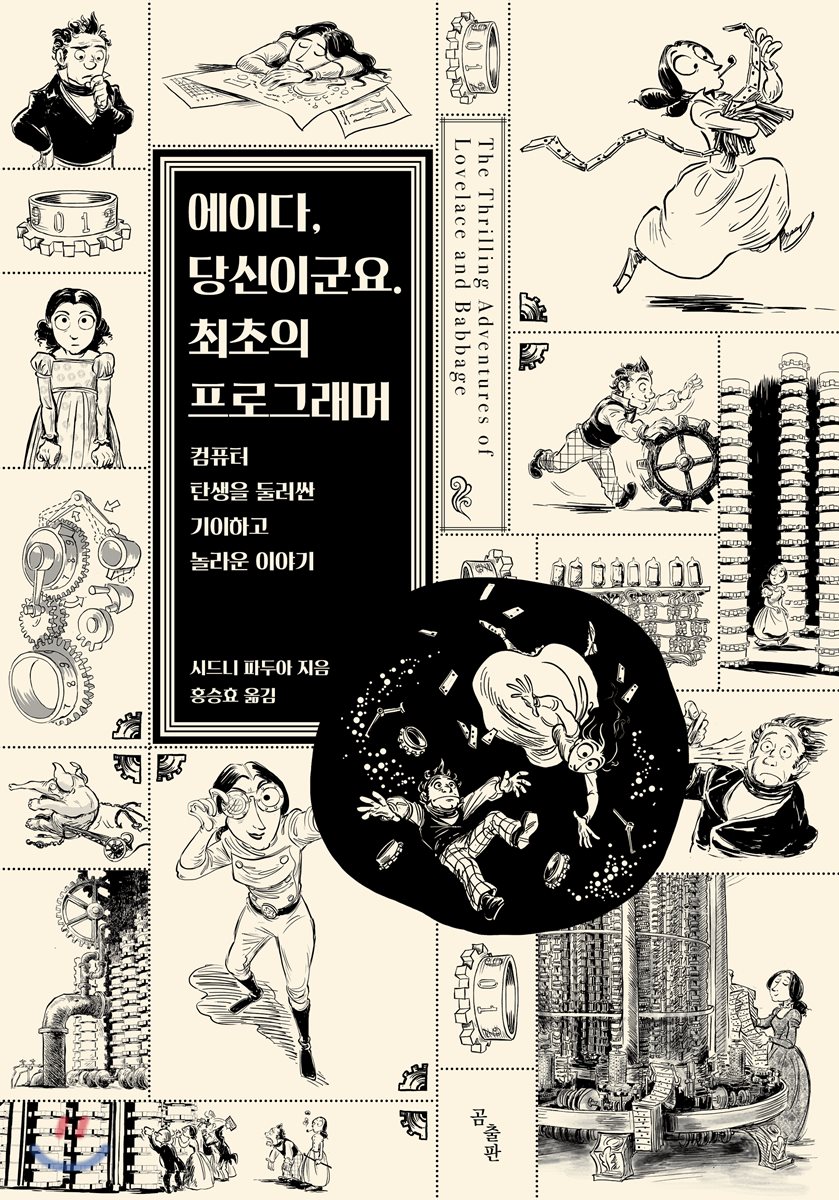
Ada, it's you. The first programmer.
 |
Description
Book Introduction
"Ada, it's you.
The First Programmer won the British Book Design and Production Award, Graphic Novel Category (2015), was nominated for the American Eisner Award (the Oscars of comics), Graphic Album Category (2016), won the British Association for the History of Mathematics Neumann Award (2015), was selected as the Guardian and Stylist's Book of the Year (2016), and was a British Amazon Bestseller in the Mathematics Category.
Ada, that's you, the story of the birth of the computer, reborn as a steampunk graphic novel.
“The First Programmer” is “a book that opened my eyes.
The more I think about it, the more I respect it.
It was selected as the Guardian Book of the Year with the comment, "It is worth reading not just once, but many times over."
The book introduces the greatest geniuses who invented the first computer.
More precisely, it is the story of the ill-fated(?) male and female protagonists, unknown until now, who devised the 'mathematical engine', which could be considered the forerunner of computers 'if it had been completed', and first proposed the main concepts of today's computer 'programming language'.
It is also a drama in which the cartoonist, inspired by this hidden story, has brought the exciting adventure to life with an extraordinary and creative touch that is no less than that of the two main characters.
They also feature in the opening chapter of "Innovators," a new book by Walter Isaacson, author of one of the best-selling biographies of all time, "Steve Jobs."
In this book, which is a story of creative geniuses who led the digital revolution, Ada Lovelace and Charles Babbage, two people who opened the curtain on the history of computers, precede Alan Turing, the father of information engineering, Robert Noyce of Intel, Bill Gates of Microsoft, Steve Wozniak and Steve Jobs of Apple, and Larry Page of Google.
The First Programmer won the British Book Design and Production Award, Graphic Novel Category (2015), was nominated for the American Eisner Award (the Oscars of comics), Graphic Album Category (2016), won the British Association for the History of Mathematics Neumann Award (2015), was selected as the Guardian and Stylist's Book of the Year (2016), and was a British Amazon Bestseller in the Mathematics Category.
Ada, that's you, the story of the birth of the computer, reborn as a steampunk graphic novel.
“The First Programmer” is “a book that opened my eyes.
The more I think about it, the more I respect it.
It was selected as the Guardian Book of the Year with the comment, "It is worth reading not just once, but many times over."
The book introduces the greatest geniuses who invented the first computer.
More precisely, it is the story of the ill-fated(?) male and female protagonists, unknown until now, who devised the 'mathematical engine', which could be considered the forerunner of computers 'if it had been completed', and first proposed the main concepts of today's computer 'programming language'.
It is also a drama in which the cartoonist, inspired by this hidden story, has brought the exciting adventure to life with an extraordinary and creative touch that is no less than that of the two main characters.
They also feature in the opening chapter of "Innovators," a new book by Walter Isaacson, author of one of the best-selling biographies of all time, "Steve Jobs."
In this book, which is a story of creative geniuses who led the digital revolution, Ada Lovelace and Charles Babbage, two people who opened the curtain on the history of computers, precede Alan Turing, the father of information engineering, Robert Noyce of Intel, Bill Gates of Microsoft, Steve Wozniak and Steve Jobs of Apple, and Larry Page of Google.
- You can preview some of the book's contents.
Preview
index
Introduction 6
Chapter 1: Ada Lovelace: The Source of Secrets! 11
Chapter 2 Pocket Universe 45
Chapter 3.
Person 51 from Pollock
Chapter 4.
Lovelace and Babbage vs.
Client! 59
Chapter 5.
Key Resources 101
Chapter 6.
Lovelace and Babbage vs.
Economic Model! 107
Chapter 7.
Anti-New Technology! 155
Chapter 8.
User Experience! 163
Chapter 9.
George Bull, come for tea.
227
Chapter 10.
Imaginary number 235
Appendix 1: Some Interesting Key Documents 281
Appendix 2: Interpretation Engine 303
Epilogue 329
Chapter 1: Ada Lovelace: The Source of Secrets! 11
Chapter 2 Pocket Universe 45
Chapter 3.
Person 51 from Pollock
Chapter 4.
Lovelace and Babbage vs.
Client! 59
Chapter 5.
Key Resources 101
Chapter 6.
Lovelace and Babbage vs.
Economic Model! 107
Chapter 7.
Anti-New Technology! 155
Chapter 8.
User Experience! 163
Chapter 9.
George Bull, come for tea.
227
Chapter 10.
Imaginary number 235
Appendix 1: Some Interesting Key Documents 281
Appendix 2: Interpretation Engine 303
Epilogue 329
Detailed image

Publisher's Review
The story of the computer's birth, reborn as a steampunk graphic novel.
“An unsung hero of science comes to the forefront.
“A sincere, cheerful, beautiful and wonderful graphic novel.”
The Independent
The story goes back to the Victorian era, a century before computers were actually created, when the Industrial Revolution and imperialism were shaking the world.
At a time when precise numerical calculations were essential for operating machines and navigating the seas, Charles Babbage (1791-1871), a famous mathematician of the time, was designing and developing a machine that could solve complex mathematical calculations.
During a chance meeting with Babbage (1833), Ada Lovelace (1815-1852) was fascinated by his 'Difference Engine' and after their meeting, she helped him develop it into the 'Analytical Engine' in both material and spiritual ways.
Unfortunately, their research was never completed.
But Sydney Padua makes full use of the modern information retrieval network, a legacy of the protagonists, to complete the larger picture of this seemingly trivial story.
Driven by a curiosity about history and humanity, this comic, drawn through persistent research and tireless exploration, is a captivating story, thanks to its extensive footnotes and detailed illustrations, making it a unique and comprehensive research book.
The first female computer programmer VS.
An empty symbol of feminism?
“Reading this book is like taking twelve high-quality college courses that teach creatively.
It's like listening to a lecture at the same time.
“It’s quite overwhelming and fascinating.”
Columbus Dispatch
Over the years, many people have attempted to build calculating machines.
Blaise Pascal patented and commercially sold the first 'mechanical calculator' (1640), and Gottfried Leibniz improved upon it with the 'cascade calculator' (1670), but encountered limitations in implementing it through engineering.
Babbage developed this further and designed a 'difference engine' that could solve polynomial equations and find approximations of differential equations.
Initially impressed by this wondrous concept, the British government decided to invest in the project, but ended up cutting off funding because the technology to implement it was still lacking and the plan was only getting bigger.
Everyone turned a blind eye, but only Lovelace fully understood the beauty of Babbage's new machine.
Beyond a simple calculating machine, we have glimpsed the mechanism of an 'interpreting engine' that combines symbols in a variety of ways and over an infinite range of successive combinations.
“This institution can analyze every topic in the world.
“A new, vast, and powerful language will be developed in the future to exploit this analysis.” (p. 29) Ada’s imagination and insight, and the “poetic science” that even Babbage could not have foreseen, have become the core concepts of today’s digital science.
It was the beginning of the concept of coding, which states that information, not only numbers but also sounds, music, symbols, pictures, and images can be expressed in digital form and manipulated by machines.
The surprising paper that contains this kind of change in thinking is the 『Commentary on the Outline of the Interpretive Institute』.
In 1840, Babbage lectured on the Analytical Engine in Italy, and in 1842, Luigi Menabre published a summary of it in a French journal.
Lovelace translated this 『Outline of the Interpreting Engines』 into English and published an annotated version in 1843, and the amount of footnotes was 2.5 times that of the original text.
“At least three copies should be ordered for every school in this land.
“As a textbook, it is ingenious, and as an original biography, it is also incredibly entertaining.”
{Literary Review}
Lovelace's grand work has become a source of controversy today (p. 256). The question is whether she can truly be recognized as "the world's first computer programmer," that is, how much of her work is Babbage's and how much is Lovelace's contribution.
This extended to gender issues, to the point where a specialized academic field emerged.
Those who claim that Lovelace was a mathematical genius who co-developed the computer sometimes downplay Babbage's contribution.
It is the viewpoint that women were sacrificed to the patriarchal system at the time.
The other side disparages her as nothing more than an empty symbol for feminism.
However, Babbage was quick to acknowledge Lovelace's contribution.
“The more I read your commentary, the more amazed I become and the more I regret not having explored this very rich vein of sublime metal sooner.” (p. 29) Sydney Padua also adds.
“Whatever the reason, it was Lovelace’s notes and her philosophy that provided the blueprint for a general-purpose computer machine for the future.” Perhaps this book ultimately wanted to say that the revolution in science and technology is not the result of a single innovator, but rather the result of collaboration.
The Power of Digital Archives & the Allure of Analog Sensibility
“Sidney Padua’s extensive research and witty writing style are truly impressive.
“A book brimming with passion and creativity, with charming illustrations, obsessively detailed footnotes and endnotes.”
{Publisher's Weekly}
Unfortunately, Babbage never built the machine and died in poverty.
Lovelace was unable to publish any more scientific papers, became addicted to gambling and opium, and died after battling cancer.
However, our lively cartoonist creates an alternate universe called Pocket Universe, claiming that this tragic ending is just a part of the multiverse.
There, they perfect their interpretation engine, utilize computers to intervene in the world, and enjoy exciting adventures!
Sydney Padua meticulously reconstructs the hazy lives of two men who, as he himself says, may have been mere footnotes in history, by scouring extensive documents from the 19th to the 21st centuries, weaving a tapestry of their own.
The story of how an eccentric genius mathematician meets his lifelong partner, the Countess of Lovelace's passion for science, highlighted as the daughter of the romantic poet Byron, and her struggles with herself unfold before your eyes like a puzzle piece through portraits of prominent figures of the time, letters, newspapers, and magazines.
The first half (Chapters 4-6), which adds the author's imagination to the society, politics, economy, and culture of the Victorian era, can be considered a unique faction, while the second half (Chapters 8-10), which deals with computers and mathematics, leads us to explore the potential of the Analytical Engine, which prepared the structure of modern computers, as if looking into the minds of Lovelace and Babbage.
“This book is more than just a celebration of the first computer programmer.
“It’s a comic that encourages us to turn our imaginations into technology, just like Lovelace did.”
{Observer Tech Monthly}
I confess.
In the past, chasing down a single, elusive truth required decades of patience and profound knowledge, but he himself attributes a great deal of his strength to the massive undertakings of Google Books and Archive.org, which have digitized and placed online the entire world's documents (p. 281). A look at the footnotes in this book and the materials included in Appendix 1—Queen Victoria's diary, a literary periodical from Maryland during the Civil War that no longer exists, and a slim memoir published by a 19th-century Ladies' Printing Society—shows that this is no exaggeration.
It could be said that the two main characters built their own new world on top of the digital world they had established.
On the other hand, looking at another appendix 2, it feels like meeting the king of analog sensibility.
Babbage's 1840s blueprints for the Difference Engine were not fully realized until 2000, when they were commissioned by the London Science Museum (p. 146). The author, as if dissecting this model piece by piece, takes on the challenge of creating a comprehensive diagram of its expanded version, the Analytical Engine (p. 304). Browsing through the detailed descriptions of each component of the Analytical Engine (pp. 306–326), including the Jacquard loom (p. 99), which inspired both of Babbage's engines, is a dizzying experience.
“An unsung hero of science comes to the forefront.
“A sincere, cheerful, beautiful and wonderful graphic novel.”
The Independent
The story goes back to the Victorian era, a century before computers were actually created, when the Industrial Revolution and imperialism were shaking the world.
At a time when precise numerical calculations were essential for operating machines and navigating the seas, Charles Babbage (1791-1871), a famous mathematician of the time, was designing and developing a machine that could solve complex mathematical calculations.
During a chance meeting with Babbage (1833), Ada Lovelace (1815-1852) was fascinated by his 'Difference Engine' and after their meeting, she helped him develop it into the 'Analytical Engine' in both material and spiritual ways.
Unfortunately, their research was never completed.
But Sydney Padua makes full use of the modern information retrieval network, a legacy of the protagonists, to complete the larger picture of this seemingly trivial story.
Driven by a curiosity about history and humanity, this comic, drawn through persistent research and tireless exploration, is a captivating story, thanks to its extensive footnotes and detailed illustrations, making it a unique and comprehensive research book.
The first female computer programmer VS.
An empty symbol of feminism?
“Reading this book is like taking twelve high-quality college courses that teach creatively.
It's like listening to a lecture at the same time.
“It’s quite overwhelming and fascinating.”
Columbus Dispatch
Over the years, many people have attempted to build calculating machines.
Blaise Pascal patented and commercially sold the first 'mechanical calculator' (1640), and Gottfried Leibniz improved upon it with the 'cascade calculator' (1670), but encountered limitations in implementing it through engineering.
Babbage developed this further and designed a 'difference engine' that could solve polynomial equations and find approximations of differential equations.
Initially impressed by this wondrous concept, the British government decided to invest in the project, but ended up cutting off funding because the technology to implement it was still lacking and the plan was only getting bigger.
Everyone turned a blind eye, but only Lovelace fully understood the beauty of Babbage's new machine.
Beyond a simple calculating machine, we have glimpsed the mechanism of an 'interpreting engine' that combines symbols in a variety of ways and over an infinite range of successive combinations.
“This institution can analyze every topic in the world.
“A new, vast, and powerful language will be developed in the future to exploit this analysis.” (p. 29) Ada’s imagination and insight, and the “poetic science” that even Babbage could not have foreseen, have become the core concepts of today’s digital science.
It was the beginning of the concept of coding, which states that information, not only numbers but also sounds, music, symbols, pictures, and images can be expressed in digital form and manipulated by machines.
The surprising paper that contains this kind of change in thinking is the 『Commentary on the Outline of the Interpretive Institute』.
In 1840, Babbage lectured on the Analytical Engine in Italy, and in 1842, Luigi Menabre published a summary of it in a French journal.
Lovelace translated this 『Outline of the Interpreting Engines』 into English and published an annotated version in 1843, and the amount of footnotes was 2.5 times that of the original text.
“At least three copies should be ordered for every school in this land.
“As a textbook, it is ingenious, and as an original biography, it is also incredibly entertaining.”
{Literary Review}
Lovelace's grand work has become a source of controversy today (p. 256). The question is whether she can truly be recognized as "the world's first computer programmer," that is, how much of her work is Babbage's and how much is Lovelace's contribution.
This extended to gender issues, to the point where a specialized academic field emerged.
Those who claim that Lovelace was a mathematical genius who co-developed the computer sometimes downplay Babbage's contribution.
It is the viewpoint that women were sacrificed to the patriarchal system at the time.
The other side disparages her as nothing more than an empty symbol for feminism.
However, Babbage was quick to acknowledge Lovelace's contribution.
“The more I read your commentary, the more amazed I become and the more I regret not having explored this very rich vein of sublime metal sooner.” (p. 29) Sydney Padua also adds.
“Whatever the reason, it was Lovelace’s notes and her philosophy that provided the blueprint for a general-purpose computer machine for the future.” Perhaps this book ultimately wanted to say that the revolution in science and technology is not the result of a single innovator, but rather the result of collaboration.
The Power of Digital Archives & the Allure of Analog Sensibility
“Sidney Padua’s extensive research and witty writing style are truly impressive.
“A book brimming with passion and creativity, with charming illustrations, obsessively detailed footnotes and endnotes.”
{Publisher's Weekly}
Unfortunately, Babbage never built the machine and died in poverty.
Lovelace was unable to publish any more scientific papers, became addicted to gambling and opium, and died after battling cancer.
However, our lively cartoonist creates an alternate universe called Pocket Universe, claiming that this tragic ending is just a part of the multiverse.
There, they perfect their interpretation engine, utilize computers to intervene in the world, and enjoy exciting adventures!
Sydney Padua meticulously reconstructs the hazy lives of two men who, as he himself says, may have been mere footnotes in history, by scouring extensive documents from the 19th to the 21st centuries, weaving a tapestry of their own.
The story of how an eccentric genius mathematician meets his lifelong partner, the Countess of Lovelace's passion for science, highlighted as the daughter of the romantic poet Byron, and her struggles with herself unfold before your eyes like a puzzle piece through portraits of prominent figures of the time, letters, newspapers, and magazines.
The first half (Chapters 4-6), which adds the author's imagination to the society, politics, economy, and culture of the Victorian era, can be considered a unique faction, while the second half (Chapters 8-10), which deals with computers and mathematics, leads us to explore the potential of the Analytical Engine, which prepared the structure of modern computers, as if looking into the minds of Lovelace and Babbage.
“This book is more than just a celebration of the first computer programmer.
“It’s a comic that encourages us to turn our imaginations into technology, just like Lovelace did.”
{Observer Tech Monthly}
I confess.
In the past, chasing down a single, elusive truth required decades of patience and profound knowledge, but he himself attributes a great deal of his strength to the massive undertakings of Google Books and Archive.org, which have digitized and placed online the entire world's documents (p. 281). A look at the footnotes in this book and the materials included in Appendix 1—Queen Victoria's diary, a literary periodical from Maryland during the Civil War that no longer exists, and a slim memoir published by a 19th-century Ladies' Printing Society—shows that this is no exaggeration.
It could be said that the two main characters built their own new world on top of the digital world they had established.
On the other hand, looking at another appendix 2, it feels like meeting the king of analog sensibility.
Babbage's 1840s blueprints for the Difference Engine were not fully realized until 2000, when they were commissioned by the London Science Museum (p. 146). The author, as if dissecting this model piece by piece, takes on the challenge of creating a comprehensive diagram of its expanded version, the Analytical Engine (p. 304). Browsing through the detailed descriptions of each component of the Analytical Engine (pp. 306–326), including the Jacquard loom (p. 99), which inspired both of Babbage's engines, is a dizzying experience.
GOODS SPECIFICS
- Date of publication: July 21, 2017
- Page count, weight, size: 336 pages | 693g | 177*253*30mm
- ISBN13: 9791195515677
- ISBN10: 1195515677
You may also like
카테고리
korean


korean

![GQ KOREA Mark (Monthly): December [2025]](http://librairie.coreenne.fr/cdn/shop/files/8ef265dbbfbf186523ed75ba7319009d.jpg?v=1765340328&width=3840)


