

Einstein's clock, Poincaré's map
 |
Description
Book Introduction
How did time become unified globally? How did the Earth, with no reference point anywhere, come to have its current longitude and latitude coordinates?
Because clocks and maps were developed separately in each part of the world, different times and maps were used in each region.
However, by the end of the 19th century, the introduction and development of railways, telegraph technology, the spread of wireless communication, and the expansion of colonial empires were increasing the need for integration of time and maps.
For example, at the international conference to determine the prime meridian, Britain and France argued over where to place the prime meridian in their respective countries.
The location of the prime meridian became a battle of pride between empires that were expanding their colonies around the world at the time.
In this late 19th century context, Henri Poincaré, a physicist, mathematician, philosopher, and key figure in the French Bureau of Longitude, advocated the concept of synchronizing conventionalized time using electromagnetic signals.
Humanity has long believed that time flows at the same speed from the past to the present and then to the future.
The idea that time flows equally throughout the universe was almost universally accepted, regardless of East or West.
However, in 1905, Einstein argued that this universal belief was incorrect through his theory of relativity.
The process of synchronizing time can be relative to the observer.
Einstein's reinterpretation of this simultaneity transformed all previous ideas about time and space into a completely new world called modern physics.
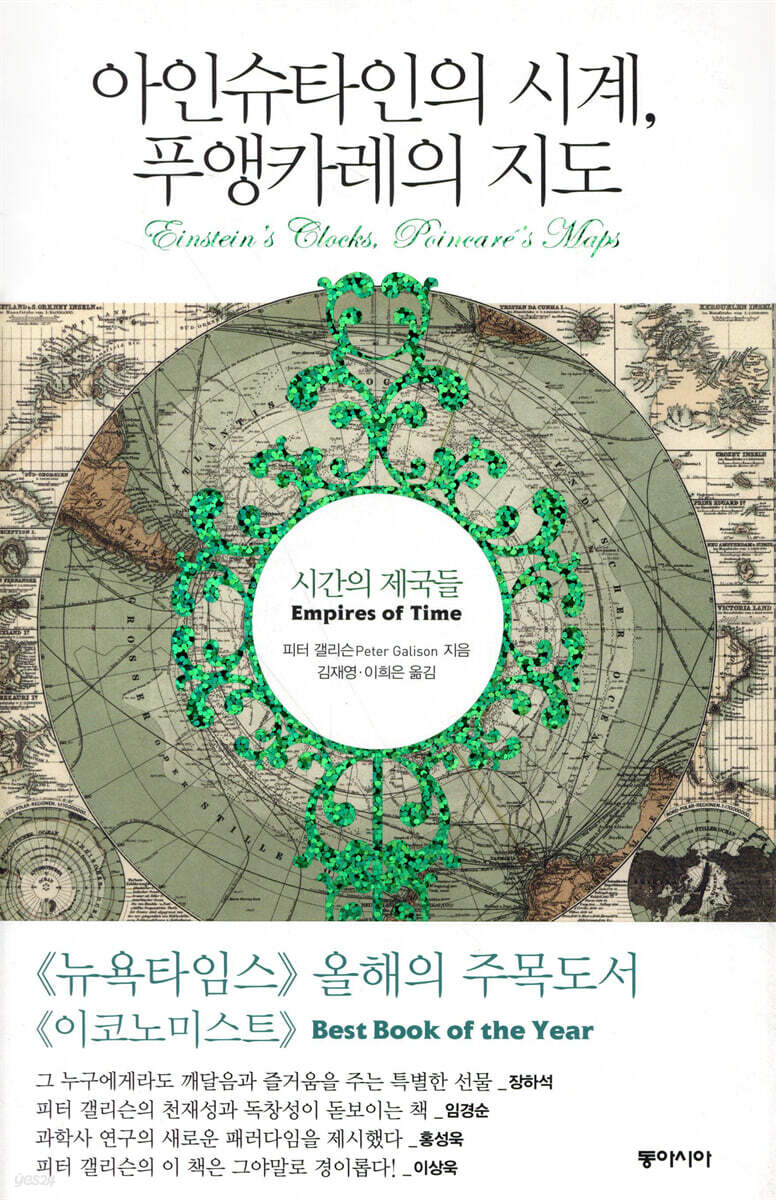
『Einstein's Clocks, Poincare's Maps: Empires of Time』(original title: Einstein's Clocks, Poincare's Maps: Empires of Time) introduces the process of establishing the prime meridian and longitude and unifying time and maps worldwide as Poincare and Einstein discovered time synchronization and the theory of relativity in the late 19th and early 20th centuries.
Because clocks and maps were developed separately in each part of the world, different times and maps were used in each region.
However, by the end of the 19th century, the introduction and development of railways, telegraph technology, the spread of wireless communication, and the expansion of colonial empires were increasing the need for integration of time and maps.
For example, at the international conference to determine the prime meridian, Britain and France argued over where to place the prime meridian in their respective countries.
The location of the prime meridian became a battle of pride between empires that were expanding their colonies around the world at the time.
In this late 19th century context, Henri Poincaré, a physicist, mathematician, philosopher, and key figure in the French Bureau of Longitude, advocated the concept of synchronizing conventionalized time using electromagnetic signals.
Humanity has long believed that time flows at the same speed from the past to the present and then to the future.
The idea that time flows equally throughout the universe was almost universally accepted, regardless of East or West.
However, in 1905, Einstein argued that this universal belief was incorrect through his theory of relativity.
The process of synchronizing time can be relative to the observer.
Einstein's reinterpretation of this simultaneity transformed all previous ideas about time and space into a completely new world called modern physics.
『Einstein's Clocks, Poincare's Maps: Empires of Time』(original title: Einstein's Clocks, Poincare's Maps: Empires of Time) introduces the process of establishing the prime meridian and longitude and unifying time and maps worldwide as Poincare and Einstein discovered time synchronization and the theory of relativity in the late 19th and early 20th centuries.
- You can preview some of the book's contents.
Preview
index
Preface to the Korean edition
Acknowledgements
Chapter 1: Time Synchronization
Einstein's Time
Milky white at the critical point
Order of argument
Chapter 2: Coal, Chaos, and Convention
coal
chaos
code
Chapter 3: Electrical World Map
Standards of space and time
Time, railways, telegraph
Time Marketing
Society of Surveying and Geodesy
Time entered into space
The fight over neutrality
Chapter 4 Poincaré's Map
Time, Reason, and Nation
Decimalization of time
About time and maps
Quito Expedition
Ether Time
Combination of three fields
Chapter 5 Einstein's Clock
Materialization of time
Theory machine
The Truth About Patents
Watch first
Radio Eiffel
Chapter 6: Place of Time
Without mechanics
Two modernisms
Looking up and looking down
main
Translator's Note
References
Copyright of illustrations and tables
Search
Acknowledgements
Chapter 1: Time Synchronization
Einstein's Time
Milky white at the critical point
Order of argument
Chapter 2: Coal, Chaos, and Convention
coal
chaos
code
Chapter 3: Electrical World Map
Standards of space and time
Time, railways, telegraph
Time Marketing
Society of Surveying and Geodesy
Time entered into space
The fight over neutrality
Chapter 4 Poincaré's Map
Time, Reason, and Nation
Decimalization of time
About time and maps
Quito Expedition
Ether Time
Combination of three fields
Chapter 5 Einstein's Clock
Materialization of time
Theory machine
The Truth About Patents
Watch first
Radio Eiffel
Chapter 6: Place of Time
Without mechanics
Two modernisms
Looking up and looking down
main
Translator's Note
References
Copyright of illustrations and tables
Search
Into the book
The lines of time were not laid on their own.
The front came with national ambition, war, industry, science, and conquest.
There are noticeable signs that countries are trying to coordinate the conventions of length, time, and electrical measurements.
In the 19th and 20th centuries, setting clocks was not simply a matter of exchanging signals.
Poincaré was the administrator of the World Electric Time Network, and Einstein was an expert at the Swiss Central Information Center for New Electrical Technologies.
Both Poincaré and Einstein focused on the electrodynamics of moving bodies and were preoccupied with philosophical ideas about space and time.
By understanding this synchronization that permeated the world, we will be able to understand what constitutes modernity in modern physics and how Einstein and Poincaré each stood at the intersection of modernity.
/ Chapter 1: Time Synchronization (page 49)
In the 1860s and 1870s, coordinated time became more deeply embedded in cities and railway systems.
Synchronized clocks were no longer an exotic science, welcomed by the press, appearing on the streets, and being studied in observatories and laboratories.
Synchronized clocks spread like a spider web through train stations, neighborhoods, and churches, permeating the everyday lives of the masses just as electricity, sewage systems, and gas did in the past, becoming like the water that circulates through modern urban life.
Unlike other public service sectors, time synchronization was directly dependent on scientists.
In the late 1870s, the Harvard College Observatory was the only place capable of transmitting time, and for a few years it was one of the largest clock services in the world.
Developments took place in different ways in Pittsburgh, Cincinnati, Greenwich, Paris, and Berlin.
Chapter 3: Electrical World Map (pp. 139-140)
Map making was a way of conquering space, both symbolically and practically.
In the great territorial scramble of the mid-19th century, location was crucial for trade, military conquest, and railroad construction.
When the United States entered the Civil War, the Coast Guard became a strategically important asset.
Chapter 3: Electrical World Map (page 171)
If the establishment of decimal time was among the projects of the Bureau of Longitude in 1897, a more urgent project was the production of a time-synchronized map, arguably the most difficult task in the Bureau's illustrious history.
As early as 1885, the Admiralty tasked the Bureau of Longitudes with determining the exact locations of Dakar and Saint-Louis in Senegal, “our colonies.”
The only reference to Senegal was in the 1897 edition of the Bureau of Longitude, which took several years to produce, and which came into Poincaré's hands just before he wrote "The Scale of Time" and became director of the Bureau of Longitude.
/ Chapter 4 Poincaré's Map (pp. 227-229)
In June 1905, the gap between Einstein and Poincaré was extremely wide.
At the age of 51, Poincaré was a full member of the Paris-based Academy and at the pinnacle of power.
He has served as a professor at some of the most distinguished institutions in France.
He served as a representative on international committees and wrote books that filled entire shelves.
The books were works on celestial mechanics, electromagnetism, wireless telegraphy, and thermodynamics.
Poincaré transformed entire fields of science with over 200 specialized academic papers bearing his name.
He was communicating his abstract musings on the meaning of science to a wide audience, including Einstein, thanks to his bestselling philosophical reflections.
In contrast, the 26-year-old Einstein was an unknown patent examiner living in an elevator-less apartment in a rather unremarkable part of Bern.
Chapter 5: Einstein's Clock (page 287)
Einstein started from the assumption that when observing the same physical process, there is no measurable difference between it occurring at rest and it occurring inside a steadily moving train.
He is Poincare or Lorentz
I took as my starting point what other leading physicists had been struggling to prove in previous games.
Scientists like Poincaré asked how the ether flattens as electrons pass through it, how electrons remain stable despite this distortion, and how the ether reacts when charged objects and light pass through it.
But in Einstein's paper, all the questions the French polymath asked disappeared.
There was not a word about the structure of ether and electrons.
/ Chapter 6: Place of Time (pp. 377-378)
The front came with national ambition, war, industry, science, and conquest.
There are noticeable signs that countries are trying to coordinate the conventions of length, time, and electrical measurements.
In the 19th and 20th centuries, setting clocks was not simply a matter of exchanging signals.
Poincaré was the administrator of the World Electric Time Network, and Einstein was an expert at the Swiss Central Information Center for New Electrical Technologies.
Both Poincaré and Einstein focused on the electrodynamics of moving bodies and were preoccupied with philosophical ideas about space and time.
By understanding this synchronization that permeated the world, we will be able to understand what constitutes modernity in modern physics and how Einstein and Poincaré each stood at the intersection of modernity.
/ Chapter 1: Time Synchronization (page 49)
In the 1860s and 1870s, coordinated time became more deeply embedded in cities and railway systems.
Synchronized clocks were no longer an exotic science, welcomed by the press, appearing on the streets, and being studied in observatories and laboratories.
Synchronized clocks spread like a spider web through train stations, neighborhoods, and churches, permeating the everyday lives of the masses just as electricity, sewage systems, and gas did in the past, becoming like the water that circulates through modern urban life.
Unlike other public service sectors, time synchronization was directly dependent on scientists.
In the late 1870s, the Harvard College Observatory was the only place capable of transmitting time, and for a few years it was one of the largest clock services in the world.
Developments took place in different ways in Pittsburgh, Cincinnati, Greenwich, Paris, and Berlin.
Chapter 3: Electrical World Map (pp. 139-140)
Map making was a way of conquering space, both symbolically and practically.
In the great territorial scramble of the mid-19th century, location was crucial for trade, military conquest, and railroad construction.
When the United States entered the Civil War, the Coast Guard became a strategically important asset.
Chapter 3: Electrical World Map (page 171)
If the establishment of decimal time was among the projects of the Bureau of Longitude in 1897, a more urgent project was the production of a time-synchronized map, arguably the most difficult task in the Bureau's illustrious history.
As early as 1885, the Admiralty tasked the Bureau of Longitudes with determining the exact locations of Dakar and Saint-Louis in Senegal, “our colonies.”
The only reference to Senegal was in the 1897 edition of the Bureau of Longitude, which took several years to produce, and which came into Poincaré's hands just before he wrote "The Scale of Time" and became director of the Bureau of Longitude.
/ Chapter 4 Poincaré's Map (pp. 227-229)
In June 1905, the gap between Einstein and Poincaré was extremely wide.
At the age of 51, Poincaré was a full member of the Paris-based Academy and at the pinnacle of power.
He has served as a professor at some of the most distinguished institutions in France.
He served as a representative on international committees and wrote books that filled entire shelves.
The books were works on celestial mechanics, electromagnetism, wireless telegraphy, and thermodynamics.
Poincaré transformed entire fields of science with over 200 specialized academic papers bearing his name.
He was communicating his abstract musings on the meaning of science to a wide audience, including Einstein, thanks to his bestselling philosophical reflections.
In contrast, the 26-year-old Einstein was an unknown patent examiner living in an elevator-less apartment in a rather unremarkable part of Bern.
Chapter 5: Einstein's Clock (page 287)
Einstein started from the assumption that when observing the same physical process, there is no measurable difference between it occurring at rest and it occurring inside a steadily moving train.
He is Poincare or Lorentz
I took as my starting point what other leading physicists had been struggling to prove in previous games.
Scientists like Poincaré asked how the ether flattens as electrons pass through it, how electrons remain stable despite this distortion, and how the ether reacts when charged objects and light pass through it.
But in Einstein's paper, all the questions the French polymath asked disappeared.
There was not a word about the structure of ether and electrons.
/ Chapter 6: Place of Time (pp. 377-378)
--- From the text
Publisher's Review
From the expansion of railways and telegraphs in the late 19th century, the spread of wireless communication, and imperial ambitions,
Even the theory of relativity, which brought about a revolution in physics in the early 20th century
A single volume condensing the process of unifying clocks and maps.
In his recommendation, Professor Hong Seong-wook explains, “It shows in an interesting and persuasive way that the extremely abstract concept of time is closely intertwined with elements of material civilization such as the expansion of railways and telegraphs since the late 19th century, the spread of wireless communication, and the bureaucracy of imperialism, and that it is within this web that Einstein’s theory of relativity and Poincaré’s concept of time synchronization emerged.”
Poincaré, who argued that the synchronization of clocks was merely a convention for the convenience of people, and Einstein, who rejected Newton's absolute time and insisted on relative time, met in the early 20th century over the problems of time synchronization and longitude determination that arose worldwide.
The theory of relativity, which was in the area of exchange between physics, philosophy, and technology, developed in each field as a symbol of modern knowledge.
After Einstein's theory was proven by experiments such as the deflection of electron paths and Arthur Eddington's solar eclipse observation experiment, the theory of relativity became a major turning point in the knowledge of physics.
Moreover, the time coordinate system of the theory of relativity serves as a model for a new era of scientific philosophy, in addition to the unification of time and maps.
The Vienna Circle accepted the simultaneity of synchronized clocks as a demonstrable scientific concept, and European and American physicists and modern philosophers actively embraced the simultaneity of signal exchange as an example of well-founded knowledge.
Quine, one of the most influential American philosophers of the 20th century, cited Einstein's concept of time as "a concept we must strive to preserve to the end, even if science must be revised in the future."
Moreover, the theory of relativity is a kind of technology that replaces traditional surveying tools and develops into cutting-edge technologies such as GPS and artificial satellites.
In addition, it colorfully introduces the landscape of the imperialist era in the late 19th century and early 20th century, such as the process in which the ether, which most physicists believed in in the late 19th century, was discarded due to the discovery of the theory of relativity, the efforts of scientists to install telegraph cables worldwide on land and under the sea, the difficulties cartographers had in exploring longitude, the process of synchronizing clocks and making world maps using telegraph signals, the process in which the metric system was internationalized, the conflict between observatory time and railroad time, and the process in which France institutionalized the revolution of the Third Republic through time regulation.
In addition, to give readers a glimpse of what it was like at the time, various illustrations were included, including a French Revolution clock using the decimal system, an interferometer, a mobile observatory, a pneumatic clock control room, a Swiss watchtower that Einstein would have seen, and a patent for the electromagnetic coordinate system of time.
Author Peter Galison, as a historian of science, approaches the theory of relativity from a social and historical perspective, so he does not require readers to have a knowledge of difficult mathematics or physics.
It also tells interesting anecdotes related to Einstein and Poincaré, genius scientists of the early 20th century.
Einstein's Swiss Patent Office and Poincaré's French Bureau of Longitude were the optimal environments!
Until Einstein and Poincaré discovered the theory of relativity and time synchronization.
Tracing the lives surrounding them in detail
As Booklist described it, “No book explains the achievements of Einstein and Poincaré more easily and captivatingly,” and author Peter Galison meticulously examines not only the society in which Einstein and Poincaré lived in the early 20th century, but also the details of their daily lives.
Peter Galison, who happened to be standing in a Nordic train station and looking at the clocks hanging on the platform, witnessed that the clocks matched each other down to the minute and even the second.
At this time, Galison thought that Einstein, who was struggling to understand the meaning of simultaneity at a distance in 1905, must have also been looking at the coordinated clock on the train station platform at the time, and this is said to have been the impetus for writing this book.
From the mid-1800s, clock coordinates began to spread, mainly among European countries.
The development of the technological infrastructure in Switzerland began quite late, in 1890, with Bern at the centre of the country's railway, telegraph, clock network and time synchronization, which then spread rapidly to Geneva, Basel, Neuchâtel and Zurich along the railway lines.
Not only was Einstein surrounded by clock coordinate technology, he also worked in the Bern patent office, the center of invention, production, and patenting of this technology.
Another scientist at the heart of clock synchronization was the Frenchman Poincaré.
Since 1893, the French Bureau of Longitude, of which Poincaré was a key member, has been at the forefront of determining longitude and coordinating time.
As head of the Bureau of Longitudes, Poincaré saw the world at the center of a global project to create an elaborate map of the world by sending time signals through thousands of kilometers of submarine cables.
The popular image of Einstein is that of a philosopher-scientist, but in fact he was a modern
He was a patent examiner-scientist with exceptional problem-solving skills.
Poincaré was not just a thinker confined to an ivory tower, but he was also a figure who participated in the mathematical solution to the famous Dreyfus Letter Affair and took the initiative in solving the problem of determining longitude, which was a hot issue in navigation and international relations at the time.
When they discovered time synchronization and relativity using light, the French Bureau of Longitude, where Poincaré worked, and the Swiss Patent Office, where Einstein worked, were the optimal environments for discovering this.
Furthermore, the author meticulously traces the schools and workplaces of Einstein and Poincaré, who they interacted with, what they were thinking, and what they were trying to uncover, through various materials such as letters, speeches, lecture materials, meeting records, and patent applications, until they each discovered the concept of the theory of relativity.
The Swiss Federal Institute of Technology, where Einstein studied, emphasized the immediate connection between theory and practice and the direct experimental process.
Known as a thought experimenter and theoretical physicist, Einstein was actually a tinkerer who loved tinkering with devices, and even tried to patent a high-sensitivity electrometer.
Outside of my time at the patent office, I cultivated my scientific and philosophical thinking through a small group called the Olympia Academy.
Meanwhile, Poincaré received an education that emphasized both pure science and applied technology at École Polytechnique, France's top educational institution, and later developed his engineering thinking while working as a mining engineer.
In addition, he broadened his scientific philosophical thinking through interactions with philosophers such as Émile Boutroux and Auguste Calinon, and contributed to solving the three-body problem, a huge challenge in celestial mechanics.
In another recommendation, Professor Lim Kyung-soon explains, “Thanks to his remarkable insight, Einstein, the theoretical physicist who wrote the difficult equation of gravity on the blackboard, regained his original form as the son of a venture businessman and an employee of the patent office in Bern, and the genius mathematician Poincaré revealed his true identity to us as the director of the Bureau of Longitude in Paris, inheriting the engineering tradition of the École Polytechnique.”
It is difficult to overlook the various circumstances, scientific events, and everyday anecdotes surrounding Einstein and Poincaré in the early 20th century when they discovered the theory of relativity, which played a decisive role in the process of unifying time and maps. This is because the circumstances surrounding Einstein and Poincaré had a decisive influence on the discovery of the theory of relativity.
Einstein's thesis that fundamentally shook humanity's belief in time
Did Einstein read Poincaré's paper before he discovered special relativity in 1905?
Uncovering the relationship between Einstein and Poincaré, who were both collaborators and rivals.
Historians of science call 1905, the year in which Einstein's five papers were published, the "Year of Miracles."
Among them, Einstein's paper "On the Electrodynamics of Moving Bodies", which was written about the special theory of relativity, contained revolutionary claims that fundamentally shook humanity's belief in absolute time, and became the most widely known physics paper of the 20th century.
But did Einstein read Poincaré's 1898 paper or its follow-up, the 1900 paper, before writing his 1905 paper? Seven years before Einstein redefined simultaneity in his 1905 paper on relativity, Henri Poincaré was developing similar ideas.
In his 1898 paper “The Scale of Time,” Poincaré argued that “simultaneity” was simply a convention formed by agreement among people, and that it was adopted as a convention not because it was true, but because it was most convenient for humans.
Therefore, simultaneity should be defined as the synchronization of clocks through the exchange of signals such as light.
It is highly likely that Einstein read Poincaré's paper.
Peter Galison even traces the possibility that Einstein read excerpts of the Poincaré paper translated into German with members of the Olympia Academy.
He also notes that Einstein's 1905 paper took a different format from typical physics papers.
Typically, physics papers include footnotes and discussions of other scholars' work, but Einstein's 1905 paper contained no footnotes.
Here, Einstein's paper explains that it follows the format of the patent world.
In patents, it is customary not to footnote previous work to demonstrate absolute originality.
Einstein's papers were full of his habits as a patent examiner.
However, as Einstein later began to attend more meetings with physicists, he ended up not including Poincaré's name in the references and footnotes of his papers.
Einstein avoided Poincaré by maintaining a constant and utter silence.
The first and last time Einstein and Poincaré met was at the Solvay Conference in Brussels in late 1911.
After the meeting, Einstein judged Poincaré negatively, saying that he “did not understand the situation.”
Meanwhile, Poincaré, who was surprised by Einstein's statement at the academic conference that "there is no dynamics," praised him highly after returning to Paris, saying, "He is one of the most original minds I have ever known."
In the early 20th century, when clock synchronization was at the intersection of technology, philosophy, and physics, Poincaré and Einstein, who discovered light synchronization and the theory of relativity, were witnesses and spokespeople, competitors and collaborators of coordinated time.
Even the theory of relativity, which brought about a revolution in physics in the early 20th century
A single volume condensing the process of unifying clocks and maps.
In his recommendation, Professor Hong Seong-wook explains, “It shows in an interesting and persuasive way that the extremely abstract concept of time is closely intertwined with elements of material civilization such as the expansion of railways and telegraphs since the late 19th century, the spread of wireless communication, and the bureaucracy of imperialism, and that it is within this web that Einstein’s theory of relativity and Poincaré’s concept of time synchronization emerged.”
Poincaré, who argued that the synchronization of clocks was merely a convention for the convenience of people, and Einstein, who rejected Newton's absolute time and insisted on relative time, met in the early 20th century over the problems of time synchronization and longitude determination that arose worldwide.
The theory of relativity, which was in the area of exchange between physics, philosophy, and technology, developed in each field as a symbol of modern knowledge.
After Einstein's theory was proven by experiments such as the deflection of electron paths and Arthur Eddington's solar eclipse observation experiment, the theory of relativity became a major turning point in the knowledge of physics.
Moreover, the time coordinate system of the theory of relativity serves as a model for a new era of scientific philosophy, in addition to the unification of time and maps.
The Vienna Circle accepted the simultaneity of synchronized clocks as a demonstrable scientific concept, and European and American physicists and modern philosophers actively embraced the simultaneity of signal exchange as an example of well-founded knowledge.
Quine, one of the most influential American philosophers of the 20th century, cited Einstein's concept of time as "a concept we must strive to preserve to the end, even if science must be revised in the future."
Moreover, the theory of relativity is a kind of technology that replaces traditional surveying tools and develops into cutting-edge technologies such as GPS and artificial satellites.
In addition, it colorfully introduces the landscape of the imperialist era in the late 19th century and early 20th century, such as the process in which the ether, which most physicists believed in in the late 19th century, was discarded due to the discovery of the theory of relativity, the efforts of scientists to install telegraph cables worldwide on land and under the sea, the difficulties cartographers had in exploring longitude, the process of synchronizing clocks and making world maps using telegraph signals, the process in which the metric system was internationalized, the conflict between observatory time and railroad time, and the process in which France institutionalized the revolution of the Third Republic through time regulation.
In addition, to give readers a glimpse of what it was like at the time, various illustrations were included, including a French Revolution clock using the decimal system, an interferometer, a mobile observatory, a pneumatic clock control room, a Swiss watchtower that Einstein would have seen, and a patent for the electromagnetic coordinate system of time.
Author Peter Galison, as a historian of science, approaches the theory of relativity from a social and historical perspective, so he does not require readers to have a knowledge of difficult mathematics or physics.
It also tells interesting anecdotes related to Einstein and Poincaré, genius scientists of the early 20th century.
Einstein's Swiss Patent Office and Poincaré's French Bureau of Longitude were the optimal environments!
Until Einstein and Poincaré discovered the theory of relativity and time synchronization.
Tracing the lives surrounding them in detail
As Booklist described it, “No book explains the achievements of Einstein and Poincaré more easily and captivatingly,” and author Peter Galison meticulously examines not only the society in which Einstein and Poincaré lived in the early 20th century, but also the details of their daily lives.
Peter Galison, who happened to be standing in a Nordic train station and looking at the clocks hanging on the platform, witnessed that the clocks matched each other down to the minute and even the second.
At this time, Galison thought that Einstein, who was struggling to understand the meaning of simultaneity at a distance in 1905, must have also been looking at the coordinated clock on the train station platform at the time, and this is said to have been the impetus for writing this book.
From the mid-1800s, clock coordinates began to spread, mainly among European countries.
The development of the technological infrastructure in Switzerland began quite late, in 1890, with Bern at the centre of the country's railway, telegraph, clock network and time synchronization, which then spread rapidly to Geneva, Basel, Neuchâtel and Zurich along the railway lines.
Not only was Einstein surrounded by clock coordinate technology, he also worked in the Bern patent office, the center of invention, production, and patenting of this technology.
Another scientist at the heart of clock synchronization was the Frenchman Poincaré.
Since 1893, the French Bureau of Longitude, of which Poincaré was a key member, has been at the forefront of determining longitude and coordinating time.
As head of the Bureau of Longitudes, Poincaré saw the world at the center of a global project to create an elaborate map of the world by sending time signals through thousands of kilometers of submarine cables.
The popular image of Einstein is that of a philosopher-scientist, but in fact he was a modern
He was a patent examiner-scientist with exceptional problem-solving skills.
Poincaré was not just a thinker confined to an ivory tower, but he was also a figure who participated in the mathematical solution to the famous Dreyfus Letter Affair and took the initiative in solving the problem of determining longitude, which was a hot issue in navigation and international relations at the time.
When they discovered time synchronization and relativity using light, the French Bureau of Longitude, where Poincaré worked, and the Swiss Patent Office, where Einstein worked, were the optimal environments for discovering this.
Furthermore, the author meticulously traces the schools and workplaces of Einstein and Poincaré, who they interacted with, what they were thinking, and what they were trying to uncover, through various materials such as letters, speeches, lecture materials, meeting records, and patent applications, until they each discovered the concept of the theory of relativity.
The Swiss Federal Institute of Technology, where Einstein studied, emphasized the immediate connection between theory and practice and the direct experimental process.
Known as a thought experimenter and theoretical physicist, Einstein was actually a tinkerer who loved tinkering with devices, and even tried to patent a high-sensitivity electrometer.
Outside of my time at the patent office, I cultivated my scientific and philosophical thinking through a small group called the Olympia Academy.
Meanwhile, Poincaré received an education that emphasized both pure science and applied technology at École Polytechnique, France's top educational institution, and later developed his engineering thinking while working as a mining engineer.
In addition, he broadened his scientific philosophical thinking through interactions with philosophers such as Émile Boutroux and Auguste Calinon, and contributed to solving the three-body problem, a huge challenge in celestial mechanics.
In another recommendation, Professor Lim Kyung-soon explains, “Thanks to his remarkable insight, Einstein, the theoretical physicist who wrote the difficult equation of gravity on the blackboard, regained his original form as the son of a venture businessman and an employee of the patent office in Bern, and the genius mathematician Poincaré revealed his true identity to us as the director of the Bureau of Longitude in Paris, inheriting the engineering tradition of the École Polytechnique.”
It is difficult to overlook the various circumstances, scientific events, and everyday anecdotes surrounding Einstein and Poincaré in the early 20th century when they discovered the theory of relativity, which played a decisive role in the process of unifying time and maps. This is because the circumstances surrounding Einstein and Poincaré had a decisive influence on the discovery of the theory of relativity.
Einstein's thesis that fundamentally shook humanity's belief in time
Did Einstein read Poincaré's paper before he discovered special relativity in 1905?
Uncovering the relationship between Einstein and Poincaré, who were both collaborators and rivals.
Historians of science call 1905, the year in which Einstein's five papers were published, the "Year of Miracles."
Among them, Einstein's paper "On the Electrodynamics of Moving Bodies", which was written about the special theory of relativity, contained revolutionary claims that fundamentally shook humanity's belief in absolute time, and became the most widely known physics paper of the 20th century.
But did Einstein read Poincaré's 1898 paper or its follow-up, the 1900 paper, before writing his 1905 paper? Seven years before Einstein redefined simultaneity in his 1905 paper on relativity, Henri Poincaré was developing similar ideas.
In his 1898 paper “The Scale of Time,” Poincaré argued that “simultaneity” was simply a convention formed by agreement among people, and that it was adopted as a convention not because it was true, but because it was most convenient for humans.
Therefore, simultaneity should be defined as the synchronization of clocks through the exchange of signals such as light.
It is highly likely that Einstein read Poincaré's paper.
Peter Galison even traces the possibility that Einstein read excerpts of the Poincaré paper translated into German with members of the Olympia Academy.
He also notes that Einstein's 1905 paper took a different format from typical physics papers.
Typically, physics papers include footnotes and discussions of other scholars' work, but Einstein's 1905 paper contained no footnotes.
Here, Einstein's paper explains that it follows the format of the patent world.
In patents, it is customary not to footnote previous work to demonstrate absolute originality.
Einstein's papers were full of his habits as a patent examiner.
However, as Einstein later began to attend more meetings with physicists, he ended up not including Poincaré's name in the references and footnotes of his papers.
Einstein avoided Poincaré by maintaining a constant and utter silence.
The first and last time Einstein and Poincaré met was at the Solvay Conference in Brussels in late 1911.
After the meeting, Einstein judged Poincaré negatively, saying that he “did not understand the situation.”
Meanwhile, Poincaré, who was surprised by Einstein's statement at the academic conference that "there is no dynamics," praised him highly after returning to Paris, saying, "He is one of the most original minds I have ever known."
In the early 20th century, when clock synchronization was at the intersection of technology, philosophy, and physics, Poincaré and Einstein, who discovered light synchronization and the theory of relativity, were witnesses and spokespeople, competitors and collaborators of coordinated time.
GOODS SPECIFICS
- Date of issue: July 5, 2017
- Page count, weight, size: 484 pages | 811g | 152*230*35mm
- ISBN13: 9788962621877
- ISBN10: 8962621878
You may also like
카테고리
korean


korean

![ELLE 엘르 스페셜 에디션 A형 : 12월 [2025]](http://librairie.coreenne.fr/cdn/shop/files/b8e27a3de6c9538896439686c6b0e8fb.jpg?v=1766436872&width=3840)


