

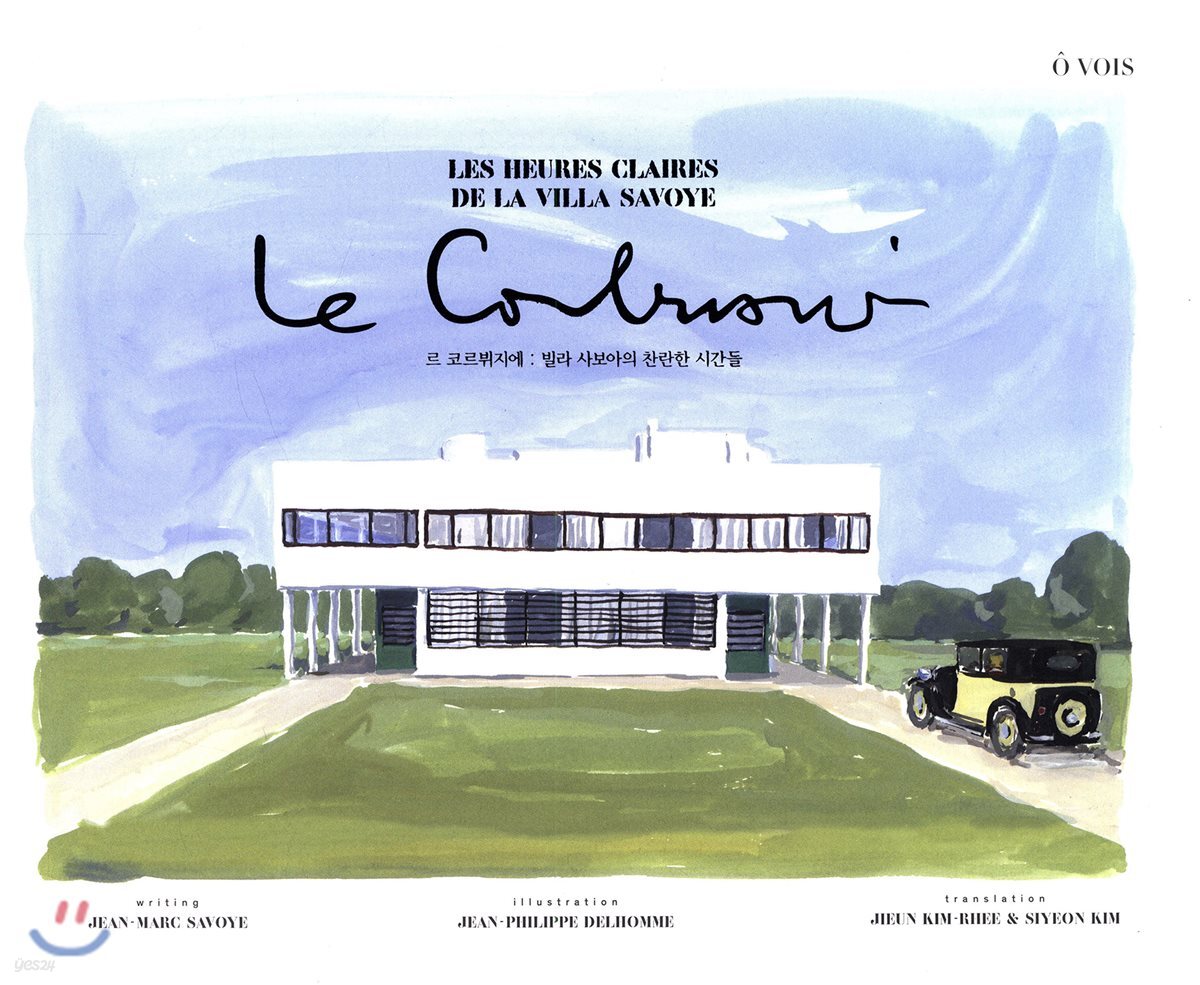
Le Corbusier: The Brilliant Hours of Villa Savoye
 |
Description
Book Introduction
Le Corbusier, the architect we are all familiar with.
This book contains the hidden architectural story of Villa Savoye, one of his famous residential architectural works, which was registered as a UNESCO World Heritage Site in 2016.
The author, Jean-Marc Savoye, is the grandson of Pierre & Eugenie Savoye, the architects who commissioned the construction of Villa Savoye. The book is very interesting in that it unravels the history of the masterpiece through personal family history.
It tells the story of why his grandparents wanted to build Villa Savoye, the process of its construction, the problems that plagued the Savoye family, how it was dramatically saved from destruction during World War II and the subsequent rapid economic development, and the people who worked to preserve the building.
- You can preview some of the book's contents.
Preview
Into the book
The key to the beauty of Villa Savoye lies here.
Fortunately, the architect met a client who wanted to build a country cottage that resembled the moment he existed in.
(Omitted) So, Le Corbusier included in his drawings that the house should be simple and convenient, and above all, modern so that the people living there would be comfortable.
--- pp.
30~31
Le Corbusier had a premonition that something very special was being built in Poissy.
On February 21, 1929, he wrote in a letter to his mother:
'I have begun to dig the ground to build a very beautiful villa in Poissy.' He even wrote to his mother on April 25, 1930, 'Villa Savoye in Poissy is becoming a little miracle.
He sent a letter saying, 'This is a creative work.'
--- pp.
41-42
Another surprising thing about Villa Savoye is the space devoted to cars.
We can see that Le Corbusier, who loved cars, applied his belief that they would greatly change our lives to Villa Savoye.
Le Corbusier said this in an interview with a German magazine in the 1930s:
“From now on, the new factor that determines the minimum size of a house is the car!”
--- pp.
37-38
There was water in the front door, water leaking into the ramp, and the parking lot walls were completely soaked.
Plus, whenever it rains, the bathroom always leaks.
Water also pours in through the windows in the ceiling.
The walls in the gardener's quarters were also said to be soaked.
_1936.09.07 Eugenie Savoie Dream.
If the discomfort caused by the north wall persists after the repair measures I have suggested, 3-4cm thick plywood should be installed inside that wall.
We assure you that we will do our best to ensure your satisfaction, and we hope that you will consider yourself a friend of the family.
_1937.10.31 Le Corbusier Dream.
--- pp.
47-48
Publisher's Review
The Hidden Architectural Story of Le Corbusier We Never Knew
: The dramatic story of Villa Savoye, which began with a letter and survived rain, war, and the threat of demolition.
Le Corbusier, the architect we are all familiar with.
This book contains the hidden architectural story of Villa Savoye, one of his famous residential architectural works, which was registered as a UNESCO World Heritage Site in 2016.
The author, Jean-Marc Savoye, is the grandson of Pierre & Eugenie Savoye, the architects who commissioned the construction of Villa Savoye. The book is very interesting in that it unravels the history of the masterpiece through personal family history.
It tells the story of why his grandparents wanted to build Villa Savoye, the process of its construction, the problems that plagued the Savoye family, how it was dramatically saved from destruction during World War II and the subsequent rapid economic development, and the people who worked to preserve the building.
To briefly look back at the history, Villa Savoye is a house that Le Corbusier was commissioned to build in 1928 and built with Pierre Jeanneret between 1930 and 1931.
The house where the author's family lived was occupied by the German army from 1940 to 1945, when World War II broke out, and then by the American army.
When Villa Savoye was later reclaimed, it was in such ruins that it was uninhabitable.
Eventually, the land of Villa Savoye was converted to farmland, and the house was used as a warehouse.
The trials of Villa Savoye continued after this.
In 1960, when the city of Poissy decided to demolish the Villa Savoye to build a new high school, a petition was signed by architects from all over the world.
The writer André Malraux, who was the French Minister of Culture at the time, dramatically saved Villa Savoye, nationalizing it, restoring it, and opening it to the public.
What makes 『Le Corbusier: The Splendid Hours of Villa Savoye』 so interesting is that you can see old documents that clearly prove the coordinates of the story, such as the overly direct architectural commission from the client Eugénie Savoye, the design drawings for Le Corbusier's atelier that were carried out three times, sketches drawn by Le Corbusier himself, letters from the client filled with various complaints and Le Corbusier's ironic replies to them, a petition to save Villa Savoye, and a letter from the Minister of Culture at the time.
Thanks to this, the book also functions as a light collection of letters and a history of architecture.
'Were they happy here?' The author asks himself this question about life at Villa Savoye, where his grandparents and parents lived.
This is because there are no documents, photos, or videos left to support this from World War II.
However, world-renowned illustrator Jean-Philippe Delhomme has recreated the 'splendid times' of the people who lived at Villa Savoye in stunning drawings.
He didn't just paint pictures.
I read Jean-Marc Savoie's writings, listened carefully to his long family history, and drew the most dramatic scenes.
The 20 or so illustrations and drawings in the book are another reason to want to own this book.
A work of art that is a mystery in itself
I kept thinking about it as I wrote about Villa Savoye.
What determines what constitutes a masterpiece? It's not simple, but a stroll through the Palace of Versailles, the Taj Mahal, or the alleyways of Venice will quickly reveal the truth.
Through the will and dedication (technical and financial) of those who commissioned these buildings, the talents of the participants, and the harmony of the completed project, we are able to encounter special works of art.
But how do we recognize the more modest, less grandiose, and avant-garde works? Why is the Mona Lisa the world's most famous painting, and why are Pierre Soulages' black canvases, which even a child could paint, and Mark Rothko's works considered masterpieces? With these questions in mind, let's journey to Villa Savoye.
(syncopation)
If you want to deeply understand Villa Savoye and appreciate its true value, you have no choice but to go there yourself.
If you ever find yourself in Paris and have a spare half day, don't hesitate to head to Villa Savoye! I guarantee you'll find something like this there.
First of all, it is so obviously beautiful.
The simplicity of its lines, the lightness of its pilotis, and the white light of its façade give the impression that Villa Savoye is completely floating in the air, like a mysterious ship towering over the sea.
That's not all.
The spatial layout and materials used in the construction, the novel space for cars, the way light is used, and the structure that breaks down the boundaries between inside and outside…
Everything about Villa Savoye is surprisingly modern.
And now you will feel, without a doubt, that you are facing a masterpiece.
Le Corbusier, like an agitator, said, “A house is a machine for living in.”
But you will never find such a house in Poissy.
Instead, if you want to feel poetic emotion and sensibility, Villa Savoye will take you to places you can't even imagine.
- From the 'Prologue'
GOODS SPECIFICS
- Publication date: November 20, 2018
- Format: Hardcover book binding method guide
- Pages, weight, size: 64 pages | 659g | 290*234*11mm
- ISBN13: 9791196518004
- ISBN10: 1196518009
You may also like
카테고리
korean


korean


