

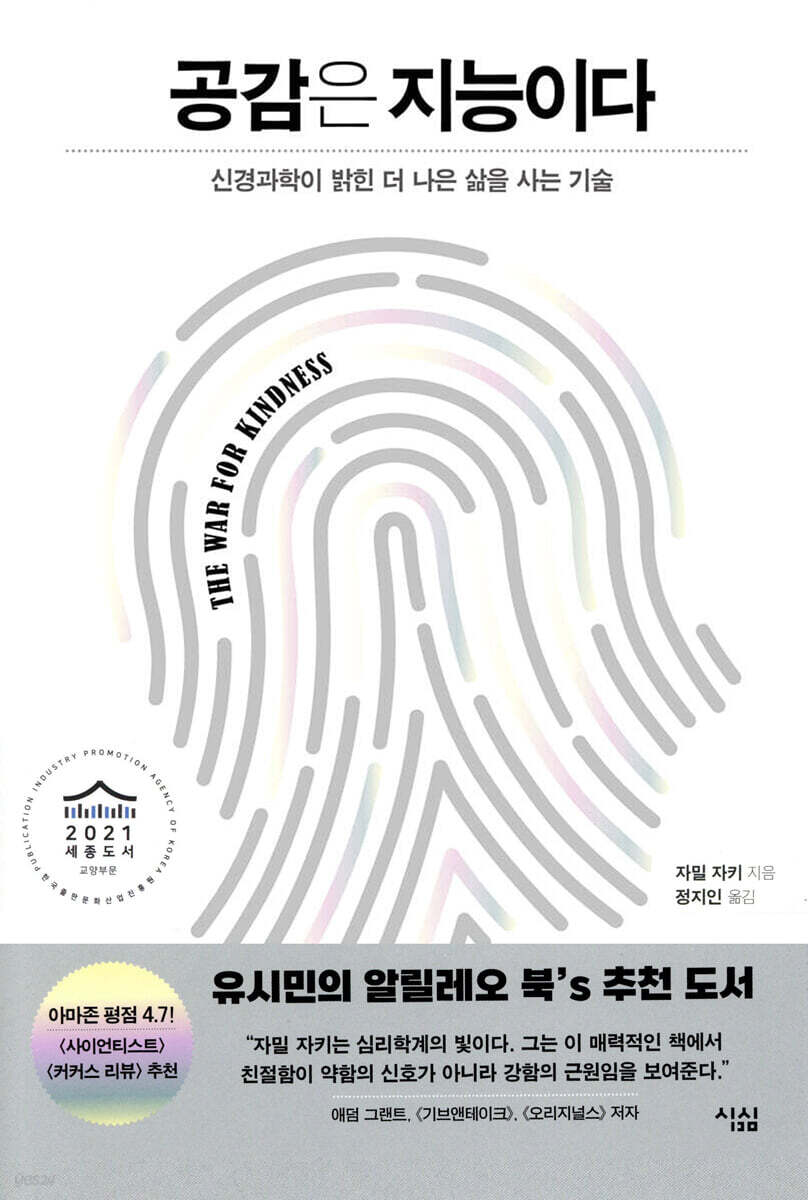
Empathy is intelligence
 |
Description
Book Introduction
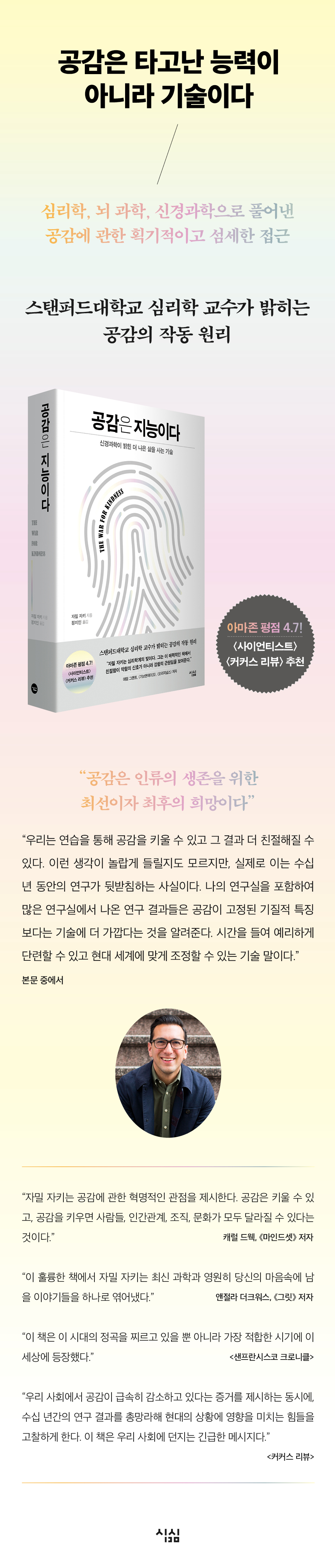
How Empathy Becomes a Skill for Living a Better Life How empathy works, revealed by a Stanford University psychology professor. For a long time, scientists believed that empathy was biological, innate and unchangeable. But as neuroscience and technology advance, this thinking is crumbling. In his book Empathy is Intelligence, Jamil Zaki, a psychology professor at Stanford University, draws on the latest research in psychology, brain science, and neuroscience to reveal that empathy is not an innate ability, but a skill that can be developed through practice and heightened or lowered according to purpose and need. Offering a revolutionary perspective on empathy, this book gives readers the opportunity to choose empathy and make a difference to create a better world, suggesting that empathy must become the new normal for modern times, so as not to be left alone in a divided world. |
- You can preview some of the book's contents.
Preview
index
Prologue: We Can Create a Kinder World
Kindness is a Human Survival Skill│In an Age of Destruction of Empathy│Is Empathy Innate?│Mirroring Emotions│The Fight for an Empathetic World
Chapter 1: The Amazing Fluidity of Human Nature
The Brain Changes | Two Perspectives on the Potential of Empathy | Empathy in Context and Environment | Recovery and Empathy in Trauma Survivors | The Empathic Mindset
Chapter 2: How Empathy Works
How Are Human Emotions Determined? │ Choose or Avoid │ The Empathy Nudge │ Can Psychopaths Become Empathetic? │ Building Your Empathy Muscle
Chapter 3: Hatred vs. Contact
Dividing the Boundaries │ How Contact Reduces Prejudice │ How to Maximize the Effectiveness of Contact │ Is There Hope for Deep-Rooted Hatred?
Chapter 4: The Impact of Literature and Art on Empathy
Does good acting lead to better empathy?│The path to empathy opened by literature│Healing collective trauma│Reading groups for criminals
Chapter 5: The Dangers of Excessive Empathy
People who struggle with empathy│Caregivers are at risk│Psychological first aid│Working with emotions instead of fighting them│The distress and anxiety caused by empathy
Chapter 6: A System That Rewards Kindness
Police officers who want to be warriors│From warriors to citizens' guardians│Empathy bias that fuels conflict│Zero tolerance and racism│Kind systems foster kind hearts│Discipline based on empathy
Chapter 7: The Double Edge of Digital
How Social Media Distorts the World│Anonymity Destroys the Pillars of Empathy│How Virtual Reality Can Increase Empathy│Emotion-Sensing Technologies│The Social Network of Mutual Empathy│The Benefits of Collective Goodwill
Epilogue: The Future of Empathy
Acknowledgements
Appendix A What is Empathy?
Appendix B Evidence Evaluation
Huzhou
Kindness is a Human Survival Skill│In an Age of Destruction of Empathy│Is Empathy Innate?│Mirroring Emotions│The Fight for an Empathetic World
Chapter 1: The Amazing Fluidity of Human Nature
The Brain Changes | Two Perspectives on the Potential of Empathy | Empathy in Context and Environment | Recovery and Empathy in Trauma Survivors | The Empathic Mindset
Chapter 2: How Empathy Works
How Are Human Emotions Determined? │ Choose or Avoid │ The Empathy Nudge │ Can Psychopaths Become Empathetic? │ Building Your Empathy Muscle
Chapter 3: Hatred vs. Contact
Dividing the Boundaries │ How Contact Reduces Prejudice │ How to Maximize the Effectiveness of Contact │ Is There Hope for Deep-Rooted Hatred?
Chapter 4: The Impact of Literature and Art on Empathy
Does good acting lead to better empathy?│The path to empathy opened by literature│Healing collective trauma│Reading groups for criminals
Chapter 5: The Dangers of Excessive Empathy
People who struggle with empathy│Caregivers are at risk│Psychological first aid│Working with emotions instead of fighting them│The distress and anxiety caused by empathy
Chapter 6: A System That Rewards Kindness
Police officers who want to be warriors│From warriors to citizens' guardians│Empathy bias that fuels conflict│Zero tolerance and racism│Kind systems foster kind hearts│Discipline based on empathy
Chapter 7: The Double Edge of Digital
How Social Media Distorts the World│Anonymity Destroys the Pillars of Empathy│How Virtual Reality Can Increase Empathy│Emotion-Sensing Technologies│The Social Network of Mutual Empathy│The Benefits of Collective Goodwill
Epilogue: The Future of Empathy
Acknowledgements
Appendix A What is Empathy?
Appendix B Evidence Evaluation
Huzhou
Detailed image
Into the book
“For the past decade, I’ve been studying how empathy works and what it does to us.
Psychologists studying empathy today are in a similar position to climatologists studying polar ice caps.
“Each year we become more deeply aware of the value of empathy and compassion, yet both continue to diminish in the world around us.”
---p.25
“We can develop empathy through practice and become kinder as a result.
This idea may sound surprising, but it's actually supported by decades of research.
Research from many labs, including my own, suggests that empathy is more of a skill than a fixed dispositional trait.
“It’s a skill that can be sharpened over time and adapted to the modern world.”
---p.35
“This book is about those drugs and the science that is their root.
By seeking out the right therapies, including friendships, art, and community-building that blossom in unexpected places, we can strengthen our empathy muscles and, in the process, broaden our scope of kindness.
In this book, we will meet police officers learning to communicate more peacefully with civilians, Hutu and Tutsi people who have endured genocide but are moving toward forgiveness, and stubborn people who have spent their lives doggedly working to dispel hatred.
You will see ex-convicts discuss the novel with the judge who convicted them, rediscovering their humanity in the process, and you will see doctors and nurses in the neonatal intensive care unit learn how to support patients' families during their most difficult times without wallowing in their own pain.”
---pp.37~38
The struggle to be kind to them is not easy, and it won't be easy for any of us. This book won't teach you 10 simple steps to becoming a kinder person today.
I wouldn't even guarantee that people are inherently good, despite what they appear to be.
At birth, humanity is either 39 percent kind, 71 percent kind, or somewhere in between.
“What matters is not what our initial state was, but what state we can move toward.”
---p.38
“New Yorkers face a deluge of hardship and poverty as they walk the streets of Manhattan.
If he were to take all of that into himself, he would be caught in a dilemma where he couldn't do anything.
He can either give everything away until he has nothing left, or he can live with the guilt of not giving.
People often avoid empathy in these situations.
One study found that people who believed they would later have the opportunity to donate to a homeless person avoided versions of the homeless person's story that contained emotionally provocative details.
“It’s not that they couldn’t empathize with the homeless, it’s that they actively chose not to empathize.”
---p.92
“In one study, male and female participants watched videos of people telling emotional stories and then were asked to guess what emotions the speakers in the videos were feeling.
Here, men were less able to guess women's emotions than women.
A follow-up study found that people were paid to accurately understand the speaker.
Then the gender gap in empathy disappeared.
A few years later, another research team told heterosexual men that women were attracted to "attentive men."
Men who learned this fact worked hard to empathize.
“It's an emotional equivalent of the behavior of putting pressure on your stomach when an attractive person passes by.”
---pp.100~101
“People in majority groups or groups with higher power often develop a more compassionate view of others when they have these discussions.
However, this was often not the case for people from minority groups or low-power groups.
They already understood the majority point of view.
Because that's what I had to do to survive.
In a recent interview, comedian Sarah Silverman captured that feeling succinctly:
“Women are very keenly aware of men’s experiences.
Because our entire existence must pass through the lens of that experience.
Men, on the other hand, have never had to understand the female experience to exist in this world.”
---p.146
“Angela was a victim of extreme bullying at school, and at some point she decided that the best way to stop being a target was to become one of the bullies.
He became homophobic and racist and began committing hate crimes.
Angela was arrested for armed robbery at a Jewish-owned store and sent to prison.
His arms, legs and chest were covered in Nazi crosses, and the Nazi salute, SIEG HEIL, was tattooed on the inside of his lower lip.
Angela expected prison life to be a race war.
But shockingly, his first cellmates were not Aryans, but a group of Jamaican women.
While playing the card game, they questioned Angela's beliefs, but also accepted her as a human being.
Angela recalled:
“Aggression, anger, violence… That’s how I’ve reacted to everything my whole life.
But when people treated me with kindness and compassion, I felt disarmed.”
---pp.152~153
“If caregivers are overly empathetic, they may be tempted to take heroic life-saving measures when they are likely to fail, or to make bad news sound palatable to avoid causing pain.
(…) Additionally, caregivers who are good at empathy may develop symptoms similar to post-traumatic stress disorder.
Not because of his own suffering, but because of the suffering of his patients.
“A quarter of neonatal intensive care unit nurses reported ‘secondary trauma’ such as insomnia, flashbacks, and burnout – a rate about twice as high as that of nurses in other departments.”
---p.222
“That vocabulary also included language that distinguished different types of empathy.
In Buddhism, 'compassion' includes caring for others without shouldering their suffering.
“That kind of separation is necessary.
“Because if you detach too much, it becomes ‘that person’s problem, not mine,’ and if detachment doesn’t occur, you identify too deeply with the suffering around you.”
Psychologists similarly distinguish between “empathic distress” and “empathic concern.”
Suffering is one outcome of emotional empathy, which involves feeling the same emotions as another person by indirectly sharing their pain.
Concern, on the other hand, is the feeling of empathy for someone else's feelings and the desire to improve their well-being.
---p.243
“People who practiced loving-kindness meditation were more generous and experienced less suffering than other groups.
These changes were also observed in their brains.
In contrast, people who learned to empathize with others' pain showed an enhanced mirroring response to pain.
Their brains reacted as if they were in pain.
However, people who practiced loving-kindness meditation showed activation in brain regions associated with motivation, and even in brain regions associated with reward.
Instead of focusing on the suffering of the victims, they imagined a world where suffering was reduced.”
---p.246
“We usually think of kindness as sacrificing ourselves to benefit others.
A person who helps others takes on the pain himself in order to make it less painful for others.
(…) However, there are also cases where you benefit from helping others.
Generosity enriches the giver, reduces stress, and, for older volunteers, even extends their lifespan.
My colleagues and I have found that the benefactor's benefits are especially significant when the giver empathizes with the recipient of the goodwill.”
---p.350
“Even if we are living together now, it is difficult to empathize with people who are distant or different from us.
But how can we expect to care about someone we'll never know? Peter Singer suggests removing the variable of our emotions from this problem.
Singer argues that effective altruists “don’t dedicate themselves to the causes that resonate most strongly with them.
“They devote themselves to the cause that does the most good,” he wrote.
---pp.356~357
“The form of empathy that has existed since time immemorial begins with self-protection.
We care for our children because they carry our genes, and we care for our tribe because they provide sustenance, sex, and security.
Caring about future generations who will never remember who we are goes against our Darwinian impulses.
But there are still ways to cultivate such consideration.
If we can cultivate that kind of mindset, we will be able to evolve our empathy in real time, growing it into something bigger and more enduring.”
---pp.362~363
“It’s easier to live without thinking about things like intentions.
Cultivating a new kind of empathy toward someone who may not reciprocate takes effort and sacrifice.
But now, faced with increasing cruelty and isolation, we struggle to live moral lives.
It's rarely worth doing something easy, and in this day and age, it's even risky.
We have a choice, and the sum total of our choices will create our future.
What will you do?”
Psychologists studying empathy today are in a similar position to climatologists studying polar ice caps.
“Each year we become more deeply aware of the value of empathy and compassion, yet both continue to diminish in the world around us.”
---p.25
“We can develop empathy through practice and become kinder as a result.
This idea may sound surprising, but it's actually supported by decades of research.
Research from many labs, including my own, suggests that empathy is more of a skill than a fixed dispositional trait.
“It’s a skill that can be sharpened over time and adapted to the modern world.”
---p.35
“This book is about those drugs and the science that is their root.
By seeking out the right therapies, including friendships, art, and community-building that blossom in unexpected places, we can strengthen our empathy muscles and, in the process, broaden our scope of kindness.
In this book, we will meet police officers learning to communicate more peacefully with civilians, Hutu and Tutsi people who have endured genocide but are moving toward forgiveness, and stubborn people who have spent their lives doggedly working to dispel hatred.
You will see ex-convicts discuss the novel with the judge who convicted them, rediscovering their humanity in the process, and you will see doctors and nurses in the neonatal intensive care unit learn how to support patients' families during their most difficult times without wallowing in their own pain.”
---pp.37~38
The struggle to be kind to them is not easy, and it won't be easy for any of us. This book won't teach you 10 simple steps to becoming a kinder person today.
I wouldn't even guarantee that people are inherently good, despite what they appear to be.
At birth, humanity is either 39 percent kind, 71 percent kind, or somewhere in between.
“What matters is not what our initial state was, but what state we can move toward.”
---p.38
“New Yorkers face a deluge of hardship and poverty as they walk the streets of Manhattan.
If he were to take all of that into himself, he would be caught in a dilemma where he couldn't do anything.
He can either give everything away until he has nothing left, or he can live with the guilt of not giving.
People often avoid empathy in these situations.
One study found that people who believed they would later have the opportunity to donate to a homeless person avoided versions of the homeless person's story that contained emotionally provocative details.
“It’s not that they couldn’t empathize with the homeless, it’s that they actively chose not to empathize.”
---p.92
“In one study, male and female participants watched videos of people telling emotional stories and then were asked to guess what emotions the speakers in the videos were feeling.
Here, men were less able to guess women's emotions than women.
A follow-up study found that people were paid to accurately understand the speaker.
Then the gender gap in empathy disappeared.
A few years later, another research team told heterosexual men that women were attracted to "attentive men."
Men who learned this fact worked hard to empathize.
“It's an emotional equivalent of the behavior of putting pressure on your stomach when an attractive person passes by.”
---pp.100~101
“People in majority groups or groups with higher power often develop a more compassionate view of others when they have these discussions.
However, this was often not the case for people from minority groups or low-power groups.
They already understood the majority point of view.
Because that's what I had to do to survive.
In a recent interview, comedian Sarah Silverman captured that feeling succinctly:
“Women are very keenly aware of men’s experiences.
Because our entire existence must pass through the lens of that experience.
Men, on the other hand, have never had to understand the female experience to exist in this world.”
---p.146
“Angela was a victim of extreme bullying at school, and at some point she decided that the best way to stop being a target was to become one of the bullies.
He became homophobic and racist and began committing hate crimes.
Angela was arrested for armed robbery at a Jewish-owned store and sent to prison.
His arms, legs and chest were covered in Nazi crosses, and the Nazi salute, SIEG HEIL, was tattooed on the inside of his lower lip.
Angela expected prison life to be a race war.
But shockingly, his first cellmates were not Aryans, but a group of Jamaican women.
While playing the card game, they questioned Angela's beliefs, but also accepted her as a human being.
Angela recalled:
“Aggression, anger, violence… That’s how I’ve reacted to everything my whole life.
But when people treated me with kindness and compassion, I felt disarmed.”
---pp.152~153
“If caregivers are overly empathetic, they may be tempted to take heroic life-saving measures when they are likely to fail, or to make bad news sound palatable to avoid causing pain.
(…) Additionally, caregivers who are good at empathy may develop symptoms similar to post-traumatic stress disorder.
Not because of his own suffering, but because of the suffering of his patients.
“A quarter of neonatal intensive care unit nurses reported ‘secondary trauma’ such as insomnia, flashbacks, and burnout – a rate about twice as high as that of nurses in other departments.”
---p.222
“That vocabulary also included language that distinguished different types of empathy.
In Buddhism, 'compassion' includes caring for others without shouldering their suffering.
“That kind of separation is necessary.
“Because if you detach too much, it becomes ‘that person’s problem, not mine,’ and if detachment doesn’t occur, you identify too deeply with the suffering around you.”
Psychologists similarly distinguish between “empathic distress” and “empathic concern.”
Suffering is one outcome of emotional empathy, which involves feeling the same emotions as another person by indirectly sharing their pain.
Concern, on the other hand, is the feeling of empathy for someone else's feelings and the desire to improve their well-being.
---p.243
“People who practiced loving-kindness meditation were more generous and experienced less suffering than other groups.
These changes were also observed in their brains.
In contrast, people who learned to empathize with others' pain showed an enhanced mirroring response to pain.
Their brains reacted as if they were in pain.
However, people who practiced loving-kindness meditation showed activation in brain regions associated with motivation, and even in brain regions associated with reward.
Instead of focusing on the suffering of the victims, they imagined a world where suffering was reduced.”
---p.246
“We usually think of kindness as sacrificing ourselves to benefit others.
A person who helps others takes on the pain himself in order to make it less painful for others.
(…) However, there are also cases where you benefit from helping others.
Generosity enriches the giver, reduces stress, and, for older volunteers, even extends their lifespan.
My colleagues and I have found that the benefactor's benefits are especially significant when the giver empathizes with the recipient of the goodwill.”
---p.350
“Even if we are living together now, it is difficult to empathize with people who are distant or different from us.
But how can we expect to care about someone we'll never know? Peter Singer suggests removing the variable of our emotions from this problem.
Singer argues that effective altruists “don’t dedicate themselves to the causes that resonate most strongly with them.
“They devote themselves to the cause that does the most good,” he wrote.
---pp.356~357
“The form of empathy that has existed since time immemorial begins with self-protection.
We care for our children because they carry our genes, and we care for our tribe because they provide sustenance, sex, and security.
Caring about future generations who will never remember who we are goes against our Darwinian impulses.
But there are still ways to cultivate such consideration.
If we can cultivate that kind of mindset, we will be able to evolve our empathy in real time, growing it into something bigger and more enduring.”
---pp.362~363
“It’s easier to live without thinking about things like intentions.
Cultivating a new kind of empathy toward someone who may not reciprocate takes effort and sacrifice.
But now, faced with increasing cruelty and isolation, we struggle to live moral lives.
It's rarely worth doing something easy, and in this day and age, it's even risky.
We have a choice, and the sum total of our choices will create our future.
What will you do?”
---p.363
Publisher's Review
How Empathy Becomes a Skill for Living a Better Life
The most groundbreaking and nuanced approach to empathy, unraveled through psychology, brain science, and neuroscience.
For a long time, scientists believed that human nature was biological, constant, and unchanging.
But as neuroscience and technology advance, this thinking is crumbling.
Many studies support the idea that the brain is not a fixed, unchangeable circuit, but rather changes throughout life.
So what about empathy, often referred to as our "innate nature"? Can we cultivate it more intentionally and transform our brains?
Based on the latest research in psychology, brain science, and neuroscience, the book “Empathy is Intelligence (original title: The War for Kindness, published by Simsim)” has been published, revealing that empathy is not an innate ability but a skill that can be developed.
The author, Jamil Zaki, is a professor of psychology at Stanford University and has been studying the science of empathy for 15 years.
In this book, he explores how empathy works and how people can learn to empathize more effectively, drawing on a variety of research both inside and outside the laboratory.
Unlike other books on empathy, this book goes beyond simply understanding the meaning and value of empathy and scientifically demonstrates how we can cultivate and improve this ability through practice.
Carol Dweck, author of Mindset, said that Zaki had “provided a revolutionary perspective on empathy in this landmark book,” and Adam Grant, author of Give and Take and Originals, praised Zaki as a light in psychology and her groundbreaking book, which shows that “kindness is not a sign of weakness, but a source of strength.”
Jackie is also a great storyteller.
In this book, he tells the stories of people whose lives were completely changed through empathy, and of people who tried to be kind to others even in difficult situations.
The stories of a former white supremacist leader who now devotes himself to saving people from hate groups (p. 117), police officers learning to communicate more peacefully with civilians (p. 262), Hutu and Tutsi people moving toward forgiveness after experiencing genocide (p. 181), ex-convicts whose perspectives on life changed through literature (p. 189), and doctors and nurses who became steadfast supporters of patients' families (p. 203) show that “just as we can choose to live a healthier lifestyle, we can also choose to be more empathetic.”
(Page 37)
In a recent column in the Wall Street Journal, Jackie made the refreshing argument that COVID-19 has sparked a global trend of kindness.
Instead of acting selfishly and violently in disaster situations, people choose to help the vulnerable and show kindness.
He emphasized the importance of empathy, which is the foundation of such kindness, and suggested that we must make empathy the new normal of the modern era so that we do not end up alone, attracting attention from major international media outlets.
We develop empathy through practice.
Can be raised or lowered to suit your needs and purposes
Jamil Zaki not only logically explains how empathy works through scientific evidence, but also describes each individual's experience and specific changes, showing that empathy is something we can control and regulate.
This book draws on decades of research to demonstrate that our brains and the degree of empathy we experience are malleable (Chapter 1) and that we can deliberately intervene in our empathy choices (Chapter 2).
And it shows that hatred born of prejudice by outsiders can be offset by contact (Chapter 3), and that literature and art can make empathy safer and more enjoyable (Chapter 4).
And it reveals how people who are exhausted from excessive empathy can protect themselves and work with their emotions (Chapter 5), and how society can be transformed in a kinder direction by changing the system and people's stereotypes (Chapter 6).
Finally, we discuss how social media and anonymity, which are often criticized for lowering empathy and isolating individuals, can also be used as tools to increase empathy and connect with one another (Chapter 7).
Through all of this discussion, we come to realize that empathizing with others ultimately benefits ourselves, society, and all beings who will live in the future.
Empathy is humanity's best and last hope for survival.
We can choose empathy
We can empathize or not empathize with someone's feelings, and we can choose and control these feelings.
In this book, Jamil Zaki reminds us that the changes made by individual choices are much greater and more powerful than we usually think.
He ignites the goodness of his readers and shows us the best choices we can make and the greatest changes we can make.
Just as someone's trust and friendship changed a racist's life, the choices readers make in this book will shape our future.
Through this book, Jackie puts the opportunity for change towards a better world in the hands of readers, and asks:
What choice will you make?
The most groundbreaking and nuanced approach to empathy, unraveled through psychology, brain science, and neuroscience.
For a long time, scientists believed that human nature was biological, constant, and unchanging.
But as neuroscience and technology advance, this thinking is crumbling.
Many studies support the idea that the brain is not a fixed, unchangeable circuit, but rather changes throughout life.
So what about empathy, often referred to as our "innate nature"? Can we cultivate it more intentionally and transform our brains?
Based on the latest research in psychology, brain science, and neuroscience, the book “Empathy is Intelligence (original title: The War for Kindness, published by Simsim)” has been published, revealing that empathy is not an innate ability but a skill that can be developed.
The author, Jamil Zaki, is a professor of psychology at Stanford University and has been studying the science of empathy for 15 years.
In this book, he explores how empathy works and how people can learn to empathize more effectively, drawing on a variety of research both inside and outside the laboratory.
Unlike other books on empathy, this book goes beyond simply understanding the meaning and value of empathy and scientifically demonstrates how we can cultivate and improve this ability through practice.
Carol Dweck, author of Mindset, said that Zaki had “provided a revolutionary perspective on empathy in this landmark book,” and Adam Grant, author of Give and Take and Originals, praised Zaki as a light in psychology and her groundbreaking book, which shows that “kindness is not a sign of weakness, but a source of strength.”
Jackie is also a great storyteller.
In this book, he tells the stories of people whose lives were completely changed through empathy, and of people who tried to be kind to others even in difficult situations.
The stories of a former white supremacist leader who now devotes himself to saving people from hate groups (p. 117), police officers learning to communicate more peacefully with civilians (p. 262), Hutu and Tutsi people moving toward forgiveness after experiencing genocide (p. 181), ex-convicts whose perspectives on life changed through literature (p. 189), and doctors and nurses who became steadfast supporters of patients' families (p. 203) show that “just as we can choose to live a healthier lifestyle, we can also choose to be more empathetic.”
(Page 37)
In a recent column in the Wall Street Journal, Jackie made the refreshing argument that COVID-19 has sparked a global trend of kindness.
Instead of acting selfishly and violently in disaster situations, people choose to help the vulnerable and show kindness.
He emphasized the importance of empathy, which is the foundation of such kindness, and suggested that we must make empathy the new normal of the modern era so that we do not end up alone, attracting attention from major international media outlets.
We develop empathy through practice.
Can be raised or lowered to suit your needs and purposes
Jamil Zaki not only logically explains how empathy works through scientific evidence, but also describes each individual's experience and specific changes, showing that empathy is something we can control and regulate.
This book draws on decades of research to demonstrate that our brains and the degree of empathy we experience are malleable (Chapter 1) and that we can deliberately intervene in our empathy choices (Chapter 2).
And it shows that hatred born of prejudice by outsiders can be offset by contact (Chapter 3), and that literature and art can make empathy safer and more enjoyable (Chapter 4).
And it reveals how people who are exhausted from excessive empathy can protect themselves and work with their emotions (Chapter 5), and how society can be transformed in a kinder direction by changing the system and people's stereotypes (Chapter 6).
Finally, we discuss how social media and anonymity, which are often criticized for lowering empathy and isolating individuals, can also be used as tools to increase empathy and connect with one another (Chapter 7).
Through all of this discussion, we come to realize that empathizing with others ultimately benefits ourselves, society, and all beings who will live in the future.
Empathy is humanity's best and last hope for survival.
We can choose empathy
We can empathize or not empathize with someone's feelings, and we can choose and control these feelings.
In this book, Jamil Zaki reminds us that the changes made by individual choices are much greater and more powerful than we usually think.
He ignites the goodness of his readers and shows us the best choices we can make and the greatest changes we can make.
Just as someone's trust and friendship changed a racist's life, the choices readers make in this book will shape our future.
Through this book, Jackie puts the opportunity for change towards a better world in the hands of readers, and asks:
What choice will you make?
GOODS SPECIFICS
- Publication date: April 19, 2021
- Page count, weight, size: 476 pages | 626g | 145*215*30mm
- ISBN13: 9791156758730
- ISBN10: 1156758734
You may also like
카테고리
korean


korean

![ELLE 엘르 스페셜 에디션 A형 : 12월 [2025]](http://librairie.coreenne.fr/cdn/shop/files/b8e27a3de6c9538896439686c6b0e8fb.jpg?v=1766436872&width=3840)


