

The fish knows
 |
Description
Book Introduction
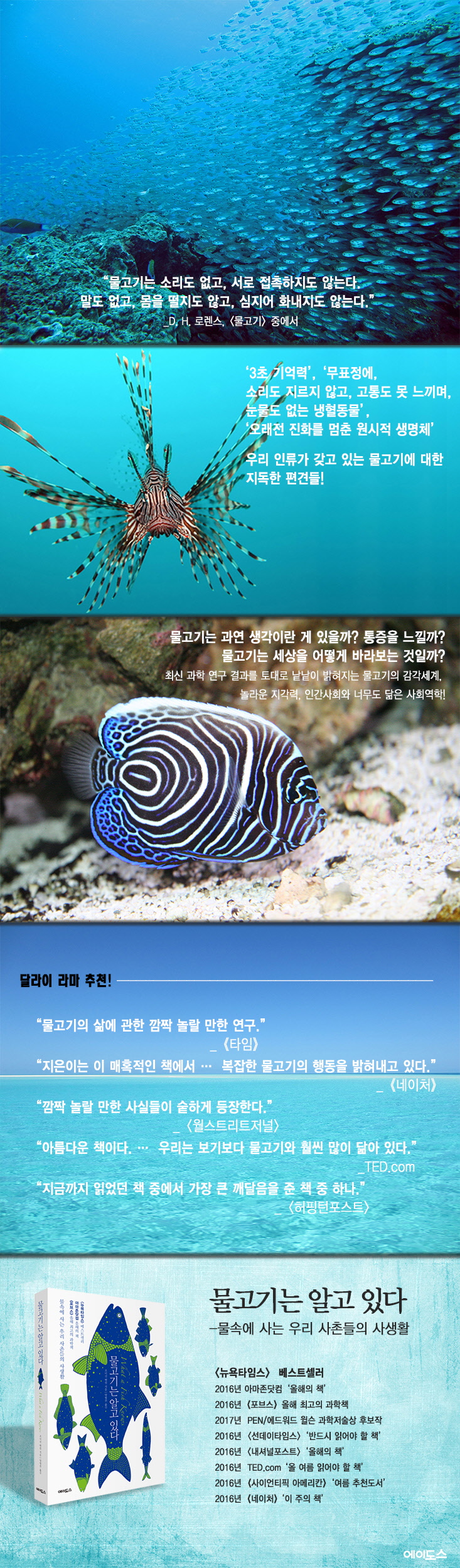
A synonym for stupid animals, animals with no expression, no pain, no tears, and zero empathy, uncivilized and primitive animals that stopped evolving long ago.
These expressions are often attached to fish.
Do fish really think? Do they feel pain? Is their memory really only three seconds? The author presents numerous scientific studies to refute and clearly answer these questions one by one, shatters our preconceptions about fish.
Published in 2016, it was a New York Times bestseller and a Book of the Year by Amazon.com, Forbes, The Sunday Times, and The National Post, and was recommended by the Dalai Lama.
It vividly depicts the sensory world of fish—sight, smell, touch, and taste—that transcends imagination, the perception of fish that surpasses that of any other primate, the dynamics of fish society that are reminiscent of human society, and the desperate lives of fish that strike a blow against anthropocentrism.
The fascinating and intimate private lives of fish, previously unknown, are revealed in detail by a scientist who loves fish.
These expressions are often attached to fish.
Do fish really think? Do they feel pain? Is their memory really only three seconds? The author presents numerous scientific studies to refute and clearly answer these questions one by one, shatters our preconceptions about fish.
Published in 2016, it was a New York Times bestseller and a Book of the Year by Amazon.com, Forbes, The Sunday Times, and The National Post, and was recommended by the Dalai Lama.
It vividly depicts the sensory world of fish—sight, smell, touch, and taste—that transcends imagination, the perception of fish that surpasses that of any other primate, the dynamics of fish society that are reminiscent of human society, and the desperate lives of fish that strike a blow against anthropocentrism.
The fascinating and intimate private lives of fish, previously unknown, are revealed in detail by a scientist who loves fish.
- You can preview some of the book's contents.
Preview
index
prolog
Part 1.
Misconceptions about fish
Chapter 1: Don't judge fish rashly.
Part 2.
Fish senses
Chapter 2: The Fish's Vision
Chapter 3 Hearing, Smell, and Taste
Chapter 4 Other Senses: Navigation, Electroreception, EOD, and Touch
Part 3.
The feeling of fish
Chapter 5: Brain, Consciousness, and Cognition
Chapter 6: Fear, Stress, Pleasure, Play, and Curiosity
Part 4.
Fish's thoughts
Chapter 7 Intelligence and Learning
Chapter 8: Using Tools, Planning
Part 5.
Social life of fish
Chapter 9: We Must Unite to Survive
Chapter 10: The Social Contract
Chapter 11: Cooperation, Democracy, and Peacekeeping
Part 6.
Fish breeding
Chapter 12 Sex Life
Chapter 13 Parenting Styles
Part 7.
fish out of water
Chapter 14: A Fish Out of Water
Epilogue
Americas
Search
Part 1.
Misconceptions about fish
Chapter 1: Don't judge fish rashly.
Part 2.
Fish senses
Chapter 2: The Fish's Vision
Chapter 3 Hearing, Smell, and Taste
Chapter 4 Other Senses: Navigation, Electroreception, EOD, and Touch
Part 3.
The feeling of fish
Chapter 5: Brain, Consciousness, and Cognition
Chapter 6: Fear, Stress, Pleasure, Play, and Curiosity
Part 4.
Fish's thoughts
Chapter 7 Intelligence and Learning
Chapter 8: Using Tools, Planning
Part 5.
Social life of fish
Chapter 9: We Must Unite to Survive
Chapter 10: The Social Contract
Chapter 11: Cooperation, Democracy, and Peacekeeping
Part 6.
Fish breeding
Chapter 12 Sex Life
Chapter 13 Parenting Styles
Part 7.
fish out of water
Chapter 14: A Fish Out of Water
Epilogue
Americas
Search
Detailed image
Into the book
“Labeling fish as ‘primitive’ is a product of gross prejudice.
This bias is based on the assumption that 'creatures that lived in water stopped evolving after some of them crawled onto land.'
This assumption is completely contradictory to the notion that 'evolution continues without pause'.
Natural selection will continue to work given time.
Even after some fish moved onto land and evolved into quadrupeds 430 million years ago, natural selection continued to weed out the remaining fish, gradually refining them.
To be clear, the brains and bodies of all extant vertebrates are a mosaic of 'primitive traits' and 'advanced traits.' --- p.31
“The symbiotic relationship between cleaner fish and client fish is one of the most well-studied and complex social systems in nature.
According to Redouane Bishari, an authority on fish symbiosis, a single cleaner wrasse can distinguish between more than 100 different clients and even remember the date of its last interaction with them.
Moreover, the symbiotic system between cleaners and customers is a complex system that involves long-term relationships based on trust, crime and punishment, demandingness, audience awareness, reputation, and flattery.
These social dynamics suggest that fish societies possess a level of consciousness and sophistication far beyond our imagination.” --- p.220
“The fish… are silent, expressionless, legless, and just stare blankly.” They don’t scream or shed tears when they are caught on a hook and pulled out of the water.
Their eyes are always wide open, which creates the misconception that fish do not feel anything.
But keep in mind that fish don't need eyelids because they are underwater.
The crucial reason why we cannot empathize with fish is because we play in different waters.
“The reason a fish doesn’t cry when it’s pulled out of the water on a fishhook is the same reason we don’t cry when we’re drowning.”
This bias is based on the assumption that 'creatures that lived in water stopped evolving after some of them crawled onto land.'
This assumption is completely contradictory to the notion that 'evolution continues without pause'.
Natural selection will continue to work given time.
Even after some fish moved onto land and evolved into quadrupeds 430 million years ago, natural selection continued to weed out the remaining fish, gradually refining them.
To be clear, the brains and bodies of all extant vertebrates are a mosaic of 'primitive traits' and 'advanced traits.' --- p.31
“The symbiotic relationship between cleaner fish and client fish is one of the most well-studied and complex social systems in nature.
According to Redouane Bishari, an authority on fish symbiosis, a single cleaner wrasse can distinguish between more than 100 different clients and even remember the date of its last interaction with them.
Moreover, the symbiotic system between cleaners and customers is a complex system that involves long-term relationships based on trust, crime and punishment, demandingness, audience awareness, reputation, and flattery.
These social dynamics suggest that fish societies possess a level of consciousness and sophistication far beyond our imagination.” --- p.220
“The fish… are silent, expressionless, legless, and just stare blankly.” They don’t scream or shed tears when they are caught on a hook and pulled out of the water.
Their eyes are always wide open, which creates the misconception that fish do not feel anything.
But keep in mind that fish don't need eyelids because they are underwater.
The crucial reason why we cannot empathize with fish is because we play in different waters.
“The reason a fish doesn’t cry when it’s pulled out of the water on a fishhook is the same reason we don’t cry when we’re drowning.”
--- p.316
Publisher's Review
Are you a primitive animal with a memory of only three seconds and no pain or tears?
There are more species of animals than mammals, birds, reptiles, and amphibians combined, accounting for 60% of vertebrates. They appeared on Earth 530 million years ago, long before humans, and have continued to evolve.
It is a fish that lives in water, the largest habitat on Earth.
But fish are animals of 'misunderstanding'.
Of course, birds are also misunderstood animals with the derogatory term 'bird brain' attached to them, but they are nothing compared to fish.
Why is that? The famous writer D.
H. Lawrence said this in his poem “Fish”:
Fish “make no sound and do not touch each other.
“They don’t speak, they don’t tremble, they don’t even get angry.” This poem very well represents our misunderstanding about fish.
Fish are labeled not only as stupid, lacking in perception, but also as cold-blooded animals that do not know pain or tears.
Fish were animals that did not evoke any sympathy from humans.
The author shatters these human prejudices.
It vividly depicts the sensory world of fish, including sight, smell, touch, and taste, that surpasses imagination, the perception of fish that surpasses that of any other primate, the dynamics of fish society that are reminiscent of human society, and the desperate lives of fish that strike a blow against anthropocentrism.
The bottom line is that fish are smarter animals than we thought, they are not primitive animals that stopped evolving long ago, but highly evolved creatures, and they are our 'cousins' who are very similar to us humans.
How do fish see the world?
How do fish perceive the world? Do they think? Do they feel pain? Is there a social structure among fish? This book answers these questions, which everyone has likely pondered at least once, based on the latest scientific research.
Various experiments that allow us to understand the sensory world of sight, smell, hearing, taste, and geomagnetism not only show us well how fish view the world, but also show that fish demonstrate the ability to learn and remember, recognize objects, play, use tools, and cooperate through the surprising behaviors of fish discovered by numerous scientists over the past 100 years or so since scientific research on fish began in earnest.
Research on fish emotions, including stress, fear, pain, pleasure, play, curiosity, fun, sex, and parenting, shows that fish also have emotions, and that "emotions" are not as unique in their evolutionary history as humans might think.
Of course, the book also includes anecdotal observations from various people, many of which have not been scientifically verified, interspersed with scientific facts.
Although these anecdotal observations lack academic credibility, the author believes they can motivate biologists to conduct research at a time when countless fish remain unstudied and shrouded in mystery.
Fish are a lot more similar to humans than we think!
Just as terrestrial animals are surrounded by the atmosphere, fish live surrounded by water.
The density of water is 800 times greater than that of air and it is incompressible.
This environment made it possible for fish to develop their own unique evolutionary mechanisms.
The reason fish have small brains, flat fins instead of hands or feet, and streamlined bodies is because they live in an underwater environment.
Therefore, we should not judge a fish by its relatively small brain or lack of hands.
The author calls for a departure from this brain-centered and anthropocentric perspective.
When we move away from anthropocentrism, fish appear in a new way.
The author says this:
“The crucial reason why we cannot empathize with fish is because we play in different waters.
“The reason a fish doesn’t cry when it’s pulled out of the water on a fishhook is the same reason we don’t cry when we’re drowning.”
If we humans live for 1 second on Earth, fish are animals that have lived on Earth for over 4 minutes.
Moreover, only 5% of the world's oceans, where fish still remain unknown to humans, have been explored to date.
Therefore, there is ample reason to turn our attention to fish, which still remain unknown creatures, to change our perception, and to reassert their moral rights.
There are more species of animals than mammals, birds, reptiles, and amphibians combined, accounting for 60% of vertebrates. They appeared on Earth 530 million years ago, long before humans, and have continued to evolve.
It is a fish that lives in water, the largest habitat on Earth.
But fish are animals of 'misunderstanding'.
Of course, birds are also misunderstood animals with the derogatory term 'bird brain' attached to them, but they are nothing compared to fish.
Why is that? The famous writer D.
H. Lawrence said this in his poem “Fish”:
Fish “make no sound and do not touch each other.
“They don’t speak, they don’t tremble, they don’t even get angry.” This poem very well represents our misunderstanding about fish.
Fish are labeled not only as stupid, lacking in perception, but also as cold-blooded animals that do not know pain or tears.
Fish were animals that did not evoke any sympathy from humans.
The author shatters these human prejudices.
It vividly depicts the sensory world of fish, including sight, smell, touch, and taste, that surpasses imagination, the perception of fish that surpasses that of any other primate, the dynamics of fish society that are reminiscent of human society, and the desperate lives of fish that strike a blow against anthropocentrism.
The bottom line is that fish are smarter animals than we thought, they are not primitive animals that stopped evolving long ago, but highly evolved creatures, and they are our 'cousins' who are very similar to us humans.
How do fish see the world?
How do fish perceive the world? Do they think? Do they feel pain? Is there a social structure among fish? This book answers these questions, which everyone has likely pondered at least once, based on the latest scientific research.
Various experiments that allow us to understand the sensory world of sight, smell, hearing, taste, and geomagnetism not only show us well how fish view the world, but also show that fish demonstrate the ability to learn and remember, recognize objects, play, use tools, and cooperate through the surprising behaviors of fish discovered by numerous scientists over the past 100 years or so since scientific research on fish began in earnest.
Research on fish emotions, including stress, fear, pain, pleasure, play, curiosity, fun, sex, and parenting, shows that fish also have emotions, and that "emotions" are not as unique in their evolutionary history as humans might think.
Of course, the book also includes anecdotal observations from various people, many of which have not been scientifically verified, interspersed with scientific facts.
Although these anecdotal observations lack academic credibility, the author believes they can motivate biologists to conduct research at a time when countless fish remain unstudied and shrouded in mystery.
Fish are a lot more similar to humans than we think!
Just as terrestrial animals are surrounded by the atmosphere, fish live surrounded by water.
The density of water is 800 times greater than that of air and it is incompressible.
This environment made it possible for fish to develop their own unique evolutionary mechanisms.
The reason fish have small brains, flat fins instead of hands or feet, and streamlined bodies is because they live in an underwater environment.
Therefore, we should not judge a fish by its relatively small brain or lack of hands.
The author calls for a departure from this brain-centered and anthropocentric perspective.
When we move away from anthropocentrism, fish appear in a new way.
The author says this:
“The crucial reason why we cannot empathize with fish is because we play in different waters.
“The reason a fish doesn’t cry when it’s pulled out of the water on a fishhook is the same reason we don’t cry when we’re drowning.”
If we humans live for 1 second on Earth, fish are animals that have lived on Earth for over 4 minutes.
Moreover, only 5% of the world's oceans, where fish still remain unknown to humans, have been explored to date.
Therefore, there is ample reason to turn our attention to fish, which still remain unknown creatures, to change our perception, and to reassert their moral rights.
GOODS SPECIFICS
- Date of publication: February 27, 2017
- Page count, weight, size: 380 pages | 519g | 142*216*26mm
- ISBN13: 9791185415130
- ISBN10: 1185415130
You may also like
카테고리
korean


korean

![ELLE 엘르 스페셜 에디션 A형 : 12월 [2025]](http://librairie.coreenne.fr/cdn/shop/files/b8e27a3de6c9538896439686c6b0e8fb.jpg?v=1766436872&width=3840)


