

Lab Girl
 |
Description
Book Introduction
This book, which received much attention and became a bestseller upon its publication in 2016, was published by Alma.
For readers who have been missing the great physician Oliver Sacks and the humanistic naturalist Stephen Jay Gould of our time, the emergence of a scientist who writes well, Hope Jahren, is more than welcome news.
In Hope Jahren, she focuses on telling her story, what she knows.
He talks about each of their survival methods in a warm and lively manner, saying that the oak tree has its own way of living, and that the kudzu and the yew have their own way of living.
The author's voice, which emphasizes the importance of living in one's own way rather than in the ways of others and the process of creating a forest, awakens the vitality that has been forgotten as we insensitively consume and destroy nature.
Hope Jaren even tells her own painful story honestly.
The bipolar disorder that plagued her, the despair she felt when she was kicked out of her lab because of childbirth, and the anxiety that she wouldn't be a good mother to her child.
What warmly embraced her and sent her back to the lab was the belief that she was doing something vital for the world, the trust of her family and colleagues, and the careful connection with her child.
Above all, it talks about the 'glass ceiling' that women inevitably face when pursuing a career in a professional field.
But she speaks calmly, never exaggerating, about what she has experienced and the gaze she has to endure as a female scientist.
Through her numerous columns and interviews, she has been vocal about breaking down the walls of prejudice and discrimination that women face, and she is willing to serve as a stepping stone for others and a strong, large tree that helps other trees.
For readers who have been missing the great physician Oliver Sacks and the humanistic naturalist Stephen Jay Gould of our time, the emergence of a scientist who writes well, Hope Jahren, is more than welcome news.
In Hope Jahren, she focuses on telling her story, what she knows.
He talks about each of their survival methods in a warm and lively manner, saying that the oak tree has its own way of living, and that the kudzu and the yew have their own way of living.
The author's voice, which emphasizes the importance of living in one's own way rather than in the ways of others and the process of creating a forest, awakens the vitality that has been forgotten as we insensitively consume and destroy nature.
Hope Jaren even tells her own painful story honestly.
The bipolar disorder that plagued her, the despair she felt when she was kicked out of her lab because of childbirth, and the anxiety that she wouldn't be a good mother to her child.
What warmly embraced her and sent her back to the lab was the belief that she was doing something vital for the world, the trust of her family and colleagues, and the careful connection with her child.
Above all, it talks about the 'glass ceiling' that women inevitably face when pursuing a career in a professional field.
But she speaks calmly, never exaggerating, about what she has experienced and the gaze she has to endure as a female scientist.
Through her numerous columns and interviews, she has been vocal about breaking down the walls of prejudice and discrimination that women face, and she is willing to serve as a stepping stone for others and a strong, large tree that helps other trees.
- You can preview some of the book's contents.
Preview
index
prolog
Part 1: Roots and Leaves
Part 2: Trees and Trees
Part 3 Flowers and Fruits
Epilogue
Acknowledgements
Additional remarks
Part 1: Roots and Leaves
Part 2: Trees and Trees
Part 3 Flowers and Fruits
Epilogue
Acknowledgements
Additional remarks
Detailed image
.jpg)
Into the book
Time has changed me, my eyes on my tree, and my eyes on how my tree sees itself.
Science has taught me that everything is more complex than we first assume, and that finding joy in discovering things is the recipe for a beautiful life.
Science has also taught us that the only defense against forgetting is to carefully write down everything important that once happened or existed but no longer exists.
--- p.49
While human dynasties rose and fell, this small seed stubbornly held on, never giving up hope for the future.
Then one day, the little plant's desire blossomed in a laboratory.
Where is that lotus flower now?
Every beginning is the end of waiting.
We all get one chance.
We are all, individually and individually, impossible yet necessary beings.
The beginning of every lush tree was a seed that did not give up waiting.
--- p.52
I learned that female professors and female secretaries working in departments are like natural enemies of academia.
And I realized that while it would be a real problem if I didn't wear a girdle, at least I was better off than another female professor.
She was in dire straits, never going to be able to lose the weight she needed to lose after giving birth if she worked 24 hours a day like that.
--- p.185
A familiar expression now appeared on everyone's face.
“That woman? No way.
“There must have been a mistake.” Public and private organizations around the world have studied the dynamics of gender discrimination in science and concluded that it is complex and multifaceted.
In my limited experience, sexism is quite simple.
Sexism is the constant hearing that you can never be the real you, and the accumulated experience of that becomes a heavy burden that weighs you down.
--- p.262
All it takes to fertilize an ovary and turn it into a seed is a single grain of pollen.
One seed can grow into a tree.
A single tree produces hundreds of thousands of flowers every year.
A single flower produces hundreds of thousands of pollen grains.
Successful plant reproduction is rare, but when it happens, it opens up a world of new possibilities, comparable to a supernova.
--- p.290
Science is work.
Nothing more, nothing less.
So we'll be working all day long as another day dawns, as this week turns into next week, as this month turns into next month.
I feel the warmth of the bright sun shining on the forest and the green world like yesterday, but deep down I know that I am not a plant.
I'm more like an ant.
Ants that find each and every dead conifer leaf, carry it on their backs, and cross the forest to add it to a huge pile.
The pile is so huge that no matter how hard I try to imagine it, I can only imagine a small corner of it.
--- p.397
The Earth seen from space is getting less green every year.
On my bad days, I can't help but think that these global problems are only getting worse in my lifetime, and I can't help but feel the nagging fear that, deep down, we will leave our descendants in a desolate wasteland when we leave this world, a world that is sicker, more hungry, more war-torn, and even more deprived of the simple comforts of green.
But on a good day, I sometimes feel like I could do something about this problem.
Science has taught me that everything is more complex than we first assume, and that finding joy in discovering things is the recipe for a beautiful life.
Science has also taught us that the only defense against forgetting is to carefully write down everything important that once happened or existed but no longer exists.
--- p.49
While human dynasties rose and fell, this small seed stubbornly held on, never giving up hope for the future.
Then one day, the little plant's desire blossomed in a laboratory.
Where is that lotus flower now?
Every beginning is the end of waiting.
We all get one chance.
We are all, individually and individually, impossible yet necessary beings.
The beginning of every lush tree was a seed that did not give up waiting.
--- p.52
I learned that female professors and female secretaries working in departments are like natural enemies of academia.
And I realized that while it would be a real problem if I didn't wear a girdle, at least I was better off than another female professor.
She was in dire straits, never going to be able to lose the weight she needed to lose after giving birth if she worked 24 hours a day like that.
--- p.185
A familiar expression now appeared on everyone's face.
“That woman? No way.
“There must have been a mistake.” Public and private organizations around the world have studied the dynamics of gender discrimination in science and concluded that it is complex and multifaceted.
In my limited experience, sexism is quite simple.
Sexism is the constant hearing that you can never be the real you, and the accumulated experience of that becomes a heavy burden that weighs you down.
--- p.262
All it takes to fertilize an ovary and turn it into a seed is a single grain of pollen.
One seed can grow into a tree.
A single tree produces hundreds of thousands of flowers every year.
A single flower produces hundreds of thousands of pollen grains.
Successful plant reproduction is rare, but when it happens, it opens up a world of new possibilities, comparable to a supernova.
--- p.290
Science is work.
Nothing more, nothing less.
So we'll be working all day long as another day dawns, as this week turns into next week, as this month turns into next month.
I feel the warmth of the bright sun shining on the forest and the green world like yesterday, but deep down I know that I am not a plant.
I'm more like an ant.
Ants that find each and every dead conifer leaf, carry it on their backs, and cross the forest to add it to a huge pile.
The pile is so huge that no matter how hard I try to imagine it, I can only imagine a small corner of it.
--- p.397
The Earth seen from space is getting less green every year.
On my bad days, I can't help but think that these global problems are only getting worse in my lifetime, and I can't help but feel the nagging fear that, deep down, we will leave our descendants in a desolate wasteland when we leave this world, a world that is sicker, more hungry, more war-torn, and even more deprived of the simple comforts of green.
But on a good day, I sometimes feel like I could do something about this problem.
--- p.400
Publisher's Review
★Time's 100 Most Influential People of 2016 ★Smithsonian Magazine's 10 Best Science Books
★ New York Times Recommended Books ★ Amazon's 20 Best Books
Since the publication plan was first revealed in 2014, more than 10 local publishers in the US have competed for the book, creating a buzz. Published in 2016, the book became a bestseller and garnered much attention. Published by Alma, it is now a popular book.
For readers who have been missing the great physician Oliver Sacks and the humanistic naturalist Stephen Jay Gould of our time, the emergence of a scientist who writes well, Hope Jahren, is more than welcome news.
American readers who first read this book confessed:
At first, I was drawn to the book by the successful career of the female scientist and her excellent writing skills, but in the end, I was able to relate to and find comfort in the book's honest self-reflection and warm perspective on neighbors and the world.
The story of a girl who dreamed of becoming a scientist, who overcame numerous trials and errors and the high walls of society she faced simply because she was a woman, and yet, with her love for nature and science and her faith in her colleagues, steadfastly walked the path of a researcher and became a scientist, is as thrilling and wonderful at the same time as watching a tree grow.
“Science is not a cold, hard, inorganic substance!”
The science that moves the heart, the research of 'Lab Girl' filled with love.
Author Hope Jahren completed her PhD at the University of California, Berkeley, and has served as an Associate Professor at the Georgia Institute of Technology and Johns Hopkins University. She currently conducts research at the University of Hawaii.
In 2005, she received the James McElwain Medal, awarded to the most distinguished geophysicist, and is the only female scientist to have won the Fulbright Award three times.
Even for her, who had a very stable career and was recognized for her abilities and achievements in many ways, writing was a reckless challenge.
And she did it again.
The author did not try to show the image of the 'alpha girl' that is commonly thought of in this book.
It depicts in detail the 24 hours of an ordinary laboratory, where one fails a hundred times to achieve a single meaningful result, and endures with patience and perseverance.
What about the prejudices and barriers women face?
Even in the world of science, which is known for its expertise, objectivity, and rationality, readers' hearts burn when they encounter scenes where achievements are not recognized or the value of effort is belittled due to gender.
But what the author draws is the sweet joy experienced within it.
The author describes his laboratory as follows:
“My lab is where the guilt of what I didn’t do is replaced by the guilt of what I do do.
“Things like not calling your parents, unpaid credit card bills, piles of unwashed dishes, and unshaven legs are trivial compared to the work you do in the lab to make sublime discoveries.” (Page 35) For the writer, the lab is not just a place for research; it is a precious treasure: a ‘home’ that bears his name, a ‘church’, and a ‘place to write.’
The science of life taught by trees,
Listen to the story of solidarity that the forest tells.
There is another reason why the author is so passionate about the lab.
It is an infinite love for plants.
I wanted to study plants from the beginning, but isn't the field of plants the one that people are least interested in?
To raise the necessary research funds, she tends plants while surviving a war-like day in the laboratory.
“An experiment that I predicted would take two hours of work took four days to complete, and eight days to complete perfectly.
Moreover, all this laboratory work had to be done in between watering and fertilizing hundreds of plants every day and recording the changes.” (Page 41) The author is so absorbed in his research that he is even harming his own body.
Her passion is breathtaking just from reading her writing.
Author Hope Jaren says:
'Once a plant sprouts, it doesn't wander.'
The last wandering a plant can choose is until it sprouts.
From then on, it's just a matter of steadily moving forward until the moment it withers and breaks.
It actively extends its roots toward the water stream, shakes its leaves toward the sun, and strengthens its body to protect itself from external dangers.
Sometimes, plants suffer from pests and diseases and are injured by strong winds, but they continue to grow while keeping the wounds intact in their rings.
In a forest, strong and tall trees will benefit, but sometimes a tree that has suffered a severe disease can teach other trees how to overcome the disease, or collect water to help nearby younger trees grow well.
With a scientist's perspective, Hope Jahren explores the process by which a seed becomes a mature tree, as well as the secrets of how trees come together to form a lush forest.
It is not really a secret, but rather a mystery that anyone with a keen eye can figure out if they pay attention.
In Rap Girl, Hope Jarren focuses on telling her story, what she knows.
He talks about each of their survival methods in a warm and lively manner, saying that the oak tree has its own way of living, and that the kudzu and the yew have their own way of living.
The author's voice, which emphasizes the importance of living in one's own way rather than in the ways of others and the process of creating a forest, awakens the vitality that has been forgotten as we insensitively consume and destroy nature.
Hope Jaren even tells her own painful story honestly.
The bipolar disorder that plagued her, the despair she felt when she was kicked out of her lab because of childbirth, and the anxiety that she wouldn't be a good mother to her child.
What warmly embraced her and sent her back to the lab was the belief that she was doing something vital for the world, the trust of her family and colleagues, and the careful connection with her child.
In Rap Girl, author Hope Jaren discusses the "glass ceiling" that women inevitably face as they pursue careers in professional fields.
But she speaks calmly, never exaggerating, about what she has experienced and the gaze she has to endure as a female scientist.
Through numerous columns and interviews, she has been vocal about breaking down the walls of prejudice and discrimination that women face, and she is willing to serve as a stepping stone for others and a strong, large tree that helps other trees.
Alma's Books for Foresters
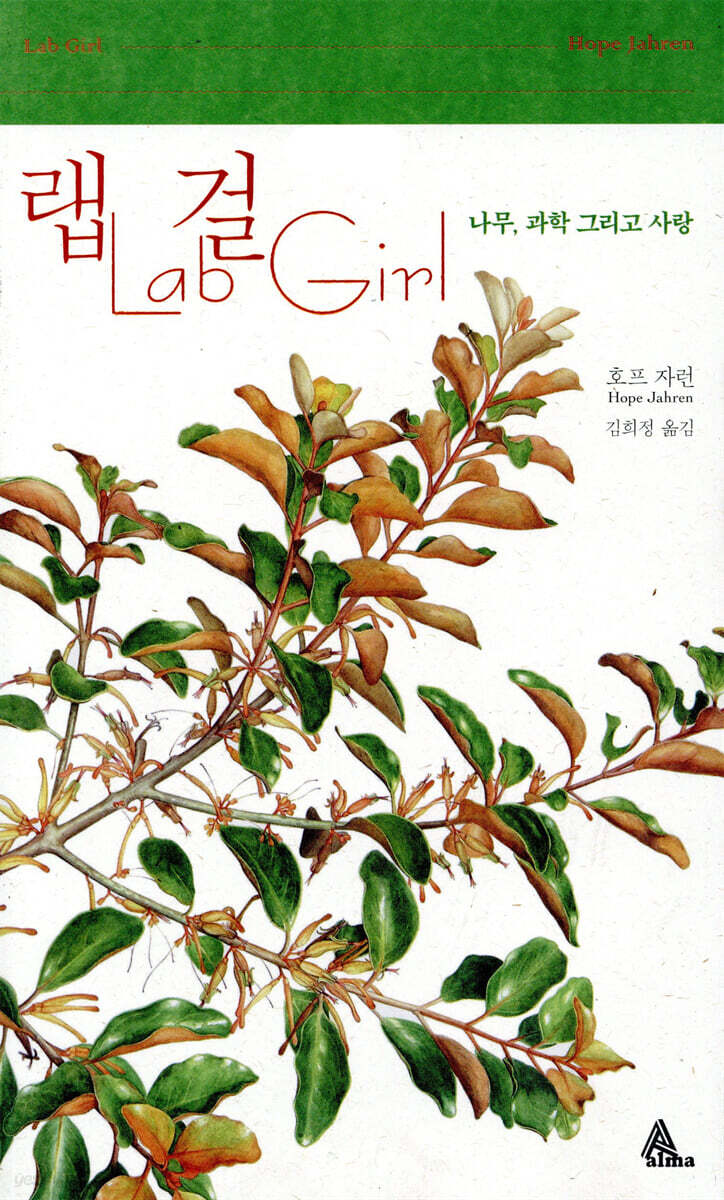
The cover of "Rap Girl - Trees, Science and Love" features a detailed drawing of "Oak Mistletoe" by Shin Hye-woo, a botanist and botanical artist who won the Royal Horticultural Society's highest award in 2014. A limited edition of 2,000 copies will be given a poster-style cover.
Alma Publishing will continue to introduce the stories of female scientists who have quietly done their best for a better world, starting with “Lab Girl,” followed by “Glass Universe” and “Rocket Girls” (tentative title, to be published), along with books by Oliver Sacks that break down people’s prejudices through a new and warm perspective on humanity.
★ New York Times Recommended Books ★ Amazon's 20 Best Books
Since the publication plan was first revealed in 2014, more than 10 local publishers in the US have competed for the book, creating a buzz. Published in 2016, the book became a bestseller and garnered much attention. Published by Alma, it is now a popular book.
For readers who have been missing the great physician Oliver Sacks and the humanistic naturalist Stephen Jay Gould of our time, the emergence of a scientist who writes well, Hope Jahren, is more than welcome news.
American readers who first read this book confessed:
At first, I was drawn to the book by the successful career of the female scientist and her excellent writing skills, but in the end, I was able to relate to and find comfort in the book's honest self-reflection and warm perspective on neighbors and the world.
The story of a girl who dreamed of becoming a scientist, who overcame numerous trials and errors and the high walls of society she faced simply because she was a woman, and yet, with her love for nature and science and her faith in her colleagues, steadfastly walked the path of a researcher and became a scientist, is as thrilling and wonderful at the same time as watching a tree grow.
“Science is not a cold, hard, inorganic substance!”
The science that moves the heart, the research of 'Lab Girl' filled with love.
Author Hope Jahren completed her PhD at the University of California, Berkeley, and has served as an Associate Professor at the Georgia Institute of Technology and Johns Hopkins University. She currently conducts research at the University of Hawaii.
In 2005, she received the James McElwain Medal, awarded to the most distinguished geophysicist, and is the only female scientist to have won the Fulbright Award three times.
Even for her, who had a very stable career and was recognized for her abilities and achievements in many ways, writing was a reckless challenge.
And she did it again.
The author did not try to show the image of the 'alpha girl' that is commonly thought of in this book.
It depicts in detail the 24 hours of an ordinary laboratory, where one fails a hundred times to achieve a single meaningful result, and endures with patience and perseverance.
What about the prejudices and barriers women face?
Even in the world of science, which is known for its expertise, objectivity, and rationality, readers' hearts burn when they encounter scenes where achievements are not recognized or the value of effort is belittled due to gender.
But what the author draws is the sweet joy experienced within it.
The author describes his laboratory as follows:
“My lab is where the guilt of what I didn’t do is replaced by the guilt of what I do do.
“Things like not calling your parents, unpaid credit card bills, piles of unwashed dishes, and unshaven legs are trivial compared to the work you do in the lab to make sublime discoveries.” (Page 35) For the writer, the lab is not just a place for research; it is a precious treasure: a ‘home’ that bears his name, a ‘church’, and a ‘place to write.’
The science of life taught by trees,
Listen to the story of solidarity that the forest tells.
There is another reason why the author is so passionate about the lab.
It is an infinite love for plants.
I wanted to study plants from the beginning, but isn't the field of plants the one that people are least interested in?
To raise the necessary research funds, she tends plants while surviving a war-like day in the laboratory.
“An experiment that I predicted would take two hours of work took four days to complete, and eight days to complete perfectly.
Moreover, all this laboratory work had to be done in between watering and fertilizing hundreds of plants every day and recording the changes.” (Page 41) The author is so absorbed in his research that he is even harming his own body.
Her passion is breathtaking just from reading her writing.
Author Hope Jaren says:
'Once a plant sprouts, it doesn't wander.'
The last wandering a plant can choose is until it sprouts.
From then on, it's just a matter of steadily moving forward until the moment it withers and breaks.
It actively extends its roots toward the water stream, shakes its leaves toward the sun, and strengthens its body to protect itself from external dangers.
Sometimes, plants suffer from pests and diseases and are injured by strong winds, but they continue to grow while keeping the wounds intact in their rings.
In a forest, strong and tall trees will benefit, but sometimes a tree that has suffered a severe disease can teach other trees how to overcome the disease, or collect water to help nearby younger trees grow well.
With a scientist's perspective, Hope Jahren explores the process by which a seed becomes a mature tree, as well as the secrets of how trees come together to form a lush forest.
It is not really a secret, but rather a mystery that anyone with a keen eye can figure out if they pay attention.
In Rap Girl, Hope Jarren focuses on telling her story, what she knows.
He talks about each of their survival methods in a warm and lively manner, saying that the oak tree has its own way of living, and that the kudzu and the yew have their own way of living.
The author's voice, which emphasizes the importance of living in one's own way rather than in the ways of others and the process of creating a forest, awakens the vitality that has been forgotten as we insensitively consume and destroy nature.
Hope Jaren even tells her own painful story honestly.
The bipolar disorder that plagued her, the despair she felt when she was kicked out of her lab because of childbirth, and the anxiety that she wouldn't be a good mother to her child.
What warmly embraced her and sent her back to the lab was the belief that she was doing something vital for the world, the trust of her family and colleagues, and the careful connection with her child.
In Rap Girl, author Hope Jaren discusses the "glass ceiling" that women inevitably face as they pursue careers in professional fields.
But she speaks calmly, never exaggerating, about what she has experienced and the gaze she has to endure as a female scientist.
Through numerous columns and interviews, she has been vocal about breaking down the walls of prejudice and discrimination that women face, and she is willing to serve as a stepping stone for others and a strong, large tree that helps other trees.
Alma's Books for Foresters
The cover of "Rap Girl - Trees, Science and Love" features a detailed drawing of "Oak Mistletoe" by Shin Hye-woo, a botanist and botanical artist who won the Royal Horticultural Society's highest award in 2014. A limited edition of 2,000 copies will be given a poster-style cover.
Alma Publishing will continue to introduce the stories of female scientists who have quietly done their best for a better world, starting with “Lab Girl,” followed by “Glass Universe” and “Rocket Girls” (tentative title, to be published), along with books by Oliver Sacks that break down people’s prejudices through a new and warm perspective on humanity.
GOODS SPECIFICS
- Date of issue: February 20, 2017
- Page count, weight, size: 412 pages | 504g | 130*213*30mm
- ISBN13: 9791159920967
- ISBN10: 1159920966
You may also like
카테고리
korean


korean

![ELLE 엘르 스페셜 에디션 A형 : 12월 [2025]](http://librairie.coreenne.fr/cdn/shop/files/b8e27a3de6c9538896439686c6b0e8fb.jpg?v=1766436872&width=3840)


