

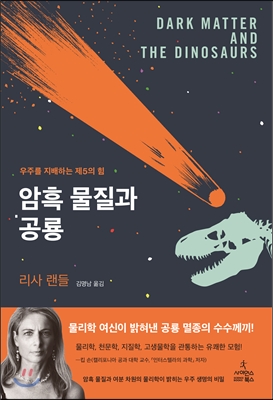
Dark Matter and Dinosaurs
 |
Description
Book Introduction
66 million years ago, it was dark matter that caused the dinosaurs to go extinct!
The female physicist closest to winning the Nobel Prize in Physics
A new convergence of cosmology and life sciences proposed by 'Goddess of Physics' Lisa Randle!
Recommended by Kip Thorne, advisory scientist for the film "Interstellar"
An urgent monograph of the latest research that has thrilled the global scientific community!
“An ambitious and lucid account of the broad fields of modern science and the remarkable interconnections between them.
It is a masterpiece of scientific writing.
A detective story that illuminates the nature of scientific research while also explaining the hypothesis that the unexpected properties of the dark matter that fills the universe may be connected to our own existence.
“I thoroughly enjoyed reading it and it gave me a lot of new and interesting ideas.”
-Kip Thorne (Professor Emeritus of Theoretical Physics, Feynman Professor, Caltech, author of Black Holes and Time Refraction and The Science of Interstellar)
It was dark matter that caused the dinosaurs to go extinct 66 million years ago!
Lisa Randall, the bestselling science fiction author of The Hidden Universe and Knocking on Heaven's Door and author of one of the world's most influential and widely cited particle physics papers, once again demonstrates her remarkable writing skills in this book, taking readers on a fascinating journey into the world of science.
This book challenges the shocking secrets hidden in the history of the universe, life, and humanity by linking the mystery of dark matter, for which even the method of exploration is still unclear, with the sudden extinction of the dinosaurs tens of millions of years ago.
66 million years ago, a celestial body the size of a city crashed from space to Earth.
The cataclysm that ensued killed the dinosaurs, along with three-quarters of all species that lived on Earth at the time.
But where did this celestial body come from? Randall's hypothesis is this:
It was a comet, and the comet was deviated from its original orbit because the solar system was disturbed as it passed through a disk of dark matter within the galactic plane of our galaxy.
Randle's research, which combines cosmological and evolutionary biology, challenges existing research that only estimates the composition and properties of dark matter, and further demonstrates the process by which scientists generate and verify new ideas.
Randall's research suggests that in some sense, dark matter may have killed the dinosaurs.
The female physicist closest to winning the Nobel Prize in Physics
A new convergence of cosmology and life sciences proposed by 'Goddess of Physics' Lisa Randle!
Recommended by Kip Thorne, advisory scientist for the film "Interstellar"
An urgent monograph of the latest research that has thrilled the global scientific community!
“An ambitious and lucid account of the broad fields of modern science and the remarkable interconnections between them.
It is a masterpiece of scientific writing.
A detective story that illuminates the nature of scientific research while also explaining the hypothesis that the unexpected properties of the dark matter that fills the universe may be connected to our own existence.
“I thoroughly enjoyed reading it and it gave me a lot of new and interesting ideas.”
-Kip Thorne (Professor Emeritus of Theoretical Physics, Feynman Professor, Caltech, author of Black Holes and Time Refraction and The Science of Interstellar)
It was dark matter that caused the dinosaurs to go extinct 66 million years ago!
Lisa Randall, the bestselling science fiction author of The Hidden Universe and Knocking on Heaven's Door and author of one of the world's most influential and widely cited particle physics papers, once again demonstrates her remarkable writing skills in this book, taking readers on a fascinating journey into the world of science.
This book challenges the shocking secrets hidden in the history of the universe, life, and humanity by linking the mystery of dark matter, for which even the method of exploration is still unclear, with the sudden extinction of the dinosaurs tens of millions of years ago.
66 million years ago, a celestial body the size of a city crashed from space to Earth.
The cataclysm that ensued killed the dinosaurs, along with three-quarters of all species that lived on Earth at the time.
But where did this celestial body come from? Randall's hypothesis is this:
It was a comet, and the comet was deviated from its original orbit because the solar system was disturbed as it passed through a disk of dark matter within the galactic plane of our galaxy.
Randle's research, which combines cosmological and evolutionary biology, challenges existing research that only estimates the composition and properties of dark matter, and further demonstrates the process by which scientists generate and verify new ideas.
Randall's research suggests that in some sense, dark matter may have killed the dinosaurs.
- You can preview some of the book's contents.
Preview
index
introduction
Part 1: The Development of the Universe
Chapter 1: The Secret Society of Dark Matter
Chapter 2: The Discovery of Dark Matter
Chapter 3: Big Questions
Chapter 4: Almost the Beginning: A Good Place to Start
Chapter 5: The Birth of a Galaxy
Part 2: The Active Solar System
Chapter 6 Meteoroids, Meteors, and Meteorites
Chapter 7: The Short and Glorious Life of a Comet
Chapter 8: The Edge of the Solar System
Chapter 9: A Dangerous Life
Chapter 10: Shock and Awe
Chapter 11 Extinction
Chapter 12: The End of the Dinosaurs
Chapter 13: Habitable Zones
Chapter 14: The Rotating Cycle
Chapter 15: Comets Swept from the Oort Cloud
Part 3: Deciphering the Identity of Dark Matter
Chapter 16: The Invisible Matter of the World
Chapter 17: How to See in the Dark
Chapter 18: Socially Connected Dark Matter
Chapter 19: The Speed of Darkness
Chapter 20: In Search of the Dark Disc
Chapter 21: Dark Matter and Comet Collisions
Acknowledgements
List of illustrations
Further Reading
Search
Part 1: The Development of the Universe
Chapter 1: The Secret Society of Dark Matter
Chapter 2: The Discovery of Dark Matter
Chapter 3: Big Questions
Chapter 4: Almost the Beginning: A Good Place to Start
Chapter 5: The Birth of a Galaxy
Part 2: The Active Solar System
Chapter 6 Meteoroids, Meteors, and Meteorites
Chapter 7: The Short and Glorious Life of a Comet
Chapter 8: The Edge of the Solar System
Chapter 9: A Dangerous Life
Chapter 10: Shock and Awe
Chapter 11 Extinction
Chapter 12: The End of the Dinosaurs
Chapter 13: Habitable Zones
Chapter 14: The Rotating Cycle
Chapter 15: Comets Swept from the Oort Cloud
Part 3: Deciphering the Identity of Dark Matter
Chapter 16: The Invisible Matter of the World
Chapter 17: How to See in the Dark
Chapter 18: Socially Connected Dark Matter
Chapter 19: The Speed of Darkness
Chapter 20: In Search of the Dark Disc
Chapter 21: Dark Matter and Comet Collisions
Acknowledgements
List of illustrations
Further Reading
Search
Publisher's Review
Cutting-edge cosmological research surrounding dark matter and
A shocking science nonfiction book that weaves together the mystery of dinosaur extinction.
Randall connects dark matter to Earth's history from a unique and expansive perspective.
Drawing on popular culture and socio-political perspectives, it presents the latest discoveries—both confirmed and speculative—about dark matter, the universe, our galaxy, asteroids, comets, and Earth-Earth collisions.
It also presents the latest discoveries on the evolution and extinction of life.
Randall brilliantly demonstrates that Earth's fate is intimately linked to the makeup of the universe, and that our existence in a universe that has evolved over billions of years may in fact be quite fragile.
In this quirky and refreshing book exploring the cosmic environment that surrounds us, Professor Randall explains the science behind our world's breathtaking story.
In this story, the small and the big, the visible and the hidden, are closely connected.
This book not only illuminates the profound relationships that hold significant meaning in our world, but also makes us realize the amazing beauty of all the structures and relationships that surround us.
Once you read this book, you will never look at the Earth or the night sky the same way again.
The 21st century will be Lisa Randall's century!
-Bill Clinton (former US President)
From Kip Thorne and Richard Dawkins to Bill Clinton and Elon Musk
The only physicist recommended by both scientists and politicians
- Selected by Time Magazine as one of the “100 Most Influential People in the World”
- Author of the most cited paper in the history of theoretical physics
- The female physicist closest to winning the Nobel Prize in Physics
Lisa Randall presents complex ideas in physics in a captivating and accessible way, with a witty style that makes you feel as if you're talking to a live audience.
This book explains recent developments in modern physics, linking them to cultural and public policy issues.
As you follow the explanations in this book, your thinking will change from the very foundation.
And it will challenge you to make wiser choices about the world.
-Bill Clinton (former US President)
Science is a challenge to the mind and spirit, armed with superstition, ignorance, and the obscurantism spread by pseudo-intellectuals.
You have no idea how grateful I am to have Lisa Randall on our side, a woman who combines top-notch science, brilliance, and charm.
-Richard Dawkins (author of The Selfish Gene and God Is a Delusion)
Theoretical physicist Lisa Randall is famous for being the first woman to hold a tenured professorship in physics at Harvard University and MIT.
Academically, he is renowned for creating twisted extradimensional physics by applying concepts from string theory and topology.
Born in 1962, he shocked the world of physics in 1999, around the turn of the century, when he published a paper titled “Warped Extra Dimensions” with Dr. Raman Sundrum.
This paper made some of the research results of string theory, which were thought to be abstract and impossible to verify, experimentally verifiable, and attracted the attention of scientists seeking the future of physics, becoming the most cited theoretical physics paper of the 21st century.
As a result, Lisa Randall became one of the most influential theoretical physicists of the modern century.
The extra-dimensional theory she proposed, called the 'Randall-Sundrum model', is highly regarded as a clue to solving many difficult problems in modern theoretical physics, and is serving as a guideline for designing new experiments at the Large Hadron Collider (LHC) operating in Geneva, Switzerland.
Randall has also contributed to inflationary cosmology, supersymmetry theory, grand unification theory, and string theory.
For these achievements, the American Physical Society awarded Randle the 'Most Cited Paper Award', and he swept many prestigious academic research awards, including the Alfred Sloan Foundation Research Award. He is also an active member of academic institutions such as the National Academy of Sciences and the American Philosophical Society, which are considered hallmarks of intellect.
Her achievements have been mentioned in various scientific media such as Discovery, The Economist, Newsweek, and Scientific American, as well as professional academic journals such as Physics Letters, Nature, and Science, and media outlets such as Seed Magazine, Newsweek, Rolling Stone, and Time have also highlighted her achievements and status with titles such as “100 Most Influential People in the World.”
His first book, "Warped Passages," and his second, "Knocking on Heaven's Door," have been translated and published in over 30 countries, including the West, Korea, and Japan, and have become bestsellers in the global science literature community. They have also been selected as "Books of the Year" by various media outlets, including The New York Times.
Lisa Randle, the first woman to be appointed a tenured professor of physics at MIT and Harvard, actively supports women's advancement in science through various public activities in addition to her academic research.
Lisa Randall will be visiting Korea on June 12th to attend the NPKI (New Physics @ Korea Institute, http://www.npki.org/) conference at Korea University. In addition to her scientific lectures, she is also preparing to encourage the advancement of female scientists through public lectures and events.
- NPKI (New Physics @ Korea Institute, http://www.npki.org/) is an annual theoretical physics conference hosted by young Korean theoretical physicists, including Professor Seung-Jun Lee of the Department of Physics at Korea University, and world-renowned senior physicists, including Csaba Csaki of the Department of Physics at Cornell University. This conference is now in its third year. It is a conference that is receiving global attention, where not only leading researchers from the world's leading physics institutions, such as CERN, DESY, and FERMILAB, but also researchers from physics research hub universities around the world gather to engage in heated physics discussions.
We are also working to popularize theoretical physics by planning public lectures open to the general public and special events for aspiring scientists.
This year's theme is "The lesson from the first results of Run 2 of the LHC."
A variety of academic events are planned, including a public lecture by Lisa Randall.
Preface to Dark Matter and Dinosaurs
The universe and we are connected by dark matter!
“Dark matter” and “dinosaurs” are things that are rarely discussed together.
Except in places like playgrounds, fantasy game clubs, or Steven Spielberg movies that haven't been released yet.
Dark matter is a mysterious substance that exists in the universe. It interacts with ordinary matter through gravity, but does not emit or absorb light.
Astronomers can detect the gravitational influence of dark matter, but they cannot literally see it.
Meanwhile, dinosaurs… do we really need to explain dinosaurs?
Dinosaurs are vertebrates that ruled the land from 230 million to 66 million years ago.
Dark matter and dinosaurs are both fantastical, but it's probably reasonable to assume that invisible physical matter and popular biological icons have nothing to do with each other.
That might really be true.
However, the universe is by definition a single entity, and its components theoretically all interact with each other.
This book will present a speculative scenario, proposed by my colleagues and myself, in which we argue that dark matter may ultimately (and indirectly) be responsible for the extinction of the dinosaurs.
Paleontologists, geologists, and physicists have discovered that 66 million years ago, an object at least 10 kilometers wide crashed from space into Earth, killing all terrestrial dinosaurs.
It also killed three-quarters of all species that lived on Earth.
The object may have been a comet from the outskirts of the solar system, but no one knows why it deviated from its original, if tenuously stable, orbit.
Our hypothesis is this:
As the Sun passes through the mid-plane of our galaxy - the Milky Way, the band of stars and bright dust visible on a clear night's sky.
- The solar system encounters a disk of dark matter.
The disc would then eject a distant celestial body from the Sun, triggering a catastrophic collision.
There is also a large amount of dark matter surrounding our galaxy, forming an incredibly smooth, spherical halo.
However, the dark matter that caused the demise of the dinosaurs would have been distributed in a very different form than most dark matter in the universe.
This new type of dark matter would leave the halo as it is, but because it interacts differently from the existing dark matter, it would clump together into a disk within the mid-plane of our galaxy.
This thin region can be very dense.
So when our solar system passes through it, as the Sun oscillates up and down in its orbit around the galaxy, the gravitational pull of the disk will be unusually strong.
The gravitational pull of the disk is so strong that it could knock comets from the outer solar system out of their orbits.
Because there, the power of the sun to restrain and restrain the celestial bodies is very weak against that force.
So a comet that goes off course could be kicked out of the solar system or, more seriously, it could take a new orbit that sends it hurtling towards the inner solar system.
Then there is a possibility that it will hit the Earth.
Let me be honest from the beginning: I don't know yet if this idea is correct.
Among dark matter, the only one that can have a measurable effect on living beings (or, strictly speaking, on those that are no longer alive) is a new type of dark matter that we have not previously anticipated.
This book is a groundbreaking hypothesis about dark matter, a surprising and influential phenomenon.
But these inferences – while provocative – are not the main focus of the book.
Just as important as the story of the comet that wiped out the dinosaurs is the context and science surrounding that story.
This includes cosmology and solar system studies, which have much better established academic frameworks.
I consider myself fortunate that the topics I study often lead me to ask grand questions.
Questions like these are examples.
What is matter made of? What are the properties of space and time? How did everything we see in the universe today evolve into the world? I hope this book will allow us to discuss many such questions.
As I studied for the research I will present below, I found myself thinking broadly about cosmology, astrophysics, geology, and even biology.
The focus remains on fundamental physics.
But I've spent my life studying more conventional particle physics - the basic units that make up familiar materials like the paper or screen you're reading this on.
- It felt refreshing to see what was known about the dark world – and what would soon be known.
The same was true for the meaning of the fundamental physical processes of the solar system and Earth.
This book explains what we currently know about the universe, our galaxy, and our solar system, and discusses what conditions must be met for a habitable environment to develop and for life to exist on Earth.
We'll discuss dark matter and the universe, but we'll also delve into comets, asteroids, and the emergence and extinction of life.
Focusing specifically on the celestial body that fell from the sky to Earth and killed not only the terrestrial dinosaurs but also countless other life forms on Earth.
I hope this book will help you gain a deeper understanding of what's happening today by introducing you to the many amazing relationships that make our existence possible.
When we think about our current planet, wouldn't it be good to better understand the context in which it developed?
As I began to delve into the concepts that underpinned the conception of this book, I couldn't help but be struck by awe and fascination.
It wasn't just because of what we knew about our environment - local, solar, galactic, and cosmic.
It was also because we, sitting on this small planet that we were given by chance, ultimately hoped to understand more.
I was also overwhelmed by the realization of the many relationships between the various phenomena that allowed us to exist here.
To be clear, my views are not religious.
I don't feel the need to ascribe any purpose or meaning to this.
But as I, too, came to understand more deeply the vastness of the universe, our past, and how it all fits together, I couldn't help but feel what people often call religious emotions.
Such feelings provide anyone with a perspective on the folly of everyday life.
This new research has given me a new perspective on the world, the many elements of the universe that gave birth to Earth, and ourselves.
As a Queens native, I grew up seeing a lot of New York's impressive buildings, but not much nature.
The nature I had encountered was mostly maintained as parks and lawns, so it barely retained its original form before the arrival of humans.
But when we walk on the beach, we are actually walking on finely chopped organisms.
On top of the protective covering of those creatures.
The limestone cliffs we see on beaches and in the countryside were also created by creatures that lived millions of years ago.
Mountains arose when tectonic plates collided, and the molten magma that drove that movement was created by radioactive material buried near the Earth's core.
The energy we have comes from nuclear reactions taking place in the sun.
Since the first nuclear reaction occurred, its energy has been transformed and stored in various ways.
Many of the resources we use are heavy elements that come from space.
These are things that asteroids or comets dropped on the Earth's surface.
Some amino acids were brought by meteorites, and perhaps these meteorites brought life, or the seeds of life, to Earth.
And before all this happened, dark matter collapsed into clumps that attracted more matter with their gravity, and those clumps eventually turned into galaxies, clusters of galaxies, and stars like the Sun.
Usually, material things - as important as they are to us - are not the whole story.
It's easy to delude ourselves into thinking we live in a self-sufficient environment, but every day at dawn and dusk, the moon and more distant stars come into view, reminding us that our planet is not alone in the universe.
Stars and nebulae are evidence that we are part of a galaxy within a much larger universe.
The Earth orbits the Sun, and the seasons that result remind us of our orientation and location in the solar system.
The fact that we measure time in days and years is also evidence of how important the environment is to us.
***
As I researched and read leading up to this book, I felt four striking lessons stood out that I would like to share with you.
What I personally treasure is the satisfaction I get from understanding how the many pieces of the universe are connected in diverse and amazing ways.
At the most fundamental level, the greatest lesson is that the physics of elementary particles, the physics of the universe, and the biology of life are all connected.
Not in some New Age sense, but in amazing ways that are worth understanding.
Matter from space constantly hits the Earth.
However, the Earth has a love-hate relationship with its surroundings.
The Earth benefits from what surrounds us, but most of it is also lethal.
Earth's location allows us just the right temperature, the outer planets deflect incoming asteroids and comets so they don't collide with Earth, the Moon's distance from Earth is just right to stabilize our orbit and prevent extreme temperature swings, and the outer solar system shields us from dangerous cosmic rays.
Meteorites that fell to Earth may have delivered vital resources to life, but they also influenced the trajectory of life in more harmful ways.
At least one such body is certain to have caused the extinction that devastated life 66 million years ago.
That celestial body wiped out the dinosaurs that lived on land, but it also opened the way for large mammals, including us, to rise to prominence.
The second lesson is - and this is also impressive.
- Of the scientific advances I will talk about, many are recent.
Perhaps at any point in human history, one could make the following statement, but that doesn't diminish its validity.
What this means is that our knowledge has advanced tremendously over the past [insert contextual number here] years.
In the study I'm about to present, this number is less than 50 years.
As I conduct my own research and read the work of others, I am constantly amazed at how many recent discoveries are new and revolutionary.
Scientists have demonstrated unwavering creativity and tenacity as they strive to incorporate into science what we have discovered about the world—often surprising, always fascinating, and sometimes frightening.
The science presented in this book is part of a broader history.
The broader history could be 13.8 billion years or 4.6 billion years, depending on whether you focus on the universe or the solar system.
However, the history of humans trying to explain these ideas is only about a century old.
Dinosaurs became extinct 66 million years ago, but it wasn't until the 1970s and 1980s that paleontologists and geologists began to deduce the nature of the extinction.
Once valid hypotheses were put forward, it took only a few decades for the scientific community to be able to evaluate them more fully.
Moreover, the timing could not be said to be a complete coincidence.
It just so happened that astronauts landed on the moon and got a close look at the craters, making the connection between extinction and extraterrestrial bodies seem more credible.
The craters on the moon were a vivid testimony to the dynamism of the solar system.
Over the past 50 years, significant advances in particle physics and cosmology have taught us more about the Standard Model.
The Standard Model is a model that describes the basic constituents of matter as we understand them today.
It was only in the last few decades of the 20th century that the amount of dark matter and dark energy in the universe was discovered.
During that time, our knowledge of the solar system also changed significantly.
It was in the 1990s that scientists discovered Kuiper Belt objects near Pluto, confirming that Pluto is not orbiting alone.
That's why the number of planets has decreased, but that's because the science you may have learned in graduate school is now richer and more complex.
The third important lesson is about the pace of change.
Natural selection allows species to adapt when they have time to evolve.
But such adaptations cannot encompass extreme changes.
Because it happens too slowly for that to happen.
The dinosaurs were not prepared for the 10-kilometer-wide meteor that struck Earth.
They couldn't adapt.
Those who were stuck to the ground, those who were too big to burrow into the ground, had nowhere to run to survive.
Whenever a new idea or technology emerges, the debate over whether it will be a catastrophic or incremental change often plays an important role.
The key to understanding most new developments—whether scientific or otherwise—is the speed of the processes that drive them.
People often say that certain developments, such as those stemming from genetic research or the Internet, are unprecedentedly dramatic.
But this is not entirely correct.
Events hundreds of years ago that brought about a better understanding of disease and the circulatory system brought about changes no less profound than those in genetics today.
The impact of written language and, later, the printing press on how we acquire knowledge and think has been no less significant than that of the Internet.
As with these developments, rapidity is a crucial factor in the current changes.
This topic is valid not only for scientific processes but also for environmental and social changes.
While the destruction caused by meteors may not be a major concern for us today, the accelerating pace of environmental change and extinction is likely to be a significant concern.
And the impact would be comparable in many ways to that of a meteor.
Another agenda, so blatantly apparent in this book that it could hardly be called hidden, is not only to help us understand more deeply the remarkable process by which we have arrived at our present state, but also to encourage us to use that knowledge wisely.
Yet, the fourth important lesson is the remarkable ability of science to describe the components of the hidden world and its development.
And how much more can we hope to understand about the universe?
These days, many people are fascinated by the concept of the multiverse, which refers to other universes that we cannot reach.
But equally fascinating are the worlds that remain hidden, yet that we have the opportunity to explore and learn more about – whether biological or physical.
In this book, I hope to illustrate to you how inspiring it can be to reflect on what we know.
Of course, this also applies to things we hope or expect to find out in the future.
***
The book begins by explaining cosmology.
Cosmology is the science that studies how the universe evolved into its present state.
In Part 1, we will introduce the Big Bang theory, the theory of rapid cosmic inflation, and the composition of the universe.
We will also explain dark matter, how we are sure of its existence, and why it is relevant to the structure of the universe.
Dark matter makes up 85 percent of all matter in the universe, compared to ordinary matter – the stuff found in stars, gases, and humans.
- It accounts for only 15 percent.
However, people are mainly interested in the existence and relevance of ordinary matter.
To be fair, it is true that ordinary matter interacts much more strongly.
But as in human society, it is not rational to focus all attention on a relatively influential few.
The 15 percent of matter we can see and feel, the dominant one, is only part of the story.
So I will explain the crucial role dark matter plays in the universe – both in influencing the formation of galaxies and galaxy clusters from the amorphous plasma of the early universe – and in maintaining the stability of astronomical structures today.
Part 2 narrows down our view to the solar system.
Of course, the solar system alone would be enough material to fill an entire book, if not an encyclopedia.
Therefore, I will focus only on elements that may be related to dinosaurs.
Meteoroids, asteroids, and comets.
We'll talk about celestial bodies that we know have hit Earth in the past, and we'll also talk about celestial bodies that we think might hit Earth in the future.
And we'll look at the evidence supporting the hypothesis that extinctions or meteor impacts occurred periodically, roughly every 30 million years, and while the evidence is weak, it's not something to be dismissed.
In Part 2, we will also talk about the formation and destruction of life.
We will review what we know about five mass extinctions, including the catastrophic event that killed the dinosaurs.
The final part, Part 3, will integrate the concepts introduced in Parts 1 and 2, beginning with a discussion of dark matter models.
Among the various hypotheses that speculate on the identity of dark matter, I will first explain the more familiar models, and then introduce new hypotheses.
This is the interacting dark matter hypothesis that was briefly mentioned above.
All we know for now is that dark matter and ordinary matter interact gravitationally.
Because the influence of gravity is generally very small, we can only notice the gravitational influence of large masses - such as the gravity of the Earth or the Sun.
Even that is quite weak.
Couldn't we successfully overcome the gravity of the entire Earth and pick up a paperclip with just a small magnet?
But perhaps dark matter experiences other forces as well.
Our new model challenges the assumptions—and biases—that ordinary matter we are familiar with is special in that it interacts through various forces—such as the electromagnetic, weak, and strong nuclear forces.
It is true that these forces of matter are much stronger than gravity and explain many of the interesting properties of the world.
But what if some dark matter also experiences interactions other than gravity? If so, the power of dark matter could lead to dramatic evidence linking fundamental matter with macroscopic phenomena.
That relationship is deeper than any relationship we already know.
Almost everything in the universe theoretically interacts with each other.
Most interactions are so weak that we can't easily detect them.
We can only observe what affects us in a perceptible way.
If something has only a minimal impact and we experience it, we may not notice it even though it is right in front of us.
That may be why individual dark matter particles – perhaps present all around us – have remained elusive until now.
Part 3 will explain how thinking more broadly about dark matter—that is, asking whether the dark universe must be simple given the complexity of our own—led us to consider some new possibilities.
Perhaps some of the dark matter may have its own powers.
If you want, you can call that power the dark light.
In that case, most dark matter would be in the relatively insignificant 85 percent, while our newly proposed dark matter would be closer to the middle class advancing to the upper layers.
Because it knows how to interact similarly to ordinary matter.
These newly added interactions will influence the composition of galaxies and allow new types of dark matter to influence the motions of stars and other celestial bodies in the realm of ordinary matter.
Over the next five years, satellite observations will measure the shape, composition, and properties of galaxies in greater detail than ever before.
The results will tell us a lot about the environment of our galaxy and will also confirm the conjectures I have presented in this book.
The existence of such observable effects means that the concept of dark matter and our models of it are sound science worth exploring.
Even though dark matter is not the stuff that makes up you and me.
The results from our model may also include meteoroid impacts.
And one such collision event may have been the link between dark matter and the extinction of the dinosaurs, as the book's title suggests.
The universe shown by the background knowledge and concepts that connect these phenomena is an incredibly vast three-dimensional universe.
The goal of this book is to share those ideas with you, encouraging you to explore, savor, and support the amazing richness of the world.
From extradimensional physics to dark matter and the future of life on Earth.
Covering physics, life sciences, astronomy and earth sciences
Lisa Randle's expansive intellectual outlook
“World-renowned physicist Lisa Randall offers a fresh perspective on one of the world’s oldest and most mysterious murder cases: the demise of the dinosaurs.
With vibrant prose and surprisingly accessible explanations, it convincingly exposes a new suspect who may ultimately be responsible for the death.
“It is a new kind of dark matter.”
-Max Tegmark (physicist, author of Our Mathematical Universe)
“From dinosaurs to DNA, comets, dark matter, and beyond, Lisa Randall is the only person who can take us on such a thrilling scientific journey, exploring the past and future of our species.
“Randall's research is rigorous, his story is powerful, and his narrative is so compelling that I couldn't put the book down.”
-Siddhartha Mukherjee (physician, author of Cancer: A Brief History of the Emperor of All Maladies)
“In this book we find a remarkable intellectual fusion.
Lisa Randall, one of the world's leading theoretical physicists, combines cosmology, astronomy, particle physics, and the science of life on Earth to reveal the existence of entirely new forces in nature that we don't know about.
In this book, Lisa Randall boldly challenges what we don't know, as great physicists have always done.”
-Brian Cox (Professor of Physics, University of Manchester, author of Quantum Universe)
“This provocative book explains how scientists like Randall have uncovered the profound connections between human existence and the wider universe.
“It’s a great book.”
Timothy Ferriss (Professor Emeritus, University of California, Berkeley, author of The Coming of the Galactic Age and The Time to Feel the Universe)
“Lisa Randall’s wonder and curiosity about the world and the universe shine through on every page, making the book feel vibrant and alive.
One of Randall's greatest talents is his ability to transform complex topics into compelling page-turners that keep readers glued to the page.
“This book is a fantastic, eye-opening experience.”
-Augustine Burroughs (author of Running with Scissors)
“This intriguing and insightful book brilliantly brings together the disparate fields of cosmology and biology.
Randall's hypothesis is that dark matter caused a disruption in the Oort cloud, triggering a chain of events that led to the extinction of all dinosaurs except birds.
This simple and neat theory finally provides a plausible explanation for mass extinctions.
“A must-read for anyone concerned about the dangers to life on Earth.”
-Jack Horner (MacArthur Fellow, author of How to Build a Dinosaur)
“This book, which is both scientific and poetic in its nature, takes us step by step toward a sublime vision we never expected.
“A must-read for anyone who wishes to attain full citizenship as a citizen of the universe.”
-Walter Kern (author of Blood Is Thicker Than Water and Up in the Air)
This book explores all aspects of the universe—from the vast expanses of cosmology to the microscopic realms of particle physics. It will be the ultimate guide for avid science readers seeking to understand the purpose of the LHC.
-Elon Musk (CEO of Tesla Motors, SpaceX, co-founder of PayPal)
This book clearly explains the fundamentals of modern physics research and the nature of recent experiments.
Lisa Randle's commentary is also one of the best explanations for non-physicists.
If you want to understand how our future will change, this book is a must-read.
-Craig Venter (the first artificial life synthesizer and human genome decipherer)
Many books elevate our minds.
This book has all the advantages of those books.
This book describes one of the greatest scientific endeavors in history.
It seeks to explain the fastest, largest, and most powerful phenomena in our universe, and to answer the deepest questions about the physical reality of nature that confront us.
Lisa Randle's lucid and enlightening presentation of the many ideas just emerging and taking shape at the forefront of modern physics is dazzling and inspiring.
I welcome her efforts to champion science and reason.
Reading this book today will be the starting point for understanding tomorrow's science.
-Steven Pinker (author of The Language Instinct and The Blank Slate, Harvard professor)
A must-read for all of us who must live in a universe filled with mysteries.
-Hitoshi Murayama (Director, Kavli Organization for Astrophysics and Mathematics, International Institute for Advanced Study, University of Tokyo)
Lisa Randle is literally a rare creature.
He is a genius physicist who writes books and gives lectures so that even those of us who are not can understand.
This book will guide non-experts into the inner workings of the universe, a space previously inaccessible to even the most inexperienced.
-Lawrence Summers (former Dean of the Harvard Graduate School)
A truly honest and beautiful feast of writing.
I applaud her cool persuasiveness and scientifically-driven commentary.
It's as if you've been invited by the Wizard to travel to the world of Oz.
-New Scientist
She is truly a treasure trove of ideas.
Her style, and above all, her overflowing excitement for physics, is what is driving this book to reach a wider audience.
-American Scientist
Lisa Randall is probably one of the most original modern physicists.
In this book, she beautifully connects the similarities and differences between scientific knowledge and artistic beauty.
Before reading this book, would anyone have thought to compare Richard Serra's symmetry-broken sculpture with the Standard Model?
-New York Times Book Review
A shocking science nonfiction book that weaves together the mystery of dinosaur extinction.
Randall connects dark matter to Earth's history from a unique and expansive perspective.
Drawing on popular culture and socio-political perspectives, it presents the latest discoveries—both confirmed and speculative—about dark matter, the universe, our galaxy, asteroids, comets, and Earth-Earth collisions.
It also presents the latest discoveries on the evolution and extinction of life.
Randall brilliantly demonstrates that Earth's fate is intimately linked to the makeup of the universe, and that our existence in a universe that has evolved over billions of years may in fact be quite fragile.
In this quirky and refreshing book exploring the cosmic environment that surrounds us, Professor Randall explains the science behind our world's breathtaking story.
In this story, the small and the big, the visible and the hidden, are closely connected.
This book not only illuminates the profound relationships that hold significant meaning in our world, but also makes us realize the amazing beauty of all the structures and relationships that surround us.
Once you read this book, you will never look at the Earth or the night sky the same way again.
The 21st century will be Lisa Randall's century!
-Bill Clinton (former US President)
From Kip Thorne and Richard Dawkins to Bill Clinton and Elon Musk
The only physicist recommended by both scientists and politicians
- Selected by Time Magazine as one of the “100 Most Influential People in the World”
- Author of the most cited paper in the history of theoretical physics
- The female physicist closest to winning the Nobel Prize in Physics
Lisa Randall presents complex ideas in physics in a captivating and accessible way, with a witty style that makes you feel as if you're talking to a live audience.
This book explains recent developments in modern physics, linking them to cultural and public policy issues.
As you follow the explanations in this book, your thinking will change from the very foundation.
And it will challenge you to make wiser choices about the world.
-Bill Clinton (former US President)
Science is a challenge to the mind and spirit, armed with superstition, ignorance, and the obscurantism spread by pseudo-intellectuals.
You have no idea how grateful I am to have Lisa Randall on our side, a woman who combines top-notch science, brilliance, and charm.
-Richard Dawkins (author of The Selfish Gene and God Is a Delusion)
Theoretical physicist Lisa Randall is famous for being the first woman to hold a tenured professorship in physics at Harvard University and MIT.
Academically, he is renowned for creating twisted extradimensional physics by applying concepts from string theory and topology.
Born in 1962, he shocked the world of physics in 1999, around the turn of the century, when he published a paper titled “Warped Extra Dimensions” with Dr. Raman Sundrum.
This paper made some of the research results of string theory, which were thought to be abstract and impossible to verify, experimentally verifiable, and attracted the attention of scientists seeking the future of physics, becoming the most cited theoretical physics paper of the 21st century.
As a result, Lisa Randall became one of the most influential theoretical physicists of the modern century.
The extra-dimensional theory she proposed, called the 'Randall-Sundrum model', is highly regarded as a clue to solving many difficult problems in modern theoretical physics, and is serving as a guideline for designing new experiments at the Large Hadron Collider (LHC) operating in Geneva, Switzerland.
Randall has also contributed to inflationary cosmology, supersymmetry theory, grand unification theory, and string theory.
For these achievements, the American Physical Society awarded Randle the 'Most Cited Paper Award', and he swept many prestigious academic research awards, including the Alfred Sloan Foundation Research Award. He is also an active member of academic institutions such as the National Academy of Sciences and the American Philosophical Society, which are considered hallmarks of intellect.
Her achievements have been mentioned in various scientific media such as Discovery, The Economist, Newsweek, and Scientific American, as well as professional academic journals such as Physics Letters, Nature, and Science, and media outlets such as Seed Magazine, Newsweek, Rolling Stone, and Time have also highlighted her achievements and status with titles such as “100 Most Influential People in the World.”
His first book, "Warped Passages," and his second, "Knocking on Heaven's Door," have been translated and published in over 30 countries, including the West, Korea, and Japan, and have become bestsellers in the global science literature community. They have also been selected as "Books of the Year" by various media outlets, including The New York Times.
Lisa Randle, the first woman to be appointed a tenured professor of physics at MIT and Harvard, actively supports women's advancement in science through various public activities in addition to her academic research.
Lisa Randall will be visiting Korea on June 12th to attend the NPKI (New Physics @ Korea Institute, http://www.npki.org/) conference at Korea University. In addition to her scientific lectures, she is also preparing to encourage the advancement of female scientists through public lectures and events.
- NPKI (New Physics @ Korea Institute, http://www.npki.org/) is an annual theoretical physics conference hosted by young Korean theoretical physicists, including Professor Seung-Jun Lee of the Department of Physics at Korea University, and world-renowned senior physicists, including Csaba Csaki of the Department of Physics at Cornell University. This conference is now in its third year. It is a conference that is receiving global attention, where not only leading researchers from the world's leading physics institutions, such as CERN, DESY, and FERMILAB, but also researchers from physics research hub universities around the world gather to engage in heated physics discussions.
We are also working to popularize theoretical physics by planning public lectures open to the general public and special events for aspiring scientists.
This year's theme is "The lesson from the first results of Run 2 of the LHC."
A variety of academic events are planned, including a public lecture by Lisa Randall.
Preface to Dark Matter and Dinosaurs
The universe and we are connected by dark matter!
“Dark matter” and “dinosaurs” are things that are rarely discussed together.
Except in places like playgrounds, fantasy game clubs, or Steven Spielberg movies that haven't been released yet.
Dark matter is a mysterious substance that exists in the universe. It interacts with ordinary matter through gravity, but does not emit or absorb light.
Astronomers can detect the gravitational influence of dark matter, but they cannot literally see it.
Meanwhile, dinosaurs… do we really need to explain dinosaurs?
Dinosaurs are vertebrates that ruled the land from 230 million to 66 million years ago.
Dark matter and dinosaurs are both fantastical, but it's probably reasonable to assume that invisible physical matter and popular biological icons have nothing to do with each other.
That might really be true.
However, the universe is by definition a single entity, and its components theoretically all interact with each other.
This book will present a speculative scenario, proposed by my colleagues and myself, in which we argue that dark matter may ultimately (and indirectly) be responsible for the extinction of the dinosaurs.
Paleontologists, geologists, and physicists have discovered that 66 million years ago, an object at least 10 kilometers wide crashed from space into Earth, killing all terrestrial dinosaurs.
It also killed three-quarters of all species that lived on Earth.
The object may have been a comet from the outskirts of the solar system, but no one knows why it deviated from its original, if tenuously stable, orbit.
Our hypothesis is this:
As the Sun passes through the mid-plane of our galaxy - the Milky Way, the band of stars and bright dust visible on a clear night's sky.
- The solar system encounters a disk of dark matter.
The disc would then eject a distant celestial body from the Sun, triggering a catastrophic collision.
There is also a large amount of dark matter surrounding our galaxy, forming an incredibly smooth, spherical halo.
However, the dark matter that caused the demise of the dinosaurs would have been distributed in a very different form than most dark matter in the universe.
This new type of dark matter would leave the halo as it is, but because it interacts differently from the existing dark matter, it would clump together into a disk within the mid-plane of our galaxy.
This thin region can be very dense.
So when our solar system passes through it, as the Sun oscillates up and down in its orbit around the galaxy, the gravitational pull of the disk will be unusually strong.
The gravitational pull of the disk is so strong that it could knock comets from the outer solar system out of their orbits.
Because there, the power of the sun to restrain and restrain the celestial bodies is very weak against that force.
So a comet that goes off course could be kicked out of the solar system or, more seriously, it could take a new orbit that sends it hurtling towards the inner solar system.
Then there is a possibility that it will hit the Earth.
Let me be honest from the beginning: I don't know yet if this idea is correct.
Among dark matter, the only one that can have a measurable effect on living beings (or, strictly speaking, on those that are no longer alive) is a new type of dark matter that we have not previously anticipated.
This book is a groundbreaking hypothesis about dark matter, a surprising and influential phenomenon.
But these inferences – while provocative – are not the main focus of the book.
Just as important as the story of the comet that wiped out the dinosaurs is the context and science surrounding that story.
This includes cosmology and solar system studies, which have much better established academic frameworks.
I consider myself fortunate that the topics I study often lead me to ask grand questions.
Questions like these are examples.
What is matter made of? What are the properties of space and time? How did everything we see in the universe today evolve into the world? I hope this book will allow us to discuss many such questions.
As I studied for the research I will present below, I found myself thinking broadly about cosmology, astrophysics, geology, and even biology.
The focus remains on fundamental physics.
But I've spent my life studying more conventional particle physics - the basic units that make up familiar materials like the paper or screen you're reading this on.
- It felt refreshing to see what was known about the dark world – and what would soon be known.
The same was true for the meaning of the fundamental physical processes of the solar system and Earth.
This book explains what we currently know about the universe, our galaxy, and our solar system, and discusses what conditions must be met for a habitable environment to develop and for life to exist on Earth.
We'll discuss dark matter and the universe, but we'll also delve into comets, asteroids, and the emergence and extinction of life.
Focusing specifically on the celestial body that fell from the sky to Earth and killed not only the terrestrial dinosaurs but also countless other life forms on Earth.
I hope this book will help you gain a deeper understanding of what's happening today by introducing you to the many amazing relationships that make our existence possible.
When we think about our current planet, wouldn't it be good to better understand the context in which it developed?
As I began to delve into the concepts that underpinned the conception of this book, I couldn't help but be struck by awe and fascination.
It wasn't just because of what we knew about our environment - local, solar, galactic, and cosmic.
It was also because we, sitting on this small planet that we were given by chance, ultimately hoped to understand more.
I was also overwhelmed by the realization of the many relationships between the various phenomena that allowed us to exist here.
To be clear, my views are not religious.
I don't feel the need to ascribe any purpose or meaning to this.
But as I, too, came to understand more deeply the vastness of the universe, our past, and how it all fits together, I couldn't help but feel what people often call religious emotions.
Such feelings provide anyone with a perspective on the folly of everyday life.
This new research has given me a new perspective on the world, the many elements of the universe that gave birth to Earth, and ourselves.
As a Queens native, I grew up seeing a lot of New York's impressive buildings, but not much nature.
The nature I had encountered was mostly maintained as parks and lawns, so it barely retained its original form before the arrival of humans.
But when we walk on the beach, we are actually walking on finely chopped organisms.
On top of the protective covering of those creatures.
The limestone cliffs we see on beaches and in the countryside were also created by creatures that lived millions of years ago.
Mountains arose when tectonic plates collided, and the molten magma that drove that movement was created by radioactive material buried near the Earth's core.
The energy we have comes from nuclear reactions taking place in the sun.
Since the first nuclear reaction occurred, its energy has been transformed and stored in various ways.
Many of the resources we use are heavy elements that come from space.
These are things that asteroids or comets dropped on the Earth's surface.
Some amino acids were brought by meteorites, and perhaps these meteorites brought life, or the seeds of life, to Earth.
And before all this happened, dark matter collapsed into clumps that attracted more matter with their gravity, and those clumps eventually turned into galaxies, clusters of galaxies, and stars like the Sun.
Usually, material things - as important as they are to us - are not the whole story.
It's easy to delude ourselves into thinking we live in a self-sufficient environment, but every day at dawn and dusk, the moon and more distant stars come into view, reminding us that our planet is not alone in the universe.
Stars and nebulae are evidence that we are part of a galaxy within a much larger universe.
The Earth orbits the Sun, and the seasons that result remind us of our orientation and location in the solar system.
The fact that we measure time in days and years is also evidence of how important the environment is to us.
***
As I researched and read leading up to this book, I felt four striking lessons stood out that I would like to share with you.
What I personally treasure is the satisfaction I get from understanding how the many pieces of the universe are connected in diverse and amazing ways.
At the most fundamental level, the greatest lesson is that the physics of elementary particles, the physics of the universe, and the biology of life are all connected.
Not in some New Age sense, but in amazing ways that are worth understanding.
Matter from space constantly hits the Earth.
However, the Earth has a love-hate relationship with its surroundings.
The Earth benefits from what surrounds us, but most of it is also lethal.
Earth's location allows us just the right temperature, the outer planets deflect incoming asteroids and comets so they don't collide with Earth, the Moon's distance from Earth is just right to stabilize our orbit and prevent extreme temperature swings, and the outer solar system shields us from dangerous cosmic rays.
Meteorites that fell to Earth may have delivered vital resources to life, but they also influenced the trajectory of life in more harmful ways.
At least one such body is certain to have caused the extinction that devastated life 66 million years ago.
That celestial body wiped out the dinosaurs that lived on land, but it also opened the way for large mammals, including us, to rise to prominence.
The second lesson is - and this is also impressive.
- Of the scientific advances I will talk about, many are recent.
Perhaps at any point in human history, one could make the following statement, but that doesn't diminish its validity.
What this means is that our knowledge has advanced tremendously over the past [insert contextual number here] years.
In the study I'm about to present, this number is less than 50 years.
As I conduct my own research and read the work of others, I am constantly amazed at how many recent discoveries are new and revolutionary.
Scientists have demonstrated unwavering creativity and tenacity as they strive to incorporate into science what we have discovered about the world—often surprising, always fascinating, and sometimes frightening.
The science presented in this book is part of a broader history.
The broader history could be 13.8 billion years or 4.6 billion years, depending on whether you focus on the universe or the solar system.
However, the history of humans trying to explain these ideas is only about a century old.
Dinosaurs became extinct 66 million years ago, but it wasn't until the 1970s and 1980s that paleontologists and geologists began to deduce the nature of the extinction.
Once valid hypotheses were put forward, it took only a few decades for the scientific community to be able to evaluate them more fully.
Moreover, the timing could not be said to be a complete coincidence.
It just so happened that astronauts landed on the moon and got a close look at the craters, making the connection between extinction and extraterrestrial bodies seem more credible.
The craters on the moon were a vivid testimony to the dynamism of the solar system.
Over the past 50 years, significant advances in particle physics and cosmology have taught us more about the Standard Model.
The Standard Model is a model that describes the basic constituents of matter as we understand them today.
It was only in the last few decades of the 20th century that the amount of dark matter and dark energy in the universe was discovered.
During that time, our knowledge of the solar system also changed significantly.
It was in the 1990s that scientists discovered Kuiper Belt objects near Pluto, confirming that Pluto is not orbiting alone.
That's why the number of planets has decreased, but that's because the science you may have learned in graduate school is now richer and more complex.
The third important lesson is about the pace of change.
Natural selection allows species to adapt when they have time to evolve.
But such adaptations cannot encompass extreme changes.
Because it happens too slowly for that to happen.
The dinosaurs were not prepared for the 10-kilometer-wide meteor that struck Earth.
They couldn't adapt.
Those who were stuck to the ground, those who were too big to burrow into the ground, had nowhere to run to survive.
Whenever a new idea or technology emerges, the debate over whether it will be a catastrophic or incremental change often plays an important role.
The key to understanding most new developments—whether scientific or otherwise—is the speed of the processes that drive them.
People often say that certain developments, such as those stemming from genetic research or the Internet, are unprecedentedly dramatic.
But this is not entirely correct.
Events hundreds of years ago that brought about a better understanding of disease and the circulatory system brought about changes no less profound than those in genetics today.
The impact of written language and, later, the printing press on how we acquire knowledge and think has been no less significant than that of the Internet.
As with these developments, rapidity is a crucial factor in the current changes.
This topic is valid not only for scientific processes but also for environmental and social changes.
While the destruction caused by meteors may not be a major concern for us today, the accelerating pace of environmental change and extinction is likely to be a significant concern.
And the impact would be comparable in many ways to that of a meteor.
Another agenda, so blatantly apparent in this book that it could hardly be called hidden, is not only to help us understand more deeply the remarkable process by which we have arrived at our present state, but also to encourage us to use that knowledge wisely.
Yet, the fourth important lesson is the remarkable ability of science to describe the components of the hidden world and its development.
And how much more can we hope to understand about the universe?
These days, many people are fascinated by the concept of the multiverse, which refers to other universes that we cannot reach.
But equally fascinating are the worlds that remain hidden, yet that we have the opportunity to explore and learn more about – whether biological or physical.
In this book, I hope to illustrate to you how inspiring it can be to reflect on what we know.
Of course, this also applies to things we hope or expect to find out in the future.
***
The book begins by explaining cosmology.
Cosmology is the science that studies how the universe evolved into its present state.
In Part 1, we will introduce the Big Bang theory, the theory of rapid cosmic inflation, and the composition of the universe.
We will also explain dark matter, how we are sure of its existence, and why it is relevant to the structure of the universe.
Dark matter makes up 85 percent of all matter in the universe, compared to ordinary matter – the stuff found in stars, gases, and humans.
- It accounts for only 15 percent.
However, people are mainly interested in the existence and relevance of ordinary matter.
To be fair, it is true that ordinary matter interacts much more strongly.
But as in human society, it is not rational to focus all attention on a relatively influential few.
The 15 percent of matter we can see and feel, the dominant one, is only part of the story.
So I will explain the crucial role dark matter plays in the universe – both in influencing the formation of galaxies and galaxy clusters from the amorphous plasma of the early universe – and in maintaining the stability of astronomical structures today.
Part 2 narrows down our view to the solar system.
Of course, the solar system alone would be enough material to fill an entire book, if not an encyclopedia.
Therefore, I will focus only on elements that may be related to dinosaurs.
Meteoroids, asteroids, and comets.
We'll talk about celestial bodies that we know have hit Earth in the past, and we'll also talk about celestial bodies that we think might hit Earth in the future.
And we'll look at the evidence supporting the hypothesis that extinctions or meteor impacts occurred periodically, roughly every 30 million years, and while the evidence is weak, it's not something to be dismissed.
In Part 2, we will also talk about the formation and destruction of life.
We will review what we know about five mass extinctions, including the catastrophic event that killed the dinosaurs.
The final part, Part 3, will integrate the concepts introduced in Parts 1 and 2, beginning with a discussion of dark matter models.
Among the various hypotheses that speculate on the identity of dark matter, I will first explain the more familiar models, and then introduce new hypotheses.
This is the interacting dark matter hypothesis that was briefly mentioned above.
All we know for now is that dark matter and ordinary matter interact gravitationally.
Because the influence of gravity is generally very small, we can only notice the gravitational influence of large masses - such as the gravity of the Earth or the Sun.
Even that is quite weak.
Couldn't we successfully overcome the gravity of the entire Earth and pick up a paperclip with just a small magnet?
But perhaps dark matter experiences other forces as well.
Our new model challenges the assumptions—and biases—that ordinary matter we are familiar with is special in that it interacts through various forces—such as the electromagnetic, weak, and strong nuclear forces.
It is true that these forces of matter are much stronger than gravity and explain many of the interesting properties of the world.
But what if some dark matter also experiences interactions other than gravity? If so, the power of dark matter could lead to dramatic evidence linking fundamental matter with macroscopic phenomena.
That relationship is deeper than any relationship we already know.
Almost everything in the universe theoretically interacts with each other.
Most interactions are so weak that we can't easily detect them.
We can only observe what affects us in a perceptible way.
If something has only a minimal impact and we experience it, we may not notice it even though it is right in front of us.
That may be why individual dark matter particles – perhaps present all around us – have remained elusive until now.
Part 3 will explain how thinking more broadly about dark matter—that is, asking whether the dark universe must be simple given the complexity of our own—led us to consider some new possibilities.
Perhaps some of the dark matter may have its own powers.
If you want, you can call that power the dark light.
In that case, most dark matter would be in the relatively insignificant 85 percent, while our newly proposed dark matter would be closer to the middle class advancing to the upper layers.
Because it knows how to interact similarly to ordinary matter.
These newly added interactions will influence the composition of galaxies and allow new types of dark matter to influence the motions of stars and other celestial bodies in the realm of ordinary matter.
Over the next five years, satellite observations will measure the shape, composition, and properties of galaxies in greater detail than ever before.
The results will tell us a lot about the environment of our galaxy and will also confirm the conjectures I have presented in this book.
The existence of such observable effects means that the concept of dark matter and our models of it are sound science worth exploring.
Even though dark matter is not the stuff that makes up you and me.
The results from our model may also include meteoroid impacts.
And one such collision event may have been the link between dark matter and the extinction of the dinosaurs, as the book's title suggests.
The universe shown by the background knowledge and concepts that connect these phenomena is an incredibly vast three-dimensional universe.
The goal of this book is to share those ideas with you, encouraging you to explore, savor, and support the amazing richness of the world.
From extradimensional physics to dark matter and the future of life on Earth.
Covering physics, life sciences, astronomy and earth sciences
Lisa Randle's expansive intellectual outlook
“World-renowned physicist Lisa Randall offers a fresh perspective on one of the world’s oldest and most mysterious murder cases: the demise of the dinosaurs.
With vibrant prose and surprisingly accessible explanations, it convincingly exposes a new suspect who may ultimately be responsible for the death.
“It is a new kind of dark matter.”
-Max Tegmark (physicist, author of Our Mathematical Universe)
“From dinosaurs to DNA, comets, dark matter, and beyond, Lisa Randall is the only person who can take us on such a thrilling scientific journey, exploring the past and future of our species.
“Randall's research is rigorous, his story is powerful, and his narrative is so compelling that I couldn't put the book down.”
-Siddhartha Mukherjee (physician, author of Cancer: A Brief History of the Emperor of All Maladies)
“In this book we find a remarkable intellectual fusion.
Lisa Randall, one of the world's leading theoretical physicists, combines cosmology, astronomy, particle physics, and the science of life on Earth to reveal the existence of entirely new forces in nature that we don't know about.
In this book, Lisa Randall boldly challenges what we don't know, as great physicists have always done.”
-Brian Cox (Professor of Physics, University of Manchester, author of Quantum Universe)
“This provocative book explains how scientists like Randall have uncovered the profound connections between human existence and the wider universe.
“It’s a great book.”
Timothy Ferriss (Professor Emeritus, University of California, Berkeley, author of The Coming of the Galactic Age and The Time to Feel the Universe)
“Lisa Randall’s wonder and curiosity about the world and the universe shine through on every page, making the book feel vibrant and alive.
One of Randall's greatest talents is his ability to transform complex topics into compelling page-turners that keep readers glued to the page.
“This book is a fantastic, eye-opening experience.”
-Augustine Burroughs (author of Running with Scissors)
“This intriguing and insightful book brilliantly brings together the disparate fields of cosmology and biology.
Randall's hypothesis is that dark matter caused a disruption in the Oort cloud, triggering a chain of events that led to the extinction of all dinosaurs except birds.
This simple and neat theory finally provides a plausible explanation for mass extinctions.
“A must-read for anyone concerned about the dangers to life on Earth.”
-Jack Horner (MacArthur Fellow, author of How to Build a Dinosaur)
“This book, which is both scientific and poetic in its nature, takes us step by step toward a sublime vision we never expected.
“A must-read for anyone who wishes to attain full citizenship as a citizen of the universe.”
-Walter Kern (author of Blood Is Thicker Than Water and Up in the Air)
This book explores all aspects of the universe—from the vast expanses of cosmology to the microscopic realms of particle physics. It will be the ultimate guide for avid science readers seeking to understand the purpose of the LHC.
-Elon Musk (CEO of Tesla Motors, SpaceX, co-founder of PayPal)
This book clearly explains the fundamentals of modern physics research and the nature of recent experiments.
Lisa Randle's commentary is also one of the best explanations for non-physicists.
If you want to understand how our future will change, this book is a must-read.
-Craig Venter (the first artificial life synthesizer and human genome decipherer)
Many books elevate our minds.
This book has all the advantages of those books.
This book describes one of the greatest scientific endeavors in history.
It seeks to explain the fastest, largest, and most powerful phenomena in our universe, and to answer the deepest questions about the physical reality of nature that confront us.
Lisa Randle's lucid and enlightening presentation of the many ideas just emerging and taking shape at the forefront of modern physics is dazzling and inspiring.
I welcome her efforts to champion science and reason.
Reading this book today will be the starting point for understanding tomorrow's science.
-Steven Pinker (author of The Language Instinct and The Blank Slate, Harvard professor)
A must-read for all of us who must live in a universe filled with mysteries.
-Hitoshi Murayama (Director, Kavli Organization for Astrophysics and Mathematics, International Institute for Advanced Study, University of Tokyo)
Lisa Randle is literally a rare creature.
He is a genius physicist who writes books and gives lectures so that even those of us who are not can understand.
This book will guide non-experts into the inner workings of the universe, a space previously inaccessible to even the most inexperienced.
-Lawrence Summers (former Dean of the Harvard Graduate School)
A truly honest and beautiful feast of writing.
I applaud her cool persuasiveness and scientifically-driven commentary.
It's as if you've been invited by the Wizard to travel to the world of Oz.
-New Scientist
She is truly a treasure trove of ideas.
Her style, and above all, her overflowing excitement for physics, is what is driving this book to reach a wider audience.
-American Scientist
Lisa Randall is probably one of the most original modern physicists.
In this book, she beautifully connects the similarities and differences between scientific knowledge and artistic beauty.
Before reading this book, would anyone have thought to compare Richard Serra's symmetry-broken sculpture with the Standard Model?
-New York Times Book Review
GOODS SPECIFICS
- Date of publication: June 25, 2016
- Page count, weight, size: 600 pages | 823g | 148*220*30mm
- ISBN13: 9788983712820
- ISBN10: 8983712821
You may also like
카테고리
korean


korean

![GQ KOREA Mark (Monthly): December [2025]](http://librairie.coreenne.fr/cdn/shop/files/8ef265dbbfbf186523ed75ba7319009d.jpg?v=1765340328&width=3840)


