

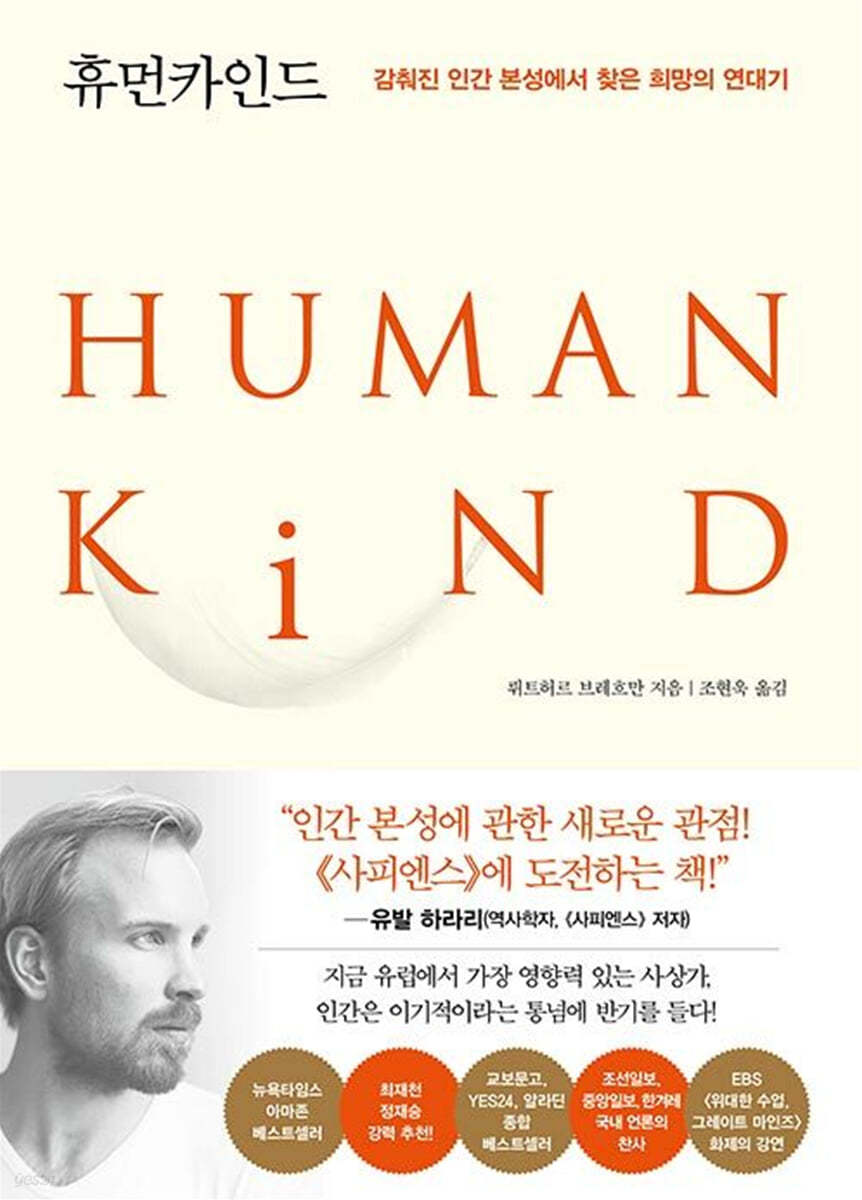
Humankind (Recover Special Edition)
 |
Description
Book Introduction
“A new perspective on human nature. “A book that challenges ‘Sapiens’!” -Yuval Harari (historian) A massive shift in thinking that shatters the frame of selfish human beings. “All tragedy begins with a misunderstanding of human nature.” - Praise from intellectuals around the world, including Adam Grant, Daniel Pink, Choi Jae-cheon, and Jeong Jae-seung! - New York Times Amazon Bestseller - 2021 Forbes Books of Hope Rutger Bregman, a young thinker who created the 'greatest moment' in the history of the Davos Forum with his famous speech at the forum. In 『Humankind』, he poses the most urgent and essential question to humanity, which stands at the crossroads of coexistence and solidarity. "Is human nature truly selfish?" The vast history of human civilization, from the first humans to the present, proves one truth: "In times of life-or-death crisis, such as war and disaster, humans have invariably been overwhelmed by their 'good nature.'" When we break the frame that human nature is selfish, we will achieve solidarity and cooperation that we could never have imagined before. And this is the most realistic and only way for humanity, trapped in the trap of inequality, hatred, and distrust, to overcome the crisis. Beyond the misconceptions about human nature, such as the 'selfish gene,' the 'Lucifer effect,' and the 'bystander effect,' a grand narrative unfolds about the goodness of humanity that has been hidden by the elite ruling power and the media. |
- You can preview some of the book's contents.
Preview
index
Recommended Reading - Humankind: A Look Back at Human History | Choi Jae-cheon
Rewriting the History of Homo Sapiens with Hope | Jeong Jae-seung
Prologue - Universal Attributes of Humanity
Chapter 1: The New Realism: A New Challenge to Human Nature
Chapter 2: The Lord of the Flies: The Truth Was the Opposite of Fiction
Part 1: Humans in a State of Nature
Chapter 3: Homo Puppy: The Birth of the Most Friendly Being
Chapter 4: Soldiers Who Refrain from Shooting: War Is Not an Instinct
Chapter 5: The Curse of Civilization: The Imagination Created by Those in Power
Chapter 6: The Mystery of Easter Island: Misquotations and Exaggerations
Part 2 After Auschwitz
Chapter 7: The Truth About the Stanford Prison Experiment: Nothing Happened There
Chapter 8 Stanley Milgram and the Electric Shock Experiment: The Intended Ending
Chapter 9: The Death of Catherine Genovese: The Media-Made 'Bystander Effect'
Part 3: Malfunction of Good Nature
Chapter 10: The Blindness of Empathy: The Greater the Distance, the More Brutal the Attack
Chapter 11: How Power Corrupts: Acquired Antisocialization
Chapter 12: The Enlightenment Trap: The Self-Fulfilling Prophecy of Pessimism
Part 4: A New Reality
Chapter 13: The Power of Intrinsic Motivation: The Limits of Economic Rewards
Chapter 14: Playful Humans: The Infinite Resilience Within Us
Chapter 15: This is Democracy: Beyond the Seven Plagues of Democracy
Part 5: Asymmetrical Strategy
Chapter 16: Tea with a Terrorist: The Cheapest and Most Realistic Way
Chapter 17: Beyond Hatred, Inequality, and Prejudice: The Power of Contact
Chapter 18 Soldiers from the Trenches: The Contagiousness of Hope
Epilogue - Ten Rules to Follow in Life
Acknowledgements
Translator's Note
main
Search
Rewriting the History of Homo Sapiens with Hope | Jeong Jae-seung
Prologue - Universal Attributes of Humanity
Chapter 1: The New Realism: A New Challenge to Human Nature
Chapter 2: The Lord of the Flies: The Truth Was the Opposite of Fiction
Part 1: Humans in a State of Nature
Chapter 3: Homo Puppy: The Birth of the Most Friendly Being
Chapter 4: Soldiers Who Refrain from Shooting: War Is Not an Instinct
Chapter 5: The Curse of Civilization: The Imagination Created by Those in Power
Chapter 6: The Mystery of Easter Island: Misquotations and Exaggerations
Part 2 After Auschwitz
Chapter 7: The Truth About the Stanford Prison Experiment: Nothing Happened There
Chapter 8 Stanley Milgram and the Electric Shock Experiment: The Intended Ending
Chapter 9: The Death of Catherine Genovese: The Media-Made 'Bystander Effect'
Part 3: Malfunction of Good Nature
Chapter 10: The Blindness of Empathy: The Greater the Distance, the More Brutal the Attack
Chapter 11: How Power Corrupts: Acquired Antisocialization
Chapter 12: The Enlightenment Trap: The Self-Fulfilling Prophecy of Pessimism
Part 4: A New Reality
Chapter 13: The Power of Intrinsic Motivation: The Limits of Economic Rewards
Chapter 14: Playful Humans: The Infinite Resilience Within Us
Chapter 15: This is Democracy: Beyond the Seven Plagues of Democracy
Part 5: Asymmetrical Strategy
Chapter 16: Tea with a Terrorist: The Cheapest and Most Realistic Way
Chapter 17: Beyond Hatred, Inequality, and Prejudice: The Power of Contact
Chapter 18 Soldiers from the Trenches: The Contagiousness of Hope
Epilogue - Ten Rules to Follow in Life
Acknowledgements
Translator's Note
main
Search
Detailed image

Into the book
Dutch zoologist Frans de Waal's 'Veneer theory' states that civilization is nothing more than a thin shell that can crack at the slightest provocation.
In reality, the opposite is true.
We humans are at our best when we are in crisis, when bombs fall or floods occur.
--- p.33, from “Chapter 1, New Realism”
Our age is addicted to news.
This drug called news produces symptoms such as misperception of danger, anxiety, low mood, learned helplessness, contempt and hostility toward others, and sensory loss.
--- p.47, from “Chapter 1, New Realism”
Sapiens lived in larger groups, migrated more frequently from one group to another, and were probably better at imitating.
If Neanderthals had super-fast computers, we could use Wi-Fi on our old PCs.
We were slower, but better connected.
--- p.116, from “Chapter 3, Homo Puppy”
I am not skeptical about climate change.
What I'm skeptical about is the fatalistic rhetoric of collapse.
The perception that we humans are inherently selfish, or worse, a disaster for the planet.
I am skeptical when this perception becomes widely accepted as 'realistic', and I am skeptical when I am told that there is no way out.
My fear is that cynicism could become a self-fulfilling prophecy, a nocebo that paralyzes us with despair while global temperatures continue to rise.
--- p.197~198, from “Chapter 6, The Mystery of Easter Island”
Oddly enough, believing in our own sinful nature offers us a kind of absolution.
If most people are bad, then participation and resistance are not worth the effort.
(Omitted) But if we believe that people are inherently good, we must question why evil exists.
This means that engagement and resistance are valuable, and it imposes on us a duty to act.
--- p.249, from “Chapter 8, Stanley Milgram and the Electric Shock Experiment”
The road to hell is paved with good intentions.
But evil does not just come out when you scratch the surface.
It takes a tremendous amount of effort to bring out evil.
And most importantly, you have to disguise evil as doing good.
--- p.243, from “Chapter 8, Stanley Milgram and the Electric Shock Experiment”
Few people feel shame.
In a nomadic society, these minorities would have been excluded.
But in modern democratic societies, shamelessness is a beneficial attribute.
Bold actions benefit from the powerful influence of the mass media.
The news always focuses on the abnormal and the outrageous, so it is the shameless who survive, not the kind and empathetic.
--- p.332, from “Chapter 11, How Power Corrupts”
As civilization began, the ugliest parts of Homo puppies came to the surface.
History books chronicle countless mass murders committed by numerous groups.
The names are different, but the mechanism is the same.
People, inspired by camaraderie and incited by cynical powers, commit the most terrible acts against one another.
This has been our struggle for thousands of years.
--- p.337, from “Chapter 12, The Traps of Enlightenment”
Modern economists have assumed that people are inherently selfish and have advocated policies that encourage selfish behavior.
When politicians convince themselves that politics is a cynical game, it really becomes so.
Now we must ask the following question:
Can things change? Can we use our intellect and reason to design new institutions?
In reality, the opposite is true.
We humans are at our best when we are in crisis, when bombs fall or floods occur.
--- p.33, from “Chapter 1, New Realism”
Our age is addicted to news.
This drug called news produces symptoms such as misperception of danger, anxiety, low mood, learned helplessness, contempt and hostility toward others, and sensory loss.
--- p.47, from “Chapter 1, New Realism”
Sapiens lived in larger groups, migrated more frequently from one group to another, and were probably better at imitating.
If Neanderthals had super-fast computers, we could use Wi-Fi on our old PCs.
We were slower, but better connected.
--- p.116, from “Chapter 3, Homo Puppy”
I am not skeptical about climate change.
What I'm skeptical about is the fatalistic rhetoric of collapse.
The perception that we humans are inherently selfish, or worse, a disaster for the planet.
I am skeptical when this perception becomes widely accepted as 'realistic', and I am skeptical when I am told that there is no way out.
My fear is that cynicism could become a self-fulfilling prophecy, a nocebo that paralyzes us with despair while global temperatures continue to rise.
--- p.197~198, from “Chapter 6, The Mystery of Easter Island”
Oddly enough, believing in our own sinful nature offers us a kind of absolution.
If most people are bad, then participation and resistance are not worth the effort.
(Omitted) But if we believe that people are inherently good, we must question why evil exists.
This means that engagement and resistance are valuable, and it imposes on us a duty to act.
--- p.249, from “Chapter 8, Stanley Milgram and the Electric Shock Experiment”
The road to hell is paved with good intentions.
But evil does not just come out when you scratch the surface.
It takes a tremendous amount of effort to bring out evil.
And most importantly, you have to disguise evil as doing good.
--- p.243, from “Chapter 8, Stanley Milgram and the Electric Shock Experiment”
Few people feel shame.
In a nomadic society, these minorities would have been excluded.
But in modern democratic societies, shamelessness is a beneficial attribute.
Bold actions benefit from the powerful influence of the mass media.
The news always focuses on the abnormal and the outrageous, so it is the shameless who survive, not the kind and empathetic.
--- p.332, from “Chapter 11, How Power Corrupts”
As civilization began, the ugliest parts of Homo puppies came to the surface.
History books chronicle countless mass murders committed by numerous groups.
The names are different, but the mechanism is the same.
People, inspired by camaraderie and incited by cynical powers, commit the most terrible acts against one another.
This has been our struggle for thousands of years.
--- p.337, from “Chapter 12, The Traps of Enlightenment”
Modern economists have assumed that people are inherently selfish and have advocated policies that encourage selfish behavior.
When politicians convince themselves that politics is a cynical game, it really becomes so.
Now we must ask the following question:
Can things change? Can we use our intellect and reason to design new institutions?
--- p.344~345, from “Chapter 12, The Traps of Enlightenment”
Publisher's Review
In times of crisis, humanity has been overwhelmed by its inherent goodness.
The goodness of nature found in wars and disasters, such as the Titanic, the 9/11 terrorist attacks, and COVID-19.
In the midst of the global crisis of COVID-19, people are ignoring quarantine rules for immediate gain, and angry mobs overseas are committing looting crimes in locked-down cities…
Every day we are bombarded with news filled with horrific violence and human selfishness.
However, contrary to the reality presented in these articles, a study of over 700 disaster sites since 1963 (University of Delaware Disaster Research Center, 2006) surprisingly found that crime rates such as murder, robbery, and rape decreased during disasters, and instead, altruistic behaviors such as people distributing goods and services in large quantities increased.
Rutger Bregman, a journalist and thinker at the Dutch innovative alternative media outlet De Correspondent, says that in representative disaster situations such as World War I and II, the sinking of the Titanic, the 9/11 terrorist attacks, and Hurricane Katrina, people have always risked their lives to help others and the weak.
History proves that in times of crisis, humans are not overcome by 'mob mentality' and panic, but rather by 'good nature'.
In his new book, Humankind, he presents an idea that is universal to humanity and could fundamentally transform society if we take it seriously.
It is the idea that ‘human nature is good.’
In "Humankind," the author sharply points out that our political and economic systems, knowledge, and worldview, from "the selfish gene," "the murderer next door," "homo economicus," and "the war of all against all," operate based on a cynical view of humanity.
Furthermore, when people lose trust in one another, we become subjects of control by those in power, and sensational and biased media coverage blinds us to this reality.
In this regard, 『Humankind』 raises an important question.
“Is human nature truly selfish?” The author points out that the pessimistic perception of human nature is the root of all the tragedies we face, such as inequality, hatred, and distrust. Drawing on extensive historical data and crossing the fields of psychology, evolutionary biology, anthropology, and philosophy, he unearths countless pieces of evidence about the good nature of humans.
And as Professor Choi Jae-cheon, who wrote the recommendation, said, “It overturns all the psychological experiments, philosophical concepts, historical events, and common sense that we have accepted without question until now, the common notion of selfish humans.” 『Human Kind』 is a chronicle of hope that contains the vast journey to complete the good face of humanity that has been forgotten in our minds and hidden by history, power, and the media.
“Humans strive to do good rather than become evil.”
Exploring the errors and contradictions in various studies, including the "Lucifer Effect," the "electric shock experiment," and the "bystander effect."
How could humans have caused countless wars, crimes, and the worst tragedy of Auschwitz? As the Western world was rebuilding from the ruins of World War II, governments and intellectuals alike sought to answer this question.
In the zeitgeist of the 1960s, criminologist James Q. Wilson, along with Philip Zimbardo ('Lucifer Effect') and Stanley Milgram ('Electric Shock Experiment'),
Wilson, the 'broken windows theory'), Genovese syndrome (bystander effect, 'bystander effect'), etc., attempted to prove the dark abyss and violence of humans who obey authority and commit evil.
And these experiments have bolstered the argument that this nature must be controlled through education and institutions.
However, Rutger Bregman captures the shocking circumstances in which these theories were manipulated and manipulated by psychologists and the media to induce negative results (Part 2). This book questions whether psychological experiments based on arbitrary and clumsy settings and instructions can reveal the truth about human nature, and proves that, amidst the errors and contradictions in various studies, we humans do our best to do good even in extreme situations, and that it takes tremendous effort to bring out the evil within us.
Furthermore, he asks whether critical moments are precisely the times when humans can trust one another, as in the “reverse bystander effect,” where witnesses can communicate with one another in times of crisis and thus be more proactive in helping one another.
“All tragedy stems from the assumption that humans are selfish.”
- Revealing the truth about the real-life "Lord of the Flies" and Easter Island, reconsidering the negative worldview of intellectual history.
Meanwhile, the true essence of this book lies in the historical exploration process that seeks out the truth behind various literary works and anthropological studies that frame the selfish nature of human beings through empirical research of historical materials and active field investigation.
The author first sets out to find real-life examples to refute William Golding's novel Lord of the Flies, which depicts the dark abyss of humanity, saying, "As bees make honey, so men make evil."
According to the case study unearthed by Rutger Bregman after months of literature research and direct interviews, unlike the boys in the novel who are marooned on a desert island and turned into savages, the six boys who were marooned for 15 months on the uninhabited island of Ata in Tonga, Polynesia in 1965 were healthy, had everything they needed for life, and created a peaceful and ideal society.
The author also reveals that the Easter Island story, which is often compared to the tragic fate of the Earth due to climate change, such as "an island devastated by logging, people eating each other," has also perpetuated misunderstandings about human nature through misquotes and amplification.
After a thrilling detective story and a rigorous review of various original sources, the author arrived at the truth about Easter Island: there was no war, famine, or cannibalism.
The author points out that these distorted histories do not stop at stories, but rather produce negative worldviews and beliefs, which in turn become nocebos (the result of negative beliefs having negative effects) and influence human behavior.
Just as the negative worldview that has long led intellectual history, such as the philosophy of Thomas Hobbes, an Enlightenment philosopher, and Machiavellianism, has brought our society to where it is today.
“Humanity at a crossroads.
“Which will you choose: conflict and coexistence, solidarity and cooperation?”
Beyond the corrupting nature of power, reviving the "homo puppy" instincts of cooperation and solidarity.
Why did Homo sapiens dominate the Earth, beating out Neanderthals with 15% larger brains and superior physical abilities? Rutger Bregman answers this controversial question, which has persisted since Yuval Harari's "Sapiens," by arguing that it is because modern humans are the only species that have evolved to cooperate and empathize with others, and that we are "Homo Puppy," which learns socially through imitation (Chapter 3). However, paradoxically, modern society and its core institutions, such as schools, corporations, and prisons, were designed based on the premise that humans are evil, and this negative socialization process weakens the intrinsic motivation of individuals and society, while constantly making us doubt our own good nature.
This distrust is used by elite powers and the media as a tool to justify their control, and it makes us subjects of their control.
This is why corrupt power has been able to persist in the civilization of Homo Puppy, which has been built on cooperation and solidarity.
The author sees this as the fundamental cause of cynicism, polarization, exclusion, selfishness, inequality, and bureaucracy.
Bregman argues that only when we regain the awareness that human nature is good can we rediscover the meaning of participation and resistance, and the duty to act.
And by finding a blueprint for this in the diverse examples of societies organized around a belief in the inherent goodness of nature, he argues that friendship, kindness, cooperation, and compassion are contagious and can become fundamental principles for reorganizing society.
And this is the 'new realism' we must create, transcending global disasters, diseases, inequality, and hatred.
The beauty of this book is that, after reading it, it transforms us into kinder people.
The hopeful history of humanity that he unfolds through captivating storytelling warms the hearts of readers and helps them to let go of hostile views, suspicion, and cynicism toward others.
I hope that in this book, which allows us to look at the good side of human nature with a scientific and sober perspective, we will find a great deal of hope to overcome the crisis we face.
The goodness of nature found in wars and disasters, such as the Titanic, the 9/11 terrorist attacks, and COVID-19.
In the midst of the global crisis of COVID-19, people are ignoring quarantine rules for immediate gain, and angry mobs overseas are committing looting crimes in locked-down cities…
Every day we are bombarded with news filled with horrific violence and human selfishness.
However, contrary to the reality presented in these articles, a study of over 700 disaster sites since 1963 (University of Delaware Disaster Research Center, 2006) surprisingly found that crime rates such as murder, robbery, and rape decreased during disasters, and instead, altruistic behaviors such as people distributing goods and services in large quantities increased.
Rutger Bregman, a journalist and thinker at the Dutch innovative alternative media outlet De Correspondent, says that in representative disaster situations such as World War I and II, the sinking of the Titanic, the 9/11 terrorist attacks, and Hurricane Katrina, people have always risked their lives to help others and the weak.
History proves that in times of crisis, humans are not overcome by 'mob mentality' and panic, but rather by 'good nature'.
In his new book, Humankind, he presents an idea that is universal to humanity and could fundamentally transform society if we take it seriously.
It is the idea that ‘human nature is good.’
In "Humankind," the author sharply points out that our political and economic systems, knowledge, and worldview, from "the selfish gene," "the murderer next door," "homo economicus," and "the war of all against all," operate based on a cynical view of humanity.
Furthermore, when people lose trust in one another, we become subjects of control by those in power, and sensational and biased media coverage blinds us to this reality.
In this regard, 『Humankind』 raises an important question.
“Is human nature truly selfish?” The author points out that the pessimistic perception of human nature is the root of all the tragedies we face, such as inequality, hatred, and distrust. Drawing on extensive historical data and crossing the fields of psychology, evolutionary biology, anthropology, and philosophy, he unearths countless pieces of evidence about the good nature of humans.
And as Professor Choi Jae-cheon, who wrote the recommendation, said, “It overturns all the psychological experiments, philosophical concepts, historical events, and common sense that we have accepted without question until now, the common notion of selfish humans.” 『Human Kind』 is a chronicle of hope that contains the vast journey to complete the good face of humanity that has been forgotten in our minds and hidden by history, power, and the media.
“Humans strive to do good rather than become evil.”
Exploring the errors and contradictions in various studies, including the "Lucifer Effect," the "electric shock experiment," and the "bystander effect."
How could humans have caused countless wars, crimes, and the worst tragedy of Auschwitz? As the Western world was rebuilding from the ruins of World War II, governments and intellectuals alike sought to answer this question.
In the zeitgeist of the 1960s, criminologist James Q. Wilson, along with Philip Zimbardo ('Lucifer Effect') and Stanley Milgram ('Electric Shock Experiment'),
Wilson, the 'broken windows theory'), Genovese syndrome (bystander effect, 'bystander effect'), etc., attempted to prove the dark abyss and violence of humans who obey authority and commit evil.
And these experiments have bolstered the argument that this nature must be controlled through education and institutions.
However, Rutger Bregman captures the shocking circumstances in which these theories were manipulated and manipulated by psychologists and the media to induce negative results (Part 2). This book questions whether psychological experiments based on arbitrary and clumsy settings and instructions can reveal the truth about human nature, and proves that, amidst the errors and contradictions in various studies, we humans do our best to do good even in extreme situations, and that it takes tremendous effort to bring out the evil within us.
Furthermore, he asks whether critical moments are precisely the times when humans can trust one another, as in the “reverse bystander effect,” where witnesses can communicate with one another in times of crisis and thus be more proactive in helping one another.
“All tragedy stems from the assumption that humans are selfish.”
- Revealing the truth about the real-life "Lord of the Flies" and Easter Island, reconsidering the negative worldview of intellectual history.
Meanwhile, the true essence of this book lies in the historical exploration process that seeks out the truth behind various literary works and anthropological studies that frame the selfish nature of human beings through empirical research of historical materials and active field investigation.
The author first sets out to find real-life examples to refute William Golding's novel Lord of the Flies, which depicts the dark abyss of humanity, saying, "As bees make honey, so men make evil."
According to the case study unearthed by Rutger Bregman after months of literature research and direct interviews, unlike the boys in the novel who are marooned on a desert island and turned into savages, the six boys who were marooned for 15 months on the uninhabited island of Ata in Tonga, Polynesia in 1965 were healthy, had everything they needed for life, and created a peaceful and ideal society.
The author also reveals that the Easter Island story, which is often compared to the tragic fate of the Earth due to climate change, such as "an island devastated by logging, people eating each other," has also perpetuated misunderstandings about human nature through misquotes and amplification.
After a thrilling detective story and a rigorous review of various original sources, the author arrived at the truth about Easter Island: there was no war, famine, or cannibalism.
The author points out that these distorted histories do not stop at stories, but rather produce negative worldviews and beliefs, which in turn become nocebos (the result of negative beliefs having negative effects) and influence human behavior.
Just as the negative worldview that has long led intellectual history, such as the philosophy of Thomas Hobbes, an Enlightenment philosopher, and Machiavellianism, has brought our society to where it is today.
“Humanity at a crossroads.
“Which will you choose: conflict and coexistence, solidarity and cooperation?”
Beyond the corrupting nature of power, reviving the "homo puppy" instincts of cooperation and solidarity.
Why did Homo sapiens dominate the Earth, beating out Neanderthals with 15% larger brains and superior physical abilities? Rutger Bregman answers this controversial question, which has persisted since Yuval Harari's "Sapiens," by arguing that it is because modern humans are the only species that have evolved to cooperate and empathize with others, and that we are "Homo Puppy," which learns socially through imitation (Chapter 3). However, paradoxically, modern society and its core institutions, such as schools, corporations, and prisons, were designed based on the premise that humans are evil, and this negative socialization process weakens the intrinsic motivation of individuals and society, while constantly making us doubt our own good nature.
This distrust is used by elite powers and the media as a tool to justify their control, and it makes us subjects of their control.
This is why corrupt power has been able to persist in the civilization of Homo Puppy, which has been built on cooperation and solidarity.
The author sees this as the fundamental cause of cynicism, polarization, exclusion, selfishness, inequality, and bureaucracy.
Bregman argues that only when we regain the awareness that human nature is good can we rediscover the meaning of participation and resistance, and the duty to act.
And by finding a blueprint for this in the diverse examples of societies organized around a belief in the inherent goodness of nature, he argues that friendship, kindness, cooperation, and compassion are contagious and can become fundamental principles for reorganizing society.
And this is the 'new realism' we must create, transcending global disasters, diseases, inequality, and hatred.
The beauty of this book is that, after reading it, it transforms us into kinder people.
The hopeful history of humanity that he unfolds through captivating storytelling warms the hearts of readers and helps them to let go of hostile views, suspicion, and cynicism toward others.
I hope that in this book, which allows us to look at the good side of human nature with a scientific and sober perspective, we will find a great deal of hope to overcome the crisis we face.
GOODS SPECIFICS
- Date of issue: March 2, 2021
- Page count, weight, size: 588 pages | 826g | 152*215*35mm
- ISBN13: 9791191056471
- ISBN10: 1191056473
You may also like
카테고리
korean


korean

![GQ KOREA Mark (Monthly): December [2025]](http://librairie.coreenne.fr/cdn/shop/files/8ef265dbbfbf186523ed75ba7319009d.jpg?v=1765340328&width=3840)


