

Symphony for the City of the Dead
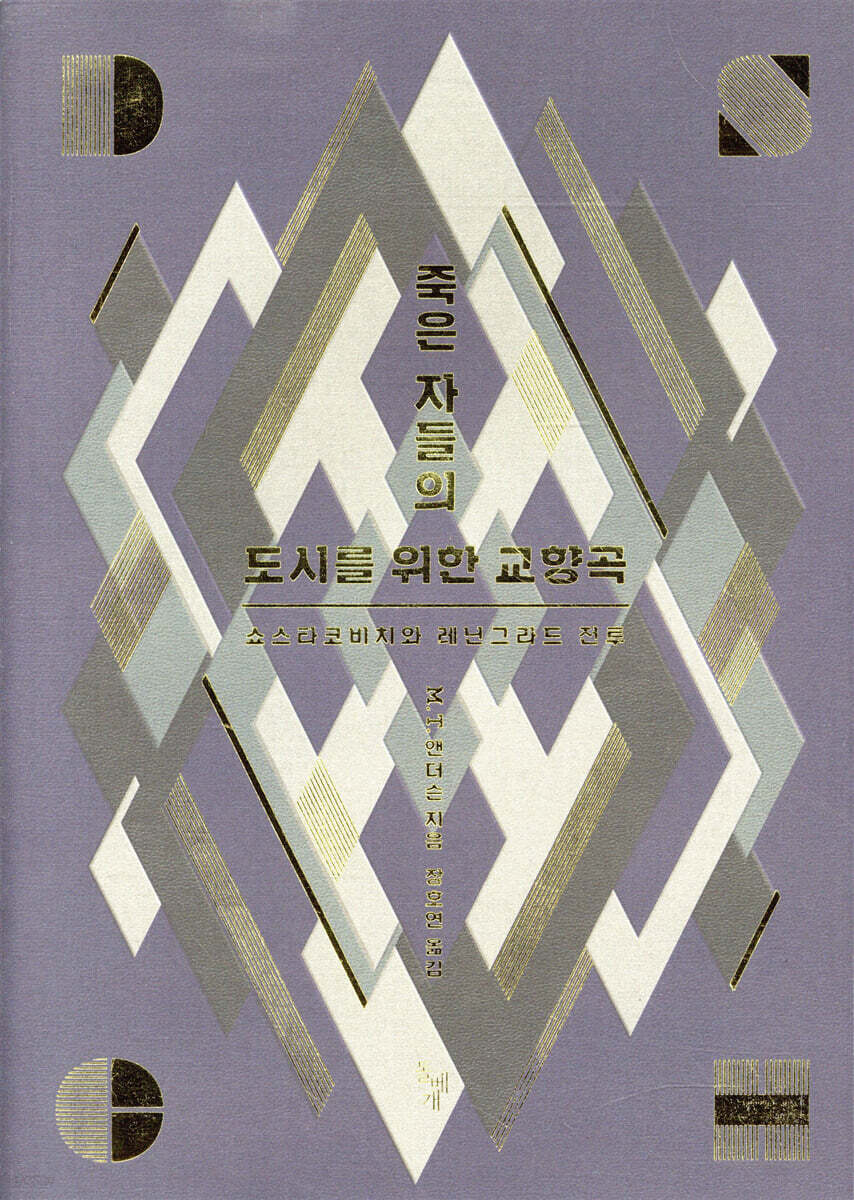 |
Description
Book Introduction
- A word from MD
-
About life and death, oppression and resistance, and musicA book that tells the story of Shostakovich's life, music, and contemporaries, focusing on the story of his birth.
The author unfolds a page of history, a passionate and brutal one, like a novel or documentary, along with the landscape of the contemporary art world, the blood-stained face of the revolution, and the conflict between camps.
May 11, 2018. Art PD Park Hyung-wook
The story of Shostakovich and his beloved city, Leningrad
Ultimately, it is a book about the power and meaning of music.
Symphony for the City of the Dead is a dynamic account of Shostakovich's eventful life and the turbulent history his contemporaries had to navigate, centered around the anecdote surrounding the birth of Symphony No. 7, Leningrad.
It is a fascinating account of how Shostakovich began composing his Symphony No. 7 while battling the horrific bombing of Leningrad, how he finished it in his refuge in Kuibyshev, and how this work, born from such hardship, could be performed in Leningrad amidst the fighting.
It also tells the story of how the citizens of Leningrad, who were dying of hunger and cold, found great comfort and hope from this one song, and how it rekindled their will to live, and how the world sympathized with Russia's plight because of this song, and how extensively they extended a helping hand thereafter.
National Book Award-winning author M.
T. Anderson opens the book with a dedication, “To all the young musicians who gave music to the world,” and then says in the prologue:
This book is a story of microfilm and secret police, of communists and capitalists, of battles lost and wars won.
The story of Dmitri Shostakovich and his beloved city of Leningrad, where a utopian dream turned into a dystopian nightmare.
But ultimately, it talks about the power and meaning of music.
It is a story of secret messages and oblique language, a story of music that acts as a code, a story of music that empowers people to endure unimaginable tragedies, a story of music that whispers between prison bars when they cannot speak aloud, a story of music that offers comfort to those in pain by saying:
“No matter what happens to you, you are not alone.”_Pages 17-18
In this way, this book is a biography and history of Shostakovich that focuses on the Battle of Leningrad and the birth of Symphony No. 7, Leningrad, and on the other hand, it is an art book that praises the power of music to comfort and rebuild a fallen world.
This masterpiece, in which the author, a novelist and classical music columnist, shines with his extensive knowledge, meticulous research, and elegant writing style, includes 130 vivid illustrations of Shostakovich and his family, daily life at the time, the art and cultural world that dominated an era, and the horrific battlefields.
It was selected as a 'Book of the Year' by The New York Times, The Boston Globe, and Publisher's Weekly in 2015.
- You can preview some of the book's contents.
Preview
index
Prologue 9
Part 1: 1.
Yesterday's Death 21/2.
Tomorrow's Birth 46 / 3.
Life is getting more enjoyable 100
Part 2: 4.
Friendship 199 / 5.
Barbarossa 220 / 6.
Advance 233 / 7.
First movement 246 / 8.
Second movement 275 / 9.
Third movement 291 / 10.
Lies and Truth 305 / 11.
Escape 322 / 12.
Train No. 7 337/13.
Kuibyshev and Leningrad 344 / 14.
Optimistic Shostakovich 355 / 15.
City of the Dead 369 / 16.
My Music is My Weapon 396 / 17.
The Way of Life 406 / 18.
Symphony No. 433 for the City of the Dead
Part 3: 19.
Cold War and Thaw 457
Author's Note 492 / Translator's Note 496 / Notes 500 / References 529 / Photo Sources 536 / Index 537
Detailed image

Into the book
The library's enthusiasm quickly wore off.
The pipe eventually froze and burst.
The electricity went out at the end of January.
Still, the librarians walked around the dark shelves with flashlights, and when they ran out of oil, they carried around burning wood.
It still served the library's patrons, and it sought to solve a practical problem posed by the city government: finding alternative ways to make matches and candles.
As the buildings grew colder and the war took its toll, the reading rooms were eventually closed one after another.
Eventually, both the patrons and the librarians settled into the administration office, where the kerosene lamp and the bourgeois stove still remained.
During the siege, people read novels, wrote diaries and poetry.
It was a surprisingly common occurrence, considering how bleak the situation had become.
These activities reminded people of another life and encouraged them not to forget the norms and routines of civilization even in the midst of chaos.
Even though they were trapped, people dreamed of escape through novels.
_Page 386
In response to the Nazis' contempt for the Slavs, who they described as "subhuman," the Russians wanted to show that they were making art while Germany was waging war.
They were determined to remain human.
But what did that mean? What kind of creatures were humans when surrounded? A quadruped, herbivore, grazing on filthy grass.
It was a predator that hunted alone or in packs.
They were social animals who discussed the noble arts and wound violin strings from dead sheep and pig intestines.
It was a being with fangs that could tear food, a tongue that could speak, and a mouth that could swallow or sing.
_Page 440
---From the text
Publisher's Review
Book Features
■ Shostakovich and his era
This book covers the entire life of Dmitri Dmitrievich Shostakovich (1906-1975).
The film unfolds chronologically over approximately 70 years, from the childhood of Mitya, who was born on September 25, 1906, into a bourgeois family in St. Petersburg, losing his father in the midst of the revolution and saying goodbye to his peaceful life, to his death on August 9, 1975 (the very day 33 years ago when his Symphony No. 7 was premiered in Leningrad, during the height of the fighting).
After a prologue that, with the speed of a spy novel, describes the process by which the score of Symphony No. 7 on microfilm was delivered to agents in the West, the author describes the situation in Russia when Shostakovich was born in St. Petersburg in 1906.
The Shostakovich family is briefly introduced, and the book provides an interesting account of Shostakovich's growth as a composer, his triumphs and humiliations as he clashed with the Stalinist dictatorship, and the inspiration he gave to the citizens of Leningrad and the world fighting the Nazis.
The images of Shostakovich in the book bring emotion, solemnity, and sometimes even unexpected laughter.
The story of Shostakovich, a sensitive and delicate boy, who confronts a great power and ultimately survives, is well known, but it also introduces aspects of him that we did not know well.
Shostakovich was a remarkably conscientious man.
Every morning at 6 o'clock sharp, I woke up, dressed up in a suit, went to my study, and started composing.
But when it came to playing, he was definitely someone who knew how to play.
He loved vodka and was such a football fanatic that he once considered becoming a football referee.
He bought a season ticket and watched every game, was dying to compose football music, and in his later years, even while lying in bed, he watched football on television.
He was, in today's parlance, a 'fool for his children'.
“I lived in constant fear that something bad might happen to my children,” a friend described as “a kind of abnormal and pathological love.”
People remember him as a naturally shy person.
He hated how the Soviets “inflated and heroized their lives through propaganda.” But he also knew how to step up when the time came.
I wrote countless letters and ran tirelessly to help people in trouble.
But he “never asked for anything for himself.”
There is even an eyewitness account that says, “In a time when everyone was starving, I would almost collapse in gratitude if I received even a can of jam for my family.”
The author introduces Shostakovich as a person, and broadly sheds light on the atmosphere surrounding Shostakovich, the people he interacted with, and the landscape of the art world of his time.
For example, the first half of the book vividly depicts the young artists who were filled with joy at the new world they had just entered after the revolution and their anticipation for the future.
The dynamic energy of the Futurist artists, who “celebrate the new modernity of Russia,” seems to live and writhe between the lines.
They believed that the revolution needed them, and that was thrilling.
“There was youth and joy within us.
We dedicated our lives to art.
“It was a time of hope and fantasy,” said a futurist. _Page 56
Although the beginning was grand and exciting, the ending was disastrous.
The fervor of the revolution soon disappeared into a storm of blood.
Mayakovsky, a symbolic figure of Futurism and an object of both admiration and loathing for Shostakovich, was a "problematic genius" who shot himself in the chest with a pistol.
“Mayakovsky could no longer endure living in a world where he had built things with his own hands.
“He was, paradoxically, an individualist who fought for a collectivist, communist society.” (p. 97) Meyerhold, a theater director and an important collaborator of Shostakovich, was executed after being tortured and cremated, and his body was classified as an unclaimed body and thrown into a drain.
Meyerhold's wife, actress Zinaida Reich, was stabbed and blinded by an intruder who broke into her home.
Marshal Tukhachevsky, the most capable man in the Red Army, a music lover, and a close friend to Shostakovich, was executed on false charges of being a spy.
The records of Tukhachevsky's interrogation, which still remain in the National Archives, are stained with blood.
Death continued endlessly.
Innocent artists, intellectuals, peasants, workers, and soldiers were dragged into concentration camps and executed.
Even those who killed innocent people were eventually killed.
Shostakovich later recalled:
“Most of my symphonies are tombstones.” These are the words Shostakovich said just before he died.
“So many of our people died and were buried in places unknown to anyone, not even their relatives.
A lot of my friends have experienced the same thing.
Where would we erect the tombstones of Meyerhold and Tukhachevsky? Only music can do so for them.”_p. 485
■ The Battle of Leningrad and Symphony No. 7, Leningrad
The core of this chronicle is undoubtedly the Siege of Leningrad and the years that followed in its horrors when Symphony No. 7, Leningrad, was born.
In September 1941, Adolf Hitler's German Wehrmacht surrounded Leningrad, the city where Shostakovich was born and raised.
It was the beginning of the longest and most destructive siege in Western history.
Over two and a half years, more than a million civilians died from bombing, hunger, and cold.
Survivors recall that corpses were left abandoned in the freezing streets because they had neither the means nor the energy to bury the dead.
At the time, Shostakovich was under double pressure from the Nazis and the Soviet dictatorship.
In particular, in 1936, when his opera "Lady Macbeth of the Mtsensk District" received harsh criticism from Stalin, saying that it was "no music, only chaos," he fell from his position as a national treasure composer in an instant and faced the crisis of becoming a scapegoat for the debate on socialist realism.
Amidst the fear of purges, Shostakovich composed Symphony No. 5, and barely regained the party's trust, receiving praise for it as "a practical and creative response by a Soviet artist to justified criticism."
But for Shostakovich, Stalin's dictatorship was always a ghostly presence that weighed down on his free spirit.
Even in the harsh circumstances that forced many artists to seek exile, Shostakovich never left his homeland.
In 1941, Shostakovich began composing Symphony No. 7, which was intended to inspire, unite, praise, and commemorate the citizens of Leningrad, which had been devastated by the German siege.
When the piece premiered in Kuibyshev on March 5, 1942, with the Bolshoi Theatre Orchestra conducted by Samuil Samosut, the Soviet authorities hailed it as a hymn of the anti-Nazi struggle.
There is still controversy over whether Shostakovich's composition was a protest against the Nazis or a protest against Stalin, the dictator who drove countless people to death.
However, there is no disagreement that Shostakovich dedicated this piece to his hometown of Leningrad, and to those who left first and those who survived.
The Western Allied nations, including the United States and the United Kingdom, were also enthusiastic about Symphony No. 7.
The symphony was put on microfilm and transported across the deserts of the Middle East and North Africa to the United States, where it was performed.
As a result, it made a remarkable contribution to strengthening the Allied alliance against the Axis powers.
And finally, August 9, 1942, Leningrad.
The surviving members of the Leningrad Radio Orchestra, who had been more than half killed and scattered in the war, and several other musicians gathered together and performed this piece for the first time in front of the citizens under the direction of Carl Eliasberg.
This news reverberates through loudspeakers throughout the city, to the soldiers on the front lines, and to the barracks of the demoralized German army.
On January 27, 1944, Leningrad was finally liberated from Nazi hands.
And the following year, on May 8, 1945, Nazi Germany declared unconditional surrender to the Allied Forces, and the world entered a long period of Cold War confrontation between the socialist bloc led by the Soviet Union and the capitalist bloc led by the United States.
Author M.
T. Anderson devotes ample space to the detailed account of the creation of Symphony No. 7.
The moment of great victory achieved through courage and a spirit of resistance in the face of fierce adversity brings a deep sense of emotion.
■ Leningrad, the city that never knelt
This book is also about Leningrad, a city that never surrendered to its cruel enemies.
It contains the heartbreaking yet noble story of the citizens of Leningrad who resisted Hitler's Nazi army, who had sealed off the city and were determined to starve the "subhumans" to death without guns or ammunition, and ultimately survived with an indomitable spirit.
They have proven that they are human, and that they love music, art, literature, family, and neighbors.
Ironically, the person who destroyed this city was Stalin before Hitler.
This capricious and brutal dictator, who liked to refer to himself in the third person as "Comrade Stalin," unleashed a storm of blood across Russia with his reckless five-year plans and purges, abandoned the Nazi invasion, and went into hiding in the early days of the war, leaving the Red Army helplessly collapsing behind.
The author quotes Shostakovich's memoirs from Solomon Volkov's Testimony.
Symphony No. 7 is “about Leningrad, which Stalin destroyed and Hitler merely finished off.”
And this book, Symphony for the City of the Dead, exposes in detail the crimes of the two enemies, Stalin and Hitler.
The citizens of Leningrad rushed into the battlefield and defended the rear to survive and defeat the common enemy.
There was no distinction between men, women, old or young.
All were one.
During the 900 days of fighting, over a million civilians died, unburied corpses littered the streets and houses, people starved to the point of eating their own animals, and cannibalism even became secretly rampant, but in the end, they survived.
The author describes the desperate struggles of the citizens of Leningrad in a calm tone.
Significantly, those who “diligently washed, emptied their dishes, and went to work through the snow and sleet” survived.
It was almost impossible to survive alone.
They could barely survive by creating a shelter where they could share the work and share food and warmth.
“We moved into one room and lived like a family.
“In the evenings we played chess and read Pushkin aloud,” someone recalled.
“To survive, I had to keep helping others.” (……) Someone said this.
“Helping others was absolutely essential for survival… Sharing became a way of life, and helping others, being busy, working, and fulfilling responsibilities gave people strength.”_pp. 384-385
German artillery fire tore a large hole in the wall of the Hermitage Museum.
Thirty to forty volunteers, most of them women over the age of 55, gathered together and spent the day clearing debris from more than 1,000 rooms, walking the museum's roughly 15-kilometer corridors. _Page 391
In this way, the city of the dead continued to live in a marginal situation.
“It was dark, quiet, and bitterly cold except for a few hours during the day, but there was a little light there too.
Some succumbed to their hungriest and most cruel selves, while others held hands and endured the crisis by recalling the elements of civilization piled up around them.”_Page 395
■ Remaining questions.
How did Shostakovich survive?
Some people disparage Shostakovich as a coward who survived through compromise and conformity, not being exiled to the Gulag or going into exile.
Not that he was not, but he was always willing to sign propaganda articles written on behalf of the government under his name.
He also composed lively dance music for the NKVD secret police band, which had driven countless of his friends to their deaths.
Was Shostakovich a loyal Stalinist, a dissident, an opportunist, or a man of conviction? The author answers:
“The answer is neither.
He struggled to survive.” (p. 481)
Shostakovich always tried to use his position and influence to help his friends, did his best to clear the names of innocent people who had been imprisoned or killed during the Great Terror, and even composed a piece secretly mocking Stalin and his cronies after the war when it seemed Stalin was preparing another purge.
However, it is said that Shostakovich was deeply ashamed of the way he survived.
“I was a coward without courage,” he admitted.
“Even if they showed it to me upside down, I signed anything.
“All I wanted was to be left alone.”_Page 482
Perhaps the most universally valid assessment of Shostakovich is this.
He was a character of mixed rebellion and conformity.
Let's hear from conductor Kurt Sanderling.
“He was just human.
“He was a coward when it came to his own problems, but he was very brave when it concerned others.” When the NKVD approached him and asked him to think of a dance, he was probably “too scared to refuse.” It is all too easy for us, who are safe, who do not have family members under the watchful eye of murderous agents, who do not have the lives of imprisoned relatives hanging over our shoulders, to criticize him. —Page 461
It is said that before he passed away, Shostakovich left these words:
“When I look back, all I see is ruins, piles of corpses… I am not exaggerating.
“It’s literally a mountain… … I’m sad and always in mourning.” (p. 484) To borrow the recommendation from Moon Hak-su, author of “The Classic,” “This book itself is a funeral symphony.”
GOODS SPECIFICS
- Date of publication: April 27, 2018
- Page count, weight, size: 546 pages | 761g | 152*215*38mm
- ISBN13: 9788971998458
- ISBN10: 8971998458
You may also like
카테고리
korean


korean


