

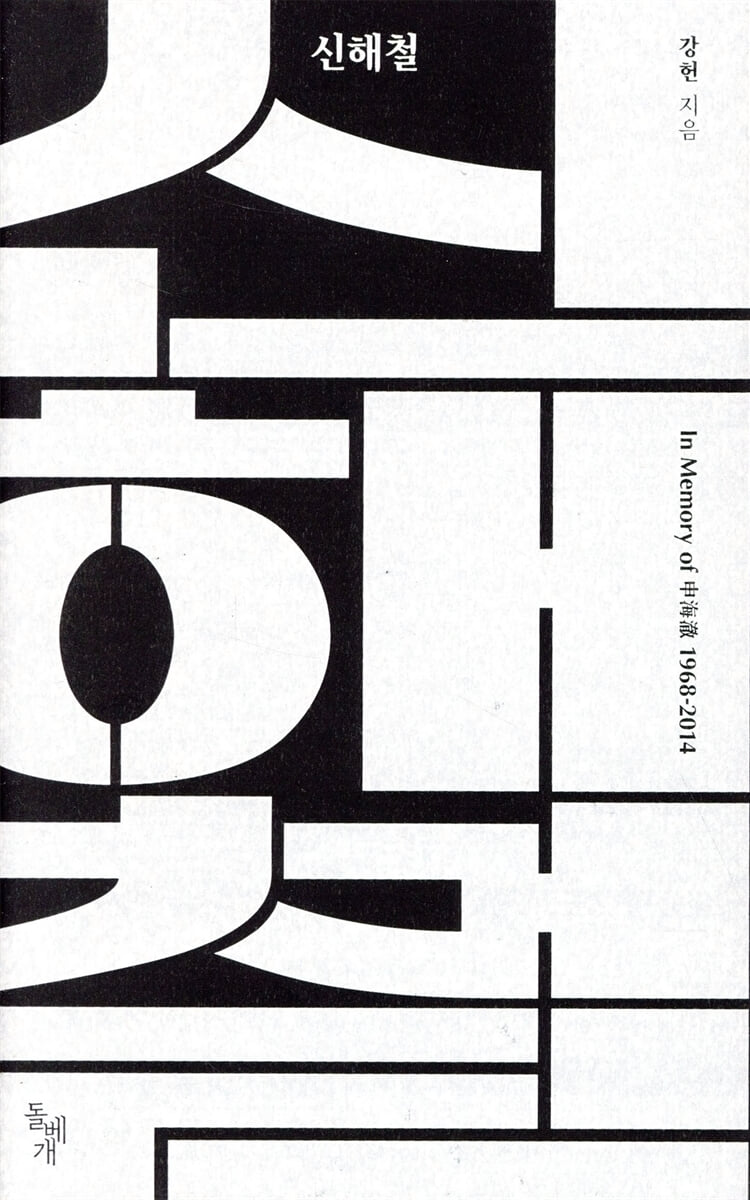
Shin Hae-cheol: In Memory of Shin Hae-cheol 1968-2014
 |
Description
Book Introduction
I liked him. A young South Korean musician who loves science fiction and fantasy. His persistent madness and chaotic discord, Sometimes, it's a bravado that's almost humorous, and then there's the unpredictable delicacy behind it. Shin Hae-chul was born in the 1980s in South Korea. He was a young man with the most contradictory passions. A glimpse into the personal exchanges and musical synergy between Kang Heon and Shin Hae-chul. There are countless musicians in the world, and many more will appear and disappear. Under the fate of capitalism, the masses easily forget what they should not forget, and they also cling to things that should be forgotten for a long time. Music critic Kang Heon says that Shin Hae-chul is a musician who has enriched the history of Korean popular music and whom we should not forget. This is because he has been on a multifaceted musical journey, exploring various music genres to the point where it is impossible to predict when and where he will jump to, and he has broken various prohibitions imposed under the name of 'celebrity' by expressing his opinions with such frankness and honesty that he has been called a polemicist and a sarcastic commentator. In this process, Shin Hae-chul provided the public with a meaningful experience both artistically and politically. The name of the band that followed Shin Hae-chul throughout his life was 'Next' N.EX.T. If you translate it literally, it means 'next', but for Shin Hae-chul, there was always a 'next'. Kang Heon says that Shin Hae-chul's relentless pursuit of new endeavors, bold steps, and exceptional artistic problem-solving skills broadened the scope of Korean popular culture in the 1990s, proving that music could be both intellectually contemplative and deeply moving to the public. 『Shin Hae-chul In Memory of 申海澈 1968-2014』 is a book that remembers musician Shin Hae-chul, who was the first generation and pioneer to break the old practices that had persisted for over 100 years. Kang Heon wrote most of the text in this book in one stroke about three years ago, after Shin Hae-chul's shocking death. However, the publication of the book was postponed out of consideration and respect for those who loved Shin Hae-chul, following the news that a collection of Shin Hae-chul's works was coming out. In 2018, the 30th anniversary of Shin Hae-chul's debut, music critic Kang Heon's most personal and professional commentary on musician Shin Hae-chul, 『Shin Hae-chul In Memory of 申海澈 1968-2014』, finally meets readers. |
- You can preview some of the book's contents.
Preview
index
Publishing a book 4
Ⅰ.
Prologue 9
Ⅱ.
Stardom 33
Ⅲ.
Band 83
Ⅳ.
Solo Flight 127
V.
Attitude 165
Ⅵ.
Epilogue 201
Interview 211
The Hero 269
Biography 327
Discography 335
Into the book
“In the early summer of 1994, exactly 20 years before his death, I first met him in front of Hongik University at the request of some media outlet I don’t remember now.
At the height of his popularity, he gave me, a novice interviewer, an unusually long amount of time, and after the interview, he said he was very happy to have his first proper interview since becoming a 'singer'.
He said he was so happy that he didn't have to do interviews that started with "Hello" and ended with "I love you."
Little did I know that our first professional encounter as a musician and a critic would lead to a friendship that would last for over 20 years.”
- 'Ⅰ.
From 'Prologue'
“Even when the tenth team out of the eleven teams that advanced to the finals had finished its turn, Ju Byeong-seon of Chugye University for the Arts, who performed a traditional music-style composition titled “Goindol” with a beautiful daegeum interlude, was a strong candidate to win the Grand Prix.
But the moment the last runner, 'Infinite Track', appeared on stage and the 25-bar intro played on twin keyboards, the game was already over.
Even today, "To You," which continues to resonate nonstop from the cheering stands in stadiums and the speakers at campaign rallies, will likely go down as the most dominant track in the history of the University Song Festival, surpassing the 1988 Grand Prix.
No, I have no hesitation in asserting that this song is the greatest debut song in the history of Korean pop music, possessing both high perfection, explosive popularity, and longevity that transcends generations.”
- 'Ⅱ.
From 'Stardom'
“It goes without saying, but even though they are both metal artists, Seo Taiji and Shin Hae-chul have completely different styles.
Nevertheless, the fact that their musical origin is the metal sound means that in the 1980s, Korean teenagers used heavy metal, the most aggressive and destructive form of rock music, as a language of liberation to escape from the various layers of oppression that surrounded them.
Of course, since the mid-to-late 1980s, the Korean metal scene has never risen to the overground.
In the West, bands like Metallica, Pantera, Van Halen, and Guns N' Roses inherited the glory of the 1960s and 1970s and exploded the 'era of rock,' but that was only a story outside the borders of South Korea.
Heavy metal's disastrous market share in Korea reinforced the uncompromising nature of rock youth defending their fortresses of poverty and obscurity, and fueled a animosity that sought to despise defectors like Seo Taiji and Shin Hae-chul, who had achieved market acclaim with black music and ballads and then returned to rock.
- 'Ⅲ.
Among the Band
“??Here, I stand for you?? is the epitome of excessive emotional empathy based on a rock band, created with a full band and orchestration, while ??Invitation to Everyday Life?? is a simple, watercolor-like ballad that builds a drama by piling up bricks of small emotions.
(…) He has dazzled countless people as a master of complex and sophisticated crossbreeding of various melodic themes, but in “Invitation to Everyday Life,” he proves that one can be an excellent melody maker with a completely opposite approach.
Moreover, his vocalization, free of any aura, is warm and persuasive, never losing composure at any moment, from deep bass to soaring high notes.
(…) In short, this song is a monumental song that completely breaks away from the tautology of Korean-style love ballads that have decorated countless hit parades since Cho Yong-pil’s “Biryeon” and Lee Yong’s “Forgotten Season” in the 1980s, and opens a new horizon of sensibility in the history of this eternal mainstream grammar.
Since "Invitation to Everyday Life," I haven't heard a more fresh and mature song of courtship.
“Even if Shin Hae-chul had composed just one song, this one, I would argue that his name should be inducted into the Hall of Fame.”
- 'Ⅳ.
From 'Solo Flight'
“I have heard about the ‘Hammer of Torture’ from his mouth several times.
Anyone who was part of the '386 generation' who spent their youth during that time has one or two stories of bravery, just like military stories.
But Shin Hae-chul's experience was not a tale of heroism, but rather a sense of helplessness brought about by fear.
To summarize the situation he faced:
While being chased by the Baekgoldan and the police, they barely managed to escape into the ironworks in Cheonggyecheon and lower the iron gate shutter. However, Baekgoldan grabbed the hair of a female student who was unable to escape in time and mercilessly smashed her head against the iron gate outside the shutter.
The young protesters in the darkness inside the ironworks had no choice but to hold their breath, and the vibration of the shutter was clearly felt on the back of Shin Hae-cheol, who had barely managed to enter and was facing away from the iron gate.
“The elation he had felt a few minutes ago was nowhere to be found, and that brief moment of fear and helplessness left an indelible memory of defeat in him.”
- 'V.
From 'Attitude'
“We set the stage for the National Assembly building in Yeouido, a place where progressives and conservatives mix, and then immediately demolished it; we created the story of people trapped in the basement of the collapsed Sampoong Department Store; we set the stage for a prison filled with political and petty criminals and then demolished it; and we brought in a lively but dark university campus as the backdrop.
But not everything was as it should be.
(…) Shin Hae-chul and I were just talking about our grievances against the Park Geun-hye administration, and then the conversation went back to the Park Chung-hee era. Then, after a long time, I was reminiscing about the song “Tribute to the 70s” from the OST of the movie “Jungle Story”, and suddenly a somewhat cheeky topic crossed my mind.
What if, what if, the assassination of Kim Jae-gyu on October 26, 1979, had failed? History lacks the conditional, but doesn't drama possess the imagination of "alternative histories"? If that had happened, an era of infinite dictatorship by a president for life would have begun, and the constitution, already in shambles due to the Yushin regime, would have become nothing more than waste paper. And if that had happened, how could our regime have avoided hereditary power? (Like North Korea.) The imaginations of old rascals began to run wild from then on.
--- 'Ⅵ.
From 'Epilogue'
Publisher's Review
Shin Hae-chul: There's always a next step for him.
In the early summer of 1994, Kang Heon first met Shin Hae-chul in front of Hongik University, and their relationship continued for over 20 years.
Shin Hae-chul, a young musician with boundless sensibility expressed through persistent madness and tumultuous discord, a pretense that is almost humorous and a reckless delicacy, and the most contradictory passion born in the 1980s.
His dynamic life and music, which sought to open a new world with humanistic thinking while distrusting the old and corrupt establishment, are presented through Kang Heon's voice in 『Shin Hae-chul In Memory of 申海澈 1968-2014』.
There are countless musicians in the world, and many more will appear and disappear.
Under the fate of capitalism, the masses easily forget what they should not forget, and they also cling to things that should be forgotten for a long time.
Music critic Kang Heon says that Shin Hae-chul is a musician who has enriched the history of Korean popular music and whom we should not forget.
This is because he has been on a multifaceted musical journey, exploring various music genres to the point where it is impossible to predict when and where he will jump to, and he has broken various prohibitions imposed under the name of 'celebrity' by expressing his opinions with such frankness and honesty that he has been called a polemicist and a sarcastic commentator.
In this process, Shin Hae-chul provided the public with a meaningful experience both artistically and politically.
The name of the band that followed Shin Hae-chul throughout his life was 'Next' N.EX.T.
If you translate it literally, it means 'next', but for Shin Hae-chul, there was always a 'next'.
Kang Heon says that Shin Hae-chul's relentless pursuit of new endeavors, bold steps, and exceptional artistic problem-solving skills broadened the scope of Korean popular culture in the 1990s, proving that music could be both intellectually contemplative and deeply moving to the public.
『Shin Hae-chul In Memory of 申海澈 1968-2014』 is a book that remembers musician Shin Hae-chul, who was the first generation and pioneer to break the old practices that had persisted for over 100 years.
Kang Heon wrote most of the text in this book in one stroke about three years ago, after Shin Hae-chul's shocking death.
However, the publication of the book was postponed out of consideration and respect for those who loved Shin Hae-chul, following the news that a collection of Shin Hae-chul's works was coming out.
In 2018, the 30th anniversary of Shin Hae-chul's debut, music critic Kang Heon's most personal and professional commentary on musician Shin Hae-chul, 『Shin Hae-chul In Memory of 申海澈 1968-2014』, finally meets readers.
“I liked him.
A young South Korean musician who loves science fiction and fantasy.
His persistent madness and chaotic discord,
Sometimes, it's a bravado that's almost humorous, and then there's the unpredictable delicacy behind it.
Shin Hae-chul was born in the 1980s in South Korea.
He was a young man with the most contradictory passions.
"
Book Features
A glimpse into the personal exchanges and musical synergy between Kang Heon and Shin Hae-chul.
Kang Heon and Shin Hae-chul first met as interviewer and interviewee in 1994, and their relationship continued until Shin Hae-chul passed away.
Kang Heon was a colleague who shared his social awareness and planned the future together, and a friend who knew his honest and considerate character better than anyone else.
He was also the music critic who best understood Shin Hae-chul's place in the history of Korean popular music.
Kang Heon witnessed Shin Hae-chul's musical wit and passion while collaborating on the OST for the film Jungle Story, and experienced his humanistic sensibility and sense of balance while working on the tribute album for Park No-hae's poetry collection, "Labor's Dawn," and the album commemorating Roh Moo-hyun. He also clearly encountered the critical awareness inherent in his songs while working on the musical The Hero.
In this book, readers will encounter the music of Shin Hae-chul, who refused to be swept up in a single trend and instead used diverse musical languages to develop a unique world of works, through the eyes of music critic Kang Heon.
Shin Hae-chul is a musician who has demonstrated a never-ending spirit of experimentation by exploring various musical genres from metal to Korean traditional music fusion. He is also the first musician to establish the creative principle of the 'concept album', which was attempted in the West, in the history of Korean popular music.
He knew the easy path to success as a popular musician, but he refused it and, enduring the criticism from the orthodox, continuously tried new things by breaking away from the existing musical grammar.
Kang Heon says the result is countless masterpieces, including "The Return of N.EX.T Part 1·The Being" and "Lazenca-A Space Rock Opera."
Kang Heon also says that Shin Hae-chul is an artist who tried to uphold 'political correctness' as a human being.
Shin Hae-chul believed that human freedom and happiness were the true values, and he fought against all enemies who threatened and undermined them, using words and actions that demonstrated true courage, transcending fear and recklessness.
He wanted to be a musician before becoming a celebrity.
Also, I thought that all musicians were citizens before they were musicians.
Furthermore, I believed that a citizen is a human being before being a citizen, and that we all deserve to be respected as human beings.
Shin Hae-chul's interests and activities, which extend beyond music to social issues, stem from these values.
Kang Heon says that the reason Shin Hae-chul's thoughts and actions were not mere idle chatter but precisely aimed at the target and provoked others was because he had a warm, human-centered perspective and a sharp humanistic viewpoint.
Shin Hae-chul was a musician with an indomitable will to constantly envision the future and take on new challenges, just like the band name "Next" that followed him throughout his life. He was also a courageous citizen and human being with an instinctive sense of grasping the essence of a situation from the perspective of the weak.
Therefore, Kang Heon asserts that Shin Hae-chul is a musician we must remember, one who opened a new horizon in the history of Korean popular music with his outstanding sense of balance and humanistic sensibility, and who is unparalleled before and after him.
He hopes that this book will contribute to delaying, even if only for a few days, the meaning and fascination of Shin Hae-chul's existence and music, which will inevitably gradually fade away.
I also hope that this will be an opportunity for even a few of those who have viewed Shin Hae-chul with mere indifference or hostile displeasure to discover his true nature.
Discover the hidden stories behind Shin Hae-chul's life and his famous songs.
In the 2000s, Shin Hae-chul rose to fame as a DJ for a radio program called Ghost Station (or Ghost Nation), and was nicknamed "Devil" or "Cult Leader," earning him the image of a talkative and friendly older brother next door, someone you could share your innermost thoughts with and giggle with.
He responded to the numerous stories sent in by listeners with free-spirited thinking and blunt speech, and showed the courage to confront all hypocrisy with resolute hypocrisy.
He has been invited as a debater on MBC's 100 Minute Debate several times for his remarks that are not tied to political 'lines' and that maintain a position of common sense 'justice', and he is active as an 'artist citizen' beyond a 'conceptual entertainer'.
The moment Shin Hae-cheol thought something was right, he accepted it without hesitation and did not hesitate to put it into action.
For Shin Hae-chul, this was possible because the microphones in the concert hall or studio booth were no different from those installed in discussion programs, campaign sites, and lecture halls.
While some might emphasize only the heavy side of Shin Hae-chul due to his clear political statements and serious musical themes, Kang Heon says he is a man of docile, flexible, yet clear-headed thinking, with the judgment and receptivity to embrace generations much younger than himself and even older than his father.
Because of his activities as a social and cultural 'mentor', many people remember Shin Hae-chul as the 'devil king' or 'debator', but not many people know much about his musical passion.
So, Kang Heon wants to draw more attention to his shining side as a ‘musician.’
Shin Hae-chul is a musician who, in keeping with a vow he made to himself in his teens (that he would not own a house or property if he could continue making music), has never attempted to accumulate any wealth except for buying books and has squandered almost all of his income on his dream of making music.
His passion for music can also be seen in the anecdote surrounding his debut song, To You.
Shin Hae-chul, who experienced the bitter taste of defeat at the Riverside Song Festival with the band 'Baby Angel', ambitiously challenges himself to the University Song Festival with the band 'Infinite Track'.
This song was written in one night by Shin Hae-chul in his room, under a blanket, with a melodica he bought at a local stationery store and an acoustic guitar muted with a sponge, in order to avoid the eyes of his father who was displeased with his only son's band, 'Nori'.
Many people still don't know that this 'debut song', which has the highest level of perfection and explosive popularity in the history of Korean popular music, was composed by a young man named Shin Hae-chul in his twenties while playing the melodica under his blanket.
Additionally, Shin Hae-chul is a musician who has never been accused of plagiarism despite producing so many albums and songs.
This is quite surprising when we recall that contemporary competitors such as Seo Taiji, Lee Juck, and Lee Seung-hwan have been accused of plagiarism at one time or another.
Kang Heon recalls his experience working on the OST for the movie Jungle Story and how he was amazed by Shin Hae-chul's unique musical sense.
Kang Heon, who wrote the screenplay for Jungle Story, asks Shin Hae-chul to intentionally plagiarize a song by the then-popular British group Shampoo in order to criticize the plagiarism rampant in the music industry.
However, Shin Hae-chul refused to take the easy way out and created a surprising new song called "Very Sometimes", which drew admiration.
Shin Hae-chul was a musician who responded with creative imitation even when plagiarism was the intention.
『Shin Hae-chul In Memory of 申海澈 1968-2014』 contains various episodes that confirm Shin Hae-chul's passion for music.
Not only anecdotes related to the OST of the movie Jungle Story, but also an invitation to everyday life that completely broke away from the tautology of Korean-style love ballads and opened up a new horizon of musical sensibility with simple and indifferent melodies; a critique of the social absurdity of the 'same-sex marriage ban' under the grammar of a love song, breaking away from the mannerisms of existing ballads, for struggling lovers; an episode about Shin Hae-chul's representative works such as Don't Be Sad, which caused the pain of being eliminated in the preliminary round of the Gangbyeon Song Festival but later made a splendid comeback in Shin Hae-chul's solo album; the story of Muhan Orbit, which became the womb of two giant bands, Next and 015B, which enriched the Korean popular music market in the 1990s; the story of Seo Taiji and Shin Hae-chul, who each had their dreams as metal kids in hiding but unfolded their musical journeys with different identities as 'unstoppable dropouts' and 'agonizing cowards'; the driving force that fueled Shin Hae-chul's unwavering experimental spirit and musical curiosity, as well as his lifelong musical inferiority complex, You can get a glimpse into the bonds Shin Hae-chul shared with Cho Yong-pil and Kim Tae-won of Boohwal, and the process by which the band was accepted by a management company called Daeyoung AV in the barren soil of Korean rock bands, and grew together with Infinite Track, 015B, Exhibition, and Next.
Also, at the end of the book, there is an interview published in the 1995 issue of 『Review』 that brought Kang Heon closer to Shin Hae-cheol, allowing us to meet the energetic Shin Hae-cheol of his youth.
Reading the Map of Popular Culture in the 1980s and 1990s Through Shin Hae-chul
1988, the year in which the most overwhelming track in the history of the University Song Festival, "To You," appeared, was another turning point in the history of Korean popular culture.
The Seoul Olympics were held, direct distribution of Hollywood films was established, and Western music videos began to be officially introduced.
In the Korean pop music scene, 'Shinchon Blues' and 'Bom Yeoreum Gaeul Gyul' made successful debuts, Kim Kwang-seok developed the group 'Zoo', and Park Nam-jung brought a dance craze across the country with his debut song 'Ah, Wind'.
Shin Hyo-beom and Yang Su-kyung heated up the female musician world that had been quiet since Lee Sun-hee and Jung Su-ra, Choi Ho-seop became a legend in the history of Korean ballad music with his song "Time Goes By", and Byun Jin-seop ascended to the throne as the crown prince of the ballad world.
At the Riverside Song Festival, Lee Sang-eun caused a stir with Damdadi.
The 1980s was a time of fantastical displays of imperialist territorial expansion by the mainstream camp and dramatic diversification by the non-mainstream camp.
In other words, it was an era of unprecedented coexistence, showing how the symbiotic harmony between the mainstream and the non-mainstream can create amazing musical richness.
In the middle of this was Shin Hae-cheol.
Shin Hae-chul tried to preserve the band format by developing into Next through an infinite orbit in the Korean music landscape filled with hostility toward bands.
Korean society continued to treat rock bands with hostility, treating them as social misfits or delinquents, but the debuts of Sanulrim in 1977 and Deulgukhwa in 1985 were jubilant milestones for young rock musicians, and for Shin Hae-chul, bands were both a topic of conversation and a destiny.
While transitioning from a band to a solo career is a common occurrence, Shin Hae-chul's return to a band after rising to stardom as a soloist is almost unprecedented.
Why was he so obsessed with the band?
The band is the smallest artistic community that can oppose the controlling system that suppresses the imagination of young musicians who have nothing in the conveyor system of the capital-dominated cultural industry.
The essence of a band is not to sing music that someone else has made for you, not to have someone else play your songs for you, not to have someone else express and guide your desires, but to create and play your own music, and further, to perfect your own production mechanism.
Since the Rolling Stones and the Beatles, rock bands have been a symbol of the complete overthrow of the popular music landscape produced under the control of capital, and have been the front line of the trenches defending artistic freedom.
This is also the reason why Shin Hae-chul overcame numerous difficulties to keep the band going.
Kang Heon introduces Shin Hae-chul's struggles through the lens of Korean popular culture.
Following this, you can understand not only Shin Hae-chul's musical world, but also the success and failure of Korean rock bands, the growth and development of mainstream and non-mainstream music, and the overall flow of Korean popular culture history.
Kang Heon's last work with Shin Hae-chul
Meet Shin Hae-chul's Jukebox Musical, The Hero
Shortly before Shin Hae-chul passed away, Kang Heon suggested to him that they create a jukebox musical consisting only of his songs.
It was a time when Shin Hae-chul, who had been in a long period of silence since the death of President Roh Moo-hyun, was about to begin his third act of musical activity by making a comeback with a new album.
Kang Heon thought that creating a musical based on the numerous famous songs he had composed so far would give Shin Hae-chul new passion and vitality as he embarked on a new path as an artist.
They soon hit it off, and, recalling ABBA's Mamma Mia, which was both commercially and artistically successful, they began to compose music and stories that reflected the problematic nature of Shin Hae-chul's songs.
As they spent months planning the musical, Kang Heon and Shin Hae-chul realized that creating a story with existing songs was much more difficult than writing new songs from scratch.
But they didn't give up.
As ambitious as they set out to do, neither of them had any intention of creating a predictable youth and love story.
We needed a plot and characters that would satisfy the critical awareness of Shin Hae-chul's songs, his questions about reality and the present, and even the atmosphere of the science fiction genre he favors.
They set the stage for the National Assembly building in Yeouido, a place where progressives and conservatives mix, and then immediately demolished it; they created a story about people trapped in the basement of the collapsed Sampoong Department Store; they set the stage for a prison filled with political and petty criminals and then demolished it; and they brought in a lively but dark university campus as their backdrop.
But not everything was as it should be.
Meanwhile, they were complaining about the Park Geun-hye government without any particular reason, and the story went all the way back to the Park Chung-hee era.
And then, while reminiscing about the song "Dedicated to the 70s" from the OST of the movie "Jungle Story," a somewhat cheeky topic suddenly came to mind.
'What if the assassination of Kim Jae-gyu on October 26, 1979 had failed?' History doesn't have a conditional mood, but drama allows for the imagination of 'alternative history.'
Their imaginations began to run wild from then on.
After much deliberation, Shin Hae-chul passed away just as he was completing the plot and characters of the musical, and Kang Heon completed the first draft of the musical, which consisted of over twenty songs by Shin Hae-chul, on his own.
This book is the first to reveal the treatment of 'Shin Hae-chul Jukebox Musical The Hero', which will be a great gift to Shin Hae-chul's fans and an opportunity for readers who lived in the same era to encounter Shin Hae-chul's intense thoughts and concerns about the times.
GOODS SPECIFICS
- Date of issue: March 30, 2018
- Format: Hardcover book binding method guide
- Page count, weight, size: 360 pages | 504g | 115*190*35mm
- ISBN13: 9788971998434
- ISBN10: 8971998431
You may also like
카테고리
korean


korean


