

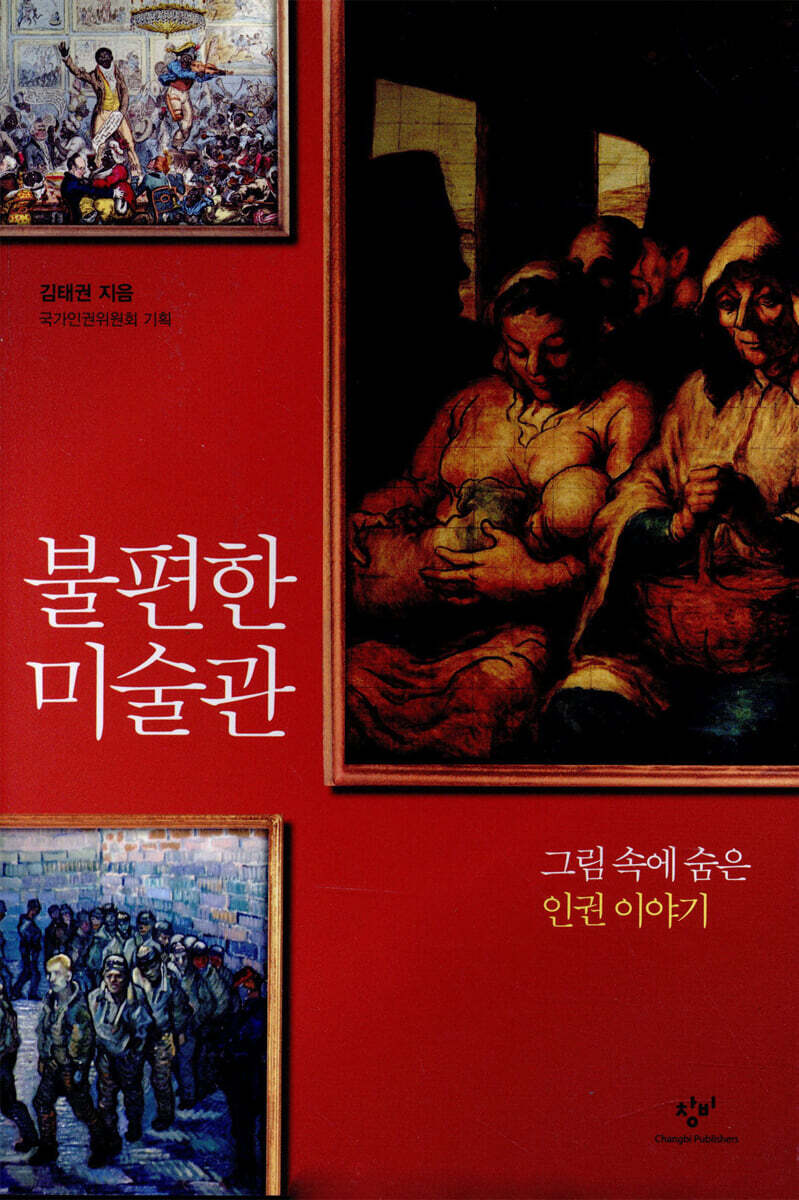
Inconvenient Art Museum
 |
Description
Book Introduction
- A word from MD
-
It's time to be willing to be uncomfortable.The works in 『The Uncomfortable Museum』 are masterpieces in themselves, but they also tell another story.
In the book, art is interpreted in various ways as "human rights," and this new attempt proves that human rights, a potentially awkward topic, is a value shared by all humanity.
A little discomfort enriches the mind.
January 19, 2018. Arts PD
From Da Vinci to Andy Warhol
Reading the picture with human rights
Are Charlie Hebdo's cartoons satirical or hate speech? Why are so many of the women in the cartoons nude? Is it acceptable to shoot Hitler in a painting?
In search of answers to these questions, Changbi published "The Uncomfortable Museum," which discusses human rights through art.
Taekwon Kim, who has a reputation for creating both entertaining and informative comics such as 『Kim Taekwon's Crusade Story』 and 『Hitler's Success Era』, guides us through the world of art and human rights this time, not with pictures, but with words.
From ancient Greek sculptures to Andy Warhol's Marilyn Monroe prints, the exhibition draws on diverse works from across time and region to discuss topics such as racism, discrimination against women, the human rights of immigrants and the disabled, freedom of expression, freedom of religion, personal rights, and animal rights in a clear and accessible manner.
By applying the standard of human rights to art, which has mainly discussed aesthetic value, it presents a new perspective on art, while expanding the scope of human rights application to art, reminding us that human rights must not be forgotten in any area of our society.
Reading the picture with human rights
Are Charlie Hebdo's cartoons satirical or hate speech? Why are so many of the women in the cartoons nude? Is it acceptable to shoot Hitler in a painting?
In search of answers to these questions, Changbi published "The Uncomfortable Museum," which discusses human rights through art.
Taekwon Kim, who has a reputation for creating both entertaining and informative comics such as 『Kim Taekwon's Crusade Story』 and 『Hitler's Success Era』, guides us through the world of art and human rights this time, not with pictures, but with words.
From ancient Greek sculptures to Andy Warhol's Marilyn Monroe prints, the exhibition draws on diverse works from across time and region to discuss topics such as racism, discrimination against women, the human rights of immigrants and the disabled, freedom of expression, freedom of religion, personal rights, and animal rights in a clear and accessible manner.
By applying the standard of human rights to art, which has mainly discussed aesthetic value, it presents a new perspective on art, while expanding the scope of human rights application to art, reminding us that human rights must not be forgotten in any area of our society.
- You can preview some of the book's contents.
Preview
index
Part 1.
Facts to remember
01 The 'uncomfortable' gaze toward women
02 Freedom from want
03 Rights of Persons with Disabilities and Prejudice of Non-Disabled Persons
04 Immigrants, humans before citizens
05 Sexual violence, violation of sexual self-determination rights
06 Human Rights of Sexual Minorities in Art
07 How to Remember Genocide
08 Right to be free from chains
09 Give me the freedom to express myself as I please.
Part 2.
Difficult questions to answer
10 Are there any limits to freedom of expression?
11 Issues Surrounding Racism
12 Misogyny: What's the Problem?
13 My Thoughts and Others' Beliefs
14 New Issues in Aging Society and Human Rights
15 New inconveniences of a new era
Facts to remember
01 The 'uncomfortable' gaze toward women
02 Freedom from want
03 Rights of Persons with Disabilities and Prejudice of Non-Disabled Persons
04 Immigrants, humans before citizens
05 Sexual violence, violation of sexual self-determination rights
06 Human Rights of Sexual Minorities in Art
07 How to Remember Genocide
08 Right to be free from chains
09 Give me the freedom to express myself as I please.
Part 2.
Difficult questions to answer
10 Are there any limits to freedom of expression?
11 Issues Surrounding Racism
12 Misogyny: What's the Problem?
13 My Thoughts and Others' Beliefs
14 New Issues in Aging Society and Human Rights
15 New inconveniences of a new era
Publisher's Review
The third human rights story, following "It's Okay to Be Inconvenient" and "If It's Inconvenient, Think About It."
This book is a cultural textbook planned by the National Human Rights Commission of Korea to convey human rights in a more easy and fun way, following “It’s Okay to Be Inconvenient” and “If It’s Inconvenient, Think About It.”
"It's Okay to Be Uncomfortable" has sold over 100,000 copies and has become synonymous with human rights education books, while "If It's Uncomfortable, Think About It" has been praised as a book that provides a prescription for solving everyday problems by using warm logic to explain various social phenomena.
The author continues the spirit of his previous works, popularizing human rights through brisk prose and exquisite metaphors, while also encouraging readers to "look at things with discomfort."
Just as masterpieces of high artistic value sometimes contain discriminatory content, we must carefully examine the things we encounter in our daily lives to see human rights-related issues. When everyone adopts such a cautious attitude, human rights can be promoted throughout society.
In today's world, where hate speech of all kinds is rampant, regardless of target: women, men, the elderly, migrant workers, etc., "The Inconvenient Museum" will be an essential book for healthy citizens who strive to confront absurd discrimination and prejudice, as well as for young readers who need to awaken a new sense of human rights.
Transcending time and trends
Reflecting on 'Human Rights' in Masterpieces
"The Uncomfortable Museum" invites readers to an exhibition woven around the theme of "human rights."
The works presented in this exhibition are diversely selected without being restricted by era, region, or trend, and encompass everything from ancient Greek sculptures to masters such as da Vinci, Van Gogh, and Andy Warhol, as well as graffiti of unknown authors.
For example, Chapter 4, which discusses the human rights of immigrants, simultaneously covers Caravaggio's "The Flight into Egypt," painted in the 16th century, photographs by Sebastião Saugadou, a world-renowned photographer today, and photographs by Mixrice, who won the Artist of the Year Award at the National Museum of Modern and Contemporary Art in 2016.
By presenting works without regard to boundaries, we shed light on a single human rights topic from various angles and provide food for thought.
Meanwhile, it is also interesting to compare works that depict the same scene in completely different ways from around the same time.
Chapter 5, which interprets sexual violence as a violation of the right to sexual self-determination, introduces works depicting Susanna from the Bible and the two men who attempt to rape her.
In Guercino's painting, the man who is about to rape Susanna puts his finger to his mouth, telling the audience to be quiet. This can be interpreted as a secondary victimization that turns Susanna into a spectacle.
On the other hand, Artemisia Gentileschi painted the same scene completely separate from the audience, allowing the audience to empathize with Susanna, the victim.
If we look at art through the lens of human rights, we can interpret it differently than before.
Some works are beautiful, but lack a sense of human rights, discriminating against or objectifying the weak. Others contain a sense of human rights that transcends the times.
"The Inconvenient Museum of Art" presents a fresh perspective on art, while expanding the scope of human rights to art and demonstrating that human rights are fundamental values that apply everywhere.
Discrimination against women, human rights for the disabled, aging society, personal rights, animal rights…
Human Rights Issues Seen Through Art
Part 1 of this book covers basic human rights that we must know but often overlook.
In particular, attention was paid to those who were objectified and had their human rights violated in the name of art.
Chapter 1 examines how women, Chapter 3 the disabled, Chapter 4 immigrants, and Chapter 6 sexual minorities are depicted in art, prompting us to reflect on whether we have inadvertently objectified and discriminated against them simply because they are different from us.
In addition, it also finds and explains human rights in art.
Chapter 2 discusses social rights by examining works that deal with poverty and deprivation, and Chapter 7 examines how art has remembered the most heinous crime, massacre.
Chapter 8 also discusses personal freedom by looking at several works based on Prometheus, and Chapter 9 tells the history of freedom of expression through the caricatures of Honoré Daumier and the works of Otto Dix, whom Hitler disliked.
Part 2 delves deeper into human rights issues that are difficult to answer clearly.
Chapter 10 asks whether there are limits to freedom of expression, using the example of Charlie Hebdo, which has become a target of terrorist attacks by Islamic extremists due to its provocative cartoons.
In addition, Chapter 11 presents issues that have been debated for a long time but for which no clear answers have been found, such as racism, Chapter 12 on misogyny, and Chapter 13 on religious freedom, and encourages readers to think about them together.
We also pay attention to human rights topics that will be discussed more heatedly in the future.
Chapter 14 diagnoses the problems that will arise in our society, which is rapidly aging due to low birth rates.
Chapter 15 explores the present and future of human rights, examining not only the right to self-determination of personal information, personality rights, and intellectual property rights, which are becoming increasingly important with the development of the Internet, but also the rights of animals and artificial intelligence.
This book is a cultural textbook planned by the National Human Rights Commission of Korea to convey human rights in a more easy and fun way, following “It’s Okay to Be Inconvenient” and “If It’s Inconvenient, Think About It.”
"It's Okay to Be Uncomfortable" has sold over 100,000 copies and has become synonymous with human rights education books, while "If It's Uncomfortable, Think About It" has been praised as a book that provides a prescription for solving everyday problems by using warm logic to explain various social phenomena.
The author continues the spirit of his previous works, popularizing human rights through brisk prose and exquisite metaphors, while also encouraging readers to "look at things with discomfort."
Just as masterpieces of high artistic value sometimes contain discriminatory content, we must carefully examine the things we encounter in our daily lives to see human rights-related issues. When everyone adopts such a cautious attitude, human rights can be promoted throughout society.
In today's world, where hate speech of all kinds is rampant, regardless of target: women, men, the elderly, migrant workers, etc., "The Inconvenient Museum" will be an essential book for healthy citizens who strive to confront absurd discrimination and prejudice, as well as for young readers who need to awaken a new sense of human rights.
Transcending time and trends
Reflecting on 'Human Rights' in Masterpieces
"The Uncomfortable Museum" invites readers to an exhibition woven around the theme of "human rights."
The works presented in this exhibition are diversely selected without being restricted by era, region, or trend, and encompass everything from ancient Greek sculptures to masters such as da Vinci, Van Gogh, and Andy Warhol, as well as graffiti of unknown authors.
For example, Chapter 4, which discusses the human rights of immigrants, simultaneously covers Caravaggio's "The Flight into Egypt," painted in the 16th century, photographs by Sebastião Saugadou, a world-renowned photographer today, and photographs by Mixrice, who won the Artist of the Year Award at the National Museum of Modern and Contemporary Art in 2016.
By presenting works without regard to boundaries, we shed light on a single human rights topic from various angles and provide food for thought.
Meanwhile, it is also interesting to compare works that depict the same scene in completely different ways from around the same time.
Chapter 5, which interprets sexual violence as a violation of the right to sexual self-determination, introduces works depicting Susanna from the Bible and the two men who attempt to rape her.
In Guercino's painting, the man who is about to rape Susanna puts his finger to his mouth, telling the audience to be quiet. This can be interpreted as a secondary victimization that turns Susanna into a spectacle.
On the other hand, Artemisia Gentileschi painted the same scene completely separate from the audience, allowing the audience to empathize with Susanna, the victim.
If we look at art through the lens of human rights, we can interpret it differently than before.
Some works are beautiful, but lack a sense of human rights, discriminating against or objectifying the weak. Others contain a sense of human rights that transcends the times.
"The Inconvenient Museum of Art" presents a fresh perspective on art, while expanding the scope of human rights to art and demonstrating that human rights are fundamental values that apply everywhere.
Discrimination against women, human rights for the disabled, aging society, personal rights, animal rights…
Human Rights Issues Seen Through Art
Part 1 of this book covers basic human rights that we must know but often overlook.
In particular, attention was paid to those who were objectified and had their human rights violated in the name of art.
Chapter 1 examines how women, Chapter 3 the disabled, Chapter 4 immigrants, and Chapter 6 sexual minorities are depicted in art, prompting us to reflect on whether we have inadvertently objectified and discriminated against them simply because they are different from us.
In addition, it also finds and explains human rights in art.
Chapter 2 discusses social rights by examining works that deal with poverty and deprivation, and Chapter 7 examines how art has remembered the most heinous crime, massacre.
Chapter 8 also discusses personal freedom by looking at several works based on Prometheus, and Chapter 9 tells the history of freedom of expression through the caricatures of Honoré Daumier and the works of Otto Dix, whom Hitler disliked.
Part 2 delves deeper into human rights issues that are difficult to answer clearly.
Chapter 10 asks whether there are limits to freedom of expression, using the example of Charlie Hebdo, which has become a target of terrorist attacks by Islamic extremists due to its provocative cartoons.
In addition, Chapter 11 presents issues that have been debated for a long time but for which no clear answers have been found, such as racism, Chapter 12 on misogyny, and Chapter 13 on religious freedom, and encourages readers to think about them together.
We also pay attention to human rights topics that will be discussed more heatedly in the future.
Chapter 14 diagnoses the problems that will arise in our society, which is rapidly aging due to low birth rates.
Chapter 15 explores the present and future of human rights, examining not only the right to self-determination of personal information, personality rights, and intellectual property rights, which are becoming increasingly important with the development of the Internet, but also the rights of animals and artificial intelligence.
GOODS SPECIFICS
- Date of issue: January 8, 2018
- Page count, weight, size: 276 pages | 416g | 140*210*20mm
- ISBN13: 9788936486228
- ISBN10: 8936486225
You may also like
카테고리
korean


korean

![GQ KOREA Mark (Monthly): December [2025]](http://librairie.coreenne.fr/cdn/shop/files/8ef265dbbfbf186523ed75ba7319009d.jpg?v=1765340328&width=3840)


