

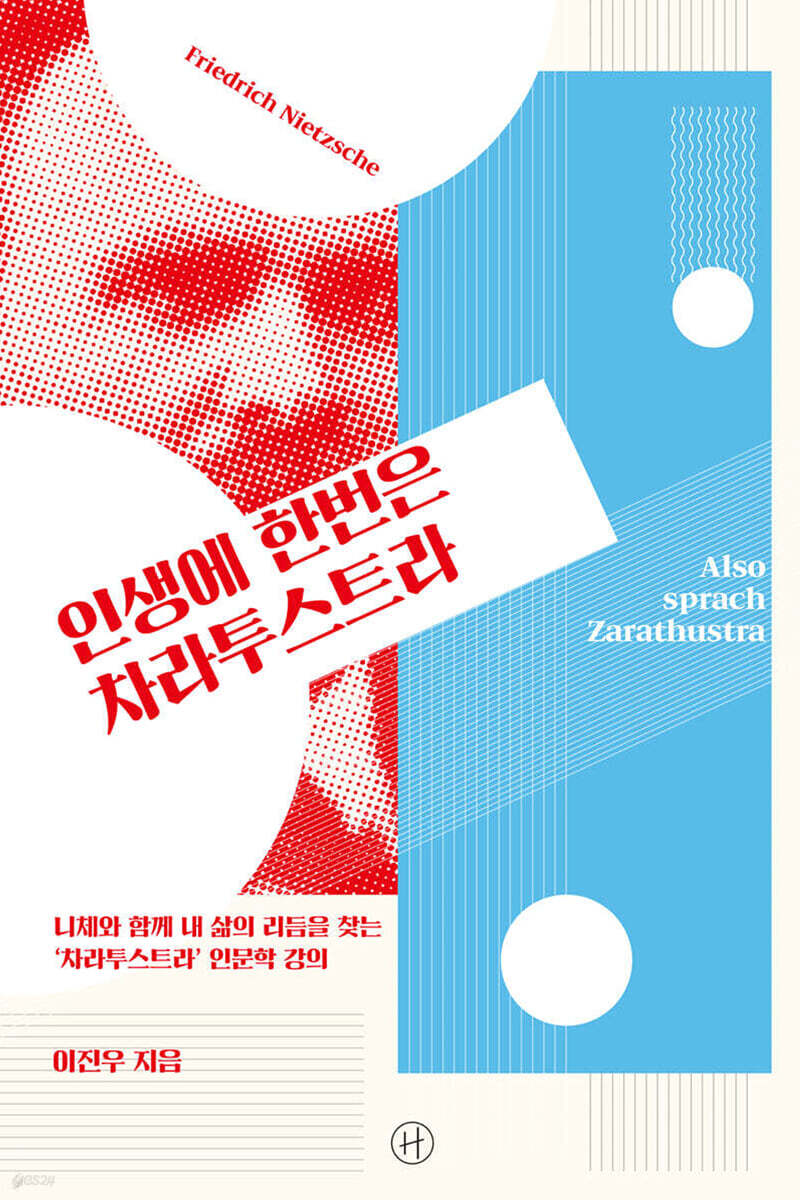
Zarathustra once in a lifetime
 |
Description
Book Introduction
Is it okay to live like this, or do you want to change? If you want to find true life, meet Zarathustra! Thus Spoke Zarathustra is a story about recognizing life, reflecting on it, and becoming oneself. Only those who take life seriously and can affirm it even in the midst of all kinds of suffering can enjoy the privilege of solving life's problems through Thus Spoke Zarathustra. This book confronts the fundamental questions of life that Nietzsche poses in Thus Spoke Zarathustra, such as life and death, love and friendship, children and marriage, joy and passion, sin and purity, revenge and war, solitude and loneliness. Join Professor Jinwoo Lee, a renowned Nietzsche expert, as we reflect on life's challenges and discover ways to transcend life's contradictions and find our own path. |
- You can preview some of the book's contents.
Preview
index
Introduction: Why We Should Hear the Song of Zarathustra
1.
Preface, Lecture 1: Zarathustra, the Birth of a New Revolutionary
2.
Preface, Part 2: The Last Human, Obsessed with Happiness
3.
Part 1, Lecture 1: Superhumans, Leaving the State and the Market
4.
Part 1, Lesson 2: The Three Metamorphoses: The Spirit of the Camel and the Lion Child
5.
Part 2, Lesson 1: Pain, Strength Achieved Through Singing
6.
Part 2, Lecture 2: The Will to Power: Everyone Seeks Power
7.
Part 3, Lecture 1: Eternal Return: Are You Living the Moment?
8.
Part 3, Lesson 2: Amor Fati, the Dance of Those Who Love Fate
9.
Part 4, Lesson 1: A Superior Human Asks for Help
10.
Part 4, Lecture 2: Dionysus, A Life of Smiling and Positive Thinking
main
1.
Preface, Lecture 1: Zarathustra, the Birth of a New Revolutionary
2.
Preface, Part 2: The Last Human, Obsessed with Happiness
3.
Part 1, Lecture 1: Superhumans, Leaving the State and the Market
4.
Part 1, Lesson 2: The Three Metamorphoses: The Spirit of the Camel and the Lion Child
5.
Part 2, Lesson 1: Pain, Strength Achieved Through Singing
6.
Part 2, Lecture 2: The Will to Power: Everyone Seeks Power
7.
Part 3, Lecture 1: Eternal Return: Are You Living the Moment?
8.
Part 3, Lesson 2: Amor Fati, the Dance of Those Who Love Fate
9.
Part 4, Lesson 1: A Superior Human Asks for Help
10.
Part 4, Lecture 2: Dionysus, A Life of Smiling and Positive Thinking
main
Detailed image

Publisher's Review
1.
How to escape the repetitive routine and find real life
─ The specific problems of 'my life' encountered in Zarathustra's journey
『Thus Spoke Zarathustra』(hereafter referred to as 『Thus Spoke Zarathustra』) is a book that Nietzsche said was 'unrivaled' among his works, and Nietzsche researchers consider this book to be his representative work.
It is an immortal classic that was published in 1883 and has been loved by countless readers for over 130 years.
This book, consisting of four parts, is a grand epic poem that contains Zarathustra's two descents, his return home, and his long journey to finally leave the cave. Although it is the great philosopher's masterpiece, it has a unique structure that is closer to a literary work than a philosophical text.
In this book, "Once in a Lifetime, Be Zarathustra," Professor Jinwoo Lee and I meticulously examine Nietzsche's "Be Zarathustra" and discover the colorful meanings hidden in Zarathustra's journey.
Zarathustra's life is filled with suffering, as he enjoys solitude in the mountains for ten years, then comes down, is ridiculed by the public, and then goes up and down the mountains again.
In this process, Zarathustra reflects on himself, wanders in search of the direction of life, and faces the contradictions of the world.
But in fact, this is not only Zarathustra's problem, but also our problem.
Listening to Zarathustra's tale, one finds oneself pondering life's fundamental questions alongside him: "How should we live our repetitive daily lives?", "How can we live a better life?", "How can we overcome ourselves?", "Can we endure a world full of contradictions?"
This is why anyone who wants to change and find their true life should use this book as a guide and read "Thus Spoke Zarathustra."
Zarathustra never teaches or preaches.
It's a story about recognizing yourself, reflecting on yourself, and becoming yourself.
Zarathustra is a grand epic about life becoming what it is.
Only those who take life seriously will listen to stories about life.
Only those who can affirm life amidst all its suffering can listen to its contradictions and tragic duality.
You cannot be positive about life if you do not accept its contradictions.
"Zarathustra" is a book written by Nietzsche, who considered life a means of knowledge, based on all the suffering and tragic knowledge he experienced.
Only those for whom life itself is a problem can hear his words, which seem to fall drop by drop from an infinitely rich light and an infinitely deep abyss.
Nietzsche says that not everyone has ears that can hear the words of Zarathustra.
Nietzsche is largely correct when he says that listening to him is the privilege of the chosen few.
- From the Introduction (pages 6-7)
2.
Nietzsche's ideas heard through the voice of Zarathustra
─ Finding the prototype of Nietzsche's thought in the philosophical images of "Thus Spoke Zarathustra"
Nietzsche's "Thus Spoke Zarathustra" is composed of four parts. Part 1 can be divided into "Preface to Zarathustra," which serves as a preface to the entire book, and "The Teachings of Zarathustra," which is similar in nature to the main text of Parts 2-4.
This book examines the central content of "Thus Spoke Zarathustra" in 10 lectures, dividing the "Preface" and Parts 1-4 of "Thus Spoke Zarathustra" into 2 lectures each.
It helps readers enjoy the difficult book, "Thus Spoke Zarathustra," by providing detailed explanations of the story of Zarathustra and its hidden meaning.
Each river is associated with a concept from Nietzsche's philosophy, such as 'superman', 'last man', 'will to power', 'eternal return', and 'amor fati'.
Of course, 『Thus Spoke Zarathustra』 is closer to a literary work containing the story of Zarathustra than a philosophical text, but as befitting a philosopher's work, it is full of ideas that serve as the starting point of thought.
In particular, the three core concepts that represent Nietzsche's philosophy—the superman, the will to power, and eternal recurrence—are closely connected to Parts 1 to 3 of Zarathustra.
In Part 1, Zarathustra must find a true companion and fight alongside him to become a superman; in Part 2, Zarathustra discovers that all living things have a will to power; and in Part 3, Zarathustra realizes eternal recurrence while watching the path he takes with the dwarf across the city gate. These all vividly reveal the philosophical images of each concept.
Professor Lee Jin-woo, the author, weaves together the philosophical images found in Zarathustra, Nietzsche's systematized philosophy, and the realities of Korean society, allowing us to confirm the true nature of Nietzsche's thought while simultaneously contemplating the specific problems of life we encounter in our daily lives.
Today, Korea is called 'Hell Joseon', and the pain and anxiety experienced by the younger generation far exceeds what people in their 50s and 60s think.
Saying that it's because you're young is no comfort at all.
It used to be said, 'You have to suffer when you're young.'
Sometimes I said that youth is about frustration, despair, and heartbreak.
The pain that the younger generation is experiencing today is the despair that comes from the feeling that no matter how hard they try, their lives will not get any better tomorrow.
It's qualitatively different.
This is a problem that young people all over the world are facing, not just in our country.
How can we overcome this anxiety that today's life will be repeated tomorrow, and tomorrow's life will be repeated the day after?
- 〈7.
From Part 3, Lecture 1: Eternal Return: Are You Living This Moment Properly? (p. 199)
Morality is the will to values.
Power creates value.
Those in power are the ones who set the agenda for what issues we should care about.
Today, all the countries that decide and lead the discussion about what the world's problems are are the great powers.
Nietzsche says:
“O greatest of wise men, this is your whole will, the will to power.
Even when you talk about good and evil and valuation, it is power that determines what is good and what is evil.
This can be proven at any time.
From ancient times to the present, the tablet of values has been constantly changing.
The old tablet was torn down and a new tablet was built.
- 〈6.
From Part 2, Lecture 2: The Will to Power: Everyone Seeks Power (p. 182)
3.
Zarathustra reborn with a fluent translation and excellent commentary
─ Professor Jinwoo Lee, a leading Nietzsche expert, publishes a translation and commentary of Zarathustra simultaneously.
Professor Jinwoo Lee of POSTECH simultaneously published the book “Thus Spoke Zarathustra” along with the translation of “Thus Spoke Zarathustra”, introducing a new world of Zarathustra to Korean society.
The translated version of "Zarathustra" is a fluent translation with faithful commentary and annotations, allowing readers to fully enjoy the story of Zarathustra. The commentary, "Zarathustra Once in a Lifetime," introduces readers to the problems of life raised in the original text and helps them engage in fundamental reflection on reality.
This project, which publishes the translation and commentary simultaneously, will be a great gift to all readers interested in the humanities and who love Nietzsche.
Who can hear Zarathustra? Nietzsche concludes the Prologue to "Behold the Man" with the words he uttered at the end of Part I of "Zarathustra."
“You too, now separate and go alone! That is what I wish.
I truly hope so for you.
“Leave me and resist Zarathustra!” Nietzsche wants neither disciples nor believers.
I also don't want to embellish or glorify my own thoughts.
What Nietzsche wants is for everyone who reads Zarathustra to find their own path.
“Let go of me and find yourselves.
And only when you all deny me will I return to you.” Nietzsche hopes it will not be read.
Nietzsche hopes that readers will read their own lives through the experience of listening to Zarathustra.
- From the Introduction (pages 7-8)
How to escape the repetitive routine and find real life
─ The specific problems of 'my life' encountered in Zarathustra's journey
『Thus Spoke Zarathustra』(hereafter referred to as 『Thus Spoke Zarathustra』) is a book that Nietzsche said was 'unrivaled' among his works, and Nietzsche researchers consider this book to be his representative work.
It is an immortal classic that was published in 1883 and has been loved by countless readers for over 130 years.
This book, consisting of four parts, is a grand epic poem that contains Zarathustra's two descents, his return home, and his long journey to finally leave the cave. Although it is the great philosopher's masterpiece, it has a unique structure that is closer to a literary work than a philosophical text.
In this book, "Once in a Lifetime, Be Zarathustra," Professor Jinwoo Lee and I meticulously examine Nietzsche's "Be Zarathustra" and discover the colorful meanings hidden in Zarathustra's journey.
Zarathustra's life is filled with suffering, as he enjoys solitude in the mountains for ten years, then comes down, is ridiculed by the public, and then goes up and down the mountains again.
In this process, Zarathustra reflects on himself, wanders in search of the direction of life, and faces the contradictions of the world.
But in fact, this is not only Zarathustra's problem, but also our problem.
Listening to Zarathustra's tale, one finds oneself pondering life's fundamental questions alongside him: "How should we live our repetitive daily lives?", "How can we live a better life?", "How can we overcome ourselves?", "Can we endure a world full of contradictions?"
This is why anyone who wants to change and find their true life should use this book as a guide and read "Thus Spoke Zarathustra."
Zarathustra never teaches or preaches.
It's a story about recognizing yourself, reflecting on yourself, and becoming yourself.
Zarathustra is a grand epic about life becoming what it is.
Only those who take life seriously will listen to stories about life.
Only those who can affirm life amidst all its suffering can listen to its contradictions and tragic duality.
You cannot be positive about life if you do not accept its contradictions.
"Zarathustra" is a book written by Nietzsche, who considered life a means of knowledge, based on all the suffering and tragic knowledge he experienced.
Only those for whom life itself is a problem can hear his words, which seem to fall drop by drop from an infinitely rich light and an infinitely deep abyss.
Nietzsche says that not everyone has ears that can hear the words of Zarathustra.
Nietzsche is largely correct when he says that listening to him is the privilege of the chosen few.
- From the Introduction (pages 6-7)
2.
Nietzsche's ideas heard through the voice of Zarathustra
─ Finding the prototype of Nietzsche's thought in the philosophical images of "Thus Spoke Zarathustra"
Nietzsche's "Thus Spoke Zarathustra" is composed of four parts. Part 1 can be divided into "Preface to Zarathustra," which serves as a preface to the entire book, and "The Teachings of Zarathustra," which is similar in nature to the main text of Parts 2-4.
This book examines the central content of "Thus Spoke Zarathustra" in 10 lectures, dividing the "Preface" and Parts 1-4 of "Thus Spoke Zarathustra" into 2 lectures each.
It helps readers enjoy the difficult book, "Thus Spoke Zarathustra," by providing detailed explanations of the story of Zarathustra and its hidden meaning.
Each river is associated with a concept from Nietzsche's philosophy, such as 'superman', 'last man', 'will to power', 'eternal return', and 'amor fati'.
Of course, 『Thus Spoke Zarathustra』 is closer to a literary work containing the story of Zarathustra than a philosophical text, but as befitting a philosopher's work, it is full of ideas that serve as the starting point of thought.
In particular, the three core concepts that represent Nietzsche's philosophy—the superman, the will to power, and eternal recurrence—are closely connected to Parts 1 to 3 of Zarathustra.
In Part 1, Zarathustra must find a true companion and fight alongside him to become a superman; in Part 2, Zarathustra discovers that all living things have a will to power; and in Part 3, Zarathustra realizes eternal recurrence while watching the path he takes with the dwarf across the city gate. These all vividly reveal the philosophical images of each concept.
Professor Lee Jin-woo, the author, weaves together the philosophical images found in Zarathustra, Nietzsche's systematized philosophy, and the realities of Korean society, allowing us to confirm the true nature of Nietzsche's thought while simultaneously contemplating the specific problems of life we encounter in our daily lives.
Today, Korea is called 'Hell Joseon', and the pain and anxiety experienced by the younger generation far exceeds what people in their 50s and 60s think.
Saying that it's because you're young is no comfort at all.
It used to be said, 'You have to suffer when you're young.'
Sometimes I said that youth is about frustration, despair, and heartbreak.
The pain that the younger generation is experiencing today is the despair that comes from the feeling that no matter how hard they try, their lives will not get any better tomorrow.
It's qualitatively different.
This is a problem that young people all over the world are facing, not just in our country.
How can we overcome this anxiety that today's life will be repeated tomorrow, and tomorrow's life will be repeated the day after?
- 〈7.
From Part 3, Lecture 1: Eternal Return: Are You Living This Moment Properly? (p. 199)
Morality is the will to values.
Power creates value.
Those in power are the ones who set the agenda for what issues we should care about.
Today, all the countries that decide and lead the discussion about what the world's problems are are the great powers.
Nietzsche says:
“O greatest of wise men, this is your whole will, the will to power.
Even when you talk about good and evil and valuation, it is power that determines what is good and what is evil.
This can be proven at any time.
From ancient times to the present, the tablet of values has been constantly changing.
The old tablet was torn down and a new tablet was built.
- 〈6.
From Part 2, Lecture 2: The Will to Power: Everyone Seeks Power (p. 182)
3.
Zarathustra reborn with a fluent translation and excellent commentary
─ Professor Jinwoo Lee, a leading Nietzsche expert, publishes a translation and commentary of Zarathustra simultaneously.
Professor Jinwoo Lee of POSTECH simultaneously published the book “Thus Spoke Zarathustra” along with the translation of “Thus Spoke Zarathustra”, introducing a new world of Zarathustra to Korean society.
The translated version of "Zarathustra" is a fluent translation with faithful commentary and annotations, allowing readers to fully enjoy the story of Zarathustra. The commentary, "Zarathustra Once in a Lifetime," introduces readers to the problems of life raised in the original text and helps them engage in fundamental reflection on reality.
This project, which publishes the translation and commentary simultaneously, will be a great gift to all readers interested in the humanities and who love Nietzsche.
Who can hear Zarathustra? Nietzsche concludes the Prologue to "Behold the Man" with the words he uttered at the end of Part I of "Zarathustra."
“You too, now separate and go alone! That is what I wish.
I truly hope so for you.
“Leave me and resist Zarathustra!” Nietzsche wants neither disciples nor believers.
I also don't want to embellish or glorify my own thoughts.
What Nietzsche wants is for everyone who reads Zarathustra to find their own path.
“Let go of me and find yourselves.
And only when you all deny me will I return to you.” Nietzsche hopes it will not be read.
Nietzsche hopes that readers will read their own lives through the experience of listening to Zarathustra.
- From the Introduction (pages 7-8)
GOODS SPECIFICS
- Publication date: November 23, 2020
- Page count, weight, size: 320 pages | 406g | 140*210*15mm
- ISBN13: 9791160804607
- ISBN10: 1160804605
You may also like
카테고리
korean


korean

![ELLE 엘르 스페셜 에디션 A형 : 12월 [2025]](http://librairie.coreenne.fr/cdn/shop/files/b8e27a3de6c9538896439686c6b0e8fb.jpg?v=1766436872&width=3840)


