

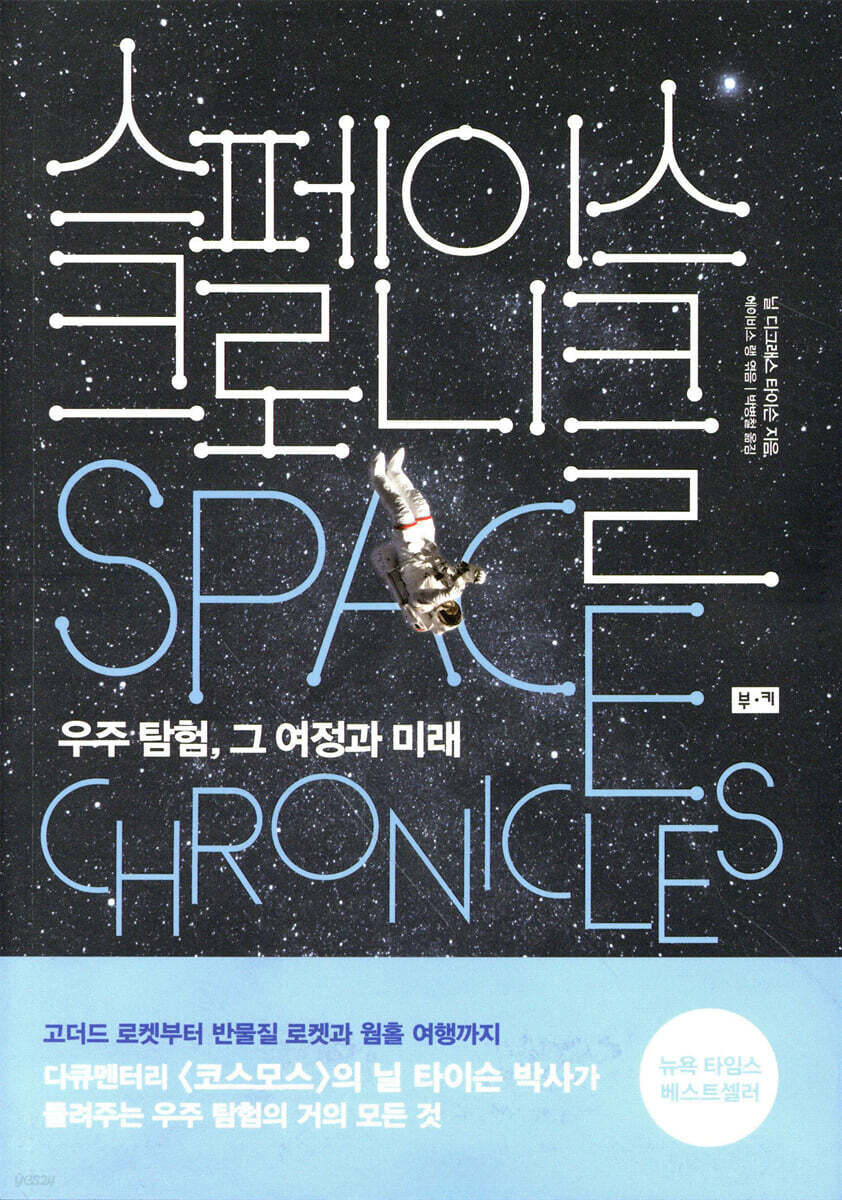
Space Chronicle
 |
Description
Book Introduction
Astrophysicist Neil Tyson, who followed in the footsteps of Carl Sagan,
Questioning the Meaning of Space Exploration
Tyson, known as "the greatest space storyteller alive," excels at explaining complex scientific and technical concepts in a clear and accessible way.
One critic even commented on his ability to blend scientific examples with pop culture, using his characteristically lively style and sense of humor to tell a story in a fluid manner, saying, “Even technical explanations, which are bound to be dry, seem like watching a movie.”
“My goal is to bring space down to Earth and make it more interesting for people who are looking for something new,” says Tyson, but he is not satisfied with just providing people with interesting entertainment.
In fact, all scientific activities naturally incur costs of one kind or another, and in the case of space development in particular, the budget is astronomical.
In today's democratic society, such a project is impossible to pursue without public support.
Dr. Tyson ultimately hopes to create a broader public understanding of space exploration, which will lead to greater support and investment in space development.
In his tenth book, Space Chronicle, which contains his own dreams, Tyson poses fundamental questions such as why humans yearn for space, why they want to go into space, and why they must go there, while looking at the past, present, and future of space exploration.
This book examines the methods and technologies we have used to explore space so far, including Sputnik, the world's first artificial satellite; Apollo 11, which placed the first humans on the moon; the Space Shuttle; and the Hubble Space Telescope. It also looks into the possibilities of future technologies, such as travel to deep space using antimatter rockets or space travel through wormholes.
Ultimately, this awakens us to the meaning of the universe and urges us to expand our perspectives and advance into the cosmos to enrich the lives and minds of humanity.
Questioning the Meaning of Space Exploration
Tyson, known as "the greatest space storyteller alive," excels at explaining complex scientific and technical concepts in a clear and accessible way.
One critic even commented on his ability to blend scientific examples with pop culture, using his characteristically lively style and sense of humor to tell a story in a fluid manner, saying, “Even technical explanations, which are bound to be dry, seem like watching a movie.”
“My goal is to bring space down to Earth and make it more interesting for people who are looking for something new,” says Tyson, but he is not satisfied with just providing people with interesting entertainment.
In fact, all scientific activities naturally incur costs of one kind or another, and in the case of space development in particular, the budget is astronomical.
In today's democratic society, such a project is impossible to pursue without public support.
Dr. Tyson ultimately hopes to create a broader public understanding of space exploration, which will lead to greater support and investment in space development.
In his tenth book, Space Chronicle, which contains his own dreams, Tyson poses fundamental questions such as why humans yearn for space, why they want to go into space, and why they must go there, while looking at the past, present, and future of space exploration.
This book examines the methods and technologies we have used to explore space so far, including Sputnik, the world's first artificial satellite; Apollo 11, which placed the first humans on the moon; the Space Shuttle; and the Hubble Space Telescope. It also looks into the possibilities of future technologies, such as travel to deep space using antimatter rockets or space travel through wormholes.
Ultimately, this awakens us to the meaning of the universe and urges us to expand our perspectives and advance into the cosmos to enrich the lives and minds of humanity.
- You can preview some of the book's contents.
Preview
index
Prologue _ Space Policy
PART I: Why Go?
1 Fascinating Universe
2 exoplanets
3 Alien life forms
4 Alien Villains
5 Killer Asteroids
6 The Road to the Stars
7 Why go to space?
8 On Awe
9 Happy Birthday NASA
10 Space - The Next 50 Years
11 Space Options
12 The Road to Discovery
PART II HOW TO GET THERE
13 flights
14 Ballistic Flight
15 Space Race
16 2001 - Fact and Fiction
17 People and Robots - Who Will We Send?
18 It's still going well
19 Sending love to Hubble
Celebrating the 20th anniversary of Apollo 11
21 How to get to heaven
22 The Last Days of the Space Shuttle
23 How to go to distant space
24 Exquisite Balance
25 Happy 45th Anniversary to Star Trek!
26 How to Prove You Were Abducted by Aliens
27 Future Space Travel
PART III Nothing is impossible
28 Problems with Space Travel
29 A trip to the stars
30 The United States and Emerging Space Powers
31 Misjudgments of Space Enthusiasts
32 Dreaming of the future
33 Principles to be observed
34 A Poem Dedicated to the Challenger
35 Spacecraft malfunction
36 NASA and America's Future
Epilogue _ Cosmic Perspective
PART I: Why Go?
1 Fascinating Universe
2 exoplanets
3 Alien life forms
4 Alien Villains
5 Killer Asteroids
6 The Road to the Stars
7 Why go to space?
8 On Awe
9 Happy Birthday NASA
10 Space - The Next 50 Years
11 Space Options
12 The Road to Discovery
PART II HOW TO GET THERE
13 flights
14 Ballistic Flight
15 Space Race
16 2001 - Fact and Fiction
17 People and Robots - Who Will We Send?
18 It's still going well
19 Sending love to Hubble
Celebrating the 20th anniversary of Apollo 11
21 How to get to heaven
22 The Last Days of the Space Shuttle
23 How to go to distant space
24 Exquisite Balance
25 Happy 45th Anniversary to Star Trek!
26 How to Prove You Were Abducted by Aliens
27 Future Space Travel
PART III Nothing is impossible
28 Problems with Space Travel
29 A trip to the stars
30 The United States and Emerging Space Powers
31 Misjudgments of Space Enthusiasts
32 Dreaming of the future
33 Principles to be observed
34 A Poem Dedicated to the Challenger
35 Spacecraft malfunction
36 NASA and America's Future
Epilogue _ Cosmic Perspective
Into the book
When a meteorite collides with the surface of a planet, it releases a tremendous amount of energy, causing rocks near the point of impact to fly upward. If the speed is faster than the escape velocity, the meteorite escapes the planet's gravitational pull and orbits the sun as if it were a planet itself, before colliding with another celestial body.
The most famous of the meteorites that left Mars, wandered through the solar system, and then landed on Earth is ALH-84001, discovered in 1984 in the Allan Hills sector of Antarctica.
Scientists have analyzed the meteorite and found faint, if any, traces of primitive life on Mars billions of years ago.
Mars has many traces of past water, including riverbeds, deltas, floodplains, eroded craters, and canyons.
Additionally, the polar ice caps, the underground ice scattered throughout the world, and minerals (silicon, clay, hematite, etc.) contained mainly in stagnant water are still found today.
Since liquid water is essential for life, the claim that life once existed on Mars is somewhat persuasive.
Some scientists claim that “life on Mars escaped the surface through some natural phenomenon, drifted through the solar system, and reached Earth, where it began to evolve.”
At first glance, it sounds like something out of a science fiction novel, but there is no evidence to refute it.
This hypothesis is called the 'panspermia hypothesis', and if it is true, then the ancestors of humans are Martians.
--- pp.84-86
New discoveries have been made steadily not only in space but also in the extremely small realm.
However, there is one particle that cleverly evades any detector, and that is the neutrino.
When a neutron decays into a proton and an electron, a bunch of neutrinos are also produced.
Even now, 200 trillion neutrinos are generated every second at the center of the sun and emitted in all directions. However, because their mass is so small and they hardly interact with other matter, they are very difficult to detect.
Astronomy would take a huge leap forward if someone could invent a telescope that could observe neutrinos.
Another way to detect a cosmic bang event is to detect gravitational waves.
Gravitational waves were predicted by Einstein's general theory of relativity in 1916, but no such waves have been directly observed yet.
If a powerful gravitational wave telescope were developed, it would be possible to observe spectacular events such as pairs of black holes orbiting each other or two galaxies merging into one.
In the future, dramatic events such as collisions, explosions, and collapses of celestial bodies will be observed routinely.
Or perhaps we could go a step further and one day observe the Big Bang itself by peering through the cosmic microwave background radiation.
Just as Ferdinand Magellan realized the limits of the "roundness of the Earth" after circumnavigating it on his ship, future astronomers, with the help of advanced equipment, will realize the limits of the "known universe."
--- pp.158-159
Another example of the application of Newton's ballistic mechanics is the 'slingshot effect'.
How fast would a space probe need to be launched from Earth to reach the edge of the solar system? I don't know, but it's unlikely to be even close to the speed at which it was launched.
Of course, the rocket engine will continue to run, allowing it to reach the speed necessary to escape Earth's gravity, but once it runs out of fuel, there is no way to accelerate the spacecraft any further.
Yet, the reason we continue to launch these slow-moving probes is because there's a secret to gaining speed during their journeys. NASA researchers meticulously analyze each planet's orbit and current position, and when a spacecraft passes a giant planet like Jupiter, they convert gravitational energy into kinetic energy.
As Jupiter moves along its orbit, the spacecraft's speed increases as it approaches, much like a rubber band slingshot being pulled back and then fired.
This is the slingshot effect.
Jupiter's gravity acts like a 'tight rubber band'.
If the location and timing are right, the spacecraft can increase its speed in the same way each time it encounters Saturn, Uranus, or Neptune.
Just using Jupiter's slingshot effect, a spacecraft's speed can almost double.
--- pp.211-212
To date, the Hubble Telescope has achieved unprecedented feats.
Even the most negative person would not disagree with this.
Hubble has generated more scientific papers than any other instrument and has provided clear answers to age-old controversies about the universe.
Perhaps the most famous example of this is the debate over the age of the universe.
In the past, observational data was so scarce that astronomers' estimates varied by almost two orders of magnitude, from 10 billion to 20 billion years.
It is certainly an uncomfortable situation when experts' opinions differ so much.
But the Hubble Space Telescope clearly showed how the brightness of any particular star varied with distance, and astronomers could plug this information into equations to calculate the star's distance.
If we turn back the clock to account for the expansion rate of the universe, we obtain the time elapsed since the creation of the universe.
The correct answer was 13.7 billion years.
Another thing Hubble discovered was that there are black holes at the centers of large galaxies.
Although this claim has been raised frequently in the past, it remained a hypothesis for a long time due to a lack of observational data.
At the center of large galaxies, including the Milky Way, lies a supermassive black hole that devours surrounding stars and matter.
Normally, the center of a galaxy is so dense that when photographed with a telescope on Earth, only a faint glow appears.
But the Hubble Space Telescope, after tracking stars near the galaxy's center step by step, discovered that they were moving at incredible speeds.
Since only a black hole could exert such a strong gravitational force in such a small space, astronomers concluded that a black hole was there.
In 2004, the year after the space shuttle Columbia disaster, NASA announced that it would no longer repair the Hubble Space Telescope.
However, the group that most strongly opposed NASA's decision at the time was not government agencies or research institutes, but the general public.
They raised their voices of opposition by using all means, including rebuttal articles and petitions, as if they were holding a torchlight protest, and the U.S. Congress, feeling the pressure of public opinion, eventually had no choice but to overturn NASA's decision.
The Hubble Telescope was acquired by the public, not by astronomers or engineers.
--- pp.243-245
In October 1998, the 2.4-meter-long, half-ton spacecraft Deep Space 1 was launched from Cape Canaveral, Florida.
The spacecraft's mission was to roam space for three years, testing a dozen advanced pieces of equipment, including an ion propulsion system. If the new propulsion system works properly, it will be able to send the spacecraft to considerable distances.
Even if the acceleration is small, if the acceleration is constant for a long time, the spaceship can move at tremendous speeds.
The basic principles of ion propulsion engines are similar to those of conventional spacecraft engines.
That is, when the propellant fuel (in this case, gas) is accelerated to a high speed and then ejected through the nozzle, the main body of the spacecraft, including the engine, is pushed in the opposite direction and moves forward.
This can be verified with a simple experiment.
If you get on a skateboard and spray the CO2 fire extinguisher backwards, your body and the skateboard will move forward.
(Experimental fire extinguishers must be purchased separately.) The direction of spraying and the direction in which the skateboard moves are always opposite.
However, ion propulsion engines and conventional rocket engines have different energy sources.
For example, the Space Shuttle's main engines used a mixture of liquid hydrogen and liquid oxygen as fuel, while Deep Space 1 used charged (ionized) xenon gas as fuel.
Ionized gases are easier to handle than highly flammable chemical fuels, and xenon, in particular, is an inert gas that does not react with other substances, making it very stable.
Deep Space 1 used an electric field to accelerate xenon ions to 40 kilometers per second and ejected them from the nozzle, consuming only 0.1 kilogram of fuel per day for 16,000 hours.
And it produced a thrust force ten times stronger than that of existing rocket engines per kilogram of fuel.
--- pp.278-279
The Helios-B solar probe, a joint project between the United States and Germany, was the fastest unmanned spacecraft ever built, launching in January 1976 and hurtling toward the Sun at 67 kilometers per second (240,000 kilometers per hour).
(Even so, this speed is only 0.02 percent of the speed of light!) If you were to fly to the nearest star in a spaceship like this, it would take about 19,000 years.
That's almost four times longer than recorded human history.
What is most desperately needed is a spacecraft capable of traveling at speeds close to the speed of light.
To reach 99 percent of the speed of light, you would need 700 million times the thrust of the Apollo 11 spacecraft.
This also assumes that our universe does not follow Einstein's special theory of relativity.
However, according to this theory, as all objects accelerate, their mass increases, and accelerating a heavier spaceship consumes more and more energy.
Roughly speaking, this amounts to about 10 billion times the energy used to travel back and forth to the moon.
According to observational data, the nearest star with a planet is 10 light-years away from Earth.
According to Einstein's special theory of relativity, time passes more slowly inside a moving spaceship than on Earth.
If the spaceship travels at 99 percent of the speed of light, the crew will only eat 14 percent of the age that Earthlings eat.
(That is, 100 years on Earth is equivalent to 14 years on a spaceship.) At this rate, a round trip of 10 light years would take 20 years on Earth, but for the crew, it would take only 3 years.
When you return home from your trip, your family probably won't even recognize you.
--- pp.323-324
The most common element in the universe is hydrogen.
So, hydrogen is the most abundant element in the human body.
Most of the hydrogen on Earth exists in the form of water.
The next most common element after hydrogen is helium, but it doesn't react chemically with other elements, so it's not very useful to our bodies.
Inhaling helium at a party might make your friends laugh, but it's virtually useless to living things.
Oxygen ranks third among the most common elements in the universe.
Oxygen is also the second most abundant element in the bodies of all living things on Earth.
Next in line is carbon, the fourth most abundant element in the universe and the third most abundant in living organisms.
Our bodies are also made up of carbon.
Next on the list is nitrogen (5th in space, 4th in life).
If our bodies were made of bismuth, we would be very special beings in the universe.
Because bismuth is a very rare element even in the universe.
But we are made of the most common elements in the universe, so we are quite ordinary in terms of rarity.
Disappointed? Don't be.
Because the components of our body are the same as the main components of the universe, we can have a sense of belonging and participation as a member of the universe.
The most famous of the meteorites that left Mars, wandered through the solar system, and then landed on Earth is ALH-84001, discovered in 1984 in the Allan Hills sector of Antarctica.
Scientists have analyzed the meteorite and found faint, if any, traces of primitive life on Mars billions of years ago.
Mars has many traces of past water, including riverbeds, deltas, floodplains, eroded craters, and canyons.
Additionally, the polar ice caps, the underground ice scattered throughout the world, and minerals (silicon, clay, hematite, etc.) contained mainly in stagnant water are still found today.
Since liquid water is essential for life, the claim that life once existed on Mars is somewhat persuasive.
Some scientists claim that “life on Mars escaped the surface through some natural phenomenon, drifted through the solar system, and reached Earth, where it began to evolve.”
At first glance, it sounds like something out of a science fiction novel, but there is no evidence to refute it.
This hypothesis is called the 'panspermia hypothesis', and if it is true, then the ancestors of humans are Martians.
--- pp.84-86
New discoveries have been made steadily not only in space but also in the extremely small realm.
However, there is one particle that cleverly evades any detector, and that is the neutrino.
When a neutron decays into a proton and an electron, a bunch of neutrinos are also produced.
Even now, 200 trillion neutrinos are generated every second at the center of the sun and emitted in all directions. However, because their mass is so small and they hardly interact with other matter, they are very difficult to detect.
Astronomy would take a huge leap forward if someone could invent a telescope that could observe neutrinos.
Another way to detect a cosmic bang event is to detect gravitational waves.
Gravitational waves were predicted by Einstein's general theory of relativity in 1916, but no such waves have been directly observed yet.
If a powerful gravitational wave telescope were developed, it would be possible to observe spectacular events such as pairs of black holes orbiting each other or two galaxies merging into one.
In the future, dramatic events such as collisions, explosions, and collapses of celestial bodies will be observed routinely.
Or perhaps we could go a step further and one day observe the Big Bang itself by peering through the cosmic microwave background radiation.
Just as Ferdinand Magellan realized the limits of the "roundness of the Earth" after circumnavigating it on his ship, future astronomers, with the help of advanced equipment, will realize the limits of the "known universe."
--- pp.158-159
Another example of the application of Newton's ballistic mechanics is the 'slingshot effect'.
How fast would a space probe need to be launched from Earth to reach the edge of the solar system? I don't know, but it's unlikely to be even close to the speed at which it was launched.
Of course, the rocket engine will continue to run, allowing it to reach the speed necessary to escape Earth's gravity, but once it runs out of fuel, there is no way to accelerate the spacecraft any further.
Yet, the reason we continue to launch these slow-moving probes is because there's a secret to gaining speed during their journeys. NASA researchers meticulously analyze each planet's orbit and current position, and when a spacecraft passes a giant planet like Jupiter, they convert gravitational energy into kinetic energy.
As Jupiter moves along its orbit, the spacecraft's speed increases as it approaches, much like a rubber band slingshot being pulled back and then fired.
This is the slingshot effect.
Jupiter's gravity acts like a 'tight rubber band'.
If the location and timing are right, the spacecraft can increase its speed in the same way each time it encounters Saturn, Uranus, or Neptune.
Just using Jupiter's slingshot effect, a spacecraft's speed can almost double.
--- pp.211-212
To date, the Hubble Telescope has achieved unprecedented feats.
Even the most negative person would not disagree with this.
Hubble has generated more scientific papers than any other instrument and has provided clear answers to age-old controversies about the universe.
Perhaps the most famous example of this is the debate over the age of the universe.
In the past, observational data was so scarce that astronomers' estimates varied by almost two orders of magnitude, from 10 billion to 20 billion years.
It is certainly an uncomfortable situation when experts' opinions differ so much.
But the Hubble Space Telescope clearly showed how the brightness of any particular star varied with distance, and astronomers could plug this information into equations to calculate the star's distance.
If we turn back the clock to account for the expansion rate of the universe, we obtain the time elapsed since the creation of the universe.
The correct answer was 13.7 billion years.
Another thing Hubble discovered was that there are black holes at the centers of large galaxies.
Although this claim has been raised frequently in the past, it remained a hypothesis for a long time due to a lack of observational data.
At the center of large galaxies, including the Milky Way, lies a supermassive black hole that devours surrounding stars and matter.
Normally, the center of a galaxy is so dense that when photographed with a telescope on Earth, only a faint glow appears.
But the Hubble Space Telescope, after tracking stars near the galaxy's center step by step, discovered that they were moving at incredible speeds.
Since only a black hole could exert such a strong gravitational force in such a small space, astronomers concluded that a black hole was there.
In 2004, the year after the space shuttle Columbia disaster, NASA announced that it would no longer repair the Hubble Space Telescope.
However, the group that most strongly opposed NASA's decision at the time was not government agencies or research institutes, but the general public.
They raised their voices of opposition by using all means, including rebuttal articles and petitions, as if they were holding a torchlight protest, and the U.S. Congress, feeling the pressure of public opinion, eventually had no choice but to overturn NASA's decision.
The Hubble Telescope was acquired by the public, not by astronomers or engineers.
--- pp.243-245
In October 1998, the 2.4-meter-long, half-ton spacecraft Deep Space 1 was launched from Cape Canaveral, Florida.
The spacecraft's mission was to roam space for three years, testing a dozen advanced pieces of equipment, including an ion propulsion system. If the new propulsion system works properly, it will be able to send the spacecraft to considerable distances.
Even if the acceleration is small, if the acceleration is constant for a long time, the spaceship can move at tremendous speeds.
The basic principles of ion propulsion engines are similar to those of conventional spacecraft engines.
That is, when the propellant fuel (in this case, gas) is accelerated to a high speed and then ejected through the nozzle, the main body of the spacecraft, including the engine, is pushed in the opposite direction and moves forward.
This can be verified with a simple experiment.
If you get on a skateboard and spray the CO2 fire extinguisher backwards, your body and the skateboard will move forward.
(Experimental fire extinguishers must be purchased separately.) The direction of spraying and the direction in which the skateboard moves are always opposite.
However, ion propulsion engines and conventional rocket engines have different energy sources.
For example, the Space Shuttle's main engines used a mixture of liquid hydrogen and liquid oxygen as fuel, while Deep Space 1 used charged (ionized) xenon gas as fuel.
Ionized gases are easier to handle than highly flammable chemical fuels, and xenon, in particular, is an inert gas that does not react with other substances, making it very stable.
Deep Space 1 used an electric field to accelerate xenon ions to 40 kilometers per second and ejected them from the nozzle, consuming only 0.1 kilogram of fuel per day for 16,000 hours.
And it produced a thrust force ten times stronger than that of existing rocket engines per kilogram of fuel.
--- pp.278-279
The Helios-B solar probe, a joint project between the United States and Germany, was the fastest unmanned spacecraft ever built, launching in January 1976 and hurtling toward the Sun at 67 kilometers per second (240,000 kilometers per hour).
(Even so, this speed is only 0.02 percent of the speed of light!) If you were to fly to the nearest star in a spaceship like this, it would take about 19,000 years.
That's almost four times longer than recorded human history.
What is most desperately needed is a spacecraft capable of traveling at speeds close to the speed of light.
To reach 99 percent of the speed of light, you would need 700 million times the thrust of the Apollo 11 spacecraft.
This also assumes that our universe does not follow Einstein's special theory of relativity.
However, according to this theory, as all objects accelerate, their mass increases, and accelerating a heavier spaceship consumes more and more energy.
Roughly speaking, this amounts to about 10 billion times the energy used to travel back and forth to the moon.
According to observational data, the nearest star with a planet is 10 light-years away from Earth.
According to Einstein's special theory of relativity, time passes more slowly inside a moving spaceship than on Earth.
If the spaceship travels at 99 percent of the speed of light, the crew will only eat 14 percent of the age that Earthlings eat.
(That is, 100 years on Earth is equivalent to 14 years on a spaceship.) At this rate, a round trip of 10 light years would take 20 years on Earth, but for the crew, it would take only 3 years.
When you return home from your trip, your family probably won't even recognize you.
--- pp.323-324
The most common element in the universe is hydrogen.
So, hydrogen is the most abundant element in the human body.
Most of the hydrogen on Earth exists in the form of water.
The next most common element after hydrogen is helium, but it doesn't react chemically with other elements, so it's not very useful to our bodies.
Inhaling helium at a party might make your friends laugh, but it's virtually useless to living things.
Oxygen ranks third among the most common elements in the universe.
Oxygen is also the second most abundant element in the bodies of all living things on Earth.
Next in line is carbon, the fourth most abundant element in the universe and the third most abundant in living organisms.
Our bodies are also made up of carbon.
Next on the list is nitrogen (5th in space, 4th in life).
If our bodies were made of bismuth, we would be very special beings in the universe.
Because bismuth is a very rare element even in the universe.
But we are made of the most common elements in the universe, so we are quite ordinary in terms of rarity.
Disappointed? Don't be.
Because the components of our body are the same as the main components of the universe, we can have a sense of belonging and participation as a member of the universe.
--- pp.392-393
Publisher's Review
Astrophysicist Neil Tyson, who followed in the footsteps of Carl Sagan,
Questioning the Meaning of Space Exploration
Cosmos, a 13-part space documentary series produced by astrophysicist Carl Sagan in 1980, is renowned for its contribution to popularizing astronomy by informing people about the laws of the universe and the origin of life through beautiful images and accessible commentary.
Sagan's book of the same name has also become a classic in astronomy.
And in 2014, this monumental space epic was given a full reboot, building on the new scientific achievements accumulated in the intervening years.
In this documentary, which aired in over 180 countries around the world, the person who took viewers on a "spaceship of imagination" instead of Carl Sagan and guided them through the vastness of space and time was astrophysicist Dr. Neil deGrasse Tyson of the Hayden Planetarium in New York.
Tyson, known as "the greatest space storyteller alive," excels at explaining complex scientific and technical concepts in a clear and accessible way.
One critic even commented on his ability to blend scientific examples with pop culture, using his characteristically lively style and sense of humor to tell a story in a fluid manner, saying, “Even technical explanations, which are bound to be dry, seem like watching a movie.”
“My goal is to bring space down to Earth and make it more interesting for people who are looking for something new,” says Tyson, but he is not satisfied with just providing people with interesting entertainment.
In fact, all scientific activities naturally incur costs of one kind or another, and in the case of space development in particular, the budget is astronomical.
In today's democratic society, such a project is impossible to pursue without public support.
Dr. Tyson ultimately hopes to create a broader public understanding of space exploration, which will lead to greater support and investment in space development.
In his tenth book, Space Chronicle, which contains his own dreams, Tyson poses fundamental questions such as why humans yearn for space, why they want to go into space, and why they must go there, while looking at the past, present, and future of space exploration.
This book examines the methods and technologies we have used to explore space so far, including Sputnik, the world's first artificial satellite; Apollo 11, which placed the first humans on the moon; the Space Shuttle; and the Hubble Space Telescope. It also looks into the possibilities of future technologies, such as travel to deep space using antimatter rockets or space travel through wormholes.
Ultimately, this awakens us to the meaning of the universe and urges us to expand our perspectives and advance into the cosmos to enrich the lives and minds of humanity.
Why do we want to go into space, and why should we go?
In this book, Tyson argues that if we want to better understand humans and the Earth, we must paradoxically look beyond the Earth and study the universe.
The five most common elements in the universe are hydrogen, helium, oxygen, carbon, and nitrogen. Of these, four, excluding helium, which does not react with other elements, are also the main elements that make up life on Earth, including humans.
This is by no means a coincidence.
Because the Earth and we were born from the remnants of a star.
Therefore, humans are not special beings in the universe, and it was only natural that our bodies were composed of the same components as they are now.
Space exploration is the path that can provide the ultimate answer to the question of the birth of life.
In the early 20th century, quantum mechanics was born as scientists observed the extremely small realm of molecules and atoms, and the theory of relativity was born as they studied the speed of light, a speed that is impossible for humans to perceive.
Through these discoveries, we have come to realize that this world exists and changes according to laws that transcend human common sense.
As we explore the universe, a vast space-time that we cannot even fathom, we may discover another law that governs the world.
Then our world view will undergo another transformation.
But perhaps because the universe isn't right before our eyes, it's still not easy to truly appreciate the value of space exploration.
Many people ask space scientists this question:
“We don’t even have enough money to save the people suffering from hunger and disease on Earth, so why are we pouring money into space, which is so far removed from our lives?” Perhaps this sense of distance from reality has been one of the factors that has kept space development at a standstill, stranded in low-Earth orbit for nearly 50 years.
Is it truly advisable to turn our attention to space, leaving aside all the problems that face us? To this question, Dr. Tyson offers a remarkably simple and realistic answer.
This is because an asteroid or comet may one day collide with Earth.
Since the first life appeared on Earth 3.7 billion years ago, ecosystems have experienced five mass extinctions.
The most recent mass extinction occurred 65 million years ago, when flightless dinosaurs disappeared from the Earth.
The most likely cause of this disaster is a meteorite impact.
Today, Mexico's Yucatan Peninsula bears the marks of a 200-kilometer-diameter crater, created by a giant meteorite measuring 10 kilometers across.
The impact energy is said to be equivalent to 5 billion atomic bombs dropped on Hiroshima during World War II.
According to research, such large meteorite impacts occur about once every 100 million years.
Tyson says that the asteroid that approaches Earth silently is the greatest threat to humanity's survival.
In fact, on April 13, 2029, an asteroid large enough to fill a large football stadium will pass Earth closer than a communications satellite.
If the asteroid, named Apophis (after the Egyptian god of darkness and death), approaches the so-called "keyhole," it will likely crash into the Pacific Ocean between California and Hawaii on its next reunion date, in 2036.
If this horrific scenario comes to fruition, a five-story-high tsunami would engulf the western coast of North America and wipe out cities in Hawaii.
Therefore, the most urgent task is to create a list of asteroids whose orbits overlap with Earth's.
We must then continue to track the movements of these asteroids and research ways to prevent dangerous asteroids from colliding with Earth.
We could detonate the asteroid by launching a nuclear bomb, or we could bring a gravity tractor close to the asteroid to slightly change its course.
Is space travel possible beyond the speed of light?
In "Space Chronicle," Tyson carefully traces the path that led humanity to "flight" into the skies and space, and then explores the possibilities of what new technologies might be available in the future.
For thousands of years, humans have longed to fly like birds and dreamed of freedom. It has only been a little over 100 years since they finally took to the skies and took flight.
In 1903, the Wright brothers became the first humans to successfully fly, but just two years earlier, Wilbur Wright had complained to his brother Orville after a failed glider test flight that "it would be 50 years before men could fly."
Even after the invention of the airplane, many people believed that flying faster than the speed of sound was impossible.
However, the sound barrier was also overcome in 1947 by the U.S. Air Force's rocket-powered Bell X-1 aircraft.
There is no law in physics that says “you can’t go faster than the speed of sound.”
Even if human dreams are technically difficult to realize, they will eventually come true as long as they do not violate the laws of physics.
Finally, in 1969, mankind succeeded in overcoming Earth's gravity and reaching the moon and back aboard Apollo 11.
One of the greatest challenges facing aerospace engineers today is developing highly efficient propulsion systems that outperform chemical fuels.
Chemical fuel rockets, which have been primarily used for space travel so far, have limitations in their propulsive power.
However, once a spacecraft leaves the Earth's atmosphere, it no longer needs to burn massive amounts of chemical fuel to generate propulsion.
For example, even a small amount of ionized xenon gas can reach incredible speeds in space.
Solar sails, which use solar wind to propel ships, are also being studied as a future technology.
If a lightweight solar sail spacecraft were launched into space and steadily accelerated, it would reach speeds of tens of thousands of kilometers per hour in a few years.
It is expected that spaceships powered by nuclear reactors will appear soon.
The energy produced in a nuclear reactor is hundreds to thousands of times more than the energy of chemical fuel.
But, of all things, the one with the highest fuel efficiency is the 'antimatter rocket'.
This is a rocket that uses the energy created when matter and antimatter meet as propulsion. It is called the best engine because it has no byproducts and is extremely efficient, but because the technology to handle antimatter has not yet been developed, it only appears occasionally in science fiction novels.
The problem is how to store antimatter.
Things like hangars and vaults are all made of matter, so no matter how solid the material is, the moment you put antimatter inside it, it disappears immediately.
Therefore, antimatter must be stored in a non-matter storage device, such as a magnetic bottle with a specially shaped magnetic field.
Going one step further, if our understanding of the universe becomes much deeper than it is now, we may be able to reach our destination through a wormhole, a shortcut in spacetime.
At this stage, the limitations of space travel will virtually disappear.
Where is humanity's next destination?
Of course, things like antimatter rockets and travel through wormholes are so far in the future that it's embarrassing to even talk about their feasibility.
So, where are the destinations we should be heading now? The closest planets to Earth include Venus and Mars. Venus's thick carbon dioxide atmosphere, fueled by a greenhouse effect, produces a surface temperature of 480 degrees Celsius and an atmospheric pressure over 90 times that of Earth. This makes it impossible for even unmanned probes, let alone humans, to survive.
Therefore, the next celestial body that can be visited beyond the moon has to be Mars.
On April 15, 2010, US President Barack Obama announced plans to send humans to Mars by the mid-2030s at the Kennedy Space Center in Florida.
Of course, robotic exploration of Mars is still ongoing.
Since the 1960s, the United States and the Soviet Union have sent probes to Mars, and currently, probes like the Mars Express Orbiter orbit the Red Planet, taking aerial photographs of the Martian surface, while rovers like Opportunity and Curiosity roam the surface, observing the Martian terrain and collecting samples to send back to Earth for analysis.
Robots are a very useful tool for conducting space exploration.
The cost of sending a robot into space is only one-fiftieth of that of a human.
There is no need for life support, and there is no need to return to Earth after completing the mission.
Even if an accident occurs, it only ends with the loss of expensive machinery.
All people have to do is sit on Earth and analyze the data sent by the robots.
But why bother sending people? Above all, it's because humans possess emotions and intuition, which sometimes allow them to accomplish tasks that robots can't.
Robots investigate and confirm predicted facts, but humans can make unexpected discoveries in unexpected places.
The Spirit rover was trapped on Mars for 12 days when its airbags deployed during its landing on January 4, 2004.
If there had been a person present, they would have removed the airbag on the spot and given the Spirit a gentle push to begin its mission immediately.
Harrison Schmitt, a geologist and astronaut on the Apollo 17 mission, the last manned lunar mission, stumbled upon some orange soil while walking around the lander and collected some on the spot.
Later analysis revealed that it was a piece of volcanic glass, and a robot would not have been able to make such an immediate judgment.
If Obama's vision comes to fruition, human space exploration is expected to enter a new era.
Since the last moon landing on Apollo 17 in 1972, humans have been in low Earth orbit for nearly half a century.
Will we ever be able to leave footprints on Mars? And after the successful manned exploration of Mars, will we be able to venture further into space? And what unexpected discoveries await us? As Dr. Tyson puts it, "Exploration and discovery may be instincts hardwired into the human brain."
Questioning the Meaning of Space Exploration
Cosmos, a 13-part space documentary series produced by astrophysicist Carl Sagan in 1980, is renowned for its contribution to popularizing astronomy by informing people about the laws of the universe and the origin of life through beautiful images and accessible commentary.
Sagan's book of the same name has also become a classic in astronomy.
And in 2014, this monumental space epic was given a full reboot, building on the new scientific achievements accumulated in the intervening years.
In this documentary, which aired in over 180 countries around the world, the person who took viewers on a "spaceship of imagination" instead of Carl Sagan and guided them through the vastness of space and time was astrophysicist Dr. Neil deGrasse Tyson of the Hayden Planetarium in New York.
Tyson, known as "the greatest space storyteller alive," excels at explaining complex scientific and technical concepts in a clear and accessible way.
One critic even commented on his ability to blend scientific examples with pop culture, using his characteristically lively style and sense of humor to tell a story in a fluid manner, saying, “Even technical explanations, which are bound to be dry, seem like watching a movie.”
“My goal is to bring space down to Earth and make it more interesting for people who are looking for something new,” says Tyson, but he is not satisfied with just providing people with interesting entertainment.
In fact, all scientific activities naturally incur costs of one kind or another, and in the case of space development in particular, the budget is astronomical.
In today's democratic society, such a project is impossible to pursue without public support.
Dr. Tyson ultimately hopes to create a broader public understanding of space exploration, which will lead to greater support and investment in space development.
In his tenth book, Space Chronicle, which contains his own dreams, Tyson poses fundamental questions such as why humans yearn for space, why they want to go into space, and why they must go there, while looking at the past, present, and future of space exploration.
This book examines the methods and technologies we have used to explore space so far, including Sputnik, the world's first artificial satellite; Apollo 11, which placed the first humans on the moon; the Space Shuttle; and the Hubble Space Telescope. It also looks into the possibilities of future technologies, such as travel to deep space using antimatter rockets or space travel through wormholes.
Ultimately, this awakens us to the meaning of the universe and urges us to expand our perspectives and advance into the cosmos to enrich the lives and minds of humanity.
Why do we want to go into space, and why should we go?
In this book, Tyson argues that if we want to better understand humans and the Earth, we must paradoxically look beyond the Earth and study the universe.
The five most common elements in the universe are hydrogen, helium, oxygen, carbon, and nitrogen. Of these, four, excluding helium, which does not react with other elements, are also the main elements that make up life on Earth, including humans.
This is by no means a coincidence.
Because the Earth and we were born from the remnants of a star.
Therefore, humans are not special beings in the universe, and it was only natural that our bodies were composed of the same components as they are now.
Space exploration is the path that can provide the ultimate answer to the question of the birth of life.
In the early 20th century, quantum mechanics was born as scientists observed the extremely small realm of molecules and atoms, and the theory of relativity was born as they studied the speed of light, a speed that is impossible for humans to perceive.
Through these discoveries, we have come to realize that this world exists and changes according to laws that transcend human common sense.
As we explore the universe, a vast space-time that we cannot even fathom, we may discover another law that governs the world.
Then our world view will undergo another transformation.
But perhaps because the universe isn't right before our eyes, it's still not easy to truly appreciate the value of space exploration.
Many people ask space scientists this question:
“We don’t even have enough money to save the people suffering from hunger and disease on Earth, so why are we pouring money into space, which is so far removed from our lives?” Perhaps this sense of distance from reality has been one of the factors that has kept space development at a standstill, stranded in low-Earth orbit for nearly 50 years.
Is it truly advisable to turn our attention to space, leaving aside all the problems that face us? To this question, Dr. Tyson offers a remarkably simple and realistic answer.
This is because an asteroid or comet may one day collide with Earth.
Since the first life appeared on Earth 3.7 billion years ago, ecosystems have experienced five mass extinctions.
The most recent mass extinction occurred 65 million years ago, when flightless dinosaurs disappeared from the Earth.
The most likely cause of this disaster is a meteorite impact.
Today, Mexico's Yucatan Peninsula bears the marks of a 200-kilometer-diameter crater, created by a giant meteorite measuring 10 kilometers across.
The impact energy is said to be equivalent to 5 billion atomic bombs dropped on Hiroshima during World War II.
According to research, such large meteorite impacts occur about once every 100 million years.
Tyson says that the asteroid that approaches Earth silently is the greatest threat to humanity's survival.
In fact, on April 13, 2029, an asteroid large enough to fill a large football stadium will pass Earth closer than a communications satellite.
If the asteroid, named Apophis (after the Egyptian god of darkness and death), approaches the so-called "keyhole," it will likely crash into the Pacific Ocean between California and Hawaii on its next reunion date, in 2036.
If this horrific scenario comes to fruition, a five-story-high tsunami would engulf the western coast of North America and wipe out cities in Hawaii.
Therefore, the most urgent task is to create a list of asteroids whose orbits overlap with Earth's.
We must then continue to track the movements of these asteroids and research ways to prevent dangerous asteroids from colliding with Earth.
We could detonate the asteroid by launching a nuclear bomb, or we could bring a gravity tractor close to the asteroid to slightly change its course.
Is space travel possible beyond the speed of light?
In "Space Chronicle," Tyson carefully traces the path that led humanity to "flight" into the skies and space, and then explores the possibilities of what new technologies might be available in the future.
For thousands of years, humans have longed to fly like birds and dreamed of freedom. It has only been a little over 100 years since they finally took to the skies and took flight.
In 1903, the Wright brothers became the first humans to successfully fly, but just two years earlier, Wilbur Wright had complained to his brother Orville after a failed glider test flight that "it would be 50 years before men could fly."
Even after the invention of the airplane, many people believed that flying faster than the speed of sound was impossible.
However, the sound barrier was also overcome in 1947 by the U.S. Air Force's rocket-powered Bell X-1 aircraft.
There is no law in physics that says “you can’t go faster than the speed of sound.”
Even if human dreams are technically difficult to realize, they will eventually come true as long as they do not violate the laws of physics.
Finally, in 1969, mankind succeeded in overcoming Earth's gravity and reaching the moon and back aboard Apollo 11.
One of the greatest challenges facing aerospace engineers today is developing highly efficient propulsion systems that outperform chemical fuels.
Chemical fuel rockets, which have been primarily used for space travel so far, have limitations in their propulsive power.
However, once a spacecraft leaves the Earth's atmosphere, it no longer needs to burn massive amounts of chemical fuel to generate propulsion.
For example, even a small amount of ionized xenon gas can reach incredible speeds in space.
Solar sails, which use solar wind to propel ships, are also being studied as a future technology.
If a lightweight solar sail spacecraft were launched into space and steadily accelerated, it would reach speeds of tens of thousands of kilometers per hour in a few years.
It is expected that spaceships powered by nuclear reactors will appear soon.
The energy produced in a nuclear reactor is hundreds to thousands of times more than the energy of chemical fuel.
But, of all things, the one with the highest fuel efficiency is the 'antimatter rocket'.
This is a rocket that uses the energy created when matter and antimatter meet as propulsion. It is called the best engine because it has no byproducts and is extremely efficient, but because the technology to handle antimatter has not yet been developed, it only appears occasionally in science fiction novels.
The problem is how to store antimatter.
Things like hangars and vaults are all made of matter, so no matter how solid the material is, the moment you put antimatter inside it, it disappears immediately.
Therefore, antimatter must be stored in a non-matter storage device, such as a magnetic bottle with a specially shaped magnetic field.
Going one step further, if our understanding of the universe becomes much deeper than it is now, we may be able to reach our destination through a wormhole, a shortcut in spacetime.
At this stage, the limitations of space travel will virtually disappear.
Where is humanity's next destination?
Of course, things like antimatter rockets and travel through wormholes are so far in the future that it's embarrassing to even talk about their feasibility.
So, where are the destinations we should be heading now? The closest planets to Earth include Venus and Mars. Venus's thick carbon dioxide atmosphere, fueled by a greenhouse effect, produces a surface temperature of 480 degrees Celsius and an atmospheric pressure over 90 times that of Earth. This makes it impossible for even unmanned probes, let alone humans, to survive.
Therefore, the next celestial body that can be visited beyond the moon has to be Mars.
On April 15, 2010, US President Barack Obama announced plans to send humans to Mars by the mid-2030s at the Kennedy Space Center in Florida.
Of course, robotic exploration of Mars is still ongoing.
Since the 1960s, the United States and the Soviet Union have sent probes to Mars, and currently, probes like the Mars Express Orbiter orbit the Red Planet, taking aerial photographs of the Martian surface, while rovers like Opportunity and Curiosity roam the surface, observing the Martian terrain and collecting samples to send back to Earth for analysis.
Robots are a very useful tool for conducting space exploration.
The cost of sending a robot into space is only one-fiftieth of that of a human.
There is no need for life support, and there is no need to return to Earth after completing the mission.
Even if an accident occurs, it only ends with the loss of expensive machinery.
All people have to do is sit on Earth and analyze the data sent by the robots.
But why bother sending people? Above all, it's because humans possess emotions and intuition, which sometimes allow them to accomplish tasks that robots can't.
Robots investigate and confirm predicted facts, but humans can make unexpected discoveries in unexpected places.
The Spirit rover was trapped on Mars for 12 days when its airbags deployed during its landing on January 4, 2004.
If there had been a person present, they would have removed the airbag on the spot and given the Spirit a gentle push to begin its mission immediately.
Harrison Schmitt, a geologist and astronaut on the Apollo 17 mission, the last manned lunar mission, stumbled upon some orange soil while walking around the lander and collected some on the spot.
Later analysis revealed that it was a piece of volcanic glass, and a robot would not have been able to make such an immediate judgment.
If Obama's vision comes to fruition, human space exploration is expected to enter a new era.
Since the last moon landing on Apollo 17 in 1972, humans have been in low Earth orbit for nearly half a century.
Will we ever be able to leave footprints on Mars? And after the successful manned exploration of Mars, will we be able to venture further into space? And what unexpected discoveries await us? As Dr. Tyson puts it, "Exploration and discovery may be instincts hardwired into the human brain."
GOODS SPECIFICS
- Date of issue: January 15, 2016
- Page count, weight, size: 448 pages | 618g | 148*210*26mm
- ISBN13: 9788960515291
- ISBN10: 8960515299
You may also like
카테고리
korean


korean

![ELLE 엘르 스페셜 에디션 A형 : 12월 [2025]](http://librairie.coreenne.fr/cdn/shop/files/b8e27a3de6c9538896439686c6b0e8fb.jpg?v=1766436872&width=3840)


