

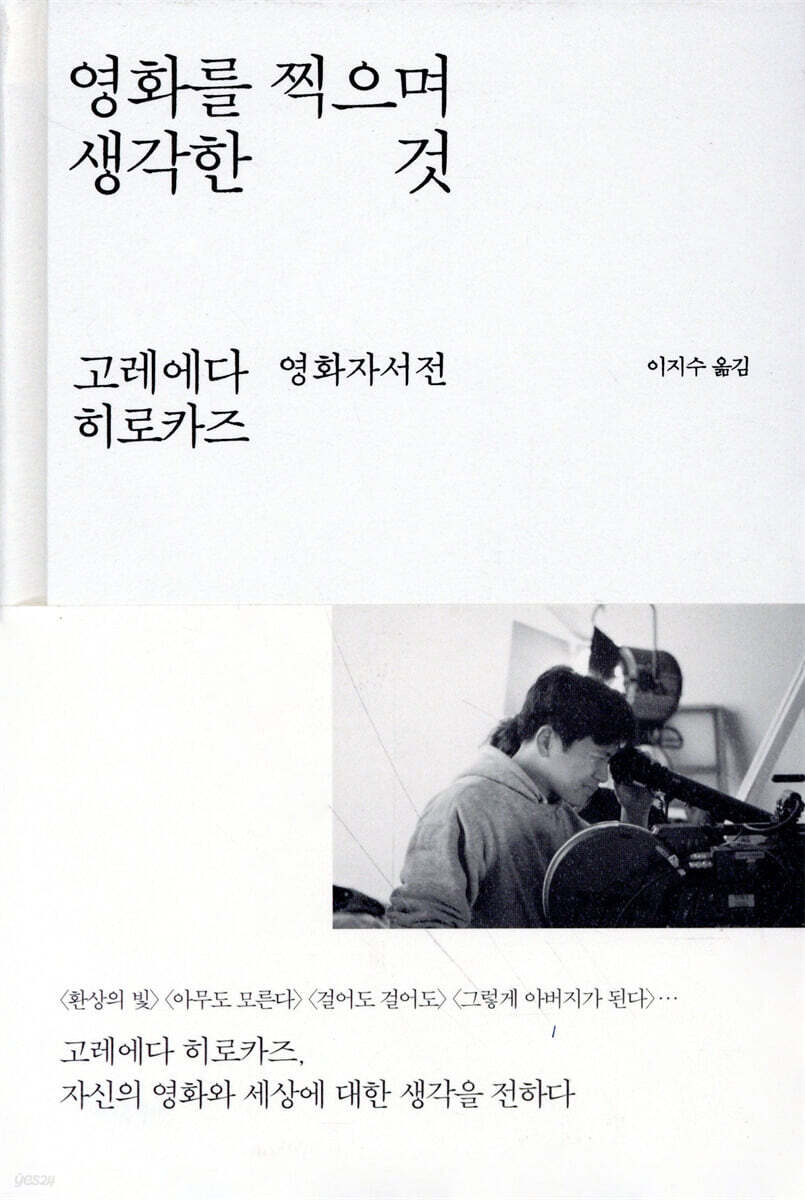
Things I thought about while making the movie
 |
Description
Book Introduction
Hirokazu Koreeda's Film Autobiography
Expressing thoughts on movies, people, and the world
This book provides a comprehensive look at Hirokazu Koreeda as a human being living in this era and as a filmmaker.
Hirokazu Koreeda conveys what he has learned and realized while making films, and the challenges he must overcome as he continues to work, with an honest and candid attitude and voice, as if it were his own films, without any artificial devices.
This book is filled with the secrets of filmmaking revealed by director Hirokazu Koreeda himself, as well as countless episodes surrounding it.
Moreover, his mistakes, regrets, reflections, and efforts to not repeat what he learned as a creator are conveyed with profound emotion.
You can get a glimpse into his attitude toward people and his serious view of the world, not just as a film director, but as a human being.
The book also contains valuable materials selected by director Hirokazu Koreeda, including film stills, storyboards, sketches, notes, screenplay draft covers, and memorable photos.
- You can preview some of the book's contents.
Preview
index
005 A preface like a review
013 Chapter 1 Debut work made with storyboards
Light of Fantasy, 1995
Wonderful Life (1998)
053 Chapter 2 Youth and Frustration
Earth ZIG ZAG 1989
"But…: Into an Era of Abandoning Welfare" (1991)
Another Education: Records of the Spring Class at Ina Elementary School, 1991
095 Chapter 3 Direction and Operation
Supporting an Era of Prosperity? Document: Pichabyeon Village, 1992
"I Wanted to Be Japanese..." 1992
〈Sketch of the Mind: Each Kenji Miyazawa's Own〉, 1993
August Without Him (1994)
The Definition of Documentary, 1995
123 Chapter 4 Neither White nor Black
Distance (2001)
Oblivion, 2005
Hana, 2006
Chapter 5: How to Live Embracing Absence
Nobody Knows (2004)
〈Walk, Walk, Walk〉 2008
"I hope it's okay: Cocco's never-ending journey" (2008)
Air Doll, 2009
265 Chapter 6: Visiting World Film Festivals
293 Chapter 7 Television Theory by Television
"It Might Have Been That Time: What Is 'Me' to Television?" (2008)
All Bad Things Are by Hagimoto Kinichi, 2010
337 Chapter 8: What Television Dramas Can Do and Their Limitations
Later, 2010
Going My Home (2012)
365 Chapter 9 As a Chef
A Miracle That Might Actually Happen (2011)
Like Father, Like Son (2013)
Seaside Village Diary 2015
After the Typhoon Passes (2016)
431 To those who will make a movie in the future, the last chapter
445 reviews
Detailed image

Publisher's Review
Hirokazu Koreeda's Film Autobiography
Expressing thoughts on movies, people, and the world
“The film was flowing leisurely before me, filling its vast river with a hundred years of history.
The river has not dried up, and will probably continue to flow, changing its shape in the future.
Those who spent their youth in the 1980s, when the saying, “All movies have already been made,” was circulated as if it were true, always have the question, “Is what I’m making now really a movie?”
But I wanted to overcome all that 'anxiety' and the sense of solidarity that seemed to be connected by blood, and just become a drop of that river.
“If even a little of the fear and longing I feel through this book can be conveyed to the readers, I believe it will not be meaningless.” - From ‘Preface Like a Postscript’ (p. 7)
Director Hirokazu Koreeda entered the film industry with “Light of Fantasy,” which has been praised as “the most beautiful debut film in the history of cinema,” and has since delivered warm and delicate emotions with each of his works, including “Nobody Knows,” “Still Walking,” “Like Father, Like Son,” and “Our Little Sister.”
"Thoughts While Making Movies" is a book in which he calmly talks about his memories and experiences with the precious people he met while making movies for over 20 years, his perspective on the world, and his thoughts on movies and television documentaries.
In this book, which took eight years from conception to completion, Hirokazu Koreeda meticulously looks back on his previous work.
He revisits 25 films, including not only feature films but also television documentaries that became the foundation of his filmmaking, and tells in great detail about the challenges of capturing the times on film, the unique philosophy and ethics he discovered in the process, the difficulties and crises he faced while making films, and the possibility of finding hope despite them all.
This book faithfully recounts the amazing stories and episodes that filled the gaps in time between his rise to fame and success in the film industry over the past 20 years.
"Thoughts While Making Films" is a book that comprehensively examines Hirokazu Koreeda as a human being living in this era and as a filmmaker.
Hirokazu Koreeda conveys what he has learned and realized while making films, and the challenges he must overcome as he continues to work, with an honest and candid attitude and voice, as if it were his own films, without any artificial devices.
This book is filled with the secrets of filmmaking revealed by director Hirokazu Koreeda himself, as well as countless episodes surrounding it.
Moreover, his mistakes, regrets, reflections, and efforts to not repeat what he learned as a creator are conveyed with profound emotion.
You can get a glimpse into his attitude toward people and his serious view of the world, not just as a film director, but as a human being.
The book also contains valuable materials selected by director Hirokazu Koreeda, including film stills, storyboards, sketches, notes, screenplay draft covers, and memorable photos.
A film director who uses “an irregular language with a touch of television dialect”
Identity as a documentary director
“When I started producing documentary broadcasts, I realized that words like facts, truth, neutrality, and fairness sounded very empty.
Rather, isn't a documentary simply 'presenting one interpretation among various interpretations in one's own way?' - Chapter 3.
In 'Direction and Manipulation' (p. 113)
Director Hirokazu Koreeda founded the television documentary production company TV Man in 1987.
He joined TVMAN UNION and started working as a director.
Before becoming independent in 2014 and forming the production group 'Bunbuku', he worked as a television documentary director and filmmaker at TV Men's Union for 27 years.
Perhaps that is why, rather than seeing himself as a pure filmmaker, he defines himself as a director who uses “an irregular language steeped in television dialect.”
In this way, he is a person whose identity as a television documentary director is more deeply engraved in his body than as a film director.
In "Thoughts While Making Films," Hirokazu Koreeda details his career as a television documentary director.
The eight documentaries he made before his directorial debut with “Light of Fantasy” in 1995 (Earth ZIG ZAG,” “But…: Towards an Era of Abandoning Welfare,” “Another Education: Records of the Spring Class at Ina Elementary School,” “Supporting the Era of Prosperity - Documentary Pichaburi,” “I Wanted to Become Japanese…” “Imagination Sketches: Each Kenji Miyazawa,” “August Without Him,” “Definition of Documentary”) are the beginning of his directing theory.
Hirokazu Koreeda has created documentaries with a critical perspective, exploring various social issues such as the illusion of welfare, alternative education, and the lives of Koreans in Japan.
This book is filled with his constant thoughts and reflections on the difference between 'directing' and 'manipulation', and how to think and judge on set in order to capture something that is 'created' rather than 'recreated'.
Hirokazu Koreeda is skeptical of the stereotype that documentaries must be objective.
Rather, as a documentary director, I consider balance of consciousness important, and I am wary of schemata and preconceptions, focusing on the relationship created between the camera and the subject.
He continues to develop what he has learned and realized while making documentaries in his subsequent films.
What Director Hirokazu Koreeda Thoughts While Making the Movie
From "The Light of Illusion" to "After the Storm," director Hirokazu Koreeda tells fascinating stories of planning, scriptwriting, location scouting, casting and auditions, filming, editing, theater screenings, film festivals, and more, all based on his vivid memory and delicate sensibility.
Director Hirokazu Koreeda's sincerity is evident in his attitude and tenacity in constantly asking himself what film is and what television is, and in his earnest search for answers.
“The Light of Fantasy” is a work that gives the director a lot to reflect on.
(…) The most painful thing of all was that I was tied down to the 300-page storyboard that I had personally worked hard to decide and draw.
If I had realized that I was tied to the storyboard, I could have just thrown it away, but at the time I didn't even know that.
“Everyone around me is a veteran, but I’m the only one on set, so I must have been very anxious.”
-〈Light of Fantasy〉(page 25)
“What I wanted to portray in this film was not criticism, lessons, or suggestions about who is right and who is wrong, how adults should treat children, or how the laws surrounding children should be changed.
Drawing the daily lives of children as if they were really living there.
And quietly watching the scenery from their side.
Listening to their voices.
This makes their speech a dialogue rather than a monologue.
Our image is projected in their eyes.
“This is what I wanted.” - “Nobody Knows” (pp. 189-190)
“I have a standard for what constitutes a home drama.
“I think that in real life, there are overwhelmingly more cases where people say things like, ‘I don’t want to get caught because we’re family,’ or ‘I don’t know because we’re family,’ rather than ‘We can understand each other because we’re family,’ or ‘We can’t say anything because we’re family.’”
-〈Walk, Walk, Walk〉(p. 226)
“At least because I started out as a documentary, I recognize that my work is never born from within myself, but rather from the intersection between myself and the world.” - Air Doll (p. 252)
“When photographing children, I am conscious of respecting them more than I would adults.
Children are also treated as human beings, just like adult actors.
But even so, there are some scenes that need to be filmed without dialogue so that the audience can become aware of the raw emotions they harbor, which is quite difficult.” -〈A Miracle That Might Actually Happen〉 (p. 376)
“If my work resembles Oz’s work, it is not in methodology or subject matter, but in the sense of time.
“I think Westerners find common ground in the Japanese sense of time as a circle, a sense that time, including life, is ‘circular.’”
-〈That's How You Become a Father〉(p. 401)
“I once said, ‘I want to be a craftsman,’ and I was told, ‘Director, please stay as a writer.’
I thought about what the difference is, and if a craftsman is thinking about how to cook delicious seasonal fish to bring out the flavor of the ingredients while also satisfying the guests, then I think a director's job is similar to that." - 〈Seaside Village Diary〉 (p. 415)
“In ‘After the Typhoon’, I poured all the elements of a ‘home drama’ that I could think of.
This film is a product of my 20 years of experience as a director, as well as my love and admiration for the home television dramas I have loved since childhood.
“It is because I realized that my DNA is most deeply ingrained in home dramas, and it is also an expression of pride in carrying on that legacy.” -〈After the Typhoon Passes〉 (p. 426)
Passing on to juniors the same lessons learned from seniors
Director Hirokazu Koreeda's warm film philosophy
“I’m not the type of person who looks back on the past much, but as I look back on the past 20 years while writing this book, I really feel how lucky I have been.
(…) What and how will we film in the next 20 years?
(…) I am seriously thinking about this and am currently writing the script for a new work.” - 'The Last Chapter.
From 'To those who will make movies in the future' (p. 441)
《Thoughts While Making Movies》 is centered around director Hirokazu Koreeda's theories on film and television, but it is also a warm philosophy of life from a man who matured along with his work.
In particular, when he expresses his respect and friendship to the producers, directors, cinematographers, and actors he met while making the film, we once again see the writer's humanity and sensitivity.
Director Hirokazu Koreeda has not only provided generous advice to junior directors to help them make stable debuts, but has also consistently worked to establish a system.
This book also provides strength to future filmmakers by filling the final chapter with helpful advice and encouraging messages.
In a situation where it is difficult to continue making movies, we introduce helpful information such as ways to make movies profitable or circumstances related to subsidies in order to 'continue making movies'.
We also share detailed information about production costs, box office revenue, distribution revenue, etc.
Director Hirokazu Koreeda has participated in over 120 film festivals while making films.
He says that 'film festivals are a place for learning' and provides ample information and guidance to junior directors on how they should prepare for film festivals.
This is probably director Hirokazu Koreeda's best effort to pass on the lessons and friendship he has learned from his seniors while making films to those who will make films in the future.
This book, which contains the warm film philosophy of Hirokazu Koreeda, who dreams of becoming a link in the chain of cinema and connecting with others, will remain as a gentle message to those who love his films and those who will make films in the future.
GOODS SPECIFICS
- Date of publication: November 27, 2017
- Format: Hardcover book binding method guide
- Page count, weight, size: 446 pages | 630g | 138*214*30mm
- ISBN13: 9788955619478
- ISBN10: 8955619472
You may also like
카테고리
korean


korean


