

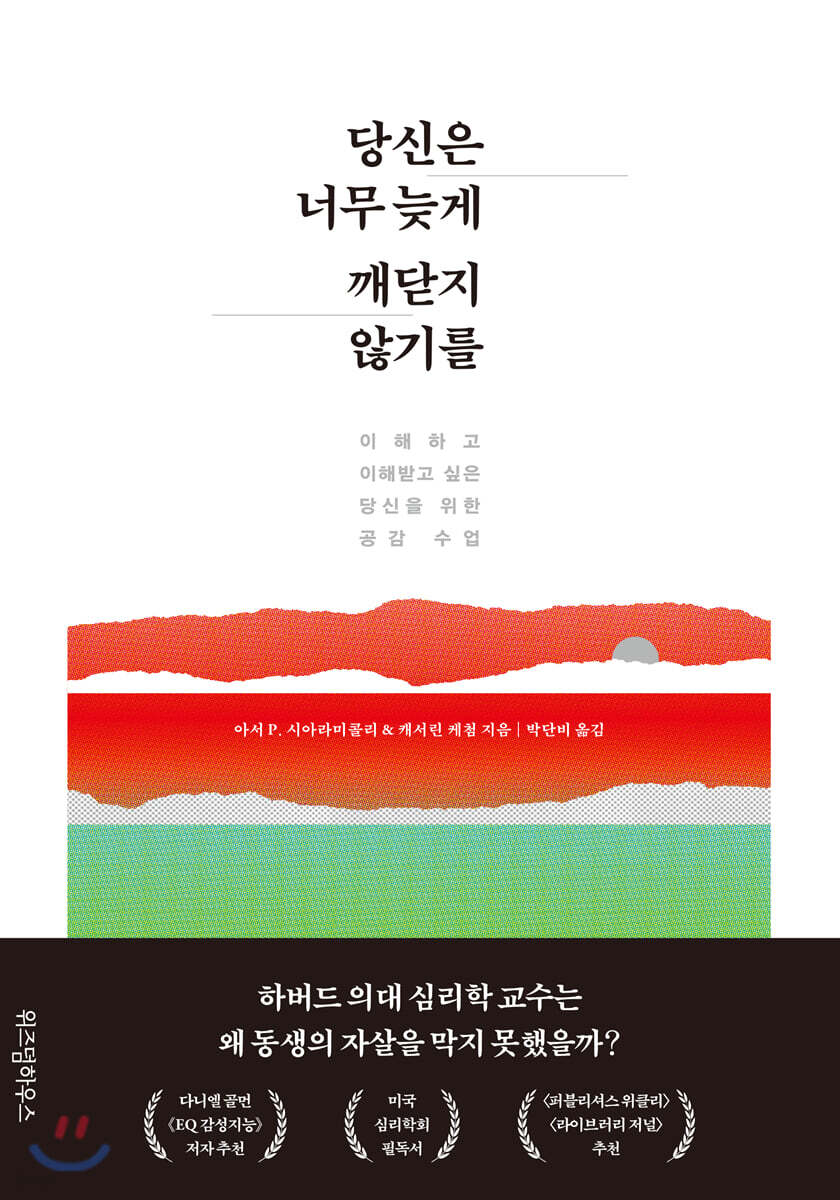
Don't realize it too late
 |
Description
Book Introduction
The result of 25 years of research by a Harvard Medical School professor and world-renowned authority on empathy!
'If I had realized it sooner, my brother wouldn't have died!'
Arthur P.
Dr. Ciaramicoli is a renowned psychologist and professor of clinical psychology at Harvard Medical School who has spent his life studying empathy.
After his brother's suicide, he was overcome with guilt and began to wonder what his brother might need when he was most desperate, and what he realized was his own lack of empathy.
After focusing on empathy research for the next 25 years, the author became a leading global authority on empathy.
This book is filled with his innovative practices and human reflections as he explores ways to heal suffering and soothe the soul, hoping that others will not have to realize it too late as he did.
'If I had realized it sooner, my brother wouldn't have died!'
Arthur P.
Dr. Ciaramicoli is a renowned psychologist and professor of clinical psychology at Harvard Medical School who has spent his life studying empathy.
After his brother's suicide, he was overcome with guilt and began to wonder what his brother might need when he was most desperate, and what he realized was his own lack of empathy.
After focusing on empathy research for the next 25 years, the author became a leading global authority on empathy.
This book is filled with his innovative practices and human reflections as he explores ways to heal suffering and soothe the soul, hoping that others will not have to realize it too late as he did.
- You can preview some of the book's contents.
Preview
index
Entering
Part 1: What We Didn't Know About Empathy
Chapter 1: The Paradox of Empathy: Empathy Has Two Sides
Chapter 2: David's Story: It All Began with Him
Chapter 3: Innate Empathy: The Seeds of Empathy Within Everyone
Chapter 4: Expressing Empathy: Seven Steps to Showing Empathy
Chapter 5: Empathic Listening: Listening to Others' Unique Experiences
Chapter 6: Empathy and Love: Idealization, Extremization, and Integration
Chapter 7: The Dark Side of Empathy: How to Protect Yourself from Destructive Empathy
Part 2: Eight Keyword Guides to Developing Empathy
Chapter 8: Honesty: Accurately Recognizing Myself and Others
Chapter 9: Humility: Realizing That You Are Part of a Deeper, Wider World
Chapter 10: Tolerance: Understanding Contradiction and Complexity
Chapter 11: Tolerance: Focusing on Commonalities, Not Differences
Chapter 12: Gratitude: Recognizing the Gifts Life Has Given
Chapter 13: Faith: Doubting with an Open Mind
Chapter 14_ Hope: Believe that you will somehow find a way
Chapter 15: Forgiveness: Seeing the Past with an Expanded Perspective
Going out
Acknowledgements
References
Part 1: What We Didn't Know About Empathy
Chapter 1: The Paradox of Empathy: Empathy Has Two Sides
Chapter 2: David's Story: It All Began with Him
Chapter 3: Innate Empathy: The Seeds of Empathy Within Everyone
Chapter 4: Expressing Empathy: Seven Steps to Showing Empathy
Chapter 5: Empathic Listening: Listening to Others' Unique Experiences
Chapter 6: Empathy and Love: Idealization, Extremization, and Integration
Chapter 7: The Dark Side of Empathy: How to Protect Yourself from Destructive Empathy
Part 2: Eight Keyword Guides to Developing Empathy
Chapter 8: Honesty: Accurately Recognizing Myself and Others
Chapter 9: Humility: Realizing That You Are Part of a Deeper, Wider World
Chapter 10: Tolerance: Understanding Contradiction and Complexity
Chapter 11: Tolerance: Focusing on Commonalities, Not Differences
Chapter 12: Gratitude: Recognizing the Gifts Life Has Given
Chapter 13: Faith: Doubting with an Open Mind
Chapter 14_ Hope: Believe that you will somehow find a way
Chapter 15: Forgiveness: Seeing the Past with an Expanded Perspective
Going out
Acknowledgements
References
Detailed image
Into the book
As a clinician, I work with a diverse range of people struggling and struggling to find a way out of despair.
But the biggest reason I am qualified to write about empathy is because, like everyone else, I am a person who struggles and worries while trying to find the answer.
The most meaningful way to connect with others is to tell your story.
Because that's what we do in genuine relationships.
By telling stories and listening to them, we take the time to discover meaning and common threads within them.
These will give us direction and goals to pursue, and will shine a light in the darkness to reveal the path ahead.
I have discovered one absolute truth in my work and life.
Empathy is the light that illuminates the darkness of pain and fear, revealing the common ground we share as fellow human beings.
--- p.7
Empathy, used constructively for good, restores relationships and bridges deep, long-standing chasms between people.
Through my interactions with hundreds of patients, I have witnessed the power of empathy to build bridges of understanding.
I was amazed to see how empathy could unleash its power to relieve tension and simultaneously lead us to a deeper understanding of ourselves.
I now believe without a doubt that empathy, more than any other human ability, is the key to forming loving relationships and the antidote to the loneliness, fear, anxiety, and despair that plague so many lives.
Empathy is the bridge that spans the valley that divides us.
By empathy as our guide, we can expand our boundaries, enter unexplored territories, and open up horizons for deep and heartfelt relationships.
By expanding our self, we can instill vibrant energy and a sense of purpose into our inner lives.
You can also reach out to others and engage them in some of life's most meaningful experiences: gratitude, humility, patience, forgiveness, compassion, and love.
--- p.29
The reason I fell in love with him was, of course, because I wanted to save my younger brother.
I want to believe that if I could talk to David now, I could save him.
During the months when everyone was wondering what to do for David as his despair deepened and his drugs torn him apart, I could have taken action without delay.
I would call my brother every day, travel thousands of kilometers to see him, and tell him that I believed in him, that I loved him, and that nothing could stop me from helping him.
Another reason I'm drawn to empathy is because I hope it will help people avoid repeating my mistakes and avoid suffering similar to what my family endured.
And the last reason is to save me.
Empathy has healed me, taught me forgiveness, and given me renewed hope in life by forming and maintaining new relationships.
Empathy reminds me every day that my life has meaning, purpose, and direction.
--- p.47~48
Listening actually seems like an easy thing to do.
Wouldn't it be better to just stop talking and focus on what the other person is saying? But of all the empathy skills, listening requires the most intense concentration and attention.
Because there are so many things that can distract our attention.
Many people listen with one ear while the other person speaks, preparing what to say when it is their turn.
We listen to stories with bias and make judgments before we hear the whole story.
After empathizing with the other person's story and connecting everything you heard to your own personal experiences, you say things like, "I understand exactly what you mean" or "I know how you feel right now," without respecting the uniqueness of the other person's feelings and thoughts.
And eventually, we end up losing our attention to the noise of our own inner voice, judging and guessing.
Empathic listening involves giving up your egocentric perspective to fully engage with the other person's experience.
It is about focusing your attention not only on what the other person is saying, but also on their gestures, overall attitude, posture, and facial expressions.
When we listen with empathy, we make a conscious effort to let go of our own biases, avoid getting caught up in others' emotions, and learn to connect with them without getting too close or too far away.
We also learn to live with ambiguity and realize that we cannot have answers or solutions to every problem.
--- p.125
As children grow and realize that no matter how hard they try, they can't achieve everything or be the best in everything, empathy helps them understand their limitations and cope with the realistic disappointments that come with them.
Children who grow up surrounded by empathy can develop an inner voice of comfort.
A voice that assures us that we are still worthy of love even if we don't hit a home run to win the game or come in first in the popularity polls.
Conversely, children who grow up in an environment that lacks or lacks empathy are often told, 'You are enough.
You will develop a harsh inner voice that constantly repeats the message, 'You didn't do your best.'
This voice often leads children to self-destructive conclusions about their own shortcomings and, inevitably, that they are not good enough.
--- p.177
Popular radio host Paul Harvey recently told an anecdote about an elderly woman he saw at the grocery store checkout line.
She turned to the middle-aged man standing behind her and said that he looked very much like her son.
“Our son recently passed away,” the man said in condolences.
The old man hesitates for a moment and then asks if he can ask you to say goodbye as he leaves the store.
“Could you please shout, ‘Goodbye, Mom!’ in a loud, clear voice? I just want to hear it one last time,” she explained.
The man, moved by the old man's affectionate smile, decided to do so.
As she walked toward the exit and turned to face him, the man called out, “Goodbye, Mom!”
She waved and smiled brightly before leaving the store.
The man made small talk with the checkout clerk while she counted groceries like bread, cheese, milk, and cat food.
“It’s $126 total,” the clerk said cheerfully.
“I think there’s something wrong with the calculations,” the man said, still reeling from the pleasant sensations he’d felt from meeting the older woman.
“I only have one thing to pay for, this basket.”
“Didn’t he say anything?” asked the clerk.
“Who are you? And what do you mean?” the man answered, bewildered.
“Oh, my God, Mother.
“I heard your son will pay the bill.”
The man who had no doubts learned a very valuable and precious lesson about empathy.
The dark side of empathy sneaks up on you when you least expect it, and is spread by people who seem kind, caring, and considerate.
--- p.220~221
One of the difficult challenges we face in everyday life is learning to 'tolerate' each other.
It is clear that we 'need' each other.
In fact, there are dozens of psychological studies that clearly demonstrate that our physical and emotional health depends on loving, strong relationships.
Psychologists, neurologists, immunologists, and philosophers all seem to agree that there is a biological basis for our need for close, affectionate relationships.
I believe that our fundamental desire to connect with others is driven by empathy.
Empathy allows us to communicate and understand each other, and most importantly, it helps us learn to live together for our mental and physical health.
We are tolerant because we can empathize with each other.
--- p.341
If I had known the power of empathy back then, as I do now, would I have been able to save my brother? I think so.
If that had been the case, I could have directly asked David about his suicidal impulses when I spoke to him in Amsterdam the day I heard him say he would rather die than go to jail.
By asking, "Are you thinking about harming yourself? How far along are you?", you could gauge how vulnerable your brother is and how likely he is to harm himself.
When David told me he loved me, I could have told my brother that I loved him too, and I would have paid more attention to what he was saying than what I was saying.
I would have been empathetic to my brother instead of letting my emotions dictate my actions by making assumptions and guesses on my own.
How could I have lived knowing that these words and actions could have saved David's life? My only answer is that I lived with the knowledge.
I understand who I was and where I was in life at that time.
I also know that I did everything I could based on the knowledge and experience I had at the time.
Our parents also did their best.
And David… …David did his best in his own way.
--- p.423~424
This is how empathy works.
Not suddenly and loudly, but gradually, like the sun rising from a distant mountain, it brings enlightenment and spreads warmth contained in understanding and insight.
Empathy shines its light on our deepest needs and never lets us forget that our survival depends on understanding and responding sensitively to one another.
Empathy is our common language, giving voice to the deepest longings of our hearts and articulating the soul's anguished questions.
Through thoughtful action and communication, empathy becomes the invisible thread that connects human beings to human beings, neighbors to villages, communities to countries, and nations to the planet.
The world becomes a friendlier place through the connections created by empathy.
A sense of belonging replaces loneliness, strangers seem less strange, the need for defensiveness diminishes, and hope replaces despair.
Doubt gives way to faith, resentment fades, and our hearts, once closed by fear and pain, open again to the possibility of forgiveness.
This is the power and promise of empathy.
But the biggest reason I am qualified to write about empathy is because, like everyone else, I am a person who struggles and worries while trying to find the answer.
The most meaningful way to connect with others is to tell your story.
Because that's what we do in genuine relationships.
By telling stories and listening to them, we take the time to discover meaning and common threads within them.
These will give us direction and goals to pursue, and will shine a light in the darkness to reveal the path ahead.
I have discovered one absolute truth in my work and life.
Empathy is the light that illuminates the darkness of pain and fear, revealing the common ground we share as fellow human beings.
--- p.7
Empathy, used constructively for good, restores relationships and bridges deep, long-standing chasms between people.
Through my interactions with hundreds of patients, I have witnessed the power of empathy to build bridges of understanding.
I was amazed to see how empathy could unleash its power to relieve tension and simultaneously lead us to a deeper understanding of ourselves.
I now believe without a doubt that empathy, more than any other human ability, is the key to forming loving relationships and the antidote to the loneliness, fear, anxiety, and despair that plague so many lives.
Empathy is the bridge that spans the valley that divides us.
By empathy as our guide, we can expand our boundaries, enter unexplored territories, and open up horizons for deep and heartfelt relationships.
By expanding our self, we can instill vibrant energy and a sense of purpose into our inner lives.
You can also reach out to others and engage them in some of life's most meaningful experiences: gratitude, humility, patience, forgiveness, compassion, and love.
--- p.29
The reason I fell in love with him was, of course, because I wanted to save my younger brother.
I want to believe that if I could talk to David now, I could save him.
During the months when everyone was wondering what to do for David as his despair deepened and his drugs torn him apart, I could have taken action without delay.
I would call my brother every day, travel thousands of kilometers to see him, and tell him that I believed in him, that I loved him, and that nothing could stop me from helping him.
Another reason I'm drawn to empathy is because I hope it will help people avoid repeating my mistakes and avoid suffering similar to what my family endured.
And the last reason is to save me.
Empathy has healed me, taught me forgiveness, and given me renewed hope in life by forming and maintaining new relationships.
Empathy reminds me every day that my life has meaning, purpose, and direction.
--- p.47~48
Listening actually seems like an easy thing to do.
Wouldn't it be better to just stop talking and focus on what the other person is saying? But of all the empathy skills, listening requires the most intense concentration and attention.
Because there are so many things that can distract our attention.
Many people listen with one ear while the other person speaks, preparing what to say when it is their turn.
We listen to stories with bias and make judgments before we hear the whole story.
After empathizing with the other person's story and connecting everything you heard to your own personal experiences, you say things like, "I understand exactly what you mean" or "I know how you feel right now," without respecting the uniqueness of the other person's feelings and thoughts.
And eventually, we end up losing our attention to the noise of our own inner voice, judging and guessing.
Empathic listening involves giving up your egocentric perspective to fully engage with the other person's experience.
It is about focusing your attention not only on what the other person is saying, but also on their gestures, overall attitude, posture, and facial expressions.
When we listen with empathy, we make a conscious effort to let go of our own biases, avoid getting caught up in others' emotions, and learn to connect with them without getting too close or too far away.
We also learn to live with ambiguity and realize that we cannot have answers or solutions to every problem.
--- p.125
As children grow and realize that no matter how hard they try, they can't achieve everything or be the best in everything, empathy helps them understand their limitations and cope with the realistic disappointments that come with them.
Children who grow up surrounded by empathy can develop an inner voice of comfort.
A voice that assures us that we are still worthy of love even if we don't hit a home run to win the game or come in first in the popularity polls.
Conversely, children who grow up in an environment that lacks or lacks empathy are often told, 'You are enough.
You will develop a harsh inner voice that constantly repeats the message, 'You didn't do your best.'
This voice often leads children to self-destructive conclusions about their own shortcomings and, inevitably, that they are not good enough.
--- p.177
Popular radio host Paul Harvey recently told an anecdote about an elderly woman he saw at the grocery store checkout line.
She turned to the middle-aged man standing behind her and said that he looked very much like her son.
“Our son recently passed away,” the man said in condolences.
The old man hesitates for a moment and then asks if he can ask you to say goodbye as he leaves the store.
“Could you please shout, ‘Goodbye, Mom!’ in a loud, clear voice? I just want to hear it one last time,” she explained.
The man, moved by the old man's affectionate smile, decided to do so.
As she walked toward the exit and turned to face him, the man called out, “Goodbye, Mom!”
She waved and smiled brightly before leaving the store.
The man made small talk with the checkout clerk while she counted groceries like bread, cheese, milk, and cat food.
“It’s $126 total,” the clerk said cheerfully.
“I think there’s something wrong with the calculations,” the man said, still reeling from the pleasant sensations he’d felt from meeting the older woman.
“I only have one thing to pay for, this basket.”
“Didn’t he say anything?” asked the clerk.
“Who are you? And what do you mean?” the man answered, bewildered.
“Oh, my God, Mother.
“I heard your son will pay the bill.”
The man who had no doubts learned a very valuable and precious lesson about empathy.
The dark side of empathy sneaks up on you when you least expect it, and is spread by people who seem kind, caring, and considerate.
--- p.220~221
One of the difficult challenges we face in everyday life is learning to 'tolerate' each other.
It is clear that we 'need' each other.
In fact, there are dozens of psychological studies that clearly demonstrate that our physical and emotional health depends on loving, strong relationships.
Psychologists, neurologists, immunologists, and philosophers all seem to agree that there is a biological basis for our need for close, affectionate relationships.
I believe that our fundamental desire to connect with others is driven by empathy.
Empathy allows us to communicate and understand each other, and most importantly, it helps us learn to live together for our mental and physical health.
We are tolerant because we can empathize with each other.
--- p.341
If I had known the power of empathy back then, as I do now, would I have been able to save my brother? I think so.
If that had been the case, I could have directly asked David about his suicidal impulses when I spoke to him in Amsterdam the day I heard him say he would rather die than go to jail.
By asking, "Are you thinking about harming yourself? How far along are you?", you could gauge how vulnerable your brother is and how likely he is to harm himself.
When David told me he loved me, I could have told my brother that I loved him too, and I would have paid more attention to what he was saying than what I was saying.
I would have been empathetic to my brother instead of letting my emotions dictate my actions by making assumptions and guesses on my own.
How could I have lived knowing that these words and actions could have saved David's life? My only answer is that I lived with the knowledge.
I understand who I was and where I was in life at that time.
I also know that I did everything I could based on the knowledge and experience I had at the time.
Our parents also did their best.
And David… …David did his best in his own way.
--- p.423~424
This is how empathy works.
Not suddenly and loudly, but gradually, like the sun rising from a distant mountain, it brings enlightenment and spreads warmth contained in understanding and insight.
Empathy shines its light on our deepest needs and never lets us forget that our survival depends on understanding and responding sensitively to one another.
Empathy is our common language, giving voice to the deepest longings of our hearts and articulating the soul's anguished questions.
Through thoughtful action and communication, empathy becomes the invisible thread that connects human beings to human beings, neighbors to villages, communities to countries, and nations to the planet.
The world becomes a friendlier place through the connections created by empathy.
A sense of belonging replaces loneliness, strangers seem less strange, the need for defensiveness diminishes, and hope replaces despair.
Doubt gives way to faith, resentment fades, and our hearts, once closed by fear and pain, open again to the possibility of forgiveness.
This is the power and promise of empathy.
--- p.444~445
Publisher's Review
★★★★★ American Psychological Association's Must-Read
★★★★★ Highly recommended by Daniel Goleman, "Emotional Intelligence."
The best psychology book to boost your mental immunity, written by a Harvard Medical School psychology professor!
“Empathy is the antidote to the loneliness, fear, anxiety, and despair that plague so many lives!”
In a world where we meet face-to-face less and less, we still want to reach each other's hearts!
Empathy classes for those seeking the right emotional distance
'A zookeeper happened to witness an injured sparrow accidentally landing in a chimpanzee enclosure.
One of the chimpanzees in our enclosure quickly grabbed a small bird in his hand.
However, contrary to the zookeeper's expectations, the chimpanzee did not harm the bird or swallow it as an afternoon snack.
The chimpanzee cupped his hands together, carefully holding the bird, and looked at it with rapt attention.
The other chimpanzees gathered around, and the sparrow was passed from hand to hand with great care.
When it was finally the last chimpanzee's turn, he walked over to the cage and handed the bird to the dumbfounded keeper.
Did the chimpanzees realize the baby bird was in distress? And did their understanding spark their empathetic reactions and the desire to help? Nothing touches our hearts more than witnessing another's despair.
We may pass by hundreds of people a day and yet not pay any attention to their state of mind.
But when we see someone in pain, whether a friend or a stranger, we feel a powerful urge to respond.
This desire is the empathy instinct that we all have.
Arthur P., a clinical psychology professor at Harvard Medical School and a lifelong researcher on empathy,
Dr. Ciaramicoli says that all living beings need empathy.
Without empathy, we would have no way to understand one another, nor would we be able to expect support, encouragement, kindness, and affection from others.
Additionally, without the ability to understand the thoughts and feelings of others, it becomes impossible to read their intentions.
Because of this, they will either regard everyone they meet for the first time as enemies or feel no interest in them, and will even treat their friends and family with indifference.
Even when we see the suffering and despair of others, we fail to understand that their feelings can influence our own emotions and thoughts, and we cannot know that their fates are inextricably intertwined with our own, so we will turn our backs and walk away without even trying to help.
Through 35 years of counseling and meeting hundreds of patients, the author has realized that empathy is a skill that can be learned and developed through relationships with others.
But simply feeling empathy is not enough.
If we are to change, grow, and become our true selves, we must learn how to express empathy within our relationships.
★★★★★ “A thoughtful reflection on how empathy can be used to deepen our relationships!” (Library Journal)
Why didn't a Harvard Medical School psychology professor prevent his brother's suicide?
The power of empathy to comfort a hurting soul, realized after the death of my brother.
This book is written by Arthur P.
It begins with the death of Dr. Ciaramicoli's brother David.
The author studied psychology in his youth and thought he knew a lot about other people's minds.
So when his younger brother David was wanted for drugs and crime and fled to Amsterdam, he understood his brother's feelings and advised him to try to find the right direction in life.
But after several phone calls, what came back was my brother's cold body.
"When my brother despaired, why couldn't I recognize the signs of death like other good doctors?" "What could I have said to comfort him? What advice would have been effective? What words or actions could have made him feel understood, accepted, and loved?" The author's questions and anguish led to his research on empathy, the art of understanding despair and suffering and comforting ailing souls.
And this book was written with the hope that others will not realize it too late and regret it like I did.
Empathy, the power to connect the world beyond ourselves and others.
Add depth to your relationships with empathy!
According to "Don't Be Too Late to Realize," empathy doesn't label our thoughts and feelings as "good" or "bad," but rather weaves together everything we feel, allowing it to evolve with each new experience and realization.
Empathy gives us the insight and information we need, allows us to understand the needs of others, and deepens our relationships by sharing their sorrows and joys.
But there are cases where this power of empathy is abused.
They are 'selling' the power of empathy, such as selling expensive health supplements to the elderly using prizes as bait, getting them to sign up for insurance with unnecessary coverage, or taking consolation money when they think they are trying to help in times of need.
To avoid this situation, we need to know more about empathy.
The more we understand empathy, the more we can detect danger and see into the hearts and minds of those who seek to deceive, exploit, and harm us.
In fact, we have unconsciously used empathy and sympathy when we are with and comfort the people around us.
So what's the difference between empathy and sympathy? Sympathy is understanding someone from your own perspective, while empathy is understanding someone else's situation from a different perspective.
Sympathy feels sorry for you, but empathy understands your feelings.
Sympathy offers many opinions and comments, but empathy only listens.
This book will not only help you clearly distinguish between empathy and sympathy, but also help you realize the power of empathy to connect you with others and the world, and learn how to make that power your own.
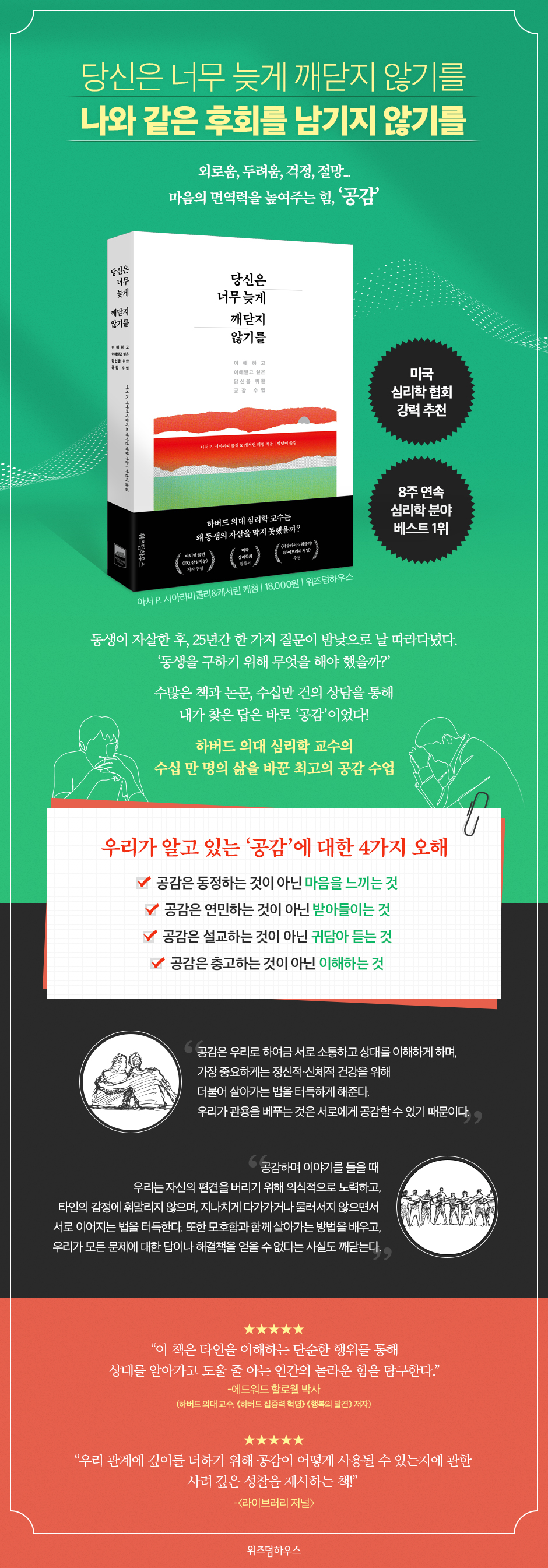
“Empathy is not sympathy, but feeling the other person’s heart.
Empathy is not about pitying, but about identifying and accepting the other person's emotional response.
Empathy is not about preaching, it's about being interested in the other person and listening.
Empathy is not about giving advice, but about understanding the other person as best you can.”
★★★★★ Highly recommended by Daniel Goleman, "Emotional Intelligence."
The best psychology book to boost your mental immunity, written by a Harvard Medical School psychology professor!
“Empathy is the antidote to the loneliness, fear, anxiety, and despair that plague so many lives!”
In a world where we meet face-to-face less and less, we still want to reach each other's hearts!
Empathy classes for those seeking the right emotional distance
'A zookeeper happened to witness an injured sparrow accidentally landing in a chimpanzee enclosure.
One of the chimpanzees in our enclosure quickly grabbed a small bird in his hand.
However, contrary to the zookeeper's expectations, the chimpanzee did not harm the bird or swallow it as an afternoon snack.
The chimpanzee cupped his hands together, carefully holding the bird, and looked at it with rapt attention.
The other chimpanzees gathered around, and the sparrow was passed from hand to hand with great care.
When it was finally the last chimpanzee's turn, he walked over to the cage and handed the bird to the dumbfounded keeper.
Did the chimpanzees realize the baby bird was in distress? And did their understanding spark their empathetic reactions and the desire to help? Nothing touches our hearts more than witnessing another's despair.
We may pass by hundreds of people a day and yet not pay any attention to their state of mind.
But when we see someone in pain, whether a friend or a stranger, we feel a powerful urge to respond.
This desire is the empathy instinct that we all have.
Arthur P., a clinical psychology professor at Harvard Medical School and a lifelong researcher on empathy,
Dr. Ciaramicoli says that all living beings need empathy.
Without empathy, we would have no way to understand one another, nor would we be able to expect support, encouragement, kindness, and affection from others.
Additionally, without the ability to understand the thoughts and feelings of others, it becomes impossible to read their intentions.
Because of this, they will either regard everyone they meet for the first time as enemies or feel no interest in them, and will even treat their friends and family with indifference.
Even when we see the suffering and despair of others, we fail to understand that their feelings can influence our own emotions and thoughts, and we cannot know that their fates are inextricably intertwined with our own, so we will turn our backs and walk away without even trying to help.
Through 35 years of counseling and meeting hundreds of patients, the author has realized that empathy is a skill that can be learned and developed through relationships with others.
But simply feeling empathy is not enough.
If we are to change, grow, and become our true selves, we must learn how to express empathy within our relationships.
★★★★★ “A thoughtful reflection on how empathy can be used to deepen our relationships!” (Library Journal)
Why didn't a Harvard Medical School psychology professor prevent his brother's suicide?
The power of empathy to comfort a hurting soul, realized after the death of my brother.
This book is written by Arthur P.
It begins with the death of Dr. Ciaramicoli's brother David.
The author studied psychology in his youth and thought he knew a lot about other people's minds.
So when his younger brother David was wanted for drugs and crime and fled to Amsterdam, he understood his brother's feelings and advised him to try to find the right direction in life.
But after several phone calls, what came back was my brother's cold body.
"When my brother despaired, why couldn't I recognize the signs of death like other good doctors?" "What could I have said to comfort him? What advice would have been effective? What words or actions could have made him feel understood, accepted, and loved?" The author's questions and anguish led to his research on empathy, the art of understanding despair and suffering and comforting ailing souls.
And this book was written with the hope that others will not realize it too late and regret it like I did.
Empathy, the power to connect the world beyond ourselves and others.
Add depth to your relationships with empathy!
According to "Don't Be Too Late to Realize," empathy doesn't label our thoughts and feelings as "good" or "bad," but rather weaves together everything we feel, allowing it to evolve with each new experience and realization.
Empathy gives us the insight and information we need, allows us to understand the needs of others, and deepens our relationships by sharing their sorrows and joys.
But there are cases where this power of empathy is abused.
They are 'selling' the power of empathy, such as selling expensive health supplements to the elderly using prizes as bait, getting them to sign up for insurance with unnecessary coverage, or taking consolation money when they think they are trying to help in times of need.
To avoid this situation, we need to know more about empathy.
The more we understand empathy, the more we can detect danger and see into the hearts and minds of those who seek to deceive, exploit, and harm us.
In fact, we have unconsciously used empathy and sympathy when we are with and comfort the people around us.
So what's the difference between empathy and sympathy? Sympathy is understanding someone from your own perspective, while empathy is understanding someone else's situation from a different perspective.
Sympathy feels sorry for you, but empathy understands your feelings.
Sympathy offers many opinions and comments, but empathy only listens.
This book will not only help you clearly distinguish between empathy and sympathy, but also help you realize the power of empathy to connect you with others and the world, and learn how to make that power your own.
“Empathy is not sympathy, but feeling the other person’s heart.
Empathy is not about pitying, but about identifying and accepting the other person's emotional response.
Empathy is not about preaching, it's about being interested in the other person and listening.
Empathy is not about giving advice, but about understanding the other person as best you can.”
GOODS SPECIFICS
- Publication date: November 20, 2020
- Page count, weight, size: 460 pages | 618g | 150*214*21mm
- ISBN13: 9791190908825
- ISBN10: 1190908824
You may also like
카테고리
korean


korean

![ELLE 엘르 스페셜 에디션 A형 : 12월 [2025]](http://librairie.coreenne.fr/cdn/shop/files/b8e27a3de6c9538896439686c6b0e8fb.jpg?v=1766436872&width=3840)


