

Psychiatrist's Study
 |
Description
Book Introduction
"If you build your mental muscle, you won't crumble in the face of failure."
Psychiatrist Professor Ha Ji-hyun shares productive reading techniques that will nurture your work and life.
Recommended by poet Oh Eun and writer Jeong Yeo-ul!
Professor Ha Ji-hyeon, a psychiatrist who reads over 100 books a year and a diligent book critic who has been writing book reviews for five years without a break, is revealing her library by publishing a reading essay, “The Psychiatrist’s Library.”
As a doctor and professor, I practice medicine and teach students, so when on earth do I find myself reading? As someone who delves into the human psyche and deals with pain, is there a different approach to reading? How do I organize and document the countless books piling up on my desk? This book is both the author's personal reading journey and his own answer to the question, "Why do I read?"
The author, who says that the reason for reading books is to develop a strong and unshakable self and mental muscles by understanding the world more deeply and broadly through the knowledge and information gained from books, speaks honestly and cheerfully about all the stories about books.
This book contains everything from practical reading methods such as know-how for reading and organizing books, how to choose books, reading books that lead to writing, and books to read by topic, to personal experiences such as memories and love of reading, library pilgrimages, and books that changed one's life, showing another world of intellectual reading driven by the 'joy of knowledge.'
Psychiatrist Professor Ha Ji-hyun shares productive reading techniques that will nurture your work and life.
Recommended by poet Oh Eun and writer Jeong Yeo-ul!
Professor Ha Ji-hyeon, a psychiatrist who reads over 100 books a year and a diligent book critic who has been writing book reviews for five years without a break, is revealing her library by publishing a reading essay, “The Psychiatrist’s Library.”
As a doctor and professor, I practice medicine and teach students, so when on earth do I find myself reading? As someone who delves into the human psyche and deals with pain, is there a different approach to reading? How do I organize and document the countless books piling up on my desk? This book is both the author's personal reading journey and his own answer to the question, "Why do I read?"
The author, who says that the reason for reading books is to develop a strong and unshakable self and mental muscles by understanding the world more deeply and broadly through the knowledge and information gained from books, speaks honestly and cheerfully about all the stories about books.
This book contains everything from practical reading methods such as know-how for reading and organizing books, how to choose books, reading books that lead to writing, and books to read by topic, to personal experiences such as memories and love of reading, library pilgrimages, and books that changed one's life, showing another world of intellectual reading driven by the 'joy of knowledge.'
- You can preview some of the book's contents.
Preview
index
Prologue: Building the Core Muscles of the Mind
Chapter 1: Reading a Psychiatrist's Book
The moment when reading becomes enjoyable│Drawing the boundaries of knowledge│My first memory of reading│Nickname: Oksu-dong
A Library Paradise│King's Cross Station 9 3/4│Discoveries through Active Serendipity│A Psychiatrist's Book Prescription
Chapter 2 Ownership of the Text
When on earth do you read books? │ The 3-Category Rule for Choosing a Book │ Where do we get information about books │ The Standard for Complete Reading │ How to Make a Book Completely Yours │ Increasing Reading Productivity │ Drawing a Year-Round Reading Map │ Hall of Fame
Chapter 3: How I Became a Writer
The Art of Writing Recommendations│The Art of Active Reading│The Bookshelf That Reads the Mind│Living as an Author│People Who Make Books
Chapter 4: Things I learned from reading a lot
Short story collections from the first installment│Imagination in picture books│Things to consider when giving a book as a gift│Guidelines for friendly readers│Imagine the author from the author introduction│Choosing a book to take on a trip│The formula for bestsellers│The unfamiliar experience of reading together
Chapter 5 I would like to recommend this book
If you want to study psychoanalysis│Books about anxiety│To understand depression│Psychiatry also needs reviews│A publisher specializing in psychology books that you can trust and choose│To draw a picture of a decent adult│Balancing work and hobbies│A moment when you need to criticize│The fate of a masterpiece│Books for people who love books│Books of my life
Just keep reading the epilogue
Books read by Ha Ji-hyun
Recommendation
Chapter 1: Reading a Psychiatrist's Book
The moment when reading becomes enjoyable│Drawing the boundaries of knowledge│My first memory of reading│Nickname: Oksu-dong
A Library Paradise│King's Cross Station 9 3/4│Discoveries through Active Serendipity│A Psychiatrist's Book Prescription
Chapter 2 Ownership of the Text
When on earth do you read books? │ The 3-Category Rule for Choosing a Book │ Where do we get information about books │ The Standard for Complete Reading │ How to Make a Book Completely Yours │ Increasing Reading Productivity │ Drawing a Year-Round Reading Map │ Hall of Fame
Chapter 3: How I Became a Writer
The Art of Writing Recommendations│The Art of Active Reading│The Bookshelf That Reads the Mind│Living as an Author│People Who Make Books
Chapter 4: Things I learned from reading a lot
Short story collections from the first installment│Imagination in picture books│Things to consider when giving a book as a gift│Guidelines for friendly readers│Imagine the author from the author introduction│Choosing a book to take on a trip│The formula for bestsellers│The unfamiliar experience of reading together
Chapter 5 I would like to recommend this book
If you want to study psychoanalysis│Books about anxiety│To understand depression│Psychiatry also needs reviews│A publisher specializing in psychology books that you can trust and choose│To draw a picture of a decent adult│Balancing work and hobbies│A moment when you need to criticize│The fate of a masterpiece│Books for people who love books│Books of my life
Just keep reading the epilogue
Books read by Ha Ji-hyun
Recommendation
Detailed image
Into the book
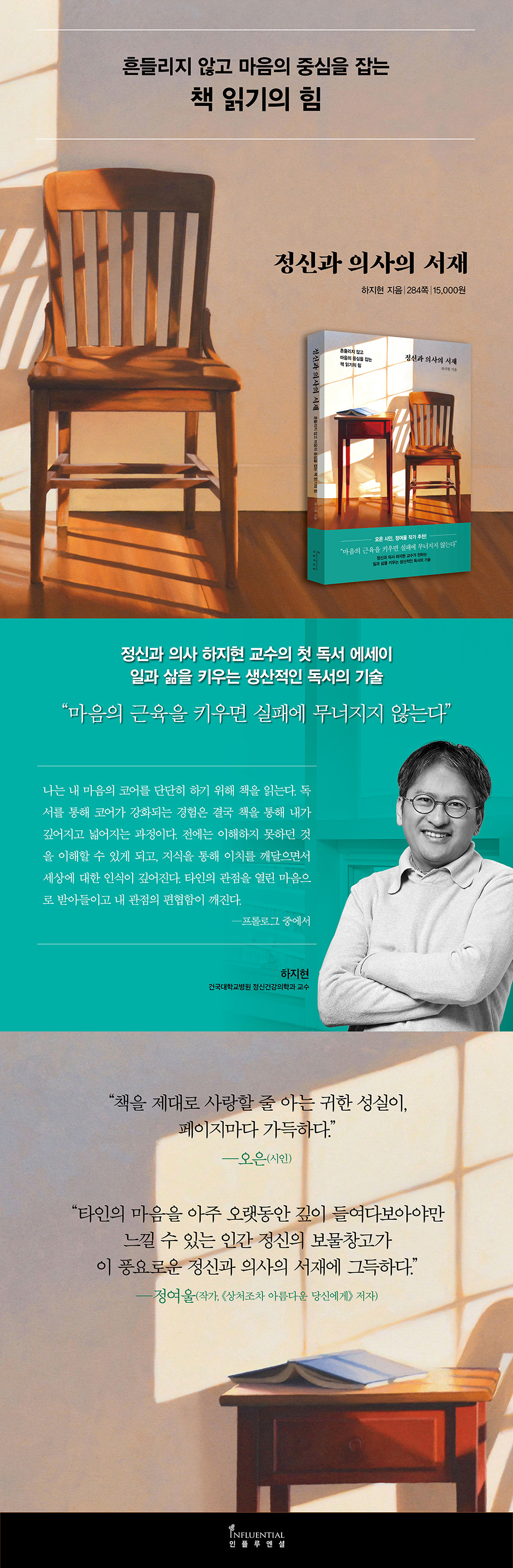
I read books to strengthen the core of my mind.
The experience of strengthening one's core through reading is ultimately a process of deepening and broadening oneself through books.
You will be able to understand things you didn't understand before, and your perception of the world will deepen as you gain insight through knowledge.
Accepting other people's perspectives with an open mind breaks down the narrowness of my own perspective.
You'll find yourself saying less indifferent things like, "What kind of person is that?" or "I don't understand that person," or flat expressions like, "How in the world can something like that happen? I'm so angry and scared."
This is because, through the indirect experience of books, we come to experience that this world is not such a flat and shallow place.
Of course, I won't be able to know everything that surrounds me and control everything that happens.
However, if you understand what kind of person this person is, why he or she crosses the line, and what the context is behind his or her actions, you can treat him or her with much greater generosity.
That becomes the core of my heart.
Many of my beliefs about right and wrong in the world are shattered with surprising ease as I read the book.
I quickly realized how narrow and prejudiced the world is when I only see it through my own eyes.
A broadened field of vision multiplies the way we see the world.
You will learn things you didn't know before and gain eyes that can understand things you can't see.
--- p.10, from "Prologue"
As knowledge accumulates and experience increases, things should become clearer and more visible, but sometimes, on the contrary, they feel more difficult.
It's easy to try to interpret any phenomenon or human behavior, but the more patients you meet and the more in-depth you delve into it, the more difficult it becomes.
There are many things that are difficult to clearly explain and judge easily.
In these areas, you need to know a lot about yourself so that you can clearly say what you don't know, so the only way is to try to learn more.
So, read, think, observe, and judge carefully.
(……)
Saying you don't know doesn't mean you stop.
When you learn something new while reading a book, you finally realize, 'So that's why it was like that.'
--- p.23, from “Drawing the Boundaries of Knowledge”
Above all, the book prescription has the strong advantage of being an indirect solution.
Psychotherapy is a one-on-one interaction between a therapist and a client.
The therapist's interpretation may be difficult for the client to accept.
Even if it is the best personalized prescription for your current situation, it may be a situation that requires confrontation.
However, it may be difficult to fully accept it.
In such cases, it may be better to step aside slightly or place a safe buffer between the therapist and the client.
Books and movies play that role.
In the therapist's mind, what the client needs most comes to mind.
At this time, you can say directly, “○○ is stuck in this area.
Rather than saying, “I’m trying to avoid that kind of thing,” you could suggest, “How about reading a book called XX? Let’s talk about it together after reading it.”
It is also a technique that can have unexpectedly effective results when used in psychotherapy with clients with weak egos or adolescents who have difficulty opening up to the therapist.
--- p.56, from “A Psychiatrist’s Book Prescription”
The knowledge gained while reading books is gathered and lined up on one side.
On the other side, pieces of my life experiences create lines of different colors.
These two meet and weave together to create a new fabric.
It is about gaining new ideas and insights from it.
It is not just about reading, but it is about experiencing the experiences, knowledge, and emotions within me, reacting chemically, and only then does the content become completely mine.
The joy of reading arises at this very point.
What remains in my memory is not the complete form of the book, but the newly woven fabric.
This is why people remember different things even when they read the same book.
--- p.85, from “How to Make a Book Completely Yours”
If you just scatter it around, it's just a pile of unrelated information.
Just as Lego blocks of various colors and shapes are combined into wonderful structures by the hands of a maker, when this information is reconstructed using one's own rules and methods, new results are born.
Writers of the past used note cards, but the analog method has limitations.
A large amount of information without a system is transformed into useful content through Evernote, where I gather information from reading to support my ideas.
The combination of the age-old practice of reading and an app has dramatically increased productivity.
The experience of strengthening one's core through reading is ultimately a process of deepening and broadening oneself through books.
You will be able to understand things you didn't understand before, and your perception of the world will deepen as you gain insight through knowledge.
Accepting other people's perspectives with an open mind breaks down the narrowness of my own perspective.
You'll find yourself saying less indifferent things like, "What kind of person is that?" or "I don't understand that person," or flat expressions like, "How in the world can something like that happen? I'm so angry and scared."
This is because, through the indirect experience of books, we come to experience that this world is not such a flat and shallow place.
Of course, I won't be able to know everything that surrounds me and control everything that happens.
However, if you understand what kind of person this person is, why he or she crosses the line, and what the context is behind his or her actions, you can treat him or her with much greater generosity.
That becomes the core of my heart.
Many of my beliefs about right and wrong in the world are shattered with surprising ease as I read the book.
I quickly realized how narrow and prejudiced the world is when I only see it through my own eyes.
A broadened field of vision multiplies the way we see the world.
You will learn things you didn't know before and gain eyes that can understand things you can't see.
--- p.10, from "Prologue"
As knowledge accumulates and experience increases, things should become clearer and more visible, but sometimes, on the contrary, they feel more difficult.
It's easy to try to interpret any phenomenon or human behavior, but the more patients you meet and the more in-depth you delve into it, the more difficult it becomes.
There are many things that are difficult to clearly explain and judge easily.
In these areas, you need to know a lot about yourself so that you can clearly say what you don't know, so the only way is to try to learn more.
So, read, think, observe, and judge carefully.
(……)
Saying you don't know doesn't mean you stop.
When you learn something new while reading a book, you finally realize, 'So that's why it was like that.'
--- p.23, from “Drawing the Boundaries of Knowledge”
Above all, the book prescription has the strong advantage of being an indirect solution.
Psychotherapy is a one-on-one interaction between a therapist and a client.
The therapist's interpretation may be difficult for the client to accept.
Even if it is the best personalized prescription for your current situation, it may be a situation that requires confrontation.
However, it may be difficult to fully accept it.
In such cases, it may be better to step aside slightly or place a safe buffer between the therapist and the client.
Books and movies play that role.
In the therapist's mind, what the client needs most comes to mind.
At this time, you can say directly, “○○ is stuck in this area.
Rather than saying, “I’m trying to avoid that kind of thing,” you could suggest, “How about reading a book called XX? Let’s talk about it together after reading it.”
It is also a technique that can have unexpectedly effective results when used in psychotherapy with clients with weak egos or adolescents who have difficulty opening up to the therapist.
--- p.56, from “A Psychiatrist’s Book Prescription”
The knowledge gained while reading books is gathered and lined up on one side.
On the other side, pieces of my life experiences create lines of different colors.
These two meet and weave together to create a new fabric.
It is about gaining new ideas and insights from it.
It is not just about reading, but it is about experiencing the experiences, knowledge, and emotions within me, reacting chemically, and only then does the content become completely mine.
The joy of reading arises at this very point.
What remains in my memory is not the complete form of the book, but the newly woven fabric.
This is why people remember different things even when they read the same book.
--- p.85, from “How to Make a Book Completely Yours”
If you just scatter it around, it's just a pile of unrelated information.
Just as Lego blocks of various colors and shapes are combined into wonderful structures by the hands of a maker, when this information is reconstructed using one's own rules and methods, new results are born.
Writers of the past used note cards, but the analog method has limitations.
A large amount of information without a system is transformed into useful content through Evernote, where I gather information from reading to support my ideas.
The combination of the age-old practice of reading and an app has dramatically increased productivity.
--- pp.91~92, from “Increasing Reading Productivity”
Publisher's Review
“I get excited when I come across a book filled with new knowledge.”
A solid storehouse of knowledge that builds the muscles of the mind
Professor Ha Ji-hyun's method of reading books: collecting, maturing, and then using them.
Author Ha Ji-hyun, author of humanities and psychology books such as “Worries Are Worries,” and a psychiatrist who treats and counsels patients, is an avid reader who reads over 100 books a year.
The author, who has been diligently serializing the book review column “The Bookshelf that Reads the Mind” for over five years without a single hiatus, has been reviewing and rating books he has read in various fields, including humanities, psychology, science, and literature, on his personal blog for over ten years, and has shown his sincerity in reading books to the point that no one can object when he writes that “reading is his hobby.”
The new work, "The Psychiatrist's Study," is a collection of reading essays that summarize the author's reading journey, while also being the author's answer to the fundamental question, "Why do we read?"
The reasons for reading books may vary from person to person, but the author prefers reading books to gain knowledge and information and pursue the 'joy of knowledge' rather than reading for empathy and healing.
He says that by gradually accumulating knowledge and information within yourself through books, you can understand the world more deeply and broadly, and develop a strong and unshakable self and mental muscles.
“It’s not like I can know everything that surrounds me and control everything that happens.
However, if you understand what kind of person this person is, why he or she crosses the line, and what the context is behind his or her actions, you can treat him or her with much greater generosity.
“That becomes the core of my heart.” (Prologue, page 10)
Drawing the "Boundaries of Knowledge": Reading as a Professional
He also mentions why reading is important as a professional psychiatrist.
In psychiatric treatment, where symptoms are not easily visible externally, such as broken bones or facial scars, constant judgment and decision-making are required, and at each such time, 'the work of establishing boundaries of knowledge' is required.
“An expert is not someone who knows everything in his field.
The definition of an expert is someone who knows how to say they don't know what they don't know and doesn't pretend to know what they don't know.
In addition to having a solid knowledge of my field, I am also someone who has a clear boundary between 'knowing that I know'.
“I want to be that kind of person.” (Pages 25-26, Building the Boundaries of Knowledge)
Rather than pretending to know unnecessarily, we must make the best judgments and decisions by being clear about what we know and what we don't know.
Of course, a constant interest in and understanding of the world's changes and trends is also essential.
Because the human mind is sensitive to social systems and changes.
A book nerd's serious but light-hearted approach to reading
The author, who reads books breathlessly enough to call himself a 'book nerd,' laments that in the Korean publishing market where 60,000 books are published annually, he can only read 'at most' about 100 books a year, but lightly introduces the secret to reading books like that even in the midst of a busy work life.
His real secret is not to read too seriously or solemnly, but to read the books he wants to read when he wants to read them.
“To the question of when do I read books, I would like to simply answer, ‘Anytime, anywhere.’
There is no set time for reading, and no designated space.
Instead, I place good books to read in the right places to fit my lifestyle.
“It’s about ‘setting’ yourself up so you can read the right book at the right time and place.” (Page 61, When on earth do you read books?)
Because of my reading habits that focus on humanities and psychology, I even created a three-category method for selecting books to avoid getting bored while reading.
There are left brain priority books, right brain priority books, and pleasure center priority books.
“Just as I carefully consider the five major nutrients when purchasing food at the supermarket for the health of my family, I carefully select books by putting them in and taking them out of my bookstore cart,” says the author, who says that although this classification sounds very science-savvy, it is a classification that he created with great care to avoid being biased towards left-brained reading.
“It may be comfortable and fun to read only books about the subject you like, but your brain may become overweight in one area and eventually become damaged.
Just as being picky about food is bad for your health.” (Page 67, The 3-Category Rules for Choosing a Book)
Professor Ha Ji-hyun's method of reading books: collecting, maturing, and then using them.
To truly make a book your own, he advises that you underline and take notes, and that you must always organize your references well.
The author, who uses a writing instrument that feels good in his hand, makes extensive use of Post-it notes, and even takes photos with his smartphone, praised the app Evernote after discovering it, saying, “The combination of the old reading habit and the latest app has dramatically increased my productivity.”
By organizing the vast amount of information you gain from reading books and storing it in a warehouse called Evernote so that you can access it whenever you need it, and by going through the process of converting that knowledge into words after maturing it in your memories and thoughts, you can fully absorb the book you read.
“If you just scatter it around, it’s just a pile of unrelated information.
Just as Lego blocks of various colors and shapes are completed into wonderful structures by the hands of the creator, if you reorganize this information according to your own rules and methods, new results are born.” (Page 91: Increasing Reading Productivity)
In this way, the author honestly and cheerfully shares his thoughts and experiences about reading, personal memories, and books that changed his life, and generously shares his know-how as a reader, from how to make time for reading and efficiently categorize books, to reading books that lead to writing, and practical tips for organizing and recording the contents of books using apps.
In particular, the book curation by author Ha Ji-hyun, included at the end of the book, is a list of books that the author has given 5-star ratings to over 10 years, making it a great gift for readers who love books.
A solid storehouse of knowledge that builds the muscles of the mind
Professor Ha Ji-hyun's method of reading books: collecting, maturing, and then using them.
Author Ha Ji-hyun, author of humanities and psychology books such as “Worries Are Worries,” and a psychiatrist who treats and counsels patients, is an avid reader who reads over 100 books a year.
The author, who has been diligently serializing the book review column “The Bookshelf that Reads the Mind” for over five years without a single hiatus, has been reviewing and rating books he has read in various fields, including humanities, psychology, science, and literature, on his personal blog for over ten years, and has shown his sincerity in reading books to the point that no one can object when he writes that “reading is his hobby.”
The new work, "The Psychiatrist's Study," is a collection of reading essays that summarize the author's reading journey, while also being the author's answer to the fundamental question, "Why do we read?"
The reasons for reading books may vary from person to person, but the author prefers reading books to gain knowledge and information and pursue the 'joy of knowledge' rather than reading for empathy and healing.
He says that by gradually accumulating knowledge and information within yourself through books, you can understand the world more deeply and broadly, and develop a strong and unshakable self and mental muscles.
“It’s not like I can know everything that surrounds me and control everything that happens.
However, if you understand what kind of person this person is, why he or she crosses the line, and what the context is behind his or her actions, you can treat him or her with much greater generosity.
“That becomes the core of my heart.” (Prologue, page 10)
Drawing the "Boundaries of Knowledge": Reading as a Professional
He also mentions why reading is important as a professional psychiatrist.
In psychiatric treatment, where symptoms are not easily visible externally, such as broken bones or facial scars, constant judgment and decision-making are required, and at each such time, 'the work of establishing boundaries of knowledge' is required.
“An expert is not someone who knows everything in his field.
The definition of an expert is someone who knows how to say they don't know what they don't know and doesn't pretend to know what they don't know.
In addition to having a solid knowledge of my field, I am also someone who has a clear boundary between 'knowing that I know'.
“I want to be that kind of person.” (Pages 25-26, Building the Boundaries of Knowledge)
Rather than pretending to know unnecessarily, we must make the best judgments and decisions by being clear about what we know and what we don't know.
Of course, a constant interest in and understanding of the world's changes and trends is also essential.
Because the human mind is sensitive to social systems and changes.
A book nerd's serious but light-hearted approach to reading
The author, who reads books breathlessly enough to call himself a 'book nerd,' laments that in the Korean publishing market where 60,000 books are published annually, he can only read 'at most' about 100 books a year, but lightly introduces the secret to reading books like that even in the midst of a busy work life.
His real secret is not to read too seriously or solemnly, but to read the books he wants to read when he wants to read them.
“To the question of when do I read books, I would like to simply answer, ‘Anytime, anywhere.’
There is no set time for reading, and no designated space.
Instead, I place good books to read in the right places to fit my lifestyle.
“It’s about ‘setting’ yourself up so you can read the right book at the right time and place.” (Page 61, When on earth do you read books?)
Because of my reading habits that focus on humanities and psychology, I even created a three-category method for selecting books to avoid getting bored while reading.
There are left brain priority books, right brain priority books, and pleasure center priority books.
“Just as I carefully consider the five major nutrients when purchasing food at the supermarket for the health of my family, I carefully select books by putting them in and taking them out of my bookstore cart,” says the author, who says that although this classification sounds very science-savvy, it is a classification that he created with great care to avoid being biased towards left-brained reading.
“It may be comfortable and fun to read only books about the subject you like, but your brain may become overweight in one area and eventually become damaged.
Just as being picky about food is bad for your health.” (Page 67, The 3-Category Rules for Choosing a Book)
Professor Ha Ji-hyun's method of reading books: collecting, maturing, and then using them.
To truly make a book your own, he advises that you underline and take notes, and that you must always organize your references well.
The author, who uses a writing instrument that feels good in his hand, makes extensive use of Post-it notes, and even takes photos with his smartphone, praised the app Evernote after discovering it, saying, “The combination of the old reading habit and the latest app has dramatically increased my productivity.”
By organizing the vast amount of information you gain from reading books and storing it in a warehouse called Evernote so that you can access it whenever you need it, and by going through the process of converting that knowledge into words after maturing it in your memories and thoughts, you can fully absorb the book you read.
“If you just scatter it around, it’s just a pile of unrelated information.
Just as Lego blocks of various colors and shapes are completed into wonderful structures by the hands of the creator, if you reorganize this information according to your own rules and methods, new results are born.” (Page 91: Increasing Reading Productivity)
In this way, the author honestly and cheerfully shares his thoughts and experiences about reading, personal memories, and books that changed his life, and generously shares his know-how as a reader, from how to make time for reading and efficiently categorize books, to reading books that lead to writing, and practical tips for organizing and recording the contents of books using apps.
In particular, the book curation by author Ha Ji-hyun, included at the end of the book, is a list of books that the author has given 5-star ratings to over 10 years, making it a great gift for readers who love books.
GOODS SPECIFICS
- Publication date: November 16, 2020
- Page count, weight, size: 284 pages | 448g | 140*210*16mm
- ISBN13: 9791191056297
- ISBN10: 1191056295
You may also like
카테고리
korean


korean

![GQ KOREA Mark (Monthly): December [2025]](http://librairie.coreenne.fr/cdn/shop/files/8ef265dbbfbf186523ed75ba7319009d.jpg?v=1765340328&width=3840)


