

How's the apartment?
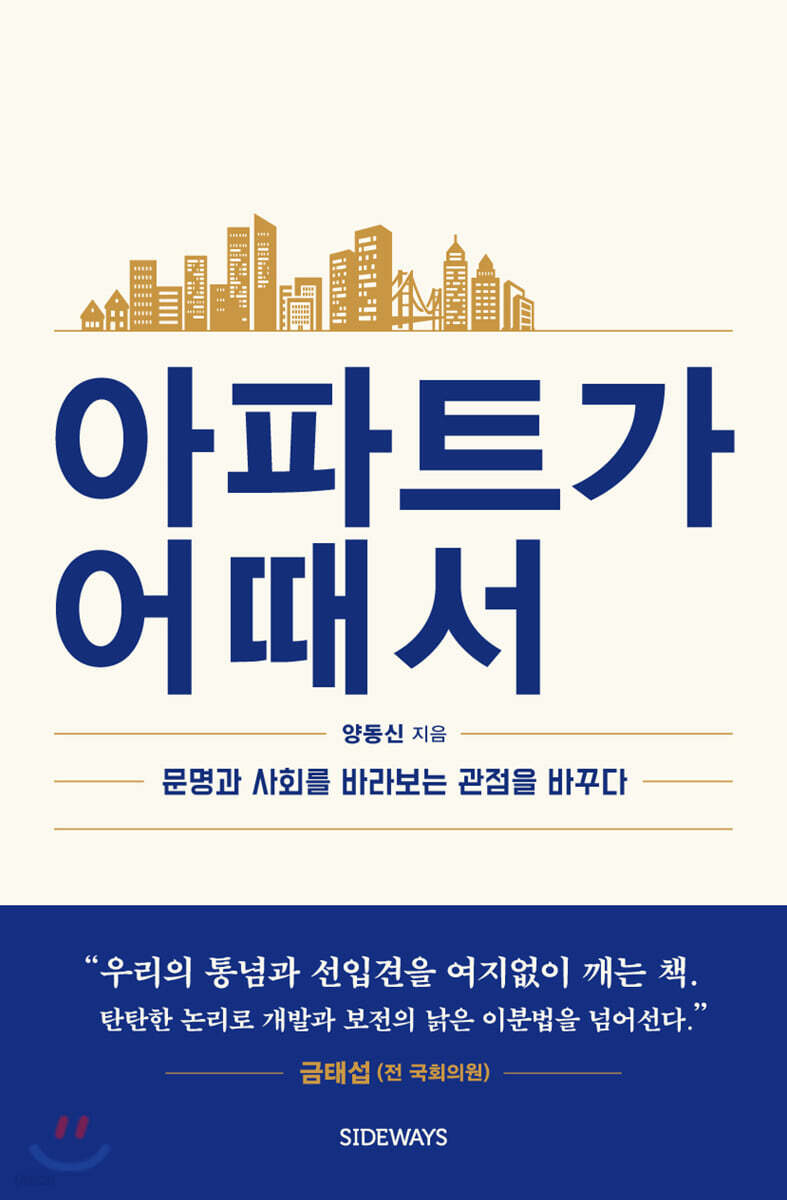 |
Description
Book Introduction
- A word from MD
-
Talking about sustainable constructionThe river must be allowed to flow.
Tunnels should not be dug to build roads and railways.
Rural areas are more environmentally friendly than big cities, and single-family homes are more environmentally friendly than apartments.
If you've been thinking this way, you absolutely must open this book.
It is time to move beyond the dichotomy of development versus preservation and consider sustainable construction.
November 13, 2020. Humanities PD Son Min-gyu
“After reading this book, you will see how cities work in a completely different way.”
Reveal the secrets of the space you live in
A feast of engineering humanities that examines society and civilization
“Crossing the bridge where starlight flows, past the reed forest where the wind blows, your apartment that always waits for me, always waiting for me...” This is a line from Yoon Soo-il’s mega hit song [Apartment] released in 1989.
This song touched the emotions and life experiences of our people in the 1990s and is still widely sung today.
What is South Korea like now, 30 years after the song first came out?
In our country, more than half of the population currently lives in apartments.
With 7 out of 10 people planning to move to an apartment in the future, this percentage is unlikely to decrease in the future.
(Ministry of Land, Infrastructure and Transport, '2019 Housing Status Survey Results') Indeed, apartments have become the undisputed trend in housing in Korea.
We are entering the 2020s with apartments.
However, society and many people's views on apartments are complex and divided.
Coupled with Korea's distorted real estate and rental markets, the notion that apartments are the exclusive domain of the middle and upper classes is deeply rooted, and it is difficult to find work that carefully examines the socio-cultural or engineering aspects of "living in" an apartment.
In addition, it is true that there is a great deal of praise or fantasy about 'country life' and 'noble rural life'.
For example, there is a clear perception that building and living in a single-family home in a quiet, secluded suburb is much more 'environmentally friendly' than living in an apartment complex in the city.
It has been over 10 years since the book 『Apartment Republic』 by French geographer Valéry Julezeau, written with this problem in mind, was published in Korea.
This book has been instrumental in disparaging our apartment living as a "matchbox culture."
Yang Dong-shin, a construction engineer who has been traveling the world for over 10 years, building tunnels, bridges, dams, ports, and subways, says:
These negative perceptions and social views surrounding apartments are enormous prejudices and stereotypes, and apartments, as a type of multi-family housing building, hold a much more important meaning to us than we might think.
We need to reflect much more deeply on this architectural structure.
In his book, “What’s Wrong with Apartments,” Yang Dong-shin innovatively changes our perspective on civilization and society through the residential form of apartments.
In our society, the term "apartment" can serve as an opportunity to break down the popular prejudice and misconception about a society's infrastructure and seriously rekindle the atmosphere in which we easily define and criticize "construction projects."
This is why we should pay attention to apartments.
Reveal the secrets of the space you live in
A feast of engineering humanities that examines society and civilization
“Crossing the bridge where starlight flows, past the reed forest where the wind blows, your apartment that always waits for me, always waiting for me...” This is a line from Yoon Soo-il’s mega hit song [Apartment] released in 1989.
This song touched the emotions and life experiences of our people in the 1990s and is still widely sung today.
What is South Korea like now, 30 years after the song first came out?
In our country, more than half of the population currently lives in apartments.
With 7 out of 10 people planning to move to an apartment in the future, this percentage is unlikely to decrease in the future.
(Ministry of Land, Infrastructure and Transport, '2019 Housing Status Survey Results') Indeed, apartments have become the undisputed trend in housing in Korea.
We are entering the 2020s with apartments.
However, society and many people's views on apartments are complex and divided.
Coupled with Korea's distorted real estate and rental markets, the notion that apartments are the exclusive domain of the middle and upper classes is deeply rooted, and it is difficult to find work that carefully examines the socio-cultural or engineering aspects of "living in" an apartment.
In addition, it is true that there is a great deal of praise or fantasy about 'country life' and 'noble rural life'.
For example, there is a clear perception that building and living in a single-family home in a quiet, secluded suburb is much more 'environmentally friendly' than living in an apartment complex in the city.
It has been over 10 years since the book 『Apartment Republic』 by French geographer Valéry Julezeau, written with this problem in mind, was published in Korea.
This book has been instrumental in disparaging our apartment living as a "matchbox culture."
Yang Dong-shin, a construction engineer who has been traveling the world for over 10 years, building tunnels, bridges, dams, ports, and subways, says:
These negative perceptions and social views surrounding apartments are enormous prejudices and stereotypes, and apartments, as a type of multi-family housing building, hold a much more important meaning to us than we might think.
We need to reflect much more deeply on this architectural structure.
In his book, “What’s Wrong with Apartments,” Yang Dong-shin innovatively changes our perspective on civilization and society through the residential form of apartments.
In our society, the term "apartment" can serve as an opportunity to break down the popular prejudice and misconception about a society's infrastructure and seriously rekindle the atmosphere in which we easily define and criticize "construction projects."
This is why we should pay attention to apartments.
- You can preview some of the book's contents.
Preview
index
Part 1: If the dam really disappeared in Frozen
1.
Frozen, Norway, and South Korea's Dams
2.
A civil engineer's thoughts on the Gangwon-do wildfires
3.
To preserve the environment of the Alps, the Swiss people
4.
What 'Yeontral Park' Tells Us
5.
Concrete, the generous tree of modern civilization
6.
Excuse for the press block
7.
Singapore's Water Story
8.
Which World Cup does the Han River's "World Cup Bridge" commemorate?
9.
What is engineering and what should it be?
Part 2: The Artificial is Beautiful
1.
The Story of Kruger National Park
2.
Walking around Baekun Lake
3.
How did Ganghwa Island become what it is today?
4.
Suwon Hwaseong, Joseon's new city
5.
The romance of the port, the romance of the breakwater
6.
Some misconceptions about fine dust
7.
Regarding Jeju Island's 'development'
8.
The Birth of a Nation, a Quiet Revolution
9.
About nature and artificiality
Part 3: What Does a City Mean to Us?
1.
Where is Deokseon's house?
2.
How's the apartment?
3.
Thoughts on the way to work in Seoul
4.
The city where others walk, the city I want to live in
5.
In an era of 100% housing supply, is supply no longer necessary?
6.
About the pre-sale and post-sale systems
7.
Walking along Anyangcheon
8.
To create a three-dimensional and shining city
9.
Hong Kong travelogue
Part 4: The Power of the Invisible
1.
Throw away the high bar
2.
Jump over the high bar
3.
Trust society
4.
The value of labor and competition
5.
What skills will our children need in the world they will live in?
6.
Our attitude toward preparing for the future
7.
What I enjoy and what I don't enjoy
8.
Thoughts on generational theory
9.
Unification may not necessarily be a jackpot, but
1.
Frozen, Norway, and South Korea's Dams
2.
A civil engineer's thoughts on the Gangwon-do wildfires
3.
To preserve the environment of the Alps, the Swiss people
4.
What 'Yeontral Park' Tells Us
5.
Concrete, the generous tree of modern civilization
6.
Excuse for the press block
7.
Singapore's Water Story
8.
Which World Cup does the Han River's "World Cup Bridge" commemorate?
9.
What is engineering and what should it be?
Part 2: The Artificial is Beautiful
1.
The Story of Kruger National Park
2.
Walking around Baekun Lake
3.
How did Ganghwa Island become what it is today?
4.
Suwon Hwaseong, Joseon's new city
5.
The romance of the port, the romance of the breakwater
6.
Some misconceptions about fine dust
7.
Regarding Jeju Island's 'development'
8.
The Birth of a Nation, a Quiet Revolution
9.
About nature and artificiality
Part 3: What Does a City Mean to Us?
1.
Where is Deokseon's house?
2.
How's the apartment?
3.
Thoughts on the way to work in Seoul
4.
The city where others walk, the city I want to live in
5.
In an era of 100% housing supply, is supply no longer necessary?
6.
About the pre-sale and post-sale systems
7.
Walking along Anyangcheon
8.
To create a three-dimensional and shining city
9.
Hong Kong travelogue
Part 4: The Power of the Invisible
1.
Throw away the high bar
2.
Jump over the high bar
3.
Trust society
4.
The value of labor and competition
5.
What skills will our children need in the world they will live in?
6.
Our attitude toward preparing for the future
7.
What I enjoy and what I don't enjoy
8.
Thoughts on generational theory
9.
Unification may not necessarily be a jackpot, but
Into the book
Most people in our country tend to think of a country home as ideal, even though they live in a multi-family housing complex like an apartment, referring to it as a "matchbox."
However, structures with low building-to-land ratios and high floor area ratios, such as apartments, may be the most advanced way to efficiently utilize limited natural resources.
I will explain how densely populated urban areas can create a much more sustainable and environmentally friendly system than living alone in the countryside.
I wonder how much readers who read this book to the end will agree with my thoughts.
--- From the "Preface"
The image of the protagonist solving a problem by destroying an artificial dam is not an unfamiliar one.
I also understand the pure desire to tear down artificial structures that weaken the foundation of the spirit and preserve nature as it is.
However, as I am a civil engineer by training, I felt somewhat disappointed and bitter.
Because I specialize in building civil engineering structures, like the dam that was tragically destroyed in this all-time movie that was seen by 13.74 million people.
You might see it as a tired viewpoint that entertainment is being accepted as a documentary, but from my perspective, I'm worried that many children who watch this film might only see the dam as a structure that blocks communication with spirits and makes the environment worse.
--- From "Part 1: Frozen, Norway, and the Dams of South Korea"
If this area had not had sufficient transportation infrastructure, if there had been no Seoul-Chuncheon Expressway, Seoul-Yangyang Expressway, Yeongdong Expressway, Misiryeong Tunnel, Baehu-ryeong Tunnel, or Inje Tunnel connecting the rugged mountainous regions of Gangwon-do, it would probably not have been possible for fire trucks from all over the country to gather in the middle of the night like this.
If fire trucks from all over the country had not been mobilized, would the Gangwon-do forest fire have been extinguished so quickly and without major accidents?
In that sense, the 2019 Gangwon-do wildfires seem to have once again highlighted the importance of infrastructure.
--- From "Part 1: Thoughts of a Civil Engineer on the Gangwon-do Wildfire"
Today, as I see countless office workers and college students traveling between Seoul and Gyeonggi-do on red intercity buses, I find myself pondering what is truly environmentally friendly and what is beneficial to the citizens.
Of course, all construction projects must undergo environmental impact assessments to minimize environmental damage, but the simple idea that simply building underground tunnels harms the environment is an extremely pre-modern way of thinking.
Nature is truly precious.
And I just hope that many people will think about the 'tunnel paradox' at least once.
--- From "Part 1: Swiss People for the Environment Conservation of the Alps"
The Gyeongui-Jungang Line, which separated Yeonhui-dong and Donggyo-dong 20 years ago, is no longer visible to our eyes.
The Gyeongui-Jungang Line, which had previously blocked people's movement and periodically caused noise, has been moved underground along with the new transportation method called the Airport Railroad, and a pleasant park in the city center has been reborn above ground.
Infrastructure changes our lives in this way, without us even realizing it.
The moment the vertical concept of the Z axis is introduced from the perspective of looking only at the horizontal view of the existing X and Y axes, we will be able to look at the city in three dimensions.
--- From "What 'Yeontral Park' Tells Us" Part 1
Human civilization was limited to a gathering economy during the Paleolithic Age when people made tools by breaking stones, but it was able to transform into a settled agricultural society by entering a production economy during the Neolithic Age when people made pottery from clay.
Concrete, which enabled humans, who had been limited to using flat spaces for a long time, to plan cities in three dimensions.
This concrete can be seen as a material that has greatly changed our society, like pottery or bronze tools that changed human civilization.
--- From "Part 1 Concrete, the Generous Tree of Modern Civilization"
Things like hydroelectric power, which temporarily holds water to create sustainable energy, road infrastructure that can connect fire trucks from all over the country in an emergency, and tunnels in the Alps that minimize carbon dioxide emissions from transportation are things that would have been difficult to exist in our society if the Scientific Revolution had not occurred.
Without reinforced concrete technology, we wouldn't be able to live in the cities we live in today, and without the water resources of Singapore, we might have risked our national fortunes constantly being mired in diplomatic conflict.
Imagine if there were no bridges across the Han River.
Seoul would still remain a place where only the nobles could reside within the four gates.
--- From "Part 1: What is Engineering and What Should It Be?"
Of course, in today's world where agricultural products are procured through international trade, facilities like Baekun Lake are no longer used for agricultural purposes. However, they still serve as excellent natural rest areas, providing a sense of leisure for many citizens in the metropolitan area.
Is this 'artificial nature' sufficiently recognized for its value among us?
Perhaps we love this artificial nature, imbued with human effort and technology, more than the untouched wild nature.
--- From "Walking around Baekun Lake, Part 2"
But what about artificial people?
Personally, from the perspective of a sculptor who sculpts nature, I believe that water management that makes it easier for us humans to live is extremely helpful to our lives.
While King Jeongjo developed a new city called Hwaseong, he paid attention to revitalizing commerce within the city walls. At the same time, he seems to have paid attention to agriculture outside the city walls and worked to build a self-sufficient city.
Securing water resources through these measures is inevitable in agriculture, and thanks to this, Suwon has been able to emerge as a mecca for Korean agricultural development.
--- From "Part 2 Joseon's New City, Suwon Hwaseong"
Even road infrastructure, which seems easy to us, is actually a long-awaited national project in some countries.
In the case of the Msikaba Bridge in South Africa, which I had previously bid on, a distance that could have been covered in one hour with a 580m cable-stayed bridge was lost, so it took five hours to go around.
Therefore, it is clear that bullet delivery systems like Coupang and Yes24 would be unthinkable unless one had a strong infrastructure like Korea.
If such infrastructure is not properly established, the gap between urban and rural areas will inevitably widen.
--- From "Part 2: The Birth of a Nation, a Quiet Revolution"
At the end of Reply 1988, Deok-sun and her family move to Pangyo.
The current appearance of Pangyo, which was once a barren wasteland, is self-explanatory.
In Pangyo, once a home to frogs and salamanders, about 90,000 people now enjoy a pleasant life.
What would the current metropolitan area look like if the first-generation new towns like Ilsan and Bundang had not been developed since 1988, and the second-generation new towns like Pangyo and Dongtan had not been developed?
Perhaps, like Deokseon's, there are still many families living in semi-basements in densely packed houses.
--- From "Where is Deokseon's house in Part 3?"
From a transportation perspective alone, households living in urban areas and using public transportation in New York and San Francisco emit, on average, more than two tons less carbon per year than households living in the suburbs and using cars.
Taking into account electricity usage, home heating, etc., the difference can be as much as 7 tons.
Professor Glaser argues that living surrounded by concrete walls is much more environmentally friendly than living surrounded by trees.
Interestingly, many in this column still admire Henry David Thoreau's forest life, but it's not clear whether Thoreau was making soup in the woods or whether he was living in the woods in Concord.
It speaks to the paradox that we must remember that we burned 300 acres of forest.
--- From "What's so great about the 3rd apartment"
When it comes to transportation infrastructure, it would be right to approach it from the perspective of ensuring the quality of life citizens can enjoy.
For example, we can talk about things like the Gyeongbu Expressway starting point underground project here.
This project has actually been discussed in Seocho-gu for a very long time, and has been reviewed by specialized organizations such as the Korea Planning Association for quite some time.
The plan is to bury the approximately 6.4km section from Hannam IC to Yangjae IC underground.
As such, building an underground passage in a metropolitan city like Seoul can bring enormous benefits to its citizens.
--- From "Thoughts on the way to work in Seoul, Part 3"
A pedestrian-friendly city is also good.
There is no one who would turn down a city where you can walk leisurely and enjoy the pleasant breeze.
However, a truly pedestrian-friendly city would be one that first establishes public transportation infrastructure sufficient for people to walk to work and then persuades and promotes it among citizens.
I hope to create a city where I want to live, not a city where others just walk around.
--- From "Part 3: The City Where Others Walk, The City I Want to Live"
As anyone who has visited modern Paris knows, the Voisin Plan never came to fruition.
Ironically, the city that has all these elements is not Paris, but a new city in South Korea.
Le Corbusier listed the five principles of modern architecture as pilotis, roof garden, free facade, free plan, and horizontal window.
If you go to a slab-type apartment in a new city in South Korea, you will see that these elements are almost all applied.
--- From "To Create a Three-Dimensional and Shining City"
Even looking at the COVID-19 outbreak in early 2020, it is clear that our country has already established a system that surpasses that of advanced countries.
Even from the perspective of per capita national income, it is difficult to deny that we have already entered the ranks of advanced countries with about 10% of the world's population.
But if there is something that is still lacking, it is the safety issue.
Of course, the problems with safety regulations and safety systems cannot be changed overnight.
As explained earlier, this is a problem of a social system, not a difference in the capabilities of one person.
--- From "Jump Over the High Bar, Part 4"
As I live, I think the most important attitude in life is to increase self-esteem.
Because my dignity is not something that is judged by others, but rather something that is acquired through my own mature thoughts and values.
Of course, if this self-esteem is not based on objective self-awareness, it can lead to 'unfounded confidence', but I believe that having a certain degree of 'unfounded confidence' is more desirable for an individual than not having it at all.
From that perspective, rather than longing for and resenting what I cannot enjoy, I need to honestly recognize what I do enjoy and the value I have earned on my own.
--- From "Part 4: What I Enjoy and What I Don't Enjoy"
As we move into modern times, humanity has developed its economy through trade centered on the sea.
In world economic history, the countries that have successfully modernized and experienced rapid economic growth over the past half century are called the "Four Asian Tigers." The characteristic of these four dragons is that they are all "island economies."
South Korea, Hong Kong, Singapore, and Taiwan are like that.
Of course, the country that succeeded in modernizing about 100 years before that was the island nation of Japan, and the country that once enjoyed the glory of being the 'country on which the sun never sets' was also the island nation of Britain.
--- From "The unification of the four parts may not necessarily be a jackpot"
We must further develop science and technology to drive electric and hydrogen vehicles that do not emit greenhouse gases, and these electricity and hydrogen must also be produced from renewable energy sources.
Cities need to expand green space by increasing the building volume ratio and reducing the building-to-land ratio, and kill two birds with one stone: improving energy efficiency and securing above-ground space through the development of underground space.
If we create a sustainable system like that, our future will become more livable than the present.
However, structures with low building-to-land ratios and high floor area ratios, such as apartments, may be the most advanced way to efficiently utilize limited natural resources.
I will explain how densely populated urban areas can create a much more sustainable and environmentally friendly system than living alone in the countryside.
I wonder how much readers who read this book to the end will agree with my thoughts.
--- From the "Preface"
The image of the protagonist solving a problem by destroying an artificial dam is not an unfamiliar one.
I also understand the pure desire to tear down artificial structures that weaken the foundation of the spirit and preserve nature as it is.
However, as I am a civil engineer by training, I felt somewhat disappointed and bitter.
Because I specialize in building civil engineering structures, like the dam that was tragically destroyed in this all-time movie that was seen by 13.74 million people.
You might see it as a tired viewpoint that entertainment is being accepted as a documentary, but from my perspective, I'm worried that many children who watch this film might only see the dam as a structure that blocks communication with spirits and makes the environment worse.
--- From "Part 1: Frozen, Norway, and the Dams of South Korea"
If this area had not had sufficient transportation infrastructure, if there had been no Seoul-Chuncheon Expressway, Seoul-Yangyang Expressway, Yeongdong Expressway, Misiryeong Tunnel, Baehu-ryeong Tunnel, or Inje Tunnel connecting the rugged mountainous regions of Gangwon-do, it would probably not have been possible for fire trucks from all over the country to gather in the middle of the night like this.
If fire trucks from all over the country had not been mobilized, would the Gangwon-do forest fire have been extinguished so quickly and without major accidents?
In that sense, the 2019 Gangwon-do wildfires seem to have once again highlighted the importance of infrastructure.
--- From "Part 1: Thoughts of a Civil Engineer on the Gangwon-do Wildfire"
Today, as I see countless office workers and college students traveling between Seoul and Gyeonggi-do on red intercity buses, I find myself pondering what is truly environmentally friendly and what is beneficial to the citizens.
Of course, all construction projects must undergo environmental impact assessments to minimize environmental damage, but the simple idea that simply building underground tunnels harms the environment is an extremely pre-modern way of thinking.
Nature is truly precious.
And I just hope that many people will think about the 'tunnel paradox' at least once.
--- From "Part 1: Swiss People for the Environment Conservation of the Alps"
The Gyeongui-Jungang Line, which separated Yeonhui-dong and Donggyo-dong 20 years ago, is no longer visible to our eyes.
The Gyeongui-Jungang Line, which had previously blocked people's movement and periodically caused noise, has been moved underground along with the new transportation method called the Airport Railroad, and a pleasant park in the city center has been reborn above ground.
Infrastructure changes our lives in this way, without us even realizing it.
The moment the vertical concept of the Z axis is introduced from the perspective of looking only at the horizontal view of the existing X and Y axes, we will be able to look at the city in three dimensions.
--- From "What 'Yeontral Park' Tells Us" Part 1
Human civilization was limited to a gathering economy during the Paleolithic Age when people made tools by breaking stones, but it was able to transform into a settled agricultural society by entering a production economy during the Neolithic Age when people made pottery from clay.
Concrete, which enabled humans, who had been limited to using flat spaces for a long time, to plan cities in three dimensions.
This concrete can be seen as a material that has greatly changed our society, like pottery or bronze tools that changed human civilization.
--- From "Part 1 Concrete, the Generous Tree of Modern Civilization"
Things like hydroelectric power, which temporarily holds water to create sustainable energy, road infrastructure that can connect fire trucks from all over the country in an emergency, and tunnels in the Alps that minimize carbon dioxide emissions from transportation are things that would have been difficult to exist in our society if the Scientific Revolution had not occurred.
Without reinforced concrete technology, we wouldn't be able to live in the cities we live in today, and without the water resources of Singapore, we might have risked our national fortunes constantly being mired in diplomatic conflict.
Imagine if there were no bridges across the Han River.
Seoul would still remain a place where only the nobles could reside within the four gates.
--- From "Part 1: What is Engineering and What Should It Be?"
Of course, in today's world where agricultural products are procured through international trade, facilities like Baekun Lake are no longer used for agricultural purposes. However, they still serve as excellent natural rest areas, providing a sense of leisure for many citizens in the metropolitan area.
Is this 'artificial nature' sufficiently recognized for its value among us?
Perhaps we love this artificial nature, imbued with human effort and technology, more than the untouched wild nature.
--- From "Walking around Baekun Lake, Part 2"
But what about artificial people?
Personally, from the perspective of a sculptor who sculpts nature, I believe that water management that makes it easier for us humans to live is extremely helpful to our lives.
While King Jeongjo developed a new city called Hwaseong, he paid attention to revitalizing commerce within the city walls. At the same time, he seems to have paid attention to agriculture outside the city walls and worked to build a self-sufficient city.
Securing water resources through these measures is inevitable in agriculture, and thanks to this, Suwon has been able to emerge as a mecca for Korean agricultural development.
--- From "Part 2 Joseon's New City, Suwon Hwaseong"
Even road infrastructure, which seems easy to us, is actually a long-awaited national project in some countries.
In the case of the Msikaba Bridge in South Africa, which I had previously bid on, a distance that could have been covered in one hour with a 580m cable-stayed bridge was lost, so it took five hours to go around.
Therefore, it is clear that bullet delivery systems like Coupang and Yes24 would be unthinkable unless one had a strong infrastructure like Korea.
If such infrastructure is not properly established, the gap between urban and rural areas will inevitably widen.
--- From "Part 2: The Birth of a Nation, a Quiet Revolution"
At the end of Reply 1988, Deok-sun and her family move to Pangyo.
The current appearance of Pangyo, which was once a barren wasteland, is self-explanatory.
In Pangyo, once a home to frogs and salamanders, about 90,000 people now enjoy a pleasant life.
What would the current metropolitan area look like if the first-generation new towns like Ilsan and Bundang had not been developed since 1988, and the second-generation new towns like Pangyo and Dongtan had not been developed?
Perhaps, like Deokseon's, there are still many families living in semi-basements in densely packed houses.
--- From "Where is Deokseon's house in Part 3?"
From a transportation perspective alone, households living in urban areas and using public transportation in New York and San Francisco emit, on average, more than two tons less carbon per year than households living in the suburbs and using cars.
Taking into account electricity usage, home heating, etc., the difference can be as much as 7 tons.
Professor Glaser argues that living surrounded by concrete walls is much more environmentally friendly than living surrounded by trees.
Interestingly, many in this column still admire Henry David Thoreau's forest life, but it's not clear whether Thoreau was making soup in the woods or whether he was living in the woods in Concord.
It speaks to the paradox that we must remember that we burned 300 acres of forest.
--- From "What's so great about the 3rd apartment"
When it comes to transportation infrastructure, it would be right to approach it from the perspective of ensuring the quality of life citizens can enjoy.
For example, we can talk about things like the Gyeongbu Expressway starting point underground project here.
This project has actually been discussed in Seocho-gu for a very long time, and has been reviewed by specialized organizations such as the Korea Planning Association for quite some time.
The plan is to bury the approximately 6.4km section from Hannam IC to Yangjae IC underground.
As such, building an underground passage in a metropolitan city like Seoul can bring enormous benefits to its citizens.
--- From "Thoughts on the way to work in Seoul, Part 3"
A pedestrian-friendly city is also good.
There is no one who would turn down a city where you can walk leisurely and enjoy the pleasant breeze.
However, a truly pedestrian-friendly city would be one that first establishes public transportation infrastructure sufficient for people to walk to work and then persuades and promotes it among citizens.
I hope to create a city where I want to live, not a city where others just walk around.
--- From "Part 3: The City Where Others Walk, The City I Want to Live"
As anyone who has visited modern Paris knows, the Voisin Plan never came to fruition.
Ironically, the city that has all these elements is not Paris, but a new city in South Korea.
Le Corbusier listed the five principles of modern architecture as pilotis, roof garden, free facade, free plan, and horizontal window.
If you go to a slab-type apartment in a new city in South Korea, you will see that these elements are almost all applied.
--- From "To Create a Three-Dimensional and Shining City"
Even looking at the COVID-19 outbreak in early 2020, it is clear that our country has already established a system that surpasses that of advanced countries.
Even from the perspective of per capita national income, it is difficult to deny that we have already entered the ranks of advanced countries with about 10% of the world's population.
But if there is something that is still lacking, it is the safety issue.
Of course, the problems with safety regulations and safety systems cannot be changed overnight.
As explained earlier, this is a problem of a social system, not a difference in the capabilities of one person.
--- From "Jump Over the High Bar, Part 4"
As I live, I think the most important attitude in life is to increase self-esteem.
Because my dignity is not something that is judged by others, but rather something that is acquired through my own mature thoughts and values.
Of course, if this self-esteem is not based on objective self-awareness, it can lead to 'unfounded confidence', but I believe that having a certain degree of 'unfounded confidence' is more desirable for an individual than not having it at all.
From that perspective, rather than longing for and resenting what I cannot enjoy, I need to honestly recognize what I do enjoy and the value I have earned on my own.
--- From "Part 4: What I Enjoy and What I Don't Enjoy"
As we move into modern times, humanity has developed its economy through trade centered on the sea.
In world economic history, the countries that have successfully modernized and experienced rapid economic growth over the past half century are called the "Four Asian Tigers." The characteristic of these four dragons is that they are all "island economies."
South Korea, Hong Kong, Singapore, and Taiwan are like that.
Of course, the country that succeeded in modernizing about 100 years before that was the island nation of Japan, and the country that once enjoyed the glory of being the 'country on which the sun never sets' was also the island nation of Britain.
--- From "The unification of the four parts may not necessarily be a jackpot"
We must further develop science and technology to drive electric and hydrogen vehicles that do not emit greenhouse gases, and these electricity and hydrogen must also be produced from renewable energy sources.
Cities need to expand green space by increasing the building volume ratio and reducing the building-to-land ratio, and kill two birds with one stone: improving energy efficiency and securing above-ground space through the development of underground space.
If we create a sustainable system like that, our future will become more livable than the present.
--- From "Epilogue"
Publisher's Review
What would happen if the dam in Frozen really disappeared?
Emphasize that not all construction is the same
According to the author, the root of the complex and negative view of apartments and condominiums lies, above all, in a long-standing misunderstanding about their "eco-friendliness."
Without addressing this social misunderstanding and deep-seated antipathy, our society's superficial and unproductive divisions over "construction projects" will continue, and we will be unable to harness the progressive energy surrounding social infrastructure.
This is because, from some point on, a critical view of civil engineering structures and infrastructure construction has been gaining ground in our society.
Of course, as the author reveals in the book, it is true that the environmental impact assessment of the Four Major Rivers Project in the past was somewhat hastily conducted.
But can we really dismiss all construction projects as the same? The author recalls the project to bury the Gyeongbu Expressway at its terminus, recently re-launched by the Seocho-gu mayor after extensive research and review by specialized organizations. He examines the various contexts in which this proactive approach has not been widely embraced in our society.
This is why the author begins to seriously question the meaning of apartments by asking, “What’s wrong with apartments?” and comprehensively reflects on the construction of social infrastructure in a country.
We need to clearly recognize the social benefits that infrastructure can provide and think more transformatively about its power and value.
Let's take a look at [Frozen 2].
In the Disney animation [Frozen 2], which recorded an astonishing audience number of 13.74 million, the main characters use the power of spirits to destroy a concrete arch dam and achieve a happy ending.
The author asks:
But what would happen if the dam actually disappeared? Norway, the setting for this story, actually enjoyed a pristine environment with single-digit fine dust concentrations thanks to its dams, laying the foundation for generating electricity for the entire country from renewable energy.
It's not just Norway's dams.
The same goes for the tunnels in Switzerland.
Switzerland, which built the world's longest Gotthard Base Tunnel in the Alps, consistently ranks first or second globally in sustainability and environmental performance indices.
The author asks:
What if the Swiss government had built the Arirang Road, a winding road over the mountains, claiming the tunnel would be detrimental to the environment? Wouldn't the Alps have suffered from even more carbon dioxide emissions?
There is another example that the author of "What's Up with the Apartment" cites in the book.
If South Korea, where 70 percent of the land is mountainous, hadn't built sufficient highways, would the 2019 wildfire in Sokcho, Gangwon Province, have been able to produce the moving scene where countless fire trucks from across the country converged on the scene in the middle of the night to quickly extinguish the blaze? According to the book, that simply couldn't have happened.
Infrastructure plays a great role in supporting a society.
Of course, the author's view is that we must be wary of the indiscriminate development fever, speculative forces, corruption, and collusion surrounding construction projects.
However, the invisible power of social infrastructure still guarantees the members' prosperous and convenient lives.
The author, who has been working as a civil engineer for over a decade, draws on his own experience to argue eloquently how engineering contributes to our society and emphasizes the importance of our attention to infrastructure.
A new and groundbreaking perspective on nature and artificiality
Speaking of the true beauty of the 'artificial'
Therefore, we must fundamentally reexamine this concrete civilization from the beginning.
Furthermore, we must ask how much a society's infrastructure construction project can 'revolutionarily' change.
In Part 1 of the book, the author meticulously examines the 'Yeontral Park' in Yeonnam-dong, Seoul, the sidewalk blocks of Gwanghwamun, and the World Cup Bridge on the Han River. In Part 2, the author begins to focus on the 'power of art' that guarantees convenient lives for citizens both domestically and globally.
We examine the process by which Baekun Lake, known to many as a natural lake, was artificially created, and trace the history of Ganghwa Island since the Goryeo Dynasty to retrace the legacy of large-scale reclamation projects.
The author, who spoke of the importance of urban planning while talking about Joseon's new city, Suwon Hwaseong, turns his attention to the Port of Los Angeles and Mumbai, India, and preaches the civilizational value of the structure called a breakwater.
What the author is trying to say is, ultimately, to maturely affirm the historical legacy and value of the scientific revolution and its engineering vision.
In "What's Wrong with Apartments," the author emphasizes how crucial it is for a society to actively embrace the advancement of engineering technology and take an infrastructure-based approach, and how urgent it is to improve the quality of life and daily living standards of citizens through this.
For example, we suffer from fine dust caused by industrialization, and this can easily be linked to a negative perception of technological advancement. However, there is a stark difference in the concentration of fine dust between representative cities in developed and developing countries.
Through strict regulations on fine dust and the active adoption of eco-friendly energy, advanced countries are already producing remarkable results in suppressing fine dust.
The same goes for transportation infrastructure and disaster prevention infrastructure, which are a culmination of a society's engineering resources and cutting-edge technologies.
It's hard to ask, "What's the big deal about building a bridge?" or "Isn't that a useless construction project?" There are still examples in Korea, such as the Cheonsadaegyo Bridge in Sinan, Jeollanam-do, that have dramatically improved regional logistics and medical services.
The flood problem that occurred in the summer of 2020, which resulted in many casualties across the country due to the failure to prevent overflow of rivers and streams, is in the same context.
The author shares vivid examples of Singapore, a country plagued by water shortages and relentless infrastructural investment, and of countries in Africa and the Middle East struggling to secure even a single cable-stayed bridge.
Traces of science and technology that enrich human civilization exist throughout the cities and lands where we live. We live by their benefits, and we must continue to pay close attention to them.
We often criticize 'gray' and 'dry' concrete structures, but it would be foolish to be fooled by such appearances.
Yang Dong-shin, the author of “What’s Wrong with Apartments,” argues that reinforced concrete is actually a blessing to humanity.
According to the author, thanks to the widespread adoption of sewerage systems in the 21st century, humanity has been freed from waterborne infectious diseases and the average life expectancy has increased by about 35 years. This sewage treatment infrastructure is a technology that would never have been developed without concrete.
If we pay close attention and pay more attention, artificial technologies and facilities, including concrete, can continue to ensure an environmentally friendly and sustainable future for humanity.
Revisiting the progressive values of "slab-type apartments"
Why the 'Apartment Republic' Perspective Is Wrong
Having calmly examined the nature and role of infrastructure and its social value, the author now analyzes the urban problems of a country, including apartments and other multi-family housing, in Part 3, directly answering the question, "What's wrong with apartments?"
The author reveals his vision of urban planning from a broad perspective that covers Seoul, Anyang, Hwaseong, Sejong, Jeju, and Hong Kong, and says that the difference between past and present cities can be defined in one word: 'the difference between the building-to-land ratio and the floor area ratio.'
Contrary to the many misconceptions surrounding 'urbanization', he firmly asserts that structures with 'low building-to-land ratio' and 'high floor area ratio', such as high-rise apartments, may be the most advanced way to efficiently utilize limited nature, and that modern cities should continue to expand green space by increasing building floor area ratio and lowering building-to-land ratio.
Furthermore, he emphasizes that only such a direction will give us a ‘three-dimensional and shining city.’
Wouldn't such a claim provoke premature resentment in many? We recall the setting of the popular drama "Reply 1988," the Deokseon family living in Ssangmun-dong, Dobong-gu, Seoul.
Looking back at the densely packed single-story and multi-family homes in a residential area, I am overcome with a vague sense of nostalgia for the place where we lived 30 years ago.
However, in terms of per capita living space, green space expansion, parking issues, environmental protection, and other aspects, such a housing style cannot be said to be better than an apartment complex.
Apartments and other multi-family housing units are supplied with high-voltage utilities, which can save on electricity, water, and gas costs. Furthermore, from a transportation perspective, more people can use public transportation, reducing greenhouse gas emissions per capita.
As Edward Glaeser, a Harvard University economist and author of “The Triumph of the City,” argues, it is true that people living in cities emit less carbon than those living in rural homes.
In short, living surrounded by concrete walls is much more environmentally friendly than living surrounded by trees.
So, what can we say about the antipathy toward apartments expressed in Valéry Julezeau's "Apartment Republic" perspective? As a counterargument, the author brings up the ideas of Le Corbusier, a master of global architecture active in the early 20th century.
In the Plan Voisin, which he advocated in the 1920s, Le Corbusier listed pilotis, roof gardens, free facades, free plans, and horizontal windows as five principles of modern architecture that could solve Paris's urban problems.
Yang Dong-shin claims that surprisingly, these elements are almost all applied to the slab-type apartments in new cities in South Korea.
Moreover, a closer look at France's public housing culture reveals that it is completely different from the apartment-centered culture and urban form that are unique to our country, and that France's apartment policy is synonymous with failed policies worldwide.
In this book, the author takes what he can from the criticisms of the French geographer who wrote "The Apartment Republic," but he explains in detail how wrong it is to unconditionally accept them.
A masterpiece that preaches the value of invisible infrastructure.
A brilliant and innovative insight from an engineer!
Yang Dong-shin, the author of "What's Wrong with Apartments," is a construction engineer who began studying urban planning and civil engineering 20 years ago and has participated in various projects, including undersea tunnels, subways, power plants, and sea bridges, in over ten countries, including India, Iraq, Vietnam, South Africa, Qatar, Uzbekistan, Oman, and Denmark.
He has been a regular columnist for a major daily newspaper (Seoul Shinmun) since 2018, and is still a practicing engineer working on various infrastructure projects across borders.
We usually understand the importance of science, engineering, and infrastructure in our heads, but he must have been able to experience the value of that infrastructure firsthand, having spent over a decade working on immersed structures and temporary hoists.
Sometimes, as written in the book, we go through very dangerous situations that could lead to death.
Ultimately, the author of this book, Yang Dong-shin, fiercely emphasizes the value of infrastructure to us.
Like some architects, we reject the conventional thinking that views cities only in terms of aesthetics, and instead think of cities from a practical perspective where more people can live more happily and conveniently.
So he finds in the "apartment complex," which we often feel baseless rejection of or criticize or belittle without warning, the sustainability, strengths and values that can open up the future of our civilization.
There are certainly many grievances against multi-family housing, especially slab-style apartments, which are home to more than half of the population and yet are often described as “inhumane,” “unnatural,” and “matchbox-like.”
According to the author, Le Corbusier was never wrong.
He was an architect who, a century ago, foresaw the potential and eco-friendliness of our apartment complex, as well as the power and value of our social infrastructure.
As Professor Kim Du-eul of the Department of Economics at Myongji University, who wrote the book's recommendation, said, the author was able to gain a groundbreaking perspective that would lead us to true reflection by "creating" tunnels, bridges, dams, and public housing.
Having personally used public transportation for over two hours every day for over 20 years since his college days, he was able to discuss the infrastructure needed from the perspective of a citizen living his daily life, and he was able to think about what kind of city he wanted to live in, rather than a city where others walk.
The author argues that we no longer need an infrastructure that centralized power can "proceed forward," but rather an infrastructure culture that improves by incorporating the voices of each and every citizen who uses it.
To create such a culture, it would be essential to hear the insights of an engineer who has been in the field for a long time and has poured concrete himself.
Just because it's an apartment doesn't mean it's a perfect architectural structure.
It is also true that metropolises around the world, including our country's, each suffer from their own problems.
But as always, humanity will find solutions to overcome the current anxiety and confusion.
When trying to find the answer, it would be best to consult the unique perspective of an engineer who has long been building undersea tunnels, subways, apartment buildings, and sea bridges.
Like the lyrics of [Apartment], we hope that the land where we live will be filled with starlight, with wind-blown greenery beside it, and that the presence of our loved ones who are always waiting for us will be with us.
As the author says, apartments and multi-family housing with high floor area ratios can guarantee just such a lifestyle.
So, when we read this book, we can sincerely ask ourselves:
How's the apartment?
Emphasize that not all construction is the same
According to the author, the root of the complex and negative view of apartments and condominiums lies, above all, in a long-standing misunderstanding about their "eco-friendliness."
Without addressing this social misunderstanding and deep-seated antipathy, our society's superficial and unproductive divisions over "construction projects" will continue, and we will be unable to harness the progressive energy surrounding social infrastructure.
This is because, from some point on, a critical view of civil engineering structures and infrastructure construction has been gaining ground in our society.
Of course, as the author reveals in the book, it is true that the environmental impact assessment of the Four Major Rivers Project in the past was somewhat hastily conducted.
But can we really dismiss all construction projects as the same? The author recalls the project to bury the Gyeongbu Expressway at its terminus, recently re-launched by the Seocho-gu mayor after extensive research and review by specialized organizations. He examines the various contexts in which this proactive approach has not been widely embraced in our society.
This is why the author begins to seriously question the meaning of apartments by asking, “What’s wrong with apartments?” and comprehensively reflects on the construction of social infrastructure in a country.
We need to clearly recognize the social benefits that infrastructure can provide and think more transformatively about its power and value.
Let's take a look at [Frozen 2].
In the Disney animation [Frozen 2], which recorded an astonishing audience number of 13.74 million, the main characters use the power of spirits to destroy a concrete arch dam and achieve a happy ending.
The author asks:
But what would happen if the dam actually disappeared? Norway, the setting for this story, actually enjoyed a pristine environment with single-digit fine dust concentrations thanks to its dams, laying the foundation for generating electricity for the entire country from renewable energy.
It's not just Norway's dams.
The same goes for the tunnels in Switzerland.
Switzerland, which built the world's longest Gotthard Base Tunnel in the Alps, consistently ranks first or second globally in sustainability and environmental performance indices.
The author asks:
What if the Swiss government had built the Arirang Road, a winding road over the mountains, claiming the tunnel would be detrimental to the environment? Wouldn't the Alps have suffered from even more carbon dioxide emissions?
There is another example that the author of "What's Up with the Apartment" cites in the book.
If South Korea, where 70 percent of the land is mountainous, hadn't built sufficient highways, would the 2019 wildfire in Sokcho, Gangwon Province, have been able to produce the moving scene where countless fire trucks from across the country converged on the scene in the middle of the night to quickly extinguish the blaze? According to the book, that simply couldn't have happened.
Infrastructure plays a great role in supporting a society.
Of course, the author's view is that we must be wary of the indiscriminate development fever, speculative forces, corruption, and collusion surrounding construction projects.
However, the invisible power of social infrastructure still guarantees the members' prosperous and convenient lives.
The author, who has been working as a civil engineer for over a decade, draws on his own experience to argue eloquently how engineering contributes to our society and emphasizes the importance of our attention to infrastructure.
A new and groundbreaking perspective on nature and artificiality
Speaking of the true beauty of the 'artificial'
Therefore, we must fundamentally reexamine this concrete civilization from the beginning.
Furthermore, we must ask how much a society's infrastructure construction project can 'revolutionarily' change.
In Part 1 of the book, the author meticulously examines the 'Yeontral Park' in Yeonnam-dong, Seoul, the sidewalk blocks of Gwanghwamun, and the World Cup Bridge on the Han River. In Part 2, the author begins to focus on the 'power of art' that guarantees convenient lives for citizens both domestically and globally.
We examine the process by which Baekun Lake, known to many as a natural lake, was artificially created, and trace the history of Ganghwa Island since the Goryeo Dynasty to retrace the legacy of large-scale reclamation projects.
The author, who spoke of the importance of urban planning while talking about Joseon's new city, Suwon Hwaseong, turns his attention to the Port of Los Angeles and Mumbai, India, and preaches the civilizational value of the structure called a breakwater.
What the author is trying to say is, ultimately, to maturely affirm the historical legacy and value of the scientific revolution and its engineering vision.
In "What's Wrong with Apartments," the author emphasizes how crucial it is for a society to actively embrace the advancement of engineering technology and take an infrastructure-based approach, and how urgent it is to improve the quality of life and daily living standards of citizens through this.
For example, we suffer from fine dust caused by industrialization, and this can easily be linked to a negative perception of technological advancement. However, there is a stark difference in the concentration of fine dust between representative cities in developed and developing countries.
Through strict regulations on fine dust and the active adoption of eco-friendly energy, advanced countries are already producing remarkable results in suppressing fine dust.
The same goes for transportation infrastructure and disaster prevention infrastructure, which are a culmination of a society's engineering resources and cutting-edge technologies.
It's hard to ask, "What's the big deal about building a bridge?" or "Isn't that a useless construction project?" There are still examples in Korea, such as the Cheonsadaegyo Bridge in Sinan, Jeollanam-do, that have dramatically improved regional logistics and medical services.
The flood problem that occurred in the summer of 2020, which resulted in many casualties across the country due to the failure to prevent overflow of rivers and streams, is in the same context.
The author shares vivid examples of Singapore, a country plagued by water shortages and relentless infrastructural investment, and of countries in Africa and the Middle East struggling to secure even a single cable-stayed bridge.
Traces of science and technology that enrich human civilization exist throughout the cities and lands where we live. We live by their benefits, and we must continue to pay close attention to them.
We often criticize 'gray' and 'dry' concrete structures, but it would be foolish to be fooled by such appearances.
Yang Dong-shin, the author of “What’s Wrong with Apartments,” argues that reinforced concrete is actually a blessing to humanity.
According to the author, thanks to the widespread adoption of sewerage systems in the 21st century, humanity has been freed from waterborne infectious diseases and the average life expectancy has increased by about 35 years. This sewage treatment infrastructure is a technology that would never have been developed without concrete.
If we pay close attention and pay more attention, artificial technologies and facilities, including concrete, can continue to ensure an environmentally friendly and sustainable future for humanity.
Revisiting the progressive values of "slab-type apartments"
Why the 'Apartment Republic' Perspective Is Wrong
Having calmly examined the nature and role of infrastructure and its social value, the author now analyzes the urban problems of a country, including apartments and other multi-family housing, in Part 3, directly answering the question, "What's wrong with apartments?"
The author reveals his vision of urban planning from a broad perspective that covers Seoul, Anyang, Hwaseong, Sejong, Jeju, and Hong Kong, and says that the difference between past and present cities can be defined in one word: 'the difference between the building-to-land ratio and the floor area ratio.'
Contrary to the many misconceptions surrounding 'urbanization', he firmly asserts that structures with 'low building-to-land ratio' and 'high floor area ratio', such as high-rise apartments, may be the most advanced way to efficiently utilize limited nature, and that modern cities should continue to expand green space by increasing building floor area ratio and lowering building-to-land ratio.
Furthermore, he emphasizes that only such a direction will give us a ‘three-dimensional and shining city.’
Wouldn't such a claim provoke premature resentment in many? We recall the setting of the popular drama "Reply 1988," the Deokseon family living in Ssangmun-dong, Dobong-gu, Seoul.
Looking back at the densely packed single-story and multi-family homes in a residential area, I am overcome with a vague sense of nostalgia for the place where we lived 30 years ago.
However, in terms of per capita living space, green space expansion, parking issues, environmental protection, and other aspects, such a housing style cannot be said to be better than an apartment complex.
Apartments and other multi-family housing units are supplied with high-voltage utilities, which can save on electricity, water, and gas costs. Furthermore, from a transportation perspective, more people can use public transportation, reducing greenhouse gas emissions per capita.
As Edward Glaeser, a Harvard University economist and author of “The Triumph of the City,” argues, it is true that people living in cities emit less carbon than those living in rural homes.
In short, living surrounded by concrete walls is much more environmentally friendly than living surrounded by trees.
So, what can we say about the antipathy toward apartments expressed in Valéry Julezeau's "Apartment Republic" perspective? As a counterargument, the author brings up the ideas of Le Corbusier, a master of global architecture active in the early 20th century.
In the Plan Voisin, which he advocated in the 1920s, Le Corbusier listed pilotis, roof gardens, free facades, free plans, and horizontal windows as five principles of modern architecture that could solve Paris's urban problems.
Yang Dong-shin claims that surprisingly, these elements are almost all applied to the slab-type apartments in new cities in South Korea.
Moreover, a closer look at France's public housing culture reveals that it is completely different from the apartment-centered culture and urban form that are unique to our country, and that France's apartment policy is synonymous with failed policies worldwide.
In this book, the author takes what he can from the criticisms of the French geographer who wrote "The Apartment Republic," but he explains in detail how wrong it is to unconditionally accept them.
A masterpiece that preaches the value of invisible infrastructure.
A brilliant and innovative insight from an engineer!
Yang Dong-shin, the author of "What's Wrong with Apartments," is a construction engineer who began studying urban planning and civil engineering 20 years ago and has participated in various projects, including undersea tunnels, subways, power plants, and sea bridges, in over ten countries, including India, Iraq, Vietnam, South Africa, Qatar, Uzbekistan, Oman, and Denmark.
He has been a regular columnist for a major daily newspaper (Seoul Shinmun) since 2018, and is still a practicing engineer working on various infrastructure projects across borders.
We usually understand the importance of science, engineering, and infrastructure in our heads, but he must have been able to experience the value of that infrastructure firsthand, having spent over a decade working on immersed structures and temporary hoists.
Sometimes, as written in the book, we go through very dangerous situations that could lead to death.
Ultimately, the author of this book, Yang Dong-shin, fiercely emphasizes the value of infrastructure to us.
Like some architects, we reject the conventional thinking that views cities only in terms of aesthetics, and instead think of cities from a practical perspective where more people can live more happily and conveniently.
So he finds in the "apartment complex," which we often feel baseless rejection of or criticize or belittle without warning, the sustainability, strengths and values that can open up the future of our civilization.
There are certainly many grievances against multi-family housing, especially slab-style apartments, which are home to more than half of the population and yet are often described as “inhumane,” “unnatural,” and “matchbox-like.”
According to the author, Le Corbusier was never wrong.
He was an architect who, a century ago, foresaw the potential and eco-friendliness of our apartment complex, as well as the power and value of our social infrastructure.
As Professor Kim Du-eul of the Department of Economics at Myongji University, who wrote the book's recommendation, said, the author was able to gain a groundbreaking perspective that would lead us to true reflection by "creating" tunnels, bridges, dams, and public housing.
Having personally used public transportation for over two hours every day for over 20 years since his college days, he was able to discuss the infrastructure needed from the perspective of a citizen living his daily life, and he was able to think about what kind of city he wanted to live in, rather than a city where others walk.
The author argues that we no longer need an infrastructure that centralized power can "proceed forward," but rather an infrastructure culture that improves by incorporating the voices of each and every citizen who uses it.
To create such a culture, it would be essential to hear the insights of an engineer who has been in the field for a long time and has poured concrete himself.
Just because it's an apartment doesn't mean it's a perfect architectural structure.
It is also true that metropolises around the world, including our country's, each suffer from their own problems.
But as always, humanity will find solutions to overcome the current anxiety and confusion.
When trying to find the answer, it would be best to consult the unique perspective of an engineer who has long been building undersea tunnels, subways, apartment buildings, and sea bridges.
Like the lyrics of [Apartment], we hope that the land where we live will be filled with starlight, with wind-blown greenery beside it, and that the presence of our loved ones who are always waiting for us will be with us.
As the author says, apartments and multi-family housing with high floor area ratios can guarantee just such a lifestyle.
So, when we read this book, we can sincerely ask ourselves:
How's the apartment?
GOODS SPECIFICS
- Publication date: November 6, 2020
- Page count, weight, size: 324 pages | 498g | 140*215*17mm
- ISBN13: 9791196349189
- ISBN10: 1196349185
You may also like
카테고리
korean


korean

![ELLE 엘르 스페셜 에디션 A형 : 12월 [2025]](http://librairie.coreenne.fr/cdn/shop/files/b8e27a3de6c9538896439686c6b0e8fb.jpg?v=1766436872&width=3840)


