

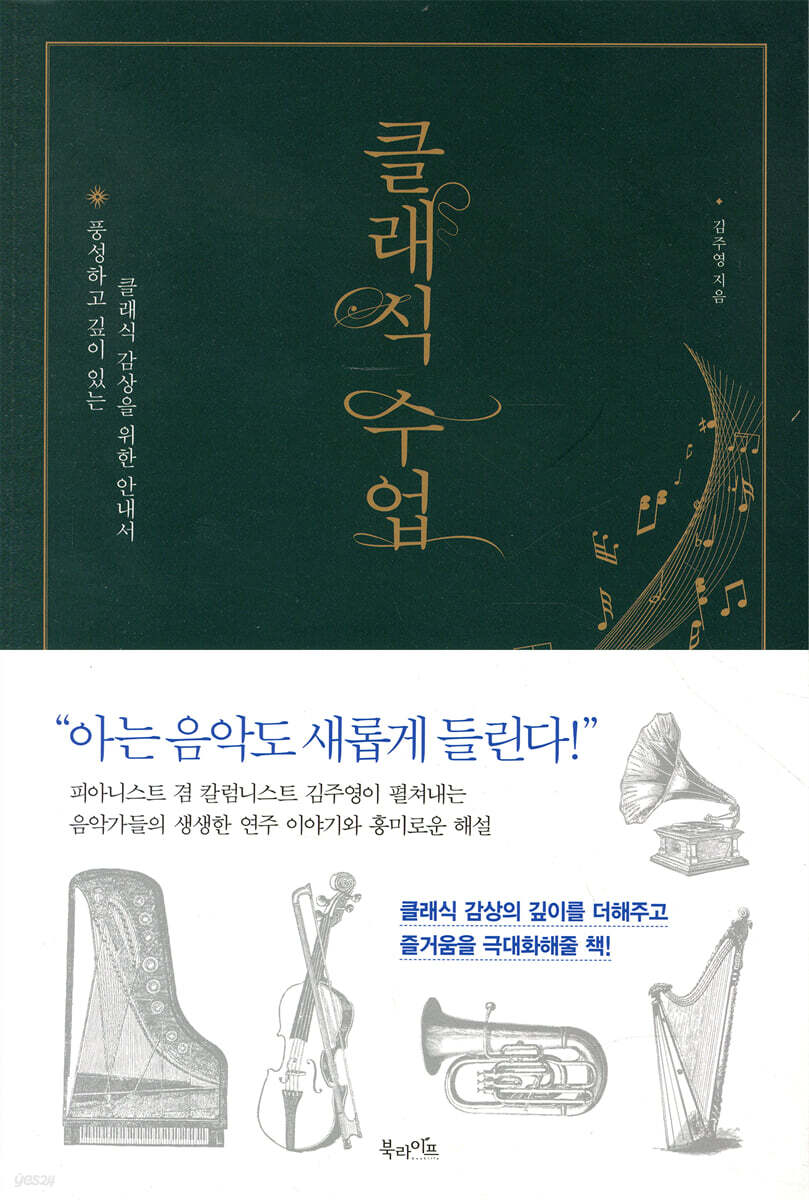
Classical classes
 |
Description
Book Introduction
Performance experience as a pianist
Commentary on various works regardless of genre or format
Easy and clear classical lessons!
Author Kim Joo-young was the first Korean to study Russian music abroad and graduated from the doctoral program in performance at the Moscow State Conservatory.
While studying abroad, he won second place (without first place) at the 1st Prokofiev International Piano Competition in Moscow and second place at the Grand International Piano Competition in Paris. In Korea, he is active as a musician, giving solo recitals at venues such as the Recital Hall of the Seoul Arts Center, the Small Auditorium of the Sejong Center for the Performing Arts, Ho-Am Art Hall, Kumho Gallery, and Kumho Art Hall.
He also actively plays the role of a commentator to convey the joy of classical music through contributions to newspapers and magazines, various lectures, and hosting the 'Art M Concert' hosted by Hyundai Pharmaceutical.
This book contains my experiences as a musician and classical music commentator, as well as my encounters with music lovers, conversations, and small realizations, along with commentary on the works.
"Classical Music Lessons," written with the hope that the moving moments that made music lovers take up music as a profession will be fully conveyed to the reader, is a useful educational book that will enhance the quality of appreciation for anyone who has ever been captivated by the captivating melodies of "classical music."
- You can preview some of the book's contents.
Preview
index
prolog
january
The charm of a hundred men against one hundred, the beginning of its specialness
Beginning and End of String Quartet
The piano quintet is an interesting duel
Lesson 1: Musician Stories Found by Birthday
february
Mozart's Violin Sonata: A Small Miracle
The thrill of the premiere, that thrilling memory
Beethoven's Thirty-Two Piano Sonatas: Getting to Know Them One by One
Lesson 2 What is sonata form?
March
Mozart's illusion
Beethoven's Neglected Symphonies
Schumann and Clara's three happy years
Lesson 3 The Conductor's Baton
april
The moment when birdsong became music
Eternal Request_ Violin Concerto in My Heart
The pianist's eternal wall, Chopin's Etudes
Lesson 4 Great Failures
May
Romeo and Juliet as a Classic
The world of cello sonatas, a culmination of hardship
Chopin alive in film
Lesson 5 What is an ambo?
June
The pain of war depicted through music
Fantasy and improvisation, their ambiguous beauty
Five Different Sorrows, Requiem
Lesson 6 Chopin's Four Heavenly Kings
July
Mephisto Byron and Franz Liszt
Symphony composers' rest
Rachmaninoff, perfume, and arrangements
Lesson 7: Classics Hidden in Raindrops
August
Music made by the sea
A beauty that cannot be returned, a Neapolitan folk song sung by Stefano
Silence in the Chatter: Sati and Mompou
Lesson 8 The World's Hardest Piano Piece
September
Classics you must listen to when going to the mountains
The decisive scene created by Rachmaninoff's concerto
The last scene depicted in Mahler's symphony
Lesson 9 Musicians and Food
october
Two great operas
The great pioneers Segovia and Rampal
The first step in 20th century music was with Poulenc.
lesson 10 Finding a living recording
November
The enigmatic pianist Richter
Before and After Impressionism
Memories of Shostakovich
Lesson 11: Leisure in the Concert Hall
december
Piazzolla, the composer of perfume
Gypsy, the source of inspiration
The Life of Repetition Discovered by Philip Glass
Lesson 12 The piano has a lot to say
Detailed image

Into the book
The most plausible theory is that the concerto with the 'protagonist vs. group' structure that we often encounter was first created in the Bologna region of Italy about 300 years ago.
The first protagonist was the trumpet, a brass instrument with a loud sound.
In theaters where opera or ballet performances were being performed, the performers would play short orchestral pieces during intermissions to give them a break. The sound of the trumpet in these pieces caught the audience's special attention, and soon orchestral concerts were held in which the trumpet played a solo, regardless of the opera.
I also wanted to play concertos for other instruments that I thought couldn't compete with the trumpet, but there was a small problem.
Loud instruments like trumpets were fine, but other instruments at the time weren't loud enough to have an equal conversation with the orchestra.
So, three instrumentalists who played solos formed a team and called this team 'Concertino'.
pp.
18~19 (The charm of a hundred men against one hundred, the beginning of its specialness)
“People make the mistake of thinking that I make songwriting very easy.
“There are almost no songs among my seniors’ works that I haven’t studied.”
Surprisingly, the owner of these words is Mozart.
It is certainly not the words of the greatest genius in human history to comfort us ordinary people, but it is literally a story of 'I also work hard and suffer to write this,' and it feels new and surprising that the subject is Mozart.
Although it is not the level of hardship that an ordinary person would go through, the representative piece among Mozart's works that he agonized over for a long time is the Quintet for Piano and Winds E-flat major, K.
452)
Completed in March 1784, this masterpiece is a testament to his interest and love for woodwind instruments, and his long-term efforts to please both himself and his audience.
Immediately after the successful premiere, Mozart wrote to his father about the piece, and his excitement was palpable.
“This time I completed two large concertos and a quintet.
Fortunately, the audience liked it, and I also think it was the best work of my life.”
p.
86 (Mozart's Illusion)
Which pianist's performance of Chopin is the most ideal? It's certainly a silly question, but the answer seems to be that, even at the turn of the century, no one has yet surpassed the four masters I'll introduce.
Even now, more than half a century later, Rubinstein's interpretation of Chopin remains our most credible standard.
However, it is a narrow-minded view to find the reason in the fact that he and Chopin were from the same country.
Rather, it is more correct to see that Rubinstein's optimistic temperament, which is characterized by his unwavering, calm phrases, bold lyricism, and a sense of comfort and freedom, was a good match for Chopin's simple, healthy beauty.
But even Rubinstein needed a lot of time to convince fans and critics of his Chopin performance.
p.
215 (Chopin's Four Heavenly Kings)
Langpal is the person who set the standard for how to program a flute recital.
At first, he imitated the style of the violin, an ancient musical instrument similar to the flute, and mixed large pieces and small pieces appropriately.
The idea was to place large-scale sonatas at the beginning and end of the program and to prevent boredom by inserting smaller pieces in the middle. This resulted in a good result, as it attracted the attention of even the audience who were unfamiliar with a concert performed solely by the flute, and this format is still used as a model for flute solo recitals to this day.
---From the text
Publisher's Review
Performance experience as a pianist
Commentary on various works regardless of genre or format
Easy and clear classical lessons!
Kim Joo-young, the author of "Classical Music Class," was the first Korean to study Russian music abroad and graduated from the doctoral program in performance at the Moscow State Conservatory.
While studying abroad, he won second place (without first place) at the 1st Prokofiev International Piano Competition in Moscow and second place at the Grand International Piano Competition in Paris. In Korea, he is active as a musician, giving solo recitals at venues such as the Recital Hall of the Seoul Arts Center, the Small Auditorium of the Sejong Center for the Performing Arts, Ho-Am Art Hall, Kumho Gallery, and Kumho Art Hall.
He also actively plays the role of a commentator to convey the joy of classical music through contributions to newspapers and magazines, various lectures, and hosting the 'Art M Concert' hosted by Hyundai Pharmaceutical.
This book contains my experiences as a musician and classical music commentator, as well as my encounters with music lovers, conversations, and small realizations, along with commentary on the works.
"Classical Music Lessons," written with the hope that the moving moments that made music lovers take up music as a profession will be fully conveyed to the reader, is a useful educational book that will enhance the quality of appreciation for anyone who has ever been captivated by the captivating melodies of "classical music."
Recommended music for various situations
『Classical Class』 is divided into twelve parts from January to December.
The 'lesson' corner, which appears at the end of each part, tells a story about music that suits various situations that change with the change of seasons, and contains information that will make classical music more interesting, such as 'The Conductor's Baton', 'Musicians and Food', and 'The World's Most Difficult Piano Piece'.
Another way to enjoy this book is to open it to the parts you need and listen to music along with the book depending on your situation.
Appreciation points that maximize the enjoyment of classics
Information conveyed from the perspective of a performer, rather than a classical commentator, is even more refreshing.
Another interesting part of this book is the parts where pianist Kim Joo-young kindly explains the composition of the song based on his own performance experience, allowing for a more three-dimensional appreciation.
The story of a Russian musician, conveying his experience studying abroad in Russia, is something not easily accessible in existing books. It vividly conveys the inspiration the composer planted throughout the score, maximizing the pleasure of listening to classical music and providing an opportunity to hear music you already know in a new way.
From Bach to Philip Glass, a musical story transcending time and space.
Beginning with Bach, the Baroque era, passing through Classicism and Romanticism, and continuing into the 20th century with the rise of Philip Glass, the story of musicians who shaped classical music is featured.
This book will help you enjoy classical music in a rich and deep way, with commentary on the works delivered in a simple and clear manner, as if speaking, regardless of genre, arrangement, or instrument.
GOODS SPECIFICS
- Date of publication: October 26, 2017
- Page count, weight, size: 420 pages | 152*225*24mm
- ISBN13: 9791185459899
- ISBN10: 1185459898
You may also like
카테고리
korean


korean


