

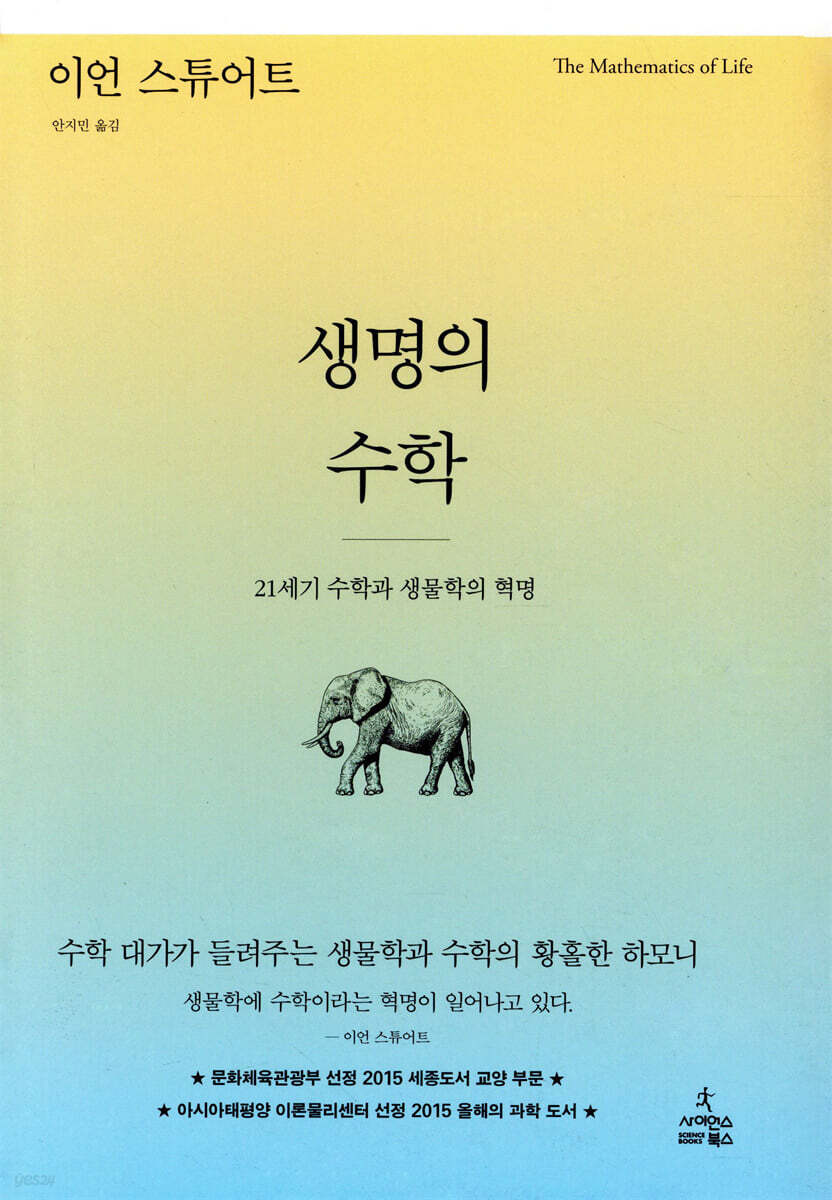
The Mathematics of Life
 |
Description
Book Introduction
The biology revolution brought about by mathematics
The Mathematics of Life: A Story of Great Mathematician Ian Stewart
DNA didn't suddenly appear in 1953 when Crick and Watson published the double helix structure in Nature. While the discovery of DNA's remarkable molecular structure was one of the greatest scientific revolutions of modern times, DNA is only one part of a much more complex story.
The DNA revolution was possible because of a mathematical technique called Bragg's law.
Our understanding of "what is life?" has changed dramatically through five revolutions: the emergence of the microscope, biological taxonomy, evolution, genes, and the structure of DNA.
And the sixth revolution is mathematics.
Ian Stewart, author of The Mathematics of Life: Unlocking the Secrets of Existence, published by Science Books, emphasizes that the sixth revolution, that is, the application of mathematical inspiration to biology, is already on its way.
He unfolds step by step how mathematical techniques and perspectives can be applied to understanding life.
The Mathematics of Life: A Story of Great Mathematician Ian Stewart
DNA didn't suddenly appear in 1953 when Crick and Watson published the double helix structure in Nature. While the discovery of DNA's remarkable molecular structure was one of the greatest scientific revolutions of modern times, DNA is only one part of a much more complex story.
The DNA revolution was possible because of a mathematical technique called Bragg's law.
Our understanding of "what is life?" has changed dramatically through five revolutions: the emergence of the microscope, biological taxonomy, evolution, genes, and the structure of DNA.
And the sixth revolution is mathematics.
Ian Stewart, author of The Mathematics of Life: Unlocking the Secrets of Existence, published by Science Books, emphasizes that the sixth revolution, that is, the application of mathematical inspiration to biology, is already on its way.
He unfolds step by step how mathematical techniques and perspectives can be applied to understanding life.
- You can preview some of the book's contents.
Preview
index
Entering
1 Mathematics and Biology
2 tiny creatures
3 A long list of lives
4 Math Found in Flowers
Origin of the 5 species
6 In the monastery garden
7 Molecules of Life
8 The Book of Life
9 Following the Tree of Life
10 Virus from the 4th dimension
11 Hidden Wiring Diagrams
12 Knots and Folds
13 Spots and Stripes
14 Lizard Games
15 Forming an information network
16 Plankton Paradox
17 What is life?
18 Is anyone there?
19 Sixth Revolution
Huzhou
Copyright of the painting
Translator's Note
1 Mathematics and Biology
2 tiny creatures
3 A long list of lives
4 Math Found in Flowers
Origin of the 5 species
6 In the monastery garden
7 Molecules of Life
8 The Book of Life
9 Following the Tree of Life
10 Virus from the 4th dimension
11 Hidden Wiring Diagrams
12 Knots and Folds
13 Spots and Stripes
14 Lizard Games
15 Forming an information network
16 Plankton Paradox
17 What is life?
18 Is anyone there?
19 Sixth Revolution
Huzhou
Copyright of the painting
Translator's Note
Publisher's Review
The biology revolution brought about by mathematics
The Mathematics of Life: A Story of Great Mathematician Ian Stewart
A mathematical revolution is taking place in biology.
- Ian Stewart
A technology that traces the history of ivory using elephant DNA is attracting attention.
By analyzing elephant dung and comparing its DNA, it is expected that it will be possible to identify the species of elephant, locate elephant poaching hotspots, and even prevent the international trade of other endangered wild animals.
Meanwhile, attempts are ongoing to restore the mammoth by fusing elephant DNA with the DNA of the already extinct mammoth.
Efforts to unlock the secrets of life using elephant DNA, the 'molecule of life', as a key will not be limited to biologists.
DNA didn't suddenly appear in 1953 when Crick and Watson published the double helix structure in Nature. While the discovery of DNA's remarkable molecular structure was one of the greatest scientific revolutions of modern times, DNA is only one part of a much more complex story.
The DNA revolution was possible because of a mathematical technique called Bragg's law.
Our understanding of "what is life?" has changed dramatically through five revolutions: the emergence of the microscope, biological taxonomy, evolution, genes, and the structure of DNA.
And the sixth revolution is mathematics.
Ian Stewart, author of The Mathematics of Life: Unlocking the Secrets of Existence, published by Science Books, emphasizes that the sixth revolution, that is, the application of mathematical inspiration to biology, is already on its way.
He unfolds step by step how mathematical techniques and perspectives can be applied to understanding life.
The union of mathematics and biology is one of the hottest topics in science.
Both disciplines have come a long way in a very short period of time.
No one knows how much further it can go.
But for sure, the road will be thrillingly fun.
--- From the text
Mathematician Ian Stewart (born September 24, 1945) studied mathematics at the University of Cambridge, England, and received his doctorate from the University of Warwick.
An honorary professor at the University of Warwick, he received the Royal Society's Michael Faraday Award for popular science in 1995 and was elected a Fellow of the Royal Society in 2001.
He received the Award for Popularizing Science from the American Association for the Advancement of Science (2002), and was praised by The Guardian as “Britain’s most outstanding mathematics writer.” He has published numerous books to help the general public enjoy mathematics, including “To the Future Mathematician,” “Patterns of Nature,” “What Shape is a Snowflake?”, “The Cow in the Maze,” and “17 Equations that Changed the World.”
In "The Mathematics of Life," the author willingly guides readers through the moments of mathematics that unlock life's deepest secrets.
A math expert tells you
Harmony of Biology and Mathematics
The role of mathematics in biology is becoming increasingly important.
Biology in the 21st century is using mathematics in ways no one could have imagined at the beginning of the 20th century.
By the 22nd century, mathematics and biology will have become unrecognizable.
--- From the text
Ian Stewart begins Chapter 1: Mathematics and Biology by introducing five revolutions in biology.
And the sixth revolutionary mathematics finds its power in diversity and novelty.
New tools like computers and new thinking tools like mathematical techniques are changing the outcomes we get from biology.
Chapter 2, Tiny Creatures, deals with the first revolution, the 'microscope'.
History proves that the world we see changes as our scale of thought changes, as we see the simplicity of the universe through a telescope and the complexity of life through a microscope.
The complex forms of embryology can be interpreted through mathematical models.
Chapter 3, "The Long List of Life," is about the creation of a list to understand the vastness of biology and the second revolution, "classification."
Linnaeus's classification system is fundamental to natural history.
The debate over how many species of creatures boarded Noah's Ark has become meaningless.
"Chapter 4: Mathematics in Flowers" takes a closer look at how mathematics first began to be widely applied to biological problems, namely the surprising patterns in the number and shape of flowers and leaves, as taxonomists counted plant parts.
"Chapter 5: On the Origin of Species" begins with a paper by Darwin and Wallace presented at the 70th anniversary of the Linnean Society.
It marked the beginning of the third revolution, the theory of evolution by natural selection.
The fourth revolution, 'heredity', was discovered by Mendel with 29,000 pea plants he cultivated over seven years.
"Chapter 6: In the Monastery Garden" is a process of adding combinatorics and probability theory from mathematics to the realization that plants have genetic elements.
And in Chapter 7, "The Molecules of Life," the fifth revolution, the structure of DNA, is revealed. What does a DNA molecule look like? In what order are its atoms arranged? The answers to these fundamental questions were made possible by Bragg's law, a mathematical technique for reconstructing atomic structure from the diffraction patterns produced by the atomic structure within a crystal, and the Fourier transform, a mathematical technique that provides specific information about the arrangement of atoms.
Chapter 8, "The Book of Life," explores how mathematics and chemistry work together in the human genome project and the genome analysis work being conducted by Celera.
The forefront of 21st century mathematics
"Chapter 9: Along the Tree of Life" introduces the concept of a tree (tree, tree, or tree diagram) as thought by mathematicians, along with Haeckel's drawing of the tree of life.
"Chapter 10: Viruses from the Fourth Dimension" is about the structure and function of synthetic molecules that organize complex life processes.
Chapter 11, "Hidden Wiring Diagram," begins with the brain and nerve cells and presents interesting research such as analysis of the walking patterns of four-legged animals and graphs of leech heartbeats.
"Chapter 12: Knots and Folds" deals with DNA research and topology, while "Chapter 13: Spots and Stripes" begins with the Turing pattern and provides a more mathematical interpretation of various symmetrical structures and patterns found in nature.
The applied mathematics covered in this book studies the evolutionary game that gave birth to the diverse life forms on this earth and is still ongoing (Chapter 14: The Lizard Game), the functioning of the nervous system and the brain (Chapter 15: Formation of Information Networks), and the dynamics of ecosystems (Chapter 16: The Plankton Paradox). Furthermore, Chapters 17: What is Life? and 18: Is There Anyone There? connect to the topics of the nature of life and the possibility of extraterrestrial life.
"The Mathematics of Life" looks back on the mathematical revolution that has already begun.
Microscopy and optical mathematics are inseparable for peering into the complexity of life.
Linnaeus's taxonomy began with counting the number of organs in a plant, and Mendel's famous peas were the result of exploiting mathematical patterns in plant individuals.
Darwin's reason for boarding the Beagle was to assist Officer Fitzroy in measuring longitude with a chronometer. In the clues to DNA structure, Chargaff's laws gave numbers a new perspective.
Mathematics was present in the five revolutions before the sixth revolution, which was mathematics.
Mathematicians love nothing more than a spring of ever-growing new questions.
Biologists will be truly impressed by the mathematicians' answers.
--- From the text
Mathematics is still new, even though it began thousands of years ago.
It is often thought that mathematics has been perfected for a long time, but as evidenced by the fact that over a million mathematical papers are published each year, new mathematics is constantly being created at an astonishing rate.
Mathematical thinking is becoming a standard tool among biology's tools.
Although biologists have used statistics for over a century, mathematics is now a tool not only for analyzing data about living things, but also for making sense of that information.
Anything that has structure or pattern, such as form, logic, or process, becomes a subject of mathematics.
The same goes for uncertainty, where there seems to be no pattern at all.
This is because statisticians have discovered that even seemingly random events eventually exhibit some average pattern.
The scope of mathematics related to life is very broad.
Its scope includes probability, (dynamic) mechanics, chaos theory, symmetry, networks, elasticity, and even knot theory.
Because of this diversity of mathematics, not only the results we obtain from biology are changing, but even how we view biology.
It's not easy to find a biologist who enjoys math, or a mathematician who enjoys biology, but Ian Stewart has achieved that crossover.
-《Discover》
Mathematics wouldn't be this exciting without Ian Stewart. - New Scientist
A captivating collection of mathematics' most profound insights. - The Washington Post
The Mathematics of Life: A Story of Great Mathematician Ian Stewart
A mathematical revolution is taking place in biology.
- Ian Stewart
A technology that traces the history of ivory using elephant DNA is attracting attention.
By analyzing elephant dung and comparing its DNA, it is expected that it will be possible to identify the species of elephant, locate elephant poaching hotspots, and even prevent the international trade of other endangered wild animals.
Meanwhile, attempts are ongoing to restore the mammoth by fusing elephant DNA with the DNA of the already extinct mammoth.
Efforts to unlock the secrets of life using elephant DNA, the 'molecule of life', as a key will not be limited to biologists.
DNA didn't suddenly appear in 1953 when Crick and Watson published the double helix structure in Nature. While the discovery of DNA's remarkable molecular structure was one of the greatest scientific revolutions of modern times, DNA is only one part of a much more complex story.
The DNA revolution was possible because of a mathematical technique called Bragg's law.
Our understanding of "what is life?" has changed dramatically through five revolutions: the emergence of the microscope, biological taxonomy, evolution, genes, and the structure of DNA.
And the sixth revolution is mathematics.
Ian Stewart, author of The Mathematics of Life: Unlocking the Secrets of Existence, published by Science Books, emphasizes that the sixth revolution, that is, the application of mathematical inspiration to biology, is already on its way.
He unfolds step by step how mathematical techniques and perspectives can be applied to understanding life.
The union of mathematics and biology is one of the hottest topics in science.
Both disciplines have come a long way in a very short period of time.
No one knows how much further it can go.
But for sure, the road will be thrillingly fun.
--- From the text
Mathematician Ian Stewart (born September 24, 1945) studied mathematics at the University of Cambridge, England, and received his doctorate from the University of Warwick.
An honorary professor at the University of Warwick, he received the Royal Society's Michael Faraday Award for popular science in 1995 and was elected a Fellow of the Royal Society in 2001.
He received the Award for Popularizing Science from the American Association for the Advancement of Science (2002), and was praised by The Guardian as “Britain’s most outstanding mathematics writer.” He has published numerous books to help the general public enjoy mathematics, including “To the Future Mathematician,” “Patterns of Nature,” “What Shape is a Snowflake?”, “The Cow in the Maze,” and “17 Equations that Changed the World.”
In "The Mathematics of Life," the author willingly guides readers through the moments of mathematics that unlock life's deepest secrets.
A math expert tells you
Harmony of Biology and Mathematics
The role of mathematics in biology is becoming increasingly important.
Biology in the 21st century is using mathematics in ways no one could have imagined at the beginning of the 20th century.
By the 22nd century, mathematics and biology will have become unrecognizable.
--- From the text
Ian Stewart begins Chapter 1: Mathematics and Biology by introducing five revolutions in biology.
And the sixth revolutionary mathematics finds its power in diversity and novelty.
New tools like computers and new thinking tools like mathematical techniques are changing the outcomes we get from biology.
Chapter 2, Tiny Creatures, deals with the first revolution, the 'microscope'.
History proves that the world we see changes as our scale of thought changes, as we see the simplicity of the universe through a telescope and the complexity of life through a microscope.
The complex forms of embryology can be interpreted through mathematical models.
Chapter 3, "The Long List of Life," is about the creation of a list to understand the vastness of biology and the second revolution, "classification."
Linnaeus's classification system is fundamental to natural history.
The debate over how many species of creatures boarded Noah's Ark has become meaningless.
"Chapter 4: Mathematics in Flowers" takes a closer look at how mathematics first began to be widely applied to biological problems, namely the surprising patterns in the number and shape of flowers and leaves, as taxonomists counted plant parts.
"Chapter 5: On the Origin of Species" begins with a paper by Darwin and Wallace presented at the 70th anniversary of the Linnean Society.
It marked the beginning of the third revolution, the theory of evolution by natural selection.
The fourth revolution, 'heredity', was discovered by Mendel with 29,000 pea plants he cultivated over seven years.
"Chapter 6: In the Monastery Garden" is a process of adding combinatorics and probability theory from mathematics to the realization that plants have genetic elements.
And in Chapter 7, "The Molecules of Life," the fifth revolution, the structure of DNA, is revealed. What does a DNA molecule look like? In what order are its atoms arranged? The answers to these fundamental questions were made possible by Bragg's law, a mathematical technique for reconstructing atomic structure from the diffraction patterns produced by the atomic structure within a crystal, and the Fourier transform, a mathematical technique that provides specific information about the arrangement of atoms.
Chapter 8, "The Book of Life," explores how mathematics and chemistry work together in the human genome project and the genome analysis work being conducted by Celera.
The forefront of 21st century mathematics
"Chapter 9: Along the Tree of Life" introduces the concept of a tree (tree, tree, or tree diagram) as thought by mathematicians, along with Haeckel's drawing of the tree of life.
"Chapter 10: Viruses from the Fourth Dimension" is about the structure and function of synthetic molecules that organize complex life processes.
Chapter 11, "Hidden Wiring Diagram," begins with the brain and nerve cells and presents interesting research such as analysis of the walking patterns of four-legged animals and graphs of leech heartbeats.
"Chapter 12: Knots and Folds" deals with DNA research and topology, while "Chapter 13: Spots and Stripes" begins with the Turing pattern and provides a more mathematical interpretation of various symmetrical structures and patterns found in nature.
The applied mathematics covered in this book studies the evolutionary game that gave birth to the diverse life forms on this earth and is still ongoing (Chapter 14: The Lizard Game), the functioning of the nervous system and the brain (Chapter 15: Formation of Information Networks), and the dynamics of ecosystems (Chapter 16: The Plankton Paradox). Furthermore, Chapters 17: What is Life? and 18: Is There Anyone There? connect to the topics of the nature of life and the possibility of extraterrestrial life.
"The Mathematics of Life" looks back on the mathematical revolution that has already begun.
Microscopy and optical mathematics are inseparable for peering into the complexity of life.
Linnaeus's taxonomy began with counting the number of organs in a plant, and Mendel's famous peas were the result of exploiting mathematical patterns in plant individuals.
Darwin's reason for boarding the Beagle was to assist Officer Fitzroy in measuring longitude with a chronometer. In the clues to DNA structure, Chargaff's laws gave numbers a new perspective.
Mathematics was present in the five revolutions before the sixth revolution, which was mathematics.
Mathematicians love nothing more than a spring of ever-growing new questions.
Biologists will be truly impressed by the mathematicians' answers.
--- From the text
Mathematics is still new, even though it began thousands of years ago.
It is often thought that mathematics has been perfected for a long time, but as evidenced by the fact that over a million mathematical papers are published each year, new mathematics is constantly being created at an astonishing rate.
Mathematical thinking is becoming a standard tool among biology's tools.
Although biologists have used statistics for over a century, mathematics is now a tool not only for analyzing data about living things, but also for making sense of that information.
Anything that has structure or pattern, such as form, logic, or process, becomes a subject of mathematics.
The same goes for uncertainty, where there seems to be no pattern at all.
This is because statisticians have discovered that even seemingly random events eventually exhibit some average pattern.
The scope of mathematics related to life is very broad.
Its scope includes probability, (dynamic) mechanics, chaos theory, symmetry, networks, elasticity, and even knot theory.
Because of this diversity of mathematics, not only the results we obtain from biology are changing, but even how we view biology.
It's not easy to find a biologist who enjoys math, or a mathematician who enjoys biology, but Ian Stewart has achieved that crossover.
-《Discover》
Mathematics wouldn't be this exciting without Ian Stewart. - New Scientist
A captivating collection of mathematics' most profound insights. - The Washington Post
GOODS SPECIFICS
- Date of issue: July 10, 2015
- Format: Hardcover book binding method guide
- Page count, weight, size: 496 pages | 784g | 145*215*33mm
- ISBN13: 9788983717412
- ISBN10: 8983717416
You may also like
카테고리
korean


korean

![ELLE 엘르 스페셜 에디션 A형 : 12월 [2025]](http://librairie.coreenne.fr/cdn/shop/files/b8e27a3de6c9538896439686c6b0e8fb.jpg?v=1766436872&width=3840)


