

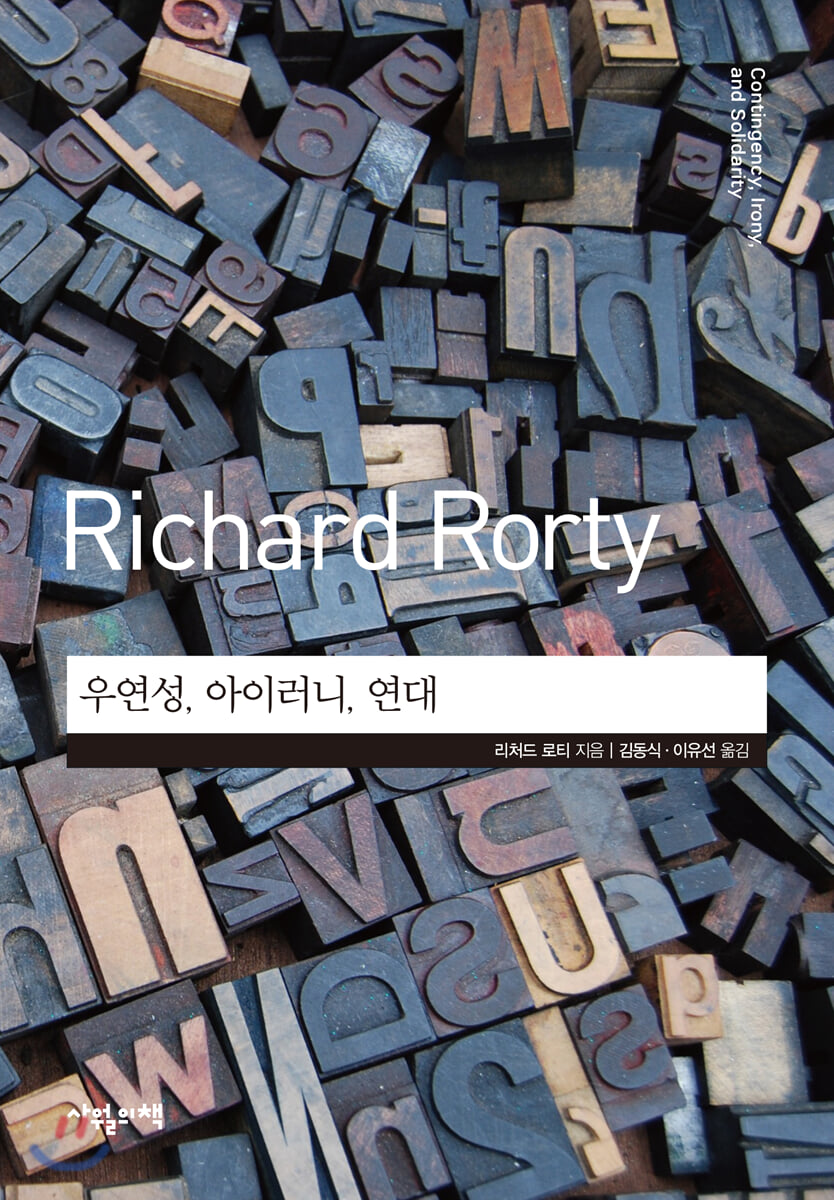
contingency, irony, and solidarity
 |
Description
Book Introduction
Philosophy for a Society of Accidental Individuals
How should we cope with an increasingly diverse and complex world? As individuals, living with contingent and fluid identities, what kind of solidarity and social hope can we envision?
In this book, world-renowned philosopher Richard Rorty offers philosophical suggestions for a new era and new individuals.
Roti speaks of the contingency of our existence.
Neither our language, nor our self, nor our community has any essence to be discovered.
We are thoroughly historical products, ironic beings who must create ourselves.
In a society of unique and peculiar individuals, the universal truths pursued by traditional philosophy can no longer serve as a basis for solidarity.
Today, human solidarity depends more on sharing common selfish hopes than on common truths.
How should we cope with an increasingly diverse and complex world? As individuals, living with contingent and fluid identities, what kind of solidarity and social hope can we envision?
In this book, world-renowned philosopher Richard Rorty offers philosophical suggestions for a new era and new individuals.
Roti speaks of the contingency of our existence.
Neither our language, nor our self, nor our community has any essence to be discovered.
We are thoroughly historical products, ironic beings who must create ourselves.
In a society of unique and peculiar individuals, the universal truths pursued by traditional philosophy can no longer serve as a basis for solidarity.
Today, human solidarity depends more on sharing common selfish hopes than on common truths.
- You can preview some of the book's contents.
Preview
index
Preface to the Korean edition
preface
introduction
Part 1: Chance
Chapter 1: The Contingency of Language
Chapter 2: The Contingency of the Self
Chapter 3: The Contingency of the Liberal Community
Part 2: Irony and Theory
Chapter 4: Private Irony and the Hope of Liberalism
Chapter 5: Self-Creation and Assimilation: Proust, Nietzsche, and Heidegger
Chapter 6: From Ironist Theory to Private Allusion: Derrida
Part 3: Cruelty and Solidarity
Chapter 7: The Barber of Casbim: Nabokov's View on Cruelty
Chapter 8: Europe's Last Intellectual: Orwell's View on Cruelty
Chapter 9 Solidarity
Translator's Note
Search
preface
introduction
Part 1: Chance
Chapter 1: The Contingency of Language
Chapter 2: The Contingency of the Self
Chapter 3: The Contingency of the Liberal Community
Part 2: Irony and Theory
Chapter 4: Private Irony and the Hope of Liberalism
Chapter 5: Self-Creation and Assimilation: Proust, Nietzsche, and Heidegger
Chapter 6: From Ironist Theory to Private Allusion: Derrida
Part 3: Cruelty and Solidarity
Chapter 7: The Barber of Casbim: Nabokov's View on Cruelty
Chapter 8: Europe's Last Intellectual: Orwell's View on Cruelty
Chapter 9 Solidarity
Translator's Note
Search
Into the book
“The aversion to cruelty is a relatively recent and relatively fragile achievement, one that relies less on an appeal to intuitive and obvious truths than on an imaginative retelling of the consequences of cruelty.”
--- p.14
“This book will sketch a figure I call a ‘liberal ironist.’
A liberal is someone who thinks that cruelty is the worst thing we can do.
By 'ironist' I mean someone who faces the contingency of his or her most fundamental beliefs and desires, someone who is historicist and nominalist enough to abandon the idea that his or her beliefs and desires point to something beyond time and chance.
“A liberal ironist is someone who includes in his hopes, which are so baseless, that suffering will eventually be lessened and that man will cease to be humiliated by man.”
--- p.25
“We need to distinguish between the claim that the world is out there and the claim that truth is out there.
To say that the world is out there and that it is not our creation is to say, as is common sense, that most things in time and space are the result of causes that do not involve human mental states.
To say that truth is not out there is nothing more than to say that where there are no sentences there is no truth, that sentences are the constituent elements of human language and that human language is a human invention.”
--- p.36
“Everyone has a set of words they use to justify their actions, their beliefs, and their lives.
They are words that carry praise for friends, insults for enemies, long-term projects, the deepest self-doubts, and the noblest hopes.
They are words that tell the story of our lives, sometimes looking forward and sometimes looking back.
I would call such words ‘the last vocabulary.’”
--- p.163
“When Nietzsche and Heidegger are absorbed in glorifying their personal canons and the little things that mean the most to them, they are as good as Proust.
They are figures we can look to and use as material when we attempt to create a new self by writing a bildungsroman about our old self.
But as soon as they offer a view on modern society, or on the fate of Europe, or on contemporary politics, they become, at best, vapid, or at worst, sadistic.”
--- p.251
“I have argued in this book that we should not try to desire anything beyond history and institutions.
The basic premise of this book is that even among people who are well aware that a belief is not caused by anything deeper than contingent historical circumstances, it can still regulate behavior and be considered worth dying for.”
--- p.386
“We will always live with that dilemma.
But such a dilemma will not be resolved by appealing to a broader and higher-order set of obligations that a philosophical forum might be expected to discover or apply.
Just as there is nothing that can validate the final vocabulary of a person or a culture, there is nothing contained within those vocabularies that can dictate how they should be reassembled when they are in conflict.
“All we can do is work with that last vocabulary, keeping our ears open to hints about how it might be expanded and revised.” --- p.399
“Human solidarity as self-doubt seems to me to be the mark of the first era in human history in which many people have been able to distinguish between the question, “Are you suffering?” and the question, “Do you believe and want what we believe and want?”
In my terms, this is the ability to distinguish between the question of whether you are suffering and the question of whether you and I have the same final vocabulary.
Distinguishing between these questions allows us to distinguish between private and public questions, between questions about life and questions about suffering, between the realm of the ironist and the realm of the liberal.
So this allows one person to do both.”
--- p.14
“This book will sketch a figure I call a ‘liberal ironist.’
A liberal is someone who thinks that cruelty is the worst thing we can do.
By 'ironist' I mean someone who faces the contingency of his or her most fundamental beliefs and desires, someone who is historicist and nominalist enough to abandon the idea that his or her beliefs and desires point to something beyond time and chance.
“A liberal ironist is someone who includes in his hopes, which are so baseless, that suffering will eventually be lessened and that man will cease to be humiliated by man.”
--- p.25
“We need to distinguish between the claim that the world is out there and the claim that truth is out there.
To say that the world is out there and that it is not our creation is to say, as is common sense, that most things in time and space are the result of causes that do not involve human mental states.
To say that truth is not out there is nothing more than to say that where there are no sentences there is no truth, that sentences are the constituent elements of human language and that human language is a human invention.”
--- p.36
“Everyone has a set of words they use to justify their actions, their beliefs, and their lives.
They are words that carry praise for friends, insults for enemies, long-term projects, the deepest self-doubts, and the noblest hopes.
They are words that tell the story of our lives, sometimes looking forward and sometimes looking back.
I would call such words ‘the last vocabulary.’”
--- p.163
“When Nietzsche and Heidegger are absorbed in glorifying their personal canons and the little things that mean the most to them, they are as good as Proust.
They are figures we can look to and use as material when we attempt to create a new self by writing a bildungsroman about our old self.
But as soon as they offer a view on modern society, or on the fate of Europe, or on contemporary politics, they become, at best, vapid, or at worst, sadistic.”
--- p.251
“I have argued in this book that we should not try to desire anything beyond history and institutions.
The basic premise of this book is that even among people who are well aware that a belief is not caused by anything deeper than contingent historical circumstances, it can still regulate behavior and be considered worth dying for.”
--- p.386
“We will always live with that dilemma.
But such a dilemma will not be resolved by appealing to a broader and higher-order set of obligations that a philosophical forum might be expected to discover or apply.
Just as there is nothing that can validate the final vocabulary of a person or a culture, there is nothing contained within those vocabularies that can dictate how they should be reassembled when they are in conflict.
“All we can do is work with that last vocabulary, keeping our ears open to hints about how it might be expanded and revised.” --- p.399
“Human solidarity as self-doubt seems to me to be the mark of the first era in human history in which many people have been able to distinguish between the question, “Are you suffering?” and the question, “Do you believe and want what we believe and want?”
In my terms, this is the ability to distinguish between the question of whether you are suffering and the question of whether you and I have the same final vocabulary.
Distinguishing between these questions allows us to distinguish between private and public questions, between questions about life and questions about suffering, between the realm of the ironist and the realm of the liberal.
So this allows one person to do both.”
--- p.402
Publisher's Review
In an era where everyone has become an accidental individual,
What kind of social hope can we imagine?
Why are all sorts of generational terms being invoked today—Millennials, those born in the 1990s, Generation Z? It's because the old social realities of homogeneous societies, collectivist cultures, and the era of averageism are coming to an end, and we're searching for new values suited to a pluralistic society, individualistic culture, and individualistic era.
But we are still confused.
It is unclear how to deal with the increasingly diverse and complex contemporary situation.
What kind of solidarity and social hope can we, as individuals who live as beings of accidental and fluid identities, imagine?
In this book, Contingency, Irony, and Solidarity, world-renowned philosopher Richard Rorty offers philosophical suggestions for a new era and new individuals.
Roti speaks of the contingency of our existence.
Neither our language, nor our self, nor our community has any essence to be discovered.
We are thoroughly historical products, ironic beings who must create ourselves.
In a society of unique and peculiar individuals, the universal truths pursued by traditional philosophy can no longer serve as a basis for solidarity.
Today, human solidarity depends more on sharing common selfish hopes than on common truths.
Loti's provocative and creative thinking has sparked worldwide discussion and debate (translated into 25 languages) and remains relevant to this day.
As the trend toward diversification deepens and the realm of individualism expands, and as a countermeasure, hatred of others grows, this book tells us that the social hope of reducing cruelty and suffering and expanding the realm of "us" is the image of a free future we must cultivate.
From an age of truth and ideology to an age of chance and imagination
- A philosophy for a society of accidental individuals
The world of the past was a time when truth and lies, right and wrong, and friend and foe were clear.
In the face of historical confrontations such as those between the communist world and the free world, military dictatorship and democratic forces, the lives of individuals were inseparably integrated with the lives of the community.
Truth and ideology were considered useful weapons for historical struggle.
But today's world is in a completely different situation.
As individual autonomy is emphasized, the separation between the private and the public is becoming more prevalent, and truth and ideology no longer have the same power as in the past.
Rather, empathy and solidarity between individuals are considered new public values.
This transition is accelerating further with the rise of the millennial generation.
Richard Rorty had already anticipated and defended this new turn in Contingency, Irony, and Solidarity (1989).
“The vocabulary of Enlightenment rationalism was crucial in the early days of liberal democracy, but it has now become an obstacle to the maintenance and development of democratic society.” (p. 112) Rorty says that the vocabulary of rationalism, such as truth, ideology, and moral obligation, is limiting our political imagination.
Rather, by focusing on historical contingency rather than necessary truth, and on imagination rather than ideology, we can understand how new imaginations expand the scope of "us" and create new solidarities.
“In my utopia, human solidarity will not be seen as a fact to be recognized by removing ‘prejudices’ or by uncovering deep truths previously hidden, but rather as a goal to be achieved.
It is something to be achieved not by inquiry but by imagination, an imagination that can see strangers as fellow sufferers.
Solidarity is not discovered through reflection, but created.
It is created by heightening our sensitivity to the specific details of the suffering and humiliation experienced by strangers.” (p. 26)
In this way, solidarity is not based on universal human nature, but rather on expanding “us” within specific historical circumstances.
This process of seeing those who are different from us not as 'them' but as 'one of us' is a matter of both a detailed description of what strangers are like and a redescription of what we ourselves are like.
Rorty says this is not a task of theory, but a task of narrative: the task of novels, films, journalism, docudrama, and so on.
In short, it is stories, not theories, that change the world.
The stories of random individuals are detailed and relatable, creating opportunities for solidarity and a force for advancing morality and politics.
The question, “Are you suffering?” and the question, “Do you believe and want what we believe and want?”
- The liberal utopia dreamed of by the new generation
Another important question that Rorty raises in 『Contingency, Irony, Solidarity』 is the provocative claim that the pursuit of private self-creation and the hope for public solidarity cannot and need not be theoretically combined.
In the past, a single truth or ideology permeated both individuals and communities, establishing the direction of life. However, now there is no single, transcendent truth that everyone can agree on.
So, Roti says, we have to do two things at the same time.
On the one hand, we must perform private acts of self-creation, savoring our personal contingency and confronting our own past (the task of the ironist); on the other hand, we must create public solidarity to understand the contingency of others and share with them our common selfish hopes (the task of the liberal).
This distinction between the private and the public is what separates the question, “Do you believe and want what we believe and want?” from the question, “Are you suffering?”; it separates the question about worldview from the question about suffering.
In short, this means that we can empathize and feel solidarity with the suffering of others even if we do not share the same nature, the same vocabulary, or the same beliefs.
When we recognize that the private and the public cannot be separated and fused, we find that the differences in our truths, theories, vocabulary, and beliefs no longer matter.
There is no need for everyone to share a single truth or ideology.
More importantly, it is about securing an autonomous space where everyone can speak their mind and upholding the hope of liberalism so that humans are not humiliated by other humans.
So Rorty turns the traditional philosophical motto, “The truth will set you free,” on its head:
“If we take care of freedom, truth will take care of itself.” (p. 359)
The 'liberal utopia' that Rorty presents in this book is a plan to avoid human suffering as much as possible and to prevent those who have more resources from taking them away from those who need them more. It is not a simple libertarian program, but rather a kind of social democratic distribution policy that supports a society that gives maximum room for each person's self-creation, and thus a society in which everyone is given equal opportunities to realize their own unique fantasies.
Isn't this precisely the kind of society that the new generations of the 21st century aspire to? In this sense, it wouldn't be an exaggeration to call this book the last 20th-century philosophy book that anticipated 21st-century society.
The Adventures of a Liberal Ironist Who Crosses Literature and Philosophy
- From Plato to Heidegger and Derrida, from Proust to Nabokov and Orwell
In 『Contingency, Irony, Solidarity』, Rorty presents a unique writing style that freely crosses the boundaries between literature and philosophy.
The book begins with a quote from Milan Kundera and delves into a variety of literary works, including Philip Larkin's poetry, Proust's In Search of Lost Time, Nabokov's Lolita, and Orwell's Nineteen Eighty-Four.
If 20th-century American analytic philosophy attempted to 'scientize' philosophy, Rorty 'literatized' philosophy again.
Through this, Rorty reveals that philosophy is not a search for transcendent truth, but rather a task of rewriting our lives.
In this respect, literature and philosophy are no different.
The philosophical figure that Rorty presents to us at this time is the 'ironist'.
The opposite of irony is common sense.
People who believe in common sense tend to describe themselves in habitual vocabulary.
But to an ironist, a sensible life is like living someone else's life without having a life of your own and then ending your life.
In this respect, an ironist is someone who tries to create his own private self by creating his own vocabulary.
In Loti's view, this kind of self-creation is not something only intellectuals or elites can do, but something that everyone can do.
Along with these insights, Rorty deeply understands how the pursuit of a private and creative life can sometimes lead to a cruelty that destroys the lives of others.
Because when we are solely focused on the work of self-creation, we can easily fall into the trap of becoming 'monsters of indifference.'
Loti says that Nabokov's novels Lolita and Pale Fire particularly capture this problem awareness (see Chapter 7).
In this way, Rorty points out both the necessity and the danger of private self-creation, and argues that we must fulfill both the tasks of the ironist and the liberal.
In this respect, an ironist must become a liberal, and a liberal must become an ironist.
This was the social hope and philosophical message of Rorty, who aspired to be a 'liberal ironist'.
“A liberal ironist is someone who includes in his hopes, which are so baseless, that suffering will eventually diminish and that humans will stop being humiliated by other humans.” (p. 25)
What kind of social hope can we imagine?
Why are all sorts of generational terms being invoked today—Millennials, those born in the 1990s, Generation Z? It's because the old social realities of homogeneous societies, collectivist cultures, and the era of averageism are coming to an end, and we're searching for new values suited to a pluralistic society, individualistic culture, and individualistic era.
But we are still confused.
It is unclear how to deal with the increasingly diverse and complex contemporary situation.
What kind of solidarity and social hope can we, as individuals who live as beings of accidental and fluid identities, imagine?
In this book, Contingency, Irony, and Solidarity, world-renowned philosopher Richard Rorty offers philosophical suggestions for a new era and new individuals.
Roti speaks of the contingency of our existence.
Neither our language, nor our self, nor our community has any essence to be discovered.
We are thoroughly historical products, ironic beings who must create ourselves.
In a society of unique and peculiar individuals, the universal truths pursued by traditional philosophy can no longer serve as a basis for solidarity.
Today, human solidarity depends more on sharing common selfish hopes than on common truths.
Loti's provocative and creative thinking has sparked worldwide discussion and debate (translated into 25 languages) and remains relevant to this day.
As the trend toward diversification deepens and the realm of individualism expands, and as a countermeasure, hatred of others grows, this book tells us that the social hope of reducing cruelty and suffering and expanding the realm of "us" is the image of a free future we must cultivate.
From an age of truth and ideology to an age of chance and imagination
- A philosophy for a society of accidental individuals
The world of the past was a time when truth and lies, right and wrong, and friend and foe were clear.
In the face of historical confrontations such as those between the communist world and the free world, military dictatorship and democratic forces, the lives of individuals were inseparably integrated with the lives of the community.
Truth and ideology were considered useful weapons for historical struggle.
But today's world is in a completely different situation.
As individual autonomy is emphasized, the separation between the private and the public is becoming more prevalent, and truth and ideology no longer have the same power as in the past.
Rather, empathy and solidarity between individuals are considered new public values.
This transition is accelerating further with the rise of the millennial generation.
Richard Rorty had already anticipated and defended this new turn in Contingency, Irony, and Solidarity (1989).
“The vocabulary of Enlightenment rationalism was crucial in the early days of liberal democracy, but it has now become an obstacle to the maintenance and development of democratic society.” (p. 112) Rorty says that the vocabulary of rationalism, such as truth, ideology, and moral obligation, is limiting our political imagination.
Rather, by focusing on historical contingency rather than necessary truth, and on imagination rather than ideology, we can understand how new imaginations expand the scope of "us" and create new solidarities.
“In my utopia, human solidarity will not be seen as a fact to be recognized by removing ‘prejudices’ or by uncovering deep truths previously hidden, but rather as a goal to be achieved.
It is something to be achieved not by inquiry but by imagination, an imagination that can see strangers as fellow sufferers.
Solidarity is not discovered through reflection, but created.
It is created by heightening our sensitivity to the specific details of the suffering and humiliation experienced by strangers.” (p. 26)
In this way, solidarity is not based on universal human nature, but rather on expanding “us” within specific historical circumstances.
This process of seeing those who are different from us not as 'them' but as 'one of us' is a matter of both a detailed description of what strangers are like and a redescription of what we ourselves are like.
Rorty says this is not a task of theory, but a task of narrative: the task of novels, films, journalism, docudrama, and so on.
In short, it is stories, not theories, that change the world.
The stories of random individuals are detailed and relatable, creating opportunities for solidarity and a force for advancing morality and politics.
The question, “Are you suffering?” and the question, “Do you believe and want what we believe and want?”
- The liberal utopia dreamed of by the new generation
Another important question that Rorty raises in 『Contingency, Irony, Solidarity』 is the provocative claim that the pursuit of private self-creation and the hope for public solidarity cannot and need not be theoretically combined.
In the past, a single truth or ideology permeated both individuals and communities, establishing the direction of life. However, now there is no single, transcendent truth that everyone can agree on.
So, Roti says, we have to do two things at the same time.
On the one hand, we must perform private acts of self-creation, savoring our personal contingency and confronting our own past (the task of the ironist); on the other hand, we must create public solidarity to understand the contingency of others and share with them our common selfish hopes (the task of the liberal).
This distinction between the private and the public is what separates the question, “Do you believe and want what we believe and want?” from the question, “Are you suffering?”; it separates the question about worldview from the question about suffering.
In short, this means that we can empathize and feel solidarity with the suffering of others even if we do not share the same nature, the same vocabulary, or the same beliefs.
When we recognize that the private and the public cannot be separated and fused, we find that the differences in our truths, theories, vocabulary, and beliefs no longer matter.
There is no need for everyone to share a single truth or ideology.
More importantly, it is about securing an autonomous space where everyone can speak their mind and upholding the hope of liberalism so that humans are not humiliated by other humans.
So Rorty turns the traditional philosophical motto, “The truth will set you free,” on its head:
“If we take care of freedom, truth will take care of itself.” (p. 359)
The 'liberal utopia' that Rorty presents in this book is a plan to avoid human suffering as much as possible and to prevent those who have more resources from taking them away from those who need them more. It is not a simple libertarian program, but rather a kind of social democratic distribution policy that supports a society that gives maximum room for each person's self-creation, and thus a society in which everyone is given equal opportunities to realize their own unique fantasies.
Isn't this precisely the kind of society that the new generations of the 21st century aspire to? In this sense, it wouldn't be an exaggeration to call this book the last 20th-century philosophy book that anticipated 21st-century society.
The Adventures of a Liberal Ironist Who Crosses Literature and Philosophy
- From Plato to Heidegger and Derrida, from Proust to Nabokov and Orwell
In 『Contingency, Irony, Solidarity』, Rorty presents a unique writing style that freely crosses the boundaries between literature and philosophy.
The book begins with a quote from Milan Kundera and delves into a variety of literary works, including Philip Larkin's poetry, Proust's In Search of Lost Time, Nabokov's Lolita, and Orwell's Nineteen Eighty-Four.
If 20th-century American analytic philosophy attempted to 'scientize' philosophy, Rorty 'literatized' philosophy again.
Through this, Rorty reveals that philosophy is not a search for transcendent truth, but rather a task of rewriting our lives.
In this respect, literature and philosophy are no different.
The philosophical figure that Rorty presents to us at this time is the 'ironist'.
The opposite of irony is common sense.
People who believe in common sense tend to describe themselves in habitual vocabulary.
But to an ironist, a sensible life is like living someone else's life without having a life of your own and then ending your life.
In this respect, an ironist is someone who tries to create his own private self by creating his own vocabulary.
In Loti's view, this kind of self-creation is not something only intellectuals or elites can do, but something that everyone can do.
Along with these insights, Rorty deeply understands how the pursuit of a private and creative life can sometimes lead to a cruelty that destroys the lives of others.
Because when we are solely focused on the work of self-creation, we can easily fall into the trap of becoming 'monsters of indifference.'
Loti says that Nabokov's novels Lolita and Pale Fire particularly capture this problem awareness (see Chapter 7).
In this way, Rorty points out both the necessity and the danger of private self-creation, and argues that we must fulfill both the tasks of the ironist and the liberal.
In this respect, an ironist must become a liberal, and a liberal must become an ironist.
This was the social hope and philosophical message of Rorty, who aspired to be a 'liberal ironist'.
“A liberal ironist is someone who includes in his hopes, which are so baseless, that suffering will eventually diminish and that humans will stop being humiliated by other humans.” (p. 25)
GOODS SPECIFICS
- Date of issue: August 10, 2020
- Page count, weight, size: 416 pages | 486g | 146*210*30mm
- ISBN13: 9788997186969
- ISBN10: 8997186965
You may also like
카테고리
korean


korean

![ELLE 엘르 스페셜 에디션 A형 : 12월 [2025]](http://librairie.coreenne.fr/cdn/shop/files/b8e27a3de6c9538896439686c6b0e8fb.jpg?v=1766436872&width=3840)


