

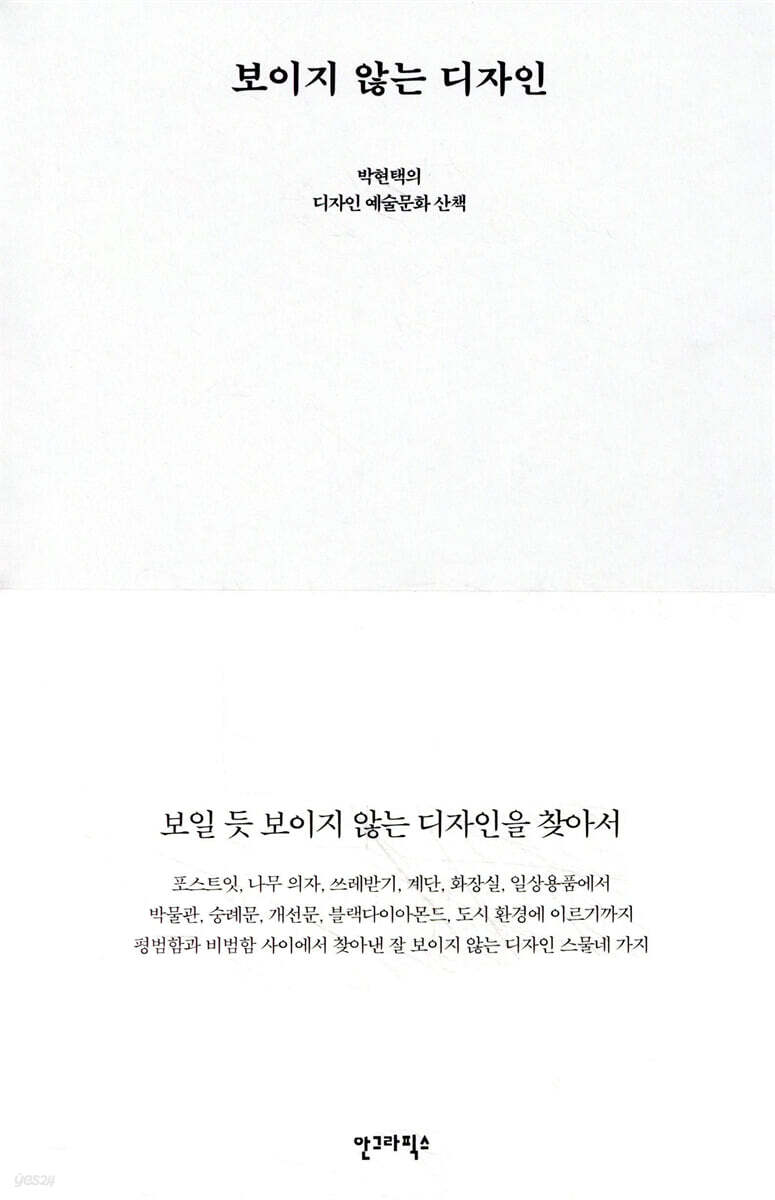
Invisible design
 |
Description
Book Introduction
The Perspective of a Designer Working in a Museum
The Value of 24 Invisible Designs in Everyday Life
“Invisible Design” begins with the question of a designer working at the National Museum of Korea: “What is good design?”
Author Park Hyun-taek finds the value of design in his surroundings and tells us that 'design' is not something special or flashy, but rather something we all do in our daily lives.
It is as common as oxygen that we easily forget its existence, but it focuses on the value of design in our daily lives, which is essential for living.
Through 24 stories, ranging from everyday objects like wooden chairs, shovels, Post-it notes, and stairs to cultural heritage sites like the Arch of Triumph, Sungnyemun, and Black Diamond, the value of everyday design unfolds across tradition and the present, Korea and the world.
Invisible Design, the author's reflections and arguments on our design aesthetics are varied and pose questions about the humanistic spirit of design, asking, "Why do we design, and for whom?"
- You can preview some of the book's contents.
Preview
index
Drawing on the era of design that makes life beautiful
It's fine as is
Supernormal
unsexy trash can
Design inspired by nature
Take the ordinary
You must leave your name
Made in Korea
Taegeuk
Forest of Letters
Duet of Past and Present
Black Diamond
Should Sungnyemun Gate shine?
Mackerel smell
A museum that wants to become a department store?
Post-it
Where is the 'gentleman's'?
They say that tears aren't the only thing a man shouldn't shed.
I'm digging
$5 imported furniture
barbershop design
Vegetable field south of Sonamu Valley
Mural Village
The House After Death
I learned how to write like a child
Closing the book
Into the book
In a world where the act of producing something original or novel is treated as creative, discovering something that exists but is less noticeable, or even if noticeable, is denied value by the mass anesthesia of modern popularization, becomes an act of creation… … .
(Han Chang-gi, publisher and founder of Deep-Rooted Tree)
Page 13, "Aphorisms"
To highlight the things that make up a city's identity, the city must serve as a simple backdrop.
Just as whiskey with ice needs to be served in a clear, featureless glass to reveal its dazzling amber color.
Pages 17-18, from "It's Good As It Is"
Perhaps it's time to rethink the concepts of ordinariness and beauty. The pursuit of ordinariness doesn't simply mean passive, regressive inaction.
This means that we should avoid overly intentional and artificial manipulation.
Isn't this an era where we need designs that naturally embody the values that have matured through a life lived with sincerity and indifference?
Page 67, from “Taking Ordinaryness”
The design of civilization cannot ultimately follow the design of nature.
Nature's design is such in itself.
Nature means that the principles of organization of all elements are formed situationally and spontaneously through the interwoven relationships among the elements.
(Do-ol Kim Yong-ok, classical scholar and thinker)
Page 71, "Aphorisms"
The spirit of supernormality tells us that beauty is hidden even in the most ordinary and ordinary things, not in the extraordinary or extraordinary.
Moreover, it is also a topic that gives me the confidence that although I am an ordinary and insignificant person who does not belong to the 'mother's chin' category, I am never discouraged and am living a completely normal life.
Page 33, from "Supernormal"
Beauty is generally thought of as an active act of creating something.
However, if you can fully reveal its unique brilliance by maintaining and caring for the existing thing as it is, that too is beautiful.
Page 42, from "The Unsexy Trashcan"
The pursuit of mediocrity does not simply mean being passive and regressive by doing nothing.
This means that we should avoid overly intentional and artificial manipulation.
Isn't this an era where we need designs that naturally embody the values that have matured through a life lived with sincerity and indifference?
Page 67, “Design that Embraces Nature”
In fact, neither one nor the other is good or evil, right or wrong.
If division is causing confusion, then 'oneness' and 'unity' naturally become important values.
But individuality and freedom,
In an age that strives for creativity, shouldn't there be nine rather than one, and shouldn't change and freedom be more urgent than integration?
Page 99, from "Taegeuk"
The deeper happiness of perceiving, of seeing, lies in the absence of efficiency.
Deep happiness comes from a long gaze that stays with things without exploiting them.
(Han Byung-chul / Philosopher, cultural critic, and professor at the Berlin University of the Arts)
Page 117, "Aphorisms"
Wherever the modern spirit reigns, there is an inevitable tendency toward improvement (newness).
From time to time, we create new things, build new things, and construct new things.
As I was creating something new every day, I suddenly felt a pity for things from the past, and sometimes I ended up preserving them.
However, in reality, many of the preservation of existing items is done not purely for historical reasons, but rather because of the thought that as old items become rare, their value will decrease.
Page 133, from "Black Diamond"
Wouldn't it also be possible to design for a funeral or a home after death, that is, a grave?
It would be difficult to call printed materials advertising a cemetery or gravestone decorations design.
Why do funerals, hearses, graves, and cemeteries still seem so repulsive? The desks, bags, smartphones, shoes, cars, and apartments we used while alive were all beautifully designed, desirable, and offered small comforts in life. Why are these benefits absent in death and after death?
If you feel wronged, don't die? Is that even possible? You have to die.
I'm saying this because I have no choice but to die.
I don't know if we use much nicer and better things like objects and clothes than we used to, but our circumstances at the time of death and after death are just miserable compared to those times.
If you are reserving a backward death like this, how can you say that your current life is not backward?
---Pages 266-267, from "The House After Death"
Publisher's Review
The Perspective of a Designer Working in a Museum
The Value of 24 Invisible Designs in Everyday Life
“Invisible Design” begins with the question of a designer working at the National Museum of Korea: “What is good design?”
Author Park Hyun-taek finds the value of design in his surroundings and tells us that 'design' is not something special or flashy, but rather something we all do in our daily lives.
It is as common as oxygen that we easily forget its existence, but it focuses on the value of design in our daily lives, which is essential for living.
Through 24 stories, ranging from everyday objects like wooden chairs, shovels, Post-it notes, and stairs to cultural heritage sites like the Arch of Triumph, Sungnyemun, and Black Diamond, the value of everyday design unfolds across tradition and the present, Korea and the world.
Invisible Design, the author's reflections and arguments on our design aesthetics are varied and pose questions about the humanistic spirit of design, asking, "Why do we design, and for whom?"
The True Meaning of “Invisible Design”
Speaking of design as an attitude toward life, not a technique for decoration.
The author focuses on the 'design value' of various products that can be conveniently used in daily life, and calls this 'invisible design.'
Good design, the author says, is something physical and psychological that comes to me without me being conscious of it and makes me feel comfortable.
Additionally, ‘invisible design’ also emphasizes the ambiguous meaning of design.
In an age of design overload, where design is mentioned more than ever before, there is a sharp diagnosis that true design is rare.
It is also regrettable that many people still do not know much about design despite the constant mention of design.
This book ultimately hopes that our design will not remain too high-end (for a very small number of designers), but will shift towards 'artistic value for all', like the spirit of the 19th-century design craft movement.
Freely transcending time and space, unfolding a narrative of art and culture.
『Invisible Design』 contains 24 stories.
The author uses diverse examples of art and culture to demonstrate how design values emerged and transformed in ancient, medieval, and modern times.
While mentioning French culture and art as an expression of 19th-century modern consciousness, it also delves into the 'meaning of letters' in ancient Chinese culture.
While focusing on Joseon's Maksabal and Chusa's artistic spirit, it also criticizes the shallow chauvinism of Koreans towards modern artists like Nam June Paik and Lee Ufan.
The author also pays attention to the design identity that has been formed from the history, geography, and ecological environment of each country, and offers interesting and witty remarks on Nordic design from Finland and Denmark, Islamic design, and Japanese minimalism.
A Korean version of the Arts and Crafts Movement, told through the designer's concerns and passion.
“There is beauty in things that are neither outstanding nor extraordinary, but just ordinary.”
We live in a paradoxical era where the term "design" is overflowing, but the values, vision, and ethics of design are becoming obscured.
Author Park Hyun-taek declares a Korean version of the Arts and Crafts Movement, filled with the designer's concerns and affection.
If design has served as a medium connecting consumers with the work of creating products, technologies, and services, now is the time to consider the more fundamental problem of bringing something to life.
The author's message that it's okay if you're not outstanding or extraordinary when everyone strives to excel, and that beauty is hidden in the ordinary, is heartwarming.
Readers of "Invisible Design" will follow the story of art and culture that transcends time and space, and ultimately come to cherish the "ordinariness" they possess through their own sincere lives. They will also realize that this, accumulated and matured, becomes a design that transforms our lives.
GOODS SPECIFICS
- Date of publication: December 16, 2016
- Page count, weight, size: 280 pages | 364g | 137*210*20mm
- ISBN13: 9788970598758
- ISBN10: 8970598758
You may also like
카테고리
korean


korean


