

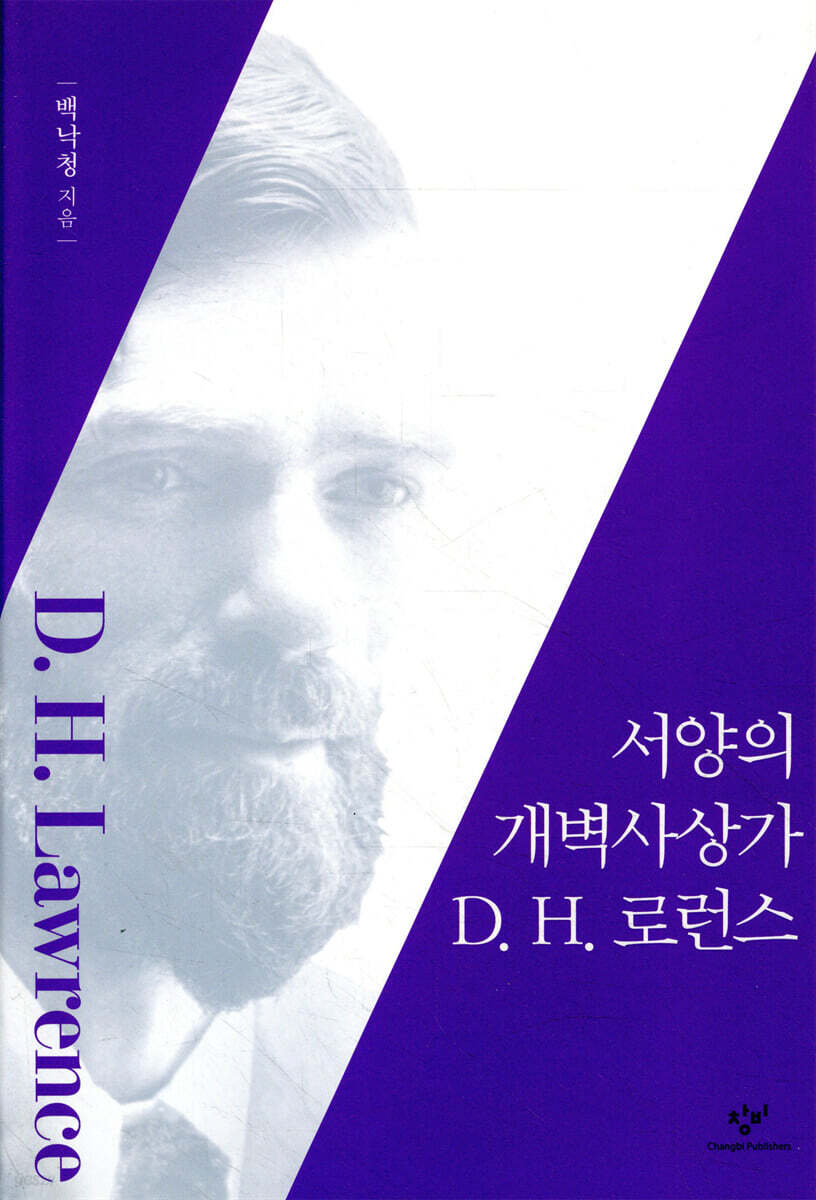
Western thinker D.H. Lawrence
 |
Description
Book Introduction
The culmination of Baek Nak-cheong's 50 years of study!
D., who challenged the overcoming of Western intellectual history. Led by H. Lawrence, Opening a new path for the Korean Peninsula's transformation and a great transformation of civilization. This book is a culmination of nearly half a century of research on Lawrence by Baek Nak-cheong, a literary critic, English literature scholar, theorist, and activist dedicated to overcoming the division system who has left a distinct mark on our intellectual history. He received his doctorate from Harvard University in 1972, and it also condenses the original ideas he has honed along the way. D., a representative writer of 20th century English literature. This is a masterpiece that seeks to overcome the limitations of Western intellectual history pursued by H. Lawrence and connects it with the idea of the opening of the Korean Peninsula, thereby seeking a path for a great transformation of civilization in our time not only in literature but also in politics and social thought. We can witness the deepening process of Baek Nak-cheong's thought over the past 50 years, including the theory of national literature, the theory of realism, the theory of the dual task of modernity, and the theory of the great transformation of civilization, which have taken root in our intellectual circles since the 1960s. The English doctoral dissertation that became the starting point was also 『D. It was translated into Korean and published together with the title, “H. Lawrence’s View of Modern Civilization.” 『Western thinker D. The topics covered in 『H. Lawrence』 are not limited to literary theoretical criticism, but include Western thought, including Plato and Aristotle, Nietzsche and Marx, Lukacs and Heidegger, Freud, Jung, Lacan, Deleuze, Derrida, Rancière, and Badiou, as well as Southern and Northern Buddhism, Confucian thought, Donghak, Jeung San Do, and Won Buddhism. Lawrence's attempt to overcome the limitations of two thousand years of Western intellectual history, while creating connections with Eastern traditional thought and the Korean Peninsula's unique idea of enlightenment, is unique and unprecedented in the author's thinking, as it opens a broad perspective on a great transformation of civilization, transcending the limitations of capitalist modernity. Needless to say, this is the fruit of the author's 50-year practice of advocating independent English literature research and practically intervening in the realities of the Korean Peninsula. However, this book does not only develop theoretical discussions with a broad perspective. Above all, the sentences that read and analyze Lawrence's works in a delicate and precise manner, passage by passage, provide the pleasure of reading good literary criticism that is easy to understand and offers insight. This book offers the joy of encountering a brilliant intellectual who effortlessly crosses diverse fields, from philosophy, aesthetics, sociology, history, politics, and even religion. It also persuasively unfolds his thoughts toward a more humane and genuine new world. |
index
At the beginning of the book
Lawrence, novelist and philosopher of the new era
Part 1
Chapter 1: "Rainbow" and the Dual Tasks of Modernity
Chapter 2: "Women in Love" and the Age of Technology
Chapter 3: Reconsidering the Typology of "Women in Love"
Chapter 4: The Adventures of Thought and Novelistic Achievements in "Sentmore"
Chapter 5: Thoughts on "The Winged Serpent"
Part 2
Chapter 6: 'Some Other Rhythmic Forms' and Realism
Chapter 7 Representation and (Virtual) Reality
Chapter 8: "Fantasia of the Unconscious," Freud, and Nietzsche
Chapter 9: The American Dream and the Burden of American Literature: Studies in Classical American Literature
Chapter 10: Lawrence's Theory of Democracy
Chapter 11: "The Ship of Death": Toward the Encounter of East and West
D.
H. Lawrence Chronology | Original Quotes | References | Forewords | Index
Lawrence, novelist and philosopher of the new era
Part 1
Chapter 1: "Rainbow" and the Dual Tasks of Modernity
Chapter 2: "Women in Love" and the Age of Technology
Chapter 3: Reconsidering the Typology of "Women in Love"
Chapter 4: The Adventures of Thought and Novelistic Achievements in "Sentmore"
Chapter 5: Thoughts on "The Winged Serpent"
Part 2
Chapter 6: 'Some Other Rhythmic Forms' and Realism
Chapter 7 Representation and (Virtual) Reality
Chapter 8: "Fantasia of the Unconscious," Freud, and Nietzsche
Chapter 9: The American Dream and the Burden of American Literature: Studies in Classical American Literature
Chapter 10: Lawrence's Theory of Democracy
Chapter 11: "The Ship of Death": Toward the Encounter of East and West
D.
H. Lawrence Chronology | Original Quotes | References | Forewords | Index
Publisher's Review
Our Time, Why Lawrence?
The introduction is by the Western literary writer D.
It addresses the question of why H. Lawrence is referred to by the seemingly contradictory term ‘revolutionary thinker.’
DH
Lawrence (1885-1930) is a giant of 20th-century English literature who left behind a vast body of work across all genres, including poetry, novels, criticism, plays, and essays, during his short life.
The achievement of Lawrence that author Baek Nak-cheong notes most is his persistent attempt to transcend not only the common sense of his contemporaries but also the traditional Western way of thinking itself, and his considerable achievements in doing so.
He presented a cosmology and view of truth reminiscent of the traditional East Asian theory of yin and yang, and argued for the concept of being (~이다+있다) as an event that achieves a completely different dimension from existence without leaving the realm of material existence.
In the author's view, this idea is a groundbreaking breakthrough that fundamentally transcends the dichotomy between ideas and the phenomenal world and metaphysical thinking that has dominated Western philosophy since Plato. This groundbreaking quality cannot be found even in Marx or Nietzsche, who are considered revolutionary thinkers of the previous generation.
Furthermore, the author calls Lawrence a "Western thinker of the opening of the world" because he excellently presents the possibility of communication with East Asian thought such as Buddhism, Taoism, and the idea of the opening of the world.
Lawrence opened up these possibilities primarily through his novels.
His full-length novels, "Rainbow" (1915) and "Women in Love" (1920), are works that achieved "true realism," a state of vivid depiction of life and things as they are, beyond naturalistic representation.
Although modern novels are clearly products of the modern era, the more outstanding they are, the more they embody a vision of overcoming modernity. Therefore, these two novels can be considered classic narratives about the dual tasks of adapting to and overcoming modernity.
Lawrence also held a cosmological and life view that the fate of human society is determined by the extent to which humans unite with life in a universe that exists as a gigantic living organism, and that in that sense, modern civilization, which has lost the sun and turned its back on the universe, is on the verge of collapse and a great transformation.
It also has affinity with East Asian post-heavenly opening ideology in that it attempted to connect it with social practice.
With this critical awareness, this book analyzes Lawrence's major works through the 11 chapters of Part 2 of the text, comprehensively synthesizing his thoughts and adding the author's own critical awareness to build a new ideological foundation.
'True Realism' and the Dual Task of Adapting to and Overcoming Modernity
Chapters 1-3 focus on The Rainbow and Women in Love, which the author considers Lawrence's best works.
The two works depict the struggles of three generations of the Brangwin family, as they escape the traditional agricultural life, encounter modern industrial civilization, adapt to it, and, at the same time, become "proud creative individuals" within it.
The differences in the circumstances of each generation, the ways in which characters relate to one another and the world, and the individual successes or failures resulting from their struggles are all part of the process of exploring the development of Western modern civilization and the possibilities of adapting to and overcoming it.
Focusing on the first and second generations of the Brangwyn family, "Rainbow" is a vivid and affectionate account of life in traditional British society, while also depicting the struggles of individuals who confront its limitations and strive to break free from the close bonds of community to become respectable members of modern society.
In "Rainbow," the author's greatest concern is to reveal whether such individuals have truly achieved a life worthy of life and reached the level of their original being.
Therefore, while it cannot avoid having the characteristics of a realistic novel, it becomes a priority to clarify and convey the essential dimension of 'existence' that has been neglected by traditional Western philosophy as well as conventional realism that reflects and reproduces reality.
The following novel, "Ladies in Love," explores various aspects of contemporary British society in a much broader and bolder way than "Rainbow," raising questions about the nature of the science and technology that would soon sweep the globe and, from there, leading to an awakening to the historical need to overcome traditional Western philosophy.
Modern technology is a form of truth revealed and achieved, and it is also a historical destiny. Forgetting this and losing humanity's most fundamental potential is the very danger facing modern civilization.
The fact that the character referred to as an "industrial titan" in "Women in Love" dies not because he cannot adapt to a technological society, but because of his own failure to find a more fundamental life reflects such an essential danger in the technological age.
"Rainbow" and "Women in Love" are works that reveal the true nature of modernity, which we must overcome as we adapt, with rare truth and intensity, and even contain important characteristics of a future reality that has not yet arrived in our time.
In particular, in the debate between the characters in 『Women in Love』 regarding the image of modern artists, the view of art that art must be combined with industry appears, and this captures the argument that postmodernists would later make that postmodern art is more popular and democratic in contrast to the elitism and artistism of early 20th century modernism.
While Lawrence shared much of the experience of early 20th-century modernism, he portrayed the possibility of a distinctly different path in the world of capital-driven technological dominance through the characters in Women in Love.
A philosophical and political vision for a new world
Chapters 4 and 5 illuminate Lawrence's critique of modern civilization and his attempts to break away from the hegemony of European ideology in his other controversial works, The Winged Serpent (1926) and The Winged Serpent (1925).
"Bitter More" deals with the subject of the spiritual devastation of modern civilization, and deeply examines the social trends and ills of the time, along with the cynicism about living a life "as one pleases."
Lawrence categorized socialism and 'modern democracy' as the same thing, and targeted 'the pursuit of happiness' as a target of criticism.
Of course, I am not against human happiness itself.
It opposes a life that pursues happiness as its ultimate goal, rather than one that becomes happy as a result of undertaking some essential adventure and achieving something commensurate with it.
Lawrence explores human society, living in harmony with the "energy" or "spirit" of the region, through a character who crosses the Atlantic and lives in seclusion in the mountains of New Mexico, confronting modern civilization.
This exploration began in earnest with 『The Winged Serpent』.
While traveling through Mexico in the 1920s, Lawrence dreamed of building a new world worthy of a "post-heavenly opening," not just a socialist revolution or a revival of traditional culture.
"The Winged Serpent" takes on the challenge of presenting that dream as a plausible fictional reality, posing fundamental questions about how religion is embedded in reality and gains popular influence, and further, what the relationship between politics and religion should be.
The novel's conclusion, in which the president declares a new religion, which aims to revive Mexico's polytheistic beliefs, as the state religion, is a meaningful challenge to modern atheism and Western monotheism, which ignore religiousness itself. However, it also clearly has limitations as a novel.
This reveals a flaw in the rigor of Lawrence's thought adventure and falls short of expressing Lawrence's deep convictions about religion.
In relation to the question raised by 『The Winged Serpent』, the Korean Peninsula's Post-Heavenly Opening Movement conceptualized the principle of politics and religion being one, that is, politics and religion should not be one body, but should move with one mind.
In exploring the possibilities of a new religious movement, the Buddhist tradition, which retains Hindu and ancient Greek elements, and the Korean Peninsula's Later Heavenly Opening Movement, which began with Suun Choi Je-u's Donghak and evolved through Haewol (Choi Si-hyung) and Jeungsan (Kang Il-sun) to Sotaesan (Park Jung-bin), serve as excellent references.
A major shift in traditional human and world views
Chapters 6 to 8 compare and examine the exploration of realism in Lawrence's novels discussed in Part 1 (Chapters 1 to 5) with the theorists such as Lukacs, Heidegger, and Derrida, and evaluate the leadership of his artistic and worldview in light of recent discussions on virtual reality.
Furthermore, through Lawrence's critique of Freudian psychoanalysis, he presents a true understanding of human nature that is not trapped by scientism.
The author's criticism of Lukács can be summarized as saying that Lukács misunderstood the efforts to 'overcome metaphysics' initiated by Marx and Nietzsche and achieved a new breakthrough by Heidegger, and remained stuck in Aristotelian metaphysics.
The 'some other rhythmic form' in the artwork that Lawrence pursues achieves a major transformation of the traditional view of humanity and the world that Lukacs' theory of realism failed to escape.
Lawrence's view of art and truth is revealed in his comments on Van Gogh's paintings: when he paints sunflowers, his paintings do not reproduce the sunflowers themselves, but rather reveal/achieve the vivid relationship between himself as a human being and the sunflowers as sunflowers in a living moment in time.
Lawrence saw the richness and fidelity of realistic representation in the novel as essential to achieving such a 'pure relationship'.
In a reality where even modern science cannot provide a basis for distinguishing between 'virtual reality' and 'real reality,' the distinction between the virtual and the real becomes possible only through the revelation/creation of 'vivid relationships' through true art and human creative acts.
Lawrence's interest in sex, which has been misunderstood by critics, must be understood in the context of this 'living in the flesh' (or not).
The same goes for Lawrence's critique of Freud.
In his exploration of the true relationship between humans and the universe and creative life, Lawrence criticizes Freud's concepts of the 'Oedipus complex', 'drive', 'instinct', and 'unconscious'.
True creative energy comes not from the suppression of sexual energy, but from its fulfillment, and the passionate unity and genuine harmony of many people in the process of actively creating a world, although not entirely unrelated to sexual impulses, are of a completely different nature.
Furthermore, Lawrence shares Nietzsche's critique of modern idealism and the reality of modern man, but differs in that he opens up the possibility of balance, harmony, and happiness inherent in all human beings.
This view of humanity leads to a diagnosis of the relationship between men and women in the modern world, and discussions such as the unique position of men in modern society and the proposal for a matriarchal system provide interesting reference points for the current debate on gender equality.
The Age of the Post-Heavenly Opening: The Path to a Great Transformation of Civilization
Chapters 9 and 10 focus on the fact that the current of "the disintegration of old consciousness" and "the formation of new consciousness," which Lawrence revealed in "Studies in Classical American Literature" (1923), finally formed an "open path" in human history with Walt Whitman, and that this led to a critique of modern democracy and the concept of a "new democracy."
『Studies in American Classical Literature』 asserts that the common belief that the Puritans came to the American continent in search of freedom in the early 17th century is a lie that Americans themselves have made to cover up the true 'story' of American literature.
Their migration to the New World was a reaction against all of Europe's old authority, but also a reaction against humanism and liberalism, so they argue that calling for the original European ideals of 'freedom' and 'democracy' is nothing but self-evasion and self-forgetting.
Lawrence's diagnosis is that the history of American thought begins with Benjamin Franklin, then Fenimore Cooper, Edgar Allan Poe, Nathaniel Hawthorne, and ends with Herman Melville, showing the final collapse of that false consciousness, and that American democratic ideology made a decisive leap forward when Walt Whitman explicitly denied the soul as separate from the body and put forward the principle of 'empathy' rather than 'love'.
Lawrence believed that the fundamental problem of modern democracy lies in its egalitarianism and idealized concept of the individual.
All kinds of confusion and unhappiness arise from mistaking 'sameness', another name for 'average', for true 'identity', and from remaining 'individuals as conceptualized units' rather than 'living individuals'.
This leads to the argument that society needs a hierarchy based on the greatness of the soul, and differentiated education based on each person's capacity for wisdom or truth.
However, the author was unable to provide an answer to the social system required for this, and argues that only when the rational core of East Asian thought, such as Confucianism's rule of courtesy and Won Buddhism's place of wisdom, is combined with this can we move toward a great transformation worthy of the opening of the world.
The final chapter, Chapter 11, analyzes the affinity between the motifs of death and rebirth in Lawrence's poetry and Buddhist thought.
Despite Lawrence's own understanding of Buddhism, his thinking transcends Christian notions and emerges as a pioneer of a 'postmodern' deconstruction of the Cartesian self.
Here, what the author points out as a crucial point of agreement between Buddhism and Lawrence is the paradoxical but powerful affirmation of the phenomenal world as an overcoming of metaphysical thinking (the Buddhism at this time is Northern Buddhism, not Southern Buddhism, which was familiar to European intellectuals of Lawrence's time).
This is the basis for moving forward to fundamental questions about modern knowledge and cosmology as a whole, and it contains a non-metaphysical thought about being that, if further developed, would also enable a productive dialogue with Buddhism.
The similarities between East Asian Buddhist thought and Lawrence's thought are a rare example of a true encounter between East and West, transcending the mere dissemination of knowledge or exchange of "influences."
The author concludes by emphasizing that a true encounter between East and West is a convergence that occurs as each person embarks on a true adventure of thought in uncharted territory, and that the exploration of this level of correspondence must naturally be a two-way endeavor.
The introduction is by the Western literary writer D.
It addresses the question of why H. Lawrence is referred to by the seemingly contradictory term ‘revolutionary thinker.’
DH
Lawrence (1885-1930) is a giant of 20th-century English literature who left behind a vast body of work across all genres, including poetry, novels, criticism, plays, and essays, during his short life.
The achievement of Lawrence that author Baek Nak-cheong notes most is his persistent attempt to transcend not only the common sense of his contemporaries but also the traditional Western way of thinking itself, and his considerable achievements in doing so.
He presented a cosmology and view of truth reminiscent of the traditional East Asian theory of yin and yang, and argued for the concept of being (~이다+있다) as an event that achieves a completely different dimension from existence without leaving the realm of material existence.
In the author's view, this idea is a groundbreaking breakthrough that fundamentally transcends the dichotomy between ideas and the phenomenal world and metaphysical thinking that has dominated Western philosophy since Plato. This groundbreaking quality cannot be found even in Marx or Nietzsche, who are considered revolutionary thinkers of the previous generation.
Furthermore, the author calls Lawrence a "Western thinker of the opening of the world" because he excellently presents the possibility of communication with East Asian thought such as Buddhism, Taoism, and the idea of the opening of the world.
Lawrence opened up these possibilities primarily through his novels.
His full-length novels, "Rainbow" (1915) and "Women in Love" (1920), are works that achieved "true realism," a state of vivid depiction of life and things as they are, beyond naturalistic representation.
Although modern novels are clearly products of the modern era, the more outstanding they are, the more they embody a vision of overcoming modernity. Therefore, these two novels can be considered classic narratives about the dual tasks of adapting to and overcoming modernity.
Lawrence also held a cosmological and life view that the fate of human society is determined by the extent to which humans unite with life in a universe that exists as a gigantic living organism, and that in that sense, modern civilization, which has lost the sun and turned its back on the universe, is on the verge of collapse and a great transformation.
It also has affinity with East Asian post-heavenly opening ideology in that it attempted to connect it with social practice.
With this critical awareness, this book analyzes Lawrence's major works through the 11 chapters of Part 2 of the text, comprehensively synthesizing his thoughts and adding the author's own critical awareness to build a new ideological foundation.
'True Realism' and the Dual Task of Adapting to and Overcoming Modernity
Chapters 1-3 focus on The Rainbow and Women in Love, which the author considers Lawrence's best works.
The two works depict the struggles of three generations of the Brangwin family, as they escape the traditional agricultural life, encounter modern industrial civilization, adapt to it, and, at the same time, become "proud creative individuals" within it.
The differences in the circumstances of each generation, the ways in which characters relate to one another and the world, and the individual successes or failures resulting from their struggles are all part of the process of exploring the development of Western modern civilization and the possibilities of adapting to and overcoming it.
Focusing on the first and second generations of the Brangwyn family, "Rainbow" is a vivid and affectionate account of life in traditional British society, while also depicting the struggles of individuals who confront its limitations and strive to break free from the close bonds of community to become respectable members of modern society.
In "Rainbow," the author's greatest concern is to reveal whether such individuals have truly achieved a life worthy of life and reached the level of their original being.
Therefore, while it cannot avoid having the characteristics of a realistic novel, it becomes a priority to clarify and convey the essential dimension of 'existence' that has been neglected by traditional Western philosophy as well as conventional realism that reflects and reproduces reality.
The following novel, "Ladies in Love," explores various aspects of contemporary British society in a much broader and bolder way than "Rainbow," raising questions about the nature of the science and technology that would soon sweep the globe and, from there, leading to an awakening to the historical need to overcome traditional Western philosophy.
Modern technology is a form of truth revealed and achieved, and it is also a historical destiny. Forgetting this and losing humanity's most fundamental potential is the very danger facing modern civilization.
The fact that the character referred to as an "industrial titan" in "Women in Love" dies not because he cannot adapt to a technological society, but because of his own failure to find a more fundamental life reflects such an essential danger in the technological age.
"Rainbow" and "Women in Love" are works that reveal the true nature of modernity, which we must overcome as we adapt, with rare truth and intensity, and even contain important characteristics of a future reality that has not yet arrived in our time.
In particular, in the debate between the characters in 『Women in Love』 regarding the image of modern artists, the view of art that art must be combined with industry appears, and this captures the argument that postmodernists would later make that postmodern art is more popular and democratic in contrast to the elitism and artistism of early 20th century modernism.
While Lawrence shared much of the experience of early 20th-century modernism, he portrayed the possibility of a distinctly different path in the world of capital-driven technological dominance through the characters in Women in Love.
A philosophical and political vision for a new world
Chapters 4 and 5 illuminate Lawrence's critique of modern civilization and his attempts to break away from the hegemony of European ideology in his other controversial works, The Winged Serpent (1926) and The Winged Serpent (1925).
"Bitter More" deals with the subject of the spiritual devastation of modern civilization, and deeply examines the social trends and ills of the time, along with the cynicism about living a life "as one pleases."
Lawrence categorized socialism and 'modern democracy' as the same thing, and targeted 'the pursuit of happiness' as a target of criticism.
Of course, I am not against human happiness itself.
It opposes a life that pursues happiness as its ultimate goal, rather than one that becomes happy as a result of undertaking some essential adventure and achieving something commensurate with it.
Lawrence explores human society, living in harmony with the "energy" or "spirit" of the region, through a character who crosses the Atlantic and lives in seclusion in the mountains of New Mexico, confronting modern civilization.
This exploration began in earnest with 『The Winged Serpent』.
While traveling through Mexico in the 1920s, Lawrence dreamed of building a new world worthy of a "post-heavenly opening," not just a socialist revolution or a revival of traditional culture.
"The Winged Serpent" takes on the challenge of presenting that dream as a plausible fictional reality, posing fundamental questions about how religion is embedded in reality and gains popular influence, and further, what the relationship between politics and religion should be.
The novel's conclusion, in which the president declares a new religion, which aims to revive Mexico's polytheistic beliefs, as the state religion, is a meaningful challenge to modern atheism and Western monotheism, which ignore religiousness itself. However, it also clearly has limitations as a novel.
This reveals a flaw in the rigor of Lawrence's thought adventure and falls short of expressing Lawrence's deep convictions about religion.
In relation to the question raised by 『The Winged Serpent』, the Korean Peninsula's Post-Heavenly Opening Movement conceptualized the principle of politics and religion being one, that is, politics and religion should not be one body, but should move with one mind.
In exploring the possibilities of a new religious movement, the Buddhist tradition, which retains Hindu and ancient Greek elements, and the Korean Peninsula's Later Heavenly Opening Movement, which began with Suun Choi Je-u's Donghak and evolved through Haewol (Choi Si-hyung) and Jeungsan (Kang Il-sun) to Sotaesan (Park Jung-bin), serve as excellent references.
A major shift in traditional human and world views
Chapters 6 to 8 compare and examine the exploration of realism in Lawrence's novels discussed in Part 1 (Chapters 1 to 5) with the theorists such as Lukacs, Heidegger, and Derrida, and evaluate the leadership of his artistic and worldview in light of recent discussions on virtual reality.
Furthermore, through Lawrence's critique of Freudian psychoanalysis, he presents a true understanding of human nature that is not trapped by scientism.
The author's criticism of Lukács can be summarized as saying that Lukács misunderstood the efforts to 'overcome metaphysics' initiated by Marx and Nietzsche and achieved a new breakthrough by Heidegger, and remained stuck in Aristotelian metaphysics.
The 'some other rhythmic form' in the artwork that Lawrence pursues achieves a major transformation of the traditional view of humanity and the world that Lukacs' theory of realism failed to escape.
Lawrence's view of art and truth is revealed in his comments on Van Gogh's paintings: when he paints sunflowers, his paintings do not reproduce the sunflowers themselves, but rather reveal/achieve the vivid relationship between himself as a human being and the sunflowers as sunflowers in a living moment in time.
Lawrence saw the richness and fidelity of realistic representation in the novel as essential to achieving such a 'pure relationship'.
In a reality where even modern science cannot provide a basis for distinguishing between 'virtual reality' and 'real reality,' the distinction between the virtual and the real becomes possible only through the revelation/creation of 'vivid relationships' through true art and human creative acts.
Lawrence's interest in sex, which has been misunderstood by critics, must be understood in the context of this 'living in the flesh' (or not).
The same goes for Lawrence's critique of Freud.
In his exploration of the true relationship between humans and the universe and creative life, Lawrence criticizes Freud's concepts of the 'Oedipus complex', 'drive', 'instinct', and 'unconscious'.
True creative energy comes not from the suppression of sexual energy, but from its fulfillment, and the passionate unity and genuine harmony of many people in the process of actively creating a world, although not entirely unrelated to sexual impulses, are of a completely different nature.
Furthermore, Lawrence shares Nietzsche's critique of modern idealism and the reality of modern man, but differs in that he opens up the possibility of balance, harmony, and happiness inherent in all human beings.
This view of humanity leads to a diagnosis of the relationship between men and women in the modern world, and discussions such as the unique position of men in modern society and the proposal for a matriarchal system provide interesting reference points for the current debate on gender equality.
The Age of the Post-Heavenly Opening: The Path to a Great Transformation of Civilization
Chapters 9 and 10 focus on the fact that the current of "the disintegration of old consciousness" and "the formation of new consciousness," which Lawrence revealed in "Studies in Classical American Literature" (1923), finally formed an "open path" in human history with Walt Whitman, and that this led to a critique of modern democracy and the concept of a "new democracy."
『Studies in American Classical Literature』 asserts that the common belief that the Puritans came to the American continent in search of freedom in the early 17th century is a lie that Americans themselves have made to cover up the true 'story' of American literature.
Their migration to the New World was a reaction against all of Europe's old authority, but also a reaction against humanism and liberalism, so they argue that calling for the original European ideals of 'freedom' and 'democracy' is nothing but self-evasion and self-forgetting.
Lawrence's diagnosis is that the history of American thought begins with Benjamin Franklin, then Fenimore Cooper, Edgar Allan Poe, Nathaniel Hawthorne, and ends with Herman Melville, showing the final collapse of that false consciousness, and that American democratic ideology made a decisive leap forward when Walt Whitman explicitly denied the soul as separate from the body and put forward the principle of 'empathy' rather than 'love'.
Lawrence believed that the fundamental problem of modern democracy lies in its egalitarianism and idealized concept of the individual.
All kinds of confusion and unhappiness arise from mistaking 'sameness', another name for 'average', for true 'identity', and from remaining 'individuals as conceptualized units' rather than 'living individuals'.
This leads to the argument that society needs a hierarchy based on the greatness of the soul, and differentiated education based on each person's capacity for wisdom or truth.
However, the author was unable to provide an answer to the social system required for this, and argues that only when the rational core of East Asian thought, such as Confucianism's rule of courtesy and Won Buddhism's place of wisdom, is combined with this can we move toward a great transformation worthy of the opening of the world.
The final chapter, Chapter 11, analyzes the affinity between the motifs of death and rebirth in Lawrence's poetry and Buddhist thought.
Despite Lawrence's own understanding of Buddhism, his thinking transcends Christian notions and emerges as a pioneer of a 'postmodern' deconstruction of the Cartesian self.
Here, what the author points out as a crucial point of agreement between Buddhism and Lawrence is the paradoxical but powerful affirmation of the phenomenal world as an overcoming of metaphysical thinking (the Buddhism at this time is Northern Buddhism, not Southern Buddhism, which was familiar to European intellectuals of Lawrence's time).
This is the basis for moving forward to fundamental questions about modern knowledge and cosmology as a whole, and it contains a non-metaphysical thought about being that, if further developed, would also enable a productive dialogue with Buddhism.
The similarities between East Asian Buddhist thought and Lawrence's thought are a rare example of a true encounter between East and West, transcending the mere dissemination of knowledge or exchange of "influences."
The author concludes by emphasizing that a true encounter between East and West is a convergence that occurs as each person embarks on a true adventure of thought in uncharted territory, and that the exploration of this level of correspondence must naturally be a two-way endeavor.
GOODS SPECIFICS
- Date of issue: July 10, 2020
- Format: Hardcover book binding method guide
- Page count, weight, size: 652 pages | 922g | 153*225*35mm
- ISBN13: 9788936486624
- ISBN10: 8936486624
You may also like
카테고리
korean


korean

![GQ KOREA Mark (Monthly): December [2025]](http://librairie.coreenne.fr/cdn/shop/files/8ef265dbbfbf186523ed75ba7319009d.jpg?v=1765340328&width=3840)


