

Asking European Picture Book Writers
 |
Description
Book Introduction
The power of picture books that embrace "It's okay just the way you are"
About the amazing truth about imagination and creativity
10 European Picture Book Authors Answer
* 2nd Brunch Book Project Grand Prize Winner *
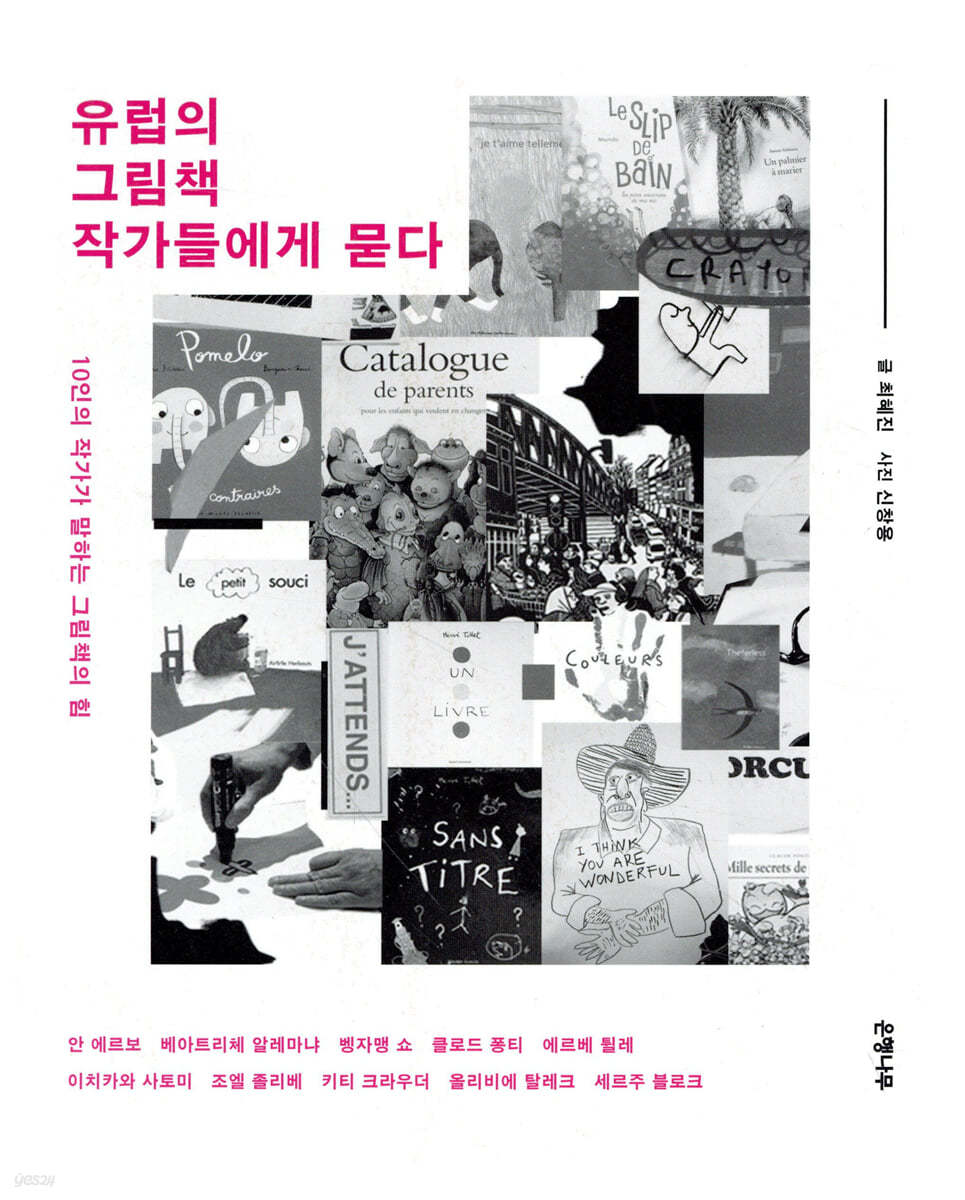
『Asking European Picture Book Writers』 (published by Eunhaengnamu) has been published, seeking inspiration for imagination and creativity through encounters with European picture book writers with unique perspectives.
This book is a compilation of interviews conducted by the author at the ateliers of 10 picture book artists active mainly in France and Belgium, along with actual work scenes.
Through honest and lighthearted stories about their childhoods, their philosophy as picture book writers, and their approach to communicating with children, we can realize that the secrets to amazing imagination and creativity surprisingly lie in the small things around us right now.
A book that allows you to feel the power of picture books that are effective not only for children but also for adults in the gap of comfort.
Author Choi Hye-jin, who was fascinated by the picture books she encountered in a bookstore while studying abroad in France, used her experience meeting numerous interviewees over 10 years as a magazine feature editor to ask questions to the authors.
Sometimes the conversations were longer and more in-depth than the writers had intended to devote, and the pointed questions brought out intimate stories that the writers rarely shared even in the local press.
Additionally, the photographs of photographer Shin Chang-yong, who has been active in both Korea and Japan, capture the vivid images of the serious yet cheerful artists and the charm of the ateliers decorated by their hands, adding a vivid sense of presence to the book.
About the amazing truth about imagination and creativity
10 European Picture Book Authors Answer
* 2nd Brunch Book Project Grand Prize Winner *
『Asking European Picture Book Writers』 (published by Eunhaengnamu) has been published, seeking inspiration for imagination and creativity through encounters with European picture book writers with unique perspectives.
This book is a compilation of interviews conducted by the author at the ateliers of 10 picture book artists active mainly in France and Belgium, along with actual work scenes.
Through honest and lighthearted stories about their childhoods, their philosophy as picture book writers, and their approach to communicating with children, we can realize that the secrets to amazing imagination and creativity surprisingly lie in the small things around us right now.
A book that allows you to feel the power of picture books that are effective not only for children but also for adults in the gap of comfort.
Author Choi Hye-jin, who was fascinated by the picture books she encountered in a bookstore while studying abroad in France, used her experience meeting numerous interviewees over 10 years as a magazine feature editor to ask questions to the authors.
Sometimes the conversations were longer and more in-depth than the writers had intended to devote, and the pointed questions brought out intimate stories that the writers rarely shared even in the local press.
Additionally, the photographs of photographer Shin Chang-yong, who has been active in both Korea and Japan, capture the vivid images of the serious yet cheerful artists and the charm of the ateliers decorated by their hands, adding a vivid sense of presence to the book.
- You can preview some of the book's contents.
Preview
index
prolog
Joël Jolivet's 'Observant Eye'
Kitty Crowder's "Questions That Create Imagination"
Olivier Talec's "The Usefulness of Empathy"
Claude Ponty's 'The Healing Imagination'
Serge Bloch, "Little Courage"
Benjamin Shaw: "Creativity Born from Imperfection"
'Deep Boredom' by Hervé Tullet
'Seeing Differently, Seeing Longer' by Anne Erbo
How to Use Time by Satomi Ichikawa
Beatrice Alemagna, 'Self-belief'
Joël Jolivet's 'Observant Eye'
Kitty Crowder's "Questions That Create Imagination"
Olivier Talec's "The Usefulness of Empathy"
Claude Ponty's 'The Healing Imagination'
Serge Bloch, "Little Courage"
Benjamin Shaw: "Creativity Born from Imperfection"
'Deep Boredom' by Hervé Tullet
'Seeing Differently, Seeing Longer' by Anne Erbo
How to Use Time by Satomi Ichikawa
Beatrice Alemagna, 'Self-belief'
Detailed image

Into the book
I think observation is the ability to empathize with or admire something you see.
I think that admiration is the beginning of observation.
There is definitely an element of love in the act of observation.
I have been doing observational croquis in cafes and subways for several decades, ever since I was a college student.
When I come across someone we often dismiss as ugly, I find beauty in their unique lines and forms.
It may seem like a characteristic of people who draw, but I actually believe that all beings are beautiful.
--- p.27 From “The Observing Gaze” by Joel Jolivet
When I was six, my parents first recognized my disability and fitted me with a hearing aid.
I went to a regular school with other kids, but it wasn't easy for me to keep up with my peers, to the point where I even repeated a grade in the third grade.
I always felt lonely and was frustrated that I would never be happy.
As a child, there was always a loud, chattering voice in my head.
“Why are all the kids laughing now?” “What is this?” “What is going to happen next?” “What is that?” It was a questioning voice.
That was the only way to fill in the missing auditory information with intuition and grasp the situation.
It was an inevitable habit for survival, and although the voice has quieted down a bit, it is still within me.
“Why?” “How?” I still ask myself these questions all the time.
--- p.43 From "'Questions that Create Imagination' by Kitty Crowder"
Rather than being self-absorbed, we need to look out at the world, reach out to people different from ourselves, talk to them, and see where new experiences take us.
That way, you can grow by breaking your limits little by little.
The essence of empathy is imagining what it would be like to be someone other than yourself.
Without empathy, your imagination will inevitably be weak.
For example, when I was drawing the “Rita and Marchant” series, I asked myself the question, “If I were Rita, what would I do in this situation?” so many times that I even reached the point where I could hear the voice, thinking, “Rita would be a little girl with this kind of voice tone.”
The characters were vivid and alive.
Empathy breathes life into our imagination and adds detail to our thoughts.
--- p.85 From “The Usefulness of Empathy” by Olivier Talec
I'm asking how close to reality is what we so easily label and describe as reality?
You know the story of Nessie, the monster said to live in Scotland's Loch Ness? Countries send expeditions, but each researcher offers a different description of its appearance.
It means seeing what's in your own head.
We see what we believe and what we know.
To me, imagination is not something absurd, but rather another explanation for interpreting reality.
I draw imaginary worlds to show children that there are many different ways and perspectives to describe reality, and that there is no single right answer.
--- p.109 From “Claude Ponty’s ‘Healing Imagination’”
I think creativity just means having the courage to do something.
That's all.
The mind that gives you permission to try something, the thought, 'Why not?', 'It's okay to fail.
An attitude that says, 'It's nothing.'
This is the only difference between creative people and those who are not.
Here's my secret.
I remember the attitude and posture I had during recess at school.
When you play with kids during recess, it doesn't require a huge decision.
I just jump in with the mindset that I'm arguing with the situation in front of me.
The spirit of play is important.
A playful mind creates leisure, and leisure creates small courage.
When you have the mindset that "I'm playing right now," you want to have a variety of experiences in various areas of life, such as cooking or meeting friends, and you want to express your creativity.
--- p.145 From "Small Courage" by Serge Bloch
Creating with flaws means deciding, "Don't try to be perfect, don't try to be someone else, just tell my story."
Of course, it's not as easy as it sounds.
Even now, I still try not to be swayed by other people's results that look good.
I wonder if I'm being generous in understanding the shortcomings of others and even finding charm in their clumsiness, while holding myself to a harsh standard.
What moves me in the works of other creators is not their machine-like perfection, but their human flaws.
The reason we are not the same is because of those gaps and clumsiness.
You have to cherish it.
If everyone painted perfect pictures, every picture in the world would be completely boring.
--- p.175 From “Benjamin Shaw, Creativity Born from Defects”
I was watching the sticks and asphalt shapes flowing down the drain on the road.
I also doodle on paper and put it up like a poster at the entrance of every neighborhood store.
There was nothing spectacular or unusual.
I think it was because I had nothing to do and was bored that I learned to play with everyday objects like paper and rocks.
When children are bored, they find their own way to entertain themselves.
Even now, I like boredom and the gaps in time.
I get the most ideas when I'm on a plane because I have free time waiting at the airport.
Giving yourself time to be bored is very important for creators.
--- p.198 From "'Deep Boredom' by Hervé Tullet"
Dreaming is the nest that nurtures creative thinking.
Dreaming is a time to see the world differently, to look at it for a long time, and to ask questions about what's beyond.
Moving from one mental state to another is not an easy task.
Move, move, move efficiently according to the use... This way, creativity is not expressed.
I'm often asked where my inspiration comes from, and I'd like to say it comes from daydreaming.
We are often fooled into thinking we are doing something.
For example, if I draw a picture by moving my hands, I feel like I've spent my time more usefully than if I just sit there doing nothing.
It's easy to be fooled by that feeling.
I believe that knowing how to choose and discard is what allows the mind to be centered and creative.
--- p.223 From "'Seeing Differently, Seeing Longer' by Anne Erbo"
Is it possible to know and be confident about what you like and what you want to do from a young age? When you're young, you don't really know what you want to do.
That's why we absolutely need time to think and explore.
Sometimes you may try this and that and think, 'It's not working.'
I didn't come to France with any certainty, I came to give myself time to explore.
When I was in Japan, I liked cooking and playing the piano.
When I asked myself, 'Is this my path?', the answer I got was, 'I don't know.'
At that time, I didn't even know that I could draw.
Since I wasn't sure what my dream was, I decided to spend some time exploring it until I could get my hands on it.
It takes time to mature.
It makes no sense to ask someone to pursue their dream without allowing them time to think about it.
--- p.258 From "How to Use Time" by Ichikawa Satomi
Comparing my youth, when I struggled in the prison of criticism my father created, to my present, when my perspective has completely changed thanks to the gift of time, the biggest difference is my attitude toward my shortcomings.
In the past, I was obsessed with how to fill my shortcomings, but now I think that weaknesses can become strengths depending on your perspective.
I want to convey the message in this book that even if we are lacking in one area, we can be sufficient in another, and that we already have ample potential and strength within us.
I'm sharing my experience of not trying to be someone else, but being myself and being completely happy in my own place.
I think that admiration is the beginning of observation.
There is definitely an element of love in the act of observation.
I have been doing observational croquis in cafes and subways for several decades, ever since I was a college student.
When I come across someone we often dismiss as ugly, I find beauty in their unique lines and forms.
It may seem like a characteristic of people who draw, but I actually believe that all beings are beautiful.
--- p.27 From “The Observing Gaze” by Joel Jolivet
When I was six, my parents first recognized my disability and fitted me with a hearing aid.
I went to a regular school with other kids, but it wasn't easy for me to keep up with my peers, to the point where I even repeated a grade in the third grade.
I always felt lonely and was frustrated that I would never be happy.
As a child, there was always a loud, chattering voice in my head.
“Why are all the kids laughing now?” “What is this?” “What is going to happen next?” “What is that?” It was a questioning voice.
That was the only way to fill in the missing auditory information with intuition and grasp the situation.
It was an inevitable habit for survival, and although the voice has quieted down a bit, it is still within me.
“Why?” “How?” I still ask myself these questions all the time.
--- p.43 From "'Questions that Create Imagination' by Kitty Crowder"
Rather than being self-absorbed, we need to look out at the world, reach out to people different from ourselves, talk to them, and see where new experiences take us.
That way, you can grow by breaking your limits little by little.
The essence of empathy is imagining what it would be like to be someone other than yourself.
Without empathy, your imagination will inevitably be weak.
For example, when I was drawing the “Rita and Marchant” series, I asked myself the question, “If I were Rita, what would I do in this situation?” so many times that I even reached the point where I could hear the voice, thinking, “Rita would be a little girl with this kind of voice tone.”
The characters were vivid and alive.
Empathy breathes life into our imagination and adds detail to our thoughts.
--- p.85 From “The Usefulness of Empathy” by Olivier Talec
I'm asking how close to reality is what we so easily label and describe as reality?
You know the story of Nessie, the monster said to live in Scotland's Loch Ness? Countries send expeditions, but each researcher offers a different description of its appearance.
It means seeing what's in your own head.
We see what we believe and what we know.
To me, imagination is not something absurd, but rather another explanation for interpreting reality.
I draw imaginary worlds to show children that there are many different ways and perspectives to describe reality, and that there is no single right answer.
--- p.109 From “Claude Ponty’s ‘Healing Imagination’”
I think creativity just means having the courage to do something.
That's all.
The mind that gives you permission to try something, the thought, 'Why not?', 'It's okay to fail.
An attitude that says, 'It's nothing.'
This is the only difference between creative people and those who are not.
Here's my secret.
I remember the attitude and posture I had during recess at school.
When you play with kids during recess, it doesn't require a huge decision.
I just jump in with the mindset that I'm arguing with the situation in front of me.
The spirit of play is important.
A playful mind creates leisure, and leisure creates small courage.
When you have the mindset that "I'm playing right now," you want to have a variety of experiences in various areas of life, such as cooking or meeting friends, and you want to express your creativity.
--- p.145 From "Small Courage" by Serge Bloch
Creating with flaws means deciding, "Don't try to be perfect, don't try to be someone else, just tell my story."
Of course, it's not as easy as it sounds.
Even now, I still try not to be swayed by other people's results that look good.
I wonder if I'm being generous in understanding the shortcomings of others and even finding charm in their clumsiness, while holding myself to a harsh standard.
What moves me in the works of other creators is not their machine-like perfection, but their human flaws.
The reason we are not the same is because of those gaps and clumsiness.
You have to cherish it.
If everyone painted perfect pictures, every picture in the world would be completely boring.
--- p.175 From “Benjamin Shaw, Creativity Born from Defects”
I was watching the sticks and asphalt shapes flowing down the drain on the road.
I also doodle on paper and put it up like a poster at the entrance of every neighborhood store.
There was nothing spectacular or unusual.
I think it was because I had nothing to do and was bored that I learned to play with everyday objects like paper and rocks.
When children are bored, they find their own way to entertain themselves.
Even now, I like boredom and the gaps in time.
I get the most ideas when I'm on a plane because I have free time waiting at the airport.
Giving yourself time to be bored is very important for creators.
--- p.198 From "'Deep Boredom' by Hervé Tullet"
Dreaming is the nest that nurtures creative thinking.
Dreaming is a time to see the world differently, to look at it for a long time, and to ask questions about what's beyond.
Moving from one mental state to another is not an easy task.
Move, move, move efficiently according to the use... This way, creativity is not expressed.
I'm often asked where my inspiration comes from, and I'd like to say it comes from daydreaming.
We are often fooled into thinking we are doing something.
For example, if I draw a picture by moving my hands, I feel like I've spent my time more usefully than if I just sit there doing nothing.
It's easy to be fooled by that feeling.
I believe that knowing how to choose and discard is what allows the mind to be centered and creative.
--- p.223 From "'Seeing Differently, Seeing Longer' by Anne Erbo"
Is it possible to know and be confident about what you like and what you want to do from a young age? When you're young, you don't really know what you want to do.
That's why we absolutely need time to think and explore.
Sometimes you may try this and that and think, 'It's not working.'
I didn't come to France with any certainty, I came to give myself time to explore.
When I was in Japan, I liked cooking and playing the piano.
When I asked myself, 'Is this my path?', the answer I got was, 'I don't know.'
At that time, I didn't even know that I could draw.
Since I wasn't sure what my dream was, I decided to spend some time exploring it until I could get my hands on it.
It takes time to mature.
It makes no sense to ask someone to pursue their dream without allowing them time to think about it.
--- p.258 From "How to Use Time" by Ichikawa Satomi
Comparing my youth, when I struggled in the prison of criticism my father created, to my present, when my perspective has completely changed thanks to the gift of time, the biggest difference is my attitude toward my shortcomings.
In the past, I was obsessed with how to fill my shortcomings, but now I think that weaknesses can become strengths depending on your perspective.
I want to convey the message in this book that even if we are lacking in one area, we can be sufficient in another, and that we already have ample potential and strength within us.
I'm sharing my experience of not trying to be someone else, but being myself and being completely happy in my own place.
--- p.299 From “‘Self-belief’ by Beatrice Alemagna”
Publisher's Review
What the authors of picture books say about inspiration and comfort
10 Creative Keywords
We chant words like creativity and originality as if they were magical spells, but the reality of these words is vague and doesn't reach us.
Looking at the education system we grew up in and the society we live in today, it seems like a long time ago.
For those who feel lost about creating something or raising creative children, this collection of interviews offers a small source of inspiration and, at the same time, comfort.
The stories of authors who grew up with picture books and are now creating them make us feel that picture books have the power to touch even the hearts of adults.
In interviews with writers, we each picked out a keyword that provided a clue to creativity.
Joel Jolivet, the author of 『Smart Zoo』 and 『Penguin 365』, who unconditionally observes facts and creates picture books like picture guides using prints based on these observations, says that if you observe carefully for a long time, your imagination will blossom where your gaze lingers.
So, Joel Jolivet's keyword is 'observing gaze'.
Although only "I'm Not Scared Anymore" has been introduced in Korea, Kitty Crowder, who is widely recognized as a master of picture books in Korea and has won the Astrid Lindgren Award, which is considered the Nobel Prize of children's literature, uses "questions that create imagination" as her keyword.
This is because asking 'why' and 'how' is a lifelong habit to make up for the lack of auditory information due to congenital hearing loss.
Olivier Talec, who is loved in Korea for 'Waterloo and Trafalgar' and 'The Kneecap', talks about the 'usefulness of empathy' that he developed to make friends while frequently transferring schools with his father, a soldier, and being an introvert.
Claude Ponty, who has been loved by both local readers and critics and has even been included in the ranks of classics in the world of children's literature, uses 'healing imagination' as a prototype for the memories of picture books that comforted his unfortunate childhood.
Serge Bloch, author of “One Day I Picked Up a Little Line on the Road” and “I Wait…”, said that creativity is “just the courage to do something,” and chose the “small courage” of trying something yourself first.
Benjamin Shaw, who received much love for the 'Bear Song' trilogy and 'The Day I Went to School Naked', recalls his childhood as a child who was good at nothing and talks about 'creativity born from flaws' based on his experience of realizing his own unique qualities through his weaknesses and clumsiness.
Self-belief, empathy, acceptance of flaws, seeing things differently and for a longer period of time…
Clues of imagination from small and ordinary things
Hervé Tullet, who grew up with parents who were too busy to talk to each other as a child and spent a lot of time alone in his book, "Book Play," said that imagination and creativity explode in such boring moments, and talked about the "deep boredom" that embraces the anxiety of doing nothing. Anne Herbo, who wrote "The Wind Is Invisible," suggested "seeing differently, seeing for a long time," saying that the time of daydreaming that she enjoyed as a child and that she now lets her young son enjoy as well provides a rich perspective on things.
Satomi Ichikawa, a Japanese woman who grew up in a similar culture to ours, recommends "time management"—making time for yourself without being swayed by the pressures of society.
These keywords can be summarized as changing one's perspective, however slightly, taking charge of one's own life and living by one's own standards rather than those of others, and empathy that transcends boundaries through empathy.
At the foundation of all of this is what Beatrice Alemagna, author of "It's Okay to Be a Little Short," calls "self-belief."
It's okay if it's not perfect, it's okay just the way it is.
The writers' confessions about their childhoods, which come out naturally in interviews, provide great comfort to us imperfect people.
The confessions of Benjamin Chau and Beatrice Alemagna, who were unhappy because they were good at nothing but drawing as children, provide a sense of relief to those of us struggling to survive in competition, and the whimsical world of works by Claude Ponty, who was emotionally abused by his mother as a child, and Hervé Tullet, who was estranged from his parents, give hope that even if you did not have an emotionally rich childhood, you can still develop rich sensibilities and outstanding creativity.
Above all, Ichikawa Satomi's message, encouraging us to become our own masters and use our time wisely, resonates deeply with those of us who are anxious about not being able to achieve the lifestyle standardized by society.
Beyond the sharp and deep questions and answers
The warm gaze and insight of picture book authors
The keywords that the authors present are fully reflected in the worldview of the picture book and are revealed in the work.
Claude Ponty style, where the protagonist, who is thrown into an unfamiliar world, goes through all kinds of adventures and trials before returning to his place; Benjamin Shaw style, where the protagonist finds preciousness in flaws through the process of regaining what he wished was gone after losing it; Beatrice Alemagna style, where the protagonist, who felt alienated because she was different or lacking something from others, finds her place and happiness after much thought… The authors’ values are completely reflected in the consistent narrative structure.
For readers who become interested in their work while reading the interviews, we present a selection of the authors' representative works at the end of each interview.
For parents who are worried about how to raise their children, a good picture book can be a strong weapon.
I hope that my child will carry this comforting message with him from a young age and never forget it. I feel relieved that I don't have to load him with books and teaching materials like others do, and that just being there for him as he is now is enough.
Of course, parenting philosophies such as the way to communicate with children through picture books taught by authors who have never lost their childlike innocence are also of great help.
The stories of these exceptionally creative European picture book authors will provide warm comfort and encouragement, helping us affirm the lives we have lived and the future we await.
A special collection of interviews that will make even readers who have never been interested in picture books believe in their power and want to rely on them.
10 Creative Keywords
We chant words like creativity and originality as if they were magical spells, but the reality of these words is vague and doesn't reach us.
Looking at the education system we grew up in and the society we live in today, it seems like a long time ago.
For those who feel lost about creating something or raising creative children, this collection of interviews offers a small source of inspiration and, at the same time, comfort.
The stories of authors who grew up with picture books and are now creating them make us feel that picture books have the power to touch even the hearts of adults.
In interviews with writers, we each picked out a keyword that provided a clue to creativity.
Joel Jolivet, the author of 『Smart Zoo』 and 『Penguin 365』, who unconditionally observes facts and creates picture books like picture guides using prints based on these observations, says that if you observe carefully for a long time, your imagination will blossom where your gaze lingers.
So, Joel Jolivet's keyword is 'observing gaze'.
Although only "I'm Not Scared Anymore" has been introduced in Korea, Kitty Crowder, who is widely recognized as a master of picture books in Korea and has won the Astrid Lindgren Award, which is considered the Nobel Prize of children's literature, uses "questions that create imagination" as her keyword.
This is because asking 'why' and 'how' is a lifelong habit to make up for the lack of auditory information due to congenital hearing loss.
Olivier Talec, who is loved in Korea for 'Waterloo and Trafalgar' and 'The Kneecap', talks about the 'usefulness of empathy' that he developed to make friends while frequently transferring schools with his father, a soldier, and being an introvert.
Claude Ponty, who has been loved by both local readers and critics and has even been included in the ranks of classics in the world of children's literature, uses 'healing imagination' as a prototype for the memories of picture books that comforted his unfortunate childhood.
Serge Bloch, author of “One Day I Picked Up a Little Line on the Road” and “I Wait…”, said that creativity is “just the courage to do something,” and chose the “small courage” of trying something yourself first.
Benjamin Shaw, who received much love for the 'Bear Song' trilogy and 'The Day I Went to School Naked', recalls his childhood as a child who was good at nothing and talks about 'creativity born from flaws' based on his experience of realizing his own unique qualities through his weaknesses and clumsiness.
Self-belief, empathy, acceptance of flaws, seeing things differently and for a longer period of time…
Clues of imagination from small and ordinary things
Hervé Tullet, who grew up with parents who were too busy to talk to each other as a child and spent a lot of time alone in his book, "Book Play," said that imagination and creativity explode in such boring moments, and talked about the "deep boredom" that embraces the anxiety of doing nothing. Anne Herbo, who wrote "The Wind Is Invisible," suggested "seeing differently, seeing for a long time," saying that the time of daydreaming that she enjoyed as a child and that she now lets her young son enjoy as well provides a rich perspective on things.
Satomi Ichikawa, a Japanese woman who grew up in a similar culture to ours, recommends "time management"—making time for yourself without being swayed by the pressures of society.
These keywords can be summarized as changing one's perspective, however slightly, taking charge of one's own life and living by one's own standards rather than those of others, and empathy that transcends boundaries through empathy.
At the foundation of all of this is what Beatrice Alemagna, author of "It's Okay to Be a Little Short," calls "self-belief."
It's okay if it's not perfect, it's okay just the way it is.
The writers' confessions about their childhoods, which come out naturally in interviews, provide great comfort to us imperfect people.
The confessions of Benjamin Chau and Beatrice Alemagna, who were unhappy because they were good at nothing but drawing as children, provide a sense of relief to those of us struggling to survive in competition, and the whimsical world of works by Claude Ponty, who was emotionally abused by his mother as a child, and Hervé Tullet, who was estranged from his parents, give hope that even if you did not have an emotionally rich childhood, you can still develop rich sensibilities and outstanding creativity.
Above all, Ichikawa Satomi's message, encouraging us to become our own masters and use our time wisely, resonates deeply with those of us who are anxious about not being able to achieve the lifestyle standardized by society.
Beyond the sharp and deep questions and answers
The warm gaze and insight of picture book authors
The keywords that the authors present are fully reflected in the worldview of the picture book and are revealed in the work.
Claude Ponty style, where the protagonist, who is thrown into an unfamiliar world, goes through all kinds of adventures and trials before returning to his place; Benjamin Shaw style, where the protagonist finds preciousness in flaws through the process of regaining what he wished was gone after losing it; Beatrice Alemagna style, where the protagonist, who felt alienated because she was different or lacking something from others, finds her place and happiness after much thought… The authors’ values are completely reflected in the consistent narrative structure.
For readers who become interested in their work while reading the interviews, we present a selection of the authors' representative works at the end of each interview.
For parents who are worried about how to raise their children, a good picture book can be a strong weapon.
I hope that my child will carry this comforting message with him from a young age and never forget it. I feel relieved that I don't have to load him with books and teaching materials like others do, and that just being there for him as he is now is enough.
Of course, parenting philosophies such as the way to communicate with children through picture books taught by authors who have never lost their childlike innocence are also of great help.
The stories of these exceptionally creative European picture book authors will provide warm comfort and encouragement, helping us affirm the lives we have lived and the future we await.
A special collection of interviews that will make even readers who have never been interested in picture books believe in their power and want to rely on them.
GOODS SPECIFICS
- Date of publication: October 21, 2016
- Page count, weight, size: 312 pages | 627g | 175*215*17mm
- ISBN13: 9788956605944
- ISBN10: 8956605947
You may also like
카테고리
korean


korean

![GQ KOREA Mark (Monthly): December [2025]](http://librairie.coreenne.fr/cdn/shop/files/8ef265dbbfbf186523ed75ba7319009d.jpg?v=1765340328&width=3840)


