

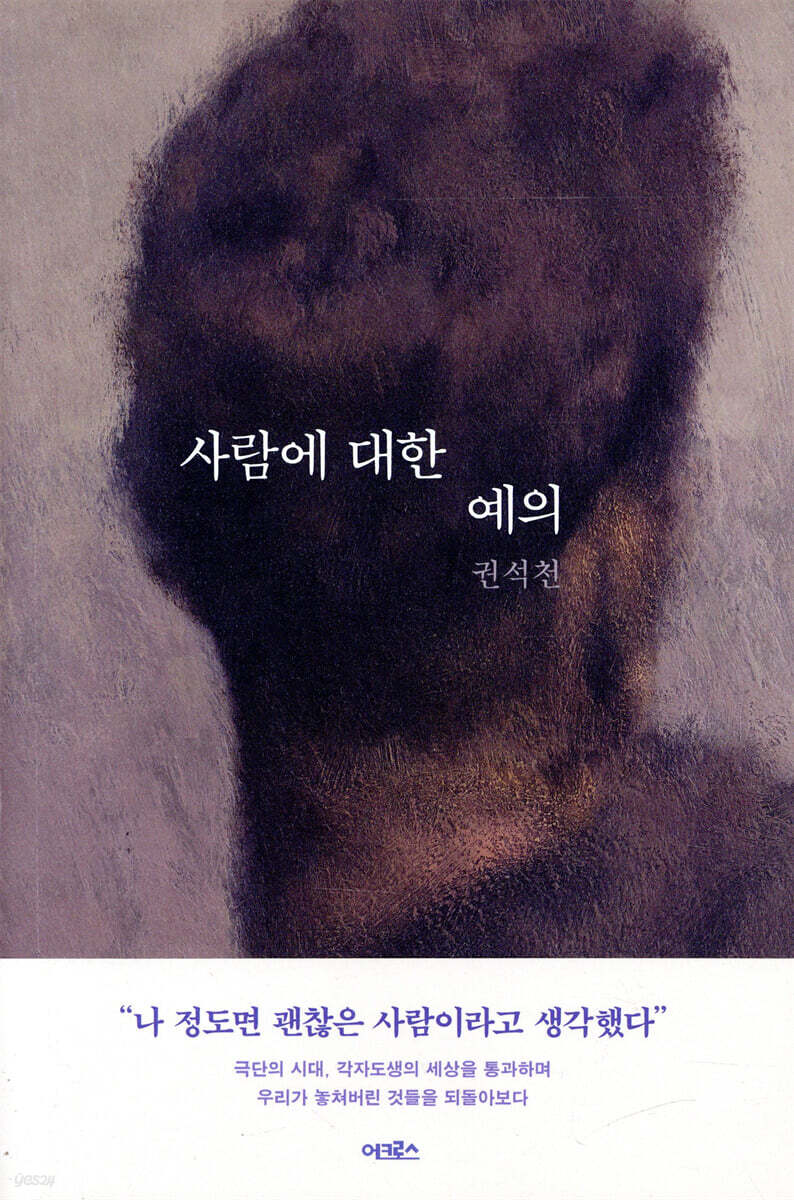
courtesy to people
 |
Description
Book Introduction
|
Each for himself: Asking about the values Korean society has lost.
“I thought I was a decent person.” Journalist Kwon Seok-cheon's bold and sharp perspective In an age of extremes, we look back with unfamiliar eyes at what we've missed. We are nervous about the abuse of power by conglomerates and public officials, and those who call the Sewol ferry disaster a “traffic accident.” They gather together in anger at sexual violence, shout, and report to the media because they cannot tolerate the verbal abuse. And says: Please treat people as people, and be polite to people. From democracy and industrialization to fairness, justice, welfare, and even basic income, changes toward a "world better for people" continue, yet why is the value of human life declining? Why do we often forget people? JTBC News Director Kwon Seok-cheon's book, "Courtesy to People," has been published. He is practically the only writer whose column is passed around by readers regardless of their progressive or conservative affiliation on the day it comes out. He is called the "Awl of the JoongAng Ilbo." In his book, he looks back on the values we have lost while going through the extreme conflict and each-for-himself Korean society. A book that vividly evokes today through sharp writing and powerful, clear reasoning finally meets readers. “Korean society often neglects to be polite to people, while advocating for courtesy to organizations and the country. At really crucial moments, people often fall out of consideration. “Now, courtesy toward people is the spirit that moves the times.” Korean society prides itself on having achieved unprecedented economic growth and democracy. But at the same time, we see Korea's shameful list of world-class rankings: the highest industrial accident fatality rate among OECD countries (2,000 workers die each year), the highest suicide rate (15 consecutive years as of 2019), the highest elderly poverty rate, the highest proportion of low-income female workers, and the lowest in the happiness index for children and adolescents. I'm working hard to fix the world's problems and achieve greater good, but I feel like I'm missing something. For example, the irregular worker who died in an accident while working at the Taean Thermal Power Plant, or the apartment security guard in Gangbuk-gu who took his own life after leaving a suicide note expressing his frustration and fear over the abuse of residents. It is only when we witness human death like this that we begin to grasp the essence of what is at stake. Not thinking about people. Kwon Seok-cheon asks whether we are missing out on people even when we are working, watching the news, leaving comments, teaching our children, or eating at a restaurant. |
- You can preview some of the book's contents.
Preview
index
Publishing a book 6
Prologue: 10 Cool Moments of Encountering a Stranger
Part 1: The Limitations of Being Human, The Salvation of Being Human
How People Turn Dark 21
No one took the bait 29
The trickle-down effect of evil 37
Be suspicious of the whispers that say, 'It's for your good' 45
Life is so trivial, even humans become trivial. 52
You are human when you fight for your own memories. 60
68 Things That Change Even If You Lose
Humanity is a house built of matchsticks 75
Love will take us somewhere 81
Somewhere, when my father blinked the sensor lights, 88
Part 2 In the darkness, when the light suddenly turns on
The World of Old People and Old Kids 99
108 Things They Carried
Zombie Process 115
Where Have You Been All This Time 122
What is my default value? 128
Fine Dust Called Prejudice 137
This imagination is not related to any specific facts 146
Please be quiet 155
Not being tamed by the constitution of reality 163
Part 3: Courtesy toward people
Necessary Conditions for the Triumph of Evil 171
The moment you stop wanting to live the way you used to live 179
There's a job to be had in the process of becoming a good person. 188
I'd rather be uncomfortable than insignificant 196
It's Okay to Betray 204
The Three Principles of Realism 211
220, who says, "Can't you be a little more arrogant?"
229 In the dark night when small truths flicker
Beyond the lie that each person is a survivor
Things That Make Us Goosebumps 239
Living in an Age That Tells Us to Exploit Ourselves 247
'Josef K' 254, cut and pasted with scissors and glue
Things you see when examining the path 264
272 Reasons I Hate Pledge of Allegiance
The Effects of Disillusionment 280
We will create a "Land of the Most Beautiful Moment in Life" where everyone is happy! 288
Is it okay to make a fool of a sane person? 297
My Life Story Through Reactions 305
Justice is always imperfect and creaky, but 313
Epilogue: A Pleasant Adventure 321
Prologue: 10 Cool Moments of Encountering a Stranger
Part 1: The Limitations of Being Human, The Salvation of Being Human
How People Turn Dark 21
No one took the bait 29
The trickle-down effect of evil 37
Be suspicious of the whispers that say, 'It's for your good' 45
Life is so trivial, even humans become trivial. 52
You are human when you fight for your own memories. 60
68 Things That Change Even If You Lose
Humanity is a house built of matchsticks 75
Love will take us somewhere 81
Somewhere, when my father blinked the sensor lights, 88
Part 2 In the darkness, when the light suddenly turns on
The World of Old People and Old Kids 99
108 Things They Carried
Zombie Process 115
Where Have You Been All This Time 122
What is my default value? 128
Fine Dust Called Prejudice 137
This imagination is not related to any specific facts 146
Please be quiet 155
Not being tamed by the constitution of reality 163
Part 3: Courtesy toward people
Necessary Conditions for the Triumph of Evil 171
The moment you stop wanting to live the way you used to live 179
There's a job to be had in the process of becoming a good person. 188
I'd rather be uncomfortable than insignificant 196
It's Okay to Betray 204
The Three Principles of Realism 211
220, who says, "Can't you be a little more arrogant?"
229 In the dark night when small truths flicker
Beyond the lie that each person is a survivor
Things That Make Us Goosebumps 239
Living in an Age That Tells Us to Exploit Ourselves 247
'Josef K' 254, cut and pasted with scissors and glue
Things you see when examining the path 264
272 Reasons I Hate Pledge of Allegiance
The Effects of Disillusionment 280
We will create a "Land of the Most Beautiful Moment in Life" where everyone is happy! 288
Is it okay to make a fool of a sane person? 297
My Life Story Through Reactions 305
Justice is always imperfect and creaky, but 313
Epilogue: A Pleasant Adventure 321
Into the book
“The realization that ‘I can’t do anything about it.’
The despair that brings humanity down, as well as the hope that saves humanity, are all nearby.
Hopefully, you won't believe in yourself.
The moment you encounter a stranger, a cool breeze will blow.
The moment you believe, you fall into the pit of prejudice, and the moment you believe, you collide with an oncoming vehicle.
“At every turn, you must sound the horn as long as possible.”
---From the "Prologue"
“Everyone says similar things after they turn black.
Don't tell your juniors as if it were an anecdote.
“I learned a lot back then.”
'At that time' refers to when you were left off the promotion list or when you 'tasted the bitterness of the organization'.
So, what does it mean to "learn a lot"? It means you've grown, not become evil.
“It means that I have truly become a ‘professional.’”
---From "How People Turn Dark"
“Even the weakest humans have powers that the devil does not have.
That power is the heart for family, friends, and people.
It is the desire to live solely as a human being.
It is a mind that will neither kneel to evil nor forgive it.
“Thus, the limitations of humanity actually become salvation.”
---From "Nobody took the bait"
“The ‘for you’ ideology is dangerous.
Even if it is truly 'for you', it can easily be distorted to mean that I can do anything to you.
It's only a matter of time before concern for a child turns into obsession and abuse, and love turns into stalking.
“It is human nature to be rude and cruel in the name of self-interest.”
---From "Doubt the whisper that says 'It's for you'"
“Once you become a slave, you will not be angry when you should be angry.
Intermittent explosive disorder isn't just about getting angry out of the blue.
Anger that is too well controlled is also called intermittent explosive disorder.
It's not just a problem when the boiler goes from 20 degrees Celsius to 30 or 40 degrees Celsius, it's also a problem when it doesn't go up or down from 20 degrees Celsius.
“It’s human to get angry when you need to get angry.”
---From "You are human when you fight for your own memories"
“It seems like a unnecessary act to do something.
Because nothing will change even if you try to open it.
Let's think again.
I wonder if anything will change if I open it.
There is definitely a change.
The dog is the person himself.
As you grow older, your resolve becomes stronger and more determined.
When it comes to fighting again, he is not shaken by even the slightest shock.
The meaning of failure also changes.
“Even if you fail, it becomes a valuable failure if you stick to your principles and insist on them.”
---From "Things that change even if you lose"
“There is an aspect of being too busy to ‘think,’ but I ‘don’t think’ because thinking makes me miserable.
If you think about it, you won't be able to survive in that organization.
“You can do your job well and survive only if you don’t have ‘useless thoughts’ that are unrelated to internal evaluation or promotion.”
---From "Zombie Process"
“A person who lives by his own standards strives to keep those standards.
Even if the standards are suddenly broken by unexpected circumstances, we feel pain and rebuild them.
People who don't have their own standards are destined to live unorganized lives.
When something happens, you have no choice but to fluctuate according to the situation.
“You have no choice but to measure your actions against the standards.”
The despair that brings humanity down, as well as the hope that saves humanity, are all nearby.
Hopefully, you won't believe in yourself.
The moment you encounter a stranger, a cool breeze will blow.
The moment you believe, you fall into the pit of prejudice, and the moment you believe, you collide with an oncoming vehicle.
“At every turn, you must sound the horn as long as possible.”
---From the "Prologue"
“Everyone says similar things after they turn black.
Don't tell your juniors as if it were an anecdote.
“I learned a lot back then.”
'At that time' refers to when you were left off the promotion list or when you 'tasted the bitterness of the organization'.
So, what does it mean to "learn a lot"? It means you've grown, not become evil.
“It means that I have truly become a ‘professional.’”
---From "How People Turn Dark"
“Even the weakest humans have powers that the devil does not have.
That power is the heart for family, friends, and people.
It is the desire to live solely as a human being.
It is a mind that will neither kneel to evil nor forgive it.
“Thus, the limitations of humanity actually become salvation.”
---From "Nobody took the bait"
“The ‘for you’ ideology is dangerous.
Even if it is truly 'for you', it can easily be distorted to mean that I can do anything to you.
It's only a matter of time before concern for a child turns into obsession and abuse, and love turns into stalking.
“It is human nature to be rude and cruel in the name of self-interest.”
---From "Doubt the whisper that says 'It's for you'"
“Once you become a slave, you will not be angry when you should be angry.
Intermittent explosive disorder isn't just about getting angry out of the blue.
Anger that is too well controlled is also called intermittent explosive disorder.
It's not just a problem when the boiler goes from 20 degrees Celsius to 30 or 40 degrees Celsius, it's also a problem when it doesn't go up or down from 20 degrees Celsius.
“It’s human to get angry when you need to get angry.”
---From "You are human when you fight for your own memories"
“It seems like a unnecessary act to do something.
Because nothing will change even if you try to open it.
Let's think again.
I wonder if anything will change if I open it.
There is definitely a change.
The dog is the person himself.
As you grow older, your resolve becomes stronger and more determined.
When it comes to fighting again, he is not shaken by even the slightest shock.
The meaning of failure also changes.
“Even if you fail, it becomes a valuable failure if you stick to your principles and insist on them.”
---From "Things that change even if you lose"
“There is an aspect of being too busy to ‘think,’ but I ‘don’t think’ because thinking makes me miserable.
If you think about it, you won't be able to survive in that organization.
“You can do your job well and survive only if you don’t have ‘useless thoughts’ that are unrelated to internal evaluation or promotion.”
---From "Zombie Process"
“A person who lives by his own standards strives to keep those standards.
Even if the standards are suddenly broken by unexpected circumstances, we feel pain and rebuild them.
People who don't have their own standards are destined to live unorganized lives.
When something happens, you have no choice but to fluctuate according to the situation.
“You have no choice but to measure your actions against the standards.”
---From "I'd rather be uncomfortable than insignificant"
Publisher's Review
The illusion that "I'm different from others" creates a dangerous world.
With a clear sense of reality and deep thoughts
A book that awakens the here and now!
Here is Kwon Seok-cheon, a man who has lived a decent life so far and believed that “I am a decent person.”
In the prologue, he introduces an episode he encountered while traveling in the Himalayan highlands, showing the self-belief he had held so far and the experience of it being shattered.
In front of the local guide and the Sherpa, an ethnic minority, I encounter a sight so unfamiliar that it makes me feel cold.
He didn't use abusive language, but he expressed his emotions without filtering them. He was grateful, but he tried not to express it, saying that there was no need to go that far.
But on the flight back, I thought, 'There probably aren't many people as good as me.'
Looking back on his experiences, he asks himself:
How can we distinguish between good and bad bullying, and how dangerous is the belief that 'I am different from others'?
Humans are beings who can easily change depending on the relationship they enter.
In other words, we realize how easily and conveniently we have forgotten 'courtesy towards people'.
“What a pathetic person I am.
They become lethal for a few pennies, bend their arms inward, and show a mean face to the powerful.
In places where we don't see familiar faces, we tend to act according to the inertia of desire and our emotions.
“They mistake timidity for kindness, disguise irresponsibility as generosity, disguise indifference as consideration, and interference as kindness.”
Kwon Seok-cheon suggests throughout the book that we should reflect on ourselves, who consider others' mistakes important and our own insignificant, who react sensitively to others' harsh words and make others uncomfortable with "jokes," and who live a life of ignorance and violation of rules while holding up a stethoscope of principles to the world.
As the author says, “human tragedy begins when one begins to believe in oneself,” he neither idealizes nor exaggerates himself, but looks at and reflects on his own shame and hypocrisy here and now with an unfamiliar gaze.
Through this, it also reminds readers of their surroundings and leads them to reflect on their current position and attitude.
"We are now living on false common sense and prejudice."
A tragicomedy of Korean society as seen in movies, dramas, and novels
Kwon Seok-cheon recommends that we frequently question the 'here and now' in which we live.
“He just threw out the bait, and your daughter bit it.” Using a line from the movie [The Wailing] as a clue, it cunningly shows one of the shameful things that our society has taken for granted.
The protagonist or bystander in the story is the author or ourselves.
He calls to mind the reality of holding victims accountable for sexual assault, saying that the misfortune began because they took the bait is an old fable in this society.
“Don’t go out late at night,” “Don’t wear short skirts,” “Don’t go to deserted places.” These are things we’ve heard and probably said ourselves.
All of these statements are based on the premise that the one who took the bait is responsible.
The logic of 'responsibility falls on those who take the bait' applies to all incidents and all victims in this land.
We easily pass over the responsibility without asking precisely who is suffering and who is responsible.
Kwon Seok-cheon says that we need to correct this misconception.
“Why did you use humidifier disinfectant?” “Why did you board the Sewol?” “Why did you go to that dangerous place?” These questions may seem plausible, but they are completely untrue.
It's a blatant lie.
It is a conspiracy to shift the responsibility of the perpetrator to the victim.
It is a false accusation to place the blame on an innocent victim.
It is the fault of those who sacrificed humans for sexual desire, the fault of those who manufactured and sold disinfectants containing toxic substances, the fault of those who launched ships that should not have been allowed to float on the sea and failed to rescue them, and the fault of those who brandished weapons at people.
“The victim is not guilty.”
In his book, Kwon Seok-cheon leads us to reflect on the thoughts we took for granted, the things we overlooked, the people we neglected, and the reasons we rationalized for ourselves.
I ask myself whether I have not turned dark on my own accord and then said, “I learned a lot back then,” as if it were an afterthought, whether I have not been rude and cruel to someone under the guise of “it’s for your sake,” whether I have not become a slave to the organization under the pretense of success, whether I have not held back even when I clearly should have been angry and furious.
“Human tragedy begins when we begin to believe in ourselves.”
What we need instead of the conclusion that we 'should' do it!
An experience of asking and answering questions about 'courtesy towards people'
In a society divided into extremes, writing is difficult and scary.
Because the space where different opinions could come together has disappeared.
Kwon Seok-cheon confesses that in that gap, he wanted to write stories about the world and people with a sense of joy rather than a sense of duty, and with a feeling of playing with stories rather than focusing on the conclusion that he "must do."
Journalist Kwon Seok-cheon, known for his calm and reflective writing, expresses a desire to write differently, something he himself describes as joy, and this desire is evident between the lines.
And the many strands of the story converged into one theme.
It's just courtesy to people.
Parts 1 through 4 cover people, organizations, attitudes, and Korean society, and readers—as individuals, members of organizations, and citizens living in Korean society—will encounter stories that they have experienced, gone through, and are likely to ponder.
Each of the 37 chapters is written in a vivid tone, as if watching a scene from a movie or novel.
From Kwon Seok-cheon's most personal story to the inside story of the villains created by the world, he summons the Joker to seriously question how people become dark, and even looks back on his own time when he was a slave to reactions and addicted to social media and asks questions to Zuckerberg.
It also tells a painful yet warm story of how our society pushes individuals into a 'zombie process' and how people suffer when society remains silent in the face of tragedy.
Seok-Cheon Kwon, who himself says that he is an imperfect human being, says:
“Justice is always imperfect and creaky, but it lives and breathes in people’s hearts.”
“It is not that perfect humans pursue perfect justice, but that imperfect humans pursue imperfect justice.”
The same goes for manners towards people.
What we should aim for is the process, not the result.
This book may be a process of discussion prepared by Kwon Seok-cheon to ask about courtesy toward people.
With a clear sense of reality and deep thoughts
A book that awakens the here and now!
Here is Kwon Seok-cheon, a man who has lived a decent life so far and believed that “I am a decent person.”
In the prologue, he introduces an episode he encountered while traveling in the Himalayan highlands, showing the self-belief he had held so far and the experience of it being shattered.
In front of the local guide and the Sherpa, an ethnic minority, I encounter a sight so unfamiliar that it makes me feel cold.
He didn't use abusive language, but he expressed his emotions without filtering them. He was grateful, but he tried not to express it, saying that there was no need to go that far.
But on the flight back, I thought, 'There probably aren't many people as good as me.'
Looking back on his experiences, he asks himself:
How can we distinguish between good and bad bullying, and how dangerous is the belief that 'I am different from others'?
Humans are beings who can easily change depending on the relationship they enter.
In other words, we realize how easily and conveniently we have forgotten 'courtesy towards people'.
“What a pathetic person I am.
They become lethal for a few pennies, bend their arms inward, and show a mean face to the powerful.
In places where we don't see familiar faces, we tend to act according to the inertia of desire and our emotions.
“They mistake timidity for kindness, disguise irresponsibility as generosity, disguise indifference as consideration, and interference as kindness.”
Kwon Seok-cheon suggests throughout the book that we should reflect on ourselves, who consider others' mistakes important and our own insignificant, who react sensitively to others' harsh words and make others uncomfortable with "jokes," and who live a life of ignorance and violation of rules while holding up a stethoscope of principles to the world.
As the author says, “human tragedy begins when one begins to believe in oneself,” he neither idealizes nor exaggerates himself, but looks at and reflects on his own shame and hypocrisy here and now with an unfamiliar gaze.
Through this, it also reminds readers of their surroundings and leads them to reflect on their current position and attitude.
"We are now living on false common sense and prejudice."
A tragicomedy of Korean society as seen in movies, dramas, and novels
Kwon Seok-cheon recommends that we frequently question the 'here and now' in which we live.
“He just threw out the bait, and your daughter bit it.” Using a line from the movie [The Wailing] as a clue, it cunningly shows one of the shameful things that our society has taken for granted.
The protagonist or bystander in the story is the author or ourselves.
He calls to mind the reality of holding victims accountable for sexual assault, saying that the misfortune began because they took the bait is an old fable in this society.
“Don’t go out late at night,” “Don’t wear short skirts,” “Don’t go to deserted places.” These are things we’ve heard and probably said ourselves.
All of these statements are based on the premise that the one who took the bait is responsible.
The logic of 'responsibility falls on those who take the bait' applies to all incidents and all victims in this land.
We easily pass over the responsibility without asking precisely who is suffering and who is responsible.
Kwon Seok-cheon says that we need to correct this misconception.
“Why did you use humidifier disinfectant?” “Why did you board the Sewol?” “Why did you go to that dangerous place?” These questions may seem plausible, but they are completely untrue.
It's a blatant lie.
It is a conspiracy to shift the responsibility of the perpetrator to the victim.
It is a false accusation to place the blame on an innocent victim.
It is the fault of those who sacrificed humans for sexual desire, the fault of those who manufactured and sold disinfectants containing toxic substances, the fault of those who launched ships that should not have been allowed to float on the sea and failed to rescue them, and the fault of those who brandished weapons at people.
“The victim is not guilty.”
In his book, Kwon Seok-cheon leads us to reflect on the thoughts we took for granted, the things we overlooked, the people we neglected, and the reasons we rationalized for ourselves.
I ask myself whether I have not turned dark on my own accord and then said, “I learned a lot back then,” as if it were an afterthought, whether I have not been rude and cruel to someone under the guise of “it’s for your sake,” whether I have not become a slave to the organization under the pretense of success, whether I have not held back even when I clearly should have been angry and furious.
“Human tragedy begins when we begin to believe in ourselves.”
What we need instead of the conclusion that we 'should' do it!
An experience of asking and answering questions about 'courtesy towards people'
In a society divided into extremes, writing is difficult and scary.
Because the space where different opinions could come together has disappeared.
Kwon Seok-cheon confesses that in that gap, he wanted to write stories about the world and people with a sense of joy rather than a sense of duty, and with a feeling of playing with stories rather than focusing on the conclusion that he "must do."
Journalist Kwon Seok-cheon, known for his calm and reflective writing, expresses a desire to write differently, something he himself describes as joy, and this desire is evident between the lines.
And the many strands of the story converged into one theme.
It's just courtesy to people.
Parts 1 through 4 cover people, organizations, attitudes, and Korean society, and readers—as individuals, members of organizations, and citizens living in Korean society—will encounter stories that they have experienced, gone through, and are likely to ponder.
Each of the 37 chapters is written in a vivid tone, as if watching a scene from a movie or novel.
From Kwon Seok-cheon's most personal story to the inside story of the villains created by the world, he summons the Joker to seriously question how people become dark, and even looks back on his own time when he was a slave to reactions and addicted to social media and asks questions to Zuckerberg.
It also tells a painful yet warm story of how our society pushes individuals into a 'zombie process' and how people suffer when society remains silent in the face of tragedy.
Seok-Cheon Kwon, who himself says that he is an imperfect human being, says:
“Justice is always imperfect and creaky, but it lives and breathes in people’s hearts.”
“It is not that perfect humans pursue perfect justice, but that imperfect humans pursue imperfect justice.”
The same goes for manners towards people.
What we should aim for is the process, not the result.
This book may be a process of discussion prepared by Kwon Seok-cheon to ask about courtesy toward people.
GOODS SPECIFICS
- Date of issue: June 5, 2020
- Page count, weight, size: 324 pages | 424g | 140*210*30mm
- ISBN13: 9791190030519
- ISBN10: 1190030519
You may also like
카테고리
korean


korean

![ELLE 엘르 스페셜 에디션 A형 : 12월 [2025]](http://librairie.coreenne.fr/cdn/shop/files/b8e27a3de6c9538896439686c6b0e8fb.jpg?v=1766436872&width=3840)


