

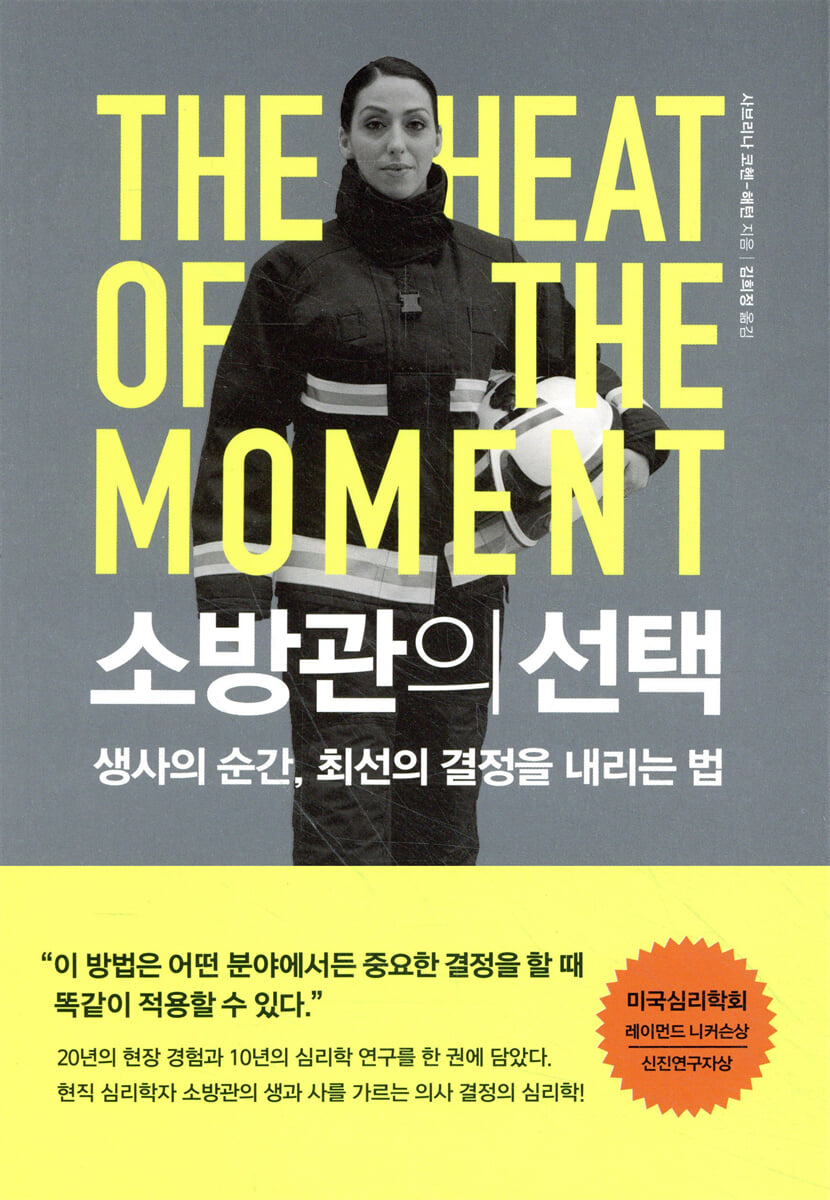
Firefighter's Choice
 |
Description
Book Introduction
- A word from MD
-
Decisive moment, wise choiceWhen everyone is running out of the building, there is one special person who runs into the building.
Sabrina Cohen-Hatton is a firefighter.
She overcame the disadvantages of being small and a woman to become a recognized firefighter.
The author, who also has a doctorate in psychology, shares his wisdom for life and making wise decisions in this book.
June 9, 2020. Humanities PD Son Min-gyu
In situations where it's impossible to maintain a clear mind, how can we make essential decisions without being consumed by emotions or shock? In this book, the author, a practicing firefighter and psychologist, draws on his work experience and research to reveal the best decision-making methods.
The qualities required of a firefighter are cool-headedness and the ability to make quick decisions.
Because rescue is not achieved just by relying on courage and jumping in blindly.
The author, the highest-ranking female firefighter in the UK, explores how to make the best decisions in urgent, high-pressure situations.
This book is the result of her 20 years of field experience and 10 years of psychology research.
The author, who received both the American Psychological Association's 'Raymond Nickerson Outstanding Paper Award' and 'Emerging Investigator Award', has research that is not limited to the profession of firefighter.
The author also provides tips on how to make wise decisions in the large and small crises we face in our daily lives.
The qualities required of a firefighter are cool-headedness and the ability to make quick decisions.
Because rescue is not achieved just by relying on courage and jumping in blindly.
The author, the highest-ranking female firefighter in the UK, explores how to make the best decisions in urgent, high-pressure situations.
This book is the result of her 20 years of field experience and 10 years of psychology research.
The author, who received both the American Psychological Association's 'Raymond Nickerson Outstanding Paper Award' and 'Emerging Investigator Award', has research that is not limited to the profession of firefighter.
The author also provides tips on how to make wise decisions in the large and small crises we face in our daily lives.
- You can preview some of the book's contents.
Preview
index
Introduction
Chapter 1.
Change your perspective
Chapter 2.
difficult problem
Chapter 3.
I'm just human
Chapter 4.
puzzle
Chapter 5.
Trust your gut
Chapter 6.
Be evaluated by your shadow
Chapter 7.
mental preparation
Chapter 8.
The price of humanity
Chapter 9.
Brain and Behavior
Chapter 10.
Things you realize after it's all over
Going out words
Acknowledgements
supplement
References
Chapter 1.
Change your perspective
Chapter 2.
difficult problem
Chapter 3.
I'm just human
Chapter 4.
puzzle
Chapter 5.
Trust your gut
Chapter 6.
Be evaluated by your shadow
Chapter 7.
mental preparation
Chapter 8.
The price of humanity
Chapter 9.
Brain and Behavior
Chapter 10.
Things you realize after it's all over
Going out words
Acknowledgements
supplement
References
Detailed image
.jpg)
Into the book
We love our work.
It inspires us, challenges us to our limits, and encourages us to become better, more prepared, and more determined to fight.
Our daily lives are the scene of disasters that completely destroy people's homes and change their fates.
It is an incredible privilege to have the trust of people going through the darkest times of their lives.
We hope that every day will be the day we perform at our best.
In fact, you have to perform at your best every day.
--- p.14
There are countless instances where the pain of a complete stranger I've never met penetrates my body as if it were my own.
A wife who lost her husband in a car accident, a child who lost their parents in a fire, people who lost siblings in an accident and can never be together again.
The list is long, just from what I've witnessed.
A list of people who wake up in the morning thinking that their everyday, ordinary days will repeat themselves, only to find that the world has changed forever and irreversibly.
That pain, that pain I experienced, came from empathy.
Empathy is what drives me to move forward a little further and work a little harder.
--- p.41
My colleagues, superiors, the press, judges, and bereaved families have advantages I don't: time and access to information after the fact.
I have to make split-second decisions while things are happening.
Limited time, the pressure to make decisions based on uncertain information, creeping self-doubt, and an inner voice whispering countless what-if scenarios can throw even the most experienced decision-makers off track.
I am a human being who makes decisions.
Having all the weaknesses and emotions of a human being.
The reason we choose something even though we know everything is because doing nothing, that is, succumbing to decision paralysis, is by far the worst choice.
--- p.68
The same emergency situation never happens twice.
It is impossible to create a set of action guidelines that can be applied to every accident scene.
--- p.84
We live our lives making hundreds of decisions every day.
There are big decisions like whether to get married or divorce, where to live, and what to name our children, and there are also small decisions like what to eat for lunch or what to wear today.
Every decision and every action taken has a reaction.
Every choice has consequences.
In the work I do, the results can sometimes mean the difference between life and death.
It can mean the difference between someone going home as usual that day or being taken to the hospital in an ambulance.
It could be the difference between someone calling and saying, “Do you know what just happened?” or someone calling and saying, “You need to come to the hospital right now.”
--- p.167
Just as I was about to call the situation room on the radio to check the information, the car made a sharp right turn.
“Stop!” I shout.
The car squeaks to a halt.
A familiar yet desperate sight greets us.
My heart stops for a moment as I look at the gruesome scene unfolding before me.
Our car stopped just a few meters away from the first vehicle involved in the accident.
Cars are strewn about on both sides of the road.
Several injured people lie on the asphalt in a mangled state.
These are probably people who crawled out of the accident vehicle or were thrown out during the collision.
Even though all the doors and windows of our car are closed, we can still hear groans and shrieks.
The pain of loss is deafening.
I reach for the doorknob and assign tasks to my team members to solve the most pressing problems.
“Alex, Tom, get your gear out.
Sandy, take charge of the trauma kit and assess the injured.
Determine the number of injured, their location, and the extent of their injuries and report accordingly.
Then, lower the hose and disconnect the car battery.
And please confirm the expected arrival time of the second ambulance.
Okay, everyone, turn on your radios and tune them to channel 1.
“Hurry up, hurry up!”
--- p.170
When I joined the Fire and Rescue Department at age 18, I was the first woman in the department's history.
That was expected.
But what I didn't expect was the tremendous sexism that greeted me at the time.
Let's just say it wasn't an atmosphere where I was welcomed with open arms.
There are countless shocking conversations that I still remember.
Usually, such conversations started like this.
“I can’t support women working in the fire department.
“I don’t mean to say this specifically about you, but I hate it.”
In that atmosphere, I found myself apologizing for my very existence without even realizing it.
But it didn't take long for my true colors and teenage stubbornness to show through.
Before I knew it, I would respond to people who spoke to me like that and cheer inwardly.
“I know what you mean.
I feel the same way about the idiots who work at the fire department.
"Those fools shouldn't be chosen, but there's nothing I can do about it! Of course, I'm not talking about you specifically."
--- p.228
Someone's scream of pain, asking for help, fills our hearts with fear and profoundly affects how we process information.
Training solely on mannequins that weigh approximately the same as an adult but have no face or life force will not prepare you for the real-world situation of saving and caring for a living person.
That kind of training won't teach you what it's like to watch people die despite your best efforts.
--- p.249
As firefighters, we are always critical of ourselves.
We are the first ones to arrive at the scene.
The first people to question our response are ourselves.
We ourselves may be the first to pave the way for better results.
We do this because we want to help other people.
Because the well-being and safety of others are very important to us.
It inspires us, challenges us to our limits, and encourages us to become better, more prepared, and more determined to fight.
Our daily lives are the scene of disasters that completely destroy people's homes and change their fates.
It is an incredible privilege to have the trust of people going through the darkest times of their lives.
We hope that every day will be the day we perform at our best.
In fact, you have to perform at your best every day.
--- p.14
There are countless instances where the pain of a complete stranger I've never met penetrates my body as if it were my own.
A wife who lost her husband in a car accident, a child who lost their parents in a fire, people who lost siblings in an accident and can never be together again.
The list is long, just from what I've witnessed.
A list of people who wake up in the morning thinking that their everyday, ordinary days will repeat themselves, only to find that the world has changed forever and irreversibly.
That pain, that pain I experienced, came from empathy.
Empathy is what drives me to move forward a little further and work a little harder.
--- p.41
My colleagues, superiors, the press, judges, and bereaved families have advantages I don't: time and access to information after the fact.
I have to make split-second decisions while things are happening.
Limited time, the pressure to make decisions based on uncertain information, creeping self-doubt, and an inner voice whispering countless what-if scenarios can throw even the most experienced decision-makers off track.
I am a human being who makes decisions.
Having all the weaknesses and emotions of a human being.
The reason we choose something even though we know everything is because doing nothing, that is, succumbing to decision paralysis, is by far the worst choice.
--- p.68
The same emergency situation never happens twice.
It is impossible to create a set of action guidelines that can be applied to every accident scene.
--- p.84
We live our lives making hundreds of decisions every day.
There are big decisions like whether to get married or divorce, where to live, and what to name our children, and there are also small decisions like what to eat for lunch or what to wear today.
Every decision and every action taken has a reaction.
Every choice has consequences.
In the work I do, the results can sometimes mean the difference between life and death.
It can mean the difference between someone going home as usual that day or being taken to the hospital in an ambulance.
It could be the difference between someone calling and saying, “Do you know what just happened?” or someone calling and saying, “You need to come to the hospital right now.”
--- p.167
Just as I was about to call the situation room on the radio to check the information, the car made a sharp right turn.
“Stop!” I shout.
The car squeaks to a halt.
A familiar yet desperate sight greets us.
My heart stops for a moment as I look at the gruesome scene unfolding before me.
Our car stopped just a few meters away from the first vehicle involved in the accident.
Cars are strewn about on both sides of the road.
Several injured people lie on the asphalt in a mangled state.
These are probably people who crawled out of the accident vehicle or were thrown out during the collision.
Even though all the doors and windows of our car are closed, we can still hear groans and shrieks.
The pain of loss is deafening.
I reach for the doorknob and assign tasks to my team members to solve the most pressing problems.
“Alex, Tom, get your gear out.
Sandy, take charge of the trauma kit and assess the injured.
Determine the number of injured, their location, and the extent of their injuries and report accordingly.
Then, lower the hose and disconnect the car battery.
And please confirm the expected arrival time of the second ambulance.
Okay, everyone, turn on your radios and tune them to channel 1.
“Hurry up, hurry up!”
--- p.170
When I joined the Fire and Rescue Department at age 18, I was the first woman in the department's history.
That was expected.
But what I didn't expect was the tremendous sexism that greeted me at the time.
Let's just say it wasn't an atmosphere where I was welcomed with open arms.
There are countless shocking conversations that I still remember.
Usually, such conversations started like this.
“I can’t support women working in the fire department.
“I don’t mean to say this specifically about you, but I hate it.”
In that atmosphere, I found myself apologizing for my very existence without even realizing it.
But it didn't take long for my true colors and teenage stubbornness to show through.
Before I knew it, I would respond to people who spoke to me like that and cheer inwardly.
“I know what you mean.
I feel the same way about the idiots who work at the fire department.
"Those fools shouldn't be chosen, but there's nothing I can do about it! Of course, I'm not talking about you specifically."
--- p.228
Someone's scream of pain, asking for help, fills our hearts with fear and profoundly affects how we process information.
Training solely on mannequins that weigh approximately the same as an adult but have no face or life force will not prepare you for the real-world situation of saving and caring for a living person.
That kind of training won't teach you what it's like to watch people die despite your best efforts.
--- p.249
As firefighters, we are always critical of ourselves.
We are the first ones to arrive at the scene.
The first people to question our response are ourselves.
We ourselves may be the first to pave the way for better results.
We do this because we want to help other people.
Because the well-being and safety of others are very important to us.
--- p.362
Publisher's Review
“I cannot pass on the weight of the orders I give to anyone.”
Limited time, creeping self-doubt,
Uncertain information, countless hypothetical scenarios…
“Who will you save and who will you give up?”
Discovered through 20 years of field experience and 10 years of psychology research
Dr. Sabrina Cohen-Hatton, a 'psychologist firefighter'
The psychology of life-or-death decision-making!
Decision-making techniques and vivid experiences from a current fire department commander in the most critical moments.
Firefighters are the only ones who rush into a raging fire while everyone else runs from the acrid smoke.
While it is important to have the courage to put others' lives before your own, another quality you absolutely must possess is the ability to make cool and quick decisions.
Because rescue is not achieved just by jumping in unconditionally.
Dr. Sabrina Cohen-Hatton, who joined the Fire and Rescue Service at 18 and went on to become the highest-ranking female firefighter in the UK, was deeply saddened by the tragic fact that so many firefighters lose their lives every year, often as a result of a momentary lapse in judgment.
So, to improve this situation, I studied psychology myself and studied how people make decisions in crisis situations.
Dr. Cohen-Hatton's pioneering research has been recognized in academic circles, and he has swept awards in related fields, including receiving a doctorate in psychology and the American Psychological Association's Raymond Nickerson Distinguished Paper Award and the Young Investigator Award.
Her research has also revolutionised firefighting systems across the UK, and its usefulness has been recognised to the extent that it is being actively replicated with interest overseas.
“Every day is someone else’s worst day.
I will never forget that fact.”
"The Firefighter's Choice" is a book that contains 20 years of field experience and 10 years of psychological research by Dr. Sabrina Cohen-Hatton, a "psychologist firefighter."
The author guides the reader into the midst of a disaster where life and death are at stake.
As a fire chief leading a rescue team, the author struggles to save people going through the darkest times of their lives from the worst fates.
She decides which of her colleagues to send into the burning building and how they should fight the flames.
When it is determined that all options have been exhausted or that the situation is hopeless, the order to withdraw personnel from the scene is also given.
Every decision a fire chief makes carries the weight of life.
Moreover, information is uncertain and there is little time to consider, and everyone is waiting for the commander's decision.
From a behavioral psychology perspective, what are the tips for making essential decisions without being overwhelmed by emotions or shock in situations where maintaining a clear mind is simply impossible? Drawing on his work experience and research, the author offers insights into the best decision-making methods.
All the case studies featured in "The Firefighter's Choice" are based on the author's own experiences, and the research cases are also based on psychological and neuroscientific experiments he conducted on fellow firefighters.
Because of this, the author's solutions to decision-making in stressful situations offer a level of credibility that is difficult to find in other psychology books.
For example, when making important decisions, do we often rely on intuition or an analytical approach? Dr. Cohen-Hatton attached cameras to the helmets of firefighters to study how they make decisions in the field.
As a result, commanders relied on intuitive decision-making far more often than they realized.
It was assumed that fire commanders made decisions analytically in most cases, and they received training and post-event evaluations accordingly, but the reality was different.
The author did not stop at these research results, but considered training methods, field manuals, and post-evaluation methods suitable for intuitive decision-making.
Ultimately, her research led to practical changes, reflected in manuals used by British firefighters, such as the 'Guidelines for the British Fire and Rescue Service' and the 'Principles for Collaboration Between Emergency Services'.
The author's achievements are not limited to his profession as a firefighter.
In urgent and uncertain situations, how would a reader make a decision? Decisions based on analysis? Or intuitive decisions based on intuition? The author also provides tips for making wise decisions in the large and small crises we face in our daily lives.
“Empathy is what moves me a little further,
“It’s a driving force that makes you try a little harder.”
The greatest appeal of "The Firefighter's Choice" is its gripping and tense plot that reads like a novel or movie.
Sometimes, the vivid descriptions of situations are so graphic that they make the reader feel as if they are standing at the scene of the accident.
The cases presented in the book are not repeated in one structure, but rather the way they are presented varies from chapter to chapter, making it an interesting read.
It's as exciting as reading an omnibus novel about firefighters, with flashbacks to past events, imagery training for training, test scenarios to assess command skills, discussions with fellow firefighters, and research the author has conducted.
Even in scenes that we know are not real, such as training or tests, it makes us sweat.
This book provides readers with remarkable insight into a profession that requires them to make some of the most difficult decisions imaginable.
Another interesting element of the book is the author himself.
The author is a veteran firefighter with 20 years of experience, a behavioral psychologist, a mother of one child, and a wife.
The autobiographical stories that appear throughout the book tell how the author came to have such an interesting background.
You'll learn why she dropped out of school to become a firefighter, why she studied psychology, and what gave her the drive to juggle parenting, school, and a career.
She also calmly describes the difficulties she faced in the male-dominated world of firefighters and how she overcame them.
The author's affection and respect for his colleagues are evident throughout the book, adding sincerity to his research and writing to prevent injuries among fellow firefighters.
Our heartfelt condolences to the victims of accidents and disasters and their families are also deeply felt.
These aspects make this book a great book on behavioral psychology, but it also resonates deeply with readers as a story about a great human being.
Limited time, creeping self-doubt,
Uncertain information, countless hypothetical scenarios…
“Who will you save and who will you give up?”
Discovered through 20 years of field experience and 10 years of psychology research
Dr. Sabrina Cohen-Hatton, a 'psychologist firefighter'
The psychology of life-or-death decision-making!
Decision-making techniques and vivid experiences from a current fire department commander in the most critical moments.
Firefighters are the only ones who rush into a raging fire while everyone else runs from the acrid smoke.
While it is important to have the courage to put others' lives before your own, another quality you absolutely must possess is the ability to make cool and quick decisions.
Because rescue is not achieved just by jumping in unconditionally.
Dr. Sabrina Cohen-Hatton, who joined the Fire and Rescue Service at 18 and went on to become the highest-ranking female firefighter in the UK, was deeply saddened by the tragic fact that so many firefighters lose their lives every year, often as a result of a momentary lapse in judgment.
So, to improve this situation, I studied psychology myself and studied how people make decisions in crisis situations.
Dr. Cohen-Hatton's pioneering research has been recognized in academic circles, and he has swept awards in related fields, including receiving a doctorate in psychology and the American Psychological Association's Raymond Nickerson Distinguished Paper Award and the Young Investigator Award.
Her research has also revolutionised firefighting systems across the UK, and its usefulness has been recognised to the extent that it is being actively replicated with interest overseas.
“Every day is someone else’s worst day.
I will never forget that fact.”
"The Firefighter's Choice" is a book that contains 20 years of field experience and 10 years of psychological research by Dr. Sabrina Cohen-Hatton, a "psychologist firefighter."
The author guides the reader into the midst of a disaster where life and death are at stake.
As a fire chief leading a rescue team, the author struggles to save people going through the darkest times of their lives from the worst fates.
She decides which of her colleagues to send into the burning building and how they should fight the flames.
When it is determined that all options have been exhausted or that the situation is hopeless, the order to withdraw personnel from the scene is also given.
Every decision a fire chief makes carries the weight of life.
Moreover, information is uncertain and there is little time to consider, and everyone is waiting for the commander's decision.
From a behavioral psychology perspective, what are the tips for making essential decisions without being overwhelmed by emotions or shock in situations where maintaining a clear mind is simply impossible? Drawing on his work experience and research, the author offers insights into the best decision-making methods.
All the case studies featured in "The Firefighter's Choice" are based on the author's own experiences, and the research cases are also based on psychological and neuroscientific experiments he conducted on fellow firefighters.
Because of this, the author's solutions to decision-making in stressful situations offer a level of credibility that is difficult to find in other psychology books.
For example, when making important decisions, do we often rely on intuition or an analytical approach? Dr. Cohen-Hatton attached cameras to the helmets of firefighters to study how they make decisions in the field.
As a result, commanders relied on intuitive decision-making far more often than they realized.
It was assumed that fire commanders made decisions analytically in most cases, and they received training and post-event evaluations accordingly, but the reality was different.
The author did not stop at these research results, but considered training methods, field manuals, and post-evaluation methods suitable for intuitive decision-making.
Ultimately, her research led to practical changes, reflected in manuals used by British firefighters, such as the 'Guidelines for the British Fire and Rescue Service' and the 'Principles for Collaboration Between Emergency Services'.
The author's achievements are not limited to his profession as a firefighter.
In urgent and uncertain situations, how would a reader make a decision? Decisions based on analysis? Or intuitive decisions based on intuition? The author also provides tips for making wise decisions in the large and small crises we face in our daily lives.
“Empathy is what moves me a little further,
“It’s a driving force that makes you try a little harder.”
The greatest appeal of "The Firefighter's Choice" is its gripping and tense plot that reads like a novel or movie.
Sometimes, the vivid descriptions of situations are so graphic that they make the reader feel as if they are standing at the scene of the accident.
The cases presented in the book are not repeated in one structure, but rather the way they are presented varies from chapter to chapter, making it an interesting read.
It's as exciting as reading an omnibus novel about firefighters, with flashbacks to past events, imagery training for training, test scenarios to assess command skills, discussions with fellow firefighters, and research the author has conducted.
Even in scenes that we know are not real, such as training or tests, it makes us sweat.
This book provides readers with remarkable insight into a profession that requires them to make some of the most difficult decisions imaginable.
Another interesting element of the book is the author himself.
The author is a veteran firefighter with 20 years of experience, a behavioral psychologist, a mother of one child, and a wife.
The autobiographical stories that appear throughout the book tell how the author came to have such an interesting background.
You'll learn why she dropped out of school to become a firefighter, why she studied psychology, and what gave her the drive to juggle parenting, school, and a career.
She also calmly describes the difficulties she faced in the male-dominated world of firefighters and how she overcame them.
The author's affection and respect for his colleagues are evident throughout the book, adding sincerity to his research and writing to prevent injuries among fellow firefighters.
Our heartfelt condolences to the victims of accidents and disasters and their families are also deeply felt.
These aspects make this book a great book on behavioral psychology, but it also resonates deeply with readers as a story about a great human being.
GOODS SPECIFICS
- Date of issue: May 25, 2020
- Page count, weight, size: 396 pages | 548g | 148*215*30mm
- ISBN13: 9791164050543
- ISBN10: 1164050540
You may also like
카테고리
korean


korean

![ELLE 엘르 스페셜 에디션 A형 : 12월 [2025]](http://librairie.coreenne.fr/cdn/shop/files/b8e27a3de6c9538896439686c6b0e8fb.jpg?v=1766436872&width=3840)


