

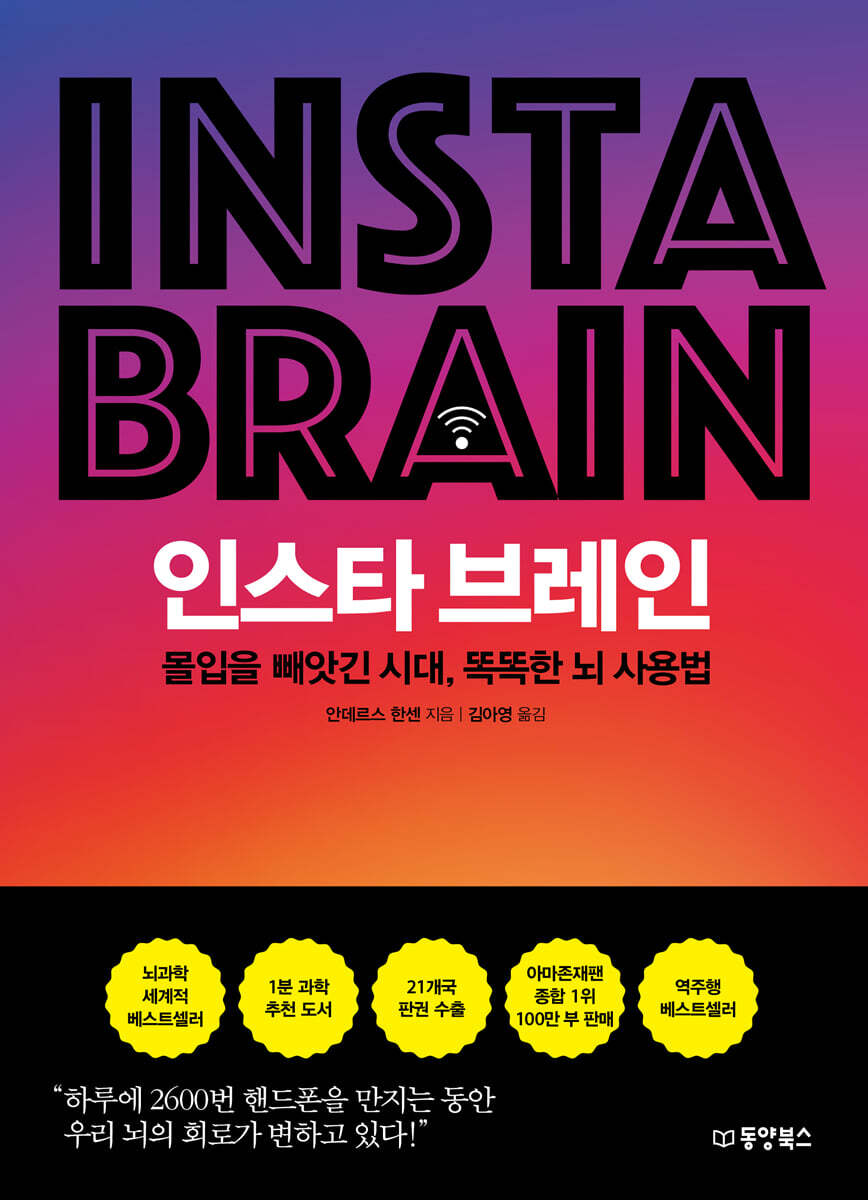
Insta Brain
 |
Description
Book Introduction
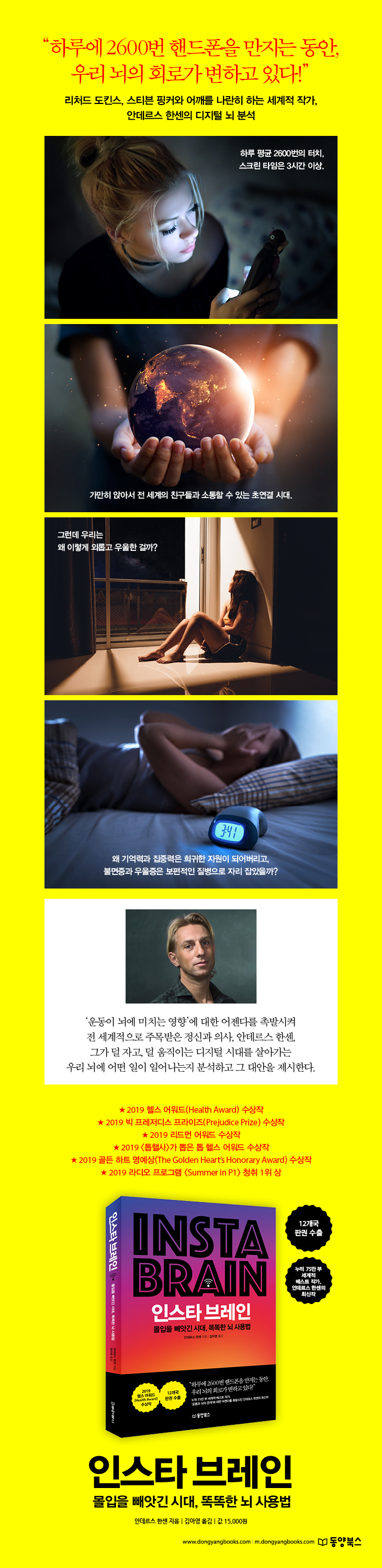
“While we touch our smartphones 2,600 times a day, “The circuitry of our brain is changing!” A world-renowned author with a cumulative circulation of 750,000 copies, Anders Hansen's latest work sparks an agenda on the relationship between exercise and the brain. *2019 Health Award Winner *2019 Big Prejudice Prize Winner *2019 Leadman Award Winner *2019 [Top Health Award] Winners of the Top Health Awards *2019 Golden Heart Honorary Award Winner *2019 Radio Program [Summer in P1] 1st Place Listening Award How have smartphones, the 21st-century time thieves, changed our brains? Richard Dawkins, a world-renowned author on par with Steven Pinker, Anders Hansen's Digital Brain Analysis An average of 2,600 touches per day, with screen time exceeding 3 hours. An object that accompanies our every move from the moment we open our eyes in the morning until we fall asleep at night, to the point where we would panic if it wasn't by our side. It is none other than a smartphone. If TV was the greatest time thief of the 20th century, smartphones are playing that role in the 21st century. But smartphones are far more addictive than TVs in that they are portable and can be used voluntarily by users. So what effect does this new invention have on our bodies and our brains? Anders Hansen, a world-renowned Swedish writer and psychiatrist, has delved deeply into this very issue. One day, he 'realized' that he couldn't concentrate on a book and kept touching his smartphone for no particular reason. He was so shocked that he started analyzing this problem from a neuroscientific perspective and wrote this book, 'Insta Brain (original title: SKARMHJARNAN; SCREEN BRAIN)'. Simply put, smartphones have made us sleep less, move less, and spend less time interacting with people in person. However, since we still have the brains of hunter-gatherers, we still have the desire to get enough sleep, the desire to move our bodies, and the desire to connect with people, so the explosive increase in insomnia and depression, the decline in concentration and academic performance among teenagers, digital dementia, etc. are inevitable results. This book compiles numerous research results, surveys, and psychological experiments from around the world on this topic. One of its greatest strengths is that, as befitting a psychiatrist and neurologist, it incorporates brain science theories to help readers understand. This book, which can be called a brain science health book in that it goes beyond raising issues and theories and provides an easy-to-understand explanation of how to do a digital detox in everyday life, has sold approximately 80,000 copies in Sweden alone, has been licensed to 12 countries, and has won over six awards, including the 2019 Health Award, which is given to individuals or organizations that have contributed to national health. Riding on this popularity, author Anders Hansen hosted a program called [Your Brain (Dinhjarna)] on the public TV network SVT, which created a lot of buzz by inviting world-renowned scholars such as Steven Pinker, Robert Sapolsky, Susan Greenfield, and Richard Dawkins as guests. |
- You can preview some of the book's contents.
Preview
index
2020 Preface We live in the strangest world in history. 008
2019 Preface: The Brain's Perceptual Shift Begins 018
Chapter 1
Our brains are still hunter-gatherers 021
“Why can’t the evolution of the body keep up with the evolution of the world?”
Chapter 2
Depression is a protective strategy of the brain 043
“Stress and depression protect our bodies?”
Chapter 3
A new type of morphine that has become a part of your body: cell phone number 073.
“Why did Jobs limit his child’s cell phone use?”
Chapter 4
In an Age of Focus Loss, How to Use Your Brain Smartly 093
“Our brains are never on our side.”
Chapter 5
The powerful suspect who is stealing our time 123
“Mobile Phone Usage and Health”
Chapter 6
141 People Who Feel Better After Quitting Social Media
Why Less Digital Use Makes You Feel Better
Chapter 7
Adolescent Depression and Cell Phones 189
“What would happen if cell phones disappeared from the classroom?”
Chapter 8
If you want change, start by moving your body 225
“Why does exercise make you more focused?”
Chapter 9
The brain is still changing 243
“Is humanity getting more and more stupid?”
Conclusion
Not everything that's natural is good 267
supplement
Safety Tips for Travelers in the Digital World 271
Acknowledgments 277
Translator's Note: How is digital technology changing our brains? 280
Reference 284
2019 Preface: The Brain's Perceptual Shift Begins 018
Chapter 1
Our brains are still hunter-gatherers 021
“Why can’t the evolution of the body keep up with the evolution of the world?”
Chapter 2
Depression is a protective strategy of the brain 043
“Stress and depression protect our bodies?”
Chapter 3
A new type of morphine that has become a part of your body: cell phone number 073.
“Why did Jobs limit his child’s cell phone use?”
Chapter 4
In an Age of Focus Loss, How to Use Your Brain Smartly 093
“Our brains are never on our side.”
Chapter 5
The powerful suspect who is stealing our time 123
“Mobile Phone Usage and Health”
Chapter 6
141 People Who Feel Better After Quitting Social Media
Why Less Digital Use Makes You Feel Better
Chapter 7
Adolescent Depression and Cell Phones 189
“What would happen if cell phones disappeared from the classroom?”
Chapter 8
If you want change, start by moving your body 225
“Why does exercise make you more focused?”
Chapter 9
The brain is still changing 243
“Is humanity getting more and more stupid?”
Conclusion
Not everything that's natural is good 267
supplement
Safety Tips for Travelers in the Digital World 271
Acknowledgments 277
Translator's Note: How is digital technology changing our brains? 280
Reference 284
Detailed image
Into the book
Because it is the key to understanding the deep-rooted desires within us that do not change: the desire to sleep, the desire to move, the desire to connect with people.
We can never feel good if we ignore these desires.
Unfortunately, the digital world seems to ignore these desires.
--- p.11
Sleep is not about conserving energy.
In fact, from the brain's perspective, it uses as much energy while sleeping as it does when awake.
One of them is cleaning up the waste products in the form of fragmented proteins that accumulate during the day.
Because so much accumulates in a day, the brain ends up cleaning out its own weight in 'garbage' over the course of a year.
Above all, the habit of cleaning every night is very important for the brain to function properly.
--- p.132
According to Robin Dunbar, an evolutionary psychologist at Oxford University, humans have the capacity to form relationships with approximately 150 individuals.
Obviously, we know many more people and can remember their names.
However, if we consider a more stable relationship, such as one in which one person knows what the other person thinks of them, it is said to be around 150 people.
This number is called 'Dunbar's number'.
--- p.148
To get your brain's mirror neurons to function optimally, you need to meet other people in real life.
Scientists compared the activity of mirror neurons when meeting other people in person, watching a play, or watching a movie, and found that mirror neurons were most active when meeting people in person.
The next time was when I was watching a play, and the last time was when I was watching a movie.
(Omitted) This means that when we see something in the form of a picture or display, the biological mechanisms that help us intuitively understand other people's thoughts or feelings are not properly activated.
--- p.170~171
According to the World Health Organization (WHO), one in ten people today suffer from an anxiety disorder.
What's interesting is that people who are physically active are generally less anxious.
Still having trouble understanding that exercise can help prevent anxiety? Consider this:
A review of more than 50 studies involving 700 patients found that movement and exercise helped reduce anxiety in both those diagnosed with an anxiety disorder and those experiencing "normal" levels of anxiety.
We can never feel good if we ignore these desires.
Unfortunately, the digital world seems to ignore these desires.
--- p.11
Sleep is not about conserving energy.
In fact, from the brain's perspective, it uses as much energy while sleeping as it does when awake.
One of them is cleaning up the waste products in the form of fragmented proteins that accumulate during the day.
Because so much accumulates in a day, the brain ends up cleaning out its own weight in 'garbage' over the course of a year.
Above all, the habit of cleaning every night is very important for the brain to function properly.
--- p.132
According to Robin Dunbar, an evolutionary psychologist at Oxford University, humans have the capacity to form relationships with approximately 150 individuals.
Obviously, we know many more people and can remember their names.
However, if we consider a more stable relationship, such as one in which one person knows what the other person thinks of them, it is said to be around 150 people.
This number is called 'Dunbar's number'.
--- p.148
To get your brain's mirror neurons to function optimally, you need to meet other people in real life.
Scientists compared the activity of mirror neurons when meeting other people in person, watching a play, or watching a movie, and found that mirror neurons were most active when meeting people in person.
The next time was when I was watching a play, and the last time was when I was watching a movie.
(Omitted) This means that when we see something in the form of a picture or display, the biological mechanisms that help us intuitively understand other people's thoughts or feelings are not properly activated.
--- p.170~171
According to the World Health Organization (WHO), one in ten people today suffer from an anxiety disorder.
What's interesting is that people who are physically active are generally less anxious.
Still having trouble understanding that exercise can help prevent anxiety? Consider this:
A review of more than 50 studies involving 700 patients found that movement and exercise helped reduce anxiety in both those diagnosed with an anxiety disorder and those experiencing "normal" levels of anxiety.
--- p.235~236
Publisher's Review
“While we touch our smartphones 2,600 times a day,
“The circuitry of our brain is changing!”
A world-renowned author with a cumulative circulation of 750,000 copies,
Anders Hansen's latest work sparks an agenda on the relationship between exercise and the brain.
*2019 Health Award Winner*2019 Big Prejudice Prize Winner
*2019 Leadman Award Winner
*2019 Top Health Award Winners Selected by Top Health Experts
*2019 Golden Heart Honorary Award Winner
*2019 Radio Program 「Summer in P1」 Listening 1st Place Award
Psychological Experiment 1
A study of memory, concentration, and language skills of 4,000 children aged 8 to 11 found that children who used digital devices for less than two hours a day performed best.
Another factor that had an impact, aside from cell phones, was that children who slept 9 to 11 hours a night not only had better grades but were also more physically active.
_From page 207 of the text
Psychological Experiment 2
After surveying about 4,000 people in their 20s about their mobile phone usage habits, they followed them for a year.
According to the results of this experiment, the more frequently people used their cell phones, the higher their stress levels and the more symptoms of depression they showed.
The American Psychological Association also conducted a survey of about 3,500 people and found similar results.
The results were published under the title "Stress in America" and showed that people who looked at their phones frequently were more stressed.
_From pages 126-127 of the text
Psychological Experiment 3
A group of college students with high anxiety sensitivity were divided into two groups: one group was assigned to high-intensity exercise (running for 20 minutes), and the other group was assigned to low-intensity exercise (walking for 20 minutes).
How did their anxiety sensitivity change after exercising three times a week for two weeks, a total of six sessions? The results were surprising.
Both groups had lower anxiety levels, but the group that ran had significantly lower anxiety levels than the group that walked.
_From page 235 of the text
How have smartphones, the 21st-century time thieves, changed our brains?
A book analyzing the digital brain by Anders Hansen, a world-renowned author who ranks alongside Richard Dawkins and Steven Pinker.
An average of 2,600 touches per day, with screen time exceeding 3 hours.
An object that accompanies our every move from the moment we open our eyes in the morning until we fall asleep at night, to the point where we would panic if it wasn't by our side.
It is none other than a smartphone.
The greatest invention of the 21st century, allowing us to conveniently handle almost everything in our daily lives, including shopping, food ordering, banking, stocks, education, cultural activities, social media, and communities, all from the palm of our hand.
Although it has a history of only about 10 years, it is now a part of our bodies, and we spend almost all of our time with it.
If TV was the greatest time thief of the 20th century, smartphones are playing that role in the 21st century.
But smartphones are far more addictive than TVs in that they are portable and can be used voluntarily by users.
So what effect does this new invention have on our bodies and our brains?
Anders Hansen, a world-renowned Swedish writer and psychiatrist, has delved deeply into this very issue.
One day, he 'realized' that he couldn't concentrate on a book and kept touching his smartphone for no particular reason. He was so shocked that he started analyzing this problem from a neuroscientific perspective and wrote this book, 'Insta Brain (original title: SKARMHJARNAN; SCREEN BRAIN)'.
The author first analyzes the reasons why we have come to love smartphones so much.
This is because the hormone called 'dopamine' is secreted when we eat or have sex, and it is also secreted when we use our smartphones, that is, when we obtain new information.
For 99.9% of human history, we lived as hunter-gatherers, and the author explains that because we couldn't survive without being sensitive to new information, our brains still function and operate like they did when we were hunter-gatherers.
So, what specific impact does our smartphone, which we cherish more than our family, friends, or any other possession and which we spend nearly 24 hours with, have on our health and happiness? Simply put, smartphones have made us sleep less, move less, and spend less time interacting with people than before.
However, as mentioned earlier, we, who have the brains of hunter-gatherers, have the same desire to get enough sleep, to move our bodies, and to connect with people, so the explosive increase in insomnia and depression, the decline in concentration and academic performance among teenagers, digital dementia, etc. are inevitable results.
This book compiles numerous research results, surveys, and psychological experiments from around the world on this topic. One of its greatest strengths is that, as befitting a psychiatrist and neurologist, it incorporates brain science theories to help readers understand.
This book, which can be called a brain science health book in that it goes beyond raising issues and theories and provides an easy-to-understand explanation of how to do a digital detox in everyday life, has sold approximately 80,000 copies in Sweden alone, has been licensed to 12 countries, and has won over six awards, including the 2019 Health Award, which is given to individuals or organizations that have contributed to national health.
Riding on this popularity, author Anders Hansen hosted a program called "Your Brain (Dinhjarna)" on the public TV network SVT, which created a lot of buzz by inviting world-renowned scholars such as Steven Pinker, Robert Sapolsky, Susan Greenfield, and Richard Dawkins as guests.
Do you think you're smarter when you exercise than when you read?
In an age of immersion, how to use your brain smartly
As the time spent using smartphones and social media increases, depression and insomnia occur, and concentration and memory decline. This phenomenon was actually a predicted result.
Since the invention of the Internet, futurist Nicholas G.
Many experts, including Carr, have warned of this reality we are currently experiencing.
However, just as we cannot give up our cars because of traffic accidents, we cannot go back to the past just because we have become aware of the side effects and harmful effects of smartphones.
Author Anders Hansen focuses on solutions alongside brain science theories.
He emphasizes that three conditions are necessary for humans to feel happy: getting enough sleep, exercising appropriately, and feeling close to others through bonds, and advises on how to put these conditions into practice.
At first glance, this may seem like an obvious statement, but the part that explains why these three conditions are so important to our brains presents a story that is quite different from what we usually know, and it is quite surprising.
For example, the reason we need to sleep is not to recharge our energy.
This is because while we sleep, our brain works to remove protein waste products that have accumulated throughout the day.
Another new theory is that going outside and moving your body is much more helpful for concentration and memory than sitting at a desk and reading a book.
Exercise makes our brains smarter than studying. The reason social networking cannot replace real-life relationships is because of the brain's mirror neurons.
These cells develop most actively when we encounter people face-to-face, and have a major impact on the development of the frontal lobe, which controls empathy and intellectual ability.
This means that if you don't meet people in person and interact with them, you can't develop empathy and intellectual abilities.
The author convinces us and makes us focus by explaining a story we already seem to know using brain science theories.
If you follow and practice the 'safety rules for the digital age' he suggests, you will find yourself becoming smarter.
This book is especially relevant to readers in Korea, an IT powerhouse where everyone uses smartphones.
“The circuitry of our brain is changing!”
A world-renowned author with a cumulative circulation of 750,000 copies,
Anders Hansen's latest work sparks an agenda on the relationship between exercise and the brain.
*2019 Health Award Winner*2019 Big Prejudice Prize Winner
*2019 Leadman Award Winner
*2019 Top Health Award Winners Selected by Top Health Experts
*2019 Golden Heart Honorary Award Winner
*2019 Radio Program 「Summer in P1」 Listening 1st Place Award
Psychological Experiment 1
A study of memory, concentration, and language skills of 4,000 children aged 8 to 11 found that children who used digital devices for less than two hours a day performed best.
Another factor that had an impact, aside from cell phones, was that children who slept 9 to 11 hours a night not only had better grades but were also more physically active.
_From page 207 of the text
Psychological Experiment 2
After surveying about 4,000 people in their 20s about their mobile phone usage habits, they followed them for a year.
According to the results of this experiment, the more frequently people used their cell phones, the higher their stress levels and the more symptoms of depression they showed.
The American Psychological Association also conducted a survey of about 3,500 people and found similar results.
The results were published under the title "Stress in America" and showed that people who looked at their phones frequently were more stressed.
_From pages 126-127 of the text
Psychological Experiment 3
A group of college students with high anxiety sensitivity were divided into two groups: one group was assigned to high-intensity exercise (running for 20 minutes), and the other group was assigned to low-intensity exercise (walking for 20 minutes).
How did their anxiety sensitivity change after exercising three times a week for two weeks, a total of six sessions? The results were surprising.
Both groups had lower anxiety levels, but the group that ran had significantly lower anxiety levels than the group that walked.
_From page 235 of the text
How have smartphones, the 21st-century time thieves, changed our brains?
A book analyzing the digital brain by Anders Hansen, a world-renowned author who ranks alongside Richard Dawkins and Steven Pinker.
An average of 2,600 touches per day, with screen time exceeding 3 hours.
An object that accompanies our every move from the moment we open our eyes in the morning until we fall asleep at night, to the point where we would panic if it wasn't by our side.
It is none other than a smartphone.
The greatest invention of the 21st century, allowing us to conveniently handle almost everything in our daily lives, including shopping, food ordering, banking, stocks, education, cultural activities, social media, and communities, all from the palm of our hand.
Although it has a history of only about 10 years, it is now a part of our bodies, and we spend almost all of our time with it.
If TV was the greatest time thief of the 20th century, smartphones are playing that role in the 21st century.
But smartphones are far more addictive than TVs in that they are portable and can be used voluntarily by users.
So what effect does this new invention have on our bodies and our brains?
Anders Hansen, a world-renowned Swedish writer and psychiatrist, has delved deeply into this very issue.
One day, he 'realized' that he couldn't concentrate on a book and kept touching his smartphone for no particular reason. He was so shocked that he started analyzing this problem from a neuroscientific perspective and wrote this book, 'Insta Brain (original title: SKARMHJARNAN; SCREEN BRAIN)'.
The author first analyzes the reasons why we have come to love smartphones so much.
This is because the hormone called 'dopamine' is secreted when we eat or have sex, and it is also secreted when we use our smartphones, that is, when we obtain new information.
For 99.9% of human history, we lived as hunter-gatherers, and the author explains that because we couldn't survive without being sensitive to new information, our brains still function and operate like they did when we were hunter-gatherers.
So, what specific impact does our smartphone, which we cherish more than our family, friends, or any other possession and which we spend nearly 24 hours with, have on our health and happiness? Simply put, smartphones have made us sleep less, move less, and spend less time interacting with people than before.
However, as mentioned earlier, we, who have the brains of hunter-gatherers, have the same desire to get enough sleep, to move our bodies, and to connect with people, so the explosive increase in insomnia and depression, the decline in concentration and academic performance among teenagers, digital dementia, etc. are inevitable results.
This book compiles numerous research results, surveys, and psychological experiments from around the world on this topic. One of its greatest strengths is that, as befitting a psychiatrist and neurologist, it incorporates brain science theories to help readers understand.
This book, which can be called a brain science health book in that it goes beyond raising issues and theories and provides an easy-to-understand explanation of how to do a digital detox in everyday life, has sold approximately 80,000 copies in Sweden alone, has been licensed to 12 countries, and has won over six awards, including the 2019 Health Award, which is given to individuals or organizations that have contributed to national health.
Riding on this popularity, author Anders Hansen hosted a program called "Your Brain (Dinhjarna)" on the public TV network SVT, which created a lot of buzz by inviting world-renowned scholars such as Steven Pinker, Robert Sapolsky, Susan Greenfield, and Richard Dawkins as guests.
Do you think you're smarter when you exercise than when you read?
In an age of immersion, how to use your brain smartly
As the time spent using smartphones and social media increases, depression and insomnia occur, and concentration and memory decline. This phenomenon was actually a predicted result.
Since the invention of the Internet, futurist Nicholas G.
Many experts, including Carr, have warned of this reality we are currently experiencing.
However, just as we cannot give up our cars because of traffic accidents, we cannot go back to the past just because we have become aware of the side effects and harmful effects of smartphones.
Author Anders Hansen focuses on solutions alongside brain science theories.
He emphasizes that three conditions are necessary for humans to feel happy: getting enough sleep, exercising appropriately, and feeling close to others through bonds, and advises on how to put these conditions into practice.
At first glance, this may seem like an obvious statement, but the part that explains why these three conditions are so important to our brains presents a story that is quite different from what we usually know, and it is quite surprising.
For example, the reason we need to sleep is not to recharge our energy.
This is because while we sleep, our brain works to remove protein waste products that have accumulated throughout the day.
Another new theory is that going outside and moving your body is much more helpful for concentration and memory than sitting at a desk and reading a book.
Exercise makes our brains smarter than studying. The reason social networking cannot replace real-life relationships is because of the brain's mirror neurons.
These cells develop most actively when we encounter people face-to-face, and have a major impact on the development of the frontal lobe, which controls empathy and intellectual ability.
This means that if you don't meet people in person and interact with them, you can't develop empathy and intellectual abilities.
The author convinces us and makes us focus by explaining a story we already seem to know using brain science theories.
If you follow and practice the 'safety rules for the digital age' he suggests, you will find yourself becoming smarter.
This book is especially relevant to readers in Korea, an IT powerhouse where everyone uses smartphones.
GOODS SPECIFICS
- Date of issue: May 15, 2020
- Page count, weight, size: 296 pages | 422g | 152*210*20mm
- ISBN13: 9791157686179
- ISBN10: 1157686176
You may also like
카테고리
korean


korean

![ELLE 엘르 스페셜 에디션 A형 : 12월 [2025]](http://librairie.coreenne.fr/cdn/shop/files/b8e27a3de6c9538896439686c6b0e8fb.jpg?v=1766436872&width=3840)


