

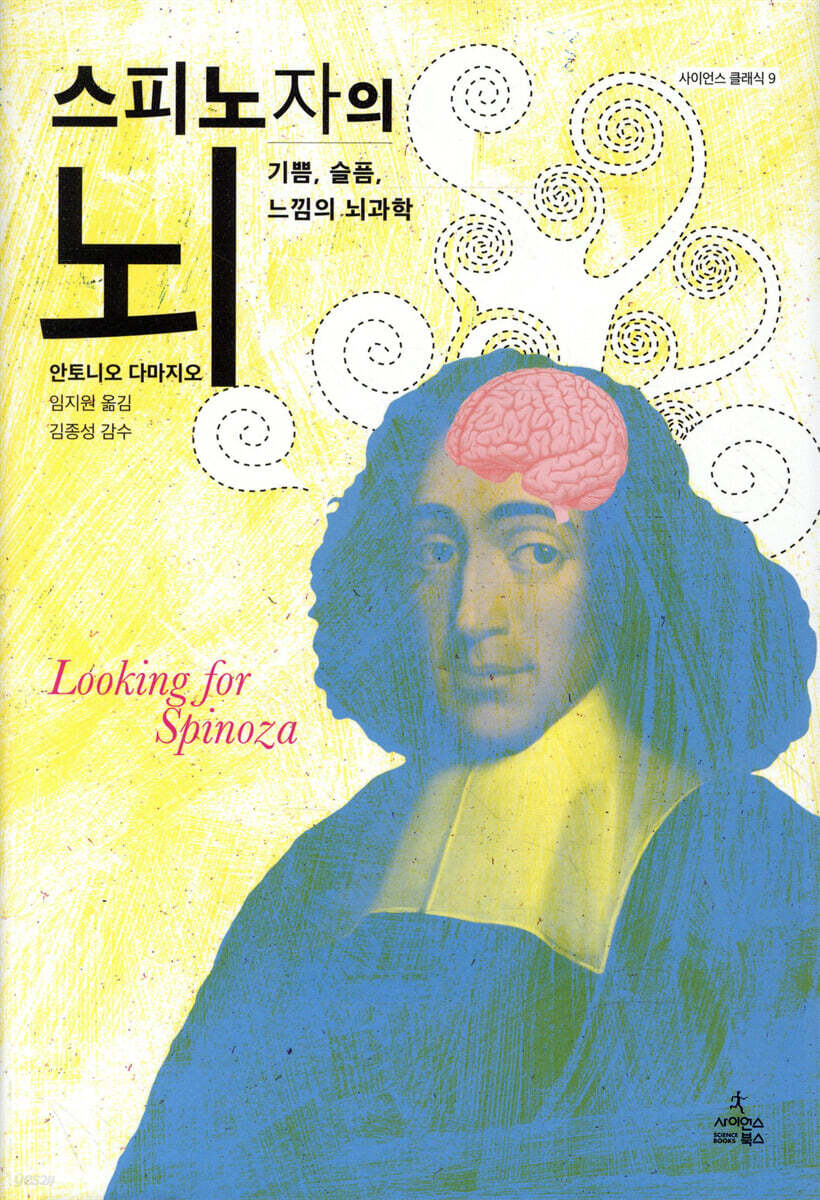
Spinoza's Brain
 |
Description
Book Introduction
The various feelings, affections, and emotions that are always around us, such as joy, sadness, jealousy, and fear, have existed beyond the boundaries of scientific discourse because they are not concrete entities that can be seen, heard, or touched.
In the 20th century, questions about the mind, such as how the mind is created and how the mind works, began to be actively addressed in evolutionary biology and neurobiology. However, feelings, emotions, and sentiments remained in the realm of philosophical discourse, unable to be incorporated into the realm of science.
However, Antonio Damosio, a Portuguese Jewish scientist who is leading the research in the field of brain science, which is at the forefront of modern science, argues that feelings, emotions, and sentiments form the foundation of our mind and that they, like the mind, can be the subject of scientific research. He delves into the essence of feelings, emotions, and sentiments step by step based on the latest neuroscientific research results and actual clinical cases.
In the 20th century, questions about the mind, such as how the mind is created and how the mind works, began to be actively addressed in evolutionary biology and neurobiology. However, feelings, emotions, and sentiments remained in the realm of philosophical discourse, unable to be incorporated into the realm of science.
However, Antonio Damosio, a Portuguese Jewish scientist who is leading the research in the field of brain science, which is at the forefront of modern science, argues that feelings, emotions, and sentiments form the foundation of our mind and that they, like the mind, can be the subject of scientific research. He delves into the essence of feelings, emotions, and sentiments step by step based on the latest neuroscientific research results and actual clinical cases.
- You can preview some of the book's contents.
Preview
index
Chapter 1: Into the Feeling
Chapter 2: Desires and Emotions
Chapter 3 Feeling
Chapter 4 Feelings, and After
Chapter 5 Body, Brain, and Mind
Chapter 6: Visiting Spinoza
Chapter 7 Who's There?
Chapter 2: Desires and Emotions
Chapter 3 Feeling
Chapter 4 Feelings, and After
Chapter 5 Body, Brain, and Mind
Chapter 6: Visiting Spinoza
Chapter 7 Who's There?
Publisher's Review
To become a neuroscientist, you must first become a Spinozist!
The author of this book, Antonio Damasio, is a former professor of neurology at the University of Iowa School of Medicine and currently serves as the director of the Brain Science Institute at the University of Southern California. He is a leading neuroscientist in the field of modern brain science, actively conducting research on the functioning of the human brain.
His first book, Descartes' Error (1994), which has been translated into 30 languages worldwide and was nominated for the Los Angeles Times Book Award, began by revealing the influence of emotions and feelings on human decision-making. His second book, The Feeling of What Happens (1999), discussed the role of feelings and emotions in the formation of the self, and finally, Looking For Spinoza, concluded his trilogy on emotions and feelings by exploring the nature of feelings and emotions.
As can be seen from the title of the book, the author begins the trilogy of 'Emotion-Feeling' with a book refuting Descartes, a representative 17th century philosopher of mind-body dualism, and ends with an homage to Spinoza, another philosopher who was his contemporary.
So why Spinoza of all people? As scientific research on consciousness and the mind became more active in the 20th century, Descartes's dualistic view of mind and body as separate entities lost ground, as the mind neither occupies space nor possesses material substance.
In order to break down the dualistic view of substance, which has been the dominant view for over 300 years in the mind-body problem, which is the largest axis for understanding human existence, it required the advancement of scientific technology such as brain imaging technology and an innovative shift in perspective.
However, Damasio reveals that Spinoza, a contemporary of Descartes, presented a viewpoint that was contrary to the prevailing mind-body dualism of the time by arguing in his Ethics that mind and body are parallel properties (expressions) of the same substance and by not placing mind and body on the basis of different substances.
In other words, Spinoza is the one who predicted modern brain science over 300 years ago by viewing feelings, emotions, and sentiments as the center of humanity from the perspective of mind-body identity.
『Spinoza's Brain』 reveals a fourth side of Spinoza, other than Spinoza as a radical religious scholar who differed from the church of his time and presented a new concept of God, Spinoza as a political scientist who described an ideal democratic state, and Spinoza as a philosopher who utilized scientific facts: Spinoza as a biological thinker who corresponds to today's neuroscience and brain science on emotions and feelings. By doing so, it delves into the essence of feelings, emotions, and feelings, and further presents a new attempt to explain the essence of the mind and the essence of human existence through brain science.
The End of Mind-Body Dualism: The Brain Science of Emotions and Feelings
Leading the field of neuroscience, and drawing on his clinical experience with patients with various brain disorders, Damasio explains the mechanisms of the brain and body that trigger and carry out feelings and emotions, and elucidates the machinery of emotion that operates within us.
In this process, it is revealed that feelings are not merely incidental products or decorations added to emotions, but rather are mental sensors that explore the interior of living beings, witnesses that testify to ongoing life activities, and, together with emotions, play a crucial role in the regulation of life.
Given that feelings and the emotions closely related to them form the foundation of our minds, and that many advanced societies use alcohol, drugs, food, and other means to manipulate individual feelings to an almost brazen degree, Damasio's attempt to scientifically elucidate the nature of feelings is of crucial importance.
Damasio also argues that feelings, and the neural processes that generate them, such as desires and emotions, have a significant impact on social behavior, through the case of patients with damage to the prefrontal cortex, which plays a crucial role in social emotions such as pity, shame, and remorse.
He boldly suggested that without social emotions and the feelings that follow, ethical behavior, altruism, religion, and other social consensuses could not have emerged in human society, even if other intellectual abilities remained intact.
Here again we see the intersection of Spinoza and neuroscience.
The proposition in the Ethics that “the primary basis of virtue is the effort to preserve oneself (conatus), and happiness consists in the ability to maintain one’s own existence” is reborn by Damasio as “all human beings are created with the tendency to preserve their lives and pursue well-being, and in the process, the biological reality of self-preservation leads to virtue.”
Although Spinoza does not use today's neurobiological terminology to explain his ethical behavior, Damasio argues that he clearly recognized the importance of biological facts by stating that the "existence of life," that is, "life's drive for self-preservation," is the basis for his ethical behavioral system.
The intersection of philosophy and brain science
Spinoza was an intellectually brilliant figure of the 17th century, the same century in which Newton, Kepler, Leibniz, and Descartes were active.
As Whitehead described it, it was “an age densely packed with remarkable events connected with genius, leaving no space for a chronological list.”
It was also a time of true convergence, when science supported philosophy and science originated from philosophy.
Spinoza, who lived in this era, was also a philosopher, religious scholar, scientist, and other multifaceted figure.
And this book, "Spinoza's Brain," which encompasses art, literature, philosophy, and brain science, brings the mind-body problem, which had been confined to philosophical discourse, into the realm of science and reveals the secrets of the body and mind in detail, can be seen as a book that attempts true synthesis, breaking down the boundaries between the humanities and science.
Although modern science has dismantled Descartes's dualism of mind and body, many obstacles still lie ahead to completely resolving the mind-body problem.
A new dualism of substance, which sees the mind and brain on one side and the body on the other, that is, a division between the brain and the body, has drawn a dark curtain over us.
At this time, Spinoza's view that the mind is not merely an idea of the body, a representation of the brain, but a representation of the body, will have great implications not only for modern neuroscientists but also for many humanists seeking answers to the questions of consciousness and human existence.
The author of this book, Antonio Damasio, is a former professor of neurology at the University of Iowa School of Medicine and currently serves as the director of the Brain Science Institute at the University of Southern California. He is a leading neuroscientist in the field of modern brain science, actively conducting research on the functioning of the human brain.
His first book, Descartes' Error (1994), which has been translated into 30 languages worldwide and was nominated for the Los Angeles Times Book Award, began by revealing the influence of emotions and feelings on human decision-making. His second book, The Feeling of What Happens (1999), discussed the role of feelings and emotions in the formation of the self, and finally, Looking For Spinoza, concluded his trilogy on emotions and feelings by exploring the nature of feelings and emotions.
As can be seen from the title of the book, the author begins the trilogy of 'Emotion-Feeling' with a book refuting Descartes, a representative 17th century philosopher of mind-body dualism, and ends with an homage to Spinoza, another philosopher who was his contemporary.
So why Spinoza of all people? As scientific research on consciousness and the mind became more active in the 20th century, Descartes's dualistic view of mind and body as separate entities lost ground, as the mind neither occupies space nor possesses material substance.
In order to break down the dualistic view of substance, which has been the dominant view for over 300 years in the mind-body problem, which is the largest axis for understanding human existence, it required the advancement of scientific technology such as brain imaging technology and an innovative shift in perspective.
However, Damasio reveals that Spinoza, a contemporary of Descartes, presented a viewpoint that was contrary to the prevailing mind-body dualism of the time by arguing in his Ethics that mind and body are parallel properties (expressions) of the same substance and by not placing mind and body on the basis of different substances.
In other words, Spinoza is the one who predicted modern brain science over 300 years ago by viewing feelings, emotions, and sentiments as the center of humanity from the perspective of mind-body identity.
『Spinoza's Brain』 reveals a fourth side of Spinoza, other than Spinoza as a radical religious scholar who differed from the church of his time and presented a new concept of God, Spinoza as a political scientist who described an ideal democratic state, and Spinoza as a philosopher who utilized scientific facts: Spinoza as a biological thinker who corresponds to today's neuroscience and brain science on emotions and feelings. By doing so, it delves into the essence of feelings, emotions, and feelings, and further presents a new attempt to explain the essence of the mind and the essence of human existence through brain science.
The End of Mind-Body Dualism: The Brain Science of Emotions and Feelings
Leading the field of neuroscience, and drawing on his clinical experience with patients with various brain disorders, Damasio explains the mechanisms of the brain and body that trigger and carry out feelings and emotions, and elucidates the machinery of emotion that operates within us.
In this process, it is revealed that feelings are not merely incidental products or decorations added to emotions, but rather are mental sensors that explore the interior of living beings, witnesses that testify to ongoing life activities, and, together with emotions, play a crucial role in the regulation of life.
Given that feelings and the emotions closely related to them form the foundation of our minds, and that many advanced societies use alcohol, drugs, food, and other means to manipulate individual feelings to an almost brazen degree, Damasio's attempt to scientifically elucidate the nature of feelings is of crucial importance.
Damasio also argues that feelings, and the neural processes that generate them, such as desires and emotions, have a significant impact on social behavior, through the case of patients with damage to the prefrontal cortex, which plays a crucial role in social emotions such as pity, shame, and remorse.
He boldly suggested that without social emotions and the feelings that follow, ethical behavior, altruism, religion, and other social consensuses could not have emerged in human society, even if other intellectual abilities remained intact.
Here again we see the intersection of Spinoza and neuroscience.
The proposition in the Ethics that “the primary basis of virtue is the effort to preserve oneself (conatus), and happiness consists in the ability to maintain one’s own existence” is reborn by Damasio as “all human beings are created with the tendency to preserve their lives and pursue well-being, and in the process, the biological reality of self-preservation leads to virtue.”
Although Spinoza does not use today's neurobiological terminology to explain his ethical behavior, Damasio argues that he clearly recognized the importance of biological facts by stating that the "existence of life," that is, "life's drive for self-preservation," is the basis for his ethical behavioral system.
The intersection of philosophy and brain science
Spinoza was an intellectually brilliant figure of the 17th century, the same century in which Newton, Kepler, Leibniz, and Descartes were active.
As Whitehead described it, it was “an age densely packed with remarkable events connected with genius, leaving no space for a chronological list.”
It was also a time of true convergence, when science supported philosophy and science originated from philosophy.
Spinoza, who lived in this era, was also a philosopher, religious scholar, scientist, and other multifaceted figure.
And this book, "Spinoza's Brain," which encompasses art, literature, philosophy, and brain science, brings the mind-body problem, which had been confined to philosophical discourse, into the realm of science and reveals the secrets of the body and mind in detail, can be seen as a book that attempts true synthesis, breaking down the boundaries between the humanities and science.
Although modern science has dismantled Descartes's dualism of mind and body, many obstacles still lie ahead to completely resolving the mind-body problem.
A new dualism of substance, which sees the mind and brain on one side and the body on the other, that is, a division between the brain and the body, has drawn a dark curtain over us.
At this time, Spinoza's view that the mind is not merely an idea of the body, a representation of the brain, but a representation of the body, will have great implications not only for modern neuroscientists but also for many humanists seeking answers to the questions of consciousness and human existence.
GOODS SPECIFICS
- Date of issue: May 7, 2007
- Format: Hardcover book binding method guide
- Page count, weight, size: 424 pages | 784g | 153*224*30mm
- ISBN13: 9788983712042
- ISBN10: 898371204X
You may also like
카테고리
korean


korean

![ELLE 엘르 스페셜 에디션 A형 : 12월 [2025]](http://librairie.coreenne.fr/cdn/shop/files/b8e27a3de6c9538896439686c6b0e8fb.jpg?v=1766436872&width=3840)


