

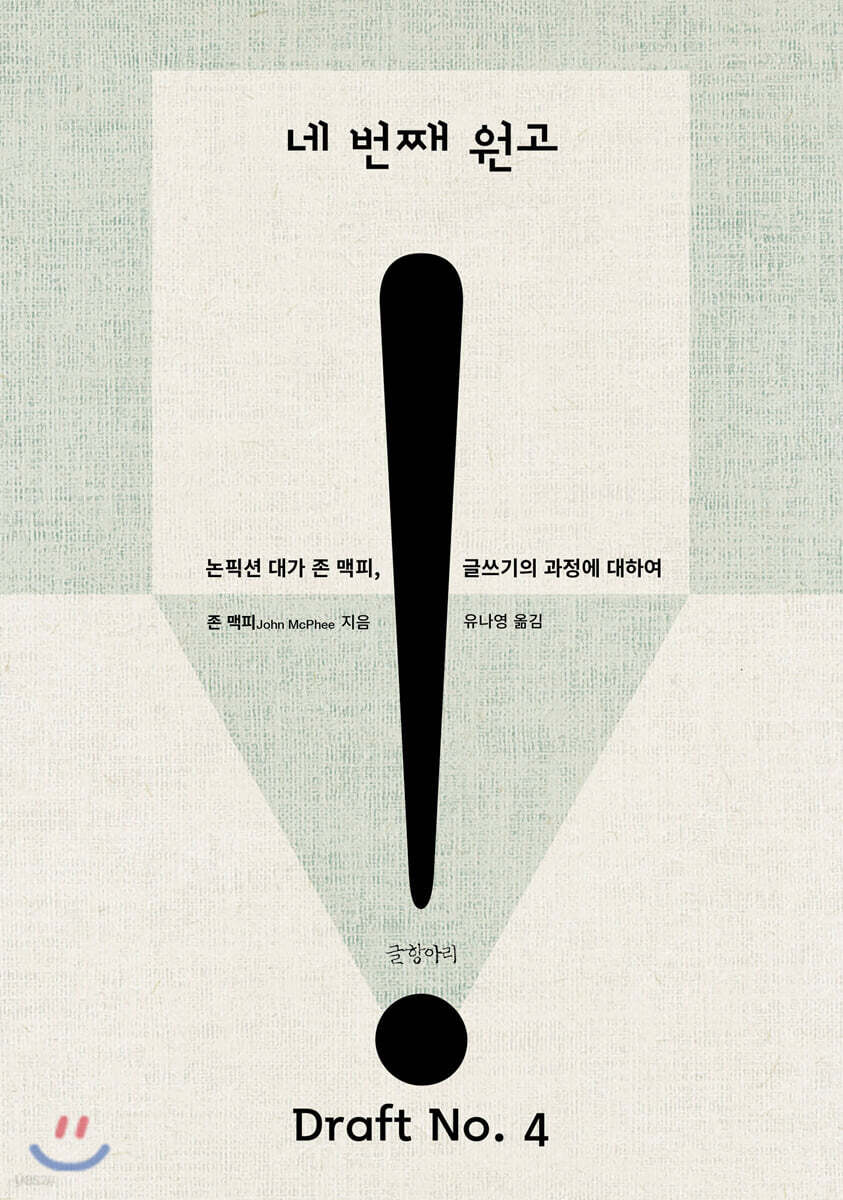
Fourth manuscript
 |
Description
Book Introduction
John McPhee, the legendary author who rewrote the history of nonfiction
From technique to sensibility—a masterclass in writing techniques that distills a life dedicated to writing.
John McPhee's name has become a legend in nonfiction.
Starting in the 1960s, when the definition and position of the nonfiction genre were still vague, McPhee began writing for Time and The New Yorker and established his own nonfiction aesthetic world. He elevated factual writing, which had been treated as mere news reports under the meaningless name of “nonfiction,” to a unique genre called “creative nonfiction.”
Over the next several decades, he became a pioneer of creative nonfiction, publishing over 30 books on a wide range of subjects including people, history, nature, science, and sports. He is credited with rewriting the history of nonfiction by winning the Pulitzer Prize for Annals of the Former World, a geological exploration of the American continent.
McPhee's Princeton lectures, one of the most prestigious writing seminars in the United States, have been a breeding ground for some of the most respected writers for decades, and his name has become a genre in itself.
『Fourth ManuscriptDraft No.
4』 is a book in which John McPhee looks back on his life in detail and dissects 'writing', the only work he has dedicated his entire life to.
The book is filled with the author's writing (or life) methods and attitudes that have become one with him over the years, his passion and friendship with legendary editors, and his deep reflections on the structure of nature and time.
When McPhee, who rarely talks about himself, published this book, countless writers and readers who call themselves McPhinos (people who admire and follow McPhee's writing) welcomed it as a long-awaited gift.
In this book, McPhee covers in detail the entire process of creating a piece of writing—from conception and structure, to writing and revision, to proofreading and editing—using examples directly from his own writing. This approach awakens, stimulates, encourages, and supports the “sense of writing,” which is also a way of existing in the world.
Naturally, these stories serve as proverbs to be remembered and pondered over for a long time by those who are writing somewhere now.
From technique to sensibility—a masterclass in writing techniques that distills a life dedicated to writing.
John McPhee's name has become a legend in nonfiction.
Starting in the 1960s, when the definition and position of the nonfiction genre were still vague, McPhee began writing for Time and The New Yorker and established his own nonfiction aesthetic world. He elevated factual writing, which had been treated as mere news reports under the meaningless name of “nonfiction,” to a unique genre called “creative nonfiction.”
Over the next several decades, he became a pioneer of creative nonfiction, publishing over 30 books on a wide range of subjects including people, history, nature, science, and sports. He is credited with rewriting the history of nonfiction by winning the Pulitzer Prize for Annals of the Former World, a geological exploration of the American continent.
McPhee's Princeton lectures, one of the most prestigious writing seminars in the United States, have been a breeding ground for some of the most respected writers for decades, and his name has become a genre in itself.
『Fourth ManuscriptDraft No.
4』 is a book in which John McPhee looks back on his life in detail and dissects 'writing', the only work he has dedicated his entire life to.
The book is filled with the author's writing (or life) methods and attitudes that have become one with him over the years, his passion and friendship with legendary editors, and his deep reflections on the structure of nature and time.
When McPhee, who rarely talks about himself, published this book, countless writers and readers who call themselves McPhinos (people who admire and follow McPhee's writing) welcomed it as a long-awaited gift.
In this book, McPhee covers in detail the entire process of creating a piece of writing—from conception and structure, to writing and revision, to proofreading and editing—using examples directly from his own writing. This approach awakens, stimulates, encourages, and supports the “sense of writing,” which is also a way of existing in the world.
Naturally, these stories serve as proverbs to be remembered and pondered over for a long time by those who are writing somewhere now.
- You can preview some of the book's contents.
Preview
index
Author's Note
The Mind of John McPhee: A Reclusive Writer Reveals His Obsessive Writing Process
chain
structure
Editors and Publishers
How to get an interview
Reference frame
checkpoint
Fourth manuscript
omission
The Mind of John McPhee: A Reclusive Writer Reveals His Obsessive Writing Process
chain
structure
Editors and Publishers
How to get an interview
Reference frame
checkpoint
Fourth manuscript
omission
Into the book
Yet, McPhee's writing is neither gloomy, nor eerie, nor sad, nor defeatist.
Rather, it is full of life.
For him, learning is a way to love and savor the world before it disappears.
In John McPhee's grand cosmology, every fact on Earth—every region, every creature, every era—is interconnected.
Its non-existence and presence.
Fish, trucks, atoms, bears, whiskey, grass, rocks, lacrosse, strange prehistoric fossils, grandchildren, and Pangaea.
---From "The Mind of John McPhee"
Robert Bingham, my editor at The New Yorker for 16 years, had a very distinct, if not exceptional, mustache.
In one of my early writings, I described someone as having a 'sincere' moustache.
As I had hoped, this expression made Bingham leave his office with the manuscript and walk down the hall to my office.
A true mustache, Mr. McPhee, a true mustache? What does that mean? Am I implying that there are also inauthentic mustaches? I said I couldn't imagine a clearer expression.
The mustache successfully landed on the ground, and I felt like I had secured my spot as The New Yorker's nonfiction mustache expert.
Since then, there have been figures like the man with the "mustache that doesn't listen to nonsense," the captain of the Great Lakes with the "gyroscopic mustache," and the northern mountain man with the "honest mustache of a forester."
One Maine family medicine physician had a "pain-relieving mustache," another had a "sedative mustache," and yet another had a "medically shaped mustache that extended straight beyond the corners of the mouth and did not imply any prognosis, positive or negative."
Writing should be fun at least once every million years.
---From the "Reference Frame"
All errors are eternal.
As Sarah told her journalism school students, once an error appears on paper, it “lives on in libraries, meticulously cataloged, meticulously indexed, and (…) converted into silicon chips to dazzle researchers for generations.
“All these researchers will rely on the initial error and produce new errors over and over again, which will lead to an exponential explosion of errors.”
The fact checker stands at the entrance to this crossing with his sword drawn.
Rather, it is full of life.
For him, learning is a way to love and savor the world before it disappears.
In John McPhee's grand cosmology, every fact on Earth—every region, every creature, every era—is interconnected.
Its non-existence and presence.
Fish, trucks, atoms, bears, whiskey, grass, rocks, lacrosse, strange prehistoric fossils, grandchildren, and Pangaea.
---From "The Mind of John McPhee"
Robert Bingham, my editor at The New Yorker for 16 years, had a very distinct, if not exceptional, mustache.
In one of my early writings, I described someone as having a 'sincere' moustache.
As I had hoped, this expression made Bingham leave his office with the manuscript and walk down the hall to my office.
A true mustache, Mr. McPhee, a true mustache? What does that mean? Am I implying that there are also inauthentic mustaches? I said I couldn't imagine a clearer expression.
The mustache successfully landed on the ground, and I felt like I had secured my spot as The New Yorker's nonfiction mustache expert.
Since then, there have been figures like the man with the "mustache that doesn't listen to nonsense," the captain of the Great Lakes with the "gyroscopic mustache," and the northern mountain man with the "honest mustache of a forester."
One Maine family medicine physician had a "pain-relieving mustache," another had a "sedative mustache," and yet another had a "medically shaped mustache that extended straight beyond the corners of the mouth and did not imply any prognosis, positive or negative."
Writing should be fun at least once every million years.
---From the "Reference Frame"
All errors are eternal.
As Sarah told her journalism school students, once an error appears on paper, it “lives on in libraries, meticulously cataloged, meticulously indexed, and (…) converted into silicon chips to dazzle researchers for generations.
“All these researchers will rely on the initial error and produce new errors over and over again, which will lead to an exponential explosion of errors.”
The fact checker stands at the entrance to this crossing with his sword drawn.
---From "Checkpoint"
Publisher's Review
John McPhee, 'Nonfiction Master' and 'America's Greatest Journalist'
Enjoying the twists and turns, thrills and pitfalls, joys and sorrows of the writing journey
Writing about an extraordinary life dedicated to writing
The Fourth Manuscript is a collection of eight essays on writing by John McPhee that appeared in The New Yorker.
From the conceptual stage of "chaining" to the final stage of "omission" where parts of the text are omitted after the writing is completed, the entire process of translating something in the writer's mind into a coherent and solid piece of writing and reaching the reader is captured.
John McPhee has published over 30 books since his first book, The Sense of Where I Am, was published in 1965.
Over the past half-century, the status of non-fiction as "non-fiction" has been elevated from the level of factual writing at the level of straight news, which gave way to the aesthetic of objectivity, to literature itself—as Svetlana Alexievich's Nobel Prize in 2015 demonstrated.
John McPhee is a pioneer of so-called creative nonfiction and has been a driving force in its advancement. He has established a unique aesthetic world in a wide range of fields, including geology, sports, natural history, history, and people, and has not only become a representative name for the nonfiction genre, but has also become the name of a new genre himself.
By "John McPhee-esque" I mean writing that displays a distinctive creativity in "what the writer chooses to write, the way he begins it, the way he presents it, the technique and skill with which he describes people and develops them as characters, the rhythm of his prose, the integrity of his writing, the anatomy of his writing, and the ability to tell the story that exists in the material he gathers."
For example, McPhee decides to write about oranges, theoretical physicists, wild food experts, tennis players, and art collectors.
Every introduction should be solid, a flash of hope for what follows and a promise to the reader.
The subject matter must be presented honestly and clearly, and the characters must be “almost unbelievably vivid” (‘When I was holding a frog in each hand, I noticed another frog.
He put one in his mouth and then caught a third frog')”.
He rereads the text he has revised several times, carving out rhymes and wandering among the letters in search of better sentences and better words.
When it comes to grammar, I strive for perfection by sharing my passion with editors who never compromise.
The structure takes as much effort as a novel.
The overwhelming amount of information gathered until it couldn't be collected any more comes together to create a story that only John McPhee can tell.
All 30 books published through this process are still in print.
Anyone who has ever published a book or worked in the publishing industry will know what this means.
The spirit of John McPhee,
John McPhee's writing
In "The Fourth Manuscript," John McPhee once again unfolds the process of writing all those words in his signature creative nonfiction.
"Chaining" is the process of developing an idea into actual writing material.
He explains in detail the process of turning an idea into a piece of writing, writing about two tennis players in three dimensions, condensing their lives, achievements, ambitions, and respect into a single match in "Levels of the Game" (which is considered a model of sports writing), and "Encounters with the Archdruid" which pits the brilliant and humane environmentalist David Brower against three of his natural enemies.
In the next chapter, "Structure," McPhee devotes more than a fifth of the book to talking about structure.
As he himself reveals, he is obsessed with structure.
“The readers should not be made to notice the structure.
The structure should be visible only to the extent that one can infer the skeleton of a person by looking at his appearance.
(…) A piece of writing must start somewhere, go somewhere, and sit down at the place it arrives at.
How do we do this? We do it by establishing structures that we hope will be irrefutable.” Many readers find the beauty of McPhee's writing in the structure.
'Why did they write it like this?' The moment the structure is revealed to the extent necessary, there is no room for rebuttal.
Once you grasp the structure, paragraphs and sentences, and the spaces between them, take on a whole new weight.
McPhee explains this process of building a structure step by step, using various diagrams (just as he did in his lectures at Princeton).
"Editors and Publishers" and "Checkpoint" feature a number of legendary publishers.
The bittersweet yet loving memories of William Shawn, who served as editor-in-chief of [The New Yorker] and raised the magazine to its current status; Eleanor Gould, who created the synonym of “Gould’s Proofreading” and made her name known to aspiring writers and editors; Mary Norris, a proofreader well-known in Korea for her book “New York Under Proofreading”; fact-checker Sarah Lippincott, who “meticulously examines every single word that contains even the tiniest bit of truth, and if it passes, issues an official fact-checker certificate with a tiny check mark in pencil”; Roger Strauss, the CEO of Farrar and Strauss & Giroux, a leading publisher that has produced many Nobel Prize winners (the same Roger Strauss who made Susan Sontag a star writer), and others are depicted with McPhee’s humor that makes you laugh.
"How to Get an Interview" is literally about interviews, an essential process in nonfiction (and fiction, of course), journalism, and other writing.
“If I were in a situation where I was with someone and trying to interview them, I would much rather be on the ceiling with Kafka,” says McPhee, who nevertheless explains how he manages to extract useful stories from his interviewees.
All sorts of practical know-how are poured out, from 'physical' advice that puts silent pressure on the interviewee while pretending to take notes, to lax interviews with comedians, film directors, actors, politicians, FBI agents, etc. who come to the office in person, to strict interviews where even the one time you meet them you have to have a security guard present.
"Reference Frame" and "Omission" point out points that must be considered in the process of completing a piece of writing, but which the writer may find difficult to recognize.
It's a sense of metaphor and simile, of prolixity and unnecessaryness—in other words, of writing that is conscious of the reader.
After writing a pun that didn't work and hearing from his editor, "I think you should take this out," McPhee stubbornly insists on it despite being given several chances to retract it, and finally goes to see him at the last minute to say,
“That's a joke.
Just erase it.
“I think I’ll have to delete it.” You may suffer the humiliation of having 85% of your writing deleted, and you may also experience the difficulty of having to explain to the publisher in detail a metaphor that no one understands, thinking it’s humor.
Through anecdotes from his own personal experience, he demonstrates that writing that is uncluttered, relevant, contemporary, and globally conscious is difficult to achieve without this process.
The title piece, "The Fourth Manuscript," is an essay about the writing life, which contains all of this process, or a life dedicated to that process.
As is often the case with books on writing, McPhee's is a self-deprecating journey riddled with fear, self-doubt, regret, and anguish.
But the point is, nevertheless, in the excitement, benefit, and pleasure he finds in each day, stepping forward word by word, toward the point he wants to reach, the point he should call the realm.
That's why McPhee titled this article and book The Fourth Manuscript.
“If every word feels like it’s trapped in a place you can’t escape from, if you feel like you’ll never be able to write and that you have no talent as a writer, if you can see it’s doomed to fail and have completely lost your confidence, then you must be a writer.” If only you could overcome the inevitable pain and make it to the “fourth draft.”
Enjoying the twists and turns, thrills and pitfalls, joys and sorrows of the writing journey
Writing about an extraordinary life dedicated to writing
The Fourth Manuscript is a collection of eight essays on writing by John McPhee that appeared in The New Yorker.
From the conceptual stage of "chaining" to the final stage of "omission" where parts of the text are omitted after the writing is completed, the entire process of translating something in the writer's mind into a coherent and solid piece of writing and reaching the reader is captured.
John McPhee has published over 30 books since his first book, The Sense of Where I Am, was published in 1965.
Over the past half-century, the status of non-fiction as "non-fiction" has been elevated from the level of factual writing at the level of straight news, which gave way to the aesthetic of objectivity, to literature itself—as Svetlana Alexievich's Nobel Prize in 2015 demonstrated.
John McPhee is a pioneer of so-called creative nonfiction and has been a driving force in its advancement. He has established a unique aesthetic world in a wide range of fields, including geology, sports, natural history, history, and people, and has not only become a representative name for the nonfiction genre, but has also become the name of a new genre himself.
By "John McPhee-esque" I mean writing that displays a distinctive creativity in "what the writer chooses to write, the way he begins it, the way he presents it, the technique and skill with which he describes people and develops them as characters, the rhythm of his prose, the integrity of his writing, the anatomy of his writing, and the ability to tell the story that exists in the material he gathers."
For example, McPhee decides to write about oranges, theoretical physicists, wild food experts, tennis players, and art collectors.
Every introduction should be solid, a flash of hope for what follows and a promise to the reader.
The subject matter must be presented honestly and clearly, and the characters must be “almost unbelievably vivid” (‘When I was holding a frog in each hand, I noticed another frog.
He put one in his mouth and then caught a third frog')”.
He rereads the text he has revised several times, carving out rhymes and wandering among the letters in search of better sentences and better words.
When it comes to grammar, I strive for perfection by sharing my passion with editors who never compromise.
The structure takes as much effort as a novel.
The overwhelming amount of information gathered until it couldn't be collected any more comes together to create a story that only John McPhee can tell.
All 30 books published through this process are still in print.
Anyone who has ever published a book or worked in the publishing industry will know what this means.
The spirit of John McPhee,
John McPhee's writing
In "The Fourth Manuscript," John McPhee once again unfolds the process of writing all those words in his signature creative nonfiction.
"Chaining" is the process of developing an idea into actual writing material.
He explains in detail the process of turning an idea into a piece of writing, writing about two tennis players in three dimensions, condensing their lives, achievements, ambitions, and respect into a single match in "Levels of the Game" (which is considered a model of sports writing), and "Encounters with the Archdruid" which pits the brilliant and humane environmentalist David Brower against three of his natural enemies.
In the next chapter, "Structure," McPhee devotes more than a fifth of the book to talking about structure.
As he himself reveals, he is obsessed with structure.
“The readers should not be made to notice the structure.
The structure should be visible only to the extent that one can infer the skeleton of a person by looking at his appearance.
(…) A piece of writing must start somewhere, go somewhere, and sit down at the place it arrives at.
How do we do this? We do it by establishing structures that we hope will be irrefutable.” Many readers find the beauty of McPhee's writing in the structure.
'Why did they write it like this?' The moment the structure is revealed to the extent necessary, there is no room for rebuttal.
Once you grasp the structure, paragraphs and sentences, and the spaces between them, take on a whole new weight.
McPhee explains this process of building a structure step by step, using various diagrams (just as he did in his lectures at Princeton).
"Editors and Publishers" and "Checkpoint" feature a number of legendary publishers.
The bittersweet yet loving memories of William Shawn, who served as editor-in-chief of [The New Yorker] and raised the magazine to its current status; Eleanor Gould, who created the synonym of “Gould’s Proofreading” and made her name known to aspiring writers and editors; Mary Norris, a proofreader well-known in Korea for her book “New York Under Proofreading”; fact-checker Sarah Lippincott, who “meticulously examines every single word that contains even the tiniest bit of truth, and if it passes, issues an official fact-checker certificate with a tiny check mark in pencil”; Roger Strauss, the CEO of Farrar and Strauss & Giroux, a leading publisher that has produced many Nobel Prize winners (the same Roger Strauss who made Susan Sontag a star writer), and others are depicted with McPhee’s humor that makes you laugh.
"How to Get an Interview" is literally about interviews, an essential process in nonfiction (and fiction, of course), journalism, and other writing.
“If I were in a situation where I was with someone and trying to interview them, I would much rather be on the ceiling with Kafka,” says McPhee, who nevertheless explains how he manages to extract useful stories from his interviewees.
All sorts of practical know-how are poured out, from 'physical' advice that puts silent pressure on the interviewee while pretending to take notes, to lax interviews with comedians, film directors, actors, politicians, FBI agents, etc. who come to the office in person, to strict interviews where even the one time you meet them you have to have a security guard present.
"Reference Frame" and "Omission" point out points that must be considered in the process of completing a piece of writing, but which the writer may find difficult to recognize.
It's a sense of metaphor and simile, of prolixity and unnecessaryness—in other words, of writing that is conscious of the reader.
After writing a pun that didn't work and hearing from his editor, "I think you should take this out," McPhee stubbornly insists on it despite being given several chances to retract it, and finally goes to see him at the last minute to say,
“That's a joke.
Just erase it.
“I think I’ll have to delete it.” You may suffer the humiliation of having 85% of your writing deleted, and you may also experience the difficulty of having to explain to the publisher in detail a metaphor that no one understands, thinking it’s humor.
Through anecdotes from his own personal experience, he demonstrates that writing that is uncluttered, relevant, contemporary, and globally conscious is difficult to achieve without this process.
The title piece, "The Fourth Manuscript," is an essay about the writing life, which contains all of this process, or a life dedicated to that process.
As is often the case with books on writing, McPhee's is a self-deprecating journey riddled with fear, self-doubt, regret, and anguish.
But the point is, nevertheless, in the excitement, benefit, and pleasure he finds in each day, stepping forward word by word, toward the point he wants to reach, the point he should call the realm.
That's why McPhee titled this article and book The Fourth Manuscript.
“If every word feels like it’s trapped in a place you can’t escape from, if you feel like you’ll never be able to write and that you have no talent as a writer, if you can see it’s doomed to fail and have completely lost your confidence, then you must be a writer.” If only you could overcome the inevitable pain and make it to the “fourth draft.”
GOODS SPECIFICS
- Date of issue: April 16, 2020
- Format: Hardcover book binding method guide
- Page count, weight, size: 312 pages | 462g | 140*200*30mm
- ISBN13: 9788967357665
- ISBN10: 8967357664
You may also like
카테고리
korean


korean

![GQ KOREA Mark (Monthly): December [2025]](http://librairie.coreenne.fr/cdn/shop/files/8ef265dbbfbf186523ed75ba7319009d.jpg?v=1765340328&width=3840)


