

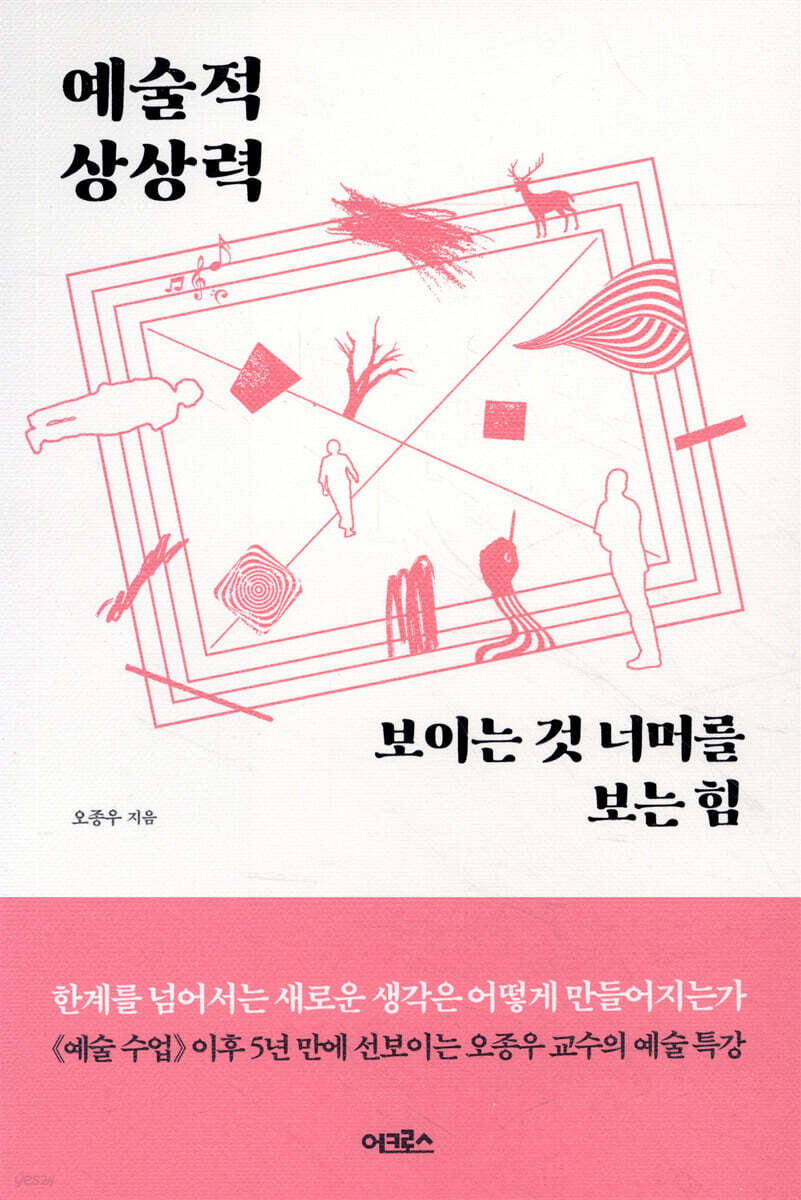
artistic imagination
 |
Description
Book Introduction
How are new ideas that transcend limitations created? Professor Oh Jong-woo's special art lecture, presented five years after "Art Class." “Artistic imagination is the power to reveal the invisible beyond the visible and to elevate life.” A new book by Professor Jong-Woo Oh, who is considered the best lecturer by students and has won the SKKU Teaching Award. Five years after 『Art Class』, which led us on an artistic adventure through the works of geniuses from literature to painting, music, and film, we are meeting readers again with a special lecture on art. "Artistic Imagination" conveys the true utility of art through a deeper understanding of the demands of a rapidly changing era. Can works created by AI also be considered art? What was depicted in the work that Hitler coveted and inspired Picasso and Proust? Why didn't Mondrian draw diagonal lines? Why does music open our senses more intuitively than other arts? Through bold ideas that have created new times and spaces in our civilization, from paintings and novels to plays, music, and even technology, it awakens the artistic imagination that allows us to see the invisible and create the unprecedented. Artistic imagination will become a new driving force in our era, which is shaking up human work from its roots. |
- You can preview some of the book's contents.
Preview
index
prolog
1 Where does imagination come from?
-The question posed by Picasso's "Two Sisters"
What made Picasso different? / An era that even changes the definition of revolution / Human vs. mechanical / Two ways of thinking / Can AI works be considered art? / Soulless humans / Beyond what is visible
Art Lesson 1 Life is not given, it is created
2 What is seen comes from what is unseen.
-The world shown by Vermeer, the artist of artists
When you don't understand transformation / The spirit of still life / Anxiety is another name for hope / Knowing art / The two dimensions of reality / The forgotten painter becomes a mythical being / "The Art of Painting" that inspired Proust
Art Class 2: Expanding Your Verbal Imagination
3. Creating something that never existed before
-Clay that captured sound on canvas
Technology, a product of imagination / Art as alchemy / From the trembling of life / Beautiful human beings / The common belief that work is useless / The secret of Mondrian's pattern / Invisible force, vanishing point / Science from which da Vinci's art sprouted / Scientiae, discovering something new / The first oil painting / Criticism poured on Impressionism / Changes in patterns that capture landscapes / Why didn't Mondrian draw diagonal lines / What Bauhaus first taught / Klee, a world created with a single line
Art Class 3 What looks better when you draw than when you look
4 The moment a new idea is born
-The utopia dreamed of by futurists
Artists of Montmartre / Setting Tradition on Fire / Can Noise Become Music? / The Origins of the Classics That Attempt to Break Them / The Age of Classics / The Power of Music as Seen Through by Tolstoy / Four Artistic Methods for Creating New Ideas / Broadening the Breadth of Life / A New Lifeform / A Look Behind the Stage Painted by Depereaux
Art Class 4: How Can Dreams Come True?
5 What is Genius?
-Why was Salieri so jealous of Mozart?
The Mechanism of Legend and Rumor / Pushkin's "Mozart and Salieri" / The Tragedy of Those Trapped by Norms / Killing the Artist for Art / The Opposite of Genius / Mozart's Death and Life / The Vitality of "Don Giovanni" / Michelangelo's "The Awakening of the Slave" and the Moment of Creation
Art Class 5 Dance, Body Knowledge
6 Paradoxes of Distorted Humans
-A person that Modigliani painted until the end of his life
The greatest problem the future will bring / Einstein's brain / How to explain the inexplicable / A world without a soul / The distorted human image / The metaphor of the lame Vulcan, the god of the blacksmith / The common notion of augmentation as self-reinforcement / Why Anna Karenina fell into misfortune / The power to gather people / What the modern minstrel sang
Art Class 6: The Thickness of Life, What Makes Me
Epilogue
References | Search
1 Where does imagination come from?
-The question posed by Picasso's "Two Sisters"
What made Picasso different? / An era that even changes the definition of revolution / Human vs. mechanical / Two ways of thinking / Can AI works be considered art? / Soulless humans / Beyond what is visible
Art Lesson 1 Life is not given, it is created
2 What is seen comes from what is unseen.
-The world shown by Vermeer, the artist of artists
When you don't understand transformation / The spirit of still life / Anxiety is another name for hope / Knowing art / The two dimensions of reality / The forgotten painter becomes a mythical being / "The Art of Painting" that inspired Proust
Art Class 2: Expanding Your Verbal Imagination
3. Creating something that never existed before
-Clay that captured sound on canvas
Technology, a product of imagination / Art as alchemy / From the trembling of life / Beautiful human beings / The common belief that work is useless / The secret of Mondrian's pattern / Invisible force, vanishing point / Science from which da Vinci's art sprouted / Scientiae, discovering something new / The first oil painting / Criticism poured on Impressionism / Changes in patterns that capture landscapes / Why didn't Mondrian draw diagonal lines / What Bauhaus first taught / Klee, a world created with a single line
Art Class 3 What looks better when you draw than when you look
4 The moment a new idea is born
-The utopia dreamed of by futurists
Artists of Montmartre / Setting Tradition on Fire / Can Noise Become Music? / The Origins of the Classics That Attempt to Break Them / The Age of Classics / The Power of Music as Seen Through by Tolstoy / Four Artistic Methods for Creating New Ideas / Broadening the Breadth of Life / A New Lifeform / A Look Behind the Stage Painted by Depereaux
Art Class 4: How Can Dreams Come True?
5 What is Genius?
-Why was Salieri so jealous of Mozart?
The Mechanism of Legend and Rumor / Pushkin's "Mozart and Salieri" / The Tragedy of Those Trapped by Norms / Killing the Artist for Art / The Opposite of Genius / Mozart's Death and Life / The Vitality of "Don Giovanni" / Michelangelo's "The Awakening of the Slave" and the Moment of Creation
Art Class 5 Dance, Body Knowledge
6 Paradoxes of Distorted Humans
-A person that Modigliani painted until the end of his life
The greatest problem the future will bring / Einstein's brain / How to explain the inexplicable / A world without a soul / The distorted human image / The metaphor of the lame Vulcan, the god of the blacksmith / The common notion of augmentation as self-reinforcement / Why Anna Karenina fell into misfortune / The power to gather people / What the modern minstrel sang
Art Class 6: The Thickness of Life, What Makes Me
Epilogue
References | Search
Detailed image

Into the book
Sometimes, arbitrary fantasies that unfold at will are confused with imagination.
The true imagination that leads to creation comes from art, which has never disappeared throughout human history.
(…) Artistic imagination is the power to penetrate the visible and reveal the invisible beyond, and it is the ability to elevate life.
When we encounter works of art, we can see reality better, hear it better, and feel it better.
--- From the "Prologue"
In an age where the development of artificial intelligence raises the question of what it means to be human, what does it really mean to be human?
Since art is a uniquely human activity, we can find the answer in art.
We can also think about the things that make people human through works of art.
Art always speaks of humanity, and constantly interacts with human things.
--- p.33
You don't study art simply to become an artist.
We find our individuality by listening to music, singing, dancing, and drawing.
A person with individuality does not envy others.
Follow your interests, not your desires.
Many personalities come together to form the world.
When that happens, the society we live in becomes healthier.
Life is not something that is given to us and determined for us to live, but rather something that we must create for ourselves.
--- p.41
The term 'beautiful human' is a term that comes from the connection between vision and perception.
The language of the senses is not limited to mere sensation.
(…) These expressions are much more specific and complex, allowing for broader thinking.
It also has an open sensibility, which gives you the imagination to open up a bigger future.
Words that we perceive with our senses also contain an aesthetic attitude toward life.
--- p.88~89
Mondrian's work overcomes the notion that the world of art exists only within the canvas.
His work extends beyond the canvas, signaling that the world of art is infinitely expanding the real world.
So, when viewed through Mondrian's frame, everything in the world looks attractive.
(…) The secret to this charm lies in the absence of diagonal lines in his patterns.
Why didn't he draw a diagonal line?
--- p.94~95
Cézanne, who adhered to the Impressionist spirit of direct encounter with nature, saw unchanging patterns in the landscape.
By carefully observing things, I extracted the permanence contained in the moment.
As I looked at the object for a long time, its pattern became clear.
We can also experience that when we stare intently at an object for a long time, the geometric shape of the object gradually becomes more apparent.
It is said that Cézanne drew a single stroke and stared at the canvas for quite a long time, alternating between the canvas and the subject.
--- p.123
In “Contemplation,” Klee expressed what art is that makes the invisible visible.
Art does not simply show us a world that was previously invisible, but rather brings that world into the realm of sight and hearing.
Hanging a picture on a blank wall breaks through the emptiness and creates a new atmosphere.
Art is a creation in itself, and it gives us the imagination to create other creations.
Humanity created civilization by exercising its imagination.
--- p.135
Life doesn't change even when information overflows.
Life changes only happen when those wise words take hold within me and become real.
Otherwise, it's just nagging.
Music flows with the progression of time, but creates space with its repetitive rhythm.
This is why the music has a lingering effect, and why leaps to other levels occur.
--- p.162
When we encounter something new, we try to explain it by linking it to things we already know.
Here again, a metaphor is needed.
Metaphor is the beginning of language.
A new language is born by describing images as if drawing a picture.
In this way, metaphor opens up new worlds through imagination.
We reconstruct the world by combining what we know on a completely different level.
Because of the unfamiliar connection, a moment, a space, arises, and it is here that reason is created.
Creativity emerges from the gap created by the meeting of heterogeneous things.
--- p.167
Genius is also the ability to bring together different categories and come up with new interpretations.
A person with a mechanical mind cannot reconcile heterogeneous elements.
Such people cannot live a creative life by only doing arithmetic calculations.
Salieri is a person who lives his life according to given standards, just as he did when learning to compose music.
(…) The opposite of creation is imitation, and the opposite of genius is slavery.
The opposite of master is also slave.
--- p.217
Among the artistic expressions, there is a negative technique that expresses a precious value that cannot be defined.
It is a method of approaching a value that cannot be defined as something by saying that it is not something.
This is a way to express the meaning without damaging the essence through regulations.
The reason we have to express something in this negative way is because it goes beyond language.
The true imagination that leads to creation comes from art, which has never disappeared throughout human history.
(…) Artistic imagination is the power to penetrate the visible and reveal the invisible beyond, and it is the ability to elevate life.
When we encounter works of art, we can see reality better, hear it better, and feel it better.
--- From the "Prologue"
In an age where the development of artificial intelligence raises the question of what it means to be human, what does it really mean to be human?
Since art is a uniquely human activity, we can find the answer in art.
We can also think about the things that make people human through works of art.
Art always speaks of humanity, and constantly interacts with human things.
--- p.33
You don't study art simply to become an artist.
We find our individuality by listening to music, singing, dancing, and drawing.
A person with individuality does not envy others.
Follow your interests, not your desires.
Many personalities come together to form the world.
When that happens, the society we live in becomes healthier.
Life is not something that is given to us and determined for us to live, but rather something that we must create for ourselves.
--- p.41
The term 'beautiful human' is a term that comes from the connection between vision and perception.
The language of the senses is not limited to mere sensation.
(…) These expressions are much more specific and complex, allowing for broader thinking.
It also has an open sensibility, which gives you the imagination to open up a bigger future.
Words that we perceive with our senses also contain an aesthetic attitude toward life.
--- p.88~89
Mondrian's work overcomes the notion that the world of art exists only within the canvas.
His work extends beyond the canvas, signaling that the world of art is infinitely expanding the real world.
So, when viewed through Mondrian's frame, everything in the world looks attractive.
(…) The secret to this charm lies in the absence of diagonal lines in his patterns.
Why didn't he draw a diagonal line?
--- p.94~95
Cézanne, who adhered to the Impressionist spirit of direct encounter with nature, saw unchanging patterns in the landscape.
By carefully observing things, I extracted the permanence contained in the moment.
As I looked at the object for a long time, its pattern became clear.
We can also experience that when we stare intently at an object for a long time, the geometric shape of the object gradually becomes more apparent.
It is said that Cézanne drew a single stroke and stared at the canvas for quite a long time, alternating between the canvas and the subject.
--- p.123
In “Contemplation,” Klee expressed what art is that makes the invisible visible.
Art does not simply show us a world that was previously invisible, but rather brings that world into the realm of sight and hearing.
Hanging a picture on a blank wall breaks through the emptiness and creates a new atmosphere.
Art is a creation in itself, and it gives us the imagination to create other creations.
Humanity created civilization by exercising its imagination.
--- p.135
Life doesn't change even when information overflows.
Life changes only happen when those wise words take hold within me and become real.
Otherwise, it's just nagging.
Music flows with the progression of time, but creates space with its repetitive rhythm.
This is why the music has a lingering effect, and why leaps to other levels occur.
--- p.162
When we encounter something new, we try to explain it by linking it to things we already know.
Here again, a metaphor is needed.
Metaphor is the beginning of language.
A new language is born by describing images as if drawing a picture.
In this way, metaphor opens up new worlds through imagination.
We reconstruct the world by combining what we know on a completely different level.
Because of the unfamiliar connection, a moment, a space, arises, and it is here that reason is created.
Creativity emerges from the gap created by the meeting of heterogeneous things.
--- p.167
Genius is also the ability to bring together different categories and come up with new interpretations.
A person with a mechanical mind cannot reconcile heterogeneous elements.
Such people cannot live a creative life by only doing arithmetic calculations.
Salieri is a person who lives his life according to given standards, just as he did when learning to compose music.
(…) The opposite of creation is imitation, and the opposite of genius is slavery.
The opposite of master is also slave.
--- p.217
Among the artistic expressions, there is a negative technique that expresses a precious value that cannot be defined.
It is a method of approaching a value that cannot be defined as something by saying that it is not something.
This is a way to express the meaning without damaging the essence through regulations.
The reason we have to express something in this negative way is because it goes beyond language.
--- p.245
Publisher's Review
What we need as we enter a new era in 2020
Where does the strength to not be swept away by the rapidly changing currents come from?
“I learned Baduk as an art.
A single work created by two people.
“Is there really anything like that left now?” Lee Sedol, 9th Dan, retired from the world of Go in November 2019, citing AI as the reason.
His words are significant.
It asks what the difference is between humans and artificial intelligence, what humans can do, and the fundamental nature of humanity.
This is also the question Professor Oh Jong-woo poses in this book.
“In an age where the development of artificial intelligence raises the question of what it means to be human, what does it really mean to be human?
Since art is a uniquely human activity, we can find the answer in art.
We can also think about the things that make people human through works of art.
“Art always speaks of what is human, and it constantly interacts with things that are human.” (p. 33)
The advancement of today's technology, including artificial intelligence, which makes us question the meaning of being human, is often defined as the Fourth Industrial Revolution.
However, Professor Oh Jong-woo says that even this concept is outdated and that “if there is an old word that can explain the current change, it is revolution.”
If there's one thing that's certain amidst the uncertainty of this rapidly changing era, it's that the driving force behind this new era is shifting from capital to imagination and creativity.
Art has opened up science, and technology has opened up new aspects of art.
The book reveals that now is the new phase.
The author traces the roots of technology to art, discovers the seeds of technology in art, and closely explores the intersections of art and science.
As we follow this journey through the works of the century, discovering how artistic imagination has shaped civilization, the future to come becomes tangible and concrete.
This book opens our eyes to the tomorrow we face, and asks us what kind of future we should dream of and create, providing a solid foundation for thinking that will not be swept away by this rapidly changing era.
Six Special Lectures on Artistic Imagination from the Creators of the Century
How to constantly imagine and realize the invisible
Chapter 1: Where Does Imagination Come From ?: Two Ways of Thinking at Work in Picasso's Work
Chapter 2 What is seen from what is not seen : How to read the paintings of Vermeer, the artist who inspired Proust
The first work you encounter when you open the book is Picasso's "Two Sisters" (1902).
The author asks which of the two women in the painting is a nun and which is a prostitute.
By answering this question, we can determine whether we are seeing things through eyes trapped by established logic, or whether we are prepared to encounter the world Picasso saw and captured without prejudice.
There are two realities in the world.
The visible world and the invisible world.
We all dream of an invisible world and want to make that dream come true in the visible world.
Exploring the early works that ushered in Picasso's Blue Period and the world depicted by Vermeer, another genius artist he delved into, it shows how artistic thinking can create a better reality in a time of upheaval that even changes the very definition of revolution.
We are reminded once again that art is not a secondary skill to be acquired, but rather a fundamental human task that shapes our lives.
Chapter 3: Creating Something That Never Existed : The Secret of Mondrian Patterns and the World Klee Created with a Single Line
Chapter 4: The Moment When New Ideas Are Born : Four Artistic Ways to Create Real Innovation
It combines the history of mankind, which has developed civilization and art by patterning all things, with the technology of augmented reality, which is the future right before our eyes, with the artistic phenomenon of rhythm (i.e. amplification).
From the spirit of the Bauhaus, which created a new way of life, to cave paintings, to the origins of the classics that Futurism sought to shatter, we trace back the history of art and glimpse the patterns of creation and the rhythm of innovation that will open a new present from the old future of art.
The power to penetrate the essence arises when one senses and patterns the infinitely expanding world with one's own rhythm.
The moment you break away from the status quo and do something new is when the rhythm of your life changes.
You will be able to read the humanists' brilliant insights into the difference between crude patterns and patterns that penetrate the essence, which arts have faded and which have made great strides, and what it takes to create a life according to one's own rhythm rather than that of others.
Chapter 5: What is Genius ?: Why the Works of Mozart and Michelangelo Have Vitality
The fifth lecture shatters our common notions about genius and the tired and false legend of Salieri as a tormented idiot who had no choice but to murder the frivolous genius Mozart.
It includes the full text of Pushkin's play "Mozart and Salieri," and the author's detailed commentary on the work allows you to encounter this brilliant classic in a new way.
When we understand why Salieri, despite accumulating artistic knowledge, was unable to explode, and what suppresses imagination and creativity, we simultaneously see the genius and slavery within us.
How can genius be kept alive?
Hearing Mozart's legacy firsthand (one of the ways this book awakens our artistic imagination is by allowing us to encounter the works firsthand.
You can enjoy music and videos through the QR code included in the book.) As you encounter Michelangelo's sculptures and paintings, you will be able to discover clues as to where the vitality of the works comes from.
Chapter 6: The Paradox of the Distorted Man : How to Approach the Inexplicable and Invisible
Following the five lectures on genius and creativity, the final lecture delves deeper into art and human potential.
Artistic imagination that senses a world that cannot be described in words, and creates it through music, painting, gestures, and ultimately language.
Could we express this artistic imagination that shapes personality and creates life with the word 'soul'?
Along with Modigliani's paintings, it speaks to the paradox of how to approach the essence that cannot be expressed in words and cannot be seen through the distorted forms of modern art.
Just as Andrei Rublev's "The Savior," which adorns the final chapter of the book, has "still looked ahead with gentle, sorrowful eyes" from the 15th century to the present, this book allows us to properly encounter the harsh reality of our lives in turbulent times without embellishing it.
It also subtly tells us that the anxiety we harbor is “another name for hope.”
The power to expand one's world without being swept away by the flow or settling for the present in a rapidly changing era.
The ability to constantly imagine and realize the invisible.
Paul Klee, who could portray the spirit of modernity with a single line, Modigliani, who tried to capture a person's soul until the end of his life, and Tolstoy and Bob Dylan were all like that.
Now it's our turn.
Where does the strength to not be swept away by the rapidly changing currents come from?
“I learned Baduk as an art.
A single work created by two people.
“Is there really anything like that left now?” Lee Sedol, 9th Dan, retired from the world of Go in November 2019, citing AI as the reason.
His words are significant.
It asks what the difference is between humans and artificial intelligence, what humans can do, and the fundamental nature of humanity.
This is also the question Professor Oh Jong-woo poses in this book.
“In an age where the development of artificial intelligence raises the question of what it means to be human, what does it really mean to be human?
Since art is a uniquely human activity, we can find the answer in art.
We can also think about the things that make people human through works of art.
“Art always speaks of what is human, and it constantly interacts with things that are human.” (p. 33)
The advancement of today's technology, including artificial intelligence, which makes us question the meaning of being human, is often defined as the Fourth Industrial Revolution.
However, Professor Oh Jong-woo says that even this concept is outdated and that “if there is an old word that can explain the current change, it is revolution.”
If there's one thing that's certain amidst the uncertainty of this rapidly changing era, it's that the driving force behind this new era is shifting from capital to imagination and creativity.
Art has opened up science, and technology has opened up new aspects of art.
The book reveals that now is the new phase.
The author traces the roots of technology to art, discovers the seeds of technology in art, and closely explores the intersections of art and science.
As we follow this journey through the works of the century, discovering how artistic imagination has shaped civilization, the future to come becomes tangible and concrete.
This book opens our eyes to the tomorrow we face, and asks us what kind of future we should dream of and create, providing a solid foundation for thinking that will not be swept away by this rapidly changing era.
Six Special Lectures on Artistic Imagination from the Creators of the Century
How to constantly imagine and realize the invisible
Chapter 1: Where Does Imagination Come From ?: Two Ways of Thinking at Work in Picasso's Work
Chapter 2 What is seen from what is not seen : How to read the paintings of Vermeer, the artist who inspired Proust
The first work you encounter when you open the book is Picasso's "Two Sisters" (1902).
The author asks which of the two women in the painting is a nun and which is a prostitute.
By answering this question, we can determine whether we are seeing things through eyes trapped by established logic, or whether we are prepared to encounter the world Picasso saw and captured without prejudice.
There are two realities in the world.
The visible world and the invisible world.
We all dream of an invisible world and want to make that dream come true in the visible world.
Exploring the early works that ushered in Picasso's Blue Period and the world depicted by Vermeer, another genius artist he delved into, it shows how artistic thinking can create a better reality in a time of upheaval that even changes the very definition of revolution.
We are reminded once again that art is not a secondary skill to be acquired, but rather a fundamental human task that shapes our lives.
Chapter 3: Creating Something That Never Existed : The Secret of Mondrian Patterns and the World Klee Created with a Single Line
Chapter 4: The Moment When New Ideas Are Born : Four Artistic Ways to Create Real Innovation
It combines the history of mankind, which has developed civilization and art by patterning all things, with the technology of augmented reality, which is the future right before our eyes, with the artistic phenomenon of rhythm (i.e. amplification).
From the spirit of the Bauhaus, which created a new way of life, to cave paintings, to the origins of the classics that Futurism sought to shatter, we trace back the history of art and glimpse the patterns of creation and the rhythm of innovation that will open a new present from the old future of art.
The power to penetrate the essence arises when one senses and patterns the infinitely expanding world with one's own rhythm.
The moment you break away from the status quo and do something new is when the rhythm of your life changes.
You will be able to read the humanists' brilliant insights into the difference between crude patterns and patterns that penetrate the essence, which arts have faded and which have made great strides, and what it takes to create a life according to one's own rhythm rather than that of others.
Chapter 5: What is Genius ?: Why the Works of Mozart and Michelangelo Have Vitality
The fifth lecture shatters our common notions about genius and the tired and false legend of Salieri as a tormented idiot who had no choice but to murder the frivolous genius Mozart.
It includes the full text of Pushkin's play "Mozart and Salieri," and the author's detailed commentary on the work allows you to encounter this brilliant classic in a new way.
When we understand why Salieri, despite accumulating artistic knowledge, was unable to explode, and what suppresses imagination and creativity, we simultaneously see the genius and slavery within us.
How can genius be kept alive?
Hearing Mozart's legacy firsthand (one of the ways this book awakens our artistic imagination is by allowing us to encounter the works firsthand.
You can enjoy music and videos through the QR code included in the book.) As you encounter Michelangelo's sculptures and paintings, you will be able to discover clues as to where the vitality of the works comes from.
Chapter 6: The Paradox of the Distorted Man : How to Approach the Inexplicable and Invisible
Following the five lectures on genius and creativity, the final lecture delves deeper into art and human potential.
Artistic imagination that senses a world that cannot be described in words, and creates it through music, painting, gestures, and ultimately language.
Could we express this artistic imagination that shapes personality and creates life with the word 'soul'?
Along with Modigliani's paintings, it speaks to the paradox of how to approach the essence that cannot be expressed in words and cannot be seen through the distorted forms of modern art.
Just as Andrei Rublev's "The Savior," which adorns the final chapter of the book, has "still looked ahead with gentle, sorrowful eyes" from the 15th century to the present, this book allows us to properly encounter the harsh reality of our lives in turbulent times without embellishing it.
It also subtly tells us that the anxiety we harbor is “another name for hope.”
The power to expand one's world without being swept away by the flow or settling for the present in a rapidly changing era.
The ability to constantly imagine and realize the invisible.
Paul Klee, who could portray the spirit of modernity with a single line, Modigliani, who tried to capture a person's soul until the end of his life, and Tolstoy and Bob Dylan were all like that.
Now it's our turn.
GOODS SPECIFICS
- Date of issue: December 31, 2019
- Page count, weight, size: 296 pages | 470g | 145*215*17mm
- ISBN13: 9791190030281
- ISBN10: 1190030284
You may also like
카테고리
korean


korean

![ELLE 엘르 스페셜 에디션 A형 : 12월 [2025]](http://librairie.coreenne.fr/cdn/shop/files/b8e27a3de6c9538896439686c6b0e8fb.jpg?v=1766436872&width=3840)


