

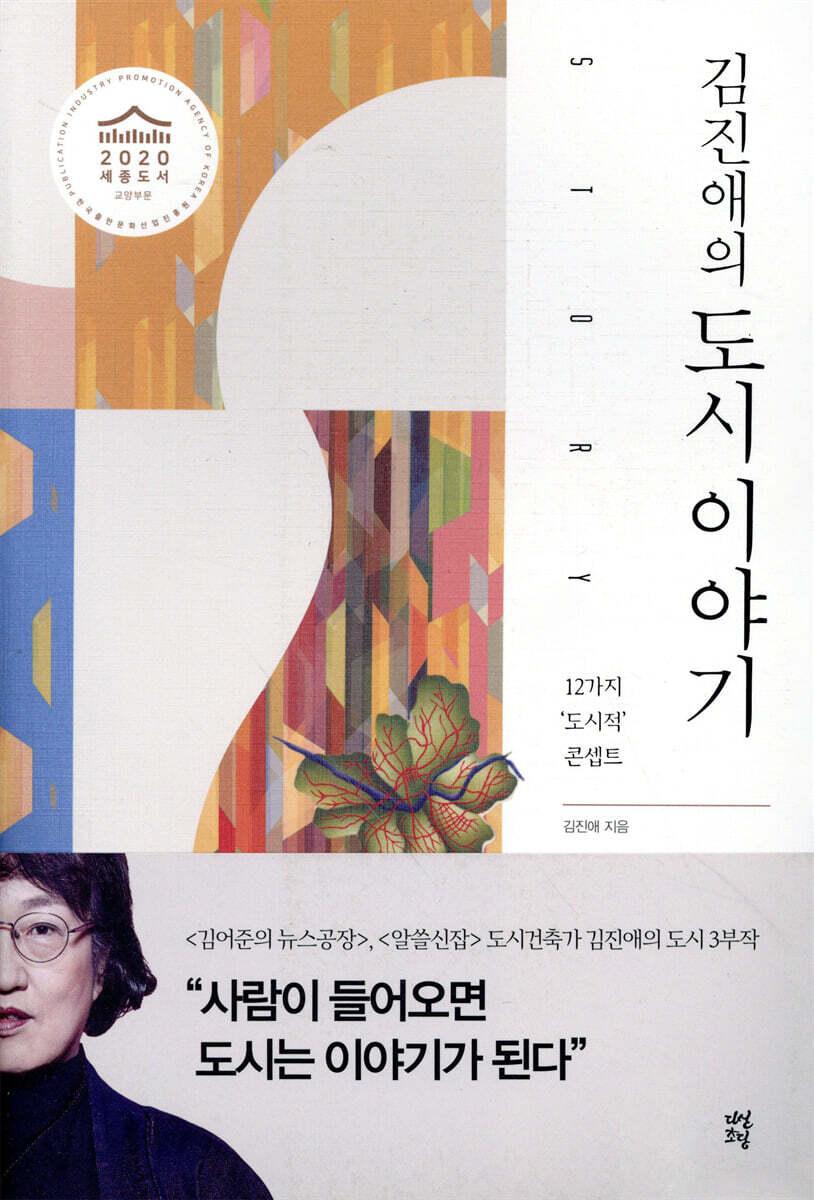
Kim Jin-ae's City Story
 |
Description
Book Introduction
- A word from MD
-
When the view is clear, the city becomes richer.You see as much as you know.
There may be ugly cities, but if all cities look ugly, it may be a matter of perspective.
Architect Jin-ae Kim presents 12 concepts necessary for appreciating the city.
Let's get the concept and go out there.
Colorful scenery will unfold and city life will be enriched.
November 26, 2019. Humanities PD Son Min-gyu
[Kim Eo-jun's News Factory], [Useless Information] Urban Architect Kim Jin-ae's City Trilogy
In our space where we work, walk and play
Deep intellectual insights exploring the possibilities of urban living
"When people come in, the city becomes a story."
Most of us live in cities, but cities are still strange to us.
Because the city is so big and complex, it is difficult to capture it all at a glance.
It feels unnecessarily difficult and seems like it has nothing to do with my life.
Accordingly, urban architect Jin-ae Kim recommends approaching the ‘city’ as a ‘story.’
Whether it's a novel or a movie, if there are people and desires, a story is born naturally. In fact, the city is a space filled with countless diverse people and desires.
Even if you talk about the city, without good glasses, everything in front of you will only appear blurry and hazy to the naked eye.
So this book presents readers with 12 'urban concepts'.
When we look at the city through the urban concepts of anonymity, power and authority, memory, praise, contrast, storytelling, decoding, desire, the temptation of corruption, phenomenon and structure, money and votes, mutation and evolution, the structure and dynamism of the urban space surrounding our lives begin to become clearly visible.
The countless interesting stories within the city touch your skin and make you want to see, hear, and talk more.
In this context, 『Kim Jin-ae's City Story』 is truly a book like no other.
It not only helps me make choices that enrich and value my life, but also increases my discernment about various policies.
Now, as I witness the possibilities of a better urban life through this book, let's add my own story to the one presented by Kim Jin-ae.
In our space where we work, walk and play
Deep intellectual insights exploring the possibilities of urban living
"When people come in, the city becomes a story."
Most of us live in cities, but cities are still strange to us.
Because the city is so big and complex, it is difficult to capture it all at a glance.
It feels unnecessarily difficult and seems like it has nothing to do with my life.
Accordingly, urban architect Jin-ae Kim recommends approaching the ‘city’ as a ‘story.’
Whether it's a novel or a movie, if there are people and desires, a story is born naturally. In fact, the city is a space filled with countless diverse people and desires.
Even if you talk about the city, without good glasses, everything in front of you will only appear blurry and hazy to the naked eye.
So this book presents readers with 12 'urban concepts'.
When we look at the city through the urban concepts of anonymity, power and authority, memory, praise, contrast, storytelling, decoding, desire, the temptation of corruption, phenomenon and structure, money and votes, mutation and evolution, the structure and dynamism of the urban space surrounding our lives begin to become clearly visible.
The countless interesting stories within the city touch your skin and make you want to see, hear, and talk more.
In this context, 『Kim Jin-ae's City Story』 is truly a book like no other.
It not only helps me make choices that enrich and value my life, but also increases my discernment about various policies.
Now, as I witness the possibilities of a better urban life through this book, let's add my own story to the one presented by Kim Jin-ae.
- You can preview some of the book's contents.
Preview
index
Publishing the City Trilogy_Cities are a Journey, Life is a Journey
Prologue: When people come into the city, it becomes a story.
Part 1: Living with strangers
Concept 1: Anonymity: Living with Strangers… Streets and Squares
Concept 2: Power and Authority: Respect or Love? … The Blue House, the National Assembly, and the Government Complex
Concept 3: Memory and Records: Who Are We? … Preservation, Conservation, Restoration, and Regeneration
Part 2_A space where emotions move
Concept 4: Praise for Knowing: The Heart-Pounding Story of Our City… Jeongjo, Suwon Hwaseong Fortress, and Juhapnu
Insights from Concept 5: Why Travel to Overseas Cities… Context and Authenticity
Concept 6 Storytelling: Where is the "Space in My Heart"? ... Tongyeong Stories and Ganghwa Stories
Concept 7: Coding and Decoding: Hidden Implications in Space… Difference, Discrimination, Hatred, Negativity, Recognition, Affirmation, Kindness, and Consideration
Part 3_The Money Game Space
Concept 8: Desire and Greed: Am I an Accomplice in the Money Game? … Apartment Republic, Complex Republic
Concept 9: The Temptation of Corruption: The City of the "B-Shaped Disease"… The Republic of Babel and El City
Concept 10: Phenomenon and Structure: The Ability to Be Strange… The Perspective of a Stranger, the Attitudes of Citizens
Part 4: The Power to Create Cities
Concept 11: Money and Votes: The Power That Shapes Cities in This Era… Polarization Between Cities and Within Cities
Concept 12: Evolution and Mutation: Cities Unable to Be Built by Design… New Towns and Daldongne
Epilogue_City Story, Forever!
Appendix_Recommended Reading on Urban Topics
Prologue: When people come into the city, it becomes a story.
Part 1: Living with strangers
Concept 1: Anonymity: Living with Strangers… Streets and Squares
Concept 2: Power and Authority: Respect or Love? … The Blue House, the National Assembly, and the Government Complex
Concept 3: Memory and Records: Who Are We? … Preservation, Conservation, Restoration, and Regeneration
Part 2_A space where emotions move
Concept 4: Praise for Knowing: The Heart-Pounding Story of Our City… Jeongjo, Suwon Hwaseong Fortress, and Juhapnu
Insights from Concept 5: Why Travel to Overseas Cities… Context and Authenticity
Concept 6 Storytelling: Where is the "Space in My Heart"? ... Tongyeong Stories and Ganghwa Stories
Concept 7: Coding and Decoding: Hidden Implications in Space… Difference, Discrimination, Hatred, Negativity, Recognition, Affirmation, Kindness, and Consideration
Part 3_The Money Game Space
Concept 8: Desire and Greed: Am I an Accomplice in the Money Game? … Apartment Republic, Complex Republic
Concept 9: The Temptation of Corruption: The City of the "B-Shaped Disease"… The Republic of Babel and El City
Concept 10: Phenomenon and Structure: The Ability to Be Strange… The Perspective of a Stranger, the Attitudes of Citizens
Part 4: The Power to Create Cities
Concept 11: Money and Votes: The Power That Shapes Cities in This Era… Polarization Between Cities and Within Cities
Concept 12: Evolution and Mutation: Cities Unable to Be Built by Design… New Towns and Daldongne
Epilogue_City Story, Forever!
Appendix_Recommended Reading on Urban Topics
Detailed image
.jpg)
Into the book
A city must become a story, at least.
When it comes to stories, we learn more, we want to know more, and above all, we love more.
You will cherish the city you live in, enjoy exploring it, and develop a desire for a better city.
The list of ‘I want to live there, I want to go there, I want to walk around there, I want to see there, I want to stop by there’ is growing.
The more you say 'I want to', the more interesting life becomes.
There is no end to city stories.
Stories created by power, stories that are futile but never disappear, stories of conflicts caused by people with different thoughts, interests, and tastes, stories that may seem insignificant but depict the subtle patterns of life, stories that connect countless invisible lines of human relationships, stories that awaken us to the infinite possibilities of humanity as well as its limitations. These and other exciting stories are all embedded within the city.
--- p.7~8 "Prologue_ When people come in, the city becomes a story."
Ensuring safety on the streets is the most basic promise of a city, given the conditions of anonymity.
Creating joy in walking is the most sophisticated form of urban art.
Guaranteeing freedom of expression and assembly in the public square is the most fundamental city promise to protect anonymous citizens.
Encouraging joy in the square is the most sophisticated form of urban art, transcending the anonymity of the city, even if only for a moment.
Most people have different feelings about streets and squares.
Things like memories, longing, excitement, and envy.
Perhaps it is deeply rooted in people's hearts as a 'cultural gene'.
This is also evident in the phenomenon of streets and squares in cities constantly being reconstructed.
--- p.53 "Concept 1_Anonymity"
Film directors are very good at capturing the hybrid nature that appears in our space.
I think that the rapid growth of our film industry may have been due to the positive aspects of our space.
Should we say that spatial sensibility and cinematic sensibility have meshed, or that spatial imagination and cinematic imagination have grown together? Director Lee Myung-se masterfully captured the psychology of Busan's 40 Steps and the labyrinthine alleyways of Dal-dongnae in "No Mercy," while director Park Chan-wook depicted a strange world of desire evoked by the hybrid spaces of Japanese, modern, and traditional hanbok shops in "Thirst."
It is a realistic imagination that is different from the emotions produced in perfectly designed sets like “The Handmaiden” or “Oldboy.”
I was impressed by director Bong Joon-ho's skill in blending contemporary and spatial awareness in his first feature film, Barking Dogs Never Bite.
Director Bong Joon-ho, who depicted the spaces contained within the outer shell of a high-rise apartment complex that could be found anywhere, and the ups and downs and hopes that unfold as people search, wander, and hide within them, continued to evolve and it was gratifying to see him depict a hybrid space of a linear and archetypal train that encompasses the human race in “Snowpiercer.”
--- p.129 "Concept 4_Praise of Knowing"
To be honest, I was surprised that I raised the issue.
There was also laughter as I listened to a series of episodes relayed by listeners.
I didn't know that 'sit-ssa (peeing while sitting on the toilet)' and 'seossa (peeing while standing on the toilet)' were such a source of conflict.
I didn't even know those two words were so widely used.
I also found out that it was a topic of gossip not only at home but also at work.
It was also an opportunity to realize that peace had finally taken hold in our home.
I also realized anew how much mothers suffer while raising their children.
It is said that it makes you sigh at the phenomenon of a three or four year old child who was good at 'sitting' starting to insist on 'standing' when going to kindergarten.
I realized anew how much debate there is about instinct and habit, and how difficult it is for men and women to live together.
I've also found that a significant number of men find the very act of raising these questions "insulting."
There is a complex and subtle psychology at work that cannot be viewed simply as a standard of cleanliness and tidying.
--- p.188 "Concept 7_Coding and Decoding"
So, what problems do apartment complexes pose at the urban level? Even considering only the functional aspect, rather than the social psychological, there are many problems.
First, the road disappears.
To be precise, the length is shortened.
Although the area occupied by the road may be similar, the length is reduced by a third or a quarter.
If you think about redevelopment, you will quickly understand.
All the alleyways that used to connect the neighborhood like threads are now included in the complex, and only a large road is created that surrounds the complex.
These days, the trend is to build only underground parking lots, so only emergency fire roads are built within apartment complexes, and the rest are all pedestrian roads.
This walkway is not easily open to the people of the surrounding neighborhood.
In this way, when an apartment complex is built in a neighborhood, the road often becomes cut off and you have to take a detour.
--- p.221~222 "Concept 8_Desire and Greed"
The moon village is a space that cannot be created through design.
It is a classic example of architecture without architects and cities without urban planners.
It comes into being as needed and changes as needed.
However, the basic rules that make up a city do not change much.
The individual changes, diversity, spontaneity and unexpectedness are exciting.
That's how you maintain your vitality for 50, 60, 70 years.
Can the new cities we build really be like this?
When it comes to stories, we learn more, we want to know more, and above all, we love more.
You will cherish the city you live in, enjoy exploring it, and develop a desire for a better city.
The list of ‘I want to live there, I want to go there, I want to walk around there, I want to see there, I want to stop by there’ is growing.
The more you say 'I want to', the more interesting life becomes.
There is no end to city stories.
Stories created by power, stories that are futile but never disappear, stories of conflicts caused by people with different thoughts, interests, and tastes, stories that may seem insignificant but depict the subtle patterns of life, stories that connect countless invisible lines of human relationships, stories that awaken us to the infinite possibilities of humanity as well as its limitations. These and other exciting stories are all embedded within the city.
--- p.7~8 "Prologue_ When people come in, the city becomes a story."
Ensuring safety on the streets is the most basic promise of a city, given the conditions of anonymity.
Creating joy in walking is the most sophisticated form of urban art.
Guaranteeing freedom of expression and assembly in the public square is the most fundamental city promise to protect anonymous citizens.
Encouraging joy in the square is the most sophisticated form of urban art, transcending the anonymity of the city, even if only for a moment.
Most people have different feelings about streets and squares.
Things like memories, longing, excitement, and envy.
Perhaps it is deeply rooted in people's hearts as a 'cultural gene'.
This is also evident in the phenomenon of streets and squares in cities constantly being reconstructed.
--- p.53 "Concept 1_Anonymity"
Film directors are very good at capturing the hybrid nature that appears in our space.
I think that the rapid growth of our film industry may have been due to the positive aspects of our space.
Should we say that spatial sensibility and cinematic sensibility have meshed, or that spatial imagination and cinematic imagination have grown together? Director Lee Myung-se masterfully captured the psychology of Busan's 40 Steps and the labyrinthine alleyways of Dal-dongnae in "No Mercy," while director Park Chan-wook depicted a strange world of desire evoked by the hybrid spaces of Japanese, modern, and traditional hanbok shops in "Thirst."
It is a realistic imagination that is different from the emotions produced in perfectly designed sets like “The Handmaiden” or “Oldboy.”
I was impressed by director Bong Joon-ho's skill in blending contemporary and spatial awareness in his first feature film, Barking Dogs Never Bite.
Director Bong Joon-ho, who depicted the spaces contained within the outer shell of a high-rise apartment complex that could be found anywhere, and the ups and downs and hopes that unfold as people search, wander, and hide within them, continued to evolve and it was gratifying to see him depict a hybrid space of a linear and archetypal train that encompasses the human race in “Snowpiercer.”
--- p.129 "Concept 4_Praise of Knowing"
To be honest, I was surprised that I raised the issue.
There was also laughter as I listened to a series of episodes relayed by listeners.
I didn't know that 'sit-ssa (peeing while sitting on the toilet)' and 'seossa (peeing while standing on the toilet)' were such a source of conflict.
I didn't even know those two words were so widely used.
I also found out that it was a topic of gossip not only at home but also at work.
It was also an opportunity to realize that peace had finally taken hold in our home.
I also realized anew how much mothers suffer while raising their children.
It is said that it makes you sigh at the phenomenon of a three or four year old child who was good at 'sitting' starting to insist on 'standing' when going to kindergarten.
I realized anew how much debate there is about instinct and habit, and how difficult it is for men and women to live together.
I've also found that a significant number of men find the very act of raising these questions "insulting."
There is a complex and subtle psychology at work that cannot be viewed simply as a standard of cleanliness and tidying.
--- p.188 "Concept 7_Coding and Decoding"
So, what problems do apartment complexes pose at the urban level? Even considering only the functional aspect, rather than the social psychological, there are many problems.
First, the road disappears.
To be precise, the length is shortened.
Although the area occupied by the road may be similar, the length is reduced by a third or a quarter.
If you think about redevelopment, you will quickly understand.
All the alleyways that used to connect the neighborhood like threads are now included in the complex, and only a large road is created that surrounds the complex.
These days, the trend is to build only underground parking lots, so only emergency fire roads are built within apartment complexes, and the rest are all pedestrian roads.
This walkway is not easily open to the people of the surrounding neighborhood.
In this way, when an apartment complex is built in a neighborhood, the road often becomes cut off and you have to take a detour.
--- p.221~222 "Concept 8_Desire and Greed"
The moon village is a space that cannot be created through design.
It is a classic example of architecture without architects and cities without urban planners.
It comes into being as needed and changes as needed.
However, the basic rules that make up a city do not change much.
The individual changes, diversity, spontaneity and unexpectedness are exciting.
That's how you maintain your vitality for 50, 60, 70 years.
Can the new cities we build really be like this?
--- p.304 "Concept 12_Evolution and Mutation"
Publisher's Review
Raising the city to the level of a story
A masterpiece by urban architect Jin-ae Kim
Few people decide to study 'cities' unless they are experts in the relevant field.
While you may explore a specific city with a clear purpose, such as a city tour or real estate investment, studying the city itself is never easy.
Moreover, it doesn't feel like it has much to do with my life, so it's even more daunting.
'Kim Jin-ae's City Story', which started as a Thursday corner of TBS Radio's 'Kim Eo-jun's News Factory', is an educational content created to break down such prejudices and preconceptions.
Kim Jin-ae's first goal was to pique the interest of factory manager Kim Eo-jun.
Because if the host is interesting, the listeners will be interested as well.
Kim Jin-ae's attitude was definitely effective.
More and more people are considering the city as their own story, and more and more people are learning to connect urban space with political, economic, social, and cultural issues.
One listener expressed gratitude to Kim Jin-ae for sharing various city stories, saying, “While listening to ‘Kim Jin-ae’s City Stories,’ I finally realized that we need to be proud of ourselves.”
Although it has the same name as the radio corner, 『Kim Jin-ae's City Story』 is a book that Kim Jin-ae wrote completely from scratch.
It is a masterpiece written in 10 years, and it is a book that deals with cities, which is his specialty.
This book not only shows that cities can be approached easily and enjoyably as stories, but also makes us realize how closely urban issues are connected to our lives and how much our lives can change by understanding cities.
Above all, it helps me develop a positive outlook on my neighborhood and city, and broadens my horizons to the point where I can think about my future in relation to the future of the city.
Anyone who reads this book will immediately add their own story to the fascinating "city story" prepared by Kim Jin-ae.
The fundamental conditions of urban life,
Provocative questions about 'anonymity'
"Kim Jin-ae's City Story" begins with a discussion that reveals the true nature of the subtle discomfort and rejection we have toward the city.
The key is anonymity, which can be said to be a fundamental condition of urban life.
The point is that since a city is essentially a space where you live with people you don't know, it's inevitable that you'll feel a certain amount of anxiety.
But this perspective is only a superficial look at the city's outward appearance.
Kim Jin-ae claims that the city's boundless freedom actually grows within anonymity, and lists the conditions for enjoying its positive aspects as follows:
“We will not define each other by our status, we will not ask where we come from, we will acknowledge that you and I share the same desires and fears, anxieties and trepidations, hopes and wishes, we will empathize with the ‘distance of intimacy’ and how far we can go, we will acknowledge that we can approach and distance ourselves at any time, and we will believe that we can feel each other’s body heat without being clammy.”
This is the moment when anonymity, which was thought to be a curse, becomes a blessing.
Unlike tribal or caste societies, urban life allows for more free and just relationships because people live with strangers they do not know.
The wisdom of living together with less hurt and less conflict can become a good culture or style that reduces social anxiety.
Moreover, looking at the city through the concept of anonymity makes us reconsider the meaning of streets and squares.
A plaza where people can walk freely and where freedom of expression is guaranteed is the most sophisticated form of urban art and the most basic promise of a city.
One thing to keep in mind is that these roads and squares are not given to us for free.
Because we have always performed the magic of transforming streets into plazas at every turning point in history, we can say that we already have the answer to how to use streets and plazas plausibly with strangers.
From the space of power to the space of everyday life
A book that makes you dream of a better urban life
The greatest appeal of this book is that it allows us to look at the urban space in which we live together from a new perspective.
Representative examples include powerful spaces such as the Blue House, the National Assembly, and the Prosecutors' Office.
Power essentially displays its authority and power through architecture.
It may evoke emotions like awe, pride, and patriotism, but the most fundamental emotion underlying it all is none other than fear.
Because in order to keep citizens submissive and prevent questions about legitimacy, power itself had to be feared.
The Blue House is a representative space of power that is often talked about because of its irrational spatial configuration.
The distance between the President's office and the secretarial staff's workspace creates significant problems in communication and work efficiency.
Meanwhile, the National Assembly building is the ugliest space of power.
They only tried to make the building itself bigger by using colonnades and domes to show off their authority.
As a result, the pillars and dome were separated, and it became a large, ugly monster with awkward proportions.
The prosecutor's office building has a blank poker face.
It hides the public power that 'our institutionalized self' possesses, and instead reveals the closed nature of bureaucracy.
It is located far from the main road, minimizing accessibility and communication possibilities.
There are also many brilliant insights that impact individual lives.
Kim Jin-ae points out that the problem is not the apartments themselves, but the "large apartment complexes," and the core of her criticism is that these large apartment complexes are destroying the city's roads.
For example, the alleyways that were intertwined like threads before redevelopment disappear the moment large apartment complexes are built.
It blocks most of the surrounding roads like a castle.
As a solution to this, I argue that our apartments should be urban apartments that promote urban living, rather than complex apartments.
Even the high-rise buildings that are becoming popular pose many problems when used as apartments.
Windows cannot be opened properly, which increases heating and cooling costs and has a negative impact on psychological and physical health.
It may look nice on the outside and be fine for a short stay or work, but it has too many problems to live in.
But our society covers up these problems.
It goes into detail about who does it and why.
In this way, 『Kim Jin-ae's City Story』 changes the way we look at urban life.
When something we took for granted looks different, we start to look for alternatives and seek change.
As individuals worry, find answers to their worries, make different choices, and take different actions, they grow significantly.
This is precisely why we need to read this book now.
Kim Jin-ae's city trilogy, completed over 20 years,
Read about my relationship with the city!
For Jin-ae Kim, who started her studies in architecture and expanded her studies to include cities, the city is, in a word, an object of love and conflict.
I love the city deeply, but I cannot help but be suspicious and questioning, and I neither idealize the city nor criticize it cynically.
That's why, when Jin-ae Kim talks about the city, she becomes more serious and thoughtful than ever, but at the same time, she becomes endlessly excited and cheerful.
'Kim Jin-ae's City Trilogy' is a life project that Kim Jin-ae completed over 20 years.
I read my relationship with the city from various angles, and figure out how to live and what to dream of.
"Kim Jin-ae's City Story" is the first volume of "Kim Jin-ae's City Trilogy."
Although this is the most recent book I have written and the first new book I am meeting with readers, I chose it as the first book because it unravels the thematic consciousness that underlies the trilogy.
The second volume, "Discovering Humans in the Urban Forest," is a newly revised version of "CEO Reading the City," published in 2009.
In addition to comparing our city with foreign cities, we explored the diverse ways in which humans grow by reading about cities and various content, including movies, books, university lectures, old maps, and the lives of specific individuals.
The third volume, “In Praise of Our City,” is a reprint of “In Praise of Our City,” published in 2003, with the title and main text intact.
By discovering the charm of our neighborhoods and cities and sharing an attitude of celebration, we narrow the gap between our lives and the spaces that surround us.
Although the three volumes are grouped together as the 'City Trilogy' series, each volume has its own unique personality due to the different writing styles and content covered.
The author recommends reading it this way:
The first volume is like listening to a 'city story' broadcast, the second volume is like imagining an overseas trip, and the third volume is like planning a weekend trip or a weekend walk.
Therefore, you can read just one book on a topic that interests you, or you can read three books together.
You can freely decide the order in which you read books according to your own tastes and interests.
"Kim Jin-ae's City Trilogy," which has freely varied and evolved over the past 20 years, will wholeheartedly support the new urban life that will unfold before you.
A masterpiece by urban architect Jin-ae Kim
Few people decide to study 'cities' unless they are experts in the relevant field.
While you may explore a specific city with a clear purpose, such as a city tour or real estate investment, studying the city itself is never easy.
Moreover, it doesn't feel like it has much to do with my life, so it's even more daunting.
'Kim Jin-ae's City Story', which started as a Thursday corner of TBS Radio's 'Kim Eo-jun's News Factory', is an educational content created to break down such prejudices and preconceptions.
Kim Jin-ae's first goal was to pique the interest of factory manager Kim Eo-jun.
Because if the host is interesting, the listeners will be interested as well.
Kim Jin-ae's attitude was definitely effective.
More and more people are considering the city as their own story, and more and more people are learning to connect urban space with political, economic, social, and cultural issues.
One listener expressed gratitude to Kim Jin-ae for sharing various city stories, saying, “While listening to ‘Kim Jin-ae’s City Stories,’ I finally realized that we need to be proud of ourselves.”
Although it has the same name as the radio corner, 『Kim Jin-ae's City Story』 is a book that Kim Jin-ae wrote completely from scratch.
It is a masterpiece written in 10 years, and it is a book that deals with cities, which is his specialty.
This book not only shows that cities can be approached easily and enjoyably as stories, but also makes us realize how closely urban issues are connected to our lives and how much our lives can change by understanding cities.
Above all, it helps me develop a positive outlook on my neighborhood and city, and broadens my horizons to the point where I can think about my future in relation to the future of the city.
Anyone who reads this book will immediately add their own story to the fascinating "city story" prepared by Kim Jin-ae.
The fundamental conditions of urban life,
Provocative questions about 'anonymity'
"Kim Jin-ae's City Story" begins with a discussion that reveals the true nature of the subtle discomfort and rejection we have toward the city.
The key is anonymity, which can be said to be a fundamental condition of urban life.
The point is that since a city is essentially a space where you live with people you don't know, it's inevitable that you'll feel a certain amount of anxiety.
But this perspective is only a superficial look at the city's outward appearance.
Kim Jin-ae claims that the city's boundless freedom actually grows within anonymity, and lists the conditions for enjoying its positive aspects as follows:
“We will not define each other by our status, we will not ask where we come from, we will acknowledge that you and I share the same desires and fears, anxieties and trepidations, hopes and wishes, we will empathize with the ‘distance of intimacy’ and how far we can go, we will acknowledge that we can approach and distance ourselves at any time, and we will believe that we can feel each other’s body heat without being clammy.”
This is the moment when anonymity, which was thought to be a curse, becomes a blessing.
Unlike tribal or caste societies, urban life allows for more free and just relationships because people live with strangers they do not know.
The wisdom of living together with less hurt and less conflict can become a good culture or style that reduces social anxiety.
Moreover, looking at the city through the concept of anonymity makes us reconsider the meaning of streets and squares.
A plaza where people can walk freely and where freedom of expression is guaranteed is the most sophisticated form of urban art and the most basic promise of a city.
One thing to keep in mind is that these roads and squares are not given to us for free.
Because we have always performed the magic of transforming streets into plazas at every turning point in history, we can say that we already have the answer to how to use streets and plazas plausibly with strangers.
From the space of power to the space of everyday life
A book that makes you dream of a better urban life
The greatest appeal of this book is that it allows us to look at the urban space in which we live together from a new perspective.
Representative examples include powerful spaces such as the Blue House, the National Assembly, and the Prosecutors' Office.
Power essentially displays its authority and power through architecture.
It may evoke emotions like awe, pride, and patriotism, but the most fundamental emotion underlying it all is none other than fear.
Because in order to keep citizens submissive and prevent questions about legitimacy, power itself had to be feared.
The Blue House is a representative space of power that is often talked about because of its irrational spatial configuration.
The distance between the President's office and the secretarial staff's workspace creates significant problems in communication and work efficiency.
Meanwhile, the National Assembly building is the ugliest space of power.
They only tried to make the building itself bigger by using colonnades and domes to show off their authority.
As a result, the pillars and dome were separated, and it became a large, ugly monster with awkward proportions.
The prosecutor's office building has a blank poker face.
It hides the public power that 'our institutionalized self' possesses, and instead reveals the closed nature of bureaucracy.
It is located far from the main road, minimizing accessibility and communication possibilities.
There are also many brilliant insights that impact individual lives.
Kim Jin-ae points out that the problem is not the apartments themselves, but the "large apartment complexes," and the core of her criticism is that these large apartment complexes are destroying the city's roads.
For example, the alleyways that were intertwined like threads before redevelopment disappear the moment large apartment complexes are built.
It blocks most of the surrounding roads like a castle.
As a solution to this, I argue that our apartments should be urban apartments that promote urban living, rather than complex apartments.
Even the high-rise buildings that are becoming popular pose many problems when used as apartments.
Windows cannot be opened properly, which increases heating and cooling costs and has a negative impact on psychological and physical health.
It may look nice on the outside and be fine for a short stay or work, but it has too many problems to live in.
But our society covers up these problems.
It goes into detail about who does it and why.
In this way, 『Kim Jin-ae's City Story』 changes the way we look at urban life.
When something we took for granted looks different, we start to look for alternatives and seek change.
As individuals worry, find answers to their worries, make different choices, and take different actions, they grow significantly.
This is precisely why we need to read this book now.
Kim Jin-ae's city trilogy, completed over 20 years,
Read about my relationship with the city!
For Jin-ae Kim, who started her studies in architecture and expanded her studies to include cities, the city is, in a word, an object of love and conflict.
I love the city deeply, but I cannot help but be suspicious and questioning, and I neither idealize the city nor criticize it cynically.
That's why, when Jin-ae Kim talks about the city, she becomes more serious and thoughtful than ever, but at the same time, she becomes endlessly excited and cheerful.
'Kim Jin-ae's City Trilogy' is a life project that Kim Jin-ae completed over 20 years.
I read my relationship with the city from various angles, and figure out how to live and what to dream of.
"Kim Jin-ae's City Story" is the first volume of "Kim Jin-ae's City Trilogy."
Although this is the most recent book I have written and the first new book I am meeting with readers, I chose it as the first book because it unravels the thematic consciousness that underlies the trilogy.
The second volume, "Discovering Humans in the Urban Forest," is a newly revised version of "CEO Reading the City," published in 2009.
In addition to comparing our city with foreign cities, we explored the diverse ways in which humans grow by reading about cities and various content, including movies, books, university lectures, old maps, and the lives of specific individuals.
The third volume, “In Praise of Our City,” is a reprint of “In Praise of Our City,” published in 2003, with the title and main text intact.
By discovering the charm of our neighborhoods and cities and sharing an attitude of celebration, we narrow the gap between our lives and the spaces that surround us.
Although the three volumes are grouped together as the 'City Trilogy' series, each volume has its own unique personality due to the different writing styles and content covered.
The author recommends reading it this way:
The first volume is like listening to a 'city story' broadcast, the second volume is like imagining an overseas trip, and the third volume is like planning a weekend trip or a weekend walk.
Therefore, you can read just one book on a topic that interests you, or you can read three books together.
You can freely decide the order in which you read books according to your own tastes and interests.
"Kim Jin-ae's City Trilogy," which has freely varied and evolved over the past 20 years, will wholeheartedly support the new urban life that will unfold before you.
GOODS SPECIFICS
- Publication date: November 18, 2019
- Page count, weight, size: 320 pages | 714g | 153*224*30mm
- ISBN13: 9791130626925
- ISBN10: 113062692X
You may also like
카테고리
korean


korean

![ELLE 엘르 스페셜 에디션 A형 : 12월 [2025]](http://librairie.coreenne.fr/cdn/shop/files/b8e27a3de6c9538896439686c6b0e8fb.jpg?v=1766436872&width=3840)


