

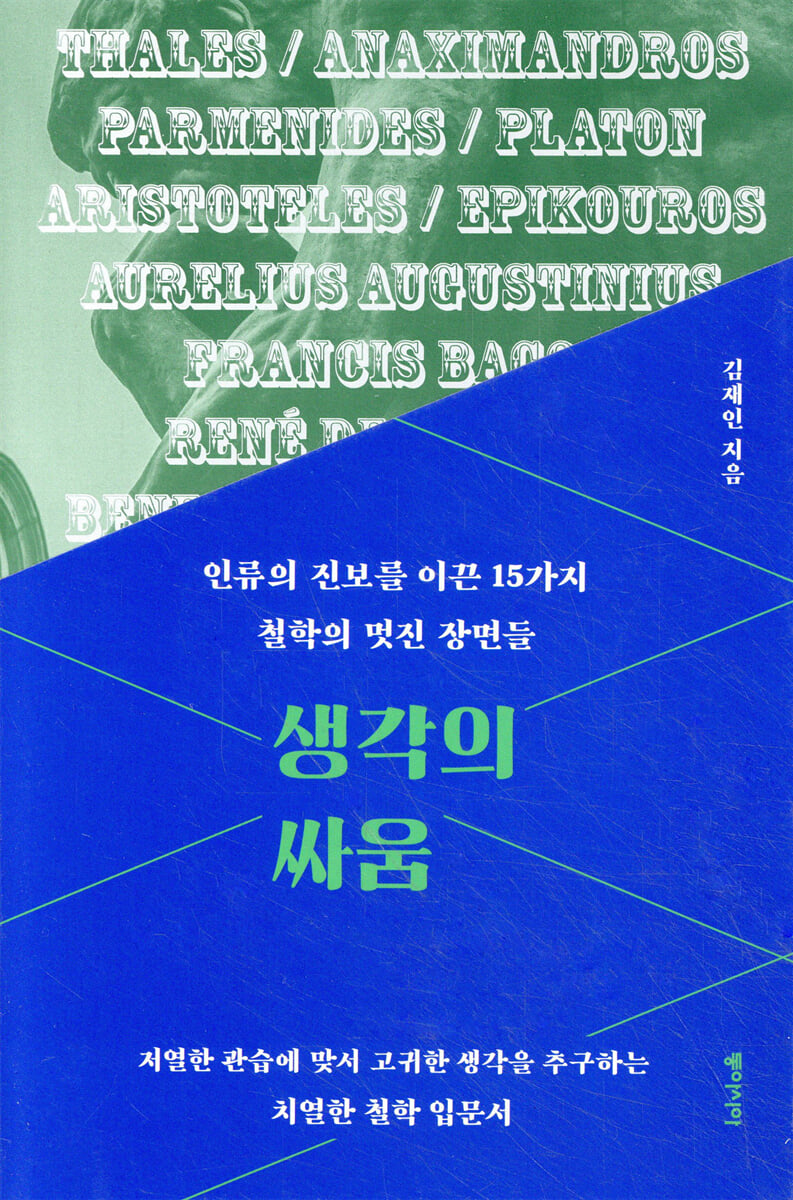
Battle of Ideas
 |
Description
Book Introduction
- A word from MD
-
15 Famous Scenes in the History of PhilosophyAn introductory book to philosophy written by philosopher Kim Jae-in, who translated Anti-Oedipus and A Thousand Plateaus.
Rather than introducing philosophers chronologically like other introductory books, it introduces the lives and thoughts of philosophers by topic.
It helps readers understand by explaining the historical context in which the idea was born and its connection to the present.
October 8, 2019. Humanities PD Son Min-gyu
The 'battle of ideas' that unfolded fiercely at every turning point in history,
Great philosophy is born fiercely!
The most intense introduction to philosophy by philosopher Kim Jae-in, who translated Anti-Oedipus and A Thousand Plateaus.
Thales is called the founder of Western philosophy.
It is also widely known that he said, 'The origin of all things is water.'
But not many people know why he said that or why his words were taken seriously.
Great philosophical theories are not born from mere speculation.
The philosophical theories and concepts are the result of fierce questioning and answering according to the needs of the times and a battle of ideas against the prevailing common sense of the time.
Therefore, in order to understand a philosophy, it is important to understand the historical context and the context in which the philosopher was situated.
Philosopher Kim Jae-in, who translated 『Anti-Oedipus』 and 『A Thousand Plateaus』, wrote 『The Battle of Thoughts』 with this problem in mind.
He compares philosophy and philosophical theory to a 'lens'.
To clearly understand the problems facing us, we need a 'conceptual lens', and philosophy has played the role of providing that lens.
Each philosopher in each era had specific problems that needed to be looked into closely.
He emphasizes that the true meaning of philosophy can only be understood by reading the context in which the problem is highlighted.
If we follow that context, we can also grasp the overall flow of Western intellectual history.
Philosophy was born and developed in the process of overcoming the ideas of previous eras and responding to the demands of a new era.
This book explores the history of Western philosophy, examining the birth of 15 philosophical moments that the author considers "great moments."
Great philosophy is born fiercely!
The most intense introduction to philosophy by philosopher Kim Jae-in, who translated Anti-Oedipus and A Thousand Plateaus.
Thales is called the founder of Western philosophy.
It is also widely known that he said, 'The origin of all things is water.'
But not many people know why he said that or why his words were taken seriously.
Great philosophical theories are not born from mere speculation.
The philosophical theories and concepts are the result of fierce questioning and answering according to the needs of the times and a battle of ideas against the prevailing common sense of the time.
Therefore, in order to understand a philosophy, it is important to understand the historical context and the context in which the philosopher was situated.
Philosopher Kim Jae-in, who translated 『Anti-Oedipus』 and 『A Thousand Plateaus』, wrote 『The Battle of Thoughts』 with this problem in mind.
He compares philosophy and philosophical theory to a 'lens'.
To clearly understand the problems facing us, we need a 'conceptual lens', and philosophy has played the role of providing that lens.
Each philosopher in each era had specific problems that needed to be looked into closely.
He emphasizes that the true meaning of philosophy can only be understood by reading the context in which the problem is highlighted.
If we follow that context, we can also grasp the overall flow of Western intellectual history.
Philosophy was born and developed in the process of overcoming the ideas of previous eras and responding to the demands of a new era.
This book explores the history of Western philosophy, examining the birth of 15 philosophical moments that the author considers "great moments."
- You can preview some of the book's contents.
Preview
index
Acknowledgements
Introduction
Chapter 1: The Beginning and End of Philosophy
01 The Birth of Philosophy _ Thales and Anaximander
02 Where Philosophy Comes _ Nietzsche
Chapter 2: The Battle of Knowledge
03 Twilight of the Idols _ Bacon
04 I am thinking _ Descartes
05 There is no causality in the world _Hume
06 All cognition is established through a framework _Kant
Chapter 3: The Battle of Being
07 What exists exists, and what does not exist does not exist _Parmenides
08 Towards the 'Good', the Reason for Inventing the 'Idea' _Plato
09 Time is the unfolding soul _Augustine
10 Possibilities are a Mirage of Reality _Bergson
Chapter 4: The Fight for Life
11 You have to try _Aristotle
12 If you are alive, death has not yet come; if you are dead, you are no longer there. _Epicurus
13. Acquire the right ideas and move towards the joy of life _Spinoza
14 Do not oppress even a quirky person _Mil
15 The Practice of Freedom and the Ethics of Self-Care _Foucault
Introduction
Chapter 1: The Beginning and End of Philosophy
01 The Birth of Philosophy _ Thales and Anaximander
02 Where Philosophy Comes _ Nietzsche
Chapter 2: The Battle of Knowledge
03 Twilight of the Idols _ Bacon
04 I am thinking _ Descartes
05 There is no causality in the world _Hume
06 All cognition is established through a framework _Kant
Chapter 3: The Battle of Being
07 What exists exists, and what does not exist does not exist _Parmenides
08 Towards the 'Good', the Reason for Inventing the 'Idea' _Plato
09 Time is the unfolding soul _Augustine
10 Possibilities are a Mirage of Reality _Bergson
Chapter 4: The Fight for Life
11 You have to try _Aristotle
12 If you are alive, death has not yet come; if you are dead, you are no longer there. _Epicurus
13. Acquire the right ideas and move towards the joy of life _Spinoza
14 Do not oppress even a quirky person _Mil
15 The Practice of Freedom and the Ethics of Self-Care _Foucault
Into the book
I said that the humanities are based on a love of language.
What would be the outcome if we evaluated the humanities and humanists in Korea based on these criteria? First, we must distinguish between "enthusiasts" and "researchers."
Loving a branch of the humanities and being good at practicing it are two different things.
The term "humanities idiot" has been coined because humanities discourse is full of terms that are completely incomprehensible, and this ridicule is quite valid.
Because even I, who has studied philosophy for quite some time and wrote my doctoral thesis on modern French philosophy, find many sentences completely incomprehensible.
If you ask the writer to explain, he will show off his humanities-crazy skills.
In short, it was written that way because it had to be written that way, and if you guess that the writer doesn't know what he's talking about, you're probably right.
To summarize the process:
At first, I didn't really understand the original text, but as I kept reading it over and over, I either understood it in my own way or just memorized the terms, and eventually I became accustomed to it.
But it's still tricky to explain to others.
If you write in this state, the writing will be completed without the author or the reader knowing.
More importantly, there is a role for other experts.
Since most people don't know, they don't point out or interfere with each other, and furthermore, they remain silent or participate in the circulation of such writing.
The absence of critical discourse and debate is living proof.
The humanities disabled body was born through this process.
--- p.9, from “Introductory Remarks”
There are two things to note about Greek democracy.
First of all, the Greeks distinguished themselves from foreigners by calling them 'barbaros', plural 'barbaroi'.
They are 'barbarians'! Barbaros is an onomatopoeia for the sound 'uh-huh-huh-huh'.
That means you don't speak Greek.
Not speaking Greek means there is no democracy.
At that time, while other regions had only free societies where the pharaoh, emperor, or king was free, in Greek democracy all citizens were free beings.
The ancient Greeks were people who repeatedly confirmed to themselves that they were free people and lived their lives doing their best to achieve that.
It was in this state of free human beings that philosophy was born.
--- p.40, 「1.
From “The Birth of Philosophy”
Nietzsche's most representative work is Thus Spoke Zarathustra.
But who is this Zarathustra? 'Zarathustra' is German, and in Greek it is 'Zoroaster.'
He is the founder of Zoroastrianism.
He was the first person to invent morality.
We know that morality was created because this man created it.
So Nietzsche assigns to Zarathustra the task of moral criticism.
If you know that morality was created, you can criticize existing morality.
It is possible to criticize morality and destroy morality, that is, to create a new morality.
Because I made it once.
Those who know that existing morality was created at some point and therefore can be created anew.
It is more important to ask and examine what meaning and value it has now than the content of morality itself.
It is important not to simply follow certain rules, norms, or customs, but to examine them and find and create our own morals, my own morals.
That is Nietzsche's central task.
Create your own morals, create your own ethics.
If you follow someone else's ethics, morals, code of conduct, or way of life, you are a slave.
--- p.62-63, 「2.
From "Where Philosophy Comes Early"
Bacon's most famous quote is “knowledge is power.”
This can be translated into two ways.
“Knowledge is power.” So, we must know and use it to control nature.
This is the first interpretation.
…
Another recent translation is this one:
“Knowledge is power.” This is Foucault’s interpretation.
We will look at Foucault later.
“Knowledge is power” and “Knowledge is power” may seem very different, but they actually mean the same thing.
The more you know, the more power you have, and that power is the power to dominate nature and the power to dominate others.
You go to someone who knows a lot and ask them, right? If they don't answer, you won't get what you want, so you have to listen to what they ask.
Of course, we can also use our knowledge to directly control others.
That is the context in which it is translated as 'knowledge is power'.
It was Bacon's project that was criticized by two philosophers, Max Horkheimer and Theodor Adorno, in their book Dialectics of Enlightenment immediately after World War II.
--- p.85, 「3.
From "Twilight of the Idol"
However, if you look at Hume's text, he concludes that the human mind is originally mad.
According to Hume, madness is a normal state.
Beyond this aspect, when looking at the topic of passion, Hume says that partiality is a human characteristic.
Why is partiality inherent in human nature? Human nature is based on empathy, which in turn creates partiality.
This doesn't make sense.
But the reason I love my family more than the family next door is because of our ability to empathize.
A characteristic of empathy is that we feel closer to things that are close, and the farther away something is, the weaker our empathy becomes.
So humans cannot help but be biased.
It's a subtle point, but it's true.
Humans are inherently capable of empathy, and it's a little crazy.
There's no valid reason why you have to be attracted to something just because it's close.
But that's how it turned out.
Empathy is the driving force behind bias and exclusivity.
Isn't that a great insight?
--- p.147-148, 「5.
From "There is no cause and effect in the world"
Pirates are criminals today, but in the past they were just a profession.
It actually was.
Piracy was one of the most important professions.
The pirate society is called a 'predatory society', a name that reflects the evaluation of our times.
It was just a job for them.
Hey, steal some more, because that's what society had to do.
In this way, things that we consider appropriate today become unappropriate when we introduce a historical perspective.
This is not simple relativism, but rather a revelation that what we think of only in theory is not true in reality.
One of the core concepts of Foucault is that kind of positivism.
Let's not start from an ideological perspective, but look at society historically, socially, and empirically.
When I looked, I realized that at the most fundamental level of knowledge acquisition, the framework itself was different from what we had known so far.
Revealing this is one of Foucault's important achievements.
Traditionally, epistemology has been a question of how accurately an individual can know external things, how much truth about the world can be obtained.
Foucault transformed this epistemological problem into a social, political, and historical problem.
What would be the outcome if we evaluated the humanities and humanists in Korea based on these criteria? First, we must distinguish between "enthusiasts" and "researchers."
Loving a branch of the humanities and being good at practicing it are two different things.
The term "humanities idiot" has been coined because humanities discourse is full of terms that are completely incomprehensible, and this ridicule is quite valid.
Because even I, who has studied philosophy for quite some time and wrote my doctoral thesis on modern French philosophy, find many sentences completely incomprehensible.
If you ask the writer to explain, he will show off his humanities-crazy skills.
In short, it was written that way because it had to be written that way, and if you guess that the writer doesn't know what he's talking about, you're probably right.
To summarize the process:
At first, I didn't really understand the original text, but as I kept reading it over and over, I either understood it in my own way or just memorized the terms, and eventually I became accustomed to it.
But it's still tricky to explain to others.
If you write in this state, the writing will be completed without the author or the reader knowing.
More importantly, there is a role for other experts.
Since most people don't know, they don't point out or interfere with each other, and furthermore, they remain silent or participate in the circulation of such writing.
The absence of critical discourse and debate is living proof.
The humanities disabled body was born through this process.
--- p.9, from “Introductory Remarks”
There are two things to note about Greek democracy.
First of all, the Greeks distinguished themselves from foreigners by calling them 'barbaros', plural 'barbaroi'.
They are 'barbarians'! Barbaros is an onomatopoeia for the sound 'uh-huh-huh-huh'.
That means you don't speak Greek.
Not speaking Greek means there is no democracy.
At that time, while other regions had only free societies where the pharaoh, emperor, or king was free, in Greek democracy all citizens were free beings.
The ancient Greeks were people who repeatedly confirmed to themselves that they were free people and lived their lives doing their best to achieve that.
It was in this state of free human beings that philosophy was born.
--- p.40, 「1.
From “The Birth of Philosophy”
Nietzsche's most representative work is Thus Spoke Zarathustra.
But who is this Zarathustra? 'Zarathustra' is German, and in Greek it is 'Zoroaster.'
He is the founder of Zoroastrianism.
He was the first person to invent morality.
We know that morality was created because this man created it.
So Nietzsche assigns to Zarathustra the task of moral criticism.
If you know that morality was created, you can criticize existing morality.
It is possible to criticize morality and destroy morality, that is, to create a new morality.
Because I made it once.
Those who know that existing morality was created at some point and therefore can be created anew.
It is more important to ask and examine what meaning and value it has now than the content of morality itself.
It is important not to simply follow certain rules, norms, or customs, but to examine them and find and create our own morals, my own morals.
That is Nietzsche's central task.
Create your own morals, create your own ethics.
If you follow someone else's ethics, morals, code of conduct, or way of life, you are a slave.
--- p.62-63, 「2.
From "Where Philosophy Comes Early"
Bacon's most famous quote is “knowledge is power.”
This can be translated into two ways.
“Knowledge is power.” So, we must know and use it to control nature.
This is the first interpretation.
…
Another recent translation is this one:
“Knowledge is power.” This is Foucault’s interpretation.
We will look at Foucault later.
“Knowledge is power” and “Knowledge is power” may seem very different, but they actually mean the same thing.
The more you know, the more power you have, and that power is the power to dominate nature and the power to dominate others.
You go to someone who knows a lot and ask them, right? If they don't answer, you won't get what you want, so you have to listen to what they ask.
Of course, we can also use our knowledge to directly control others.
That is the context in which it is translated as 'knowledge is power'.
It was Bacon's project that was criticized by two philosophers, Max Horkheimer and Theodor Adorno, in their book Dialectics of Enlightenment immediately after World War II.
--- p.85, 「3.
From "Twilight of the Idol"
However, if you look at Hume's text, he concludes that the human mind is originally mad.
According to Hume, madness is a normal state.
Beyond this aspect, when looking at the topic of passion, Hume says that partiality is a human characteristic.
Why is partiality inherent in human nature? Human nature is based on empathy, which in turn creates partiality.
This doesn't make sense.
But the reason I love my family more than the family next door is because of our ability to empathize.
A characteristic of empathy is that we feel closer to things that are close, and the farther away something is, the weaker our empathy becomes.
So humans cannot help but be biased.
It's a subtle point, but it's true.
Humans are inherently capable of empathy, and it's a little crazy.
There's no valid reason why you have to be attracted to something just because it's close.
But that's how it turned out.
Empathy is the driving force behind bias and exclusivity.
Isn't that a great insight?
--- p.147-148, 「5.
From "There is no cause and effect in the world"
Pirates are criminals today, but in the past they were just a profession.
It actually was.
Piracy was one of the most important professions.
The pirate society is called a 'predatory society', a name that reflects the evaluation of our times.
It was just a job for them.
Hey, steal some more, because that's what society had to do.
In this way, things that we consider appropriate today become unappropriate when we introduce a historical perspective.
This is not simple relativism, but rather a revelation that what we think of only in theory is not true in reality.
One of the core concepts of Foucault is that kind of positivism.
Let's not start from an ideological perspective, but look at society historically, socially, and empirically.
When I looked, I realized that at the most fundamental level of knowledge acquisition, the framework itself was different from what we had known so far.
Revealing this is one of Foucault's important achievements.
Traditionally, epistemology has been a question of how accurately an individual can know external things, how much truth about the world can be obtained.
Foucault transformed this epistemological problem into a social, political, and historical problem.
--- p.396-397, 「15.
From “The Practice of Freedom and the Ethics of Self-Care”
From “The Practice of Freedom and the Ethics of Self-Care”
Publisher's Review
The 'battle of ideas' that occurred at every turning point in history,
Making the history of intelligence
Thales is called the founder of Western philosophy.
It is also widely known that he said, 'The origin of all things is water.'
But not many people know why he said that or why his words were taken seriously.
Great philosophical theories are not born from mere speculation.
The philosophical theories and concepts are the result of fierce questioning and answering according to the needs of the times and a battle of ideas against the prevailing common sense of the time.
Therefore, in order to understand a philosophy, it is important to understand the historical context and the context in which the philosopher was situated.
Philosopher Kim Jae-in, who translated 『Anti-Oedipus』 and 『A Thousand Plateaus』, wrote 『The Battle of Thoughts』 with this problem in mind.
He compares philosophy and philosophical theory to a 'lens'.
To clearly understand the problems facing us, we need a 'conceptual lens', and philosophy has played the role of providing that lens.
Each philosopher in each era had specific problems that needed to be looked into closely.
He emphasizes that the true meaning of philosophy can only be understood by reading the context in which the problem is highlighted.
If we follow that context, we can also grasp the overall flow of Western intellectual history.
Philosophy was born and developed in the process of overcoming the ideas of previous eras and responding to the demands of a new era.
This book explores the history of Western philosophy, examining the birth of 15 philosophical moments that the author considers "great moments."
Philosophy? What's the big deal?
Explaining the meaning of philosophy in the language of our time
The author of this book, Kim Jae-in, says that there is no need to study philosophy.
If you don't need to study philosophy, does that mean you don't need to read this book? Great philosophers used philosophy to solve specific problems.
For example, Bacon, Descartes, Spinoza, and Hume, who left a great mark on the history of modern philosophy, were all amateur philosophers.
This means that philosophy was not his main occupation and that he did not have a strong awareness of ‘doing philosophy.’
They were not engrossed in 'philosophy' but in solving very specific and particular problems that had to be solved at the time, such as how to acquire certain knowledge and how to live a desirable life.
Although we later praise them as great philosophers, they did not strive to build a great philosophy; they engaged in a 'battle of ideas' to solve the most pressing problems for them.
That's what it means to say that there is no 'necessary' need to study philosophy.
There is no point in memorizing some fancy-sounding term associated with the name 'philosophy'.
The important thing is to understand why philosophers developed their ideas, in what situations, and to what problems they tried to solve.
It is also important to examine the impact such concerns and thinking activities have had on us.
Because there is no need to know old stories that are difficult to understand and have nothing to do with us.
By following this process, we are not simply 'learning' philosophy, but rather discovering the problems presented to us and, through them, beginning a new battle of ideas.
It started with a love for language
Training yourself to read philosophical texts
What are the humanities? What would define their characteristics? Kim Jae-in, the author of this book, argues that a "love of language" lies at the very foundation of the humanities.
This means that it is important to understand language as a means rather than as an end in itself.
So, he emphasizes that in order to understand the thoughts of philosophers well, you must understand their language well.
On the one hand, it is diagnosed that the crisis in humanities that our country is experiencing is due to this very 'language'.
To study the humanities, a certain level of proficiency in multiple languages is essential, and nuances that cannot be fully captured through translation must be delved into the relevant language to be understood.
However, since this process is not carried out properly, the following happens.
The term "humanities idiot" has been coined because humanities discourse is full of terms that are completely incomprehensible, and this ridicule is quite valid.
Because even I, who has studied philosophy for quite some time and even wrote my doctoral thesis on modern French philosophy, find many sentences completely incomprehensible.
If you ask the writer to explain, he will show off his humanities-crazy skills.
In short, it was written that way because it had to be written that way, and if you guess that the writer doesn't know what he's talking about, you're probably right.
To summarize the process:
At first, I didn't really understand the original text, but as I kept reading it over and over, I either understood it in my own way or just memorized the terms, and eventually I became accustomed to it.
But it's still tricky to explain to others.
If you write in this state, the writing will be completed without the author or the reader knowing.
More importantly, there is a role for other experts.
Since most people don't know, they don't point out or interfere with each other, and furthermore, they remain silent or participate in the circulation of such writing.
The absence of critical discourse and debate is living proof.
The humanities disabled body was born through this process.
-From the opening remarks
The general public often complains that humanities discourse is made up of unfamiliar terms, and the author agrees with this assessment.
In that sense, this book attempts to approach the philosopher's thoughts by directly reading the translated version of the original text.
Even humanities and philosophy enthusiasts who are interested in philosophy find it burdensome to read the original text.
As a result, many people become familiar with only the philosophical concepts summarized in introductory books.
However, the most accurate way to understand what the philosopher is truly trying to say is through the original text and his own language.
This book reads excerpts from the original text line by line, explaining the meaning of words and expressions deemed essential and examining the context of the philosopher's language.
There are not many cases in which Korean philosophers use language in an introductory philosophy book that fits our concepts and situations.
Furthermore, as you read this book, you will develop the ability to read the original philosophical texts on your own, as the author intended.
This book is a compilation of lectures given by the author on the podcast [Famous Scenes in the History of Philosophy], so you can read it as if you were listening to a lecture.
There is also a Q&A section at the end of the article, so you can find questions that the general public is curious about.
This is a must-read for anyone looking for a deep, accurate, and friendly introduction to philosophy.
From Thales to Anaximander, from Descartes to Hume
Depicting the process by which philosophy is established through criticism and overcoming.
This book provides an overview of Western philosophy, focusing on 15 scenes that the author considers important.
The major philosophers covered are 16, including well-known philosophers such as Plato, Aristotle, Descartes, and Kant, as well as lesser-known philosophers such as Parmenides, Augustine, Epicurus, and Bergson.
This book does not cover the philosophy of any particular philosopher.
For example, when talking about Augustine, only Augustine's view of time is discussed.
When explaining Descartes, we tend to read only a part of the Meditations together.
This is a plan to read the history of philosophy 'centered on problems' rather than 'in chronological order'.
Reading philosophy from a problem-centered perspective allows me to more precisely understand how the way we view problems has changed.
For example, in the first chapter, ‘The Beginning and End of Philosophy,’ the characteristics of the activity of philosophy are specifically pointed out, connecting Nietzsche with Thales and Anaximander, who initiated the activity of philosophy.
The philosophical tradition, which began with the free criticism of the teacher's theories, became, with Nietzsche, a means and purpose for all humanity to move forward by questioning all morals and common sense that surround us.
In the "Battle of Knowledge" that continues from Bacon, Descartes, Hume, and Kant, we can see the process in which philosophers who wondered whether the certainty of knowledge could be guaranteed overcame the philosophers of the previous generation and presented their own answers.
In 'The Battle of Being', we trace how Parmenides' 'being', which was not created or changed, follows a certain flow and is reborn as a modern-viewpoint existence in relation to 'time'.
In 'The Fight of Life,' we meet philosophers who, in different eras and contexts, emphasized topics such as conduct, ethics, and freedom.
The history of philosophy, organized by topic, shows that philosophy is not a solitary activity, but rather a process of constantly overcoming itself by battling with previous thinking while being influenced by the times and circumstances.
On the one hand, it will show readers how to set their own problems and solve them on their own.
Making the history of intelligence
Thales is called the founder of Western philosophy.
It is also widely known that he said, 'The origin of all things is water.'
But not many people know why he said that or why his words were taken seriously.
Great philosophical theories are not born from mere speculation.
The philosophical theories and concepts are the result of fierce questioning and answering according to the needs of the times and a battle of ideas against the prevailing common sense of the time.
Therefore, in order to understand a philosophy, it is important to understand the historical context and the context in which the philosopher was situated.
Philosopher Kim Jae-in, who translated 『Anti-Oedipus』 and 『A Thousand Plateaus』, wrote 『The Battle of Thoughts』 with this problem in mind.
He compares philosophy and philosophical theory to a 'lens'.
To clearly understand the problems facing us, we need a 'conceptual lens', and philosophy has played the role of providing that lens.
Each philosopher in each era had specific problems that needed to be looked into closely.
He emphasizes that the true meaning of philosophy can only be understood by reading the context in which the problem is highlighted.
If we follow that context, we can also grasp the overall flow of Western intellectual history.
Philosophy was born and developed in the process of overcoming the ideas of previous eras and responding to the demands of a new era.
This book explores the history of Western philosophy, examining the birth of 15 philosophical moments that the author considers "great moments."
Philosophy? What's the big deal?
Explaining the meaning of philosophy in the language of our time
The author of this book, Kim Jae-in, says that there is no need to study philosophy.
If you don't need to study philosophy, does that mean you don't need to read this book? Great philosophers used philosophy to solve specific problems.
For example, Bacon, Descartes, Spinoza, and Hume, who left a great mark on the history of modern philosophy, were all amateur philosophers.
This means that philosophy was not his main occupation and that he did not have a strong awareness of ‘doing philosophy.’
They were not engrossed in 'philosophy' but in solving very specific and particular problems that had to be solved at the time, such as how to acquire certain knowledge and how to live a desirable life.
Although we later praise them as great philosophers, they did not strive to build a great philosophy; they engaged in a 'battle of ideas' to solve the most pressing problems for them.
That's what it means to say that there is no 'necessary' need to study philosophy.
There is no point in memorizing some fancy-sounding term associated with the name 'philosophy'.
The important thing is to understand why philosophers developed their ideas, in what situations, and to what problems they tried to solve.
It is also important to examine the impact such concerns and thinking activities have had on us.
Because there is no need to know old stories that are difficult to understand and have nothing to do with us.
By following this process, we are not simply 'learning' philosophy, but rather discovering the problems presented to us and, through them, beginning a new battle of ideas.
It started with a love for language
Training yourself to read philosophical texts
What are the humanities? What would define their characteristics? Kim Jae-in, the author of this book, argues that a "love of language" lies at the very foundation of the humanities.
This means that it is important to understand language as a means rather than as an end in itself.
So, he emphasizes that in order to understand the thoughts of philosophers well, you must understand their language well.
On the one hand, it is diagnosed that the crisis in humanities that our country is experiencing is due to this very 'language'.
To study the humanities, a certain level of proficiency in multiple languages is essential, and nuances that cannot be fully captured through translation must be delved into the relevant language to be understood.
However, since this process is not carried out properly, the following happens.
The term "humanities idiot" has been coined because humanities discourse is full of terms that are completely incomprehensible, and this ridicule is quite valid.
Because even I, who has studied philosophy for quite some time and even wrote my doctoral thesis on modern French philosophy, find many sentences completely incomprehensible.
If you ask the writer to explain, he will show off his humanities-crazy skills.
In short, it was written that way because it had to be written that way, and if you guess that the writer doesn't know what he's talking about, you're probably right.
To summarize the process:
At first, I didn't really understand the original text, but as I kept reading it over and over, I either understood it in my own way or just memorized the terms, and eventually I became accustomed to it.
But it's still tricky to explain to others.
If you write in this state, the writing will be completed without the author or the reader knowing.
More importantly, there is a role for other experts.
Since most people don't know, they don't point out or interfere with each other, and furthermore, they remain silent or participate in the circulation of such writing.
The absence of critical discourse and debate is living proof.
The humanities disabled body was born through this process.
-From the opening remarks
The general public often complains that humanities discourse is made up of unfamiliar terms, and the author agrees with this assessment.
In that sense, this book attempts to approach the philosopher's thoughts by directly reading the translated version of the original text.
Even humanities and philosophy enthusiasts who are interested in philosophy find it burdensome to read the original text.
As a result, many people become familiar with only the philosophical concepts summarized in introductory books.
However, the most accurate way to understand what the philosopher is truly trying to say is through the original text and his own language.
This book reads excerpts from the original text line by line, explaining the meaning of words and expressions deemed essential and examining the context of the philosopher's language.
There are not many cases in which Korean philosophers use language in an introductory philosophy book that fits our concepts and situations.
Furthermore, as you read this book, you will develop the ability to read the original philosophical texts on your own, as the author intended.
This book is a compilation of lectures given by the author on the podcast [Famous Scenes in the History of Philosophy], so you can read it as if you were listening to a lecture.
There is also a Q&A section at the end of the article, so you can find questions that the general public is curious about.
This is a must-read for anyone looking for a deep, accurate, and friendly introduction to philosophy.
From Thales to Anaximander, from Descartes to Hume
Depicting the process by which philosophy is established through criticism and overcoming.
This book provides an overview of Western philosophy, focusing on 15 scenes that the author considers important.
The major philosophers covered are 16, including well-known philosophers such as Plato, Aristotle, Descartes, and Kant, as well as lesser-known philosophers such as Parmenides, Augustine, Epicurus, and Bergson.
This book does not cover the philosophy of any particular philosopher.
For example, when talking about Augustine, only Augustine's view of time is discussed.
When explaining Descartes, we tend to read only a part of the Meditations together.
This is a plan to read the history of philosophy 'centered on problems' rather than 'in chronological order'.
Reading philosophy from a problem-centered perspective allows me to more precisely understand how the way we view problems has changed.
For example, in the first chapter, ‘The Beginning and End of Philosophy,’ the characteristics of the activity of philosophy are specifically pointed out, connecting Nietzsche with Thales and Anaximander, who initiated the activity of philosophy.
The philosophical tradition, which began with the free criticism of the teacher's theories, became, with Nietzsche, a means and purpose for all humanity to move forward by questioning all morals and common sense that surround us.
In the "Battle of Knowledge" that continues from Bacon, Descartes, Hume, and Kant, we can see the process in which philosophers who wondered whether the certainty of knowledge could be guaranteed overcame the philosophers of the previous generation and presented their own answers.
In 'The Battle of Being', we trace how Parmenides' 'being', which was not created or changed, follows a certain flow and is reborn as a modern-viewpoint existence in relation to 'time'.
In 'The Fight of Life,' we meet philosophers who, in different eras and contexts, emphasized topics such as conduct, ethics, and freedom.
The history of philosophy, organized by topic, shows that philosophy is not a solitary activity, but rather a process of constantly overcoming itself by battling with previous thinking while being influenced by the times and circumstances.
On the one hand, it will show readers how to set their own problems and solve them on their own.
GOODS SPECIFICS
- Date of issue: September 24, 2019
- Page count, weight, size: 408 pages | 548g | 140*210*27mm
- ISBN13: 9788962623048
- ISBN10: 8962623048
You may also like
카테고리
korean


korean

![GQ KOREA Mark (Monthly): December [2025]](http://librairie.coreenne.fr/cdn/shop/files/8ef265dbbfbf186523ed75ba7319009d.jpg?v=1765340328&width=3840)


