

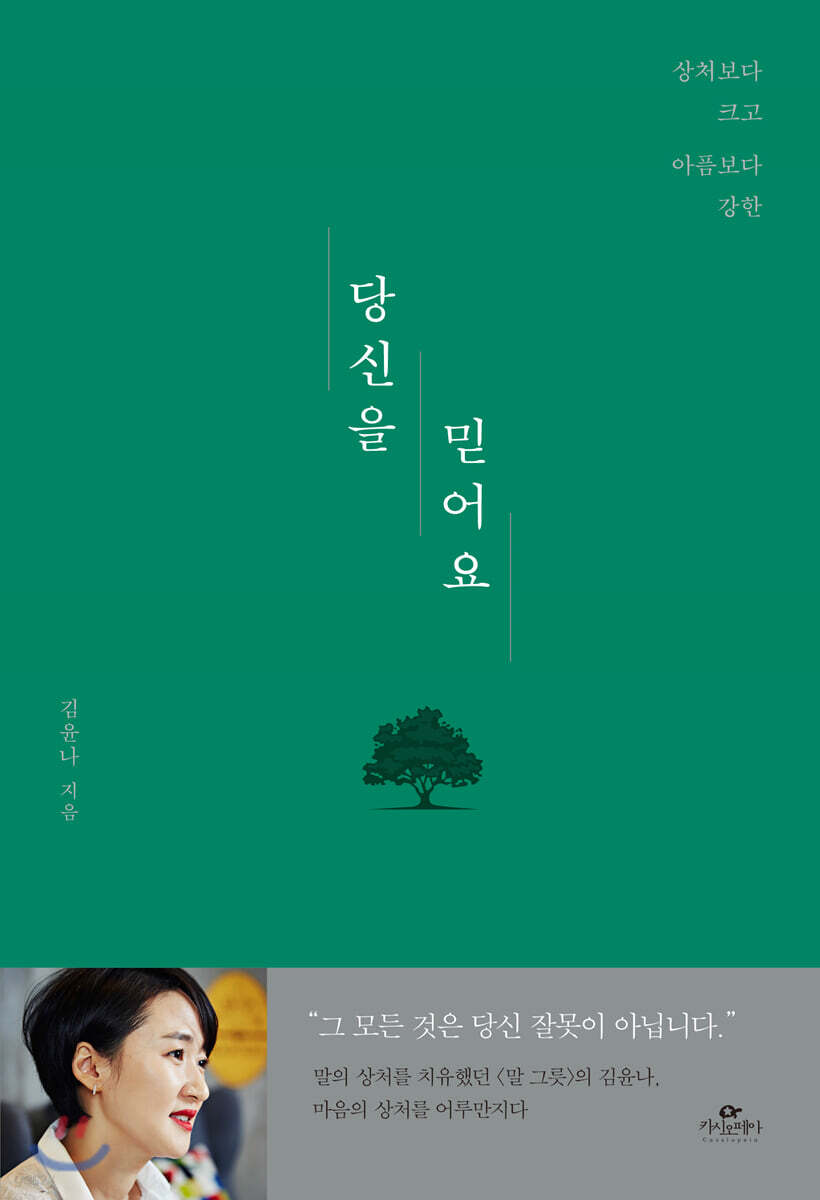
I trust you
 |
Description
Book Introduction
“I believe you have the strength to overcome your wounds.” Kim Yun-na's intimate and painful confession and overwhelming emotion in "The Bowl of Words" Kim Yun-na, author of 『The Bowl of Words』, which healed the wounds of words, has returned with a psychological healing essay that soothes the wounds of the heart. He calmly confesses about his parents' divorce when he was 7, his father's alcoholism, his childhood of extreme poverty, and his past of being obsessed with achievement, offering comfort to those who have been unable to overcome the wounds of the past and giving them the courage to take a step forward. It emphasizes that our existence is greater than our wounds and stronger than our pain, and it urges us to believe in that fact. What people who cannot face the bare face of their wounds need is 'faith'. I believe that I can handle it. "I Believe in You" is densely packed with insights into the human mind, and its deeply moving language makes the process of reading it a moment of deep empathy. It helps us escape from the swamp of self-doubt and gradually find our original place. This book is the most intimate and honest self-confession about wounds, and it is a heart-healing book that provides overwhelming comfort and emotion after a fierce and painful confession. |
- You can preview some of the book's contents.
Preview
index
Prologue_To you who cannot go further because of your wounds.
Chapter 1: Living with Wounds
I trust you, because that's who you are
What I can do
The landmine called 'special trigger stimulus'
I didn't make that effort in the first place.
Yeah, it's not your fault
When tears suddenly fall
Chapter 2: Slightly different choices
A person trapped in time
The first rule of relationships
Of course it can be so
A tree with exposed roots
To become an island that does not sway in the waves.
How to use inferiority complex
ENOUGH
Chapter 3: Growing Up with Wounds
Full of unfinished work
Family Secret
About forgiveness
The Pitfalls of Self-Analysis
When anxiety rises
Chapter 4: Attitude toward misfortune
Qualification for Happiness
No one has been hurt
In the face of others' suffering
Things that are visible again
To you who cried for a long time
Epilogue_Thanks to my real mom
Chapter 1: Living with Wounds
I trust you, because that's who you are
What I can do
The landmine called 'special trigger stimulus'
I didn't make that effort in the first place.
Yeah, it's not your fault
When tears suddenly fall
Chapter 2: Slightly different choices
A person trapped in time
The first rule of relationships
Of course it can be so
A tree with exposed roots
To become an island that does not sway in the waves.
How to use inferiority complex
ENOUGH
Chapter 3: Growing Up with Wounds
Full of unfinished work
Family Secret
About forgiveness
The Pitfalls of Self-Analysis
When anxiety rises
Chapter 4: Attitude toward misfortune
Qualification for Happiness
No one has been hurt
In the face of others' suffering
Things that are visible again
To you who cried for a long time
Epilogue_Thanks to my real mom
Detailed image
Into the book
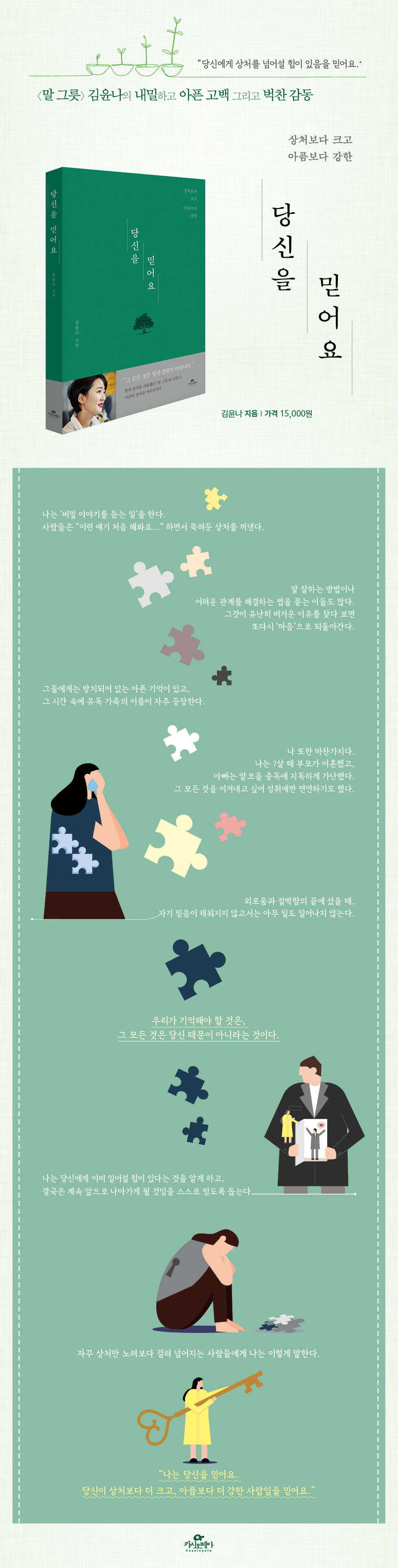
What people who cannot face the bare face of their wounds need is 'faith'.
I believe that I can handle it.
When you are at the edge of loneliness and desperation, nothing happens unless your self-belief is filled.
A coach helps you realize that you already have the power to do it, and helps you believe that you will eventually keep moving forward.
I say this to people who keep looking at their wounds and stumble.
“I trust you.
“My goal is for you to believe in yourself more than I believe in you.” --- p.18
I've often seen people run away saying they understand.
He says he understands because he knows that bringing up the past will only cause headaches and nothing will change.
Instead of saying 'it hurts', say 'I understand', and instead of saying 'I'm sad', say 'there's nothing I can do'.
I used to say this whenever people tried to console a poor child who was separated from his mother.
“I understand you, Mom.
I don't think I could have lived with my dad either.
“Mom was young too, so it must have been an unavoidable choice.” After saying this, people stopped talking.
As time passed, I realized that the understanding was not real.
To be honest, I still shouldn't have abandoned my child.
I was 7 years old and needed my mom so badly.
But I believed that if I just understood and let it go, I would be less hurt and would seem less pitiful to people.
--- p.64
There are several criteria for guessing the state of one's mental health when talking to people, one of which is called 'time zone'.
We have lived in the past, we live in the present, and we will live in the future.
Each of us is entangled in these three time dimensions.
However, the way we manage our time varies from person to person.
Anyone who experiences a rift in their life in any way has dimensions of time that are out of balance.
There is too much power on one side.
For example, we are stuck in a point in the past, helplessly immersed in the present, or running towards the future without the capacity to look back.
Psychological fixation occurs independently of physical time.
--- p.72
I know how much you endured and how much you had to endure to do that.
You needed care, you longed for comfort, you waited for an apology.
A person who has been exposed to a lack of desire for a long time cannot help but reach such a state of mind.
I want to understand that hellish heart.
Guilt stems from the illusory belief that parents must be loved and respected no matter what, and the mistaken belief that there are certain emotions appropriate for children.
There is no such thing.
All emotions are valid and justified.
We have a legitimate right to be jealous, to hate, and to be angry.
Even if it's your parents or family.
--- p.95
When I was in my late twenties, I realized that if I wanted to create the life I wanted, I had to stop playing the role of "special daughter."
In the meantime, I met adults who lived differently from my parents, read various books, and walked through other people's lives together, and I realized that I was the director of my own life.
I also learned the courage to quit a role that I had been given by chance.
--- p.214
When you're wondering where to start, try finding small, seemingly trivial things to do and living your day.
Someone will finish a report, prepare a meal for the child, or read a book in their spare time.
I'll walk around the neighborhood, prepare a gift for a friend, and listen to his story.
Instead of filling your time to compensate for the past, let's expand our time for our ordinary goals.
When the terribly lonely and desolate night comes, don't call out to your old, weak and helpless self. Instead, let's fall asleep looking at the small sweat and definite effort you shed today.
I believe that I can handle it.
When you are at the edge of loneliness and desperation, nothing happens unless your self-belief is filled.
A coach helps you realize that you already have the power to do it, and helps you believe that you will eventually keep moving forward.
I say this to people who keep looking at their wounds and stumble.
“I trust you.
“My goal is for you to believe in yourself more than I believe in you.” --- p.18
I've often seen people run away saying they understand.
He says he understands because he knows that bringing up the past will only cause headaches and nothing will change.
Instead of saying 'it hurts', say 'I understand', and instead of saying 'I'm sad', say 'there's nothing I can do'.
I used to say this whenever people tried to console a poor child who was separated from his mother.
“I understand you, Mom.
I don't think I could have lived with my dad either.
“Mom was young too, so it must have been an unavoidable choice.” After saying this, people stopped talking.
As time passed, I realized that the understanding was not real.
To be honest, I still shouldn't have abandoned my child.
I was 7 years old and needed my mom so badly.
But I believed that if I just understood and let it go, I would be less hurt and would seem less pitiful to people.
--- p.64
There are several criteria for guessing the state of one's mental health when talking to people, one of which is called 'time zone'.
We have lived in the past, we live in the present, and we will live in the future.
Each of us is entangled in these three time dimensions.
However, the way we manage our time varies from person to person.
Anyone who experiences a rift in their life in any way has dimensions of time that are out of balance.
There is too much power on one side.
For example, we are stuck in a point in the past, helplessly immersed in the present, or running towards the future without the capacity to look back.
Psychological fixation occurs independently of physical time.
--- p.72
I know how much you endured and how much you had to endure to do that.
You needed care, you longed for comfort, you waited for an apology.
A person who has been exposed to a lack of desire for a long time cannot help but reach such a state of mind.
I want to understand that hellish heart.
Guilt stems from the illusory belief that parents must be loved and respected no matter what, and the mistaken belief that there are certain emotions appropriate for children.
There is no such thing.
All emotions are valid and justified.
We have a legitimate right to be jealous, to hate, and to be angry.
Even if it's your parents or family.
--- p.95
When I was in my late twenties, I realized that if I wanted to create the life I wanted, I had to stop playing the role of "special daughter."
In the meantime, I met adults who lived differently from my parents, read various books, and walked through other people's lives together, and I realized that I was the director of my own life.
I also learned the courage to quit a role that I had been given by chance.
--- p.214
When you're wondering where to start, try finding small, seemingly trivial things to do and living your day.
Someone will finish a report, prepare a meal for the child, or read a book in their spare time.
I'll walk around the neighborhood, prepare a gift for a friend, and listen to his story.
Instead of filling your time to compensate for the past, let's expand our time for our ordinary goals.
When the terribly lonely and desolate night comes, don't call out to your old, weak and helpless self. Instead, let's fall asleep looking at the small sweat and definite effort you shed today.
--- p.243
Publisher's Review
“You are bigger than your wounds and stronger than your pain.”
A story of healing wounds that comforts you and comforts those who cried in secret.
We often see people running away saying they understand.
Because I know that digging up the past will only cause me a headache and nothing will change.
Instead of saying 'it hurts', say 'I understand', and instead of saying 'I'm sad', say 'there's nothing I can do'.
The author, who says he "listens to secret stories," says that when people search for reasons why relationships or conversations are particularly burdensome, they often return to their "heart."
They have painful memories that have been neglected, and the names of their families appear particularly frequently during those times.
The author says calmly that he was abandoned by his mother.
The inner self that doesn't want to be abandoned again keeps bringing up this fact.
He confesses that he fell off a cliff and had to go back to the starting line every time he was called out for not being able to pay his childhood education fee, or when his alcoholic father was taken to the hospital emergency room and was hospitalized and discharged repeatedly.
But what we must remember is that it is not all because of you.
What we need is not the strength to overcome vulnerability, but the wisdom to acknowledge vulnerability, not be swayed by guilt, and see it as it is.
That is why this book speaks to those who keep looking at their wounds and stumble.
“I trust you.
“I believe that you are bigger than your scars and stronger than your pain.”
“Why do we always fall in the same place?”
Kim Yoon-na's affectionate consolation for you, who always slumps in the same spot.
This book vividly captures author Kim Yun-na's honest, intimate, and intense growth process.
There are two things the author wants to say by revealing his wounds.
The first is to let all of us who have been so ignorant of our own grief know that “it’s not your fault.”
The second is to believe that “you are bigger than your wounds.”
By revealing one's own wounds in this way, one comforts and heals others.
The book consists of four chapters in total.
Chapter 1.
Living with scars speaks to being abandoned.
Those who have been abandoned, who remember moments of intense rejection, may have to deal with the emotional toll for the rest of their lives.
There is no quick fix for the trauma of abandonment, but it is important to believe that “we are not abandoned because we deserve to be abandoned.”
The author uses his own story of abandonment to help us find our original place little by little.
Chapter 2.
'A Little Different Choice' tells the story of people who are stuck in the past and cannot escape from feelings of inferiority and loss.
Through the story of his father, who was unable to escape from the past while repeating it, and himself, who ran into the future to escape from that place, he emphasizes the importance of life here and now.
The wounds still crop up and trap the mind, but it emphasizes that we can make slightly different choices, and talks about how to do that.
Chapter 3.
In 'Growing with Wounds', we are urged to see reality as it is.
As you unpack your own forgiveness episodes, it helps you put aside the empty bowls and see what you already have and what remains as possibilities.
It tells intimate stories that fill life with the possibility of becoming a person bigger than one's wounds.
Chapter 4.
In 'Attitudes toward Misfortune', we discuss how to talk to anxiety and what we see when we do so.
We talk about the attitude we should show in the face of others' suffering and give you warm courage so that you, who have cried for a long time, can walk anew.
A story of healing wounds that comforts you and comforts those who cried in secret.
We often see people running away saying they understand.
Because I know that digging up the past will only cause me a headache and nothing will change.
Instead of saying 'it hurts', say 'I understand', and instead of saying 'I'm sad', say 'there's nothing I can do'.
The author, who says he "listens to secret stories," says that when people search for reasons why relationships or conversations are particularly burdensome, they often return to their "heart."
They have painful memories that have been neglected, and the names of their families appear particularly frequently during those times.
The author says calmly that he was abandoned by his mother.
The inner self that doesn't want to be abandoned again keeps bringing up this fact.
He confesses that he fell off a cliff and had to go back to the starting line every time he was called out for not being able to pay his childhood education fee, or when his alcoholic father was taken to the hospital emergency room and was hospitalized and discharged repeatedly.
But what we must remember is that it is not all because of you.
What we need is not the strength to overcome vulnerability, but the wisdom to acknowledge vulnerability, not be swayed by guilt, and see it as it is.
That is why this book speaks to those who keep looking at their wounds and stumble.
“I trust you.
“I believe that you are bigger than your scars and stronger than your pain.”
“Why do we always fall in the same place?”
Kim Yoon-na's affectionate consolation for you, who always slumps in the same spot.
This book vividly captures author Kim Yun-na's honest, intimate, and intense growth process.
There are two things the author wants to say by revealing his wounds.
The first is to let all of us who have been so ignorant of our own grief know that “it’s not your fault.”
The second is to believe that “you are bigger than your wounds.”
By revealing one's own wounds in this way, one comforts and heals others.
The book consists of four chapters in total.
Chapter 1.
Living with scars speaks to being abandoned.
Those who have been abandoned, who remember moments of intense rejection, may have to deal with the emotional toll for the rest of their lives.
There is no quick fix for the trauma of abandonment, but it is important to believe that “we are not abandoned because we deserve to be abandoned.”
The author uses his own story of abandonment to help us find our original place little by little.
Chapter 2.
'A Little Different Choice' tells the story of people who are stuck in the past and cannot escape from feelings of inferiority and loss.
Through the story of his father, who was unable to escape from the past while repeating it, and himself, who ran into the future to escape from that place, he emphasizes the importance of life here and now.
The wounds still crop up and trap the mind, but it emphasizes that we can make slightly different choices, and talks about how to do that.
Chapter 3.
In 'Growing with Wounds', we are urged to see reality as it is.
As you unpack your own forgiveness episodes, it helps you put aside the empty bowls and see what you already have and what remains as possibilities.
It tells intimate stories that fill life with the possibility of becoming a person bigger than one's wounds.
Chapter 4.
In 'Attitudes toward Misfortune', we discuss how to talk to anxiety and what we see when we do so.
We talk about the attitude we should show in the face of others' suffering and give you warm courage so that you, who have cried for a long time, can walk anew.
GOODS SPECIFICS
- Date of issue: August 19, 2019
- Page count, weight, size: 248 pages | 380g | 140*205*16mm
- ISBN13: 9791188674725
- ISBN10: 1188674722
You may also like
카테고리
korean


korean

![GQ KOREA Mark (Monthly): December [2025]](http://librairie.coreenne.fr/cdn/shop/files/8ef265dbbfbf186523ed75ba7319009d.jpg?v=1765340328&width=3840)


