

A walk through the Spanish art museums
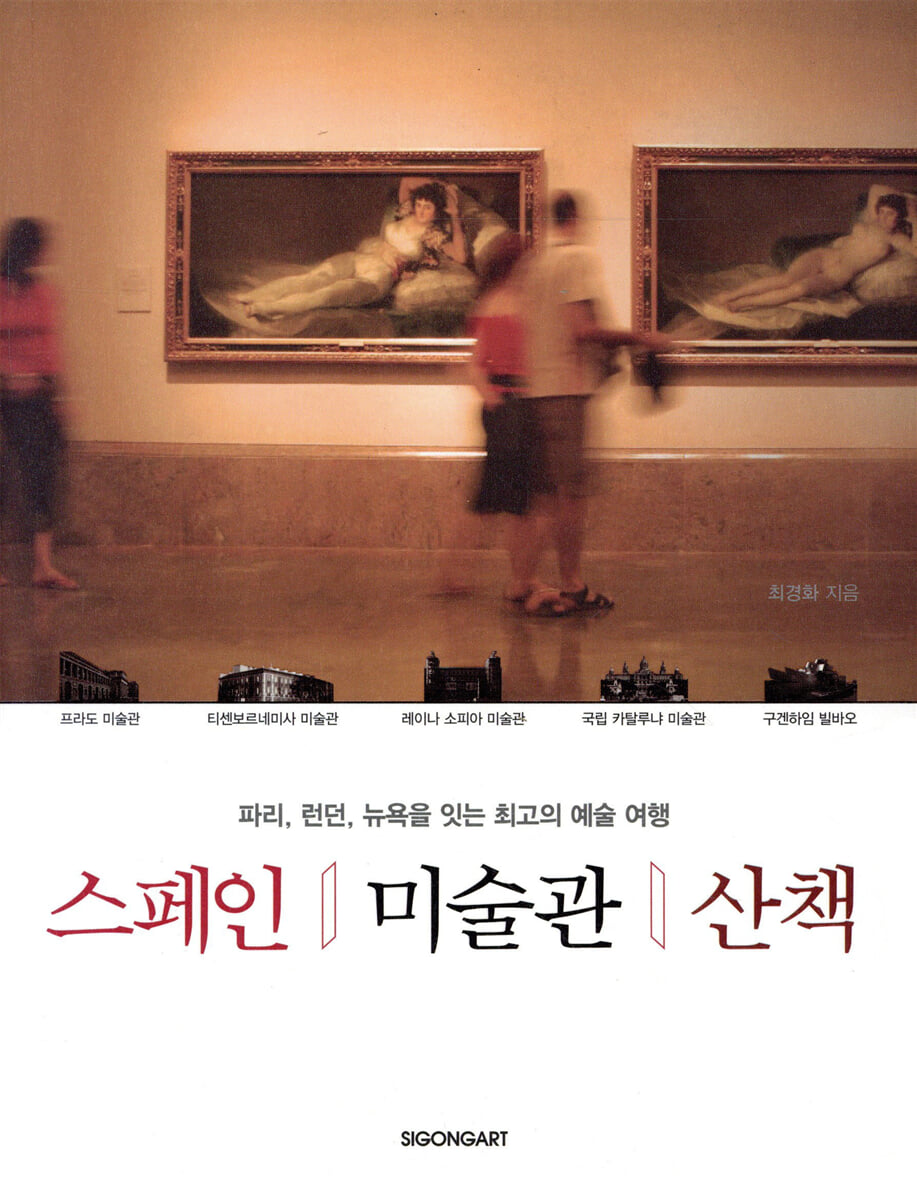 |
Description
Book Introduction
From Europe's hidden treasure trove
The joy of encountering masterpieces
This book introduces famous art museums in Spain and tells the stories of the masterpieces contained within them.
The National Gallery in London, England, the Uffizi Gallery in Florence, Italy, and the Prado Museum in Madrid, Spain are often cited as the three major art museums in Europe.
Spain has more world-class art museums and masterpieces than we might think.
The author, who worked as a guide for Korean tourists at the Prado Museum, tells an interesting story about the painting based on his experience.
In this book, you can hear stories of fascinating works of art housed in the Prado Museum, Thyssen-Bornemisza Museum, Reina Sofia Museum, National Museum of Catalonia, Picasso Museum in Barcelona, and Guggenheim Museum Bilbao.
In addition to the works, the beautiful architecture of Gaudi, a representative Spanish artist, is also introduced.
In the 19th century, in the Catalonia region of Spain, a movement arose against industrialization and a return to handicrafts, called 'modernisme'.
At that time, there was a wind of urban redevelopment blowing in Barcelona, and many buildings were built under the influence of Modernismo.
To help visitors see these modernist buildings, the Barcelona Tourist Board created the 'Ruta del Modernisme'.
You can enjoy the fun of choosing on the 'Modernismo Route', where you can see buildings designed by Gaudi and his contemporaries.
In addition, we recommend five additional small but rich art museums to provide the ultimate art tour.
The joy of encountering masterpieces
This book introduces famous art museums in Spain and tells the stories of the masterpieces contained within them.
The National Gallery in London, England, the Uffizi Gallery in Florence, Italy, and the Prado Museum in Madrid, Spain are often cited as the three major art museums in Europe.
Spain has more world-class art museums and masterpieces than we might think.
The author, who worked as a guide for Korean tourists at the Prado Museum, tells an interesting story about the painting based on his experience.
In this book, you can hear stories of fascinating works of art housed in the Prado Museum, Thyssen-Bornemisza Museum, Reina Sofia Museum, National Museum of Catalonia, Picasso Museum in Barcelona, and Guggenheim Museum Bilbao.
In addition to the works, the beautiful architecture of Gaudi, a representative Spanish artist, is also introduced.
In the 19th century, in the Catalonia region of Spain, a movement arose against industrialization and a return to handicrafts, called 'modernisme'.
At that time, there was a wind of urban redevelopment blowing in Barcelona, and many buildings were built under the influence of Modernismo.
To help visitors see these modernist buildings, the Barcelona Tourist Board created the 'Ruta del Modernisme'.
You can enjoy the fun of choosing on the 'Modernismo Route', where you can see buildings designed by Gaudi and his contemporaries.
In addition, we recommend five additional small but rich art museums to provide the ultimate art tour.
- You can preview some of the book's contents.
Preview
index
Entering and me in Spain
Prado Museum | A must-see on any trip to Spain
Rogier van der Weyden | The Descent from the Cross
Fra Angelico | Annunciation
Albrecht Dürer | Adam and Eve
Hieronymus Bosch | The Garden of Earthly Delights
Titian Vecellio | Danae in the Golden Rain
Titian Vecellio | Venus and Adonis
Caravaggio | David and Goliath
El Greco | The Trinity
El Greco | Allegory
El Greco | The Knight with His Hand on His Heart
El Greco | Adoration of the Shepherds
Peter Paul Rubens | Saint Jorge Slaying the Dragon
Diego Velázquez | Felipe IV
Diego Velázquez | The Triumph of Bacchus (The Drunken Ones)
Diego Velázquez | The Forge of Vulcan
Diego Velázquez | Deer Head
Diego Velázquez | Equestrian Portrait of Isabel de Borbon
Diego Velázquez | The Ladies-in-waiting (The Family of Philip IV)
Francisco de Goya | The Countess of Chinchón
Francisco de Goya | Equestrian Portrait of Queen Maria Luisa
Francisco de Goya | Portrait of the Family of Carlos IV
Francisco de Goya | The Naked Maja / The Clothed Maja
Francisco de Goya | May 2, 1808
Francisco de Goya | Saturn Devouring His Children
Thyssen-Bornemisza Museum | Collection of a German Noble Family
Duccio di Buoninsegna | Christ and the Samaritan Woman
Jan van Eyck | The Annunciation
Domenico Ghirlandaio | Portrait of Giovanna Tornabuoni
The Master of Grosskmine | Saint Jerome in Cardinal's attire
Hans Holbein | Henry VIII of England
Willem Kalp | Still Life with Decorative Cups, Chinese Porcelain
Pieter Jans Saanredam | West Door of the Church of Santa Maria in Utrecht
Canaletto | St. Mark's Square in Venice
Camille Pissarro | The Rue Saint-Honoré in the Afternoon, Rain Effect
Edgar Degas | Leaning Ballerina
Vincent van Gogh | The Village of Les Vesneaux
André Derain | Waterloo Bridge
Piet Mondrian | New York City 3
Reina Sofia Museum | Where Guernica Breathes
Pablo Picasso | Guernica
Salvador Dali | Figure at the Window
Joan Miro | Painting (Man with a Pipe)
Roy Lichtenstein | Brushstroke
National Museum of Catalonia | Discover 12th-Century Murals
The Master of Taul | The Apse of the Basilica of St. Clement of Taul
Unknown artist | Altarpiece of La Seu d'Orgel
Unknown artist | Abia Altarpiece
Ramon Casas | Ramon Casas and Pere Romeu on a tandem bike
The Modernismo Route | Exploring Barcelona with Gaudí
Antoni Gaudí | Casa Batlló
Antoni Gaudí | Casa Mila (La Pedrera)
Antoni Gaudí | Sagrada Familia
Antoni Gaudí | Park Güell
Luis Domenech i Montaner | Palau de la Musica Catalana
Barcelona Picasso Museum | Discover the many facets of Picasso
Pablo Picasso | Science and Philanthropy
Pablo Picasso | Waiting (Margot)
Pablo Picasso | Harlequin
Pablo Picasso | The Maids of Honor
Guggenheim Bilbao | The Museum That Changed an Entire City
Jeff Koons | Puppy
Louise Bourgeois | Mother
Jenny Holzer | Installation for Bilbao
Richard Serra | A Matter of Time
Small but rich art museums
Sorolla Museum in Madrid
Cerralvo Museum in Madrid
Barcelona/Madrid Caixa Forum
Joan Miró Foundation in Barcelona
Toledo Santa Cruz Museum of Art
Prado Museum | A must-see on any trip to Spain
Rogier van der Weyden | The Descent from the Cross
Fra Angelico | Annunciation
Albrecht Dürer | Adam and Eve
Hieronymus Bosch | The Garden of Earthly Delights
Titian Vecellio | Danae in the Golden Rain
Titian Vecellio | Venus and Adonis
Caravaggio | David and Goliath
El Greco | The Trinity
El Greco | Allegory
El Greco | The Knight with His Hand on His Heart
El Greco | Adoration of the Shepherds
Peter Paul Rubens | Saint Jorge Slaying the Dragon
Diego Velázquez | Felipe IV
Diego Velázquez | The Triumph of Bacchus (The Drunken Ones)
Diego Velázquez | The Forge of Vulcan
Diego Velázquez | Deer Head
Diego Velázquez | Equestrian Portrait of Isabel de Borbon
Diego Velázquez | The Ladies-in-waiting (The Family of Philip IV)
Francisco de Goya | The Countess of Chinchón
Francisco de Goya | Equestrian Portrait of Queen Maria Luisa
Francisco de Goya | Portrait of the Family of Carlos IV
Francisco de Goya | The Naked Maja / The Clothed Maja
Francisco de Goya | May 2, 1808
Francisco de Goya | Saturn Devouring His Children
Thyssen-Bornemisza Museum | Collection of a German Noble Family
Duccio di Buoninsegna | Christ and the Samaritan Woman
Jan van Eyck | The Annunciation
Domenico Ghirlandaio | Portrait of Giovanna Tornabuoni
The Master of Grosskmine | Saint Jerome in Cardinal's attire
Hans Holbein | Henry VIII of England
Willem Kalp | Still Life with Decorative Cups, Chinese Porcelain
Pieter Jans Saanredam | West Door of the Church of Santa Maria in Utrecht
Canaletto | St. Mark's Square in Venice
Camille Pissarro | The Rue Saint-Honoré in the Afternoon, Rain Effect
Edgar Degas | Leaning Ballerina
Vincent van Gogh | The Village of Les Vesneaux
André Derain | Waterloo Bridge
Piet Mondrian | New York City 3
Reina Sofia Museum | Where Guernica Breathes
Pablo Picasso | Guernica
Salvador Dali | Figure at the Window
Joan Miro | Painting (Man with a Pipe)
Roy Lichtenstein | Brushstroke
National Museum of Catalonia | Discover 12th-Century Murals
The Master of Taul | The Apse of the Basilica of St. Clement of Taul
Unknown artist | Altarpiece of La Seu d'Orgel
Unknown artist | Abia Altarpiece
Ramon Casas | Ramon Casas and Pere Romeu on a tandem bike
The Modernismo Route | Exploring Barcelona with Gaudí
Antoni Gaudí | Casa Batlló
Antoni Gaudí | Casa Mila (La Pedrera)
Antoni Gaudí | Sagrada Familia
Antoni Gaudí | Park Güell
Luis Domenech i Montaner | Palau de la Musica Catalana
Barcelona Picasso Museum | Discover the many facets of Picasso
Pablo Picasso | Science and Philanthropy
Pablo Picasso | Waiting (Margot)
Pablo Picasso | Harlequin
Pablo Picasso | The Maids of Honor
Guggenheim Bilbao | The Museum That Changed an Entire City
Jeff Koons | Puppy
Louise Bourgeois | Mother
Jenny Holzer | Installation for Bilbao
Richard Serra | A Matter of Time
Small but rich art museums
Sorolla Museum in Madrid
Cerralvo Museum in Madrid
Barcelona/Madrid Caixa Forum
Joan Miró Foundation in Barcelona
Toledo Santa Cruz Museum of Art
Detailed image

Publisher's Review
Masterpieces of the Century Encountered in the Land of Passion
This book introduces famous art museums in Spain and tells the stories of the masterpieces contained within them.
The National Gallery in London, England, the Uffizi Gallery in Florence, Italy, and the Prado Museum in Madrid, Spain are often cited as the three major art museums in Europe.
Spain has more world-class art museums and masterpieces than we might think.
The author, who worked as a guide for Korean tourists at the Prado Museum, tells an interesting story about the painting based on his experience.
In this book, you can hear stories of fascinating works of art housed in the Prado Museum, Thyssen-Bornemisza Museum, Reina Sofia Museum, National Museum of Catalonia, Picasso Museum in Barcelona, and Guggenheim Museum Bilbao.
Spain, a European treasure trove you can't miss
Spain is a country with a history of art as deep as England, France, and Italy.
Diego Velazquez, famous for Las Meninas, Francisco de Goya, who captured human nature on canvas, Pablo Picasso, the undeniably genius painter, Salvador Dali and Joan Miró, the leading figures of surrealism, and Antoni Gaudi, the mastermind behind the Basilica de la Sagrada Familia, which has been under construction for over a century, are all artists born and active in Spain.
The traces of these masters are preserved in Spanish art museums, so the museums introduced in this book are not to be missed.
The Prado Museum has the largest collection of Rubens' works and displays representative works by Velazquez and Goya, while the Thyssen-Bornemisza Museum houses a collection of Jan van Eyck's paintings, of which only a few remain.
The Reina Sofia Museum is where you can appreciate the 20th-century masterpiece Guernica, and the Guggenheim Bilbao Museum is what transformed the declining industrial city of Bilbao into a city of art.
Spain boasts world-class art museums as well as smaller, more distinctive museums, each with its own unique character that attracts visitors.
If you visit Spain, this is why you should definitely remember the art museums introduced in this book.
The stories behind exciting masterpieces
These are beautiful pictures to just look at, but the emotion is doubled when you know the story behind them.
The author selects about 60 works and explains the story of each.
The faces and postures of the women in the two portraits are identical, suggesting that these two women are the same person.
But one is a naked woman, and the other is a clothed woman.
There are countless female nudes in Western art, but the subjects are mainly mythological gods or biblical women.
In other words, they were women with clear social status.
But the problem with these two works was that the identities of the women were unknown.
So the portrait of the naked woman ended up being the subject of the Inquisition.
The artist of this painting is Goya, and the title of the work is The Naked Maha and The Clothed Maha.
In the center of another painting is a princess and her maids, while to one side is a large canvas and a painter.
Interestingly, most of the figures in the painting are facing forward.
Who are they looking at? The answer lies in the mirror on the wall.
If you look closely at the mirror, you can see the faint reflection of the king and queen.
The painter is painting them right now, and to relieve the boredom of the king and queen, some dwarf clowns have been called in, and the young daughter, Princess Margarita, has come with her maids to see her mother and father.
But the interesting thing is that in Spain at that time, the king and queen were not painted together in royal portraits.
Velazquez's work, The Maids of Honor, is full of mysteries.
The Vasco region in northern Spain was a region that supported the Republicans during the Spanish Civil War.
At about 4:30 p.m. on April 26, 1937, the year after the civil war broke out, bombs began falling on Guernica, a small town in the Vasco region.
Hitler of Germany sent fighter planes to support the Spanish military and dropped a huge amount of bombs.
Guernica burned for two days, killing or wounding more than half its population.
When Picasso heard this news, he was so angry that he started painting, which became Guernica.
At that time, the Spanish government commissioned Picasso to create a mural for the Spanish Pavilion at the Paris World's Fair, and Guernica was exhibited in many European countries after its debut at the fair.
However, it was not exhibited in Spain, as it is said that Picasso opposed the work being sent to Spain, which was under the military regime of Franco.
Following Picasso's will to send Guernica to Spain after Franco's death, the work was brought to Spain in 1981, where it was displayed under tight police security and surrounded by bulletproof glass.
In addition to works of art, this book also introduces beautiful architectural works by Gaudi, a representative Spanish artist.
In the 19th century, in the Catalonia region of Spain, a movement arose against industrialization and a return to handicrafts, called 'modernisme'.
At that time, there was a wind of urban redevelopment blowing in Barcelona, and many buildings were built under the influence of Modernismo.
To help visitors see these modernist buildings, the Barcelona Tourist Board created the 'Ruta del Modernisme'.
You can enjoy the fun of choosing on the 'Modernismo Route', where you can see buildings designed by Gaudi and his contemporaries.
In addition, we recommend five additional small but rich art museums to provide the ultimate art tour.
This book introduces famous art museums in Spain and tells the stories of the masterpieces contained within them.
The National Gallery in London, England, the Uffizi Gallery in Florence, Italy, and the Prado Museum in Madrid, Spain are often cited as the three major art museums in Europe.
Spain has more world-class art museums and masterpieces than we might think.
The author, who worked as a guide for Korean tourists at the Prado Museum, tells an interesting story about the painting based on his experience.
In this book, you can hear stories of fascinating works of art housed in the Prado Museum, Thyssen-Bornemisza Museum, Reina Sofia Museum, National Museum of Catalonia, Picasso Museum in Barcelona, and Guggenheim Museum Bilbao.
Spain, a European treasure trove you can't miss
Spain is a country with a history of art as deep as England, France, and Italy.
Diego Velazquez, famous for Las Meninas, Francisco de Goya, who captured human nature on canvas, Pablo Picasso, the undeniably genius painter, Salvador Dali and Joan Miró, the leading figures of surrealism, and Antoni Gaudi, the mastermind behind the Basilica de la Sagrada Familia, which has been under construction for over a century, are all artists born and active in Spain.
The traces of these masters are preserved in Spanish art museums, so the museums introduced in this book are not to be missed.
The Prado Museum has the largest collection of Rubens' works and displays representative works by Velazquez and Goya, while the Thyssen-Bornemisza Museum houses a collection of Jan van Eyck's paintings, of which only a few remain.
The Reina Sofia Museum is where you can appreciate the 20th-century masterpiece Guernica, and the Guggenheim Bilbao Museum is what transformed the declining industrial city of Bilbao into a city of art.
Spain boasts world-class art museums as well as smaller, more distinctive museums, each with its own unique character that attracts visitors.
If you visit Spain, this is why you should definitely remember the art museums introduced in this book.
The stories behind exciting masterpieces
These are beautiful pictures to just look at, but the emotion is doubled when you know the story behind them.
The author selects about 60 works and explains the story of each.
The faces and postures of the women in the two portraits are identical, suggesting that these two women are the same person.
But one is a naked woman, and the other is a clothed woman.
There are countless female nudes in Western art, but the subjects are mainly mythological gods or biblical women.
In other words, they were women with clear social status.
But the problem with these two works was that the identities of the women were unknown.
So the portrait of the naked woman ended up being the subject of the Inquisition.
The artist of this painting is Goya, and the title of the work is The Naked Maha and The Clothed Maha.
In the center of another painting is a princess and her maids, while to one side is a large canvas and a painter.
Interestingly, most of the figures in the painting are facing forward.
Who are they looking at? The answer lies in the mirror on the wall.
If you look closely at the mirror, you can see the faint reflection of the king and queen.
The painter is painting them right now, and to relieve the boredom of the king and queen, some dwarf clowns have been called in, and the young daughter, Princess Margarita, has come with her maids to see her mother and father.
But the interesting thing is that in Spain at that time, the king and queen were not painted together in royal portraits.
Velazquez's work, The Maids of Honor, is full of mysteries.
The Vasco region in northern Spain was a region that supported the Republicans during the Spanish Civil War.
At about 4:30 p.m. on April 26, 1937, the year after the civil war broke out, bombs began falling on Guernica, a small town in the Vasco region.
Hitler of Germany sent fighter planes to support the Spanish military and dropped a huge amount of bombs.
Guernica burned for two days, killing or wounding more than half its population.
When Picasso heard this news, he was so angry that he started painting, which became Guernica.
At that time, the Spanish government commissioned Picasso to create a mural for the Spanish Pavilion at the Paris World's Fair, and Guernica was exhibited in many European countries after its debut at the fair.
However, it was not exhibited in Spain, as it is said that Picasso opposed the work being sent to Spain, which was under the military regime of Franco.
Following Picasso's will to send Guernica to Spain after Franco's death, the work was brought to Spain in 1981, where it was displayed under tight police security and surrounded by bulletproof glass.
In addition to works of art, this book also introduces beautiful architectural works by Gaudi, a representative Spanish artist.
In the 19th century, in the Catalonia region of Spain, a movement arose against industrialization and a return to handicrafts, called 'modernisme'.
At that time, there was a wind of urban redevelopment blowing in Barcelona, and many buildings were built under the influence of Modernismo.
To help visitors see these modernist buildings, the Barcelona Tourist Board created the 'Ruta del Modernisme'.
You can enjoy the fun of choosing on the 'Modernismo Route', where you can see buildings designed by Gaudi and his contemporaries.
In addition, we recommend five additional small but rich art museums to provide the ultimate art tour.
GOODS SPECIFICS
- Date of issue: August 2, 2013
- Page count, weight, size: 404 pages | 676g | 153*200*30mm
- ISBN13: 9788952769633
- ISBN10: 8952769635
You may also like
카테고리
korean


korean

![GQ KOREA Mark (Monthly): December [2025]](http://librairie.coreenne.fr/cdn/shop/files/8ef265dbbfbf186523ed75ba7319009d.jpg?v=1765340328&width=3840)


