

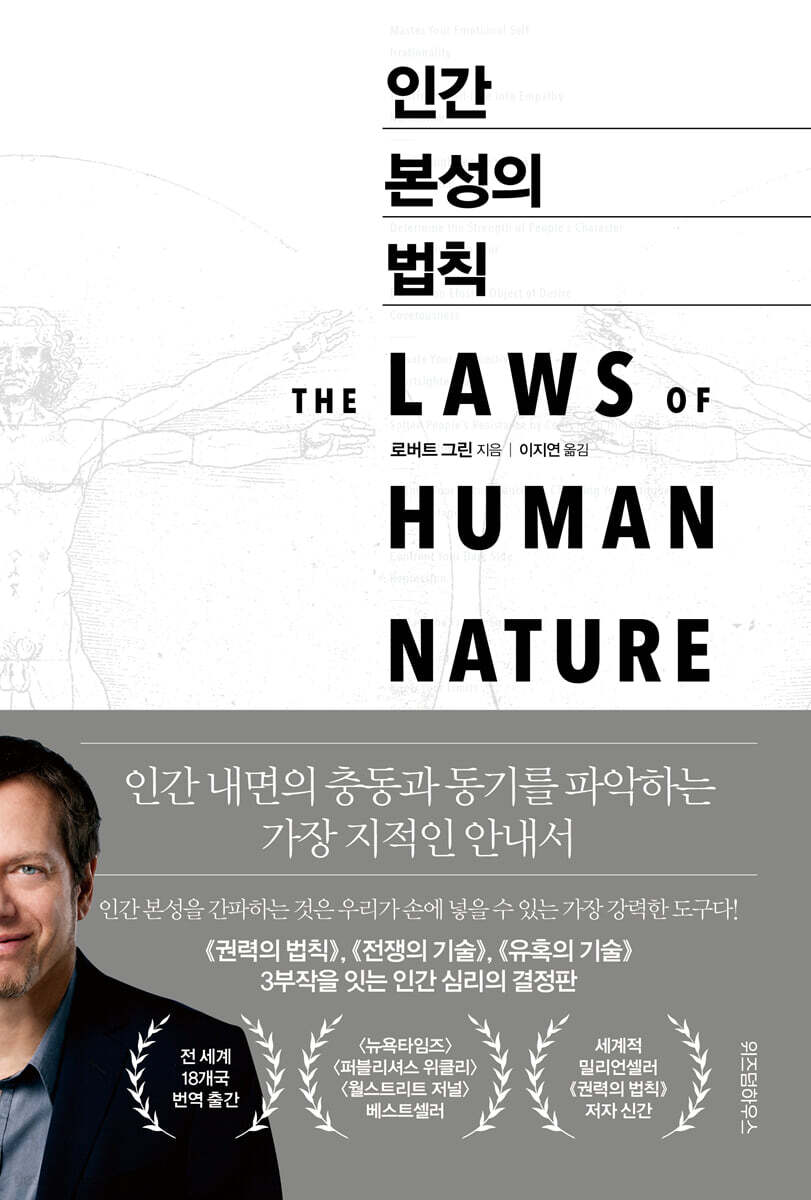
The Laws of Human Nature
 |
Description
Book Introduction
- A word from MD
-
Robert Greene's definitive book on humanismWhile 『The Laws of Power』 and 『The Art of War』 focused on the social surface, such as competition and power, this new work looks into the inner self of the individual.
It deals with the motivations and desires that underlie human behavior.
Understanding Green's 18 laws can help you better understand yourself and others.
August 2, 2019. Humanities PD Son Min-gyu
“The ability to discern human nature is the most powerful tool we can possess!”
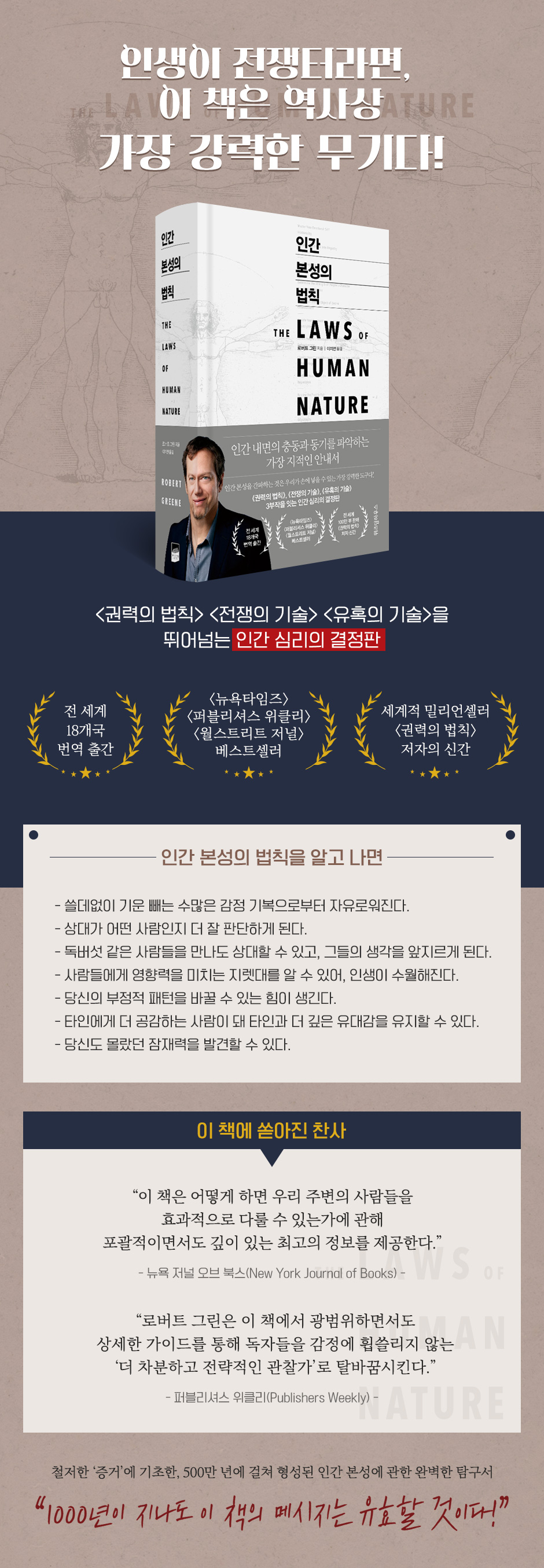
The most intelligent guide to understanding the inner drives and motivations of human beings.
Humans are social animals.
Our very lives are inevitably dependent on our relationships with people.
Therefore, interpreting the complex emotions and behaviors of people is the most important tool we can possess.
Robert Greene, author of the world-renowned million-seller "The Laws of Power," reveals 18 laws of human nature hidden within us.
In this book, he explores the true nature of humanity, a fascinating being that coexists with the ordinary, the strange, and the destructive.
In this book, the author presents a brutally realistic assessment of our species.
We are urged to thoroughly dissect our true selves and act with greater awareness, lest our jealous, narcissistic, and delusional human nature trap us in negative patterns, and lest we be subjected to those around us who manipulate people and situations to their advantage.
Also, true to his reputation as a mentor in the arts of power and modern survival strategies, his book details how to understand our true nature and use it as a tool to guide our lives in a positive direction.
You will discover the wisdom to achieve success at work, in relationships, and develop yourself, as well as the most effective strategies to protect yourself.
The most intelligent guide to understanding the inner drives and motivations of human beings.
Humans are social animals.
Our very lives are inevitably dependent on our relationships with people.
Therefore, interpreting the complex emotions and behaviors of people is the most important tool we can possess.
Robert Greene, author of the world-renowned million-seller "The Laws of Power," reveals 18 laws of human nature hidden within us.
In this book, he explores the true nature of humanity, a fascinating being that coexists with the ordinary, the strange, and the destructive.
In this book, the author presents a brutally realistic assessment of our species.
We are urged to thoroughly dissect our true selves and act with greater awareness, lest our jealous, narcissistic, and delusional human nature trap us in negative patterns, and lest we be subjected to those around us who manipulate people and situations to their advantage.
Also, true to his reputation as a mentor in the arts of power and modern survival strategies, his book details how to understand our true nature and use it as a tool to guide our lives in a positive direction.
You will discover the wisdom to achieve success at work, in relationships, and develop yourself, as well as the most effective strategies to protect yourself.
- You can preview some of the book's contents.
Preview
index
The only key to deciphering the human mind
Law 1: Overcoming the Emotions That Control Me
What I fear is not the other person, but my own mistakes.
The Key to Human Nature: Don't Look Outside for the Causes of Failure
Step 1: Become aware of your own biases.
Step 2: Identify psychological triggers.
Step 3: Bring out your rational self
Law 2: The Law of Narcissism: Focus on Others, Not Yourself
Everyone is thirsty for attention.
Four Types of Narcissists
Law 3: The Law of Role-Playing: Seeing Through the Mask
second language
The Key to Human Nature: Become a Strategic Observer
Observation skills to detect the opponent's signals
People who only show their best faces
The authenticity created
Law 4: The Law of Compulsive Behavior: Identify Your Character Strengths
Pattern of failure
The Key to Human Nature: You Create Your Own Destiny
The other person's behavior is an indicator of their personality.
Destructive types of people wrapped in positivity
Change your patterns, not your personality
Law 5: The Law of Desire: Become the Object of Desire, Yet Elusive
The Magic of Psychology
The Key to Human Nature: Triggering People's Repressed Fantasies
Three Strategies to Stimulate Desire
Turn dissatisfaction into motivation for growth.
Law 6: The Law of Myopia: Watch the Bigger Trends That Underlie the Event
The moment when your sense of reality collapses
The Key to Human Nature: Prioritizing the Long Term
Four Signs of Short-Term Thinking
Broaden your relationship with time and slow down
Law 7: The Law of Defensiveness: Make the Other Person Commit to You
Influence game
The Key to Human Nature: The Golden Key to Unlocking People's Defenses
Five Strategies to Capture Your Opponent's Heart
A child's flexibility and an adult's reasoning ability
Law 8: The Law of Self-Sabotage: Change Your Attitude and Your Surroundings Will Change
Ultimate freedom
The Key to Human Nature: We See Only the Reality We Create
Five Types of Negative Attitudes
A Five-Step Roadmap to Openness
Law 9: The Law of Suppression: Don't Hide Your Negative Tendencies
Nixon's tragedy
The Key to Human Nature: Capturing Your Inner Shadow
Seven Types of Shadows
Connect with the shadow within you
Law 10: The Law of Jealousy: Don't Offend the Other Person's Pride
Deadly Friend
The Key to Human Nature: Envy Underlies Others' Anger
Signs of jealousy
The tendency to be jealous is formed in childhood.
A situation where jealousy is triggered
Tips for turning your comparative tendencies into productive ones
Law 11: The Law of Grandeur: Realistically Assess Your Limitations
The illusion of success
The Key to Human Nature: Others Don't React the Way I Want
Dangerous Leader
Five Principles for High Satisfaction
Law 12: The Law of Gender Stereotypes: Create Your Own Gender Role
It brings out different sides of me
The Key to Human Nature: Capturing the Other's Repressed Side
Six Types of Gender Projection
Return to your original nature
Law 13: The Law of Losing Your Goal: Discover Your Life's Calling and Use It as Your Guide
A voice from within
The Key to Human Nature: Your Choices Now Affect Your Whole Life
Five Strategies for Navigating Life's Obstacles
Trap of false purpose
Law 14: Maintaining Independence from the Group
Mao Zedong's experiment
The Key to Human Nature: Recognizing the Influence of Groups
The struggle surrounding the leader
Five Strategies for Achieving Reality Groups
Law 15: The Law of Mood: Authority is the art of creating an appearance that people want to follow.
Nothing is taken for granted
The Key to Human Nature: Humans Always Feel Ambivalent Emotions
Make them willing to follow
Voice of Conscience
Law 16: The Law of Aggression: Detecting Hostility Behind a Kind Face
A sophisticated and cunning attacker
The Key to Human Nature: Aggression Is Potential in All Humans
Human aggression comes from a sense of helplessness.
How to Protect Yourself from Passive Aggressors
Four Elements of Positive Use
Law 17: The Law of Generation Myopia: Seizing Opportunities in the Flow of Time
Loss of a glorious past
The Key to Human Nature: Generational Change Is Part of a Repeating History
The Birth of the Zeitgeist
Patterns of human history
A strategy that breaks out of the generational mold
Time is a human creation
Law 18: The Law of Death Denial: When we recognize death, life becomes more intense.
A bullet lodged in the side
The Key to Human Nature: Connecting with the Reality of Death
Philosophy of life through death
Law 1: Overcoming the Emotions That Control Me
What I fear is not the other person, but my own mistakes.
The Key to Human Nature: Don't Look Outside for the Causes of Failure
Step 1: Become aware of your own biases.
Step 2: Identify psychological triggers.
Step 3: Bring out your rational self
Law 2: The Law of Narcissism: Focus on Others, Not Yourself
Everyone is thirsty for attention.
Four Types of Narcissists
Law 3: The Law of Role-Playing: Seeing Through the Mask
second language
The Key to Human Nature: Become a Strategic Observer
Observation skills to detect the opponent's signals
People who only show their best faces
The authenticity created
Law 4: The Law of Compulsive Behavior: Identify Your Character Strengths
Pattern of failure
The Key to Human Nature: You Create Your Own Destiny
The other person's behavior is an indicator of their personality.
Destructive types of people wrapped in positivity
Change your patterns, not your personality
Law 5: The Law of Desire: Become the Object of Desire, Yet Elusive
The Magic of Psychology
The Key to Human Nature: Triggering People's Repressed Fantasies
Three Strategies to Stimulate Desire
Turn dissatisfaction into motivation for growth.
Law 6: The Law of Myopia: Watch the Bigger Trends That Underlie the Event
The moment when your sense of reality collapses
The Key to Human Nature: Prioritizing the Long Term
Four Signs of Short-Term Thinking
Broaden your relationship with time and slow down
Law 7: The Law of Defensiveness: Make the Other Person Commit to You
Influence game
The Key to Human Nature: The Golden Key to Unlocking People's Defenses
Five Strategies to Capture Your Opponent's Heart
A child's flexibility and an adult's reasoning ability
Law 8: The Law of Self-Sabotage: Change Your Attitude and Your Surroundings Will Change
Ultimate freedom
The Key to Human Nature: We See Only the Reality We Create
Five Types of Negative Attitudes
A Five-Step Roadmap to Openness
Law 9: The Law of Suppression: Don't Hide Your Negative Tendencies
Nixon's tragedy
The Key to Human Nature: Capturing Your Inner Shadow
Seven Types of Shadows
Connect with the shadow within you
Law 10: The Law of Jealousy: Don't Offend the Other Person's Pride
Deadly Friend
The Key to Human Nature: Envy Underlies Others' Anger
Signs of jealousy
The tendency to be jealous is formed in childhood.
A situation where jealousy is triggered
Tips for turning your comparative tendencies into productive ones
Law 11: The Law of Grandeur: Realistically Assess Your Limitations
The illusion of success
The Key to Human Nature: Others Don't React the Way I Want
Dangerous Leader
Five Principles for High Satisfaction
Law 12: The Law of Gender Stereotypes: Create Your Own Gender Role
It brings out different sides of me
The Key to Human Nature: Capturing the Other's Repressed Side
Six Types of Gender Projection
Return to your original nature
Law 13: The Law of Losing Your Goal: Discover Your Life's Calling and Use It as Your Guide
A voice from within
The Key to Human Nature: Your Choices Now Affect Your Whole Life
Five Strategies for Navigating Life's Obstacles
Trap of false purpose
Law 14: Maintaining Independence from the Group
Mao Zedong's experiment
The Key to Human Nature: Recognizing the Influence of Groups
The struggle surrounding the leader
Five Strategies for Achieving Reality Groups
Law 15: The Law of Mood: Authority is the art of creating an appearance that people want to follow.
Nothing is taken for granted
The Key to Human Nature: Humans Always Feel Ambivalent Emotions
Make them willing to follow
Voice of Conscience
Law 16: The Law of Aggression: Detecting Hostility Behind a Kind Face
A sophisticated and cunning attacker
The Key to Human Nature: Aggression Is Potential in All Humans
Human aggression comes from a sense of helplessness.
How to Protect Yourself from Passive Aggressors
Four Elements of Positive Use
Law 17: The Law of Generation Myopia: Seizing Opportunities in the Flow of Time
Loss of a glorious past
The Key to Human Nature: Generational Change Is Part of a Repeating History
The Birth of the Zeitgeist
Patterns of human history
A strategy that breaks out of the generational mold
Time is a human creation
Law 18: The Law of Death Denial: When we recognize death, life becomes more intense.
A bullet lodged in the side
The Key to Human Nature: Connecting with the Reality of Death
Philosophy of life through death
Detailed image
Into the book
As you live, you inevitably meet all kinds of people.
Among them, there are those who deliberately cause trouble, those who make my life tiring, and those who make me feel uncomfortable.
He could be my boss or leader, a coworker or a friend.
I may be overtly aggressive or I may be subtle in my aggression, but I am equally free to play with my emotions.
The problem is that such people often appear attractive on the outside.
They are so full of ideas and passion, so confident that it feels refreshing, that we often fall under their spell.
It was only later that he realized that his confidence was irrational and that his ideas were not the result of careful consideration, but it was already too late to turn back time.
--- p.005
Interactions with people are a major cause of our emotional turmoil.
But it doesn't have to be that way.
The problem is that we are constantly judging others.
And at the same time, we hope that the other person will be a different person than they are now.
We want to change others.
We want others to think and act in a certain way, often like 'me'.
But that's not possible, and since no two people are exactly alike under the sun, we are constantly frustrated and upset.
Instead, treat people as a phenomenon.
Look at it as an object without any value judgment, like a comet or a plant.
They just exist, they are all different, and they are there to enrich and enrich life.
When people say or do something, don't resist or try to change it; treat it as an object of study.
Make understanding people a fun game.
It's like solving a puzzle.
Everything is just a scene from a comedy played out by humans.
--- p.070
From the moment we are born, the human need for attention is endless.
We are social animals to the core.
My survival and happiness depend on the bonds I form with others.
If others don't pay attention to me, there's no way for me to connect with them.
Among the things of interest, there are some that must be felt with the actual body.
We only feel alive when someone is looking at us.
As those who have been isolated for a long time will attest, when we cannot make eye contact with people, we begin to doubt our very existence and fall into deep depression.
But the need for attention is also very psychological.
Depending on the attention others give us, we feel that they recognize and acknowledge us.
My perceived worth depends on this.
Attention is so important to humans that they will do anything to get attention, including committing crimes and attempting suicide.
If you look back at each and every action you've taken, you'll find that your first motivation has always been a desire for attention.
--- p.077
The most important indicator of a person's personality is their behavior when observed over time.
No matter how much the other person says they learned a great lesson from the last experience and became a different person, they will undoubtedly repeat the same actions and decisions in the future.
It is precisely such decisions that reveal their character.
Any noticeable behavior from the other person must be taken note of.
For example, when you're under too much stress, you might suddenly disappear, fail to complete important tasks, become suddenly aggressive when challenged, or, conversely, perform well when given responsibility.
With this in mind, research your partner's past.
Now that I think about it, hasn't the other person behaved in a similar way in the past? Take a close look at what they're doing now.
(Omitted) The most important conclusion to always keep in mind is this.
'People never do something just once,' the other person might try to make an excuse.
You could say I lost my mind at that moment.
But I guarantee you he'll do that stupid thing again, no matter what.
His personality and habits will inevitably lead him to do so.
In reality, people often repeat the same behavior even when it is completely against their own interests.
--- p.189~190
By nature, we are not easily satisfied with what we have.
Because of some twisted force within us, the moment we possess something or get what we desire, our minds already drift towards something different.
Imagining that I could have something better.
The more difficult and distant that new object is to obtain, the greater our desire to have it becomes.
You could call this the 'other person's lawn syndrome'.
It's the psychological version of an optical illusion.
When we get too close to that grass, that new object, we realize that the grass isn't really that green.
(Omitted) This phenomenon also occurs in everyday life.
I keep seeing people who seem to have something better than me.
Their parents seem more loving, their jobs seem more interesting, and their lives seem easier.
Even when you're in a perfectly satisfying relationship, your heart is constantly wandering in search of someone new.
I think there are others who don't have this vivid flaw in my spouse.
--- p.226~227
Everyone feels jealous.
It's when I feel like someone else has more of what I want, whether it's things, attention, respect, or whatever.
I deserve as much as that person, but somehow I feel like I won't be able to have it.
But as I said above, jealousy also means admitting to myself that I am inferior to the other person in some area that I consider important.
It's painful enough to admit this inferiority, but it's even more painful for others to know that I feel this way.
So, as soon as we feel this jealousy, we are motivated to hide it even from ourselves.
'What I feel is not jealousy.
I feel that the distribution of goods and attention is unfair.
This unfairness is what I resent.
I'm angry.
Besides, that guy isn't really superior, he's just lucky.
It's either too ambitious or immoral.
'That's why I ended up in that position.' Once I convince myself that my motivation isn't jealousy but something else, it becomes very difficult for others to detect the jealousy that lies beneath my skin.
Others now see nothing but my anger, my resentment, my hostile criticism, and my sarcastic praise.
--- p.433~434
Humans like to believe that our emotional experiences are simple.
Some people love it, some people hate it.
I feel awe for this person, but contempt for that person.
But this is actually rarely the case.
It is a fundamental fact of human nature that we rarely experience simple emotions, and almost always experience ambivalent ones.
We can love and hate at the same time, and feel respect and envy at the same time.
This duality begins in childhood and becomes a lifelong pattern.
People whose parents gave them relatively much attention and love will remember their childhood fondly, as a golden time.
But we conveniently forget that we even resented such parents because we depended on their love and care.
Sometimes it was suffocating.
We wanted to express our will and show that we can stand on our own two feet.
Feeling overly dependent on my parents' attention could have led to immense anxiety about how vulnerable I would be when they were gone.
So, while we love our parents, we inevitably feel some degree of hostility and rebellion.
Among them, there are those who deliberately cause trouble, those who make my life tiring, and those who make me feel uncomfortable.
He could be my boss or leader, a coworker or a friend.
I may be overtly aggressive or I may be subtle in my aggression, but I am equally free to play with my emotions.
The problem is that such people often appear attractive on the outside.
They are so full of ideas and passion, so confident that it feels refreshing, that we often fall under their spell.
It was only later that he realized that his confidence was irrational and that his ideas were not the result of careful consideration, but it was already too late to turn back time.
--- p.005
Interactions with people are a major cause of our emotional turmoil.
But it doesn't have to be that way.
The problem is that we are constantly judging others.
And at the same time, we hope that the other person will be a different person than they are now.
We want to change others.
We want others to think and act in a certain way, often like 'me'.
But that's not possible, and since no two people are exactly alike under the sun, we are constantly frustrated and upset.
Instead, treat people as a phenomenon.
Look at it as an object without any value judgment, like a comet or a plant.
They just exist, they are all different, and they are there to enrich and enrich life.
When people say or do something, don't resist or try to change it; treat it as an object of study.
Make understanding people a fun game.
It's like solving a puzzle.
Everything is just a scene from a comedy played out by humans.
--- p.070
From the moment we are born, the human need for attention is endless.
We are social animals to the core.
My survival and happiness depend on the bonds I form with others.
If others don't pay attention to me, there's no way for me to connect with them.
Among the things of interest, there are some that must be felt with the actual body.
We only feel alive when someone is looking at us.
As those who have been isolated for a long time will attest, when we cannot make eye contact with people, we begin to doubt our very existence and fall into deep depression.
But the need for attention is also very psychological.
Depending on the attention others give us, we feel that they recognize and acknowledge us.
My perceived worth depends on this.
Attention is so important to humans that they will do anything to get attention, including committing crimes and attempting suicide.
If you look back at each and every action you've taken, you'll find that your first motivation has always been a desire for attention.
--- p.077
The most important indicator of a person's personality is their behavior when observed over time.
No matter how much the other person says they learned a great lesson from the last experience and became a different person, they will undoubtedly repeat the same actions and decisions in the future.
It is precisely such decisions that reveal their character.
Any noticeable behavior from the other person must be taken note of.
For example, when you're under too much stress, you might suddenly disappear, fail to complete important tasks, become suddenly aggressive when challenged, or, conversely, perform well when given responsibility.
With this in mind, research your partner's past.
Now that I think about it, hasn't the other person behaved in a similar way in the past? Take a close look at what they're doing now.
(Omitted) The most important conclusion to always keep in mind is this.
'People never do something just once,' the other person might try to make an excuse.
You could say I lost my mind at that moment.
But I guarantee you he'll do that stupid thing again, no matter what.
His personality and habits will inevitably lead him to do so.
In reality, people often repeat the same behavior even when it is completely against their own interests.
--- p.189~190
By nature, we are not easily satisfied with what we have.
Because of some twisted force within us, the moment we possess something or get what we desire, our minds already drift towards something different.
Imagining that I could have something better.
The more difficult and distant that new object is to obtain, the greater our desire to have it becomes.
You could call this the 'other person's lawn syndrome'.
It's the psychological version of an optical illusion.
When we get too close to that grass, that new object, we realize that the grass isn't really that green.
(Omitted) This phenomenon also occurs in everyday life.
I keep seeing people who seem to have something better than me.
Their parents seem more loving, their jobs seem more interesting, and their lives seem easier.
Even when you're in a perfectly satisfying relationship, your heart is constantly wandering in search of someone new.
I think there are others who don't have this vivid flaw in my spouse.
--- p.226~227
Everyone feels jealous.
It's when I feel like someone else has more of what I want, whether it's things, attention, respect, or whatever.
I deserve as much as that person, but somehow I feel like I won't be able to have it.
But as I said above, jealousy also means admitting to myself that I am inferior to the other person in some area that I consider important.
It's painful enough to admit this inferiority, but it's even more painful for others to know that I feel this way.
So, as soon as we feel this jealousy, we are motivated to hide it even from ourselves.
'What I feel is not jealousy.
I feel that the distribution of goods and attention is unfair.
This unfairness is what I resent.
I'm angry.
Besides, that guy isn't really superior, he's just lucky.
It's either too ambitious or immoral.
'That's why I ended up in that position.' Once I convince myself that my motivation isn't jealousy but something else, it becomes very difficult for others to detect the jealousy that lies beneath my skin.
Others now see nothing but my anger, my resentment, my hostile criticism, and my sarcastic praise.
--- p.433~434
Humans like to believe that our emotional experiences are simple.
Some people love it, some people hate it.
I feel awe for this person, but contempt for that person.
But this is actually rarely the case.
It is a fundamental fact of human nature that we rarely experience simple emotions, and almost always experience ambivalent ones.
We can love and hate at the same time, and feel respect and envy at the same time.
This duality begins in childhood and becomes a lifelong pattern.
People whose parents gave them relatively much attention and love will remember their childhood fondly, as a golden time.
But we conveniently forget that we even resented such parents because we depended on their love and care.
Sometimes it was suffocating.
We wanted to express our will and show that we can stand on our own two feet.
Feeling overly dependent on my parents' attention could have led to immense anxiety about how vulnerable I would be when they were gone.
So, while we love our parents, we inevitably feel some degree of hostility and rebellion.
--- p.711~712
Publisher's Review
Technology hasn't changed human nature!
A definitive exploration of human nature, shaped over five million years, based on rigorous 'evidence'.
Have you ever, in a relationship with someone you couldn't avoid, acted or said something that made you wonder why you did that? You were so caught up in the behavior of that person, so charming and confident, that you made a decision that you couldn't believe was your normal self. Only to later realize you were in that state.
“I think I’m possessed by something!”
Robert Greene, who gained fame as the "resurrected Machiavelli" with his international bestseller "The Laws of Power," which has been translated into 17 languages, has now returned to the most dangerous subject of all.
It is “The Laws of Human Nature” (published by Wisdom House).
We tend to think that most of our actions are conscious and willful.
But in reality, we are governed by many forces located deep within us.
What we see with our eyes is merely the result of our inner forces, such as our thoughts and feelings.
The book discusses 'human nature', the reality of the forces that move our emotions and lead us to take certain actions, which we are usually not aware of.
This is not based on a specific viewpoint or moral judgment, but on 'evidence' revealed through humanistic considerations that cross fields such as psychology, science, and philosophy.
Carl Jung's research reveals the dark shadows within us, while Jared Diamond's reveals the aggression that has existed since our ancestors tens of thousands of years ago.
Furthermore, through Schopenhauer's experiment on envy, we can glimpse the most evil human emotion, Schadenfreude (the joy felt at the misfortune of others).
Human nature comes from the way our brains are already structured in a certain way, and the makeup of our nervous system and the way we process emotions also influence that.
These are all parts that were gradually created and developed over the course of 5 million years of evolution as a species.
If we look at human nature, it is related to the fact that humans have evolved in a very unique way as social animals to ensure survival.
To survive, we had to learn to cooperate with others, align our behavior with the group at a higher level, maintain group discipline, and invent new ways of communicating.
This process, which took place in ancient times, still lives within us and determines our actions.
Even our highly technologically advanced modern society has not been able to change human nature.
In the words of Michael Eisner, who brought new prosperity to the declining Disney,
Was Howard Hughes, the protagonist of "The Aviator," simply a lunatic?
Uncover the true nature of humanity, a being that cannot help but be captivating!
The book offers a brutally realistic assessment of our species.
We are urged to thoroughly dissect our true selves and act with greater awareness, lest our jealous, narcissistic, and delusional human nature trap us in negative patterns, and lest we be subjected to those around us who manipulate people and situations to their advantage.
Since Walt Disney's death, time has seemed to stand still at Walt Disney Pictures.
In the words of actor Tom Hanks, who worked on a Disney film set at the time, it was like “a 1950s intercity bus parking lot.”
Eisner, who had built a strong track record at Paramount, was appointed to Disney, which was on the verge of collapse.
Soon, Disney was producing films based on Eisner's standards of low cost and clear concept, and during his first year, he produced 17 films and achieved 15 successes.
Since then, they have achieved great success by re-releasing Disney's classic animations on video, unearthing them from the Disney archives, and creating related character merchandise.
Disney's stock price was skyrocketing, and Eisner's luck seemed unstoppable.
But after a few big successes, he began to develop an overconfidence that everything he touched would be the best choice.
Disneyland Paris, which was built with the dream of becoming a modern-day Medici, was in deep debt due to a lack of analysis of the local situation, and ended up firing Katzenberg, who played a pivotal role in the animation department by producing “The Lion King,” “Aladdin,” and “Beauty and the Beast,” out of jealousy.
This was followed by a series of terrible decisions, including the acquisition of ABC and the production of Pearl Harbor, which recorded a huge loss, and the collapse of his empire.
Why did Eisner, who had such a successful career, not just experience one or two failures, but consistently make terrible decisions? It was because our inner "delusional nature"—the belief that everything was due to our own abilities and that we were always making the best choices—was at work, fueled by past success.
In addition, the book explains the nature that triggers human emotions and behaviors through examples of historical figures from the past and present, such as the 'law of compulsive behavior' that caused Howard Hughes, who had a lot of wealth and a brilliant mind, to repeat a pattern of failure due to his personality that had to control everything himself, and the 'law of envy' that hit Mary Shelley, the author of 'Frankenstein', who was born into an intellectual family and had great talent, on the back of the head, and provides an incredibly vivid interpretation of the true nature of ourselves and those around us.
“The ability to discern human nature is the best tool we can have!”
Our inner instruction manual for turning relationships and situations to our advantage.
Robert Greene does not stop at a simple interpretation of the nature that exists within us.
True to his reputation as a mentor in the arts of power and modern survival strategies, his book details how to understand our true nature and use it as a tool to guide our lives in a positive direction.
The 'law of desire' utilized by Chanel, who transformed herself from a poor girl to an icon of her time and established herself in history, was the result of an accurate understanding of our nature to desire what we do not have.
To harness the psychological magic of the "other side's grass syndrome," where the grass always looks greener on the other side, a few strategies are needed.
First, to become a presence that is both tangible and elusive, a strategy of being a little cold in relationships and periodically disappearing is effective.
When it comes to negotiating, you need to involve third and fourth parties to create the impression that you are the object of desire for many.
Moreover, in today's world, where we live under more regulation than ever before and are exposed to all kinds of media, we need a strategy to associate ourselves with things that are "slightly illegal, unconventional, and progressive."
Because of our nature to long for things we shouldn't do, to cross the lines we've drawn for ourselves, it can become an object of desire that prompts us to dedicate ourselves to something without demanding it.
This was the strategy that established Michael Jackson, Chanel, and others as icons of the times.
The book also teaches us how to maintain a proper distance from our emotions, develop self-control, and develop empathy, which provides insight.
It also explains how to see through people's masks and how to develop your own sense of purpose without conforming.
This book will teach you the wisdom to achieve success at work, in relationships, and develop yourself, as well as the most effective strategies to protect yourself.
“A riveting piece of writing and captivating ideas! Robert Greene offers insights that anyone can apply.
“A useful book that advocates freedom and creativity.”
_〈Quartz〉
“This book offers many lessons with profound and implicit meaning.
Each 'law' describes a historical figure with remarkable vividness.”
_〈Inc.〉
“This book provides comprehensive and in-depth information on how to effectively manage the people around us.”
_New York Journal of Books
“In this comprehensive yet detailed guide, Robert Greene transforms readers into ‘calmer, more strategic observers’ who are less swept up in emotions.”
_〈Publishers Weekly〉
A definitive exploration of human nature, shaped over five million years, based on rigorous 'evidence'.
Have you ever, in a relationship with someone you couldn't avoid, acted or said something that made you wonder why you did that? You were so caught up in the behavior of that person, so charming and confident, that you made a decision that you couldn't believe was your normal self. Only to later realize you were in that state.
“I think I’m possessed by something!”
Robert Greene, who gained fame as the "resurrected Machiavelli" with his international bestseller "The Laws of Power," which has been translated into 17 languages, has now returned to the most dangerous subject of all.
It is “The Laws of Human Nature” (published by Wisdom House).
We tend to think that most of our actions are conscious and willful.
But in reality, we are governed by many forces located deep within us.
What we see with our eyes is merely the result of our inner forces, such as our thoughts and feelings.
The book discusses 'human nature', the reality of the forces that move our emotions and lead us to take certain actions, which we are usually not aware of.
This is not based on a specific viewpoint or moral judgment, but on 'evidence' revealed through humanistic considerations that cross fields such as psychology, science, and philosophy.
Carl Jung's research reveals the dark shadows within us, while Jared Diamond's reveals the aggression that has existed since our ancestors tens of thousands of years ago.
Furthermore, through Schopenhauer's experiment on envy, we can glimpse the most evil human emotion, Schadenfreude (the joy felt at the misfortune of others).
Human nature comes from the way our brains are already structured in a certain way, and the makeup of our nervous system and the way we process emotions also influence that.
These are all parts that were gradually created and developed over the course of 5 million years of evolution as a species.
If we look at human nature, it is related to the fact that humans have evolved in a very unique way as social animals to ensure survival.
To survive, we had to learn to cooperate with others, align our behavior with the group at a higher level, maintain group discipline, and invent new ways of communicating.
This process, which took place in ancient times, still lives within us and determines our actions.
Even our highly technologically advanced modern society has not been able to change human nature.
In the words of Michael Eisner, who brought new prosperity to the declining Disney,
Was Howard Hughes, the protagonist of "The Aviator," simply a lunatic?
Uncover the true nature of humanity, a being that cannot help but be captivating!
The book offers a brutally realistic assessment of our species.
We are urged to thoroughly dissect our true selves and act with greater awareness, lest our jealous, narcissistic, and delusional human nature trap us in negative patterns, and lest we be subjected to those around us who manipulate people and situations to their advantage.
Since Walt Disney's death, time has seemed to stand still at Walt Disney Pictures.
In the words of actor Tom Hanks, who worked on a Disney film set at the time, it was like “a 1950s intercity bus parking lot.”
Eisner, who had built a strong track record at Paramount, was appointed to Disney, which was on the verge of collapse.
Soon, Disney was producing films based on Eisner's standards of low cost and clear concept, and during his first year, he produced 17 films and achieved 15 successes.
Since then, they have achieved great success by re-releasing Disney's classic animations on video, unearthing them from the Disney archives, and creating related character merchandise.
Disney's stock price was skyrocketing, and Eisner's luck seemed unstoppable.
But after a few big successes, he began to develop an overconfidence that everything he touched would be the best choice.
Disneyland Paris, which was built with the dream of becoming a modern-day Medici, was in deep debt due to a lack of analysis of the local situation, and ended up firing Katzenberg, who played a pivotal role in the animation department by producing “The Lion King,” “Aladdin,” and “Beauty and the Beast,” out of jealousy.
This was followed by a series of terrible decisions, including the acquisition of ABC and the production of Pearl Harbor, which recorded a huge loss, and the collapse of his empire.
Why did Eisner, who had such a successful career, not just experience one or two failures, but consistently make terrible decisions? It was because our inner "delusional nature"—the belief that everything was due to our own abilities and that we were always making the best choices—was at work, fueled by past success.
In addition, the book explains the nature that triggers human emotions and behaviors through examples of historical figures from the past and present, such as the 'law of compulsive behavior' that caused Howard Hughes, who had a lot of wealth and a brilliant mind, to repeat a pattern of failure due to his personality that had to control everything himself, and the 'law of envy' that hit Mary Shelley, the author of 'Frankenstein', who was born into an intellectual family and had great talent, on the back of the head, and provides an incredibly vivid interpretation of the true nature of ourselves and those around us.
“The ability to discern human nature is the best tool we can have!”
Our inner instruction manual for turning relationships and situations to our advantage.
Robert Greene does not stop at a simple interpretation of the nature that exists within us.
True to his reputation as a mentor in the arts of power and modern survival strategies, his book details how to understand our true nature and use it as a tool to guide our lives in a positive direction.
The 'law of desire' utilized by Chanel, who transformed herself from a poor girl to an icon of her time and established herself in history, was the result of an accurate understanding of our nature to desire what we do not have.
To harness the psychological magic of the "other side's grass syndrome," where the grass always looks greener on the other side, a few strategies are needed.
First, to become a presence that is both tangible and elusive, a strategy of being a little cold in relationships and periodically disappearing is effective.
When it comes to negotiating, you need to involve third and fourth parties to create the impression that you are the object of desire for many.
Moreover, in today's world, where we live under more regulation than ever before and are exposed to all kinds of media, we need a strategy to associate ourselves with things that are "slightly illegal, unconventional, and progressive."
Because of our nature to long for things we shouldn't do, to cross the lines we've drawn for ourselves, it can become an object of desire that prompts us to dedicate ourselves to something without demanding it.
This was the strategy that established Michael Jackson, Chanel, and others as icons of the times.
The book also teaches us how to maintain a proper distance from our emotions, develop self-control, and develop empathy, which provides insight.
It also explains how to see through people's masks and how to develop your own sense of purpose without conforming.
This book will teach you the wisdom to achieve success at work, in relationships, and develop yourself, as well as the most effective strategies to protect yourself.
“A riveting piece of writing and captivating ideas! Robert Greene offers insights that anyone can apply.
“A useful book that advocates freedom and creativity.”
_〈Quartz〉
“This book offers many lessons with profound and implicit meaning.
Each 'law' describes a historical figure with remarkable vividness.”
_〈Inc.〉
“This book provides comprehensive and in-depth information on how to effectively manage the people around us.”
_New York Journal of Books
“In this comprehensive yet detailed guide, Robert Greene transforms readers into ‘calmer, more strategic observers’ who are less swept up in emotions.”
_〈Publishers Weekly〉
GOODS SPECIFICS
- Date of issue: July 29, 2019
- Format: Hardcover book binding method guide
- Page count, weight, size: 920 pages | 1,474g | 165*233*49mm
- ISBN13: 9791190182560
- ISBN10: 1190182564
You may also like
카테고리
korean


korean

![ELLE 엘르 스페셜 에디션 A형 : 12월 [2025]](http://librairie.coreenne.fr/cdn/shop/files/b8e27a3de6c9538896439686c6b0e8fb.jpg?v=1766436872&width=3840)


