

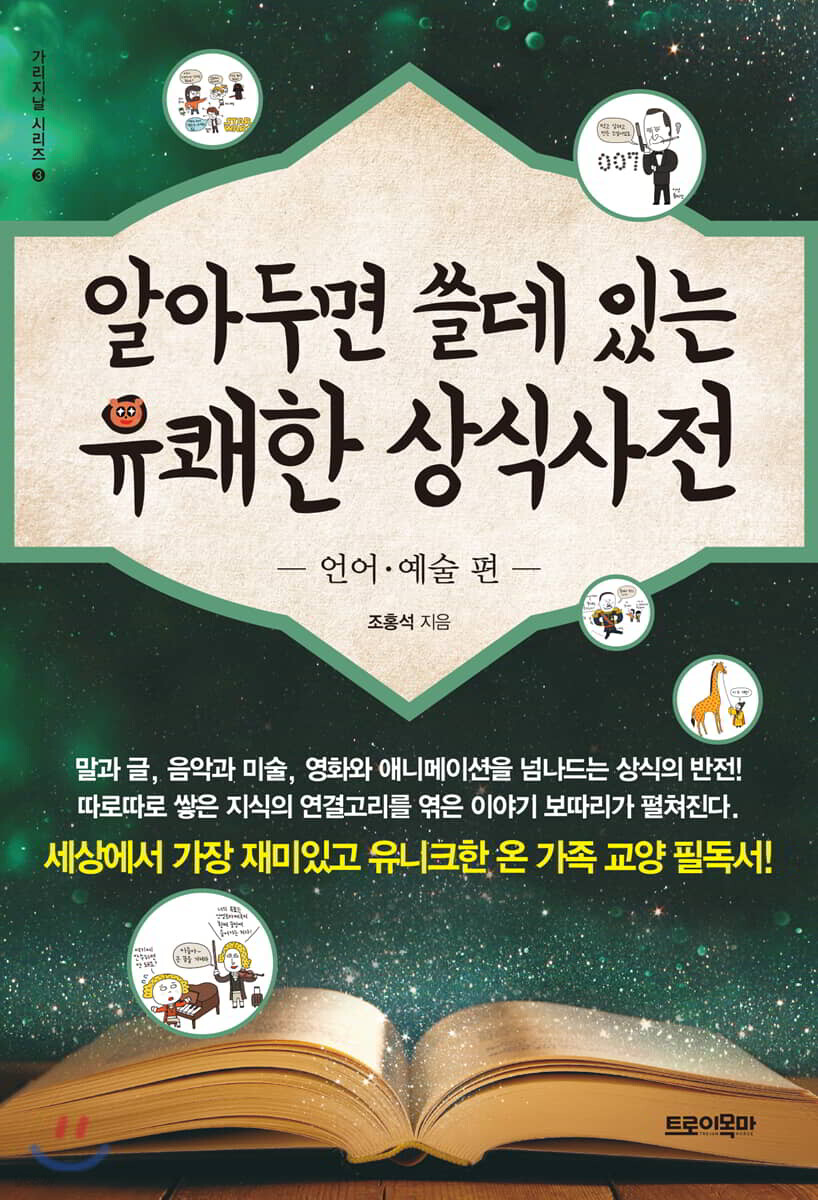
A Useful Dictionary of Common Sense: Language and Arts
 |
Description
Book Introduction
"Wow! All the language and art knowledge I had was fake!" The third installment of the Garijinal series, revealing surprising facts 99% of people don't know. This is the third book in the "Garigenal Series" (a common sense dictionary series that reveals in detail that the common sense that most people think is "original" is actually "fake original" and explains the origin and history of original knowledge), which started with the question, "Is the common sense I know really true?" and was compiled by digging through numerous books, various research materials, newspapers, broadcasts, etc. Among the numerous common sense pieces that are either incorrectly or not properly known to the public, the third volume, “Language and Arts,” was published, which covers speech and writing, music and art, film and animation. Following the positive responses from readers to the first volume of the series, "Daily Life," and the second volume, "Science and Economics," the author expanded the scope of the series to publish "Language and Arts." This book is somewhat unrelated to my major or related work, but it contains knowledge accumulated through my long-term life as a fan in an original and interesting way. Language and art have been important tools and means for developing and connecting human knowledge and culture, and it shows how they have changed and developed throughout history, presenting interconnected knowledge that was not taught in Korean language, music, or art classes during school. In addition to witty and engaging storytelling, it also introduces stories that are currently in debate, providing readers with both reading pleasure and useful knowledge. This book contains countless stories of stories in the fields of communication and the arts, including language, music, art, and video, about the British who crossed over to the Americas on the Mayflower and were able to communicate with Native Americans in English; the Malmoi Movement and modern history to protect our language and Hangul despite Japan's harsh oppression during the Japanese colonial period; stories related to words such as "Sphinx," "Dutch pay," and "Pennsylvania"; surprising stories hidden in world-famous buildings, statues, and paintings; why pink is for men, blue is the hottest color, and all Western monsters are green; the episode where Michael Jackson recommended a single by the world-famous rock group "Queen" and became a huge hit; the story of Epstein, the unsung hero who made the Beatles the strongest band in the universe; and the incredible creative economy that George Lucas, a science fiction novel nerd and Japanese culture maniac, created with the "Star Wars" series. The author is evaluated by many as a Korean-style knowledge curator and the "Korean Bill Bryson" by questioning the so-called common sense that 99% of people believe without question, finding the source of knowledge and delivering a surprising story. Furthermore, believing that "all knowledge is interconnected, not isolated," we strive to provide readers with small insights that allow them to explore the three-dimensional connections between diverse knowledge sources, rather than providing fragmented knowledge. |
- You can preview some of the book's contents.
Preview
index
Entering
Part 1.
language
01.
How did the English on the Mayflower communicate with the Indians?
02.
Before and after the Malmoi movement
03.
Do you know about the water hawk incident?
04.
When you go to Naseong, send me a letter, Dubituwa~
05.
Finding the correct 'principle' of using our language
06.
Finding words that will be used all over the world
07.
Corea? Korea?
Part 2.
art
01.
How much do you know about Goryeo celadon?
02.
The sky is black and the sea is red? The history of color development.
03.
Why does the rainbow have seven colors: red, orange, yellow, green, blue, indigo, and violet?
04.
Are Greek statues white?
05.
Are you saying that the building you see now is not that building?
06.
Find the secret hidden in the picture
Part 3.
music
01.
The Birth of Opera
02.
Bread and Circuses
03.
Bohemian Rhapsody, Rock Forever
04.
Do you know Epstein, the fifth member of the Beatles?
05.
Praise for Korean indie music
Part 4.
Video media
01.
The birth of cinema
02.
Her Majesty's '007'
03.
The lion is the king of Africa?
04.
The Beginning of the 'Star Wars' Myth
05.
Can I tell you now? The dark history of Korean comic theme songs.
06.
Candy is depression?
References
Part 1.
language
01.
How did the English on the Mayflower communicate with the Indians?
02.
Before and after the Malmoi movement
03.
Do you know about the water hawk incident?
04.
When you go to Naseong, send me a letter, Dubituwa~
05.
Finding the correct 'principle' of using our language
06.
Finding words that will be used all over the world
07.
Corea? Korea?
Part 2.
art
01.
How much do you know about Goryeo celadon?
02.
The sky is black and the sea is red? The history of color development.
03.
Why does the rainbow have seven colors: red, orange, yellow, green, blue, indigo, and violet?
04.
Are Greek statues white?
05.
Are you saying that the building you see now is not that building?
06.
Find the secret hidden in the picture
Part 3.
music
01.
The Birth of Opera
02.
Bread and Circuses
03.
Bohemian Rhapsody, Rock Forever
04.
Do you know Epstein, the fifth member of the Beatles?
05.
Praise for Korean indie music
Part 4.
Video media
01.
The birth of cinema
02.
Her Majesty's '007'
03.
The lion is the king of Africa?
04.
The Beginning of the 'Star Wars' Myth
05.
Can I tell you now? The dark history of Korean comic theme songs.
06.
Candy is depression?
References
Detailed image
Into the book
Part 1 is about language.
We will explore the sad history of the New World, a useful tool for spreading human knowledge, the English spelling of our country, words that are used in many countries, and little-known stories related to our language and writing in modern and contemporary history.
Part 2 of Art will primarily discuss stereotypes about color and the biases surrounding sculptures and artwork.
Also, about the old origins of color images and the recent reversal of them.
In Part 3, Music, I organized information that was either misunderstood or vaguely known, under the theme that the development of music from classical music to the present was not entirely unrelated to socioeconomic trends.
The fourth visual medium (film, TV) is a comprehensive art form that encompasses language, art, music, etc., as previously introduced, and its influence has been growing recently.
Among them, I would like to talk about common misconceptions and the origins and development of the recently popular series of movies.
--- p.6
What on earth was going on? Why was there suddenly a young Indian man who had studied abroad in England and was welcoming us with his fluent London King's English accent? Columbus had set out to find India in 1492 to establish a direct pepper purchasing route, but had inadvertently discovered the New World. By 1620, when these Puritans landed, it had been 128 years since Europeans had first discovered the New World, meaning European nations had already carved it up, and the eastern and southern parts of the United States were under the control of British settlement companies.
The young Indian named Squanto whom these Plymouth Puritans met at that time was a member of the Paducet tribe, a branch of the Wampanoag (People of the Dawn) confederacy.
In 1605, when he was in his twenties, he was kidnapped by British explorers who came to explore the area and taken to England, where he learned English for ten years.
At that time, the pioneers wanted to teach English to the native youth and use them as interpreters during the colonization.
--- pp.21~22
The hallway outside the door was packed with people impressed by the two days of heated discussion.
Red Corner~ Professor Choi Hyeon-bae of the Korean Language Society appears.
Blue Corner~ Mr. Park Seung-bae of the Korean Language Research Association appears.
The last runner is Professor Choi Hyeon-bae of the Korean Language Society, a disciple of Professor Joo Si-gyeong.
He can be said to be a representative player of the Korean Language Society.
Ah, Mr. Choi Hyeon-bae! He launches a heavy attack, advocating for "ideologicalism," which reveals the original form of the stem and writes it down.
Professor Park Seung-bae of the Korean Language Research Association, who has launched a counterattack, lightly counters by emphasizing the convenience of using letters and advocating for 'phoneticism', which writes words as they are pronounced.
Oh, Mr. Choi Hyun-bae, stand up in indignation! 'It's easier to write down the pronunciation.
But! If we write down words as they're pronounced, as the Japanese recommend, each person and region will write them differently. What's the point of establishing a unified Korean spelling system? To properly preserve our language, we need to clearly define the meaning of each stem. This will prevent confusion for our descendants, who will one day be able to freely use our language again.
Ah, all the audience gathered here are cheering and applauding enthusiastically to support Mr. Choi Hyeon-bae.
The Korean Language Society, after a poor first day, achieves a great victory! This concludes the broadcast of the special lecture hall hosted by the Dong-A Ilbo.
--- pp.56~57
When you hear the word "Sphinx," what image comes to mind? Do you picture the Sphinx, a lion-headed creature guarding the pyramids in Egypt? Yes, that's right.
Most people probably think of the huge sculpture in the photo, 72 meters long and 20 meters high.
However, the name of this sculpture is Sphinx, which is a misnomer.
The Greeks misunderstood the idea that this huge sculpture was called a Sphinx.
The ancient Egyptians originally called this sculpture 'Harmakhis', which is said to be derived from 'Horus en Akhet (Horus of the Horizon)'.
Horus was one of the gods believed in by the Egyptians, and was the son of Isis and Osiris.
He is often depicted with the head of an eagle and the body of a human, and there is a myth that he became the sun god and the founder of the Egyptian dynasty by defeating the god Set, who killed his father Osiris.
The pharaoh who ruled Egypt called himself the 'son of the sun god', and the guardian statue that protected the pyramid that was used as a tomb after the pharaoh's death was considered 'Horus of the Horizon'.
The name Sphinx originally comes from a monster in Greek mythology. It is said that the goddess Hera, wife of Zeus, sent this sphinx monster to Egypt to punish Laius, the king of Thebes in Greece, for his sins.
The name comes from the Greek word 'sphink', meaning 'one who strangles', and is said to be the sister of other female monsters such as Hydra and Chimera.
It is said that she lived deep in the mountains of Thebes with the face and breasts of a woman, the body of a lion, and the wings of a bird, and that she would pose a quiz to anyone who passed by her mountain path and strangle and eat anyone who could not answer it.
--- pp.102~104
Japan, which did not possess magnetic development technology until the 16th century, constantly sent envoys to Goryeo and the early Joseon Dynasty to beg for magnetic technology, and was always on the lookout for opportunities to acquire the technology.
That is why, during the Imjin War, Japan systematically kidnapped a large number of Joseon potters, a group of advanced technicians, and created a pottery village in the Kyushu region. They treated them well and guaranteed the best treatment to create new products, and began to foster the pottery industry.
However, unlike Joseon, at the time, Japan had not discovered pure white porcelain clay without iron that could withstand the high temperature of 1300°C, so at first, they could not produce porcelain at the Joseon level.
Then, one day in 1616, when the Joseon potter Yi Sam-pyeong discovered white porcelain clay in Izumiyama and succeeded in producing white porcelain, the daimyo Nabeshima Naoshige decided to treat Yi Sam-pyeong as a samurai with exclusive production rights and exile 826 Japanese potters. The Japanese ceramics industry commemorates 1616 as the 'first year of Japanese white porcelain.'
Even now, they still produce 10,000 tons of white clay here annually. Later, in 1644, a merchant from Arita Prefecture learned the red dye "Akae" technique from a Chinese who had come to Nagasaki Port to trade, and applied it to porcelain. This gave birth to Arita white porcelain, a gorgeously colored porcelain different from existing Chinese and Korean porcelain.
--- pp.139~140
Let me ask you a question out of the blue.
As the title suggests, why is Shrek a green monster? Come to think of it, the Avengers' ultimate boss, the two-faced Hulk, also has green skin.
Ah, in the memorable American TV series 'V', the aliens were green reptiles.
And in the famous Japanese animation 'Gundam', the main villain is green, in the movie 'Mask', Jim Carrey becomes a green man when he transforms, the monster orc in 'The Lord of the Rings' is also green, the main character of the Disney cartoon 'Monsters, Inc.' is a green furry one-eyed monster, and the 100-year-old goblin in the animation 'The Haunted House', which is loved by Korean children, is also green.
I looked it up and there are quite a few.
Why do monsters have so many green skins? Haven't you ever wondered? Or am I the only one? It's because of Islam, because of Islam, because of scary Islam. Oh! Sorry.
The song “It’s because of the liver” that was popular in a certain commercial suddenly came to mind… … .
Anyone who has looked closely at the flags of Arab countries will know that green is used in many flags, including Saudi Arabia and Libya.
Since most of these areas are deserts, people have always longed for green oases, so green became their favorite color and naturally became the symbolic color of Islam.
(Omitted) It is said that during the Middle Ages, the expansion of Islam was the most terrifying experience for Europeans for nearly a thousand years, so for a long time, green was considered a symbol of evil, and monsters were always associated with green monsters.
Now you know why Western monsters are green? --- pp.171~173
Millet's paintings have since become objects of respect and admiration for countless art students, and Vincent van Gogh even copied them countless times.
It is also known that our country's artist Park Soo-keun decided to become a painter after seeing Millet's 'The Angelus' as a child.
The world-renowned painter Salvador Dali was also shocked when he saw Millet's painting 'The Angelus' as a boy.
But his shock was not a feeling of awe from the sublime beauty felt in the painting, but rather a vague sense of unease.
Although this inexplicable anxiety continued to torment him, Dali was rather inspired by this unpleasant feeling and created a number of works parodying Millet's 'The Angelus'. After he began to make a name for himself as a painter, he persistently claimed that "there is a child's coffin in the basket in the painting 'The Angelus'."
At the time, many people did not listen to Dali's claims, but when Dali persistently argued, even publishing a paper, the Louvre Museum conducted an X-ray to uncover the truth, and confirmed that there was a rough sketch of a small square box beneath the potato basket brush strokes, proving that Dali's claims were not fiction.
--- pp.219~220
At the time when Mozart was in trouble, European society was swept up in revolutionary fever, and the situation of musicians also changed rapidly.
With the decline of the nobility and clergy, who had been steadfast supporters throughout their lives, musicians now had to appeal to the general public with their professional abilities in order to make a living.
To put it simply, I thought I would be a civil servant with a secure job for the rest of my life if I just had good skills, but I was suddenly forced into the situation of becoming self-employed.
So, at that time, unemployed musicians formed a group and joined hands with the emerging bourgeoisie to perform in theaters to survive.
Until then, small-scale chamber music for the patronizing aristocracy had been the mainstream, but now that musicians could only make a living by collecting admission fees from the general public, they began to focus on opera, a large-scale performance format in which vocalists performed both singing and acting, and instrumentalists formed an orchestra and played, according to their individual abilities. This spread throughout Europe.
--- pp.234~235
Although the Beatles' music is now considered a huge success from the start, their debut song reached number 17 on the UK charts, drawing attention with comments like, "Wow, a country band is actually quite popular."
But this chart entry was also due to Epstein's efforts.
Huh? What kind of effort was that? Epstein bought a whopping 10,000 copies to promote the band.
(Ah~, the pioneer of record buying, Mr. Ep!) And, he changed the image of the members who used to wear a punk style into neat, school uniform-wearing, unkempt bachelors (Mozz look) to increase their popularity, saying, “The life of rock music is rebellion.”
(Ahh~, the pioneer of professional clothing coordination, Mr. Ep!) There is a term in business administration called 'Tipping Point'.
It refers to the moment when a product that was initially known only to a small number of early adopters becomes explosively well-known. The Beatles' second single, "Please Please Me," topped the charts, and their third and fourth singles also topped the charts for seven and six consecutive weeks, respectively.
After their first album, 'Please Please Me', was ranked number one for 30 weeks, their second album, 'With the Beatles', immediately took the number one spot, making Britain a Beatles paradise in 1963.
--- p.284
It is commonly believed that the 007 novels are based on Ian Fleming's real-life experiences as a spy, but this is far from the truth.
After dropping out of the Royal Military Academy in the UK, Ian Fleming studied abroad in Germany and Switzerland and worked as a reporter for Reuters before joining the British Foreign Intelligence Service (MI6) in 1939. He worked as a rear support intelligence officer for the Royal Navy, so although he developed operational plans, he never actually deployed in combat like James Bond in the novels.
After dropping out of the Royal Military Academy in the UK, Ian Fleming studied abroad in Germany and Switzerland and worked as a reporter for Reuters before joining the British Foreign Intelligence Service (MI6) in 1939. He worked as a rear support intelligence officer for the Royal Navy, so although he developed operational plans, he never actually deployed in combat like James Bond in the novels.
But then, Sir William Stevenson, the head of the Intelligence Service at the time, would make his juniors work hard, and then after work, whenever he got drunk, he would boast about it, saying, "Back in the day, I was like that~", so he got tired of it and retired after the war. However, when he couldn't find a full-time reporter position, he wrote freelance articles for newspapers, but the money wasn't great, and he was struggling financially, so he suddenly remembered his old boss's series of boasts.
'Well, let's write a 20th-century version of Don Quixote based on that man's boasts!' And so, in 1953, the first novel about the adventures of the fictional British Navy Lieutenant Commander James Bond was born, and that work was Casino Royale.
James Bond's code name, '007', given to him in his first film, is the British Secret Service's license to kill number.
That means 007 is the 7th agent with the '00' code who can kill without any problem.
He considered this novel to be an adventure novel rather than a real spy novel.
(Omitted) So… …, office workers, please don’t turn a deaf ear to your boss’s jokes or boasting at company dinners. Listen carefully.
If you do it right, you might just hit the jackpot with a novel based on your boss's boasts, right? --- pp.335-336
However, George Lucas's business success did not come from movie profits.
He first proposes and signs a contract stating that in exchange for a significant reduction in directing fees, he will keep all other profits.
From the film company's perspective, they were worried that 'the president and the planning director invested in a movie that would fail for no reason, and it's a big deal,' but when the director said he would take a small portion of his own income, they thought 'what a windfall~' and danced around and signed... ... but as the film became a huge hit, George Lucas monopolized all the profits from additional businesses, such as various character toys, VTRs, and DVDs, creating an enormous added value that was dozens of times more than that of the film company.
At that time, 'Star Wars Episode IV' was so popular that toy companies couldn't even make all the toys for the 1977 Christmas season, so they sold them with notes inside the gift boxes saying, 'We'll ship them later.' Based on the money he made at that time, he produced the subsequent 'Star Wars' movies entirely with his own money, and recently sold the rights to Disney for 4 trillion won. This can be said to be a true 'creative economy' that started with the idea that the competitiveness of sci-fi geeks would one day shine, and was created by his contract gamble.
--- p.371
And originally, Luke's father was someone else and Darth Vader was just a bad guy, but George Lucas, after a long discussion with the director and writer he chose, decided to make a big deal out of Darth Vader being Luke's father.
But you kept it a secret from all the actors.
So, during filming, they had Darth Vader say this childish, brilliant line: “You want to be with Leia? Come to me!”
Anyway, since I'm wearing a mask, the shape of my mouth isn't visible.
And then, in the final recording, he finally puts in the famous line, “I am Your Father.” and makes it to the grand premiere in New York.
So, not only the audience in the theater at the time, but also the actors were in a state of shock! It is a well-known anecdote that the science fiction master Isaac Asimov, who had been invited at the time, shouted to George Lucas as soon as the lights came up, “Hurry up and make the next one! I’m dying of curiosity.”
So, until Episode VI: Return of the Jedi came out three years later, people were waiting for the sequel, debating whether Darth Vader was really the father or just a joke.
Most of us plan thoroughly in advance and put it into action, but things rarely go as planned.
How to overcome that crisis can be seen as determining success or failure. George Lucas wisely dealt with both big and small incidents, such as the scar on the main character's face, that occurred while preparing the sequel to 'Star Wars' and developed the story into a more developed one, which enabled 'Star Wars' to endure as a series for over 40 years rather than a one-time hit.
We will explore the sad history of the New World, a useful tool for spreading human knowledge, the English spelling of our country, words that are used in many countries, and little-known stories related to our language and writing in modern and contemporary history.
Part 2 of Art will primarily discuss stereotypes about color and the biases surrounding sculptures and artwork.
Also, about the old origins of color images and the recent reversal of them.
In Part 3, Music, I organized information that was either misunderstood or vaguely known, under the theme that the development of music from classical music to the present was not entirely unrelated to socioeconomic trends.
The fourth visual medium (film, TV) is a comprehensive art form that encompasses language, art, music, etc., as previously introduced, and its influence has been growing recently.
Among them, I would like to talk about common misconceptions and the origins and development of the recently popular series of movies.
--- p.6
What on earth was going on? Why was there suddenly a young Indian man who had studied abroad in England and was welcoming us with his fluent London King's English accent? Columbus had set out to find India in 1492 to establish a direct pepper purchasing route, but had inadvertently discovered the New World. By 1620, when these Puritans landed, it had been 128 years since Europeans had first discovered the New World, meaning European nations had already carved it up, and the eastern and southern parts of the United States were under the control of British settlement companies.
The young Indian named Squanto whom these Plymouth Puritans met at that time was a member of the Paducet tribe, a branch of the Wampanoag (People of the Dawn) confederacy.
In 1605, when he was in his twenties, he was kidnapped by British explorers who came to explore the area and taken to England, where he learned English for ten years.
At that time, the pioneers wanted to teach English to the native youth and use them as interpreters during the colonization.
--- pp.21~22
The hallway outside the door was packed with people impressed by the two days of heated discussion.
Red Corner~ Professor Choi Hyeon-bae of the Korean Language Society appears.
Blue Corner~ Mr. Park Seung-bae of the Korean Language Research Association appears.
The last runner is Professor Choi Hyeon-bae of the Korean Language Society, a disciple of Professor Joo Si-gyeong.
He can be said to be a representative player of the Korean Language Society.
Ah, Mr. Choi Hyeon-bae! He launches a heavy attack, advocating for "ideologicalism," which reveals the original form of the stem and writes it down.
Professor Park Seung-bae of the Korean Language Research Association, who has launched a counterattack, lightly counters by emphasizing the convenience of using letters and advocating for 'phoneticism', which writes words as they are pronounced.
Oh, Mr. Choi Hyun-bae, stand up in indignation! 'It's easier to write down the pronunciation.
But! If we write down words as they're pronounced, as the Japanese recommend, each person and region will write them differently. What's the point of establishing a unified Korean spelling system? To properly preserve our language, we need to clearly define the meaning of each stem. This will prevent confusion for our descendants, who will one day be able to freely use our language again.
Ah, all the audience gathered here are cheering and applauding enthusiastically to support Mr. Choi Hyeon-bae.
The Korean Language Society, after a poor first day, achieves a great victory! This concludes the broadcast of the special lecture hall hosted by the Dong-A Ilbo.
--- pp.56~57
When you hear the word "Sphinx," what image comes to mind? Do you picture the Sphinx, a lion-headed creature guarding the pyramids in Egypt? Yes, that's right.
Most people probably think of the huge sculpture in the photo, 72 meters long and 20 meters high.
However, the name of this sculpture is Sphinx, which is a misnomer.
The Greeks misunderstood the idea that this huge sculpture was called a Sphinx.
The ancient Egyptians originally called this sculpture 'Harmakhis', which is said to be derived from 'Horus en Akhet (Horus of the Horizon)'.
Horus was one of the gods believed in by the Egyptians, and was the son of Isis and Osiris.
He is often depicted with the head of an eagle and the body of a human, and there is a myth that he became the sun god and the founder of the Egyptian dynasty by defeating the god Set, who killed his father Osiris.
The pharaoh who ruled Egypt called himself the 'son of the sun god', and the guardian statue that protected the pyramid that was used as a tomb after the pharaoh's death was considered 'Horus of the Horizon'.
The name Sphinx originally comes from a monster in Greek mythology. It is said that the goddess Hera, wife of Zeus, sent this sphinx monster to Egypt to punish Laius, the king of Thebes in Greece, for his sins.
The name comes from the Greek word 'sphink', meaning 'one who strangles', and is said to be the sister of other female monsters such as Hydra and Chimera.
It is said that she lived deep in the mountains of Thebes with the face and breasts of a woman, the body of a lion, and the wings of a bird, and that she would pose a quiz to anyone who passed by her mountain path and strangle and eat anyone who could not answer it.
--- pp.102~104
Japan, which did not possess magnetic development technology until the 16th century, constantly sent envoys to Goryeo and the early Joseon Dynasty to beg for magnetic technology, and was always on the lookout for opportunities to acquire the technology.
That is why, during the Imjin War, Japan systematically kidnapped a large number of Joseon potters, a group of advanced technicians, and created a pottery village in the Kyushu region. They treated them well and guaranteed the best treatment to create new products, and began to foster the pottery industry.
However, unlike Joseon, at the time, Japan had not discovered pure white porcelain clay without iron that could withstand the high temperature of 1300°C, so at first, they could not produce porcelain at the Joseon level.
Then, one day in 1616, when the Joseon potter Yi Sam-pyeong discovered white porcelain clay in Izumiyama and succeeded in producing white porcelain, the daimyo Nabeshima Naoshige decided to treat Yi Sam-pyeong as a samurai with exclusive production rights and exile 826 Japanese potters. The Japanese ceramics industry commemorates 1616 as the 'first year of Japanese white porcelain.'
Even now, they still produce 10,000 tons of white clay here annually. Later, in 1644, a merchant from Arita Prefecture learned the red dye "Akae" technique from a Chinese who had come to Nagasaki Port to trade, and applied it to porcelain. This gave birth to Arita white porcelain, a gorgeously colored porcelain different from existing Chinese and Korean porcelain.
--- pp.139~140
Let me ask you a question out of the blue.
As the title suggests, why is Shrek a green monster? Come to think of it, the Avengers' ultimate boss, the two-faced Hulk, also has green skin.
Ah, in the memorable American TV series 'V', the aliens were green reptiles.
And in the famous Japanese animation 'Gundam', the main villain is green, in the movie 'Mask', Jim Carrey becomes a green man when he transforms, the monster orc in 'The Lord of the Rings' is also green, the main character of the Disney cartoon 'Monsters, Inc.' is a green furry one-eyed monster, and the 100-year-old goblin in the animation 'The Haunted House', which is loved by Korean children, is also green.
I looked it up and there are quite a few.
Why do monsters have so many green skins? Haven't you ever wondered? Or am I the only one? It's because of Islam, because of Islam, because of scary Islam. Oh! Sorry.
The song “It’s because of the liver” that was popular in a certain commercial suddenly came to mind… … .
Anyone who has looked closely at the flags of Arab countries will know that green is used in many flags, including Saudi Arabia and Libya.
Since most of these areas are deserts, people have always longed for green oases, so green became their favorite color and naturally became the symbolic color of Islam.
(Omitted) It is said that during the Middle Ages, the expansion of Islam was the most terrifying experience for Europeans for nearly a thousand years, so for a long time, green was considered a symbol of evil, and monsters were always associated with green monsters.
Now you know why Western monsters are green? --- pp.171~173
Millet's paintings have since become objects of respect and admiration for countless art students, and Vincent van Gogh even copied them countless times.
It is also known that our country's artist Park Soo-keun decided to become a painter after seeing Millet's 'The Angelus' as a child.
The world-renowned painter Salvador Dali was also shocked when he saw Millet's painting 'The Angelus' as a boy.
But his shock was not a feeling of awe from the sublime beauty felt in the painting, but rather a vague sense of unease.
Although this inexplicable anxiety continued to torment him, Dali was rather inspired by this unpleasant feeling and created a number of works parodying Millet's 'The Angelus'. After he began to make a name for himself as a painter, he persistently claimed that "there is a child's coffin in the basket in the painting 'The Angelus'."
At the time, many people did not listen to Dali's claims, but when Dali persistently argued, even publishing a paper, the Louvre Museum conducted an X-ray to uncover the truth, and confirmed that there was a rough sketch of a small square box beneath the potato basket brush strokes, proving that Dali's claims were not fiction.
--- pp.219~220
At the time when Mozart was in trouble, European society was swept up in revolutionary fever, and the situation of musicians also changed rapidly.
With the decline of the nobility and clergy, who had been steadfast supporters throughout their lives, musicians now had to appeal to the general public with their professional abilities in order to make a living.
To put it simply, I thought I would be a civil servant with a secure job for the rest of my life if I just had good skills, but I was suddenly forced into the situation of becoming self-employed.
So, at that time, unemployed musicians formed a group and joined hands with the emerging bourgeoisie to perform in theaters to survive.
Until then, small-scale chamber music for the patronizing aristocracy had been the mainstream, but now that musicians could only make a living by collecting admission fees from the general public, they began to focus on opera, a large-scale performance format in which vocalists performed both singing and acting, and instrumentalists formed an orchestra and played, according to their individual abilities. This spread throughout Europe.
--- pp.234~235
Although the Beatles' music is now considered a huge success from the start, their debut song reached number 17 on the UK charts, drawing attention with comments like, "Wow, a country band is actually quite popular."
But this chart entry was also due to Epstein's efforts.
Huh? What kind of effort was that? Epstein bought a whopping 10,000 copies to promote the band.
(Ah~, the pioneer of record buying, Mr. Ep!) And, he changed the image of the members who used to wear a punk style into neat, school uniform-wearing, unkempt bachelors (Mozz look) to increase their popularity, saying, “The life of rock music is rebellion.”
(Ahh~, the pioneer of professional clothing coordination, Mr. Ep!) There is a term in business administration called 'Tipping Point'.
It refers to the moment when a product that was initially known only to a small number of early adopters becomes explosively well-known. The Beatles' second single, "Please Please Me," topped the charts, and their third and fourth singles also topped the charts for seven and six consecutive weeks, respectively.
After their first album, 'Please Please Me', was ranked number one for 30 weeks, their second album, 'With the Beatles', immediately took the number one spot, making Britain a Beatles paradise in 1963.
--- p.284
It is commonly believed that the 007 novels are based on Ian Fleming's real-life experiences as a spy, but this is far from the truth.
After dropping out of the Royal Military Academy in the UK, Ian Fleming studied abroad in Germany and Switzerland and worked as a reporter for Reuters before joining the British Foreign Intelligence Service (MI6) in 1939. He worked as a rear support intelligence officer for the Royal Navy, so although he developed operational plans, he never actually deployed in combat like James Bond in the novels.
After dropping out of the Royal Military Academy in the UK, Ian Fleming studied abroad in Germany and Switzerland and worked as a reporter for Reuters before joining the British Foreign Intelligence Service (MI6) in 1939. He worked as a rear support intelligence officer for the Royal Navy, so although he developed operational plans, he never actually deployed in combat like James Bond in the novels.
But then, Sir William Stevenson, the head of the Intelligence Service at the time, would make his juniors work hard, and then after work, whenever he got drunk, he would boast about it, saying, "Back in the day, I was like that~", so he got tired of it and retired after the war. However, when he couldn't find a full-time reporter position, he wrote freelance articles for newspapers, but the money wasn't great, and he was struggling financially, so he suddenly remembered his old boss's series of boasts.
'Well, let's write a 20th-century version of Don Quixote based on that man's boasts!' And so, in 1953, the first novel about the adventures of the fictional British Navy Lieutenant Commander James Bond was born, and that work was Casino Royale.
James Bond's code name, '007', given to him in his first film, is the British Secret Service's license to kill number.
That means 007 is the 7th agent with the '00' code who can kill without any problem.
He considered this novel to be an adventure novel rather than a real spy novel.
(Omitted) So… …, office workers, please don’t turn a deaf ear to your boss’s jokes or boasting at company dinners. Listen carefully.
If you do it right, you might just hit the jackpot with a novel based on your boss's boasts, right? --- pp.335-336
However, George Lucas's business success did not come from movie profits.
He first proposes and signs a contract stating that in exchange for a significant reduction in directing fees, he will keep all other profits.
From the film company's perspective, they were worried that 'the president and the planning director invested in a movie that would fail for no reason, and it's a big deal,' but when the director said he would take a small portion of his own income, they thought 'what a windfall~' and danced around and signed... ... but as the film became a huge hit, George Lucas monopolized all the profits from additional businesses, such as various character toys, VTRs, and DVDs, creating an enormous added value that was dozens of times more than that of the film company.
At that time, 'Star Wars Episode IV' was so popular that toy companies couldn't even make all the toys for the 1977 Christmas season, so they sold them with notes inside the gift boxes saying, 'We'll ship them later.' Based on the money he made at that time, he produced the subsequent 'Star Wars' movies entirely with his own money, and recently sold the rights to Disney for 4 trillion won. This can be said to be a true 'creative economy' that started with the idea that the competitiveness of sci-fi geeks would one day shine, and was created by his contract gamble.
--- p.371
And originally, Luke's father was someone else and Darth Vader was just a bad guy, but George Lucas, after a long discussion with the director and writer he chose, decided to make a big deal out of Darth Vader being Luke's father.
But you kept it a secret from all the actors.
So, during filming, they had Darth Vader say this childish, brilliant line: “You want to be with Leia? Come to me!”
Anyway, since I'm wearing a mask, the shape of my mouth isn't visible.
And then, in the final recording, he finally puts in the famous line, “I am Your Father.” and makes it to the grand premiere in New York.
So, not only the audience in the theater at the time, but also the actors were in a state of shock! It is a well-known anecdote that the science fiction master Isaac Asimov, who had been invited at the time, shouted to George Lucas as soon as the lights came up, “Hurry up and make the next one! I’m dying of curiosity.”
So, until Episode VI: Return of the Jedi came out three years later, people were waiting for the sequel, debating whether Darth Vader was really the father or just a joke.
Most of us plan thoroughly in advance and put it into action, but things rarely go as planned.
How to overcome that crisis can be seen as determining success or failure. George Lucas wisely dealt with both big and small incidents, such as the scar on the main character's face, that occurred while preparing the sequel to 'Star Wars' and developed the story into a more developed one, which enabled 'Star Wars' to endure as a series for over 40 years rather than a one-time hit.
--- pp.378~379
Publisher's Review
A reversal of common sense that crosses words and writing, music and art, film and animation,
A true common sense story that links together the knowledge accumulated separately!
We uncover the origins and history of original common sense by uncovering the fake originals, or "Garijinals."
This book, "A Useful Dictionary of Common Sense," "Language and Arts," is the third book in the Garijinal series, following Volume 1, "Daily Life," and Volume 2, "Science and Economics."
The Garijinal series is a common sense dictionary that reveals in detail that common sense that most people think of as 'original' is actually fake original, or 'garijinal', and explains the origin and history of original knowledge.
The author of this book, Hong-Seok Cho, has studied numerous books, research materials, newspapers, broadcasts, etc. to create original content. For nine years, he has shared this content with approximately 40,000 people through the company intranet blog, emails to club members, colleagues, and customers, and columns in external media.
Thanks to the support of over 40,000 people who were enthusiastic about the author's 'Garijinal' content, the author published the 'Daily Life' and 'Science and Economics' editions of 'A Fun Dictionary of Useful Common Sense', which received positive reviews from numerous readers for being fun and informative.
The author, who has been called 'the walking Naver', 'Yuval Harari's younger brother, Mubal Harari', and 'the Bill Bryson of Korea', and has introduced 'original' common sense and knowledge across various fields such as history (Korean history, world history), people, geography, astronomy, food, clothing, shelter, sports, music, art, and language, has published a book that encompasses the fields of language and art by unfolding the knowledge he has accumulated not only through books and broadcasts but also through his long-time life as a fan (geek).
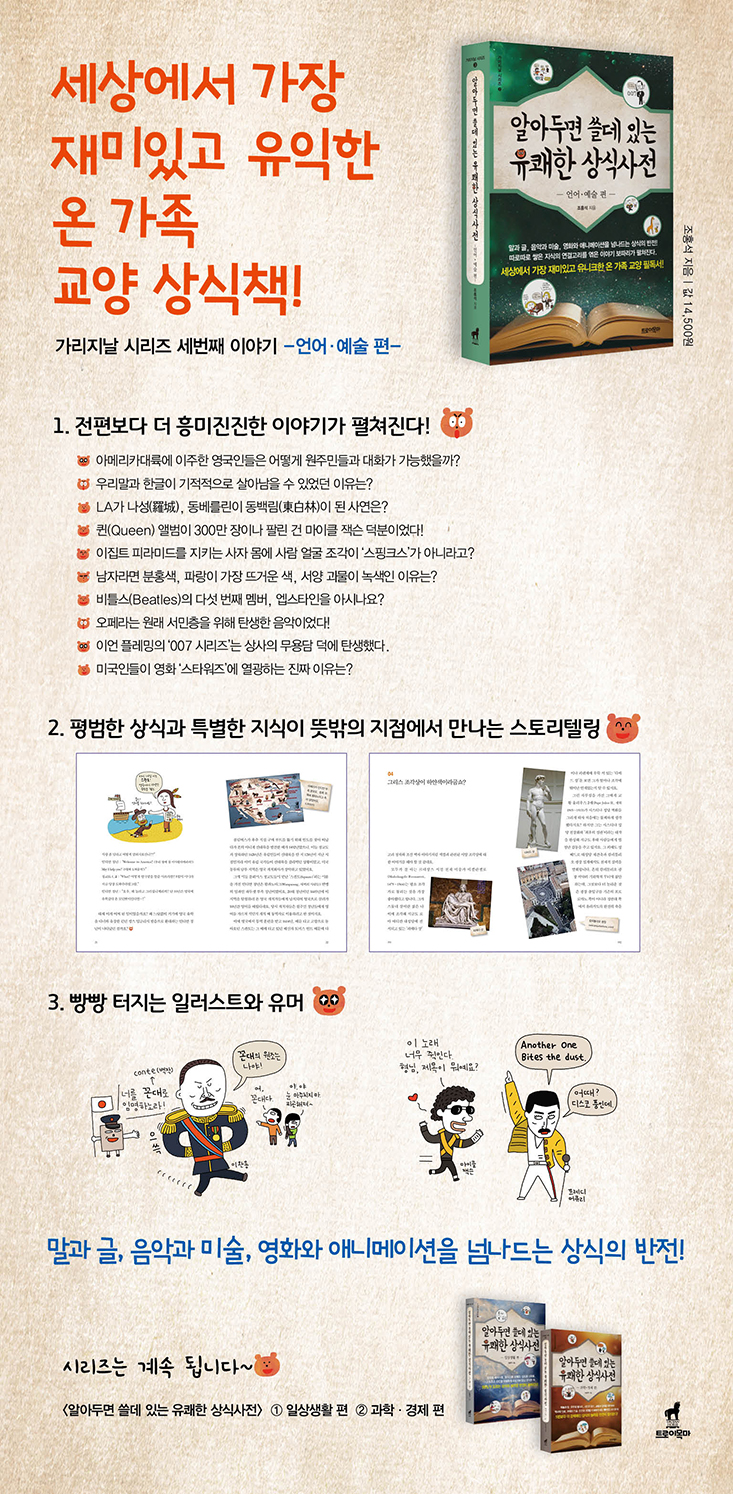
- How were the British who immigrated to the Americas able to communicate with the natives?
- Why were our language and Hangul able to miraculously survive?
- What is the story behind LA becoming Nasung and East Berlin becoming Dongbaekrim?
- It was thanks to Michael Jackson that Queen's album sold 3 million copies!
- Isn't the 'Sphinx' a sculpture of a human face on the body of a lion guarding the Egyptian pyramids?
- Why are pink and blue the hottest colors for men, and green for Western monsters?
- Do you know Epstein, the fifth member of the Beatles?
-Opera was originally music created for the common people!
- Ian Fleming's '007 series' was born thanks to the boss's heroic tale!
- What's the real reason Americans are crazy about the movie 'Star Wars'?
Through this book, readers can gain new enjoyment and knowledge across the fields of communication and art, including speech and writing, music and art, film and animation.
Following parts 1 and 2, ordinary common sense and special knowledge meet in an unexpected way.
Following the first and second volumes of the series, the author continues to tell a captivating and engaging story in this third book.
For example, it starts with the story of the Mayflower British who were able to converse in English with Native Americans, and then goes on to look at the history of the conquest of the American continent; it traces the modern and contemporary history of our language and writing through the Malmoi movement; it explains how the number of colors has changed historically and why some colors are established as opposite concepts; and it reveals that the Western high-class comprehensive art genre 'opera' was created as music for the common people due to the economic circumstances of musicians.
Also, the little-known stories of the Beatles and Queen that reflect the author's taste as a rock music fanatic, the incredible patchwork skills of George Lucas who created the 'Star Wars Saga', the misunderstandings surrounding Goryeo celadon and Joseon white porcelain and the reason why Japan, which had no ceramics technology, advanced into the world through ceramics exports, and the anecdote with Salvador Dali related to the potato basket in French painter Millet's 'The Angelus', etc., the author's storytelling that starts with familiar and easy common sense and ends with special and exciting knowledge makes the reader feel that 'all common sense and knowledge in the world are interconnected'.
Colloquial explanations and delightful illustrations provide both fun and meaning.
In addition to storytelling that transcends time and space, the strengths of this book include its colloquial language and dialogue.
To make it easier and more approachable for general readers, the author wrote in a colloquial style, as if he were having a conversation with the readers right there on the spot.
In addition, the author's 'situation description dialogue' and the illustrations, which are combined in a cheerful and lively style, are a great device to provide readers with great laughter and fun.
Dutch Merchant: “We’re in trouble, Netherlands.
When the Qing Dynasty came into power, trade with Holland was halted.
Joseon is a completely closed country, an unknown world. Brussels.
“Now where do you get yourself?”
Japanese Merchant: “Oh, we make pottery in Japan too.”
“How about this new porcelain?”
Dutch Merchant: “Wow.
I've seen blue patterned white porcelain before
“This is the first time I’ve seen such colorful patterned porcelain.”
Japanese merchant: “Arita porcelain, newly made this year.
Shameless… … No, I’ll give you a reasonable price~.”
Dutch Merchant: “Come on! Promise us that from now on you’ll only do business with us.”
A true common sense story that links together the knowledge accumulated separately!
We uncover the origins and history of original common sense by uncovering the fake originals, or "Garijinals."
This book, "A Useful Dictionary of Common Sense," "Language and Arts," is the third book in the Garijinal series, following Volume 1, "Daily Life," and Volume 2, "Science and Economics."
The Garijinal series is a common sense dictionary that reveals in detail that common sense that most people think of as 'original' is actually fake original, or 'garijinal', and explains the origin and history of original knowledge.
The author of this book, Hong-Seok Cho, has studied numerous books, research materials, newspapers, broadcasts, etc. to create original content. For nine years, he has shared this content with approximately 40,000 people through the company intranet blog, emails to club members, colleagues, and customers, and columns in external media.
Thanks to the support of over 40,000 people who were enthusiastic about the author's 'Garijinal' content, the author published the 'Daily Life' and 'Science and Economics' editions of 'A Fun Dictionary of Useful Common Sense', which received positive reviews from numerous readers for being fun and informative.
The author, who has been called 'the walking Naver', 'Yuval Harari's younger brother, Mubal Harari', and 'the Bill Bryson of Korea', and has introduced 'original' common sense and knowledge across various fields such as history (Korean history, world history), people, geography, astronomy, food, clothing, shelter, sports, music, art, and language, has published a book that encompasses the fields of language and art by unfolding the knowledge he has accumulated not only through books and broadcasts but also through his long-time life as a fan (geek).
- How were the British who immigrated to the Americas able to communicate with the natives?
- Why were our language and Hangul able to miraculously survive?
- What is the story behind LA becoming Nasung and East Berlin becoming Dongbaekrim?
- It was thanks to Michael Jackson that Queen's album sold 3 million copies!
- Isn't the 'Sphinx' a sculpture of a human face on the body of a lion guarding the Egyptian pyramids?
- Why are pink and blue the hottest colors for men, and green for Western monsters?
- Do you know Epstein, the fifth member of the Beatles?
-Opera was originally music created for the common people!
- Ian Fleming's '007 series' was born thanks to the boss's heroic tale!
- What's the real reason Americans are crazy about the movie 'Star Wars'?
Through this book, readers can gain new enjoyment and knowledge across the fields of communication and art, including speech and writing, music and art, film and animation.
Following parts 1 and 2, ordinary common sense and special knowledge meet in an unexpected way.
Following the first and second volumes of the series, the author continues to tell a captivating and engaging story in this third book.
For example, it starts with the story of the Mayflower British who were able to converse in English with Native Americans, and then goes on to look at the history of the conquest of the American continent; it traces the modern and contemporary history of our language and writing through the Malmoi movement; it explains how the number of colors has changed historically and why some colors are established as opposite concepts; and it reveals that the Western high-class comprehensive art genre 'opera' was created as music for the common people due to the economic circumstances of musicians.
Also, the little-known stories of the Beatles and Queen that reflect the author's taste as a rock music fanatic, the incredible patchwork skills of George Lucas who created the 'Star Wars Saga', the misunderstandings surrounding Goryeo celadon and Joseon white porcelain and the reason why Japan, which had no ceramics technology, advanced into the world through ceramics exports, and the anecdote with Salvador Dali related to the potato basket in French painter Millet's 'The Angelus', etc., the author's storytelling that starts with familiar and easy common sense and ends with special and exciting knowledge makes the reader feel that 'all common sense and knowledge in the world are interconnected'.
Colloquial explanations and delightful illustrations provide both fun and meaning.
In addition to storytelling that transcends time and space, the strengths of this book include its colloquial language and dialogue.
To make it easier and more approachable for general readers, the author wrote in a colloquial style, as if he were having a conversation with the readers right there on the spot.
In addition, the author's 'situation description dialogue' and the illustrations, which are combined in a cheerful and lively style, are a great device to provide readers with great laughter and fun.
Dutch Merchant: “We’re in trouble, Netherlands.
When the Qing Dynasty came into power, trade with Holland was halted.
Joseon is a completely closed country, an unknown world. Brussels.
“Now where do you get yourself?”
Japanese Merchant: “Oh, we make pottery in Japan too.”
“How about this new porcelain?”
Dutch Merchant: “Wow.
I've seen blue patterned white porcelain before
“This is the first time I’ve seen such colorful patterned porcelain.”
Japanese merchant: “Arita porcelain, newly made this year.
Shameless… … No, I’ll give you a reasonable price~.”
Dutch Merchant: “Come on! Promise us that from now on you’ll only do business with us.”
GOODS SPECIFICS
- Date of issue: July 17, 2019
- Page count, weight, size: 400 pages | 415g | 128*188*24mm
- ISBN13: 9791187440499
- ISBN10: 1187440493
You may also like
카테고리
korean


korean

![GQ KOREA Mark (Monthly): December [2025]](http://librairie.coreenne.fr/cdn/shop/files/8ef265dbbfbf186523ed75ba7319009d.jpg?v=1765340328&width=3840)


