

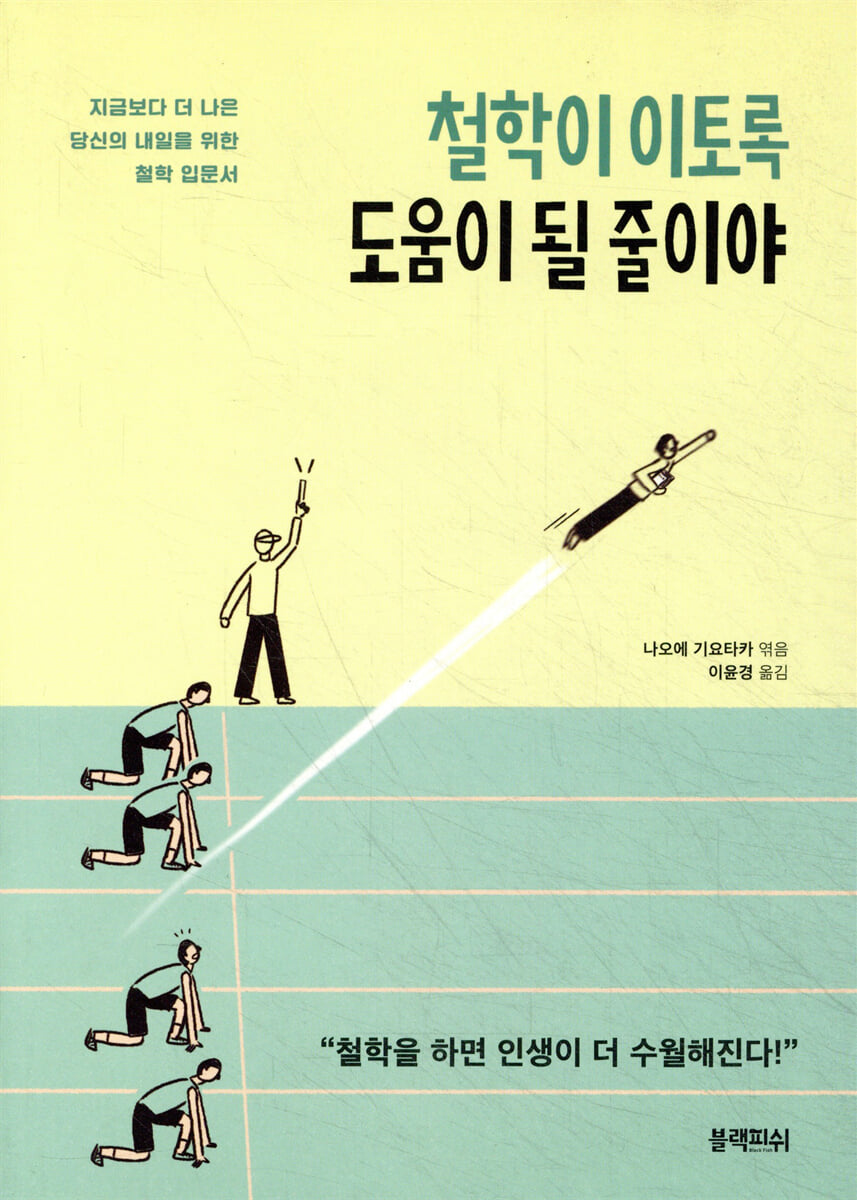
I never knew philosophy could be so helpful
 |
Description
Book Introduction
It is neither comfort, healing, nor a way to live.
This is an era where 'philosophy' is needed!
An Introduction to Philosophy for a Better Tomorrow Than Today
In modern society, where we are constantly forced to ponder "How to Live" and "How to Die," what we need is not worldly wisdom that merely evades the moment, but the philosophy and power of reflection that empower us to proactively shape our own lives! For those who find life difficult and overwhelming, blocked by the walls of reality, and whose days are filled with endless worry, the useful humanities book "Who knew philosophy could be this helpful" has been published.
This book is an introductory book to philosophy that offers a novel-like, exciting storytelling philosophy unlike anything you've ever seen before. It is the "culmination of collective intelligence" completed through the joint participation of 35 experts in the fields of philosophy and ideology.
Starting from the concerns of everyday reality, this book allows you to experience various philosophies from the East and the West, past and present. It is packed with philosophers you have heard of but never properly read, including the Bible, Socrates, Descartes, Wittgenstein, Popper, John Rawls, and other leading figures in philosophy, as well as Adam Smith, the father of economics, and modern philosopher Amartya Sen, as well as their representative classics.
In this book, rather than memorizing difficult philosophical theories, we can simply observe the process of unraveling the threads of our worries in reality through interesting stories and naturally practice thinking.
Viktor Frankl, who sought the meaning of life even in the harsh conditions of a concentration camp; Montaigne, who never hastily concluded, "What do I know?"; and Descartes, who confirmed his existence by constantly asking himself questions.
Let's enjoy the intellectual pleasure of turning everyday question marks into exclamation points, along with the fascinating stories of philosophers who solidified their thinking and reflection each day.
This is an era where 'philosophy' is needed!
An Introduction to Philosophy for a Better Tomorrow Than Today
In modern society, where we are constantly forced to ponder "How to Live" and "How to Die," what we need is not worldly wisdom that merely evades the moment, but the philosophy and power of reflection that empower us to proactively shape our own lives! For those who find life difficult and overwhelming, blocked by the walls of reality, and whose days are filled with endless worry, the useful humanities book "Who knew philosophy could be this helpful" has been published.
This book is an introductory book to philosophy that offers a novel-like, exciting storytelling philosophy unlike anything you've ever seen before. It is the "culmination of collective intelligence" completed through the joint participation of 35 experts in the fields of philosophy and ideology.
Starting from the concerns of everyday reality, this book allows you to experience various philosophies from the East and the West, past and present. It is packed with philosophers you have heard of but never properly read, including the Bible, Socrates, Descartes, Wittgenstein, Popper, John Rawls, and other leading figures in philosophy, as well as Adam Smith, the father of economics, and modern philosopher Amartya Sen, as well as their representative classics.
In this book, rather than memorizing difficult philosophical theories, we can simply observe the process of unraveling the threads of our worries in reality through interesting stories and naturally practice thinking.
Viktor Frankl, who sought the meaning of life even in the harsh conditions of a concentration camp; Montaigne, who never hastily concluded, "What do I know?"; and Descartes, who confirmed his existence by constantly asking himself questions.
Let's enjoy the intellectual pleasure of turning everyday question marks into exclamation points, along with the fascinating stories of philosophers who solidified their thinking and reflection each day.
- You can preview some of the book's contents.
Preview
index
Entering
This book's user manual
[PART 1: Philosophy: Who knew it would help me so much?]
_13 Philosophy Questions to Help Me
Is love a natural emotion? | What does it mean to make a friend? | Was it a good thing not to believe the boy who cried wolf? | Why do diets fail? | What is human 'sin'? | Where is my true self? | Is a life that is not helpful to others a worthless life? | Infertility and sterility are increasing, so is surrogacy not a good idea? | How much can we trust information on the internet? | Can anything be certain in an uncertain world? | If my words and yours are the same, do they mean the same thing? | Is it possible to find the 'right answer' among various opinions? | Is it okay to openly talk about sex?
[Column] Why do we "think"? | What does it mean to like someone? | Isn't it okay to live moderately? | What is aging? | Everyone has the potential to become a "villain." | What is writing?
[PART 2: Philosophy: Who knew it could be so beneficial to society?]
_15 Philosophy Questions to Help the World
No matter how much suffering one may have, can one find meaning in life? | Why live in a region subject to heavy snowfall? | What is the suffering of Minamata disease? | Is there such a thing as eternal peace? | Is it okay to retaliate against those who have committed corruption? | What is justice to those who believe in God? | Should we respect all ways of thinking? | To what extent can I forgive the mistakes of others? | Is it okay for a few to be sacrificed for the happiness of the many? | To what extent should I help the poor? | What kind of competition is 'free competition'? | Will the world flow on regardless of my efforts? | Is freedom really important? | Is faith unfree? | Are our lives all determined by our genes?
[Column] Reflecting on Justice Since Ancient Greece | On Enduring Life | Reading Philosophy's "Classics" | Encountering the Various Forms of Freedom | Erich Fromm's "Escape from Freedom"
Special Appendix for Philosophy Training
This book's user manual
[PART 1: Philosophy: Who knew it would help me so much?]
_13 Philosophy Questions to Help Me
Is love a natural emotion? | What does it mean to make a friend? | Was it a good thing not to believe the boy who cried wolf? | Why do diets fail? | What is human 'sin'? | Where is my true self? | Is a life that is not helpful to others a worthless life? | Infertility and sterility are increasing, so is surrogacy not a good idea? | How much can we trust information on the internet? | Can anything be certain in an uncertain world? | If my words and yours are the same, do they mean the same thing? | Is it possible to find the 'right answer' among various opinions? | Is it okay to openly talk about sex?
[Column] Why do we "think"? | What does it mean to like someone? | Isn't it okay to live moderately? | What is aging? | Everyone has the potential to become a "villain." | What is writing?
[PART 2: Philosophy: Who knew it could be so beneficial to society?]
_15 Philosophy Questions to Help the World
No matter how much suffering one may have, can one find meaning in life? | Why live in a region subject to heavy snowfall? | What is the suffering of Minamata disease? | Is there such a thing as eternal peace? | Is it okay to retaliate against those who have committed corruption? | What is justice to those who believe in God? | Should we respect all ways of thinking? | To what extent can I forgive the mistakes of others? | Is it okay for a few to be sacrificed for the happiness of the many? | To what extent should I help the poor? | What kind of competition is 'free competition'? | Will the world flow on regardless of my efforts? | Is freedom really important? | Is faith unfree? | Are our lives all determined by our genes?
[Column] Reflecting on Justice Since Ancient Greece | On Enduring Life | Reading Philosophy's "Classics" | Encountering the Various Forms of Freedom | Erich Fromm's "Escape from Freedom"
Special Appendix for Philosophy Training
Detailed image

Into the book
Popper calls the attitude and method of thinking about things in a reasonable way, using words to confirm each thing one by one, without making conclusions based on dogmatism and prejudice, 'rationalism.'
However, this is completely different from the coercion that values efficiency or the rational approach.
Instead, it suggests a rather difficult way to exchange opinions with people who think differently.
Obviously, I don't feel very good when other people have different opinions than me.
Even among friends, unexpected clashes of opinions can cause a rift between them.
But if I stop at superficial discussions for fear of becoming emotional, the conversation won't progress at all and my thoughts won't broaden.
Popper advises us to abandon dogmatism and be open to other ideas.
It goes one step further than the idea that everyone has different values, but it means that we should go beyond relativism by sharing opinions and thinking repeatedly.
So how can we overcome relativism?
The important thing at this time is the method of ‘criticism.’
According to Popper, criticism is the act of examining and examining the validity of claims and theories in the light of experience.
Criticism is when one party thinks rationally with the other party without getting emotional.
--- From Popper's "Conjectures and Refutations"
Life has limits.
That is why, while we are alive, we want to live abundantly rather than just living.
So what does an "abundant life" mean? We've become accustomed to a fast, convenient life where everything is readily available.
Because of this, aren't we focusing only on the immediate tasks at hand, ignoring those that are inconvenient, inefficient, impractical, or of no immediate use? The convenience and speed of modern society expects immediate results.
So we try to live up to it somehow.
If you do that, it's easy to think that it's natural for other people to put in as much effort as you do.
Also, humans have a duty to make efforts, and those who do not make efforts are thought to be weak or lazy, so they criticize and attack the weak.
Could it be because we are under the illusion that strong people are valuable and weak people are valuable?
It is not easy for a person with the life philosophy that 'there is nothing you cannot achieve if you try' to accept values that are the exact opposite.
So, it is easy to unconsciously ignore the weak who do not try, as well as the weak who are in a position where they cannot try even if they want to, thinking them useless.
Even useless people are seen as a nuisance and the weak as a scourge to society, and so we consciously try to exclude them.
Lao Tzu said that if we only focus on the visible 'being', we will miss the true meaning of the invisible 'nothingness'.
Zhuangzi also said that there are times when things that were considered 'useless' are actually useful.
Both Lao-tzu and Zhuang-tzu teach us that we must overturn the common sense and beliefs we are held by, transform our rigid and entrenched thinking, and embrace diverse values.
In other words, if you let go of relative values, you can realize the value of 'uselessness', which at first glance seems useless in this world.
The writings of Lao-tzu and Zhuang-tzu provide clues to rethink what a truly abundant life is.
Zhuangzi tells us to turn our eyes to the truth that the most precious thing to a person is life, and that enjoying the lifespan given is the most meaningful life.
The more we try to use our potential, the shorter our lifespan becomes.
No matter how many useful abilities you have, they are of no use if they harm your mind and body.
We try hard.
But if we think about Lao Tzu's saying that soft and weak water breaks hard and solid rock, being strong does not necessarily mean being valuable or a condition for being a winner.
As the Chinese idiom 'softness makes strength' suggests, isn't living as soft and strong as water a truly strong life?
--- From 『Laozi』 and 『Zhuangzi』
In a modern liberal society, public power can restrict citizens' freedom only when citizens harm others.
In other words, it means that our decisions are respected as long as they do not harm others (this is called the principle of harm to others).
So, does this mean that as long as you don't harm others, your body is yours and you're free to do whatever you want with it? Does it mean you can harm yourself? The foundation for this thinking is the thought of the 18th-century German philosopher Kant.
He wrote about suicide in his book:
“Humans are not objects.
Therefore, it should not be treated merely as a means, but all of its actions should always be viewed as ends in themselves.
Therefore, I cannot do whatever I want with the human being within my person, harming, destroying, or killing him.” --- Kant, from 『The Foundations of the Metaphysics of Morals』
Kant believed that we should not dispose of, harm, or kill rational beings like humans, even if they are ourselves.
According to Kant, objects are irrational beings, and we can freely use them as means (tools).
Goods can be exchanged for equivalents.
In contrast, a rational human being is a person with dignity and is a precious being.
Dignity has an absolute and incomparable value.
To harm such a human being is an insult to divine dignity.
Some people may think that it is okay to harm others but not themselves.
However, since we are equal to others in that we possess reason, Kant believed that from the perspective of human dignity, harming oneself is a violation of dignity and therefore ethically unacceptable.
Let's go back to surrogacy.
It cannot be denied that surrogacy involves using the surrogate mother's body as a means for pregnancy and childbirth.
If there is a machine that can grow a fertilized egg into a baby, there may be no need to ask a surrogate mother.
Therefore, from the perspective of human dignity, using a surrogate mother's body as a means for surrogate birth or exposing her to the risk of losing her life cannot be tolerated even if the surrogate mother herself consents.
Moreover, when it comes to surrogacy businesses in the US, India, and Thailand, where people receive financial compensation for becoming surrogate mothers, the implication that the body is being used as a means becomes even stronger.
--- From Kant's "Groundwork of the Metaphysics of Morals"
“They say happiness is different for everyone.”
“Some people feel happy when they are active in the front lines or earn money and live a comfortable life, while others...
“I am happiest when I am eating delicious food.”
"That's right! But even eating delicious food requires some effort."
“Isn’t that the suffering of life?”
“You need money to eat delicious food.
“I think that if you work hard for it, you can feel the joy of life.”
“But even if you work hard to get delicious food, if you damage your health through overwork, you won’t be able to eat it.”
“What would Lao Tzu or Zhuang Tzu say?”
“You might say, ‘A life that is the exact opposite of that is happiness.’
“Don’t try to find something delicious, just eat the food you have now and feel that it is delicious.”
“But once you experience something delicious, you’ll want to try something even more delicious next time.”
"you're right.
Then, you end up wanting something that isn't on the menu.”
"You're never satisfied, is that it? 'At what point will you be satisfied?' is a difficult question, but one we must learn."
“Rather than wanting to have everything, I need to acknowledge who I am now and accept that I can’t do what I can’t do.”
“Like Epicurus, who values ‘self-sufficiency.’
Epicurus says that any dish can be enjoyed deliciously as long as you have cheese, so if you want to live a rich life, don't accumulate wealth, but reduce your desires.
They say that desire originally starts from a sense of lack.
“If I reduce my desires, I will realize that what I already have is enough.”
“This is the very spirit of ‘knowing contentment’ that Lao Tzu spoke of.” --- From “Column - Is it okay to live moderately?”
What kind of world awaits us if everyone gets swept up in something without thinking?
Frank Pavlov's 'The Brown Morning' provides a clue to unraveling such thoughts.
The plot is as follows.
When it becomes illegal to keep pets other than brown in one country, the protagonist ends up killing his own pet.
Anti-government newspapers are shut down and the media is controlled.
The protagonist, who initially had a negative reaction, is swept along by those around him, thinking, "You can live comfortably as long as you don't go against the flow of the world."
One morning, news spreads that the law has been revised so that anyone who previously owned an animal other than brown can be arrested for treason, and the protagonist is taken away by the vigilantes.
No, to be precise, to the vigilantes knocking on his front door, "Please don't knock so hard.
“I’m going out now,” he replies.
There is a short story by Kobo Abe titled “Yangsikpa” that has a similar story.
The main character is a chicken.
There are many enemies, so you have to go far to get your hands on food.
At that time, a human appears and offers to build a sturdy chicken coop with wire mesh and provide food.
However, the chicken coop can be locked with a key.
The human speaks to the anxious chicken.
“If a chicken can open it, a cat can open it too.”
There were chickens who questioned this, but they were eventually accused of being spies and kicked out.
Finally, the chickens called 'Yangsik (the ability to correctly understand things)' come to a conclusion.
“Since the human being said he would do that much, let’s do as he said.
If something goes wrong, we can all discuss it and decide together.”
Eventually they walk into the chicken coop on their own.
What both fables have in common is that the protagonist, despite harboring resentment and doubts, gives up thinking and gets swept up in the situation, resulting in his own loss of 'freedom'.
If you don't think, you might lose your freedom.
However, this is completely different from the coercion that values efficiency or the rational approach.
Instead, it suggests a rather difficult way to exchange opinions with people who think differently.
Obviously, I don't feel very good when other people have different opinions than me.
Even among friends, unexpected clashes of opinions can cause a rift between them.
But if I stop at superficial discussions for fear of becoming emotional, the conversation won't progress at all and my thoughts won't broaden.
Popper advises us to abandon dogmatism and be open to other ideas.
It goes one step further than the idea that everyone has different values, but it means that we should go beyond relativism by sharing opinions and thinking repeatedly.
So how can we overcome relativism?
The important thing at this time is the method of ‘criticism.’
According to Popper, criticism is the act of examining and examining the validity of claims and theories in the light of experience.
Criticism is when one party thinks rationally with the other party without getting emotional.
--- From Popper's "Conjectures and Refutations"
Life has limits.
That is why, while we are alive, we want to live abundantly rather than just living.
So what does an "abundant life" mean? We've become accustomed to a fast, convenient life where everything is readily available.
Because of this, aren't we focusing only on the immediate tasks at hand, ignoring those that are inconvenient, inefficient, impractical, or of no immediate use? The convenience and speed of modern society expects immediate results.
So we try to live up to it somehow.
If you do that, it's easy to think that it's natural for other people to put in as much effort as you do.
Also, humans have a duty to make efforts, and those who do not make efforts are thought to be weak or lazy, so they criticize and attack the weak.
Could it be because we are under the illusion that strong people are valuable and weak people are valuable?
It is not easy for a person with the life philosophy that 'there is nothing you cannot achieve if you try' to accept values that are the exact opposite.
So, it is easy to unconsciously ignore the weak who do not try, as well as the weak who are in a position where they cannot try even if they want to, thinking them useless.
Even useless people are seen as a nuisance and the weak as a scourge to society, and so we consciously try to exclude them.
Lao Tzu said that if we only focus on the visible 'being', we will miss the true meaning of the invisible 'nothingness'.
Zhuangzi also said that there are times when things that were considered 'useless' are actually useful.
Both Lao-tzu and Zhuang-tzu teach us that we must overturn the common sense and beliefs we are held by, transform our rigid and entrenched thinking, and embrace diverse values.
In other words, if you let go of relative values, you can realize the value of 'uselessness', which at first glance seems useless in this world.
The writings of Lao-tzu and Zhuang-tzu provide clues to rethink what a truly abundant life is.
Zhuangzi tells us to turn our eyes to the truth that the most precious thing to a person is life, and that enjoying the lifespan given is the most meaningful life.
The more we try to use our potential, the shorter our lifespan becomes.
No matter how many useful abilities you have, they are of no use if they harm your mind and body.
We try hard.
But if we think about Lao Tzu's saying that soft and weak water breaks hard and solid rock, being strong does not necessarily mean being valuable or a condition for being a winner.
As the Chinese idiom 'softness makes strength' suggests, isn't living as soft and strong as water a truly strong life?
--- From 『Laozi』 and 『Zhuangzi』
In a modern liberal society, public power can restrict citizens' freedom only when citizens harm others.
In other words, it means that our decisions are respected as long as they do not harm others (this is called the principle of harm to others).
So, does this mean that as long as you don't harm others, your body is yours and you're free to do whatever you want with it? Does it mean you can harm yourself? The foundation for this thinking is the thought of the 18th-century German philosopher Kant.
He wrote about suicide in his book:
“Humans are not objects.
Therefore, it should not be treated merely as a means, but all of its actions should always be viewed as ends in themselves.
Therefore, I cannot do whatever I want with the human being within my person, harming, destroying, or killing him.” --- Kant, from 『The Foundations of the Metaphysics of Morals』
Kant believed that we should not dispose of, harm, or kill rational beings like humans, even if they are ourselves.
According to Kant, objects are irrational beings, and we can freely use them as means (tools).
Goods can be exchanged for equivalents.
In contrast, a rational human being is a person with dignity and is a precious being.
Dignity has an absolute and incomparable value.
To harm such a human being is an insult to divine dignity.
Some people may think that it is okay to harm others but not themselves.
However, since we are equal to others in that we possess reason, Kant believed that from the perspective of human dignity, harming oneself is a violation of dignity and therefore ethically unacceptable.
Let's go back to surrogacy.
It cannot be denied that surrogacy involves using the surrogate mother's body as a means for pregnancy and childbirth.
If there is a machine that can grow a fertilized egg into a baby, there may be no need to ask a surrogate mother.
Therefore, from the perspective of human dignity, using a surrogate mother's body as a means for surrogate birth or exposing her to the risk of losing her life cannot be tolerated even if the surrogate mother herself consents.
Moreover, when it comes to surrogacy businesses in the US, India, and Thailand, where people receive financial compensation for becoming surrogate mothers, the implication that the body is being used as a means becomes even stronger.
--- From Kant's "Groundwork of the Metaphysics of Morals"
“They say happiness is different for everyone.”
“Some people feel happy when they are active in the front lines or earn money and live a comfortable life, while others...
“I am happiest when I am eating delicious food.”
"That's right! But even eating delicious food requires some effort."
“Isn’t that the suffering of life?”
“You need money to eat delicious food.
“I think that if you work hard for it, you can feel the joy of life.”
“But even if you work hard to get delicious food, if you damage your health through overwork, you won’t be able to eat it.”
“What would Lao Tzu or Zhuang Tzu say?”
“You might say, ‘A life that is the exact opposite of that is happiness.’
“Don’t try to find something delicious, just eat the food you have now and feel that it is delicious.”
“But once you experience something delicious, you’ll want to try something even more delicious next time.”
"you're right.
Then, you end up wanting something that isn't on the menu.”
"You're never satisfied, is that it? 'At what point will you be satisfied?' is a difficult question, but one we must learn."
“Rather than wanting to have everything, I need to acknowledge who I am now and accept that I can’t do what I can’t do.”
“Like Epicurus, who values ‘self-sufficiency.’
Epicurus says that any dish can be enjoyed deliciously as long as you have cheese, so if you want to live a rich life, don't accumulate wealth, but reduce your desires.
They say that desire originally starts from a sense of lack.
“If I reduce my desires, I will realize that what I already have is enough.”
“This is the very spirit of ‘knowing contentment’ that Lao Tzu spoke of.” --- From “Column - Is it okay to live moderately?”
What kind of world awaits us if everyone gets swept up in something without thinking?
Frank Pavlov's 'The Brown Morning' provides a clue to unraveling such thoughts.
The plot is as follows.
When it becomes illegal to keep pets other than brown in one country, the protagonist ends up killing his own pet.
Anti-government newspapers are shut down and the media is controlled.
The protagonist, who initially had a negative reaction, is swept along by those around him, thinking, "You can live comfortably as long as you don't go against the flow of the world."
One morning, news spreads that the law has been revised so that anyone who previously owned an animal other than brown can be arrested for treason, and the protagonist is taken away by the vigilantes.
No, to be precise, to the vigilantes knocking on his front door, "Please don't knock so hard.
“I’m going out now,” he replies.
There is a short story by Kobo Abe titled “Yangsikpa” that has a similar story.
The main character is a chicken.
There are many enemies, so you have to go far to get your hands on food.
At that time, a human appears and offers to build a sturdy chicken coop with wire mesh and provide food.
However, the chicken coop can be locked with a key.
The human speaks to the anxious chicken.
“If a chicken can open it, a cat can open it too.”
There were chickens who questioned this, but they were eventually accused of being spies and kicked out.
Finally, the chickens called 'Yangsik (the ability to correctly understand things)' come to a conclusion.
“Since the human being said he would do that much, let’s do as he said.
If something goes wrong, we can all discuss it and decide together.”
Eventually they walk into the chicken coop on their own.
What both fables have in common is that the protagonist, despite harboring resentment and doubts, gives up thinking and gets swept up in the situation, resulting in his own loss of 'freedom'.
If you don't think, you might lose your freedom.
--- From the column “Why Do We ‘Think’?”
Publisher's Review
What we need now in this marathon called life is
It is not comfort, healing, or a way of life, but a ‘philosophy’!
Life is a series of sufferings.
We struggle with love and friendship, we strive to live freely and happily, and we struggle to find meaning in life even in the midst of suffering.
In modern society, where we are forced to constantly ponder 'how to live' and 'how to die,' what we need is not a way of life that merely escapes the moment, but a philosophy and the power of reflection that will allow us to proactively lead our own lives.
In this book, "I Never Knew Philosophy Could Be This Helpful," you'll discover a storytelling philosophy as exciting as a novel, unlike anything you've ever seen before.
The book asks Aristotle about the reasons for diet failure, and asks Luhmann about the indifferent society that did not believe the shepherd boy.
Also, while thinking, 'Am I useless in this life?', he meets Lao-tzu and Zhuang-tzu, and hears Bacon's opinion on what to believe in an uncertain world.
We can also think about bioethics with Kant on the topic of surrogacy.
Have you spent your days lost in thought, lost in a world filled with questions? If so, check out this book, "I Never Knew Philosophy Could Be This Helpful," which explores diverse philosophies from across the East and the West, starting from the real-life concerns of everyday life.
Viktor Frankl, who sought to find the meaning of life without losing hope even in the harsh conditions of concentration camp life, Montaigne, who never hastily concluded what he knew, and Descartes, who confirmed his existence by constantly asking himself questions.
Let's enjoy the intellectual pleasure of turning everyday question marks into exclamation points, along with the fascinating stories of philosophers who solidified their thinking and reflection each day.
A philosophy that will turn life's question marks(?) into exclamation points(!)!
Using a famous classic that you may have heard of at least once
How to untangle the thread of my worries!
The primary goal of this book is to empower readers to utilize classic philosophical texts for direct reflection, thereby developing the "strength" to tackle complex problems. Thirty-five experts in philosophy and ideology have painstakingly selected intriguing topics worthy of deep reflection throughout life, incorporating them into this book alongside the philosophers' core theories.
The book is largely divided into Part 1 and Part 2, and several columns that add depth to the thinking.
First, in PART 1, we ask 13 questions to ‘understand myself (human being)’.
In "Is Love a Natural Emotion?", we compare the "love" of Plato, Aristotle, and Jesus, and in "Is a Life That Doesn't Help Others a Worthless Life?", we read the thoughts of Lao-tzu and Zhuang-tzu together and consider whether there really is such a thing as a "useless life."
Beyond this, you can encounter vast and profound thoughts starting from simple and everyday questions such as, "Where is my true self?" and "If my words and yours are the same, do they mean the same?"
In PART 2, we ask 15 questions to further understand the world we live in together, that is, ‘society’.
In "How Far Should We Help the Poor?", he compares Mill's utilitarianism with Rawls and Sen's ideas on the standards for ensuring social fairness and justice, and in "What Kind of Competition Is 'Free Competition'?", he approaches 'free competition' from an ethical perspective with Adam Smith.
In this way, through the realistic topics and questions that appear in the book, we come to realize that "philosophy always provides answers" whether we're trying to discern truth in a world filled with fiction, struggling to choose between human dignity and ethical principles, or unsure how to love, live, or die.
Stop studying difficult and boring 'ideology'.
A surprisingly 'fun' introduction to the philosophy of storytelling!
When we discern certainty from uncertain information, when we want revenge on someone who has harmed us, when aging feels negative, or even when we are torn between freedom and individuality.
Even in these trivial moments of daily life, philosophical thinking is useful.
But how can we understand and practice ‘philosophy’?
This book is an introduction to storytelling philosophy that brings the potentially difficult and boring philosophy classics into "my life" through fun and realistic stories.
The book's 28 dialogues vividly portray the fascinating discussions and debates between fictional characters, providing us with the opportunity to constantly ask ourselves questions and reflect on our own experiences.
In this process, countless problems that we have pondered in life naturally lead to the world of classics and then back to reality.
Rather than memorizing the names and theories of leading philosophers, the book 『I Never Knew Philosophy Could Be This Helpful』 is a fun philosophy book where you can simply watch the process of unraveling your worries in reality through interesting stories.
The process of developing philosophical thinking is introduced through familiar and easy-to-understand materials such as the fable "The Boy Who Cried Wolf," the movie "The Matrix," and Saint-Exupéry's novel "The Little Prince," as well as dozens of thinkers and their theories.
To you who have endless worries about life, such as, "Do I have to love my family?" and "How much can I forgive others' mistakes?" and find it difficult to think alone, and to you who want to cultivate a slightly lighter mind, I recommend this book, which will naturally make "philosophy" yours as you read it with enjoyment.
35 writers
They are experts in the fields of philosophy and ideology, and are active in various fields such as bioethics, sociology, and Buddhist studies.
This book was completed jointly by leading scholars who teach philosophy and thought to students majoring in engineering, medicine, law, and other fields.
It is not comfort, healing, or a way of life, but a ‘philosophy’!
Life is a series of sufferings.
We struggle with love and friendship, we strive to live freely and happily, and we struggle to find meaning in life even in the midst of suffering.
In modern society, where we are forced to constantly ponder 'how to live' and 'how to die,' what we need is not a way of life that merely escapes the moment, but a philosophy and the power of reflection that will allow us to proactively lead our own lives.
In this book, "I Never Knew Philosophy Could Be This Helpful," you'll discover a storytelling philosophy as exciting as a novel, unlike anything you've ever seen before.
The book asks Aristotle about the reasons for diet failure, and asks Luhmann about the indifferent society that did not believe the shepherd boy.
Also, while thinking, 'Am I useless in this life?', he meets Lao-tzu and Zhuang-tzu, and hears Bacon's opinion on what to believe in an uncertain world.
We can also think about bioethics with Kant on the topic of surrogacy.
Have you spent your days lost in thought, lost in a world filled with questions? If so, check out this book, "I Never Knew Philosophy Could Be This Helpful," which explores diverse philosophies from across the East and the West, starting from the real-life concerns of everyday life.
Viktor Frankl, who sought to find the meaning of life without losing hope even in the harsh conditions of concentration camp life, Montaigne, who never hastily concluded what he knew, and Descartes, who confirmed his existence by constantly asking himself questions.
Let's enjoy the intellectual pleasure of turning everyday question marks into exclamation points, along with the fascinating stories of philosophers who solidified their thinking and reflection each day.
A philosophy that will turn life's question marks(?) into exclamation points(!)!
Using a famous classic that you may have heard of at least once
How to untangle the thread of my worries!
The primary goal of this book is to empower readers to utilize classic philosophical texts for direct reflection, thereby developing the "strength" to tackle complex problems. Thirty-five experts in philosophy and ideology have painstakingly selected intriguing topics worthy of deep reflection throughout life, incorporating them into this book alongside the philosophers' core theories.
The book is largely divided into Part 1 and Part 2, and several columns that add depth to the thinking.
First, in PART 1, we ask 13 questions to ‘understand myself (human being)’.
In "Is Love a Natural Emotion?", we compare the "love" of Plato, Aristotle, and Jesus, and in "Is a Life That Doesn't Help Others a Worthless Life?", we read the thoughts of Lao-tzu and Zhuang-tzu together and consider whether there really is such a thing as a "useless life."
Beyond this, you can encounter vast and profound thoughts starting from simple and everyday questions such as, "Where is my true self?" and "If my words and yours are the same, do they mean the same?"
In PART 2, we ask 15 questions to further understand the world we live in together, that is, ‘society’.
In "How Far Should We Help the Poor?", he compares Mill's utilitarianism with Rawls and Sen's ideas on the standards for ensuring social fairness and justice, and in "What Kind of Competition Is 'Free Competition'?", he approaches 'free competition' from an ethical perspective with Adam Smith.
In this way, through the realistic topics and questions that appear in the book, we come to realize that "philosophy always provides answers" whether we're trying to discern truth in a world filled with fiction, struggling to choose between human dignity and ethical principles, or unsure how to love, live, or die.
Stop studying difficult and boring 'ideology'.
A surprisingly 'fun' introduction to the philosophy of storytelling!
When we discern certainty from uncertain information, when we want revenge on someone who has harmed us, when aging feels negative, or even when we are torn between freedom and individuality.
Even in these trivial moments of daily life, philosophical thinking is useful.
But how can we understand and practice ‘philosophy’?
This book is an introduction to storytelling philosophy that brings the potentially difficult and boring philosophy classics into "my life" through fun and realistic stories.
The book's 28 dialogues vividly portray the fascinating discussions and debates between fictional characters, providing us with the opportunity to constantly ask ourselves questions and reflect on our own experiences.
In this process, countless problems that we have pondered in life naturally lead to the world of classics and then back to reality.
Rather than memorizing the names and theories of leading philosophers, the book 『I Never Knew Philosophy Could Be This Helpful』 is a fun philosophy book where you can simply watch the process of unraveling your worries in reality through interesting stories.
The process of developing philosophical thinking is introduced through familiar and easy-to-understand materials such as the fable "The Boy Who Cried Wolf," the movie "The Matrix," and Saint-Exupéry's novel "The Little Prince," as well as dozens of thinkers and their theories.
To you who have endless worries about life, such as, "Do I have to love my family?" and "How much can I forgive others' mistakes?" and find it difficult to think alone, and to you who want to cultivate a slightly lighter mind, I recommend this book, which will naturally make "philosophy" yours as you read it with enjoyment.
35 writers
They are experts in the fields of philosophy and ideology, and are active in various fields such as bioethics, sociology, and Buddhist studies.
This book was completed jointly by leading scholars who teach philosophy and thought to students majoring in engineering, medicine, law, and other fields.
GOODS SPECIFICS
- Date of issue: June 18, 2019
- Page count, weight, size: 384 pages | 522g | 148*210*25mm
- ISBN13: 9788968332128
- ISBN10: 8968332126
You may also like
카테고리
korean


korean

![ELLE 엘르 스페셜 에디션 A형 : 12월 [2025]](http://librairie.coreenne.fr/cdn/shop/files/b8e27a3de6c9538896439686c6b0e8fb.jpg?v=1766436872&width=3840)


