

Hannah Arendt's Political Lectures
 |
Description
Book Introduction
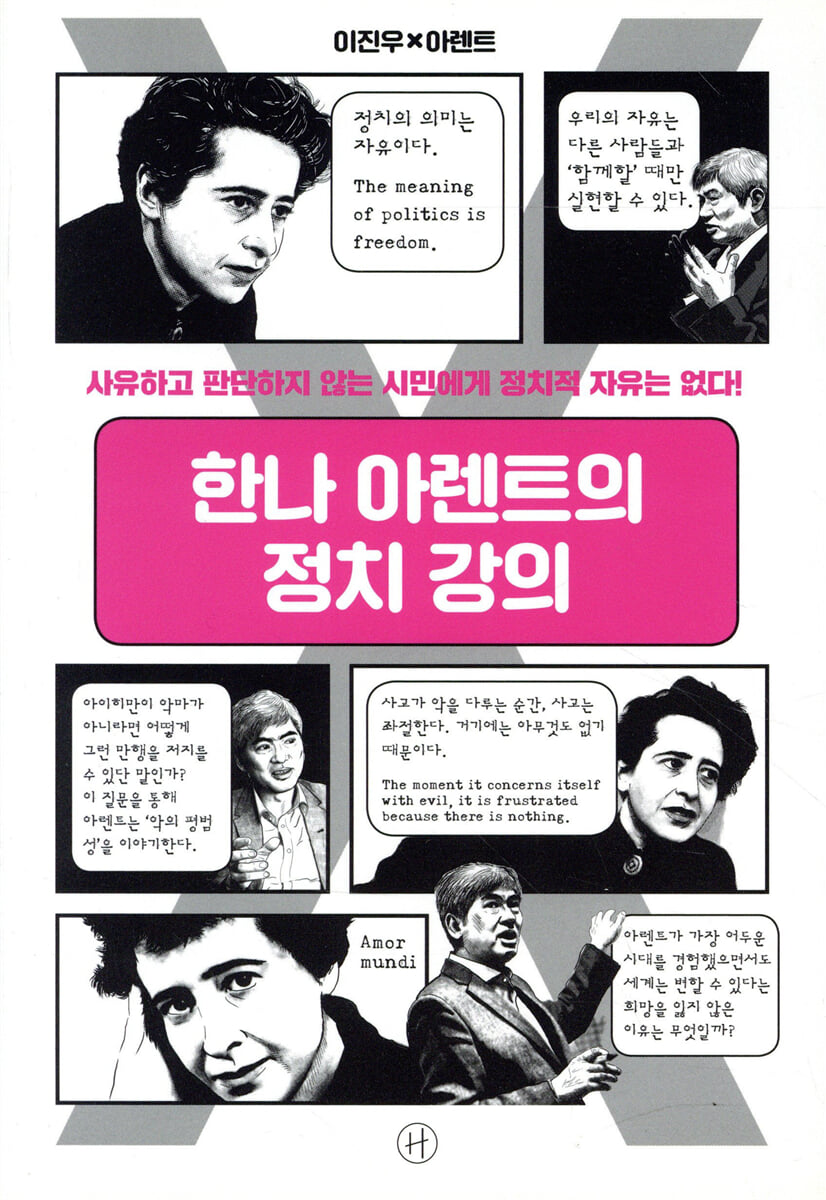
The greatest threat to us today is giving up thinking for ourselves! A Stimulant for Deep Thought: How to 'Understand' Our Times Through Arendt Hannah Arendt is the greatest political philosopher of the 20th century who intensely contemplated the issues of politics and freedom while experiencing the totalitarianism of the Nazi regime firsthand. Professor Jinwoo Lee of POSTECH, who has provided countless readers with the joy of philosophical thought through works such as "Nietzsche's Lectures on Life" and "The Philosophy of Doubt," will read Arendt's political philosophy together and, through it, examine the most important political issues of our time. From what perspective should we consider politics? How can we achieve political freedom? Let's explore this path through the philosophy of Arendt, a "stimulant of thought," who constantly challenges us to pause and reflect, urging us to avoid becoming slaves to our time. The problems of realpolitik are complex and subtle. In a situation where various positions and interests are intertwined, it is extremely difficult to properly grasp reality and make sound political judgments. How should we view and assess the complex issues that impact our lives: recurring economic crises, social polarization and inequality, new poverty amidst affluence, corruption, terrorism, gender conflict, refugee issues, climate change, and more? This book examines the diverse problems facing modern people through the lens of Arendt's political philosophy, helping us cultivate political judgment and seek solutions based on deeper insight. |
- You can preview some of the book's contents.
Preview
index
Not thinking about the text you are entering, this is evil!
1.
Is totalitarianism over now?
2.
What makes us useless?
3.
Why aren't those who commit monstrous evils monsters?
4.
Why are completely private people not free?
5.
Why should we have different opinions?
6.
What are we free for?
7.
Does political power necessarily have to be violent?
8.
Why does politics create fake news?
9.
Is a politics of equality that transcends the relationship of domination possible?
10.
How can we make the rules of politics?
Hannah Arendt's Chronology
main
References
1.
Is totalitarianism over now?
2.
What makes us useless?
3.
Why aren't those who commit monstrous evils monsters?
4.
Why are completely private people not free?
5.
Why should we have different opinions?
6.
What are we free for?
7.
Does political power necessarily have to be violent?
8.
Why does politics create fake news?
9.
Is a politics of equality that transcends the relationship of domination possible?
10.
How can we make the rules of politics?
Hannah Arendt's Chronology
main
References
Publisher's Review
1.
Never stop thinking so you don't become another Eichmann!
Arendt's Warning to Citizens Seeking Political Freedom
Hannah Arendt, the greatest political philosopher of the 20th century, wrote masterpieces that will remain in the history of philosophy, such as 『The Origins of Totalitarianism』, 『The Human Condition』, and 『Eichmann in Jerusalem』.
She was barred from teaching and imprisoned in a concentration camp because she was Jewish. After witnessing the Nazi regime murdering some 6 million Jews, she asked the following question:
“How could humans kill millions of innocent people for no reason?” I asked myself, and I devoted all my passion to understanding this horrific event, which was both incomprehensible and unforgivable.
What Arendt discovered while delving into the issues of Nazi totalitarianism and the Holocaust was the famous 'banality of evil.'
Otto Adolf Eichmann, the Nazi SS lieutenant colonel who deported Jews from across Europe to concentration camps, was by no means a monster or a demon.
He was a warm father who loved his family and a conscientious public servant who did his job well, but he committed evil because he did not think about what he was doing.
After observing Eichmann in the Jerusalem courtroom, Arendt came to the shocking conclusion that the inability to think ultimately leads to evil.
Arendt's thought still sends a chilling warning even in this age when the Nazi regime has fallen and totalitarianism seems to have ended.
In a rapidly changing capitalist society, are we sufficiently reflecting on life, community, and the world? Are we so busy, so pressed for time to resolve problems, so complex that we have given up on reflection and are now living in a habitual state? This book, "Hannah Arendt's Political Lectures," examines the political and philosophical questions of our time, drawing on Arendt's thought, which constantly stimulates our own reflection.
Rather than simply understanding Arendt's thought, we consider together from what perspective we should think about the political problems of our reality.
Arendt says that if we do not think about reality, we could become another Eichmann, and that totalitarianism like the Nazi regime could return at any time.
There is no one who will think about my problems for me, and even if there were, it would mean giving up my political rights and freedoms.
This is why Arendt's thinking is essential for citizens seeking political freedom.
Arendt advises that, in order to avoid becoming slaves to our times, we must stop, think, and reflect deeply on what we are doing.
Our times are times of uncertainty.
The future is unpredictable, and past actions are even more irreversible.
That is why, more than ever, we need politics that finds the direction of the future within reality.
The solution to real-world problems lies within reality.
There are no longer any ideologies or ideals that can explain reality, and no universal values that can determine the direction of the future.
(Omitted) How can we begin something new from a familiar reality that seems to repeat itself endlessly? For those who find this question compelling, Hannah Arendt is a crucial catalyst for reflection.
Hannah Arendt never offers clear solutions to the major problems of our time, nor does she offer a universally valid political ideology.
Arendt is not a guide who leads us directly down a specific path, but rather a stimulant who constantly leads us to think for ourselves.
- From “Introductory Text: Not Thinking, This Is Evil!”
2.
How to Think Politics from Arendt's Perspective
- Examining ten political and philosophical issues arising in modern society.
From what perspective should we consider political issues? Arendt doesn't offer us a solution.
The expectation that Arendt's political philosophy will give us direction and lead us down a particular path is completely contrary to her intentions.
Arendt demands that we face the complex and confusing reality and think and judge for ourselves without relying on others.
What she offers is not solutions or directions, but a 'perspective' necessary for citizens who want to think about political issues for themselves.
Arendt's perspective is most vividly revealed when we examine how she viewed problems, how she thought about them, and how she sought solutions.
This book examines ten political and philosophical questions, including: "Is totalitarianism over?", "Why aren't those who commit monstrous evils monsters?", "Why do politicians create fake news?", and "Does political power necessarily have to be violent?"
These questions are both core themes of Arendt's philosophy and issues that we living in modern society must ponder.
Professor Jinwoo Lee of POSTECH shares with readers the messages found in Arendt's original text, examines her perspective on contemporary issues, and considers how we might address them. By doing so, he demonstrates what it means to consider political issues from Arendt's perspective.
In this book, I will describe ten political-philosophical questions that still arise in contemporary society from Arendt's perspective.
All these questions relate to 'political freedom'.
Arendt says that the freedom of finite human beings who are born on earth, live with others, and will one day die is the ability to begin.
Although the society in which we live with diverse people often suppresses and destroys our freedom, our freedom can only be realized when we live with others.
Simply put, the meaning of politics is freedom.
Political thinking is about finding the possibility of freedom within social relations.
The problems encountered in this process were raised in the form of questions.
- From “Introductory Text: Not Thinking, This Is Evil!”
3.
Political Issues of the 21st Century Seen Through Arendt's Insights
- What do Arendt's views on fake news, the Jeju refugee crisis, and the candlelight revolution look like?
The problems of realpolitik are complex and subtle.
In a situation where various positions and interests are intertwined, it is extremely difficult to properly grasp reality and make sound political judgments.
How should we view and assess the complex issues that impact our lives: recurring economic crises, social polarization and inequality, new poverty amidst affluence, corruption, terrorism, gender conflict, refugee issues, climate change, and more? This book examines the diverse problems facing modern people through the lens of Arendt's political philosophy, helping us cultivate political judgment and seek solutions based on deeper insight.
For example, Arendt's philosophy, which distinguishes between rational truth (self-evident truth) and factual truth (truth that allows for diverse interpretations and opinions), offers another perspective on fake news.
Was it foreseeable that this wasn't simply a matter of truth versus falsehood, but rather the rise of fake news, where facts and information are exploited in politics? Indeed, in today's information-saturated society, it's become remarkably easy to single out facts that justify a particular political ideology. Recently, this has been exploited to create a rampant "organized lie" that combines and distorts information and facts.
In addition, various issues in modern society viewed through Arendt's perspective, such as the Jeju refugee crisis, the 2016-2017 candlelight revolution, and the 2016 Brexit vote, provide readers with fresh and original perspectives.
The 2016 US presidential election was a time when political lies and so-called fake news were rampant.
President Donald Trump's success was largely due to widespread anger among the public.
Facts didn't matter to Trump, who enjoyed using Twitter.
He successfully stoked public sentiment that everything had gotten worse since Barack Obama's presidency.
(Omitted) Perhaps because it was a decisive fact that led to the impeachment of former President Park Geun-hye and the end of the conservative regime, some pro-Park groups and far-right media outlets are constantly raising the Choi Soon-sil tablet PC manipulation theory and spreading fake news related to it.
Here, the final results of the National Institute of Scientific Investigation's assessment that there was no modification or manipulation of Choi Soon-sil's tablet PC also do not have any influence as fact.
Why do people mistake what they want to believe for fact, rather than correcting their opinions based on facts? - 「8.
From "Why Does Politics Create Fake News?"
Among the 561 Yemeni nationals who entered South Korea through Jeju Island as of June 20, 2018, 549 applied for refugee status, bringing the refugee issue, which was previously a foreign issue, to our country.
The refugee issue has exposed the true face and inner workings of South Korea, a developed democratic nation that prides itself on having achieved democracy.
(Omitted) The refugee issue ultimately questions the identity of our political culture.
To what extent can our political culture embrace difference and disparity? Can we democratically address our internal differences while absolutely rejecting and excluding cultures different from our own? What political values do we pursue? - "5.
From "Why should we have different opinions?"
Never stop thinking so you don't become another Eichmann!
Arendt's Warning to Citizens Seeking Political Freedom
Hannah Arendt, the greatest political philosopher of the 20th century, wrote masterpieces that will remain in the history of philosophy, such as 『The Origins of Totalitarianism』, 『The Human Condition』, and 『Eichmann in Jerusalem』.
She was barred from teaching and imprisoned in a concentration camp because she was Jewish. After witnessing the Nazi regime murdering some 6 million Jews, she asked the following question:
“How could humans kill millions of innocent people for no reason?” I asked myself, and I devoted all my passion to understanding this horrific event, which was both incomprehensible and unforgivable.
What Arendt discovered while delving into the issues of Nazi totalitarianism and the Holocaust was the famous 'banality of evil.'
Otto Adolf Eichmann, the Nazi SS lieutenant colonel who deported Jews from across Europe to concentration camps, was by no means a monster or a demon.
He was a warm father who loved his family and a conscientious public servant who did his job well, but he committed evil because he did not think about what he was doing.
After observing Eichmann in the Jerusalem courtroom, Arendt came to the shocking conclusion that the inability to think ultimately leads to evil.
Arendt's thought still sends a chilling warning even in this age when the Nazi regime has fallen and totalitarianism seems to have ended.
In a rapidly changing capitalist society, are we sufficiently reflecting on life, community, and the world? Are we so busy, so pressed for time to resolve problems, so complex that we have given up on reflection and are now living in a habitual state? This book, "Hannah Arendt's Political Lectures," examines the political and philosophical questions of our time, drawing on Arendt's thought, which constantly stimulates our own reflection.
Rather than simply understanding Arendt's thought, we consider together from what perspective we should think about the political problems of our reality.
Arendt says that if we do not think about reality, we could become another Eichmann, and that totalitarianism like the Nazi regime could return at any time.
There is no one who will think about my problems for me, and even if there were, it would mean giving up my political rights and freedoms.
This is why Arendt's thinking is essential for citizens seeking political freedom.
Arendt advises that, in order to avoid becoming slaves to our times, we must stop, think, and reflect deeply on what we are doing.
Our times are times of uncertainty.
The future is unpredictable, and past actions are even more irreversible.
That is why, more than ever, we need politics that finds the direction of the future within reality.
The solution to real-world problems lies within reality.
There are no longer any ideologies or ideals that can explain reality, and no universal values that can determine the direction of the future.
(Omitted) How can we begin something new from a familiar reality that seems to repeat itself endlessly? For those who find this question compelling, Hannah Arendt is a crucial catalyst for reflection.
Hannah Arendt never offers clear solutions to the major problems of our time, nor does she offer a universally valid political ideology.
Arendt is not a guide who leads us directly down a specific path, but rather a stimulant who constantly leads us to think for ourselves.
- From “Introductory Text: Not Thinking, This Is Evil!”
2.
How to Think Politics from Arendt's Perspective
- Examining ten political and philosophical issues arising in modern society.
From what perspective should we consider political issues? Arendt doesn't offer us a solution.
The expectation that Arendt's political philosophy will give us direction and lead us down a particular path is completely contrary to her intentions.
Arendt demands that we face the complex and confusing reality and think and judge for ourselves without relying on others.
What she offers is not solutions or directions, but a 'perspective' necessary for citizens who want to think about political issues for themselves.
Arendt's perspective is most vividly revealed when we examine how she viewed problems, how she thought about them, and how she sought solutions.
This book examines ten political and philosophical questions, including: "Is totalitarianism over?", "Why aren't those who commit monstrous evils monsters?", "Why do politicians create fake news?", and "Does political power necessarily have to be violent?"
These questions are both core themes of Arendt's philosophy and issues that we living in modern society must ponder.
Professor Jinwoo Lee of POSTECH shares with readers the messages found in Arendt's original text, examines her perspective on contemporary issues, and considers how we might address them. By doing so, he demonstrates what it means to consider political issues from Arendt's perspective.
In this book, I will describe ten political-philosophical questions that still arise in contemporary society from Arendt's perspective.
All these questions relate to 'political freedom'.
Arendt says that the freedom of finite human beings who are born on earth, live with others, and will one day die is the ability to begin.
Although the society in which we live with diverse people often suppresses and destroys our freedom, our freedom can only be realized when we live with others.
Simply put, the meaning of politics is freedom.
Political thinking is about finding the possibility of freedom within social relations.
The problems encountered in this process were raised in the form of questions.
- From “Introductory Text: Not Thinking, This Is Evil!”
3.
Political Issues of the 21st Century Seen Through Arendt's Insights
- What do Arendt's views on fake news, the Jeju refugee crisis, and the candlelight revolution look like?
The problems of realpolitik are complex and subtle.
In a situation where various positions and interests are intertwined, it is extremely difficult to properly grasp reality and make sound political judgments.
How should we view and assess the complex issues that impact our lives: recurring economic crises, social polarization and inequality, new poverty amidst affluence, corruption, terrorism, gender conflict, refugee issues, climate change, and more? This book examines the diverse problems facing modern people through the lens of Arendt's political philosophy, helping us cultivate political judgment and seek solutions based on deeper insight.
For example, Arendt's philosophy, which distinguishes between rational truth (self-evident truth) and factual truth (truth that allows for diverse interpretations and opinions), offers another perspective on fake news.
Was it foreseeable that this wasn't simply a matter of truth versus falsehood, but rather the rise of fake news, where facts and information are exploited in politics? Indeed, in today's information-saturated society, it's become remarkably easy to single out facts that justify a particular political ideology. Recently, this has been exploited to create a rampant "organized lie" that combines and distorts information and facts.
In addition, various issues in modern society viewed through Arendt's perspective, such as the Jeju refugee crisis, the 2016-2017 candlelight revolution, and the 2016 Brexit vote, provide readers with fresh and original perspectives.
The 2016 US presidential election was a time when political lies and so-called fake news were rampant.
President Donald Trump's success was largely due to widespread anger among the public.
Facts didn't matter to Trump, who enjoyed using Twitter.
He successfully stoked public sentiment that everything had gotten worse since Barack Obama's presidency.
(Omitted) Perhaps because it was a decisive fact that led to the impeachment of former President Park Geun-hye and the end of the conservative regime, some pro-Park groups and far-right media outlets are constantly raising the Choi Soon-sil tablet PC manipulation theory and spreading fake news related to it.
Here, the final results of the National Institute of Scientific Investigation's assessment that there was no modification or manipulation of Choi Soon-sil's tablet PC also do not have any influence as fact.
Why do people mistake what they want to believe for fact, rather than correcting their opinions based on facts? - 「8.
From "Why Does Politics Create Fake News?"
Among the 561 Yemeni nationals who entered South Korea through Jeju Island as of June 20, 2018, 549 applied for refugee status, bringing the refugee issue, which was previously a foreign issue, to our country.
The refugee issue has exposed the true face and inner workings of South Korea, a developed democratic nation that prides itself on having achieved democracy.
(Omitted) The refugee issue ultimately questions the identity of our political culture.
To what extent can our political culture embrace difference and disparity? Can we democratically address our internal differences while absolutely rejecting and excluding cultures different from our own? What political values do we pursue? - "5.
From "Why should we have different opinions?"
GOODS SPECIFICS
- Date of publication: June 24, 2019
- Page count, weight, size: 272 pages | 364g | 145*210*14mm
- ISBN13: 9791160802719
- ISBN10: 1160802718
You may also like
카테고리
korean


korean

![ELLE 엘르 스페셜 에디션 A형 : 12월 [2025]](http://librairie.coreenne.fr/cdn/shop/files/b8e27a3de6c9538896439686c6b0e8fb.jpg?v=1766436872&width=3840)


