

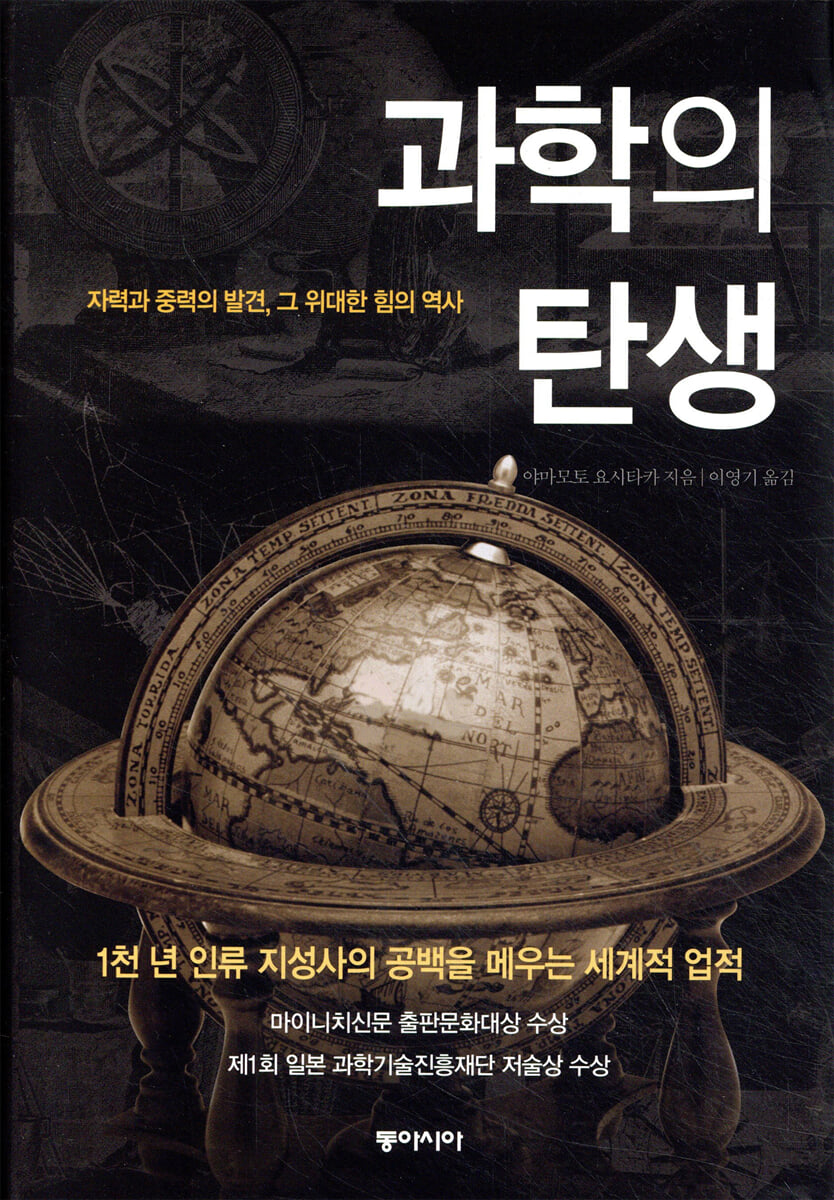
The Birth of Science
 |
Description
Book Introduction
The scene where Archimedes of ancient Greece realized the principle of volume in his bath and shouted 'Eureka!' is a familiar scene to us.
The scene where Galileo repeated, "And yet the Earth moves," is also one of the famous scenes in the history of science.
But at this point, there is something that makes you question something.
What happened in the long gap between Archimedes and Galileo?
The nearly millennium-long so-called Dark Ages, a time when scientific progress was hampered by religion and divinity, is said to have been a time when science truly "jumped" from ancient Greece to the heliocentric theory. This book explores the neglected aspects of the path leading to the birth of modern science, exploring alchemy, the occult, and magic from the Middle Ages through the Renaissance and the Age of Exploration, revealing how the foundations of modern science were laid.
In fact, most of the chemical elements and colorful compounds we know were first discovered in secret alchemical chambers, and through the Renaissance and the development of empiricism, magic transformed into a method of science, magic based on experimentation and observation.
This book can restore a thousand years of science that were omitted from world history books, in addition to the politics, economy, and society of the Middle Ages, and fill in the gaps in readers' historical memories.
The scene where Galileo repeated, "And yet the Earth moves," is also one of the famous scenes in the history of science.
But at this point, there is something that makes you question something.
What happened in the long gap between Archimedes and Galileo?
The nearly millennium-long so-called Dark Ages, a time when scientific progress was hampered by religion and divinity, is said to have been a time when science truly "jumped" from ancient Greece to the heliocentric theory. This book explores the neglected aspects of the path leading to the birth of modern science, exploring alchemy, the occult, and magic from the Middle Ages through the Renaissance and the Age of Exploration, revealing how the foundations of modern science were laid.
In fact, most of the chemical elements and colorful compounds we know were first discovered in secret alchemical chambers, and through the Renaissance and the development of empiricism, magic transformed into a method of science, magic based on experimentation and observation.
This book can restore a thousand years of science that were omitted from world history books, in addition to the politics, economy, and society of the Middle Ages, and fill in the gaps in readers' historical memories.
index
introduction
Chapter 1: The First Step Toward the Discovery of Power
Chapter 2: The Opposition Between Reductionism and Holism
Chapter 3: Networks of Empathy and Antipathy
Chapter 4 Medieval Christianity and Magical Thought
Chapter 5: Transitions in Medieval Society and the Discovery of Magnet Orientation
Chapter 6: The Limits and Positivity of Scholastic Philosophy
Chapter 7: Roger Bacon and the Propagation of Magnetism
Chapter 8: Escape from Mysticism - Peregrinus and
Chapter 9: Cusanus and the Quantification of Magnetism
Chapter 10: Rediscovering the Ancient World: Magical Thought in the Early Renaissance
Chapter 11: The Age of Exploration and the Discovery of Declination
Chapter 12: New Protagonists in Natural Science
Chapter 13: The 16th-Century Cultural Revolution and Understanding Self-Reliance
Chapter 14: Paracelsus's Philosophy of Chemistry and Magnetism
Chapter 15: In Search of Hidden Powers: Late Renaissance Magical Thought
Chapter 16: Towards Modern Natural Science - Della Porta and
Chapter 17: The Ascension of the Modern Cosmos and Gilbert's Philosophy of Self
Chapter 18: The Embryos of Universal Gravitation: Kepler's Celestial Physics
Chapter 19: Refuges of Ignorance: Seventeenth-Century Mechanistic Philosophy
Chapter 20: Robert Boyle and the Transformation of British Mechanism
Chapter 21: The Discovery of Magnetism and Gravity: Hooke and Newton
Chapter 22: Epilogue: Measurement and Confirmation of the Law of Magnetism
Author's Note
Translator's Note
main
References
Search
Chapter 1: The First Step Toward the Discovery of Power
Chapter 2: The Opposition Between Reductionism and Holism
Chapter 3: Networks of Empathy and Antipathy
Chapter 4 Medieval Christianity and Magical Thought
Chapter 5: Transitions in Medieval Society and the Discovery of Magnet Orientation
Chapter 6: The Limits and Positivity of Scholastic Philosophy
Chapter 7: Roger Bacon and the Propagation of Magnetism
Chapter 8: Escape from Mysticism - Peregrinus and
Chapter 9: Cusanus and the Quantification of Magnetism
Chapter 10: Rediscovering the Ancient World: Magical Thought in the Early Renaissance
Chapter 11: The Age of Exploration and the Discovery of Declination
Chapter 12: New Protagonists in Natural Science
Chapter 13: The 16th-Century Cultural Revolution and Understanding Self-Reliance
Chapter 14: Paracelsus's Philosophy of Chemistry and Magnetism
Chapter 15: In Search of Hidden Powers: Late Renaissance Magical Thought
Chapter 16: Towards Modern Natural Science - Della Porta and
Chapter 17: The Ascension of the Modern Cosmos and Gilbert's Philosophy of Self
Chapter 18: The Embryos of Universal Gravitation: Kepler's Celestial Physics
Chapter 19: Refuges of Ignorance: Seventeenth-Century Mechanistic Philosophy
Chapter 20: Robert Boyle and the Transformation of British Mechanism
Chapter 21: The Discovery of Magnetism and Gravity: Hooke and Newton
Chapter 22: Epilogue: Measurement and Confirmation of the Law of Magnetism
Author's Note
Translator's Note
main
References
Search
Born in Busan, he graduated from the Department of Physics at Seoul National University.
While working as a reporter in the culture department of a newspaper, I enjoyed writing about a variety of topics across culture, including science, philosophy, and film.
He wrote 『A History of Science Beyond Common Sense』(Saegil), and translated 『Einstein's Philosophical Views and Theory of Relativity』(Ilbit), 『Film Dictionary - Theory and Criticism』(Hannarae), and 『Conversations with Hitchcock』(Hannarae).
Born in Busan, he graduated from the Department of Physics at Seoul National University.
While working as a reporter in the culture department of a newspaper, I enjoyed writing about a variety of topics across culture, including science, philosophy, and film.
He wrote 『A History of Science Beyond Common Sense』(Saegil), and translated 『Einstein's Philosophical Views and Theory of Relativity』(Ilbit), 『Film Dictionary - Theory and Criticism』(Hannarae), and 『Conversations with Hitchcock』(Hannarae).
While working as a reporter in the culture department of a newspaper, I enjoyed writing about a variety of topics across culture, including science, philosophy, and film.
He wrote 『A History of Science Beyond Common Sense』(Saegil), and translated 『Einstein's Philosophical Views and Theory of Relativity』(Ilbit), 『Film Dictionary - Theory and Criticism』(Hannarae), and 『Conversations with Hitchcock』(Hannarae).
Born in Busan, he graduated from the Department of Physics at Seoul National University.
While working as a reporter in the culture department of a newspaper, I enjoyed writing about a variety of topics across culture, including science, philosophy, and film.
He wrote 『A History of Science Beyond Common Sense』(Saegil), and translated 『Einstein's Philosophical Views and Theory of Relativity』(Ilbit), 『Film Dictionary - Theory and Criticism』(Hannarae), and 『Conversations with Hitchcock』(Hannarae).
Into the book
The revolution in space that began with Copernicus was finally completed by Newton, who elucidated the physical order of the solar system through Kepler and Robert Hooke.
Although Copernicus advocated a geometrical transition from a geocentric to a heliocentric system, it was Kepler and Newton who provided the physical and dynamical basis for it.
Their central argument was the concept of gravitational force acting between celestial bodies.
In 1600, William Gilbert saw the Earth not as a motionless lump of dirt, but as a magnet with an active force.
In 1609, Kepler, inspired by the word magnet, proposed that the Sun exerts a magnetic force on the planets.
Subsequently, Newton derived the concept of universal gravitation, which is inversely proportional to the square of the distance and proportional to each mass, from Kepler's laws of planetary motion.
Through this series of processes, a new cosmological model was born that replaced the Aristotelian-Ptolemaic model that had dominated for nearly two thousand years.
Although Copernicus advocated a geometrical transition from a geocentric to a heliocentric system, it was Kepler and Newton who provided the physical and dynamical basis for it.
Their central argument was the concept of gravitational force acting between celestial bodies.
In 1600, William Gilbert saw the Earth not as a motionless lump of dirt, but as a magnet with an active force.
In 1609, Kepler, inspired by the word magnet, proposed that the Sun exerts a magnetic force on the planets.
Subsequently, Newton derived the concept of universal gravitation, which is inversely proportional to the square of the distance and proportional to each mass, from Kepler's laws of planetary motion.
Through this series of processes, a new cosmological model was born that replaced the Aristotelian-Ptolemaic model that had dominated for nearly two thousand years.
---From the preface
GOODS SPECIFICS
- Date of issue: April 8, 2005
- Page count, weight, size: 1,004 pages | 1,556g | 165*232*60mm
- ISBN13: 9788988165553
- ISBN10: 8988165551
You may also like
카테고리
korean


korean

![ELLE 엘르 스페셜 에디션 A형 : 12월 [2025]](http://librairie.coreenne.fr/cdn/shop/files/b8e27a3de6c9538896439686c6b0e8fb.jpg?v=1766436872&width=3840)


