

Living with dignity
 |
Description
Book Introduction
“If you want your death to be dignified,
Shouldn’t life be dignified first?”
Gerald Hütter, a living intellectual from Germany and a world-renowned neuroscientist, poses a question.
A bold topic that will shake up individuals and society
In a lecture hall with hundreds of people gathered, a scientist suddenly asked a CEO who was on the panel this question.
“You have been given the opportunity to make a very big profit.
But that opportunity is something that destroys your dignity.
“What choice will you make?” The CEO, caught in a dilemma, was speechless for a while.
As a representative of a company, I could not say that I would give up profits, but I could not say that I would give up my personal dignity either.
Could we, unlike that CEO, have unhesitatingly chosen dignity? Living in an age where only winning the competition and achieving wealth and fame are considered successful, we deeply empathize with how difficult that choice is.
The protagonist of this lecture that silenced the CEO was none other than Germany's leading intellectual and neurobiologist, Gerald Hütter.
He says that when people think of 'dignity', they think of natural rights guaranteed by the Constitution or philosophical topics, but from a neurobiological perspective, dignity is an innate 'instinct' that humans have and a 'sense' that we must revive in life.
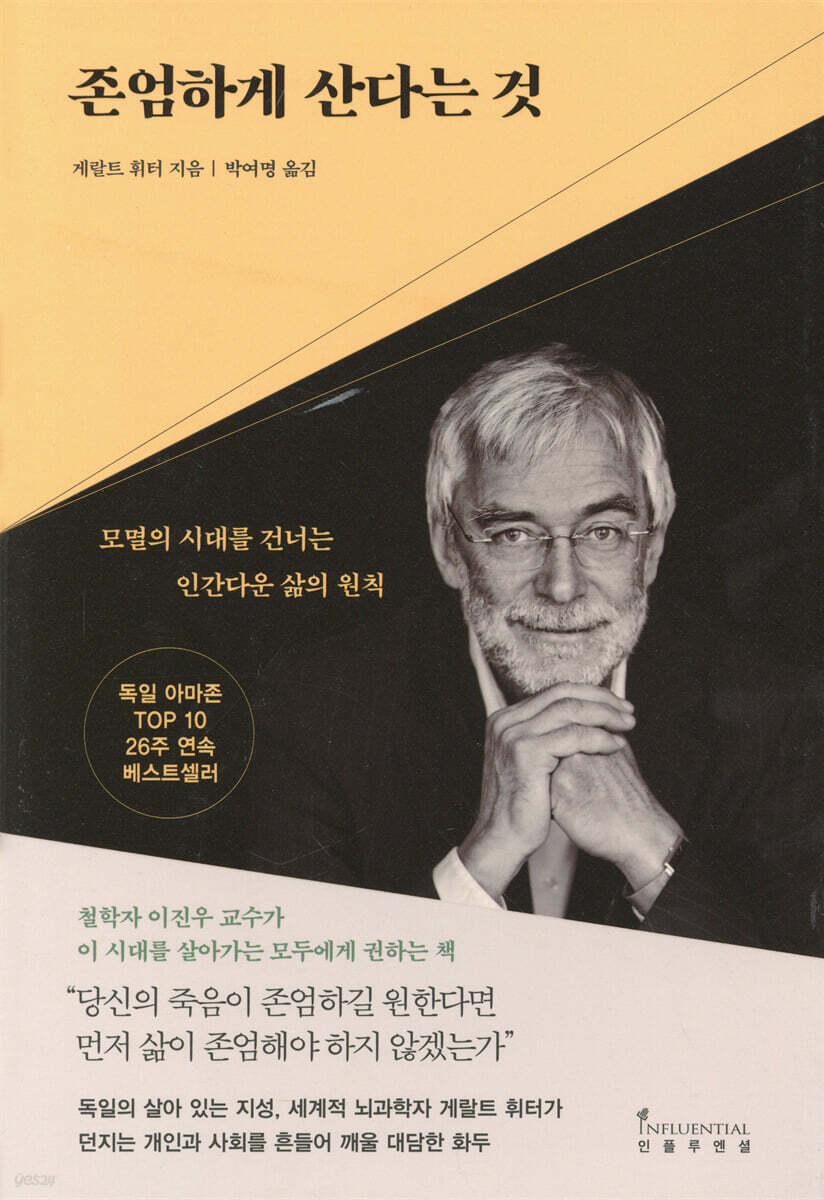
His book, "Wurde: Was uns stark macht - als Einzelne und als Gesellschaft", which explains the meaning of dignity based on an objective analysis of the human nervous system and cognitive abilities, had a great impact on German society, staying in the top 10 of the German Amazon bestseller list for 26 consecutive weeks at the time of its publication.
This book seems to ask this question to us living in the same era.
“Are our lives truly dignified?”
All humans have an innate desire to be respected and protected, but as we live, we become lost and unsteady amidst the countless demands of others and the community we encounter.
This is because the human brain is a 'social organ' that learns and is structured through relationships with others throughout life.
Gerald Hütter, a prominent German intellectual and neurobiologist, says that the brain needs a kind of compass to escape this state of chaos and restore inner order.
It is 'dignity'.
'Dignity' is not a natural right, but rather a thought pattern and attitude toward life that is formed in the brain through a long process in which individuals and society maintain meaning.
This book, which contains the insights gained from Gerald Hütter's lifelong research on the question, "What is a humane life, a life of dignity?", will provide the courage to persevere in life in times of turmoil.
Shouldn’t life be dignified first?”
Gerald Hütter, a living intellectual from Germany and a world-renowned neuroscientist, poses a question.
A bold topic that will shake up individuals and society
In a lecture hall with hundreds of people gathered, a scientist suddenly asked a CEO who was on the panel this question.
“You have been given the opportunity to make a very big profit.
But that opportunity is something that destroys your dignity.
“What choice will you make?” The CEO, caught in a dilemma, was speechless for a while.
As a representative of a company, I could not say that I would give up profits, but I could not say that I would give up my personal dignity either.
Could we, unlike that CEO, have unhesitatingly chosen dignity? Living in an age where only winning the competition and achieving wealth and fame are considered successful, we deeply empathize with how difficult that choice is.
The protagonist of this lecture that silenced the CEO was none other than Germany's leading intellectual and neurobiologist, Gerald Hütter.
He says that when people think of 'dignity', they think of natural rights guaranteed by the Constitution or philosophical topics, but from a neurobiological perspective, dignity is an innate 'instinct' that humans have and a 'sense' that we must revive in life.
His book, "Wurde: Was uns stark macht - als Einzelne und als Gesellschaft", which explains the meaning of dignity based on an objective analysis of the human nervous system and cognitive abilities, had a great impact on German society, staying in the top 10 of the German Amazon bestseller list for 26 consecutive weeks at the time of its publication.
This book seems to ask this question to us living in the same era.
“Are our lives truly dignified?”
All humans have an innate desire to be respected and protected, but as we live, we become lost and unsteady amidst the countless demands of others and the community we encounter.
This is because the human brain is a 'social organ' that learns and is structured through relationships with others throughout life.
Gerald Hütter, a prominent German intellectual and neurobiologist, says that the brain needs a kind of compass to escape this state of chaos and restore inner order.
It is 'dignity'.
'Dignity' is not a natural right, but rather a thought pattern and attitude toward life that is formed in the brain through a long process in which individuals and society maintain meaning.
This book, which contains the insights gained from Gerald Hütter's lifelong research on the question, "What is a humane life, a life of dignity?", will provide the courage to persevere in life in times of turmoil.
- You can preview some of the book's contents.
Preview
index
Recommendation
prolog
Chapter 1: Thinking about Lost Dignity
About the memories we have lost | No more insect sounds | Labor that is not respected | Precarious beings everywhere | The trap of profit maximization | When a fearful future becomes reality
Chapter 2: How Dignity Was Born
Old and Noble | The Middle Ages, Humans Resembling God | Kant, the Unconditional Command on Dignity | The Declaration of Dignity Blooming from the Ashes of War | Self-Understanding in a New Era
Chapter 3: The Extremely Human Brain
The Brain: Ability to Learn | The Human Social Brain | A Deeper Understanding of Humanity | The 21st Century's Most Urgent Challenge | Faulty Survival Strategies
Chapter 4: The Social Brain: Learning Dignity
Energy Minimization and Optimization | Consistency as a Survival Strategy | Identity as a Pattern
Chapter 5: In Search of Dignity Engraved in Instinct
Socialized Neural Circuits | Warning Lights of Crisis
Chapter 6: Why We Must Protect the Dignity of Others
Self-consciousness that begins with others | The painful experience of objectification | The mirror of the dignity of others
Chapter 7: The Beginning of a Journey to a Stronger Life
The First Step Toward Freedom | Between Crime and Dignity | You Can't Hurt Me
Chapter 8: What kind of world will we teach?
The Most Urgent Educational Issue | Waiting, Not Solutions | Rethinking the Meaning of Education
Chapter 9: To no longer live by means
The Dogma of the "Selfish Gene" | The Birth of a New Circuit | A Life That Feels Alive
Epilogue
Acknowledgements
prolog
Chapter 1: Thinking about Lost Dignity
About the memories we have lost | No more insect sounds | Labor that is not respected | Precarious beings everywhere | The trap of profit maximization | When a fearful future becomes reality
Chapter 2: How Dignity Was Born
Old and Noble | The Middle Ages, Humans Resembling God | Kant, the Unconditional Command on Dignity | The Declaration of Dignity Blooming from the Ashes of War | Self-Understanding in a New Era
Chapter 3: The Extremely Human Brain
The Brain: Ability to Learn | The Human Social Brain | A Deeper Understanding of Humanity | The 21st Century's Most Urgent Challenge | Faulty Survival Strategies
Chapter 4: The Social Brain: Learning Dignity
Energy Minimization and Optimization | Consistency as a Survival Strategy | Identity as a Pattern
Chapter 5: In Search of Dignity Engraved in Instinct
Socialized Neural Circuits | Warning Lights of Crisis
Chapter 6: Why We Must Protect the Dignity of Others
Self-consciousness that begins with others | The painful experience of objectification | The mirror of the dignity of others
Chapter 7: The Beginning of a Journey to a Stronger Life
The First Step Toward Freedom | Between Crime and Dignity | You Can't Hurt Me
Chapter 8: What kind of world will we teach?
The Most Urgent Educational Issue | Waiting, Not Solutions | Rethinking the Meaning of Education
Chapter 9: To no longer live by means
The Dogma of the "Selfish Gene" | The Birth of a New Circuit | A Life That Feels Alive
Epilogue
Acknowledgements
Detailed image

Into the book
What I hope to discover with you through this book is a kind of inner compass.
An inner compass that an individual forms as he or she lives.
A compass to help you avoid losing yourself in the face of the many demands that come from outside.
A compass that will protect you from the countless temptations and promises made by others.
--- From the "Prologue"
In front of an audience of about 200 people, I immediately asked a question to a CEO of a large corporation who was sitting next to me on the panel.
“You have been given the opportunity to make a lot of money.
But that opportunity is something that destroys one's own dignity.
“What choice would you make when faced with the immediate benefits and personal dignity?” Looking at the CEO, I realized anew that a person can be so bewildered and helpless.
--- From "Epilogue"
The solution to the problem also lies with the people living in that society and those who will continue to evolve across generations.
This is because it is a biological ability and potential that humans have had since the beginning.
The answer lies in the brain structure and function that only humans possess.
The human brain has special conditions that enable it to awaken, and even compel it to awaken, the idea of human dignity as a human being.
It is the enormous openness of the human brain and the plasticity of the brain that continues throughout life.
--- From “Chapter 2: How Dignity Was Born”
The human brain becomes confused when a problem arises and the emotional center of the brain becomes activated, and when the brain activity deviates from a consistent state, it needs something to help stabilize it.
In the process, the activated neural networks are further expanded and strengthened.
Generally speaking, the brain is structured based on the solutions discovered in the process of finding important meaning in life.
If, in the process, a person experiences protection and belonging, as well as personal creativity and autonomy over one's own body, the greater the intensity of that experience, the more deeply it becomes rooted in the brain.
These basic needs are firmly fixed in the brain, making it more likely that one will recognize one's own dignity. --- From "Chapter 3: The Extremely Human Brain"
The amount of energy available is limited, and we adjust our working methods to avoid consuming more energy than that.
This problem is not limited to our brain.
All living things must establish internal order and structures that minimize the energy consumption of their systems.
Because that's how we can survive.
But this basic principle causes problems in the human brain.
This is because our brain already uses 20 percent of its available energy even when it is at rest, that is, when it is doing nothing and not even thinking about anything.
This is by no means a small amount.
Even when we start thinking, face a problem that needs to be solved, find ourselves in a conflict situation, or simply learn something new, our energy expenditure skyrockets.
--- From "Chapter 4: The Social Brain, Learning Dignity"
Children have an intuition that something is wrong and a red light comes on.
It exists not in the form of an idea, thought, conviction, or demand, but as a very subtle emotion, that is, a subjective sensation.
Children are born with this sense.
It is a sense of what is right, a sense of how one wants to be treated, and a sense of how one should coexist with others.
A sense of what it means to live like a human being, that is, to live with 'dignity'.
--- From "Chapter 5: In Search of Dignity Engraved in Instinct"
When humans, who should be ends in themselves, are treated as a means, it destroys the fundamental human desire for affection and belonging, as well as for subjectivity and freedom.
Surprisingly, the areas of the brain that are activated when we are in these environments are the same areas that are activated when something goes wrong in our bodies.
It is literally a 'painful' experience for the brain as well.
--- From “Chapter 6: Why We Must Protect the Dignity of Others”
A person who lives with dignity, not just living as he or she lives.
Not a person who lives without direction, but a person who lives toward humanity.
Recognizing one's own dignity is the first step toward freedom and the first act of self-reliance.
--- From "Chapter 7: The Beginning of a Journey to a Strong Life"
An inner compass that an individual forms as he or she lives.
A compass to help you avoid losing yourself in the face of the many demands that come from outside.
A compass that will protect you from the countless temptations and promises made by others.
--- From the "Prologue"
In front of an audience of about 200 people, I immediately asked a question to a CEO of a large corporation who was sitting next to me on the panel.
“You have been given the opportunity to make a lot of money.
But that opportunity is something that destroys one's own dignity.
“What choice would you make when faced with the immediate benefits and personal dignity?” Looking at the CEO, I realized anew that a person can be so bewildered and helpless.
--- From "Epilogue"
The solution to the problem also lies with the people living in that society and those who will continue to evolve across generations.
This is because it is a biological ability and potential that humans have had since the beginning.
The answer lies in the brain structure and function that only humans possess.
The human brain has special conditions that enable it to awaken, and even compel it to awaken, the idea of human dignity as a human being.
It is the enormous openness of the human brain and the plasticity of the brain that continues throughout life.
--- From “Chapter 2: How Dignity Was Born”
The human brain becomes confused when a problem arises and the emotional center of the brain becomes activated, and when the brain activity deviates from a consistent state, it needs something to help stabilize it.
In the process, the activated neural networks are further expanded and strengthened.
Generally speaking, the brain is structured based on the solutions discovered in the process of finding important meaning in life.
If, in the process, a person experiences protection and belonging, as well as personal creativity and autonomy over one's own body, the greater the intensity of that experience, the more deeply it becomes rooted in the brain.
These basic needs are firmly fixed in the brain, making it more likely that one will recognize one's own dignity. --- From "Chapter 3: The Extremely Human Brain"
The amount of energy available is limited, and we adjust our working methods to avoid consuming more energy than that.
This problem is not limited to our brain.
All living things must establish internal order and structures that minimize the energy consumption of their systems.
Because that's how we can survive.
But this basic principle causes problems in the human brain.
This is because our brain already uses 20 percent of its available energy even when it is at rest, that is, when it is doing nothing and not even thinking about anything.
This is by no means a small amount.
Even when we start thinking, face a problem that needs to be solved, find ourselves in a conflict situation, or simply learn something new, our energy expenditure skyrockets.
--- From "Chapter 4: The Social Brain, Learning Dignity"
Children have an intuition that something is wrong and a red light comes on.
It exists not in the form of an idea, thought, conviction, or demand, but as a very subtle emotion, that is, a subjective sensation.
Children are born with this sense.
It is a sense of what is right, a sense of how one wants to be treated, and a sense of how one should coexist with others.
A sense of what it means to live like a human being, that is, to live with 'dignity'.
--- From "Chapter 5: In Search of Dignity Engraved in Instinct"
When humans, who should be ends in themselves, are treated as a means, it destroys the fundamental human desire for affection and belonging, as well as for subjectivity and freedom.
Surprisingly, the areas of the brain that are activated when we are in these environments are the same areas that are activated when something goes wrong in our bodies.
It is literally a 'painful' experience for the brain as well.
--- From “Chapter 6: Why We Must Protect the Dignity of Others”
A person who lives with dignity, not just living as he or she lives.
Not a person who lives without direction, but a person who lives toward humanity.
Recognizing one's own dignity is the first step toward freedom and the first act of self-reliance.
--- From "Chapter 7: The Beginning of a Journey to a Strong Life"
--- From "Chapter 7: The Beginning of a Journey to a Strong Life"
Publisher's Review
The question that silenced the CEO: “Can you choose dignity over immediate profit?”
In a lecture hall with hundreds of people gathered, a scientist suddenly asked a CEO who was on the panel this question.
“You have been given the opportunity to make a very big profit.
But that opportunity is something that destroys your dignity.
“What choice will you make?” The CEO, caught in a dilemma, was speechless for a while.
As a representative of a company, I could not say that I would give up profits, but I could not say that I would give up my personal dignity either.
Could we, unlike that CEO, have unhesitatingly chosen dignity? Living in an age where only winning the competition and achieving wealth and fame are considered successful, we deeply empathize with how difficult that choice is.
The protagonist of this lecture that silenced the CEO was none other than Germany's leading intellectual and neurobiologist, Gerald Hütter.
He says that when people think of 'dignity', they think of natural rights guaranteed by the Constitution or philosophical topics, but from a neurobiological perspective, dignity is an innate 'instinct' that humans have and a 'sense' that we must revive in life.
His book, "Wurde: Was uns stark macht - als Einzelne und als Gesellschaft", which explains the meaning of dignity based on an objective analysis of the human nervous system and cognitive abilities, had a great impact on German society, staying in the top 10 of the German Amazon bestseller list for 26 consecutive weeks at the time of its publication.
This book seems to ask this question to us living in the same era.
“Are our lives truly dignified?”
In an age of lost dignity, "Why talk about a dignified life now?"
Since the Netherlands first legalized euthanasia in 2000, death with dignity has become a global issue.
But sitting in a field in Göttingen, where pollution has wiped out all the bees, Gerald Hütter raises a powerful question.
“Why do people talk about a dignified and dignified death, but not about a dignified life before that?”
Gerald Hütter, as a neuroscientist, identifies these undignified conditions of life one by one, and expresses deep concern about the aspects of our lives that are losing their way and heading towards destruction.
In the midst of the great wave of capitalism, everything that businesses, societies, and individuals have chosen to compete and survive has returned to us as unexpected results.
Environmental disasters such as global warming and air pollution that threaten our survival, the reality of labor being replaced by AI and automated robots in the name of profit maximization, and even the greed of individuals that has grown inflated amidst the countless advertisements and excessive information encountered online…
In this reality, humans, who should be an end in themselves, are reduced to objects and tools of evaluation, losing their direction and staggering.
What's interesting is that when we are in an environment that destroys basic human needs like affection, belonging, agency, and freedom, when we scan our brains with a precision machine, the same areas that are activated when the body feels pain are activated.
The brain literally suffers from the undignified reality.
In this way, “Living with Dignity” says that in this era of humiliation that causes suffering and loss of respect and dignity, in this era where humanity has been lost, the most urgent task is to revive the principle of life called dignity.
Dignity from a Neurobiological Perspective: "It's a Brain Sense, Not a Right"
What does "dignity" truly mean to humans? The human brain, which consumes 20% of its energy even while sleeping or resting, is already in such disarray that it struggles to function properly in today's complex society.
At this time, we need an inner compass that calms the confusion and provides a consistent direction, and Gerald Hütter reveals that 'dignity', a sense deeply rooted in the brain, plays this role.
Gerald Hütter, who has dedicated himself to educating the public by translating his research findings on anxiety, depression, potential, and motivation into everyday language, explains in this book that dignity is a belief system that influences human attitudes and behavior.
The human brain is a "social organ" that learns and is structured through experiences with others, forming new patterns of neurons that control and direct thought and behavior throughout life.
This property of the brain is called 'brain plasticity', and through this characteristic that only humans have, the belief system called dignity is formed.
Dignity is a sense that only humans possess.
The book's central proposition, "A human being who has come to recognize his own dignity is never deceived," comes from this very way the brain works.
People who have fully experienced protection, belonging, creativity, and autonomy in their relationships with others can sustain their lives against any external temptation based on a strongly rooted belief in "dignity."
Therefore, if a process is initiated to continuously help people recognize dignity in various communities, such as families, educational institutions, and workplaces, this will enable fundamental change and development not only for individuals but also for society.
How to Restore Dignity: "A person who recognizes dignity is never deceived."
Children have an intuition that something is wrong and a red light comes on.
Even though they haven't yet gone through the stage of forming a belief system, children already have a sense of dignity in the form of very subtle emotions from birth.
According to Gerald Hütter's research on the early stages of human brain formation, the most important task of education is to constantly make children 'aware of dignity'.
In an overly competitive society, our children inevitably encounter experiences where they become the objects of others' goals, expectations, and even orders, and they gradually lose the dignity that is inherent in them.
To avoid the pain of losing their dignity, children seek solutions, such as treating others as a means to an end, or making themselves objects of evaluation by others.
However, a child who is confident in his or her own dignity will not be greatly hurt by the rude behavior of others.
They are curious and passionate, and they study not to win competitions and be recognized, but because they are open-minded and find everything interesting.
When given ample time to learn what is most important in life and what it means to be human, the human brain can reach its full potential by thinking and acting more consistently and efficiently.
It's like someone who couldn't ride a bicycle without help, but after a few repetitions, they become accustomed to pedaling and are finally able to go further.
Gerald Hütter's assertion that through dignity, every individual can awaken their potential and be reborn as a free being comes as a warm encouragement to us who have grown weary from running solely for competition.
For individuals and societies that pursue greater happiness through dignity, beyond competition.
Even in the horrific Jewish concentration camps where human instincts were destroyed, humans tried to preserve their dignity.
As Dr. Viktor Frankl said, “The inalienable spiritual freedom that compels us to find ways to make our lives more meaningful, even to our last breath,” dignity is the power that gives us hope to live again in the last bastion of life.
Even amidst the countless incidents that have rocked Korean society, including drug abuse, sexual violence, bullying, and various other corruptions, the stories of those who extend a helping hand to the underprivileged in order to uphold the principle of dignity shine even brighter.
This book, which contains the insights gleaned from Gerald Hütter's lifelong research on the question, "What is a humane life, a life of dignity?", will provide courage to Korean society, living in a time of turmoil, to seek the possibility and potential for greater happiness.
In a lecture hall with hundreds of people gathered, a scientist suddenly asked a CEO who was on the panel this question.
“You have been given the opportunity to make a very big profit.
But that opportunity is something that destroys your dignity.
“What choice will you make?” The CEO, caught in a dilemma, was speechless for a while.
As a representative of a company, I could not say that I would give up profits, but I could not say that I would give up my personal dignity either.
Could we, unlike that CEO, have unhesitatingly chosen dignity? Living in an age where only winning the competition and achieving wealth and fame are considered successful, we deeply empathize with how difficult that choice is.
The protagonist of this lecture that silenced the CEO was none other than Germany's leading intellectual and neurobiologist, Gerald Hütter.
He says that when people think of 'dignity', they think of natural rights guaranteed by the Constitution or philosophical topics, but from a neurobiological perspective, dignity is an innate 'instinct' that humans have and a 'sense' that we must revive in life.
His book, "Wurde: Was uns stark macht - als Einzelne und als Gesellschaft", which explains the meaning of dignity based on an objective analysis of the human nervous system and cognitive abilities, had a great impact on German society, staying in the top 10 of the German Amazon bestseller list for 26 consecutive weeks at the time of its publication.
This book seems to ask this question to us living in the same era.
“Are our lives truly dignified?”
In an age of lost dignity, "Why talk about a dignified life now?"
Since the Netherlands first legalized euthanasia in 2000, death with dignity has become a global issue.
But sitting in a field in Göttingen, where pollution has wiped out all the bees, Gerald Hütter raises a powerful question.
“Why do people talk about a dignified and dignified death, but not about a dignified life before that?”
Gerald Hütter, as a neuroscientist, identifies these undignified conditions of life one by one, and expresses deep concern about the aspects of our lives that are losing their way and heading towards destruction.
In the midst of the great wave of capitalism, everything that businesses, societies, and individuals have chosen to compete and survive has returned to us as unexpected results.
Environmental disasters such as global warming and air pollution that threaten our survival, the reality of labor being replaced by AI and automated robots in the name of profit maximization, and even the greed of individuals that has grown inflated amidst the countless advertisements and excessive information encountered online…
In this reality, humans, who should be an end in themselves, are reduced to objects and tools of evaluation, losing their direction and staggering.
What's interesting is that when we are in an environment that destroys basic human needs like affection, belonging, agency, and freedom, when we scan our brains with a precision machine, the same areas that are activated when the body feels pain are activated.
The brain literally suffers from the undignified reality.
In this way, “Living with Dignity” says that in this era of humiliation that causes suffering and loss of respect and dignity, in this era where humanity has been lost, the most urgent task is to revive the principle of life called dignity.
Dignity from a Neurobiological Perspective: "It's a Brain Sense, Not a Right"
What does "dignity" truly mean to humans? The human brain, which consumes 20% of its energy even while sleeping or resting, is already in such disarray that it struggles to function properly in today's complex society.
At this time, we need an inner compass that calms the confusion and provides a consistent direction, and Gerald Hütter reveals that 'dignity', a sense deeply rooted in the brain, plays this role.
Gerald Hütter, who has dedicated himself to educating the public by translating his research findings on anxiety, depression, potential, and motivation into everyday language, explains in this book that dignity is a belief system that influences human attitudes and behavior.
The human brain is a "social organ" that learns and is structured through experiences with others, forming new patterns of neurons that control and direct thought and behavior throughout life.
This property of the brain is called 'brain plasticity', and through this characteristic that only humans have, the belief system called dignity is formed.
Dignity is a sense that only humans possess.
The book's central proposition, "A human being who has come to recognize his own dignity is never deceived," comes from this very way the brain works.
People who have fully experienced protection, belonging, creativity, and autonomy in their relationships with others can sustain their lives against any external temptation based on a strongly rooted belief in "dignity."
Therefore, if a process is initiated to continuously help people recognize dignity in various communities, such as families, educational institutions, and workplaces, this will enable fundamental change and development not only for individuals but also for society.
How to Restore Dignity: "A person who recognizes dignity is never deceived."
Children have an intuition that something is wrong and a red light comes on.
Even though they haven't yet gone through the stage of forming a belief system, children already have a sense of dignity in the form of very subtle emotions from birth.
According to Gerald Hütter's research on the early stages of human brain formation, the most important task of education is to constantly make children 'aware of dignity'.
In an overly competitive society, our children inevitably encounter experiences where they become the objects of others' goals, expectations, and even orders, and they gradually lose the dignity that is inherent in them.
To avoid the pain of losing their dignity, children seek solutions, such as treating others as a means to an end, or making themselves objects of evaluation by others.
However, a child who is confident in his or her own dignity will not be greatly hurt by the rude behavior of others.
They are curious and passionate, and they study not to win competitions and be recognized, but because they are open-minded and find everything interesting.
When given ample time to learn what is most important in life and what it means to be human, the human brain can reach its full potential by thinking and acting more consistently and efficiently.
It's like someone who couldn't ride a bicycle without help, but after a few repetitions, they become accustomed to pedaling and are finally able to go further.
Gerald Hütter's assertion that through dignity, every individual can awaken their potential and be reborn as a free being comes as a warm encouragement to us who have grown weary from running solely for competition.
For individuals and societies that pursue greater happiness through dignity, beyond competition.
Even in the horrific Jewish concentration camps where human instincts were destroyed, humans tried to preserve their dignity.
As Dr. Viktor Frankl said, “The inalienable spiritual freedom that compels us to find ways to make our lives more meaningful, even to our last breath,” dignity is the power that gives us hope to live again in the last bastion of life.
Even amidst the countless incidents that have rocked Korean society, including drug abuse, sexual violence, bullying, and various other corruptions, the stories of those who extend a helping hand to the underprivileged in order to uphold the principle of dignity shine even brighter.
This book, which contains the insights gleaned from Gerald Hütter's lifelong research on the question, "What is a humane life, a life of dignity?", will provide courage to Korean society, living in a time of turmoil, to seek the possibility and potential for greater happiness.
GOODS SPECIFICS
- Date of issue: May 17, 2019
- Page count, weight, size: 230 pages | 336g | 135*195*18mm
- ISBN13: 9791189995072
- ISBN10: 1189995077
You may also like
카테고리
korean


korean

![ELLE 엘르 스페셜 에디션 A형 : 12월 [2025]](http://librairie.coreenne.fr/cdn/shop/files/b8e27a3de6c9538896439686c6b0e8fb.jpg?v=1766436872&width=3840)


