

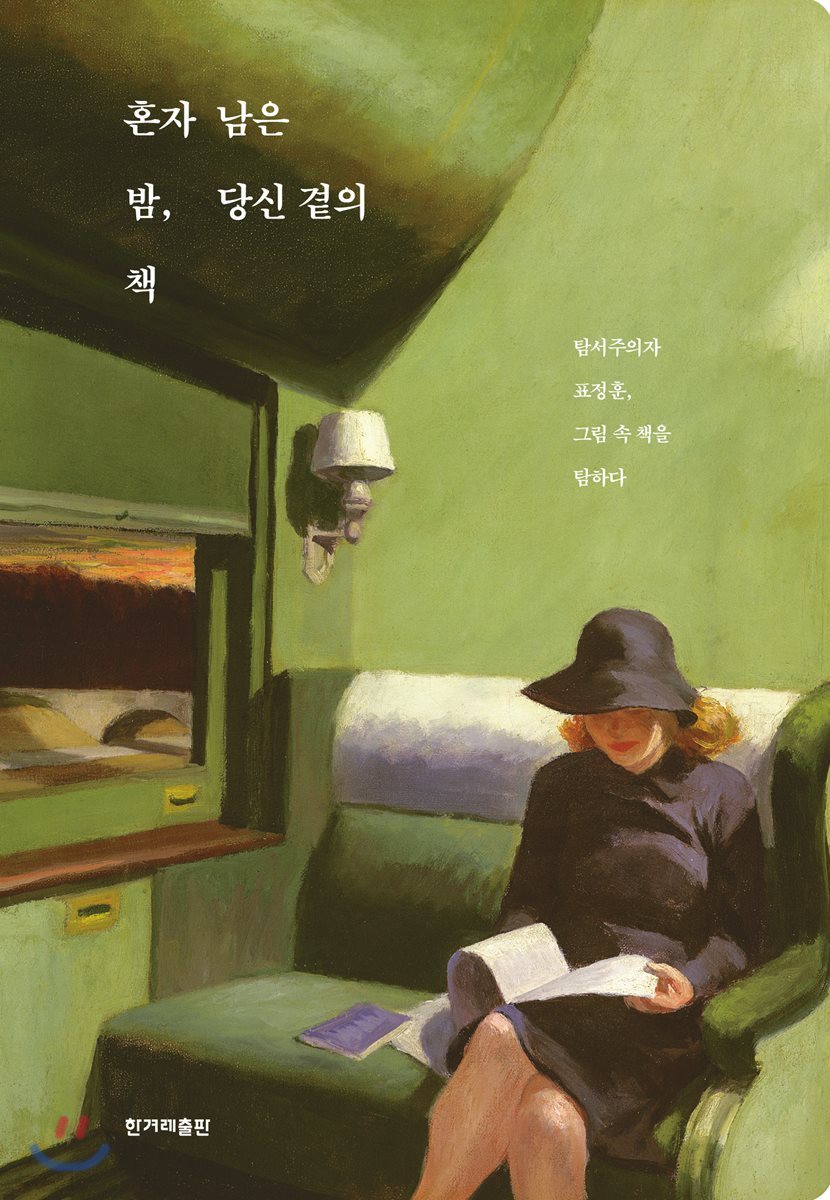
A book by your side on a night left alone
 |
Description
Book Introduction
- A word from MD
-
A fascinating story about books and peopleHave you ever glanced at someone else's book in a cafe? Even the bibliophile author seems to have this curiosity.
He wrote this book because he was curious about what books appear in famous paintings.
Filled with fascinating stories about books, this book is a treasure that many bibliophiles will covet.
May 3, 2019. Humanities PD Son Min-gyu
“What book is that in the picture?”
Edward Hopper, René Magritte, Velazquez,
Including works by Van Gogh and lesser-known painters at home and abroad
Discover 38 books from new and exciting works
“There are quite a few pictures depicting books.
So, wouldn't it be worthwhile to ask yourself this question at least once?
'What book is that in the picture?'
“It was precisely this curiosity that gave rise to this book.”
The new work, "A Book by Your Side, Left Alone at Night," by Pyo Jeong-hun, a publishing critic and translator who excels at gathering knowledge across Eastern and Western literature, history, and philosophy, has been published.
This is the first solo publication in about six years since “Turning on Philosophy.”
'What kind of book is that in the painting?' This book, written from this question, introduces new and interesting works by lesser-known artists, both domestically and internationally, as well as works by Edward Hopper, René Magritte, Vincent van Gogh, and Velazquez, who are familiar to the public.
Among them, only the paintings featuring books are selected to tell the cultural history of the two most powerful and poignant friends: paintings and books.
Artist Pyo Jeong-hun completed this book by imagining the stories likely embedded in these paintings, the deep conversations between the painter and the characters in the paintings, and a glimpse into the lives of the characters in the paintings, all of these secrets.
The book in the picture was imagined by estimating the book, reading, and publishing culture of the time when the picture was drawn.
This kind of imagination is possible because of the long-time hobby and extensive reading of writer Pyo Jeong-hun.
The author, who is well known as a bibliophile, has long had a hobby of imagining stories hidden in paintings and imagining paintings from stories.
The material for imagination is a collection of 20,000 books.
His long-standing hobby, long-term perspective, and extensive knowledge accumulated through extensive reading gave birth to this book, “A Book by Your Side, Left Alone at Night.”
I had a hard time selecting thirty-eight pieces.
This book is a humanities essay that reflects the flow of time, history, culture, and art, and at the same time discusses books and paintings. It is a book that will stay by your side on nights when you are left alone.
Edward Hopper, René Magritte, Velazquez,
Including works by Van Gogh and lesser-known painters at home and abroad
Discover 38 books from new and exciting works
“There are quite a few pictures depicting books.
So, wouldn't it be worthwhile to ask yourself this question at least once?
'What book is that in the picture?'
“It was precisely this curiosity that gave rise to this book.”
The new work, "A Book by Your Side, Left Alone at Night," by Pyo Jeong-hun, a publishing critic and translator who excels at gathering knowledge across Eastern and Western literature, history, and philosophy, has been published.
This is the first solo publication in about six years since “Turning on Philosophy.”
'What kind of book is that in the painting?' This book, written from this question, introduces new and interesting works by lesser-known artists, both domestically and internationally, as well as works by Edward Hopper, René Magritte, Vincent van Gogh, and Velazquez, who are familiar to the public.
Among them, only the paintings featuring books are selected to tell the cultural history of the two most powerful and poignant friends: paintings and books.
Artist Pyo Jeong-hun completed this book by imagining the stories likely embedded in these paintings, the deep conversations between the painter and the characters in the paintings, and a glimpse into the lives of the characters in the paintings, all of these secrets.
The book in the picture was imagined by estimating the book, reading, and publishing culture of the time when the picture was drawn.
This kind of imagination is possible because of the long-time hobby and extensive reading of writer Pyo Jeong-hun.
The author, who is well known as a bibliophile, has long had a hobby of imagining stories hidden in paintings and imagining paintings from stories.
The material for imagination is a collection of 20,000 books.
His long-standing hobby, long-term perspective, and extensive knowledge accumulated through extensive reading gave birth to this book, “A Book by Your Side, Left Alone at Night.”
I had a hard time selecting thirty-eight pieces.
This book is a humanities essay that reflects the flow of time, history, culture, and art, and at the same time discusses books and paintings. It is a book that will stay by your side on nights when you are left alone.
- You can preview some of the book's contents.
Preview
index
Preface/Reading the Pictures in the Book
Part 1: The Comfort of Reading
Solitude is soft
Homo biblica, the birth of the Western race
The moment when you willingly become a prisoner
A book that stands by your side in times of frustration
We invite you to a play of gaze.
Panathenaic Festival Assassination
Weekend dramas to watch with books
Between the pain and happiness of reading
Reading Newton's Echoes
Part 2: Her Own Room
Her eyes opened wide
She started writing
Madame de Châtelet, holding a compass and a rose
There is no 'female'.
There are only humans
A country you can't go to
Books are a light of comfort
“They have their due rights.”
Part 3: Life, Love, and Art
To all the daughters and sons of the world
Break down the wall!
The moment when two souls meet
Love has no shackles
The instincts of life and death, and stories
The Time of Truth
Hot love, cold hands
Part 4: Subjects of Freedom
Eros and the Encyclopedia
Madame de Pompadour, actress of 'Attic Theater'
Jews of The Hague and Jerusalem
tear a book
Friends from Paris and Berlin
Between Purity and Madness
One self-portrait, two looks
Part 5: Books Become Life
Books belong to everyone
There is no heresy in books and reading.
A bookstore, more than just a bookstore
The age of the classic is 18
A self-portrait that is not a self-portrait
“I had to learn on my own.”
The big book that the dwarf read
Reading and Writing, the Conditions of Freedom and Liberation
Part 1: The Comfort of Reading
Solitude is soft
Homo biblica, the birth of the Western race
The moment when you willingly become a prisoner
A book that stands by your side in times of frustration
We invite you to a play of gaze.
Panathenaic Festival Assassination
Weekend dramas to watch with books
Between the pain and happiness of reading
Reading Newton's Echoes
Part 2: Her Own Room
Her eyes opened wide
She started writing
Madame de Châtelet, holding a compass and a rose
There is no 'female'.
There are only humans
A country you can't go to
Books are a light of comfort
“They have their due rights.”
Part 3: Life, Love, and Art
To all the daughters and sons of the world
Break down the wall!
The moment when two souls meet
Love has no shackles
The instincts of life and death, and stories
The Time of Truth
Hot love, cold hands
Part 4: Subjects of Freedom
Eros and the Encyclopedia
Madame de Pompadour, actress of 'Attic Theater'
Jews of The Hague and Jerusalem
tear a book
Friends from Paris and Berlin
Between Purity and Madness
One self-portrait, two looks
Part 5: Books Become Life
Books belong to everyone
There is no heresy in books and reading.
A bookstore, more than just a bookstore
The age of the classic is 18
A self-portrait that is not a self-portrait
“I had to learn on my own.”
The big book that the dwarf read
Reading and Writing, the Conditions of Freedom and Liberation
Detailed image

Into the book
Hopper painted scenes of cities and trains, but also scenes of solitude.
Even in paintings featuring many people, each person lives his or her own inner life.
It seems unlikely that such a Hopper would have met Catherine from the neighboring farm and talked about her short trip to New York, or about the Scribner's Magazine or Tender Is the Night that she had read on the train during the trip.
But did I catch a glimpse of Catherine from afar, walking home in the darkness after returning from New York? --- pp.23-24
If someone loves books and hoards them, but rarely reads them, should they be ridiculed? No.
Wouldn't someone like that just read the cover of a book?
Even if a person only sees the title, author, and publisher information on the cover, and just appreciates the cover design and binding, he or she is clearly a reader.
Among readings, the one that is surprisingly rewarding and beneficial is 'cover reading'.
--- pp.30-31
The artist depicted the chair Carlos sits on as a virtual throne.
Could this be a consolation for Carlos, the rightful heir to the throne, who had fallen from grace due to conflict with his father? Surrounded by books, he holds them open and in his hands, but Carlos's gaze appears bewildered.
Perhaps it's because, even while immersed in a book, a deep regret suddenly creeps into my heart, reminding me of my current situation. Sometimes, upon first seeing a painting without any prior knowledge, a few words come to mind.
This picture is enough to bring to mind the words frustration and disappointment.
In the midst of such frustration and disappointment, could books, or rather, books alone, offer a small solace? Looking at Carlos's expression, it seems both ways.
What book was he holding? Given his philosophical background, wouldn't it be Boethius's "The Consolation of Philosophy"? --- pp. 44-45
The woman's expression looks relaxed.
It doesn't seem to be a book that stirs the mind, a book that shatters mental lethargy, or a book that shakes the reader with new and surprising knowledge.
Reading is a form of complete relaxation, a way to relax and escape the stresses of everyday life.
Sharpening the mind is not the only benefit or purpose of reading.
Leisurely choosing the knots of your heart, or rather, that may be the true joy of reading.
--- p.62
A time when women's creativity was called a "miracle of nature," a time when women's abilities were considered merely a gift from nature, not something achieved through arduous training.
The firm and direct gaze with which Anguissola looks at us, this challenging directness, is her determination to overcome countless difficulties, both up until then and in the future.
Anguisola said.
The world and life are full of surprises.
I open my eyes wide.
And look.
To capture that surprise,' she said, her eyes widening in the picture.
--- pp.88-89
Even if it is not the expression 'female', it is still not uncommon for people to use expressions such as 'female-specific delicacy'.
I know quite a few women, including my wife, who are less delicate than I am.
Sensitivity varies from person to person, not by gender.
Even if that aspect is visible, it is simply a result of the fact that historically, women have been more often assigned to jobs that require delicacy.
It is difficult to see that women are more often given such tasks because they are more delicate.
Let's not keep mistaking social, cultural, and historical things for natural things, like, "That's just how women are!"
It has been 600 years since Christine de Pizan deeply recognized and criticized this point.
--- p.109
Whenever Van Gogh was extremely depressed, it was novels that comforted him and gave him strength.
For Van Gogh, who was a foreigner wandering in foreign countries, often with a very limited circle of friends and virtually cut off from society, books were the bridge that connected him to the world.
It was also novels that informed him of the thoughts and emotions of the people of his time and the social reality.
He speaks of his time in the novel.
'We know how to read.
So you should read it.' --- pp.162-163
It is a path that is difficult for ordinary people to pursue, the lonely path of a philosopher.
The joys and pains of love for the temporary and finite are what most of us live for.
Should I walk the path Spinoza walks in the painting? Or should I stand among the people watching him? I keep wanting to stand among the crowd.
Even in paintings featuring many people, each person lives his or her own inner life.
It seems unlikely that such a Hopper would have met Catherine from the neighboring farm and talked about her short trip to New York, or about the Scribner's Magazine or Tender Is the Night that she had read on the train during the trip.
But did I catch a glimpse of Catherine from afar, walking home in the darkness after returning from New York? --- pp.23-24
If someone loves books and hoards them, but rarely reads them, should they be ridiculed? No.
Wouldn't someone like that just read the cover of a book?
Even if a person only sees the title, author, and publisher information on the cover, and just appreciates the cover design and binding, he or she is clearly a reader.
Among readings, the one that is surprisingly rewarding and beneficial is 'cover reading'.
--- pp.30-31
The artist depicted the chair Carlos sits on as a virtual throne.
Could this be a consolation for Carlos, the rightful heir to the throne, who had fallen from grace due to conflict with his father? Surrounded by books, he holds them open and in his hands, but Carlos's gaze appears bewildered.
Perhaps it's because, even while immersed in a book, a deep regret suddenly creeps into my heart, reminding me of my current situation. Sometimes, upon first seeing a painting without any prior knowledge, a few words come to mind.
This picture is enough to bring to mind the words frustration and disappointment.
In the midst of such frustration and disappointment, could books, or rather, books alone, offer a small solace? Looking at Carlos's expression, it seems both ways.
What book was he holding? Given his philosophical background, wouldn't it be Boethius's "The Consolation of Philosophy"? --- pp. 44-45
The woman's expression looks relaxed.
It doesn't seem to be a book that stirs the mind, a book that shatters mental lethargy, or a book that shakes the reader with new and surprising knowledge.
Reading is a form of complete relaxation, a way to relax and escape the stresses of everyday life.
Sharpening the mind is not the only benefit or purpose of reading.
Leisurely choosing the knots of your heart, or rather, that may be the true joy of reading.
--- p.62
A time when women's creativity was called a "miracle of nature," a time when women's abilities were considered merely a gift from nature, not something achieved through arduous training.
The firm and direct gaze with which Anguissola looks at us, this challenging directness, is her determination to overcome countless difficulties, both up until then and in the future.
Anguisola said.
The world and life are full of surprises.
I open my eyes wide.
And look.
To capture that surprise,' she said, her eyes widening in the picture.
--- pp.88-89
Even if it is not the expression 'female', it is still not uncommon for people to use expressions such as 'female-specific delicacy'.
I know quite a few women, including my wife, who are less delicate than I am.
Sensitivity varies from person to person, not by gender.
Even if that aspect is visible, it is simply a result of the fact that historically, women have been more often assigned to jobs that require delicacy.
It is difficult to see that women are more often given such tasks because they are more delicate.
Let's not keep mistaking social, cultural, and historical things for natural things, like, "That's just how women are!"
It has been 600 years since Christine de Pizan deeply recognized and criticized this point.
--- p.109
Whenever Van Gogh was extremely depressed, it was novels that comforted him and gave him strength.
For Van Gogh, who was a foreigner wandering in foreign countries, often with a very limited circle of friends and virtually cut off from society, books were the bridge that connected him to the world.
It was also novels that informed him of the thoughts and emotions of the people of his time and the social reality.
He speaks of his time in the novel.
'We know how to read.
So you should read it.' --- pp.162-163
It is a path that is difficult for ordinary people to pursue, the lonely path of a philosopher.
The joys and pains of love for the temporary and finite are what most of us live for.
Should I walk the path Spinoza walks in the painting? Or should I stand among the people watching him? I keep wanting to stand among the crowd.
--- p.201
Publisher's Review
Written with imagination and curiosity
A story about life and love contained in a picture book
“Books and pictures are unexpected friends in that they are ‘texts’ that can be read and viewed.
“I wanted to honor the special, long-standing friendship between the two friends by trying to decipher the identity of the book in the picture.”
The process by which author Pyo Jeong-hun gathers and deduces knowledge about paintings and books in this book is interesting.
It allows you to imagine a conversation between the artist who drew the picture and the person in it, and adds to the enjoyment of reading by dramatizing the situation of the main character in the picture like a novel.
In Part 1 [The Comfort of Reading], 'Solitude is Soft', the protagonist in Edward Hopper's painting is imagined as a woman living next to the farm where Hopper actually stayed from 1937 to 1938, and considering the circumstances of the time, the author infers her occupation, the bookstore where she bought her books, and the books she reads.
It feels like reading a short story.
“In April of that year, there was a woman on a train from New York to Burlington, Vermont.
Let's call the woman Catherine.
(...) Catherine, who doesn't want to pay attention to the scenery or the people, opens the Scribner's Magazine that she bought at the Strand Bookstore, the only place she visited in New York.
April 1934 issue.
On the cover 'F.
Because I saw the name 'Scott Fitzgerald'." - Part 1 [The Comfort of Reading] From 'Solitude is Soft'
The author intimately reveals the deep loneliness and contemplative thoughts she must have felt, so readers will inevitably watch with pounding hearts as they glimpse a part of the life of the character in the painting.
The feeling of reading a well-written humanities book, sometimes an art book, or even a literary work is the comfort of the rich emotions and knowledge this book contains.
If Part 1 [The Comfort of Reading] is a story about books and people in paintings who find solace in books and fall into a vast world of solitude and contemplation, Part 2 [Her Own Room] is a story about women, specifically women as subjects, and their books.
The works include the self-portraits of painter Sofonisba Anguissola, who revealed herself as an independent woman; Christine de Pizan, who wrote "La Cité des Beaux-Arts" and is considered one of the pioneers of feminism; and the woman who writes in the paintings of painter Thomas Pollock Anschutz, who portrayed women as independent selves, not belonging to anyone, but fulfilling themselves.
They don't urge you to look at 'me' in a world full of prejudice.
Don't destroy your ego with a dry desire for recognition.
Just slowly fill yourself up and move forward.
The girls in the picture are not broken.
They say.
“The world and life are full of surprises.
I open my eyes wide.
And look.
“To capture that surprise.”
Part 3 [Life, Love, and Art] makes us reflect on the meaning of breathing, thinking, and living in this beautiful universe.
This is a story about three things that give you the strength to live again even when everything gets boring: life, love, and art.
The sadness of putting one's children first and the disillusionment that comes at the end, if you can turn that around, love will bloom and life will flow.
This is the insight provided by the story of Léopold, the second daughter of the great French writer Émile Zola, and the paintings of Auguste de Chatillon.
In the paintings of Lytton Strachey by artist Dora Carrington, you will feel that there was a world where love was everything.
These are the ones who protected love through death.
“Stretch’s hands in the painting appear to be exaggerated in size and length to the point of being unrealistic.
(...) thin and long fingers, and an overall long and thin hand.
Carrington must have been very impressed by Strachey's hands.
“Carrington must have felt that long, slender hand deeply, not only the moment when Strachey’s hand touched her, but every moment she remembered that moment.” - From ‘Hot Love, Cold Hand’ in Part 3 [Life, Love and Art]
In Part 3, you will encounter a grand narrative that embraces all of these things as "life," including the vain sorrow that follows the death of a child, the immortal love achieved through death, and the art created through pain and obsession.
The reason we are never alone in the face of sorrow is the power of the three words I mentioned earlier.
Those who stand up with free will are the main characters of Part 4 [Subjects of Freedom].
It speaks of the human will to never abandon dignity while also expressing a thirst for learning and freedom.
Through the works of Spinoza, who solidified his own philosophy despite being excommunicated from Judaism, and Garcin, a writer with a sensitive moral sensibility who always wrote with a repentant heart, we can feel the nobility and purity of a person.
It is the strong figure of someone who is determined to achieve something despite the world's negativity and guilt towards 'my world'.
Whether the end is failure, success, or death, the book they touched at their fingertips is in our hands after hundreds of years.
You will be able to experience the depth of the sentences that cross over literature, philosophy, and art while not losing their center through the books and characters in the four pictures.
Part 5 [Books Become Life] explores the scale of the world contained in books.
The painter Vittorio Matteo Corcos illustrated the same book in several other paintings, including [Dream].
Perhaps the book, worn and worn, still appears in the artist's paintings, is truly the artist's world itself. It's a fascinating imagination.
That this imagination is not a leap of imagination is revealed through the book-burning scene in Pedro Berruguete's work [Saint Dominic and the Albigensians], and the story of Part 5 proves that a small book has the power to shake the world.
Author Pyo Jeong-hun stated in the beginning of the book that if you have a book by your side, you will not be lonely even if you are alone.
The painter Van Gogh, who appears in Part 3 of this book, is also said to have read novels whenever his life became extremely depressed.
For Van Gogh, who was a foreigner wandering in foreign countries, often with a very limited circle of friends and virtually cut off from society, books were the bridge that connected him to the world.
That's what Van Gogh says.
“We know how to read.
So you should read it.” Part 3 [Life, Love, and Art] ‘The Instinct of Life and Death, and Stories’
I hope that the stories of readers who encounter the painting up close and personal, and the 'joy of reading' they tell, will now lead to a shock of happiness for readers who have read this book and will read it again.
On a quiet night, under low light, if I had just this one book, I would surely wish to be filled with it.
“Everywhere in my world
I looked for a place to rest, but finally found it,
“There is no place better than a corner room with books.”
Thomas a Kempis
A story about life and love contained in a picture book
“Books and pictures are unexpected friends in that they are ‘texts’ that can be read and viewed.
“I wanted to honor the special, long-standing friendship between the two friends by trying to decipher the identity of the book in the picture.”
The process by which author Pyo Jeong-hun gathers and deduces knowledge about paintings and books in this book is interesting.
It allows you to imagine a conversation between the artist who drew the picture and the person in it, and adds to the enjoyment of reading by dramatizing the situation of the main character in the picture like a novel.
In Part 1 [The Comfort of Reading], 'Solitude is Soft', the protagonist in Edward Hopper's painting is imagined as a woman living next to the farm where Hopper actually stayed from 1937 to 1938, and considering the circumstances of the time, the author infers her occupation, the bookstore where she bought her books, and the books she reads.
It feels like reading a short story.
“In April of that year, there was a woman on a train from New York to Burlington, Vermont.
Let's call the woman Catherine.
(...) Catherine, who doesn't want to pay attention to the scenery or the people, opens the Scribner's Magazine that she bought at the Strand Bookstore, the only place she visited in New York.
April 1934 issue.
On the cover 'F.
Because I saw the name 'Scott Fitzgerald'." - Part 1 [The Comfort of Reading] From 'Solitude is Soft'
The author intimately reveals the deep loneliness and contemplative thoughts she must have felt, so readers will inevitably watch with pounding hearts as they glimpse a part of the life of the character in the painting.
The feeling of reading a well-written humanities book, sometimes an art book, or even a literary work is the comfort of the rich emotions and knowledge this book contains.
If Part 1 [The Comfort of Reading] is a story about books and people in paintings who find solace in books and fall into a vast world of solitude and contemplation, Part 2 [Her Own Room] is a story about women, specifically women as subjects, and their books.
The works include the self-portraits of painter Sofonisba Anguissola, who revealed herself as an independent woman; Christine de Pizan, who wrote "La Cité des Beaux-Arts" and is considered one of the pioneers of feminism; and the woman who writes in the paintings of painter Thomas Pollock Anschutz, who portrayed women as independent selves, not belonging to anyone, but fulfilling themselves.
They don't urge you to look at 'me' in a world full of prejudice.
Don't destroy your ego with a dry desire for recognition.
Just slowly fill yourself up and move forward.
The girls in the picture are not broken.
They say.
“The world and life are full of surprises.
I open my eyes wide.
And look.
“To capture that surprise.”
Part 3 [Life, Love, and Art] makes us reflect on the meaning of breathing, thinking, and living in this beautiful universe.
This is a story about three things that give you the strength to live again even when everything gets boring: life, love, and art.
The sadness of putting one's children first and the disillusionment that comes at the end, if you can turn that around, love will bloom and life will flow.
This is the insight provided by the story of Léopold, the second daughter of the great French writer Émile Zola, and the paintings of Auguste de Chatillon.
In the paintings of Lytton Strachey by artist Dora Carrington, you will feel that there was a world where love was everything.
These are the ones who protected love through death.
“Stretch’s hands in the painting appear to be exaggerated in size and length to the point of being unrealistic.
(...) thin and long fingers, and an overall long and thin hand.
Carrington must have been very impressed by Strachey's hands.
“Carrington must have felt that long, slender hand deeply, not only the moment when Strachey’s hand touched her, but every moment she remembered that moment.” - From ‘Hot Love, Cold Hand’ in Part 3 [Life, Love and Art]
In Part 3, you will encounter a grand narrative that embraces all of these things as "life," including the vain sorrow that follows the death of a child, the immortal love achieved through death, and the art created through pain and obsession.
The reason we are never alone in the face of sorrow is the power of the three words I mentioned earlier.
Those who stand up with free will are the main characters of Part 4 [Subjects of Freedom].
It speaks of the human will to never abandon dignity while also expressing a thirst for learning and freedom.
Through the works of Spinoza, who solidified his own philosophy despite being excommunicated from Judaism, and Garcin, a writer with a sensitive moral sensibility who always wrote with a repentant heart, we can feel the nobility and purity of a person.
It is the strong figure of someone who is determined to achieve something despite the world's negativity and guilt towards 'my world'.
Whether the end is failure, success, or death, the book they touched at their fingertips is in our hands after hundreds of years.
You will be able to experience the depth of the sentences that cross over literature, philosophy, and art while not losing their center through the books and characters in the four pictures.
Part 5 [Books Become Life] explores the scale of the world contained in books.
The painter Vittorio Matteo Corcos illustrated the same book in several other paintings, including [Dream].
Perhaps the book, worn and worn, still appears in the artist's paintings, is truly the artist's world itself. It's a fascinating imagination.
That this imagination is not a leap of imagination is revealed through the book-burning scene in Pedro Berruguete's work [Saint Dominic and the Albigensians], and the story of Part 5 proves that a small book has the power to shake the world.
Author Pyo Jeong-hun stated in the beginning of the book that if you have a book by your side, you will not be lonely even if you are alone.
The painter Van Gogh, who appears in Part 3 of this book, is also said to have read novels whenever his life became extremely depressed.
For Van Gogh, who was a foreigner wandering in foreign countries, often with a very limited circle of friends and virtually cut off from society, books were the bridge that connected him to the world.
That's what Van Gogh says.
“We know how to read.
So you should read it.” Part 3 [Life, Love, and Art] ‘The Instinct of Life and Death, and Stories’
I hope that the stories of readers who encounter the painting up close and personal, and the 'joy of reading' they tell, will now lead to a shock of happiness for readers who have read this book and will read it again.
On a quiet night, under low light, if I had just this one book, I would surely wish to be filled with it.
“Everywhere in my world
I looked for a place to rest, but finally found it,
“There is no place better than a corner room with books.”
Thomas a Kempis
GOODS SPECIFICS
- Publication date: April 28, 2019
- Page count, weight, size: 292 pages | 406g | 135*195*17mm
- ISBN13: 9791160402490
- ISBN10: 1160402493
You may also like
카테고리
korean


korean

![GQ KOREA Mark (Monthly): December [2025]](http://librairie.coreenne.fr/cdn/shop/files/8ef265dbbfbf186523ed75ba7319009d.jpg?v=1765340328&width=3840)


