

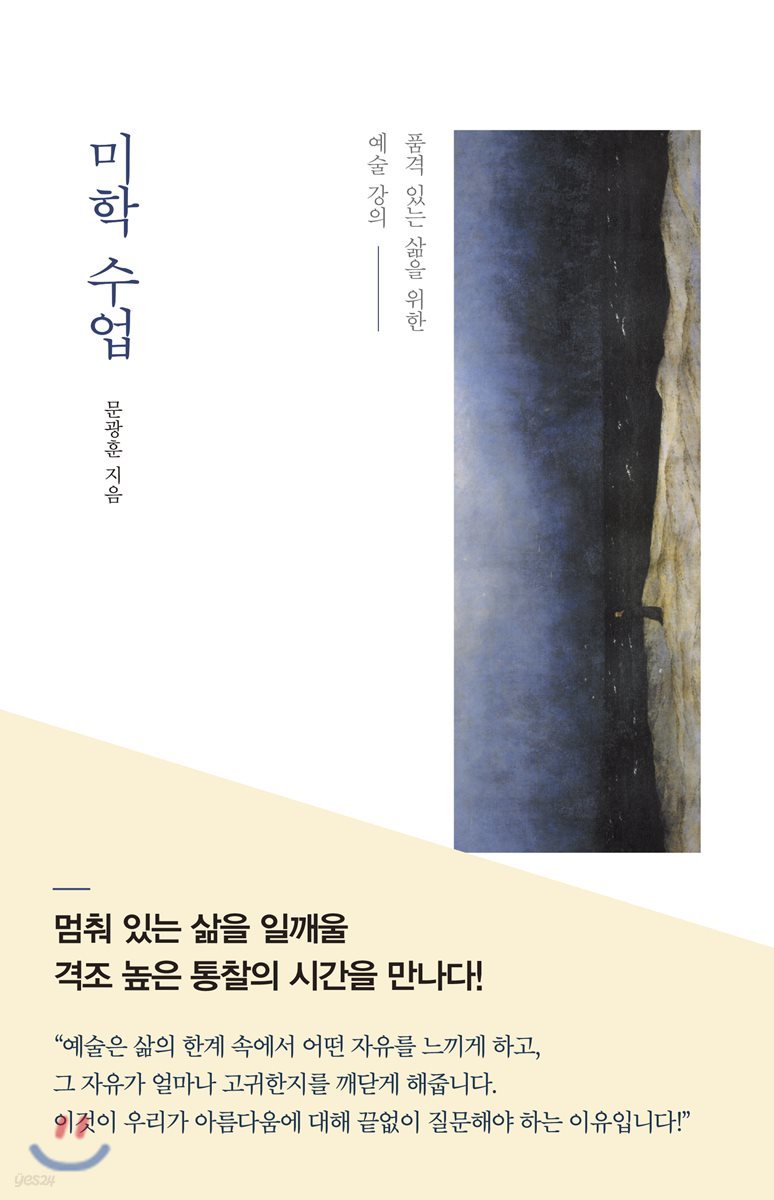
aesthetics class
 |
Description
Book Introduction
Why are we fascinated by beautiful things and feel happy? Professor Moon Gwan-hoon's art education class, offering wisdom and insight into life! Professor Moon Gwang-hoon of the Department of German Language and Literature at Chungbuk National University, a humanist and aesthetician, published "Aesthetics Class: Art Lectures for a Dignified Life" (hereafter "Aesthetics Class"), which talks about "why art is important in the reality we live in, and how individual lives can be changed through art." Art is a new attempt through exploration and observation of life. Professor Moon Gwang-hoon says that the more we look deeply into this art, the easier it becomes to discover the unique beauty and nobility inherent in each individual's life. Therefore, the experience of empathy and connection with this art breathes life into everyday life, brings joy, and ultimately provides moments of wisdom, intelligence, and thought that lead to a new way of life. Through this book, readers will experience a high-level liberal arts education that allows them to see, hear, feel, and think in new ways across various genres of art, including art, music, literature, and architecture. This book, "Aesthetics Class," reminds us of things we have forgotten or dreamed of in the transcendent world led by art. These may be ideals, or they may be truths. Professor Moon Gwang-hoon, like a docent at an exhibition hall, guides readers through the profound and broad principles that lead us to realize that life has infinite possibilities. It tells us that as long as we constantly feel and dream, this world can develop in a better direction. But this realization does not simply occur in consciousness. These thoughts have a powerful force that changes our values and attitudes in how we actually live. This is the ultimate value we can obtain through the experience of art and aesthetic experience that Professor Moon Gwan-hoon speaks of. If philosophy is a discipline that teaches us how to live, aesthetics is a discipline that teaches us how to feel, think, and create life as it should be. And it finally allows me to live that life ‘my way’. This is because the experience of art is essentially an active act that is voluntary and autonomous. Only then can art become enjoyable and pleasant. The goal of this book, "Aesthetics Class," is to spontaneously construct life through art. |
- You can preview some of the book's contents.
Preview
index
introduction
prolog
Lesson 1: The Experience of Infinity
Lesson 2: Beauty and Horror Are a Pair
Lesson 3 The Joy of Chatting
Lesson 4: Seeing Beyond the 'Fantastic Reality'
Lesson 5 I draw myself
Lesson 6: The Frustration of an Aspirational Life
Lesson 7 Youth and Old Age: Beautiful Days Are Gone
Lesson 8: On Grief
Lesson 9: Behind the Scenes
Lesson 10 Big City - Night - Bar - Anonymity
Lesson 11: Hell's Reality
Lesson 12: Looking Back at the Empty Seat
Lesson 13 Looking Out the Window
Lesson 14 Life has always been like that and will always be like that
Lesson 15: What is Beauty?
Lesson 16: Mountains, Houses, Rivers, and Trees
Lesson 17: Education in the Multimedia Age
Lesson 18 Writing: Engaging with Humanity
Lesson 19: Precarious Moments
Lesson 20 Forever Childlike
Lesson 21 You too, Dried Pollack
Lesson 22: Don't argue with spring
Lesson 23 Love is rejoicing in what is right!
Lesson 24: Loosen Up, Refine Your Life
Lesson 25: In Praise of Music
Lesson 26 The city and streets we live in
Lesson 27: Earth's Balance Sheet
Lesson 28: Memories of the Sycamore Shade
Lesson 29: Escape the Garden of the Private Self
Lesson 30 Home, Water, Body, Grass
Lesson 31 Nothing is Everything in Existence
Lesson 32 Brahms in the fall
Lesson 33 As if from afar
Lesson 34: Self-Facing: The Hardest Thing in the World
Lesson 35: The Meaning of Culture
Lesson 36: Awakening the Humanities
Lesson 37 Violence and Narcissism
Lesson 38: The Luxury of Academic Freedom
Lesson 39: How to Live, How to Learn to Live
Lesson 40: Picking at the Wounds
Lesson 41: The Path Back to Yourself
Lesson 42: The Unknowable and Infinite
Lesson 43 I Want to Wander
Lesson 44: Songs of Life with the Aesthetics of the Times
Lesson 45: The Humanities: The Self-Organization of Life
Lesson 46: Art and the Global Community
Epilogue
prolog
Lesson 1: The Experience of Infinity
Lesson 2: Beauty and Horror Are a Pair
Lesson 3 The Joy of Chatting
Lesson 4: Seeing Beyond the 'Fantastic Reality'
Lesson 5 I draw myself
Lesson 6: The Frustration of an Aspirational Life
Lesson 7 Youth and Old Age: Beautiful Days Are Gone
Lesson 8: On Grief
Lesson 9: Behind the Scenes
Lesson 10 Big City - Night - Bar - Anonymity
Lesson 11: Hell's Reality
Lesson 12: Looking Back at the Empty Seat
Lesson 13 Looking Out the Window
Lesson 14 Life has always been like that and will always be like that
Lesson 15: What is Beauty?
Lesson 16: Mountains, Houses, Rivers, and Trees
Lesson 17: Education in the Multimedia Age
Lesson 18 Writing: Engaging with Humanity
Lesson 19: Precarious Moments
Lesson 20 Forever Childlike
Lesson 21 You too, Dried Pollack
Lesson 22: Don't argue with spring
Lesson 23 Love is rejoicing in what is right!
Lesson 24: Loosen Up, Refine Your Life
Lesson 25: In Praise of Music
Lesson 26 The city and streets we live in
Lesson 27: Earth's Balance Sheet
Lesson 28: Memories of the Sycamore Shade
Lesson 29: Escape the Garden of the Private Self
Lesson 30 Home, Water, Body, Grass
Lesson 31 Nothing is Everything in Existence
Lesson 32 Brahms in the fall
Lesson 33 As if from afar
Lesson 34: Self-Facing: The Hardest Thing in the World
Lesson 35: The Meaning of Culture
Lesson 36: Awakening the Humanities
Lesson 37 Violence and Narcissism
Lesson 38: The Luxury of Academic Freedom
Lesson 39: How to Live, How to Learn to Live
Lesson 40: Picking at the Wounds
Lesson 41: The Path Back to Yourself
Lesson 42: The Unknowable and Infinite
Lesson 43 I Want to Wander
Lesson 44: Songs of Life with the Aesthetics of the Times
Lesson 45: The Humanities: The Self-Organization of Life
Lesson 46: Art and the Global Community
Epilogue
Detailed image

Into the book
I like looking at pictures.
When I have a headache, when things don't go my way, or when I take a break after finishing something, I flip through my art book as if I'm listening to music.
Landscapes are good, self-portraits are good, oriental paintings are good, and western paintings are good.
When I look at it like that, my mind becomes at ease.
When we look at the painting, we feel the immense weight of the place where we live, what surrounds us, and what we stand on.
Eating, sleeping, and wearing clothes are precious.
But more than that, what is more valuable is keeping these daily tasks simple.
Much of the current economic crisis, to put it bluntly, stems from greed.
Bubbles, expansions, crazes, and indiscriminate thinking arise from a lack of awareness of one's own limitations.
Limitations are realized by looking back at the boundaries of life.
It is this fundamental order that art reminds us of.
In the face of this order, truth becomes illusion, and the useless becomes useful.
When I look around, my mind becomes fearful and at the same time peaceful.
--- From "Mountains, Houses, Rivers, and Trees"
How should I look at the picture?
There are many factors such as changes in motifs or forms, composition methods, etc., but that cannot be the correct answer.
The simplest thing, as cliché as it may be, is to just take your time and savor each thing carefully.
There is a lot to be said for how people and objects are arranged in a painting, where the light comes from and illuminates, and what the characters' facial expressions, limbs, and body postures are like.
Not only the artist's technical skill, but also his interests, personality, and even his awareness of the issues are reflected in it.
What I'm noticing is the author's traces embedded in these things? His attitude toward the world.
How did he express this world, and how did he live his life? After all, art is ultimately a way to explore life's possibilities.
When I have a headache, when things don't go my way, or when I take a break after finishing something, I flip through my art book as if I'm listening to music.
Landscapes are good, self-portraits are good, oriental paintings are good, and western paintings are good.
When I look at it like that, my mind becomes at ease.
When we look at the painting, we feel the immense weight of the place where we live, what surrounds us, and what we stand on.
Eating, sleeping, and wearing clothes are precious.
But more than that, what is more valuable is keeping these daily tasks simple.
Much of the current economic crisis, to put it bluntly, stems from greed.
Bubbles, expansions, crazes, and indiscriminate thinking arise from a lack of awareness of one's own limitations.
Limitations are realized by looking back at the boundaries of life.
It is this fundamental order that art reminds us of.
In the face of this order, truth becomes illusion, and the useless becomes useful.
When I look around, my mind becomes fearful and at the same time peaceful.
--- From "Mountains, Houses, Rivers, and Trees"
How should I look at the picture?
There are many factors such as changes in motifs or forms, composition methods, etc., but that cannot be the correct answer.
The simplest thing, as cliché as it may be, is to just take your time and savor each thing carefully.
There is a lot to be said for how people and objects are arranged in a painting, where the light comes from and illuminates, and what the characters' facial expressions, limbs, and body postures are like.
Not only the artist's technical skill, but also his interests, personality, and even his awareness of the issues are reflected in it.
What I'm noticing is the author's traces embedded in these things? His attitude toward the world.
How did he express this world, and how did he live his life? After all, art is ultimately a way to explore life's possibilities.
--- From "Beauty and Horror Are a Pair"
Publisher's Review
A guide on the journey to find the true 'me',
Art makes us realize how precious freedom is!
The so-called great masterpieces of art that have been passed down from the past to the present without being lost, such as the paintings of Picasso, Renoir, and Rembrandt, the symphonies of Beethoven, Schumann, and Brahms, the novels of Kafka, the poetry of Kim Su-young, and the sculptures of Michelangelo, are still loved by many people even after centuries have passed.
These works of art give us joy, inspire us, and give us time to reflect and reflect on our lives.
This book, "Aesthetics Class," is an art education book for citizens (this book is a reprint of "Tuning of the Soul," which was published in 2011 and was out of print.
(Many parts of the design and content of the existing book were significantly revised and edited before being republished.)
The ‘citizens’ here are ‘me’, ‘you’, and ‘us’ who are living together in this era.
According to Professor Moon Gwang-hoon, studying art is not about finding out what inspired the artist to create his work.
It is not about finding out how art reflected the social conditions of the time or how it changed the landscape of life and the structure of society at that time.
The most fundamental purpose of studying art is to transform the life of 'me' living in the present through the window of art.
Art allows us to feel infinite freedom within the limitations of finite life, and it makes us realize how precious that freedom is.
“Art neither asserts nor imposes anything.
In aesthetic experience, no one is the ruler, and no one oppresses another.
Because art always promotes equal relationships, both emotionally and politically.
No one is bound, only each person is helped to choose a life that suits his or her nature.
It is not about superficial glory, but about hinting at possibilities beyond the limits of reality.
Thus, when we experience art, we gradually recover the image of paradise that we had forgotten.
“Life can always be reconstructed anew within the sensory and cognitive density of aesthetic experience.” (From the text)
By looking at art, we contemplate the present reality and ideals, while engaging in philosophical reflections on beauty and ugliness, the moment and eternity, life and death.
As we go through this process, we ponder more deeply about the world around us and seek answers to change reality for the better.
And ultimately, art guides us to discover what is most 'me', what is our true 'me'.
This is why we must study art and why we must continue to question beauty.
This book, "Aesthetics Class," becomes a compass that you should refer to again and again on your journey.
Why should we study aesthetics?
The reality in art is a completely ‘different reality.’
Because this world is not only unfamiliar but also entirely new, we come to perceive art in a variety of ways, not just through one interpretation.
Here is a piece of art.
This is Caravaggio's work, [Child Bitten by a Lizard] (1595).
This painting depicts a scene where a child reaches out to touch a beautiful flower and is bitten on the finger by a lizard hiding in the leaves.
“The focus in this painting is on the flowers and the lizard.
It can be translated as a contrast between beauty and horror.
Rilke said, "Beauty is only the beginning of horror," but beauty does not come alone.
Next to beauty there is horror, and before and behind it there is ugliness, convulsions, and shudders.
We tend to think of beauty and awe as unrelated, but they are deeply intertwined.
There is a difference in specific gravity, but they always come mixed together.
Beauty and horror are paired in reality like light and darkness.
In this intersecting fate, we often seek beauty in vain.
But life begins and ends between a few moments of beauty and horror.” (From the text)
When appreciating art, some people feel beauty and are moved.
But on the other hand, someone might express ugliness, strangeness, and horror.
Each of these choices determines our attitude toward art, and based on these decisions, the direction of our lives changes.
This is precisely why art is a door, a window, an entrance, and a crossroads leading to another world.
This is precisely why we must look at art correctly.
Professor Moon Gwang-hoon says that good works of art ultimately awaken the senses that have become engrossed in the repetitiveness of daily life and encourage renewal of life.
Through works of art, we briefly connect with the soul of the artist and indirectly experience the world they see.
Based on this experience, we expand our horizons about the world and go beyond the 'present', even if only for a moment.
It is a completely different way of thinking and imagining that heightens our senses.
This is the ability of art to ‘transcend’, which can be expressed as ‘moving forward’ and ‘progressing’ towards somewhere.
This book, "Aesthetics Class," reminds us of things we have forgotten or dreamed of in the transcendent world led by art.
These may be ideals, or they may be truths.
Professor Moon Gwang-hoon, like a docent at an exhibition hall, guides readers through the profound and broad principles that lead us to realize that life has infinite possibilities.
It tells us that as long as we constantly feel and dream, this world can develop in a better direction.
But this realization does not simply occur in consciousness.
These thoughts have a powerful force that changes our values and attitudes in how we actually live.
This is the ultimate value we can obtain through the experience of art and aesthetic experience that Professor Moon Gwan-hoon speaks of.
“The reason beauty is important is, simply put, because it begins with my feelings.
And what do other people feel? Because it is objective empathy.
That is, I and the object are naturally connected in beauty.
Beauty is something I feel (subjective/sensory) and something that others can feel and think they feel (objective/rational).
Therefore, beauty connects sense and thought, individual and society.
“In this medium, the right beauty reflects on reality.” (From the text)
A time of high-quality insight that awakens life!
We want our lives to be more valuable and better today than yesterday, and tomorrow than today.
The goal of art is no different.
In this book, "Aesthetics Class," Professor Moon Gwang-hoon places greater importance on our attitude toward art rather than interpreting the meaning of art itself.
The infinite possibilities of art lie with us who interpret it, and these possibilities are only useful if they shake our inner selves and transform our outward attitude toward life.
If artistic experience does not reach this point, says Professor Moon Gwang-hoon, art is not art.
“Art allows us to feel a certain freedom within the limits of life, reminds us of the responsibility that goes beyond that freedom, and in this responsibility, makes us realize once again how precious freedom is.
If either freedom or responsibility is missing, art is nothing but an illusion.
Change in life only happens when I can awaken the dreams of others while dreaming them.
In art, we dream again, choose again, awaken again, and act anew.
Art is a crossing experience of excitement and regret.
This makes us take a moment to reflect on where we came from and where we are going.” (From the text)
If philosophy is a discipline that teaches us how to live, aesthetics is a discipline that teaches us how to feel, think, and create life as it should be.
And it finally allows me to live that life ‘my way’.
This is because the experience of art is essentially an active act that is voluntary and autonomous.
Only then can art become enjoyable and pleasant.
The goal of this book, "Aesthetics Class," is to spontaneously construct life through art.
Art makes us realize how precious freedom is!
The so-called great masterpieces of art that have been passed down from the past to the present without being lost, such as the paintings of Picasso, Renoir, and Rembrandt, the symphonies of Beethoven, Schumann, and Brahms, the novels of Kafka, the poetry of Kim Su-young, and the sculptures of Michelangelo, are still loved by many people even after centuries have passed.
These works of art give us joy, inspire us, and give us time to reflect and reflect on our lives.
This book, "Aesthetics Class," is an art education book for citizens (this book is a reprint of "Tuning of the Soul," which was published in 2011 and was out of print.
(Many parts of the design and content of the existing book were significantly revised and edited before being republished.)
The ‘citizens’ here are ‘me’, ‘you’, and ‘us’ who are living together in this era.
According to Professor Moon Gwang-hoon, studying art is not about finding out what inspired the artist to create his work.
It is not about finding out how art reflected the social conditions of the time or how it changed the landscape of life and the structure of society at that time.
The most fundamental purpose of studying art is to transform the life of 'me' living in the present through the window of art.
Art allows us to feel infinite freedom within the limitations of finite life, and it makes us realize how precious that freedom is.
“Art neither asserts nor imposes anything.
In aesthetic experience, no one is the ruler, and no one oppresses another.
Because art always promotes equal relationships, both emotionally and politically.
No one is bound, only each person is helped to choose a life that suits his or her nature.
It is not about superficial glory, but about hinting at possibilities beyond the limits of reality.
Thus, when we experience art, we gradually recover the image of paradise that we had forgotten.
“Life can always be reconstructed anew within the sensory and cognitive density of aesthetic experience.” (From the text)
By looking at art, we contemplate the present reality and ideals, while engaging in philosophical reflections on beauty and ugliness, the moment and eternity, life and death.
As we go through this process, we ponder more deeply about the world around us and seek answers to change reality for the better.
And ultimately, art guides us to discover what is most 'me', what is our true 'me'.
This is why we must study art and why we must continue to question beauty.
This book, "Aesthetics Class," becomes a compass that you should refer to again and again on your journey.
Why should we study aesthetics?
The reality in art is a completely ‘different reality.’
Because this world is not only unfamiliar but also entirely new, we come to perceive art in a variety of ways, not just through one interpretation.
Here is a piece of art.
This is Caravaggio's work, [Child Bitten by a Lizard] (1595).
This painting depicts a scene where a child reaches out to touch a beautiful flower and is bitten on the finger by a lizard hiding in the leaves.
“The focus in this painting is on the flowers and the lizard.
It can be translated as a contrast between beauty and horror.
Rilke said, "Beauty is only the beginning of horror," but beauty does not come alone.
Next to beauty there is horror, and before and behind it there is ugliness, convulsions, and shudders.
We tend to think of beauty and awe as unrelated, but they are deeply intertwined.
There is a difference in specific gravity, but they always come mixed together.
Beauty and horror are paired in reality like light and darkness.
In this intersecting fate, we often seek beauty in vain.
But life begins and ends between a few moments of beauty and horror.” (From the text)
When appreciating art, some people feel beauty and are moved.
But on the other hand, someone might express ugliness, strangeness, and horror.
Each of these choices determines our attitude toward art, and based on these decisions, the direction of our lives changes.
This is precisely why art is a door, a window, an entrance, and a crossroads leading to another world.
This is precisely why we must look at art correctly.
Professor Moon Gwang-hoon says that good works of art ultimately awaken the senses that have become engrossed in the repetitiveness of daily life and encourage renewal of life.
Through works of art, we briefly connect with the soul of the artist and indirectly experience the world they see.
Based on this experience, we expand our horizons about the world and go beyond the 'present', even if only for a moment.
It is a completely different way of thinking and imagining that heightens our senses.
This is the ability of art to ‘transcend’, which can be expressed as ‘moving forward’ and ‘progressing’ towards somewhere.
This book, "Aesthetics Class," reminds us of things we have forgotten or dreamed of in the transcendent world led by art.
These may be ideals, or they may be truths.
Professor Moon Gwang-hoon, like a docent at an exhibition hall, guides readers through the profound and broad principles that lead us to realize that life has infinite possibilities.
It tells us that as long as we constantly feel and dream, this world can develop in a better direction.
But this realization does not simply occur in consciousness.
These thoughts have a powerful force that changes our values and attitudes in how we actually live.
This is the ultimate value we can obtain through the experience of art and aesthetic experience that Professor Moon Gwan-hoon speaks of.
“The reason beauty is important is, simply put, because it begins with my feelings.
And what do other people feel? Because it is objective empathy.
That is, I and the object are naturally connected in beauty.
Beauty is something I feel (subjective/sensory) and something that others can feel and think they feel (objective/rational).
Therefore, beauty connects sense and thought, individual and society.
“In this medium, the right beauty reflects on reality.” (From the text)
A time of high-quality insight that awakens life!
We want our lives to be more valuable and better today than yesterday, and tomorrow than today.
The goal of art is no different.
In this book, "Aesthetics Class," Professor Moon Gwang-hoon places greater importance on our attitude toward art rather than interpreting the meaning of art itself.
The infinite possibilities of art lie with us who interpret it, and these possibilities are only useful if they shake our inner selves and transform our outward attitude toward life.
If artistic experience does not reach this point, says Professor Moon Gwang-hoon, art is not art.
“Art allows us to feel a certain freedom within the limits of life, reminds us of the responsibility that goes beyond that freedom, and in this responsibility, makes us realize once again how precious freedom is.
If either freedom or responsibility is missing, art is nothing but an illusion.
Change in life only happens when I can awaken the dreams of others while dreaming them.
In art, we dream again, choose again, awaken again, and act anew.
Art is a crossing experience of excitement and regret.
This makes us take a moment to reflect on where we came from and where we are going.” (From the text)
If philosophy is a discipline that teaches us how to live, aesthetics is a discipline that teaches us how to feel, think, and create life as it should be.
And it finally allows me to live that life ‘my way’.
This is because the experience of art is essentially an active act that is voluntary and autonomous.
Only then can art become enjoyable and pleasant.
The goal of this book, "Aesthetics Class," is to spontaneously construct life through art.
GOODS SPECIFICS
- Date of issue: March 19, 2019
- Page count, weight, size: 360 pages | 616g | 145*225*21mm
- ISBN13: 9788965963035
- ISBN10: 8965963036
You may also like
카테고리
korean


korean

![ELLE 엘르 스페셜 에디션 A형 : 12월 [2025]](http://librairie.coreenne.fr/cdn/shop/files/b8e27a3de6c9538896439686c6b0e8fb.jpg?v=1766436872&width=3840)


