

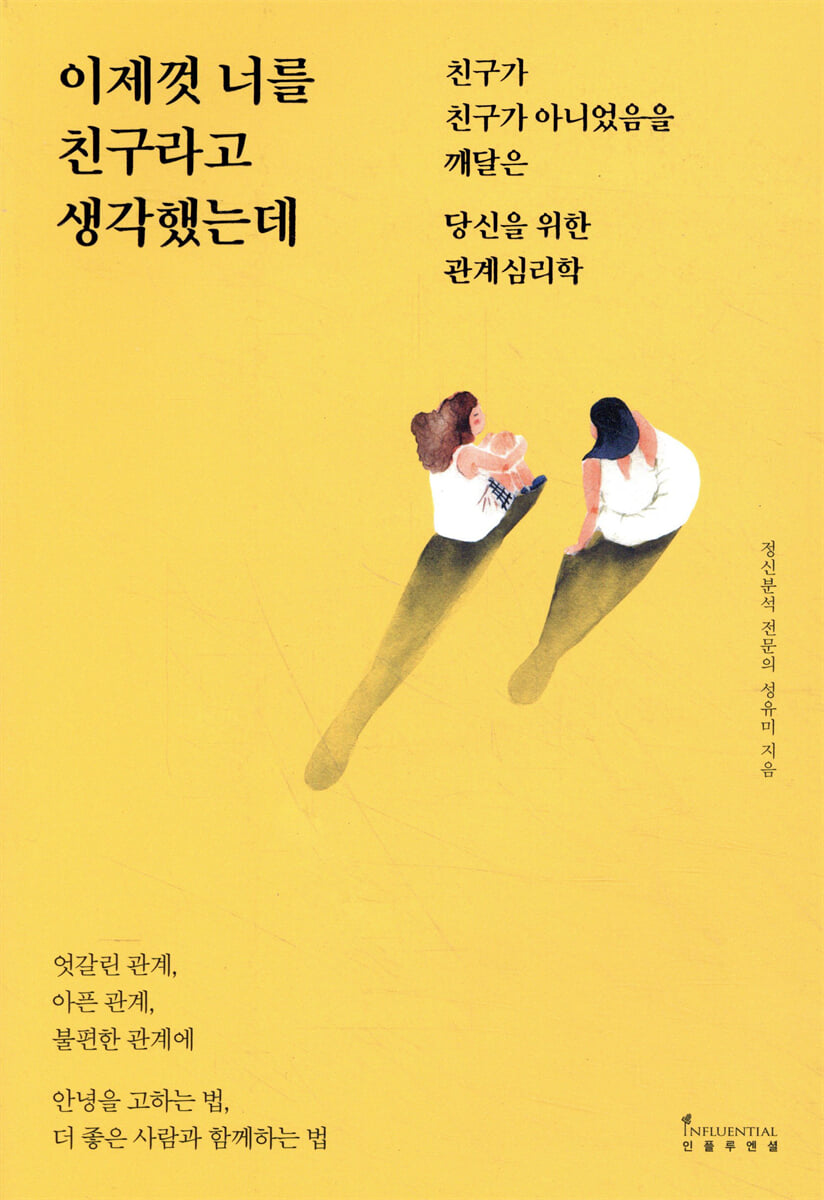
I always thought of you as a friend
 |
Description
Book Introduction
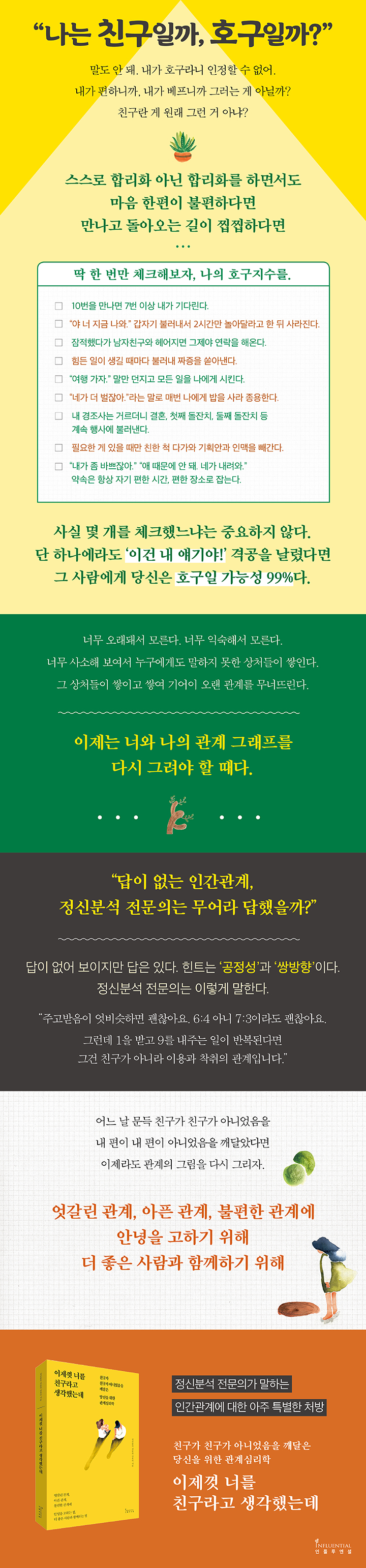
As the psychoanalyst says,
The most blatant and realistic solution to human relationships
There is no such thing as an 'inevitable relationship', there is only me who says there is nothing I can do about it.
“People are all about connections.
“You should never break up with someone.” “We’ve been friends for 20 years. How can I reject him? I’ll have to endure it this time too.” “That’s weird.
“I always feel dirty on the way home after this meeting.” We are caught up in all kinds of uncomfortable relationships.
We're stuck in dysfunctional relationships for years and decades, either because we feel pressured to have a wide network, because they're old, or because we're afraid they might turn us into bad people.
Psychoanalyst Seong Yu-mi tells patients who come to her with interpersonal relationship issues, “There is no relationship in this world that you have no choice but to accept.
You can also choose relationships.
“If we just become aware of that fact, we can be happy enough just by ending fake relationships and establishing new real ones,” he advises.
This book contains solutions and prescriptions for such human relationships.
It helps you realize and acknowledge the wounds in your relationships that seem too trivial to tell anyone, that have been there for so long that they have become familiar, and that you can rebuild your relationships on your own.
The most blatant and realistic solution to human relationships
There is no such thing as an 'inevitable relationship', there is only me who says there is nothing I can do about it.
“People are all about connections.
“You should never break up with someone.” “We’ve been friends for 20 years. How can I reject him? I’ll have to endure it this time too.” “That’s weird.
“I always feel dirty on the way home after this meeting.” We are caught up in all kinds of uncomfortable relationships.
We're stuck in dysfunctional relationships for years and decades, either because we feel pressured to have a wide network, because they're old, or because we're afraid they might turn us into bad people.
Psychoanalyst Seong Yu-mi tells patients who come to her with interpersonal relationship issues, “There is no relationship in this world that you have no choice but to accept.
You can also choose relationships.
“If we just become aware of that fact, we can be happy enough just by ending fake relationships and establishing new real ones,” he advises.
This book contains solutions and prescriptions for such human relationships.
It helps you realize and acknowledge the wounds in your relationships that seem too trivial to tell anyone, that have been there for so long that they have become familiar, and that you can rebuild your relationships on your own.
- You can preview some of the book's contents.
Preview
index
Author's Note
Prologue_ On the phrase 'being used'
Part 1 I won't be used by you anymore
Chapter 1.
They were not interested in relationships from the beginning.
I have a senior who only contacts me when necessary. _The difference between 'use' and 'favor'
If you feel uncomfortable, you are not good - Punishment of the superego
I don't want to live as your sidekick anymore _ Those with malignant narcissism
Loving yourself and being self-centered are different things - when desires take precedence over ego.
Think about it again) There is no 'me', only 'desire' remains.
I'm not your two-hour movie - Don't get me wrong, the definition of a sucker
Am I You to You, or Am I That? _An Exercise in Recognizing the Nature of Relationships
Chapter 2.
Being cheated on and betrayed in a relationship are two different things.
Where money goes, the heart goes, and where the heart goes, money goes - The limit of cost
Even God can't solve the problem of condolence money - Money is the barometer of relationships.
How long will you keep trying to please others? _Why bad relationships keep repeating themselves
Some Ways to Defeat Bad People _The Rule of Five
We may not have been friends from the beginning - there was no betrayal, just an illusion about the relationship.
When I realized how different the size of our affection was _the meaning of two-way
The Courage to Be Hated: What We Need to Know Next _ About the Courage to Love Again
Chapter 3.
They use them in order of proximity.
Families are inherently more selfish - what to accept and what to reject
Devotion mode is now turned off _ Deadline for sacrifice
(Think about it again) The more family you have, the more intentional attention you need.
There is no Anne of Green Gables and Diana _ The fantasy of a mother's best friend
My Close Friend's Success Makes Me Uncomfortable - Surviving the Destructive Instinct of Jealousy
Should I receive the same amount of anger as you did for me? _Emotional Debt Relationship
(Think about it again) Some criteria for letting go of bad people and keeping good people
Part 2: How to Protect Myself from His and Her Wrath
Chapter 1.
Say no to what you don't like, say no to what you don't like
There is also a profit and loss statement between people: the exchange of material and mental resources.
No one is born to give, not even mothers _ people who are insensitive to loss
Maybe you need a follow-up _ The real meaning of 'emotional regulation'
Not being able to feel anger is also a disease - maybe you have emotional dyslexia too
No one can accuse me of being a vulgarian - The requirements for marriage in psychoanalysis
You have to live with a sense of pride to breathe freely _ Be free from the gaze of others
When I acted funny, it really became funny _ Even things that look difficult are strategies
Chapter 2.
Let go of my hand as if we'll meet again
If now is not a good time, it is also a way to pass by _Me who is still, you who are already
"Inevitably" is a blanket covering failure _YES or YES
I'm Not Your Empathy Gas Station _ Fighting Empathy Exploitation
I figured it out, I'm your emotional trash can _ another name for attack
Bad feelings are mine, and uncomfortable feelings are mine too - Objectifying Emotions
If I don't ask, the other person will take it - Practice saying everything you want to say while maintaining the relationship.
Breaking up is harder than meeting up - The definition of a good breakup
At any moment, I must be the top priority - Fixing a conflicted relationship
Let go of my hand as if we'll meet again - a break, not a separation
(Thinking about it again) Some Q&A about relationships
Epilogue: We are both flowers and needs for each other.
Prologue_ On the phrase 'being used'
Part 1 I won't be used by you anymore
Chapter 1.
They were not interested in relationships from the beginning.
I have a senior who only contacts me when necessary. _The difference between 'use' and 'favor'
If you feel uncomfortable, you are not good - Punishment of the superego
I don't want to live as your sidekick anymore _ Those with malignant narcissism
Loving yourself and being self-centered are different things - when desires take precedence over ego.
Think about it again) There is no 'me', only 'desire' remains.
I'm not your two-hour movie - Don't get me wrong, the definition of a sucker
Am I You to You, or Am I That? _An Exercise in Recognizing the Nature of Relationships
Chapter 2.
Being cheated on and betrayed in a relationship are two different things.
Where money goes, the heart goes, and where the heart goes, money goes - The limit of cost
Even God can't solve the problem of condolence money - Money is the barometer of relationships.
How long will you keep trying to please others? _Why bad relationships keep repeating themselves
Some Ways to Defeat Bad People _The Rule of Five
We may not have been friends from the beginning - there was no betrayal, just an illusion about the relationship.
When I realized how different the size of our affection was _the meaning of two-way
The Courage to Be Hated: What We Need to Know Next _ About the Courage to Love Again
Chapter 3.
They use them in order of proximity.
Families are inherently more selfish - what to accept and what to reject
Devotion mode is now turned off _ Deadline for sacrifice
(Think about it again) The more family you have, the more intentional attention you need.
There is no Anne of Green Gables and Diana _ The fantasy of a mother's best friend
My Close Friend's Success Makes Me Uncomfortable - Surviving the Destructive Instinct of Jealousy
Should I receive the same amount of anger as you did for me? _Emotional Debt Relationship
(Think about it again) Some criteria for letting go of bad people and keeping good people
Part 2: How to Protect Myself from His and Her Wrath
Chapter 1.
Say no to what you don't like, say no to what you don't like
There is also a profit and loss statement between people: the exchange of material and mental resources.
No one is born to give, not even mothers _ people who are insensitive to loss
Maybe you need a follow-up _ The real meaning of 'emotional regulation'
Not being able to feel anger is also a disease - maybe you have emotional dyslexia too
No one can accuse me of being a vulgarian - The requirements for marriage in psychoanalysis
You have to live with a sense of pride to breathe freely _ Be free from the gaze of others
When I acted funny, it really became funny _ Even things that look difficult are strategies
Chapter 2.
Let go of my hand as if we'll meet again
If now is not a good time, it is also a way to pass by _Me who is still, you who are already
"Inevitably" is a blanket covering failure _YES or YES
I'm Not Your Empathy Gas Station _ Fighting Empathy Exploitation
I figured it out, I'm your emotional trash can _ another name for attack
Bad feelings are mine, and uncomfortable feelings are mine too - Objectifying Emotions
If I don't ask, the other person will take it - Practice saying everything you want to say while maintaining the relationship.
Breaking up is harder than meeting up - The definition of a good breakup
At any moment, I must be the top priority - Fixing a conflicted relationship
Let go of my hand as if we'll meet again - a break, not a separation
(Thinking about it again) Some Q&A about relationships
Epilogue: We are both flowers and needs for each other.
Detailed image
Into the book
What does "exploitation" mean in a relationship? We often say things like, "I got completely ripped off again today."
But even though they keep saying things like this, if you ask them why they think that way, they can't give a clear answer.
If it's hot, I just feel like I've been used, and I don't have any specific memories of the situation or pattern.
“Something feels off, but what is this feeling?” “(Looking back) I can’t say I was used, but I can’t say no either.” There is a huge psychological cost to lifting a depressed person up.
Comforting someone is a very difficult task that can make you lose your mind once you meet them.
Have you ever felt your soul stripped away for the sake of someone else's convenience? Even if it happened once or twice, if it happens again and again, it's time to consider and end the relationship.
--- pp.25-26
“I was happy to have a like-minded older sister, but I guess it was just me.
“I’m being abandoned right away when a better candidate appears.” Su-ah was dumbfounded by her senior’s changed attitude.
The relationship between these two was clear.
For Sua, the relationship with her senior was a 'me and you' relationship, but for her senior, it was a 'me and that' relationship.
I advised him not to attach much significance to his senior's actions.
“There are not only pure relationships in the world.
“I’m sure that Ms. Sua also has an ‘I and it’ relationship like that senior.” When I tell people about these two relationships, they usually react by rejecting the ‘I and it’ relationship.
The problem is that it is not easy to distinguish between the two.
So, it is important to have the discerning eye to distinguish between these two seemingly similar creatures.
--- p.60
People who try to deceive me or take advantage of me can be found anywhere, at any time.
Should I let that person into my life? Should I jump into a relationship with that person? This is entirely my choice.
Of course, this decision is not easy.
It is difficult to know everything from the beginning because you have to discern what kind of person you are facing.
So, it is true that you have to experience it to know.
But don't avoid meeting someone for fear of being deceived.
You can only become mature by gaining a lot of experience, developing the ability to discern people, and learning the skills to build relationships.
It's okay if you don't always succeed.
Betrayal hurts and I hate it, but it doesn't kill me.
It's just a very small relationship failure.
--- p.87
“When you meet people, troubles arise, relationships can become one-sided, and things like that.
If someone asks me this, “Then do I have to stumble and fall every time?”, I would answer like this.
“Just once, stay with your instincts.” This means to reflect on what those instincts mean, what those uncomfortable feelings mean.
Only you can find the answer.
embrace.
If you admit that you have a feeling that this is not the case, then adjustments to your relationship with that person become inevitable.
Moreover, if it is a relationship that I want to hold on to, I want to ignore the touch even more.
But did you know that when someone you truly trusted starts to leave you, the right to let go isn't theirs alone.
I may be the first to let go of your hand after sensing the touch.
--- pp. 100-101
The most difficult patients to treat in the clinic are those who are in pain but do not feel pain.
Knowing that you are sick may seem like a simple thing, but for some people it takes a tremendous investment of time and effort.
So, to avoid reaching this point, let's press the 'stop button' when we detect danger signals and change direction from 'others to ourselves.'
Doing so will not destroy your family's life, nor will it result in as great a tragedy as you might imagine.
Finally, if someone were to ask, “What exactly is family?” I would answer, “Mom is Mom’s burden, Dad is Dad’s burden, my siblings are their burden, and I am the one who carries my burden and walks the path together.”
Carrying one's share of the burden.
This is the true meaning of family and the first condition for harmony.
--- pp.121-122
Sure, they were good friends in your teens or twenties, but they might not be now.
When we are young, everything is similar: our environment, our worries, our goals, and even the people around us.
But now it's different.
Their backgrounds are different, they meet different people, their worries are different, and their social status is different.
“My kid said this at school this time.” “I’m bored.
Stop talking about the kid.
Do you know what happened at my company? Our main interests are not the same.
“I’m planning to go to Hawaii this holiday and rest for a week.
“I need to buy new beachwear and everything, so let’s go to the department store together.” “No…
“If I take a day off from business, I’ll lose customers.” It’ll be hard to admit.
But you have to accept it.
That there is nothing left to share or empathize with, that you and I have different lives.
--- p.129
Above all, it is important to hold on to the awareness that something is wrong.
These are the words that perpetrators use to vent their anger and make excuses.
"Something big happened at home, that's why." "The company went bankrupt and I'm about to get fired. Would you be happy about that? So you should be nice to me." This is false causality.
You shouldn't think, 'Oh, so that's why he's mad at me.'
Of course, this doesn't mean you should get angry together or end the relationship.
Even if you have no choice but to accept the other person's anger, you must hold on to the thought that this is not right.
If you take it for granted, you will never be able to escape the position of receiving the arrows whenever something bad happens to the other person.
--- p.149
If there is someone who makes you uncomfortable, don't just go to the group he is in, create three or four other groups.
That is, staying within the existing relationship but minimizing the influence of that relationship.
Just having multiple people to meet and things to do makes you much more free from that person's influence.
I call this method the "making weekend friends weekday friends" strategy.
“This weekend? That won’t work.
“Um… let’s just see each other on Wednesday evening.” This is a strategy to demote the person to someone you can only see briefly on a weekday evening, without giving them your precious weekend time.
Why should I give up my precious weekend to someone who makes me suffer so much?
It's just about organizing people into people you can meet on weekdays.
--- p.162
They have advantages that outweigh their disadvantages.
For example, when you don't have someone to spend weekends with, you don't have a friend who is as good as you. Or you have a coworker who is annoying but takes your boss's wrath on your behalf. Or you have a boss who treats his juniors like puppets but still takes care of them at crucial moments.
It's maintained because maintaining a relationship with that person isn't 100 percent a bad thing.
We express this situation as 'there's nothing we can do'.
A more accurate expression would be 'I haven't decided yet.'
And perhaps this is an excuse to sneak away from the responsibility of making a decision.
If you find yourself in this situation, I have one piece of advice for you.
Keep as much distance as possible from the other person and wait until you are sure of your mind.
--- p.217
It would be good to understand that a good breakup is the beginning of the next meeting, the next relationship.
Just as when constructing a new building, the process of demolishing the existing building and leveling the ground is important.
When a couple facing divorce comes to counseling, the issue is not how to reconcile the two.
How can we break up well?
The first thing to do is to examine whether both people have the ability to end the relationship well and the capacity to break up well.
Even if it's small, it's a blessing for the therapist to discover a possibility.
It would be better if it was both, but it's okay if it's just one person.
Let's start from there.
And it helps the parties involved accept that it is better to break up and meet again later than to hold on and make a mess of each other.
But even though they keep saying things like this, if you ask them why they think that way, they can't give a clear answer.
If it's hot, I just feel like I've been used, and I don't have any specific memories of the situation or pattern.
“Something feels off, but what is this feeling?” “(Looking back) I can’t say I was used, but I can’t say no either.” There is a huge psychological cost to lifting a depressed person up.
Comforting someone is a very difficult task that can make you lose your mind once you meet them.
Have you ever felt your soul stripped away for the sake of someone else's convenience? Even if it happened once or twice, if it happens again and again, it's time to consider and end the relationship.
--- pp.25-26
“I was happy to have a like-minded older sister, but I guess it was just me.
“I’m being abandoned right away when a better candidate appears.” Su-ah was dumbfounded by her senior’s changed attitude.
The relationship between these two was clear.
For Sua, the relationship with her senior was a 'me and you' relationship, but for her senior, it was a 'me and that' relationship.
I advised him not to attach much significance to his senior's actions.
“There are not only pure relationships in the world.
“I’m sure that Ms. Sua also has an ‘I and it’ relationship like that senior.” When I tell people about these two relationships, they usually react by rejecting the ‘I and it’ relationship.
The problem is that it is not easy to distinguish between the two.
So, it is important to have the discerning eye to distinguish between these two seemingly similar creatures.
--- p.60
People who try to deceive me or take advantage of me can be found anywhere, at any time.
Should I let that person into my life? Should I jump into a relationship with that person? This is entirely my choice.
Of course, this decision is not easy.
It is difficult to know everything from the beginning because you have to discern what kind of person you are facing.
So, it is true that you have to experience it to know.
But don't avoid meeting someone for fear of being deceived.
You can only become mature by gaining a lot of experience, developing the ability to discern people, and learning the skills to build relationships.
It's okay if you don't always succeed.
Betrayal hurts and I hate it, but it doesn't kill me.
It's just a very small relationship failure.
--- p.87
“When you meet people, troubles arise, relationships can become one-sided, and things like that.
If someone asks me this, “Then do I have to stumble and fall every time?”, I would answer like this.
“Just once, stay with your instincts.” This means to reflect on what those instincts mean, what those uncomfortable feelings mean.
Only you can find the answer.
embrace.
If you admit that you have a feeling that this is not the case, then adjustments to your relationship with that person become inevitable.
Moreover, if it is a relationship that I want to hold on to, I want to ignore the touch even more.
But did you know that when someone you truly trusted starts to leave you, the right to let go isn't theirs alone.
I may be the first to let go of your hand after sensing the touch.
--- pp. 100-101
The most difficult patients to treat in the clinic are those who are in pain but do not feel pain.
Knowing that you are sick may seem like a simple thing, but for some people it takes a tremendous investment of time and effort.
So, to avoid reaching this point, let's press the 'stop button' when we detect danger signals and change direction from 'others to ourselves.'
Doing so will not destroy your family's life, nor will it result in as great a tragedy as you might imagine.
Finally, if someone were to ask, “What exactly is family?” I would answer, “Mom is Mom’s burden, Dad is Dad’s burden, my siblings are their burden, and I am the one who carries my burden and walks the path together.”
Carrying one's share of the burden.
This is the true meaning of family and the first condition for harmony.
--- pp.121-122
Sure, they were good friends in your teens or twenties, but they might not be now.
When we are young, everything is similar: our environment, our worries, our goals, and even the people around us.
But now it's different.
Their backgrounds are different, they meet different people, their worries are different, and their social status is different.
“My kid said this at school this time.” “I’m bored.
Stop talking about the kid.
Do you know what happened at my company? Our main interests are not the same.
“I’m planning to go to Hawaii this holiday and rest for a week.
“I need to buy new beachwear and everything, so let’s go to the department store together.” “No…
“If I take a day off from business, I’ll lose customers.” It’ll be hard to admit.
But you have to accept it.
That there is nothing left to share or empathize with, that you and I have different lives.
--- p.129
Above all, it is important to hold on to the awareness that something is wrong.
These are the words that perpetrators use to vent their anger and make excuses.
"Something big happened at home, that's why." "The company went bankrupt and I'm about to get fired. Would you be happy about that? So you should be nice to me." This is false causality.
You shouldn't think, 'Oh, so that's why he's mad at me.'
Of course, this doesn't mean you should get angry together or end the relationship.
Even if you have no choice but to accept the other person's anger, you must hold on to the thought that this is not right.
If you take it for granted, you will never be able to escape the position of receiving the arrows whenever something bad happens to the other person.
--- p.149
If there is someone who makes you uncomfortable, don't just go to the group he is in, create three or four other groups.
That is, staying within the existing relationship but minimizing the influence of that relationship.
Just having multiple people to meet and things to do makes you much more free from that person's influence.
I call this method the "making weekend friends weekday friends" strategy.
“This weekend? That won’t work.
“Um… let’s just see each other on Wednesday evening.” This is a strategy to demote the person to someone you can only see briefly on a weekday evening, without giving them your precious weekend time.
Why should I give up my precious weekend to someone who makes me suffer so much?
It's just about organizing people into people you can meet on weekdays.
--- p.162
They have advantages that outweigh their disadvantages.
For example, when you don't have someone to spend weekends with, you don't have a friend who is as good as you. Or you have a coworker who is annoying but takes your boss's wrath on your behalf. Or you have a boss who treats his juniors like puppets but still takes care of them at crucial moments.
It's maintained because maintaining a relationship with that person isn't 100 percent a bad thing.
We express this situation as 'there's nothing we can do'.
A more accurate expression would be 'I haven't decided yet.'
And perhaps this is an excuse to sneak away from the responsibility of making a decision.
If you find yourself in this situation, I have one piece of advice for you.
Keep as much distance as possible from the other person and wait until you are sure of your mind.
--- p.217
It would be good to understand that a good breakup is the beginning of the next meeting, the next relationship.
Just as when constructing a new building, the process of demolishing the existing building and leveling the ground is important.
When a couple facing divorce comes to counseling, the issue is not how to reconcile the two.
How can we break up well?
The first thing to do is to examine whether both people have the ability to end the relationship well and the capacity to break up well.
Even if it's small, it's a blessing for the therapist to discover a possibility.
It would be better if it was both, but it's okay if it's just one person.
Let's start from there.
And it helps the parties involved accept that it is better to break up and meet again later than to hold on and make a mess of each other.
--- p.245
Publisher's Review
“I don’t want to meet people who make me uncomfortable anymore.”
We stand in the midst of the birth, aging, sickness, and death of relationships.
The difficulties of human relationships are constantly being talked about, and now people are talking about breaking up.
“That guy is always late when he meets me.
“It doesn’t happen like that in other gatherings.”
“I have a senior who only contacts me when he needs something.
“I was hesitating for a long time, but now I think it’s certain.”
“I have a close boss… When he’s annoyed, he just vents everything, but when he’s happy, he’s so nice to me. I don’t know what’s going on.”
“We’ve been friends for 15 years, but we recently deleted our contact information.
Whenever something difficult happened, he would come to me like that, but when something good happened, he would leave me alone.
I thought, “This isn’t it.”
One of the common interests of people of all ages, from their teens to their fifties, is ‘human relationships.’
It's been a long time since books about human relationships have been overflowing.
YouTube is now overflowing with advice on relationships from self-help experts, novelists, lawyers, and monks.
Questions like “How do you build good interpersonal relationships?” have changed to “How can you manage them well?”, and ‘answer-type’ messages like “The best types of people to trust and filter out” and “How to find your true friends” dominate the ‘likes’ and sympathy comments.
| 3040 Mom Cafe, Developer Community, YouTube Key Issues: Human Relationships
What is more noteworthy here is the 30s and 40s.
Their main concerns have been money worries, worries about quitting their jobs, and worries about retirement.
Also, it was under the ideology of “Korean society is about righteousness” and “Isn’t the number of old friends a person has a good measure of their character?”
From some point on, these people began to openly talk about their doubts about friends and the breakdown of interpersonal relationships through various communities.
The comments on the YouTube talk show hosted by writer Kim Eo-jun and philosopher Kang Shin-ju on the topic of "Most people are not real friends" were overflowing with empathy and testimonials in the form of "Me too, me too, me too."
We are now at a point where 'relationships are aging, sickening, and dying'.
“When I’m not doing well, my friends leave me, and when I’m doing well, my friends leave me.”
A comment from someone who appears to be a middle-aged man is particularly memorable.
The skepticism and despair about interpersonal relationships have reached a point where they cannot be resolved with simple prescriptions such as difficult conversation methods or maintaining an appropriate distance.
Everyone had a teenage period where they laughed and cried with their friends.
As we enter our 20s, 30s, and 40s, our thoughts and circumstances change, and the concept and role of friends also change.
So, perhaps it is time for us to discuss the 'birth, aging, illness, and death' of relationships, namely 'aging', 'illness', and 'death'.
“Teacher, am I a friend or a fool?”
People who knock on the door of a psychiatrist because of interpersonal relationships
I've been waiting for my friend for four years
We cry because of people, we feel like we're going to die because of people, and when we can't find answers through alcohol, books, and counseling from acquaintances, we end up looking for a 'mental expert'.
Director Seong Yu-mi of the Department of Psychiatry at Yonsei University College of Psychiatry in Gwanghwamun, where a significant number of patients are office workers, explained the reason for publishing the book by saying that recently, there have been many people visiting the hospital due to interpersonal relationship problems.
“Publishing a book about human relationships, [I Thought You Were My Friend], is also an extension of that kind of treatment and counseling.” I am curious.
Even though the threshold for psychiatric hospitals has been lowered, what kind of interpersonal problems do people have to go to the hospital?
A friend complained that he was having a hard time because his friend was always late.
If you meet 10 times, 8 times you are late.
The problem was my friend's attitude rather than the waiting time.
Mr. Jin's friend didn't seem sorry at all.
Then, one time, a friend of mine was 30 minutes late.
At this time, the friend got angry at the acquaintance and said, “You made me wait, so shoot the full course today.”
The friend who had never bought me a cup of coffee for four years despite me being late was pushing Mr. Ji-in around as if he was someone who shouldn't be waited for.
No one has to endure unilaterally
It's such a common case that it makes you think, 'Doesn't everyone have a friend like this?'
However, as the same thing happened over and over again for four years, discomfort, doubt, and resentment built up in Jiin's heart, and it eventually became an illness.
Author Seong Yu-mi says that the case of Ji-in is a typical example of a relationship imbalance, a relationship of loss and gain.
“One of the topics that people who can’t escape a damaging relationship often bring up is surprisingly ‘time of promise.’
It may seem trivial, but there is no standard that clearly defines the relationship between two people as much as the time of the appointment.
The reason is the dependency effect. The person who waits becomes a 'less valuable being', while the person who arrives late becomes a person with enough influence to control the other person's time.
But the bigger problem here is that Mr. Jiin has been unilaterally accepting this relationship for four years.
The moment you harm someone, you suffer from the punishment of the superego.
Is that friend who's been putting up with this for four years a good person? From a third-party perspective, I'd like to ask, "Are you a pushover?" But what can I do?
This is a characteristic of a person with a strong superego.
People like you think like this.
'I don't mind waiting, but I don't like it when the other person waits.
I hate causing harm to others more than death.
'I'd rather wait.' In psychoanalysis, this thought is expressed as 'the moment you harm others, you suffer punishment from the superego.'
Among those who always wait and always lose out, there are many who suffer from this ‘punishment of the superego.’
It's not really good.
Even though it makes you feel uncomfortable, you endure it because you are punishing yourself with your superego.
“I’m not stressed.
“I feel strangely sick.”
When your heart is sick, your body becomes sick too.
| I don't know my feelings, false self
When something like what happened to Mr. Jiin happens, we usually end up blaming ourselves.
'It's a problem that arose because I was timid.
Maybe it's because I have low self-esteem.' As always, it's easier to just blame yourself in the moment.
However, if you do not clearly understand the cause and effect, the same thing will repeat itself and the relationship will not progress.
Eventually, mental illness turns into physical illness.
“Recently? Nothing much has happened.
But recently I've been having a headache.
“I don’t know the cause.”
“I ran all kinds of tests and they said there was nothing wrong.
But why can't I digest it?"
It is one of the symptoms of ‘false self’.
You don't feel the emotions or feelings you should be feeling, and only belatedly realize your condition after encountering a physical abnormality.
There are two types of anger: positive anger and negative anger.
Anger, like anger, is expressed through physical abnormalities rather than through emotional forms.
The body is falling asleep.
This is why we must be sensitive to the discomfort, stress, and anger that arise from interpersonal relationships and not simply ignore them.
To say that it has reached a point beyond the body means that the string that was stretched tight can no longer hold and has broken.
Don't be fooled by fake kindness
Mr. Myung-Hoon applied for a one-year leave of absence.
This is because he suffered from extreme stress due to his team leader who worked hard to help him become a regular employee.
Whenever the team leader got annoyed, he would vent his anger on the easy-going Myung-Hoon.
And then, after she had calmed down, she poured out sweet words and affection as if they were the only ones in the world together, making Myung-hoon unable to move.
Mr. Myung-Hoon is also a case where his body was damaged due to emotional wounds, but he is a bit more unique.
It's because I wasn't just unilaterally attacked, but also unilaterally loved.
Of course, it is 'fake kindness'.
The team leader uses Myung-hoon as a scapegoat for his anger, but then expresses intense affection towards him.
The point here is that being angry isn't a genuine act of kindness that comes from feeling sorry.
Moreover, he does a ‘better than expected’ job to the point that it makes you forget the previous situation.
When you receive such excessive kindness and generosity, you find yourself thinking about the next thing without even realizing it.
‘I was originally a good person, but I guess I did something wrong.’ ‘I’m not that bad of a person.’ By making rationalizations like this, which are not rationalizations at all, the person who is being treated also enters into ‘false peace.’
That's why Myeong-Hoon said he thought he was okay.
The story goes that he only realized the truth after his mind and body were ruined to the point of having to take a leave of absence.
Author Seong Yu-mi points out the distortion of relationships.
“Until the affected party recognizes the cause and breaks free from the vicious cycle, this pathological relationship will inevitably continue.
They are not easy to detect or escape because they cleverly wield both the 'carrot and the stick'.
So we need to change our focus.
Don't focus on fake kindness.
It's better to avoid being the target of someone's anger even once than to receive a hundred fake kindnesses.
“We need to focus here.”
“I might use you just as you use me.”
The most ideal relationship according to a psychoanalyst
| Am I a friend or a fool? If I'm ambiguous
Those who visited the clinic may be considered fortunate.
This is because he vaguely recognized his own problem and set out to find a solution.
Most people don't know their problems.
You might even be sick.
I'm confused as to whether I'm a friend or a fool.
They say, “I got completely robbed,” as if joking, but they don’t know what (time, money, empathy, affection) they’re being exploited for.
So, I want you to ask yourself one question:
"Do I feel uncomfortable or not? Do I like this relationship or not?" If the answer to any of these questions is "no," hold on to that answer.
You don't have to know right now why or how it happened.
What's important is that my heart said no.
Then the following self-questioning should follow.
“Is this relationship fair? And is it two-way?”
The essence of a relationship is fairness and two-way communication.
The author says that the key to a relationship is fairness and two-way communication.
To talk about balance in a relationship, two people must have similar thoughts about each other. It doesn't have to be 50/50, but it should be at least 60/40, or at least 70/30, to be a two-way relationship.
The very use of words like "use" or "exploitation" between people may be off-putting, but if fair relationships have broken down, we need to distance ourselves and reflect on whether use and exploitation are not our own story.
In addition, the author says there is something more important to say.
“But does giving and receiving have to be done with pure hearts? No.
Usually, we exchange 'hearts'.
You can give and receive 'needs' at the same time.
Relationships between people should be pure, we have an obsession with purity in relationships.
But is that really the reality?
We must acknowledge the 'give and take' of giving to the other person when he or she needs us and using him or her when we need him or her.
What's important here, too, is not one-sided but two-way, and a similar balance.
“I think that the most realistic relationship is one where we share both our ‘heart and needs.’”
| About a relationship that shares 'heart and needs'
Put your hand on your heart and think about it.
Who can be free from exploitation and exploitation? Perhaps there's another ulterior motive behind our condemnation of others.
I may have given my friend 'empathy and time', but in return I may have gotten 'a popular friend who is good to post on Instagram'.
I may have enjoyed the reputation of being a 'good and cute junior' that I gained by lending my 'connections' to my senior.
The reason for giving 100,000 won to a colleague for a condolence gift may be the future utility value of 'wanting to look good to this colleague.'
Everyone needs others.
The important thing is to bring to the surface your own tendency to 'take advantage of others' and acknowledge it yourself.
Only then, when someone takes advantage of me, can I properly resolve the relationship issue without immediately condemning the other person.
“Dislike of people and frustration with relationships should not be allowed to become excessive and lead to ‘disconnection.’
Because we can't live like that.
People who are very sick may have to wait for the next time, but in any case, we can only be happy if we have good people by our side and go together.
The point is that ending or severing relationships should not be the goal.” The author says he hopes this book will help heal the wounds from long-term relationships and find the lost “subjectivity of relationships.”
It may be helpful for those who are starting a new relationship, but it actually focuses more on the wounds of those who have been 'hurt' in various ways while going through long-term relationships.
And beyond that, it cautiously suggests and encourages the healing process and the challenge of new human relationships.
I hope that this book will be of some help to more people who cannot find a doctor's office, so that they can find 'better relationships' without falling into 'hatred and frustration' toward people.
We stand in the midst of the birth, aging, sickness, and death of relationships.
The difficulties of human relationships are constantly being talked about, and now people are talking about breaking up.
“That guy is always late when he meets me.
“It doesn’t happen like that in other gatherings.”
“I have a senior who only contacts me when he needs something.
“I was hesitating for a long time, but now I think it’s certain.”
“I have a close boss… When he’s annoyed, he just vents everything, but when he’s happy, he’s so nice to me. I don’t know what’s going on.”
“We’ve been friends for 15 years, but we recently deleted our contact information.
Whenever something difficult happened, he would come to me like that, but when something good happened, he would leave me alone.
I thought, “This isn’t it.”
One of the common interests of people of all ages, from their teens to their fifties, is ‘human relationships.’
It's been a long time since books about human relationships have been overflowing.
YouTube is now overflowing with advice on relationships from self-help experts, novelists, lawyers, and monks.
Questions like “How do you build good interpersonal relationships?” have changed to “How can you manage them well?”, and ‘answer-type’ messages like “The best types of people to trust and filter out” and “How to find your true friends” dominate the ‘likes’ and sympathy comments.
| 3040 Mom Cafe, Developer Community, YouTube Key Issues: Human Relationships
What is more noteworthy here is the 30s and 40s.
Their main concerns have been money worries, worries about quitting their jobs, and worries about retirement.
Also, it was under the ideology of “Korean society is about righteousness” and “Isn’t the number of old friends a person has a good measure of their character?”
From some point on, these people began to openly talk about their doubts about friends and the breakdown of interpersonal relationships through various communities.
The comments on the YouTube talk show hosted by writer Kim Eo-jun and philosopher Kang Shin-ju on the topic of "Most people are not real friends" were overflowing with empathy and testimonials in the form of "Me too, me too, me too."
We are now at a point where 'relationships are aging, sickening, and dying'.
“When I’m not doing well, my friends leave me, and when I’m doing well, my friends leave me.”
A comment from someone who appears to be a middle-aged man is particularly memorable.
The skepticism and despair about interpersonal relationships have reached a point where they cannot be resolved with simple prescriptions such as difficult conversation methods or maintaining an appropriate distance.
Everyone had a teenage period where they laughed and cried with their friends.
As we enter our 20s, 30s, and 40s, our thoughts and circumstances change, and the concept and role of friends also change.
So, perhaps it is time for us to discuss the 'birth, aging, illness, and death' of relationships, namely 'aging', 'illness', and 'death'.
“Teacher, am I a friend or a fool?”
People who knock on the door of a psychiatrist because of interpersonal relationships
I've been waiting for my friend for four years
We cry because of people, we feel like we're going to die because of people, and when we can't find answers through alcohol, books, and counseling from acquaintances, we end up looking for a 'mental expert'.
Director Seong Yu-mi of the Department of Psychiatry at Yonsei University College of Psychiatry in Gwanghwamun, where a significant number of patients are office workers, explained the reason for publishing the book by saying that recently, there have been many people visiting the hospital due to interpersonal relationship problems.
“Publishing a book about human relationships, [I Thought You Were My Friend], is also an extension of that kind of treatment and counseling.” I am curious.
Even though the threshold for psychiatric hospitals has been lowered, what kind of interpersonal problems do people have to go to the hospital?
A friend complained that he was having a hard time because his friend was always late.
If you meet 10 times, 8 times you are late.
The problem was my friend's attitude rather than the waiting time.
Mr. Jin's friend didn't seem sorry at all.
Then, one time, a friend of mine was 30 minutes late.
At this time, the friend got angry at the acquaintance and said, “You made me wait, so shoot the full course today.”
The friend who had never bought me a cup of coffee for four years despite me being late was pushing Mr. Ji-in around as if he was someone who shouldn't be waited for.
No one has to endure unilaterally
It's such a common case that it makes you think, 'Doesn't everyone have a friend like this?'
However, as the same thing happened over and over again for four years, discomfort, doubt, and resentment built up in Jiin's heart, and it eventually became an illness.
Author Seong Yu-mi says that the case of Ji-in is a typical example of a relationship imbalance, a relationship of loss and gain.
“One of the topics that people who can’t escape a damaging relationship often bring up is surprisingly ‘time of promise.’
It may seem trivial, but there is no standard that clearly defines the relationship between two people as much as the time of the appointment.
The reason is the dependency effect. The person who waits becomes a 'less valuable being', while the person who arrives late becomes a person with enough influence to control the other person's time.
But the bigger problem here is that Mr. Jiin has been unilaterally accepting this relationship for four years.
The moment you harm someone, you suffer from the punishment of the superego.
Is that friend who's been putting up with this for four years a good person? From a third-party perspective, I'd like to ask, "Are you a pushover?" But what can I do?
This is a characteristic of a person with a strong superego.
People like you think like this.
'I don't mind waiting, but I don't like it when the other person waits.
I hate causing harm to others more than death.
'I'd rather wait.' In psychoanalysis, this thought is expressed as 'the moment you harm others, you suffer punishment from the superego.'
Among those who always wait and always lose out, there are many who suffer from this ‘punishment of the superego.’
It's not really good.
Even though it makes you feel uncomfortable, you endure it because you are punishing yourself with your superego.
“I’m not stressed.
“I feel strangely sick.”
When your heart is sick, your body becomes sick too.
| I don't know my feelings, false self
When something like what happened to Mr. Jiin happens, we usually end up blaming ourselves.
'It's a problem that arose because I was timid.
Maybe it's because I have low self-esteem.' As always, it's easier to just blame yourself in the moment.
However, if you do not clearly understand the cause and effect, the same thing will repeat itself and the relationship will not progress.
Eventually, mental illness turns into physical illness.
“Recently? Nothing much has happened.
But recently I've been having a headache.
“I don’t know the cause.”
“I ran all kinds of tests and they said there was nothing wrong.
But why can't I digest it?"
It is one of the symptoms of ‘false self’.
You don't feel the emotions or feelings you should be feeling, and only belatedly realize your condition after encountering a physical abnormality.
There are two types of anger: positive anger and negative anger.
Anger, like anger, is expressed through physical abnormalities rather than through emotional forms.
The body is falling asleep.
This is why we must be sensitive to the discomfort, stress, and anger that arise from interpersonal relationships and not simply ignore them.
To say that it has reached a point beyond the body means that the string that was stretched tight can no longer hold and has broken.
Don't be fooled by fake kindness
Mr. Myung-Hoon applied for a one-year leave of absence.
This is because he suffered from extreme stress due to his team leader who worked hard to help him become a regular employee.
Whenever the team leader got annoyed, he would vent his anger on the easy-going Myung-Hoon.
And then, after she had calmed down, she poured out sweet words and affection as if they were the only ones in the world together, making Myung-hoon unable to move.
Mr. Myung-Hoon is also a case where his body was damaged due to emotional wounds, but he is a bit more unique.
It's because I wasn't just unilaterally attacked, but also unilaterally loved.
Of course, it is 'fake kindness'.
The team leader uses Myung-hoon as a scapegoat for his anger, but then expresses intense affection towards him.
The point here is that being angry isn't a genuine act of kindness that comes from feeling sorry.
Moreover, he does a ‘better than expected’ job to the point that it makes you forget the previous situation.
When you receive such excessive kindness and generosity, you find yourself thinking about the next thing without even realizing it.
‘I was originally a good person, but I guess I did something wrong.’ ‘I’m not that bad of a person.’ By making rationalizations like this, which are not rationalizations at all, the person who is being treated also enters into ‘false peace.’
That's why Myeong-Hoon said he thought he was okay.
The story goes that he only realized the truth after his mind and body were ruined to the point of having to take a leave of absence.
Author Seong Yu-mi points out the distortion of relationships.
“Until the affected party recognizes the cause and breaks free from the vicious cycle, this pathological relationship will inevitably continue.
They are not easy to detect or escape because they cleverly wield both the 'carrot and the stick'.
So we need to change our focus.
Don't focus on fake kindness.
It's better to avoid being the target of someone's anger even once than to receive a hundred fake kindnesses.
“We need to focus here.”
“I might use you just as you use me.”
The most ideal relationship according to a psychoanalyst
| Am I a friend or a fool? If I'm ambiguous
Those who visited the clinic may be considered fortunate.
This is because he vaguely recognized his own problem and set out to find a solution.
Most people don't know their problems.
You might even be sick.
I'm confused as to whether I'm a friend or a fool.
They say, “I got completely robbed,” as if joking, but they don’t know what (time, money, empathy, affection) they’re being exploited for.
So, I want you to ask yourself one question:
"Do I feel uncomfortable or not? Do I like this relationship or not?" If the answer to any of these questions is "no," hold on to that answer.
You don't have to know right now why or how it happened.
What's important is that my heart said no.
Then the following self-questioning should follow.
“Is this relationship fair? And is it two-way?”
The essence of a relationship is fairness and two-way communication.
The author says that the key to a relationship is fairness and two-way communication.
To talk about balance in a relationship, two people must have similar thoughts about each other. It doesn't have to be 50/50, but it should be at least 60/40, or at least 70/30, to be a two-way relationship.
The very use of words like "use" or "exploitation" between people may be off-putting, but if fair relationships have broken down, we need to distance ourselves and reflect on whether use and exploitation are not our own story.
In addition, the author says there is something more important to say.
“But does giving and receiving have to be done with pure hearts? No.
Usually, we exchange 'hearts'.
You can give and receive 'needs' at the same time.
Relationships between people should be pure, we have an obsession with purity in relationships.
But is that really the reality?
We must acknowledge the 'give and take' of giving to the other person when he or she needs us and using him or her when we need him or her.
What's important here, too, is not one-sided but two-way, and a similar balance.
“I think that the most realistic relationship is one where we share both our ‘heart and needs.’”
| About a relationship that shares 'heart and needs'
Put your hand on your heart and think about it.
Who can be free from exploitation and exploitation? Perhaps there's another ulterior motive behind our condemnation of others.
I may have given my friend 'empathy and time', but in return I may have gotten 'a popular friend who is good to post on Instagram'.
I may have enjoyed the reputation of being a 'good and cute junior' that I gained by lending my 'connections' to my senior.
The reason for giving 100,000 won to a colleague for a condolence gift may be the future utility value of 'wanting to look good to this colleague.'
Everyone needs others.
The important thing is to bring to the surface your own tendency to 'take advantage of others' and acknowledge it yourself.
Only then, when someone takes advantage of me, can I properly resolve the relationship issue without immediately condemning the other person.
“Dislike of people and frustration with relationships should not be allowed to become excessive and lead to ‘disconnection.’
Because we can't live like that.
People who are very sick may have to wait for the next time, but in any case, we can only be happy if we have good people by our side and go together.
The point is that ending or severing relationships should not be the goal.” The author says he hopes this book will help heal the wounds from long-term relationships and find the lost “subjectivity of relationships.”
It may be helpful for those who are starting a new relationship, but it actually focuses more on the wounds of those who have been 'hurt' in various ways while going through long-term relationships.
And beyond that, it cautiously suggests and encourages the healing process and the challenge of new human relationships.
I hope that this book will be of some help to more people who cannot find a doctor's office, so that they can find 'better relationships' without falling into 'hatred and frustration' toward people.
GOODS SPECIFICS
- Date of issue: March 15, 2019
- Page count, weight, size: 276 pages | 460g | 145*210*17mm
- ISBN13: 9791186560952
- ISBN10: 1186560959
You may also like
카테고리
korean


korean

![ELLE 엘르 스페셜 에디션 A형 : 12월 [2025]](http://librairie.coreenne.fr/cdn/shop/files/b8e27a3de6c9538896439686c6b0e8fb.jpg?v=1766436872&width=3840)


